Alixe Bovey Appointed Editor-in-Chief at British Art Studies
From the Paul Mellon Centre announcement (16 June 2025) . . .
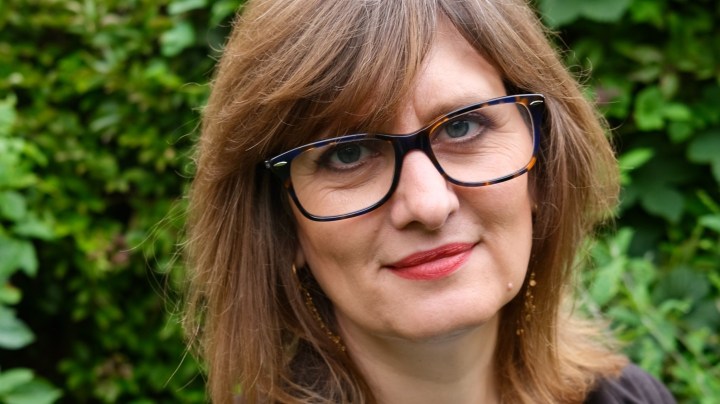 Alixe Bovey has been appointed to the position of British Art Studies (BAS) Editor-in-Chief. In this role she will lead on the development of material for publication in the journal, commission new articles and projects, and work collaboratively with authors. BAS is an innovative space for new peer-reviewed scholarship on all aspects of British art, co-published by Paul Mellon Centre for Studies in British Art and the Yale Center for British Art.
Alixe is Professor of Medieval Art History at The Courtauld, where she specialises in the art and culture of the Middle Ages. Her particular interests include illuminated manuscripts, visual storytelling and the relationship between myth and material culture across historical periods and geographical boundaries. Her publications explore a variety of medieval and early Renaissance topics, including Gothic art and immateriality (2015), monsters (2002, 2013), English genealogical rolls (2005, 2021), and monographic studies including Jean de Carpentin’s Book of Hours (Paul Holberton Press, 2011). Following a ten-year stint as Head of Research then Executive Dean and Deputy Director of The Courtauld, she is currently at work on a new book exploring the vibrant culture of storytelling in word and image in fourteenth-century London. Alongside her historical research, she is keenly interested in the creative relationship between practice and art history, and has organised a variety of programmes that bring works of art, artists and art historians together.
Sarah Victoria Turner, Director of PMC, comments: “We are so excited to have Alixe leading British Art Studies and I know she will do this with huge curiosity and commitment to publishing original research on British art. She has been an advocate for the journal and our approach to digital publishing.”
Alixe took up the role in June 2025 with a tenure of two years. Researchers interested in publishing with BAS are warmly encouraged to contact Alixe with questions, ideas or manuscripts for submission at baseditor@paul-mellon-centre.ac.uk.
The Burlington Magazine, June 2025
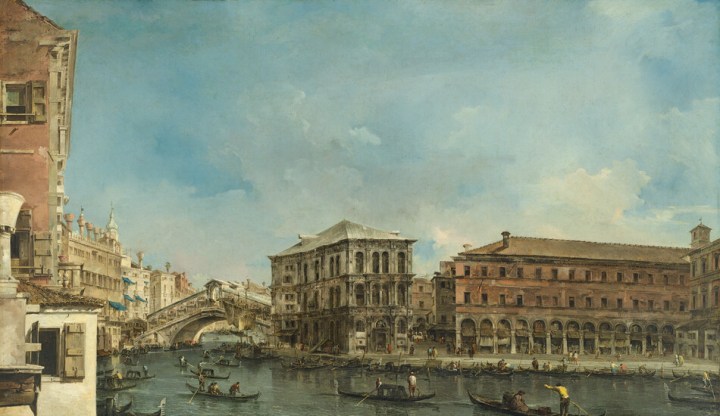
Francesco Guardi, Venice: The Rialto Bridge with the Palazzo dei Camerlenghi, ca.1764, oil on canvas, 120 × 204 cm
(Private collection)
◊ ◊ ◊ ◊ ◊
The long 18th century in the June issue of The Burlington:
The Burlington Magazine 167 (June 2025)
e d i t o r i a l
• “American Gothic,” p. 531.
There are many excoriating ways in which the current administration in Washington might be described; a number of them are perhaps too impolite to appear in a decorous journal such as this. The necessity of restraint does not, however, mean we should refrain from expressing a view on the provocative actions of the new United States government. They are not merely a matter of political theatre that feeds the news cycles, but also a corrosive force that is undermining many valued cultural institutions and having a direct and negative impact on the lives of tens of millions of people.
l e t t e r
• David Wilson, “More on Lorenzo Bartolini’s The Campbell Sisters Dancing a Waltz,” pp. 532–34.
Response to the article in the February issue by Lucy Wood and Timothy Stevens, “The Elder Sisters of The Campbell Sisters: William Gordon Cumming’s Patronage of Lorenzo Bartolini.”
a r t i c l e s
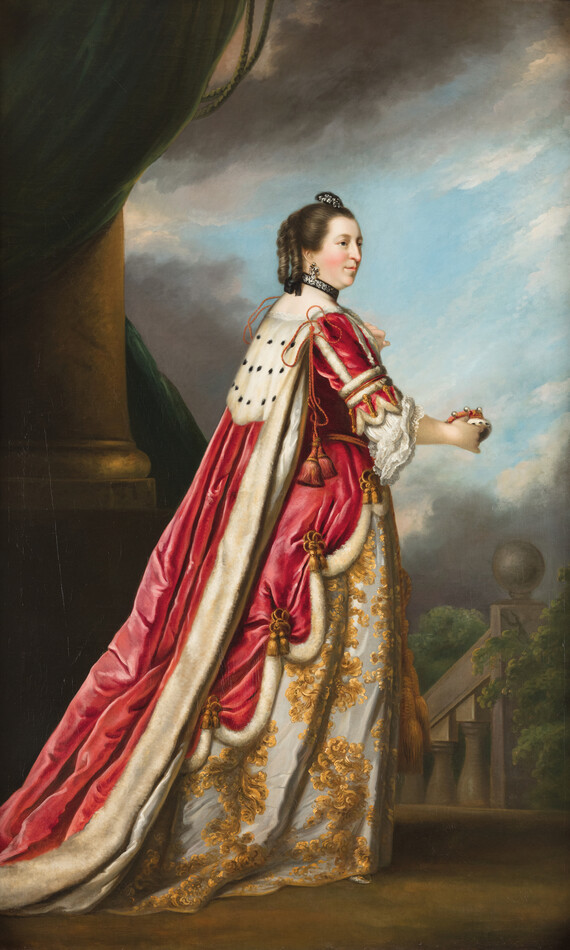
Joshua Reynolds, Elizabeth Percy, Countess (later Duchess) of Northumberland, 1757, oil on canvas, 240 × 148.6 cm. (Collection of the Duke of Northumberland, Syon House, London).
• Justus Lange and Martin Spies, “Two Royal Portraits by Reynolds Rediscovered in Kassel,” pp. 564–71.
Two paintings in the Gemäldegalerie Alte Meister, Kassel, are here identified as portraits by Joshua Reynolds of Princess Amelia, second daughter of George II, and her brother William Augustus, Duke of Cumberland. Both were gifts from the sitters to their sister Mary, Landgravine of Hesse-Kassel, a provenance that sheds new light on the cultural links between England and the landgraviate in the mid-eighteenth century.
• Giovanna Perini Folesani, “An Unpublished Letter by Sir Joshua Reynolds,” pp. 575–78.
in the historical archive of the Accademia di Belle Arti, Florence, there is an autograph letter by Sir Joshua Reynolds dated 20th May 1785 that was sent from London. . . . The text is in impeccable Italian, suggesting that Reynolds copied a translation made by a native speaker. . . .
• Francis Russell, “Guardi and the English Tourist: A Postscript,” pp. 578–83.
Some three decades ago this writer sought to demonstrate in this Magazine that the early evolution of Francesco Guardi (1712–93) as a vedutista could be followed in a number of pictures supplied to English patrons who were in Venice from the late 1750s. Other pieces of the jigsaw now fall into place. . . .
r e v i e w s
• Christoph Martin Vogtherr, Review of Schönbrunn: Die Kaiserliche Sommerresidenz, edited by Elfriede Iby and Anna Mader-Kratky (Kral Verlag, 2023), pp. 614–16.
• Steven Brindle, Review of Christopher Tadgell, Architecture in the Indian Subcontinent: From the Mauryas to the Mughals (Routledge, 2024), pp. 620–21.
• Stephen Lloyd, Review of ‘What Would You Like?’ Collecting Art for the Nation: An Account by a Director of Collections, edited by Magnus Olausson and Eva-Lena Karlsson (Nationalmuseum Stockholm, 2024), pp. 627–28.
Print Quarterly, June 2025
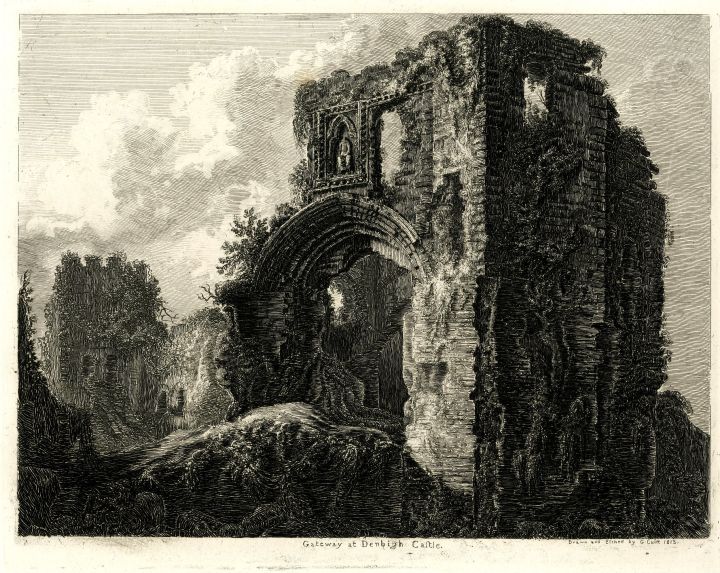
George Cuitt, Gateway at Denbigh Castle, 1813, etching, 252 × 315 mm
(London, British Museum), reproduced on p. 200.
◊ ◊ ◊ ◊ ◊
The long eighteenth century in the latest issue of Print Quarterly:
Print Quarterly 42.2 (June 2025)
a r t i c l e s
• Jane Eade, “A Mezzotint by Jacob Christoff Le Blon (1667–1741) at Oxburgh Hall,” pp. 143–53. This article examines a newly discovered impression of Jacob Christoff Le Blon’s colour mezzotint after Sir Anthony van Dyck’s (1599–1641) portrait of The Three Eldest Children of Charles I at Windsor Castle. The author discusses Le Blon’s invention of his revolutionary printing technique, the print’s distribution history, the operations of Le Blon’s workshop known as the ‘Picture Office’, as well as the circumstances surrounding the Oxburgh Hall impression, including its recent conservation treatment.
• Stephen Bann, “Abraham Raimbach and the Reception of Prints after Sir David Wilkie in France,” pp. 154–67. This article establishes the premise that Sir David Wilkie (1785–1841) introduced a new style of narrative painting in England that would prove influential for painting throughout Europe. It was previously thought that Paul Delaroche (1797–1856) popularized this new narrative style a couple of decades later in France. Since the French public had no local access to Wilkie’s paintings, it is here shown that it was the reproductive engravings of Abraham Raimbach that brought Wilkie to their attention. In doing so, this idea challenges the centrality of Delaroche’s sole influence on European painting.
• Paul Joannides, “John Linnell, Leonardo Cungi and the Vault of the Sistine Chapel,” pp. 168–84. This article discusses John Linnell’s (1792–1882) mezzotints after the Sistine Chapel ceiling and the recently discovered drawings on which the prints were based. The drawings, once a single sheet, are here attributed to Leonardo Cungi (1500/25–69); in its entirety, it is the earliest known copy to show the complete ceiling in full detail.
n o t e s a n d r e v i e w s
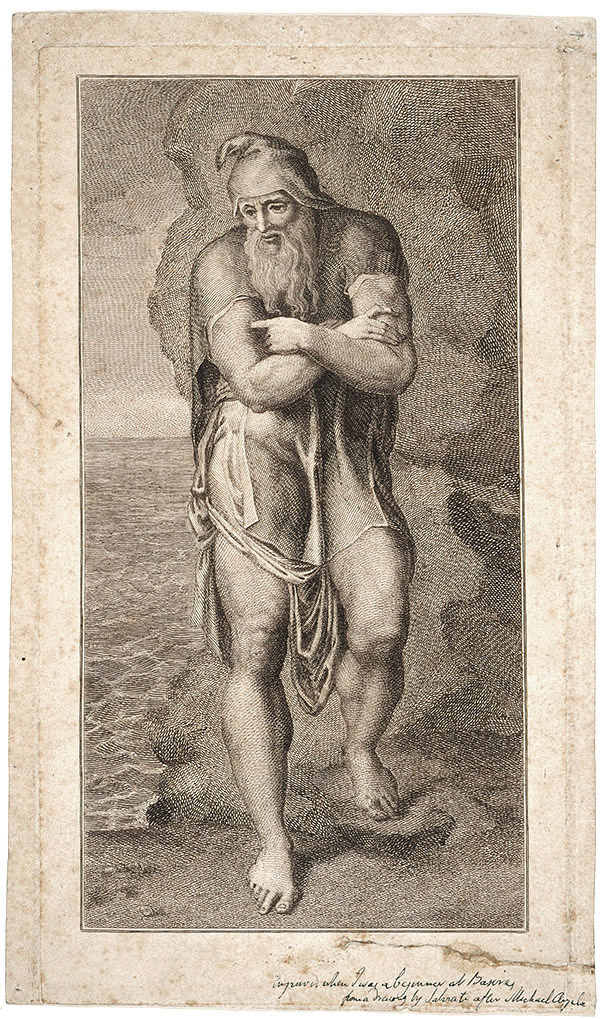
William Blake, Joseph of Arimathea among the Rocks of Albion, ca. 1773, engraving, 254 × 138 mm (Cambridge, Fitzwilliam Museum), reproduced on p. 192.
• Ulrike Eydinger, Review of Jürgen Müller, Lea Hagedorn, Giuseppe Peterlini and Frank Schmidt, eds., Gegenbilder. Bildparodistische Verfahren in der Frühen Neuzeit (Deutscher Kunstverlag, 2021), pp. 185–87.
• Nigel Ip, Review of Owen Davies, Art of the Grimoire (Yale University Press, 2023), pp. 187–89.
• Antony Griffiths, Review of Mario Bevilacqua, ed., Edizione Nazionale dei Testi delle Opere di Giovanni Battista Piranesi. I. Opere giovanili, ‘Vedute di Roma’, ‘Pianta di Roma e Campo marzo’ (De Luca Editori d’Arte, 2023), pp. 191–92.
• Mark Crosby, John Barrett and Adam Lowe, Note on William Blake as an apprentice engraver, pp. 192–93.
• Ersy Contogouris, Review of Pascal Dupuy, ed. De la création à la confrontation. Diffusion et politique des images (1750–1848) (Presses Universitaires de Rouen et du Havre, 2023), pp. 194–95.
• Cynthia Roman, Review of David Atkinson and Steve Roud, Cheap Print and Street Literature of the Long Eighteenth Century (Open Book Publishers, 2023), pp. 197–98.
• Sarah Grant, Review of Peter Boughton and Ian Dunn, George Cuitt (1779–1854), ‘England’s Piranesi’: His Life and Work and a Catalogue Raisonné of His Etchings (University of Chester Press, 2022), pp. 199–201.
• Timon Screech, Review of Akiko Yano, ed., Salon Culture in Japan: Making Art, 1750–1900 (British Museum Press, 2024), pp. 201–03.
• Bethan Stevens, Review of Evanghelia Stead, Goethe’s Faust I Outlined: Moritz Retzsch’s Prints in Circulation (Brill, 2023), pp. 240–43.
The Burlington Magazine, May 2025
The long 18th century in the May issue of The Burlington:
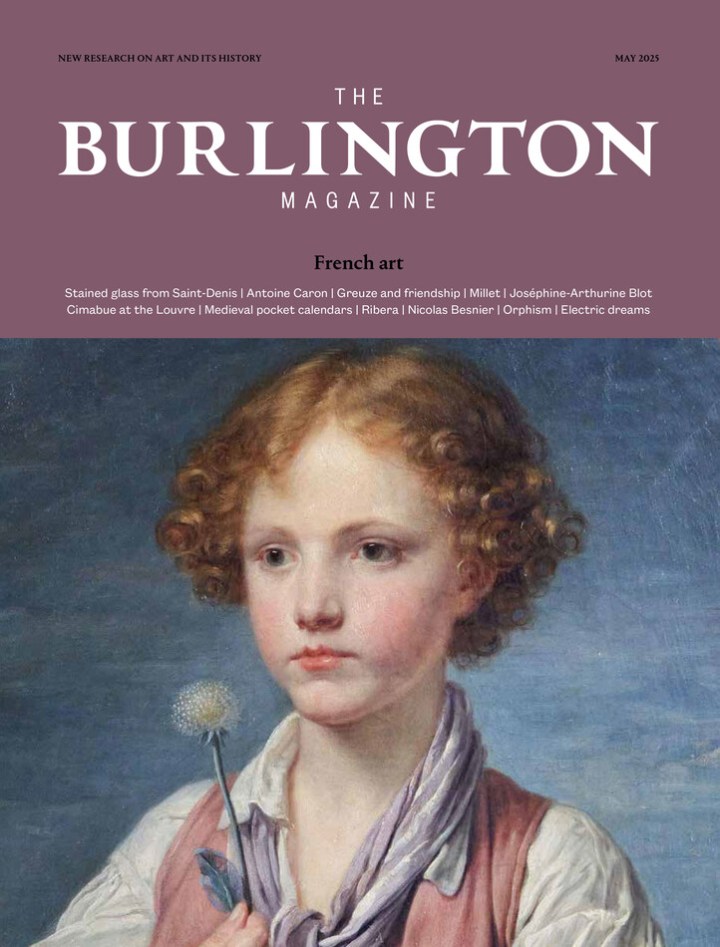
The Burlington Magazine 167 (May 2025) | French Art
 e d i t o r i a l
• “Fashionistas,” p. 427.
The costume institute and its annual gala in May at the Metropolitan Museum of Art, New York (the Met), have become fixtures on the museum world’s map and calendar. Whether you delight in them or are bemused by the spectacle they provide, or indeed try and take no notice at all, they are hard to ignore. The alignment they represent between fashion history, contemporary celebrity and the gravitas of a major museum is immensely beneficial in terms of fundraising and profile.
l e t t e r
• “A Sleeping Apostolado at Wentworth Woodhouse,” pp. 428–29.
We are launching an appeal for the conservation, reframing, and rehanging of an important set of seventeenth-century paintings. We are making this appeal in honour of the art historian Alastair Laing, who died aged seventy-nine in 2024. It was he who identified the artist of this series as the Flemish painter Gérard Seghers (1591–1651). . . . By 1870 the thirteen paintings were framed in groups and fixed against the walls, as they are now, probably to give a more church-like feel to the simple prayer-book chapel of 1736, with its panelling and gallery of craved, unstained oak.
a r t i c l e s
• Yuriko Jackall, John Delaney, and Michael Swicklik, “Friendship Tokens: Jean-Baptiste Greuze’s Paintings for Madame de Pompadour,” pp. 438–49.
Greuze’s paintings, known for their sentimentality and charm, were lauded by the artist’s contemporaries. Two early compositions, Simplicity and Young Shepherd Holding a Flower, were part of the collection of Madame de Pompadour; stylistic and technical analysis of them, in conjunction with another version of Simplicity, expands their early provenance.
• Humphrey Wine, “Napoleon Crossing the Alps: British Press Reaction to the London Exhibitions of David, Lefèvre, Wicar, and Lethière,” pp. 450–59.
Paintings by notable French artists were exhibited in Britain during the first third of the nineteenth century. Reactions to these works published in British newspapers and journals between 1814 and 1830 were often negative in tone and politically motivated. Despite this criticism, these accounts provide a valuable perspective on the art of the period that was shipped across the Channel.
• Daniëlle Kisluk-Grosheide, “Bravery, Ingenuity, and Aerial Post: An Enamelled Bowl by Joséphine-Arthurine Blot,” pp. 470–77.
During the height of the Franco-Prussian War, Gaston Tissandier made a perilous balloon journey from Paris to deliver correspondence from the besieged city. The flight is commemorated in a small bowl by Joséphine-Arthurine Blot, a technically accomplished yet little-known enamellist. Her bold design celebrates Tissandier’s bravery as well as French resistance and resourcefulness.
r e v i e w s
• Alice Minter, Review of Christophe Huchet de Quénetain, Nicolas Besnier (1686–1754): Architecte, orfèvre du roi et échevin de la Ville de Paris (Presses universitaires de Rennes, 2024), pp. 516–17.
• Céline Cachaud, Review of La Tabatière Choiseul: Un monument du XVIIIe siècle, edited by Michèle Bimbenet-Privat (Éditions Faton, 2025), pp. 519–20.
• Mark Evans, Review of Ulrike Müller, Private Collectors in Brussels, Antwerp, and Ghent, ca.1780–1914: Between Public Relevance and Personal Pleasure (Brepols, 2024), pp. 521–22.
o b i t u a r y
• Christopher Baker and Stephen Duffy, Obituary for Rosalind Joy Savill (1951–2024), pp. 526–28.
An immensely successful director of the Wallace Collection, London, and a pre-eminent scholar of eighteenth-century Sèvres porcelain, Rosalind (‘Ros’) Savill had a profound and enduring impact both on the museum and the research she cared passionately about.
The Burlington Magazine, April 2025
The long 18th century in the April issue of The Burlington:
The Burlington Magazine 167 (April 2025) | Art in Britain
e d i t o r i a l
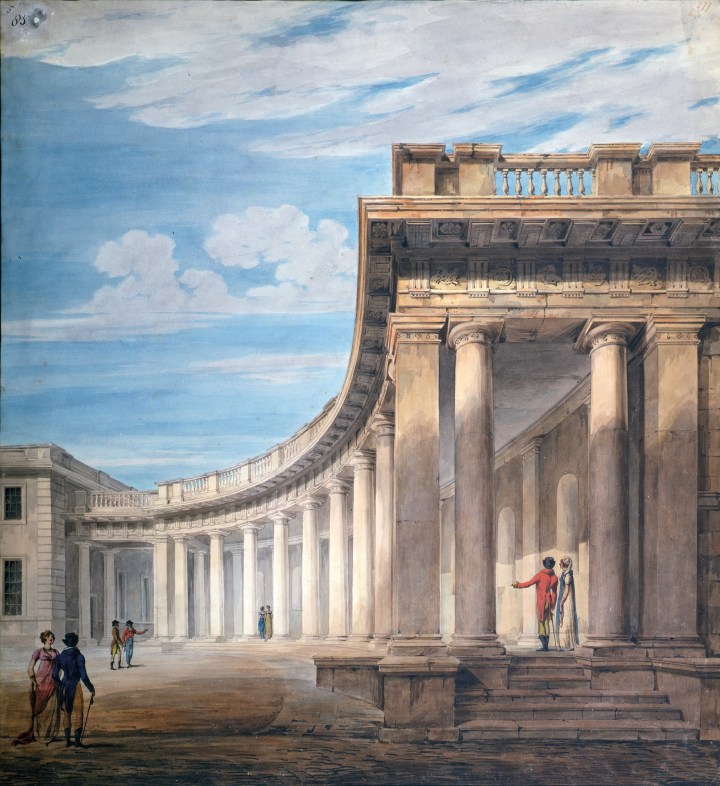
RA Lecture Illustration of the Colonnade at Burlington House, produced by the Soane Office. ca.1806–17, pen, pencil, wash and coloured washes on wove paper, 72 × 67 cm (London: Sir John Soane’s Museum).
• “Boughton’s Heavenly Visions,” pp. 327–29.
Boughton in Northamptonshire is an improbable dream of a house. It is an essay in restrained French Classicism that was gently set into the English countryside in the late seventeenth century, encasing an older building. The house was chiefly the creation of the francophile Ralph, 1st Duke of Montagu (1638–1709), who served as Charles II’s ambassador to the court of Louis XIV. Its most splendid internal feature is the so-called Grand Apartment, which consists of a parade of impressive state rooms.
a r t i c l e s
• William Aslet, “The Discovery of James Gibbs’s Designs for the Façade of Burlington House,” pp. 354–67.
A reassessment of drawings by Gibbs in the Ashmolean Museum, Oxford, demonstrates that, as well as the stables and service wings and celebrated colonnade, the architect provided an unexecuted design for the façade of Burlington House, London—an aspect of the project with which he has hitherto not been connected. This discovery deepens our understanding of one of the most important townhouse commissions of eighteenth-century Britain and the evolving taste of Lord Burlington.
• Adriana Concin, “A Serendipitous Discovery: A Lost Italian Portrait from Horace Walpole’s Miniature Cabinet,” pp. 368–75.
Among the portraits in Horace Walpole’s renowned collection at Strawberry Hill were a number of images of Bianca Cappello, a Medici grand duchess of some notoriety. Here the rediscovery of a late sixteenth-century Italian miniature once displayed in Walpole’s cabinet is discussed; long thought to depict Cappello, it is now attributed to Lavinia Fontana.
• Edward Town and Jessica David, “The Portraits of Alice Spencer, Countess of Derby, and Her Family by Paul van Somer,” pp. 376–85.
Research into a portrait at the Yale Center for British Art, New Haven, has revealed the identities of twelve Jacobean portraits attributed to the Flemish painter Paul van Somer. The portraits were probably commissioned by Alice Spencer, Countess of Derby, and create a potent illustration of her dynastic heritage. [The research depends in part upon the eighteenth-century provenance of these portraits.]
r e v i e w s
• Anna Koldeweij, Review of the exhibition Rachel Ruysch: Nature into Art (Alte Pinakothek, Munich, 2024–25; Toledo Museum of Art, 2025; MFA, Boston 2025), pp. 393–96.
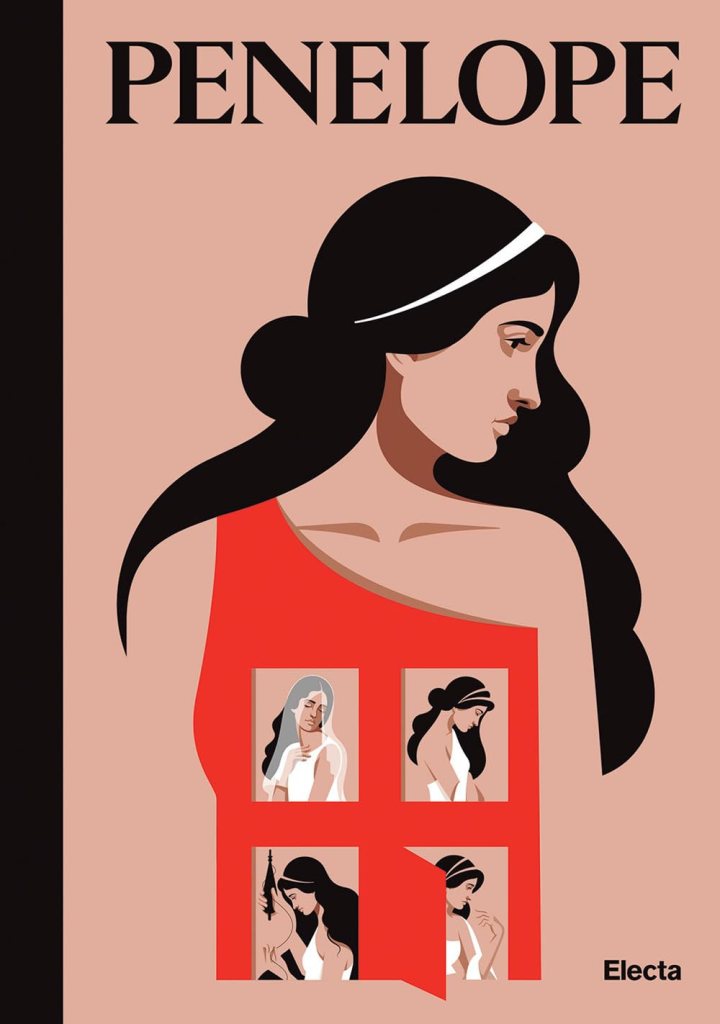
• Christine Gardner-Dseagu, Review of the exhibition catalogue Penelope, ed. by Alessandra Sarchi and Claudio Franzoni (Electa, 2024), pp. 404–07.
• Andreina D’Agliano, Review of the exhibition catalogue, Magnificence of Rococo: Kaendler’s Meissen Porcelain Figures, ed. by Alfredo Reyes and Claudia Bodinek (Arnoldsche, 2024), pp. 412–14.
• Stephen Lloyd, Review of Susan Sloman, British Portrait Miniatures from the Thomson Collection (Ad Ilissum, 2024), pp. 418–19.
• Natalie Rudd, Review of Discovering Women Sculptors, ed. by Marjorie Trusted and Joanna Barnes (PSSA Publishing, 2023), pp. 422–23.
Art History 48 (February 2025)
The 18th century in the latest issue of Art History:
Art History 48 (February 2025)
a r t i c l e s
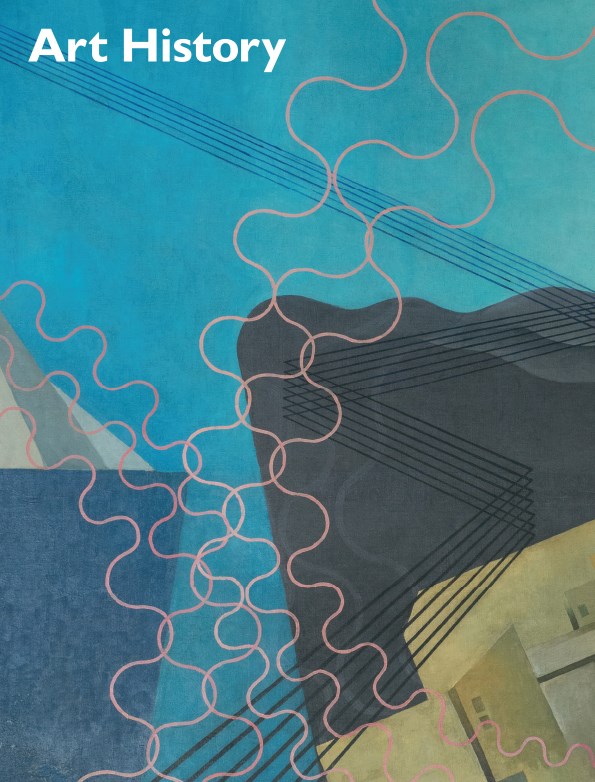 • Oliver Wunsch, “The Aesthetic Redemption of the Black Body in Eighteenth-Century France,” pp. 14–44.
Audiences in eighteenth-century France felt little compunction about admiring African people in art while denigrating them in life. They reconciled this apparent contradiction through a belief in the ameliorative effects of art, yielding what is described here as a theory of aesthetic redemption. This essay argues that the theory of aesthetic redemption that developed in eighteenth-century France gave art a unique position in the construction of race. Because those who believed in the possibility of aesthetic redemption distinguished between art’s content and its manner of representation, they created the conditions for artists to depict people of colour using materials, techniques, and formal structures whose qualities would otherwise be considered at odds with the subject. The resulting art often strikes audiences today as progressive, yet it did little to challenge the biases of the original viewers, who admired aesthetic departures from stereotypes precisely because they took those stereotypes for granted.
• Diarmuid Costello, “Die Schönheit des Mittelmenschen: Stephan Balkenhol’s ‘Everyday Beauty’,” pp. 132–61.
This essay considers Stephan Balkenhol’s ‘everyman and woman’ sculptures through the optic of Kant’s ‘ideal of beauty’ (§17, Critique of Aesthetic Judgement, 1790). I take a pair of miniature figures as my test case. Despite minor variations, all these sculptures depict the same generic man and woman, a man or woman who average or middling in every way. What could make depictions of average everydayness so compelling? For a clue, I turn to Kant’s ‘ideal of beauty’. This comprises a ‘standard aesthetic idea’ and an ‘idea of reason’: the former is a (culturally specific) ‘model image’ of the human being; the latter implicates Kant’s (universal) conception of ‘humanity in the person’, where the latter manifests itself through the former. I ask whether this illuminates Balkenhol’s work, suggesting that although the relevance of the former is clear, and the latter less so, there is reason not to rule it out.
• Viccy Coltman, “Travelling Knick-Knacks and Picturesque Points of View: Reverend James Plumptre’s Narrative of a Pedestrian Journey … to the Highlands of Scotland … in the Summer of the Year 1799,” pp. 162–84.
This essay revisits later eighteenth-century picturesque aesthetics in Britain as they were articulated in theory, applied in practice, and reproduced in travel literature and art. It considers the sometimes congruent, at other times contested, relationship between the natural landscape, written descriptions of that landscape, and its pictorial representation. Focusing on unpublished extracts from Reverend James Plumptre’s manuscript travel journal, Narrative of a Pedestrian Journey […] to the Highlands of Scotland […] in the Summer of the Year 1799, it argues for an original interpretation of the pedestrian picturesque as a suite of practices which entailed travelling by foot, viewing the landscape with a range of hand-held implements or ‘knick-knacks’, and representing nature ‘as seen’ without remedial artistic correction or improvement. According to this account, ‘people, places, and things’ becomes a useful rubric for conceptualising Plumptre’s 1799 pedestrian tour of Scotland which included visits to the Edinburgh studios of artists Alexander Nasmyth, Henry Raeburn, and Hugh William Williams.
r e v i e w s
• Brigid von Preussen, “A Woman’s Work,” Review of Paris Spies-Gans, A Revolution on Canvas: The Rise of Women Artists in Britain and France, 1760–1830 (Yale UP, 2022) and Rosalind Blakesley, Women Artists in the Reign of Catherine the Great (Lund Humphries, 2023), pp. 186–92.
Ten Axioms: Drimmer and Nygren on Art History and AI
I was slow finding this essay on artificial intelligence, but it strikes me as immensely helpful (it seems someone asks me about art and AI at least once a week these days). –CH
Sonja Drimmer and Christopher Nygren, “Art History and AI: Ten Axioms,” International Journal for Digital Art History 10 (2023): 5.01–10. Link»
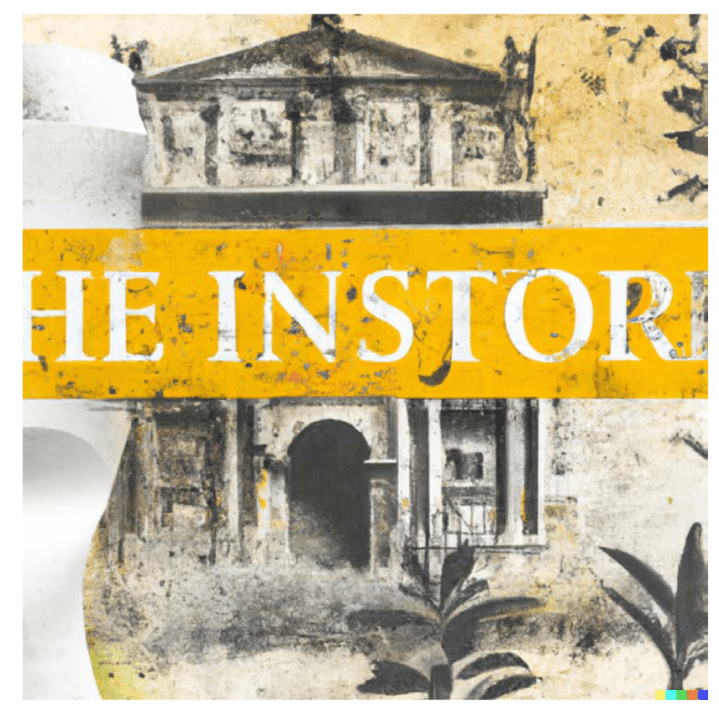
One of a handful of digital images accompanying the article created by Dall-e-2 using the following prompt: “the history of art as understood by artificial intelligence.”
Abstract | AI has become an increasingly prevalent tool for researchers working in Digital Art History. The promise of AI is great, but so are the ethical and intellectual issues it raises. Here we propose 10 axioms related to the use of AI in art historical research that scholars should consider when embarking on such projects, and we make some proposals for how these axioms might be integrated into disciplinary conversations.
Sonja Drimmer is associate professor of medieval art in the Department of the History of Art and Architecture at the University of Massachusetts Amherst. Her research is chiefly concerned with the book arts of the Middle Ages, addressing in particular issues of mediation, collaborative production, and replication. She is the author of The Art of Allusion: Illuminators and the Making of English Literature, 1403–1476 (University of Pennsylvania, 2018), which received High Commendation for Exemplary Scholarship from the Historians of British Art.
Christopher J. Nygren is associate professor of early modern art in the Department of the History of Art and Architecture at the University of Pittsburgh. In 2022, his book, Titian’s Icons: Charisma, Tradition, and Devotion in the Italian Renaissance (Penn State, 2020), won the Phyllis Goodhart Gordan Prize for best book in Renaissance studies from the Renaissance Society of America. Profesoor Nygren is also developing several collaborative research projects, including in the Digital Humanities. From 2017 to 2019 he served as Principal Investigator on “The Morelli Machine,” a project funded by the National Science Foundation that sought to examine whether computational methods might be used in the attribution of Old Master paintings.
The Burlington Magazine, March 2025
The long 18th century in the March issue of The Burlington:
The Burlington Magazine 167 (March 2025)
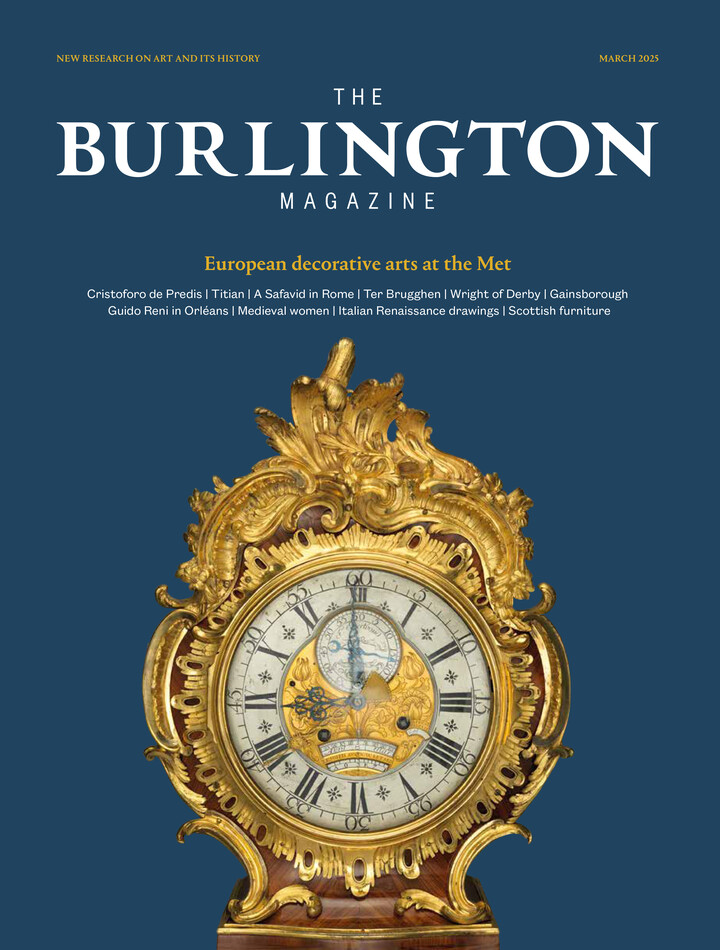
Cover of The Burlington Magazine with a recent acquisition at The Met: Longcase equation regulator, clockmaker: Ferdinand Berthoud, case maker: Balthazar Lieutaud, ca. 1752 (New York: The Metropolitan Museum of Art, 2016.28a–e).
e d i t o r i a l
• “A Frick Renaissance,” p. 203–05.
On 17th April 2025 the Frick Collection on Fifth Avenue re-opens after a long period of redevelopment. When an old friend has a face lift, the results can be disconcerting. Happily, the impact here is, however, reassuringly subtle—as the splendid Gilded-age character of one of New York’s iconic cultural institutions has been retained, while elegant new facilities have been deftly integrated.
a r t i c l e s
• Julia Seimon, “Two Boys with a Bladder in the J. Paul Getty Museum and Joseph Wright of Derby’s Early Candlelights,” pp. 242–57.
A careful re-assessment of Joseph Wright of Derby’s painting of Two Boys with a Bladder in the Getty’s collection, supported by documentary discoveries, clarifies the circumstances of the painting’s creation and first exhibition and has significant implications for dating several of the artist’s other painted and drawn works.
s h o r t e r n o t i c e s
• Oliver Fairclough, “Paul Sandby and Sir Watkin Williams-Wynn Revisited,” pp. 258–61.
• Christina Milton O’Connell, “Observations about the Abandoned Portrait beneath Gainsborough’s Blue Boy,” pp. 26–65.
r e v i e w s
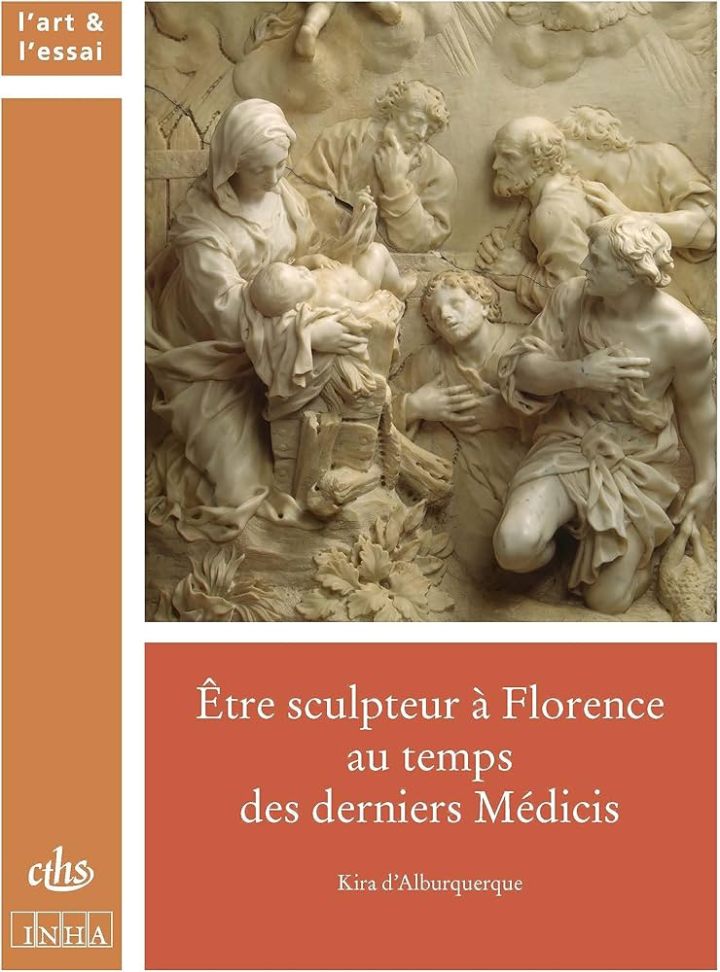
Cover of Être sculpteur à Florence au temps des derniers Médicis, featuring a photograph of Giovanni Battista Foggini’s Adoration of the Shepherds, ca. 1675, marble (Saint Petersburg: Hermitage).
• Nicola Ciarlo, Review of Kira d’Alburquerque, Être sculpteur à Florence au temps des derniers Médicis (CTHS, 2023), pp. 292–94.
• Adam Bowett, Review of Stephen Jackson, Scottish Furniture 1500–1914 (NMS Publishing, 2024), pp. 296–98.
• Penelope Curtis, Review of the exhibition catalogue Souvenirs de jeunesse: Entrer aux Beaux-Arts de Paris 1780–1980, edited by Alice Thomine-Berrada (Beaux-Arts de Paris, 2024), pp. 298–99.
• Alan Powers, Review of Edward McParland, The Language of Architectural Classicism: From Looking to Seeing (Lund Humphries Publishers, 2025), pp. 299–300.
• Max Marmor, Review of Julius von Schlosser, The Literature of Art: A Manual for Source Work in the History of Early Modern European Art Theory, translated by Karl Johns (Ariadne Press, 2023), p. 303.
s u p p l e m e n t
• Sarah Lawrence, “Recent Acquisitions (2014–24) of European Decorative Arts at The Metropolitan Museum of Art,” pp. 305–24.
Journal18, Fall 2024 — Craft
The latest issue of J18 (I’m sorry to be slow with this one! –CH) . . .
Journal18, Issue #18 (Fall 2024) — Craft
Issue edited by Jennifer Chuong and Sarah Grandin
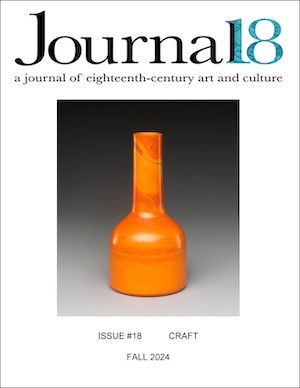 When, where, and why does craft matter? Craft, by definition, is any activity involving manual skill. But in the modern western world, the term typically implies specific kinds of activities that produce specific kinds of objects: things like baskets, lace, and lacquerware. In a culture that has historically privileged rationality and innovation, craft’s commitment to tradition, reliance on haptic knowledge, and association with marginalized subjects have rendered it the minor counterpart to more ‘serious’ forms of material production. As a subsidiary to art and industry, craft has often occupied a circumscribed role in accounts of modern art and modernity’s origins in the eighteenth century. Recently, however, craft—as a more capacious category of material production—has become a crucial term in efforts to expand and diversify the study of eighteenth-century art.
This special issue builds on recent investigations while considering how craft’s ancillary role within the Anglo-European tradition has limited its capacity to transform the field. Drawing inspiration from the absence of an art/craft divide in many cultures, we are interested in exploring craft’s potential to radically reframe, reconceptualize, and globalize the history of art.
a r t i c l e s
Elizabeth Eager — Labor, Leisure, and Lost Time in Eighteenth-Century Women’s Embroidery
Yve Chavez — Eighteenth-Century Loom and Basket Weaving at the California Missions
Hampton Smith — Insurgent Tooling and the Collective Making of Slave Revolts
Natalie E. Wright and Glenn Adamson — Encyclopædia Materia: Material Intelligence and Common Knowledge
Julie Bellemare, N. Astrid R. van Giffen, and Robert Schaut — Hot Tempered: Recreating a Lost Glass Recipe
Caroline Wigginton — Reading with Indigenous Form: Lucy Tantaquidgeon Tecomwas’s Moccasins (ca. 1767)
Ellen Siebel-Achenbach — Bookbinding in Eighteenth-Century Nuremberg: Reconstructing an Edge Plough from the Hausbücher der Nürnberger Zwölfbrüderstiftungen
All articles are available for free here, along with recent notes & queries:
r e c e n t n o t e s a n d q u e r i e s
Lytle Shaw — A Pirate Primer? Review of Stan Douglas: The Enemy of All Mankind
Sofya Dmitrieva — The Art Collection of the French Royal Academy of Painting and Sculpture: Notes on the Database
Jennifer Laffick — Lethière in Williamstown and Paris: A Transatlantic Exhibition Review
Kristina Kleutghen — Beijing to Dresden via St. Petersburg: An Early Qing Enameled Snuff Bottle in the Collection of Augustus II the Strong
Geoff Quilley — Lubaina Himid’s Naming the Money at the Entangled Pasts, 1768-now Exhibition, Royal Academy, London
Print Quarterly, March 2025
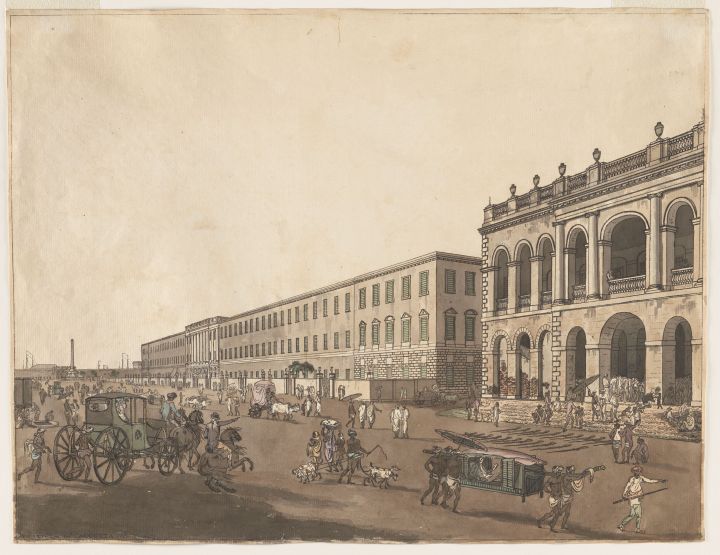
Thomas Daniell, The Old Court House and Writers’ Building, 1786, hand-coloured etching, 403 × 524 mm
(Philadelphia Museum of Art; image Thomas Primeau).
◊ ◊ ◊ ◊ ◊
The long eighteenth century in the latest issue of Print Quarterly:
Print Quarterly 42.1 (March 2025)
a r t i c l e s
• Jalen Chang, “‘Bengalee Work’ before Aquatint: Thomas Daniell’s Views of Calcutta”, pp. 20–30.
This article reevaluates eleven hand-coloured etchings by Thomas Daniell (1749–1840) held by the Philadelphia Museum of Art, previously presumed to be published states of his 1786–88 print series Views of Calcutta, often cited as the earliest aquatints made outside of Europe. Devoid of the rudimentary aquatinting and hand-coloured skies which characterize other extant examples, the relatively bare objects document a distinct stage of Daniell’s artistic process and are unprecedented in their survival. The article suggests that these prints were trial proofs never intended for publication or sale, meant instead to serve as colour tests for Daniell and his team of Indian copyists. Furthermore, the article considers early imperial printmaking and its ideological functions in British India.
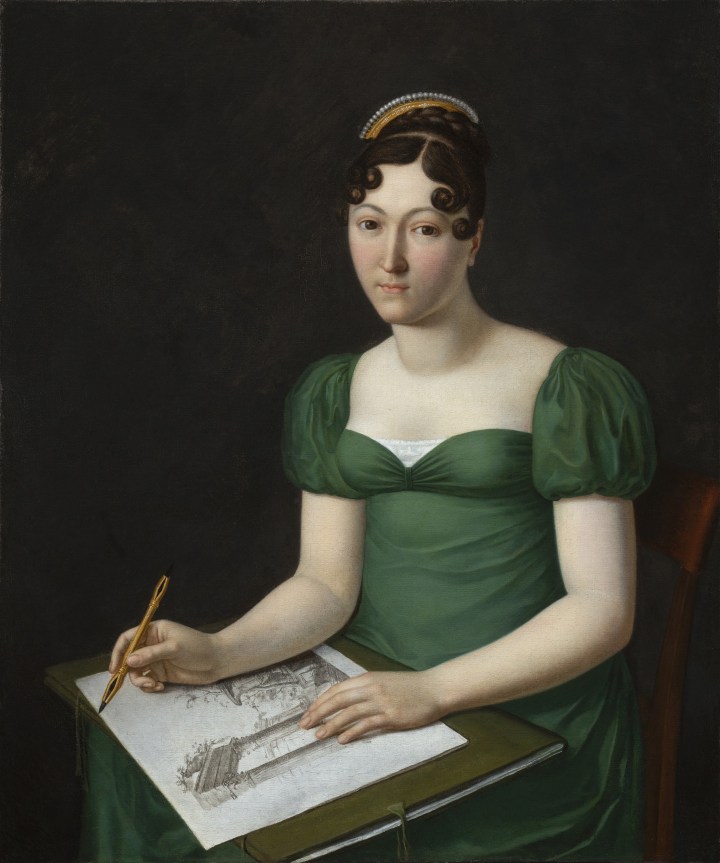
Charlotte Bonaparte, Self-Portrait, ca. 1824–26, oil on canvas, 885 × 730 mm (Princeton University Art Museum).
• Thomas Busciglio-Ritter, “From Brussels to Point Breeze: Charlotte Bonaparte’s Lithographic Landscapes, 1821–25”, pp. 31–43.
This article discusses a series of twelve lithographs by Charlotte Bonaparte (1802–1839), niece to Napoleon I, of North American views known as the Vues pittoresques de l’Amérique dessinées par la Comtesse Charlotte de Survillier (printed 1824), which she completed and disseminated on her return to Europe. The series, published in Brussels, became the first lithographic scenic views of the United States to circulate among western European audiences. The article situates Bonaparte’s landscape views within the context of transatlantic print culture of the early nineteenth century, touching on the role of women as producers of landscape images and the introduction of lithography as a new medium for American audiences.
n o t e s a n d r e v i e w s
• Bernard Aikema, Review of the exhibition catalogue Connecting Worlds: Artists and Travel, ed. by Anita Viola Sganzerla and Stephanie Buck (Paul Holberton Publishing, 2023), pp. 64–66.
• Catherine Jenkins, Review of the exhibition catalogue Trésors en noir et blanc. Estampes du Petit Palais, de Dürer à Toulouse-Lautrec, by Anne-Charlotte Cathelineau, Joëlle Raineau-Lehuédé, and Clara Roca (Paris Musées, 2023), pp. 74–76.
• Ellis Tinios, Review of Hokusai’s Fuji, ed. by Kyoko Wada (Thames and Hudson, 2023), pp. 76–77.
• Victoria Sancho Lobis, Review of Aaron Hyman, Rubens in Repeat: The Logic of the Copy in Colonial Latin America (Getty Research Institute, 2021), pp. 99–105.










 Enfilade
leave a comment