From the December 2011 Issue of ‘Apollo Magazine’
From Apollo Magazine:
Michael Burrell, “Reynolds and Leonardo,” Apollo Magazine (December 2011)
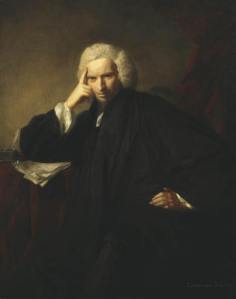
Joshua Reynolds, "The Revd Laurence Sterne," 1760 (London: National Portrait Gallery)
Among the highlights of the National Gallery’s current exhibition on Leonardo da Vinci is his Last Supper [a near-contemporary, full-scale copy on loan from the Royal Academy]. The fresco greatly influenced Sir Joshua Reynolds’ Society of Dilettanti paintings, and is one of nine new examples of Reynolds’ borrowing from the master, revealed here for the first time.
The borrowings of the 18th-century painter Sir Joshua Reynolds are the subject of fascination and much discussion. One painting by Reynolds, The Revd Laurence Sterne, has already been identified as derived from a Studio of Leonardo da Vinci painting. This article proposes other works by Reynolds that are derived from or influenced by Leonardo: a Leonardo drawing in the Ashmolean; a painting that was at the time in the Palazzo Barberini and attributed to Leonardo or a follower; and, intriguingly, Leonardo’s Last Supper. . . .
The full article is available here»
November 2011 Issue of ‘Art History’
Eighteenth-century offerings from the November 2011 issue:
Andrei Pop, “Sympathetic Spectators: Henry Fuseli’s Nightmare and Emma Hamilton’s Attitudes,” Art History 34.5 (November 2011): 934-57.
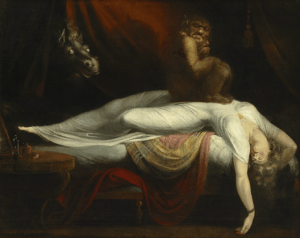
Henry Fuseli, "The Nightmare," 1781, exhibited in 1782 at the Royal Academy of London (Detroit Institute of Arts)
Abstract: Henry Fuseli’s painting The Nightmare (1782), unusual in the artist’s oeuvre and in the painting of its time as the public visualization of a private mental state, can be made sense of in light of late eighteenth-century practices and theories of privacy and of the agency that minds can exert on the world on on each other. By comparison with another dream-like performance, Emma Hamilton’s Attitudes, and informed by David Hume’s theory of sympathy, which was designed to explain the social communicability of mental states, a reading of The Nightmare emerges which shows that it did not aim to make visible dream imagery, but to induce spectators to have or feel as if they had an analogous experience. The painting is thus typical of the formative stage of a modern understanding of public life as a contingent
association of private lives.
Andrei Pop studied art history at Stanford and Harvard Universities and is a postdoctoral fellow at the Universität Berlin. The present essay is part of Neopaganism, a book in progress on the cultural politics of classicism. His article on Fuseli and tragedy will appear in the March 2012 Art Bulletin. His translation, together with Mechtild Widrich, of Karl Rosenkranz’s Aesthetics of Ugliness (1853) is forthcoming.
◊ ◊ ◊ ◊ ◊
Steven Adams, “Amateurs and Revolutionaries in Eighteenth-century France,” Art History 34.5 (November 2011): 1042-46.
 Review of Charlotte Guichard, Les Amateurs d’art à Paris au XVIII siècle (Paris: Champ Vallon, 2008); Laura Auricchio, Adélaïde Labille-Guiard: Artist in the Age of Revolution (Los Angeles: Getty Publications, 2009); and Rolf Reichardt and Hubertus Kohle, Visualizing the Revolution: Politics and the Pictorial Arts in Late Eighteenth-century France (London: Reaktion Books, 2008).
◊ ◊ ◊ ◊ ◊
Marion Endt-Jones, “Commemorative Reconsiderations,” Art History 34.5 (November 2011): 1053-56.
 Review of Diana Donald and Jane Munro, eds., Endless Forms: Charles Darwin, Natural Science, and the Visual Arts (New Haven and London: Yale Center for British Art, 2009); and Andrew Graciano, ed., Visualizing the Unseen: Imagining the Unknown, Perfecting the Natural: Art and Science in the 18th and 19th Centuries (Newcastle: Cambridge Scholars Publishing, 2008).
◊ ◊ ◊ ◊ ◊
Editor’s Note: At February’s CAA meeting in Los Angeles, there is an entire session, sponsored by the Midwest Art History Society, on the subject of The Nightmare. -CH.
Icons of the Midwest: Henry Fuseli’s Nightmare
Wednesday, 22 February, 12:30–2:00
Chairs: Laura Gelfand (Utah State University) and Judith Mann (Saint Louis Art Museum)
• Salvador Salort-Pons (Detroit Institute of the Arts), Living with Fuseli’s Nightmare
• Beth S. Wright (University of Texas at Arlington), ‘As I Was Perpetually Haunted by These
Ideas’: Fuseli’s Influence on Mary Shelley’s Mathilda and Frankenstein
• Scott Bukatman (Stanford University), Dreams, Fiends, and Dream Screens
Call for Articles: Eating Together
I’m afraid there’s not much time for this one, but interesting enough that I wanted to pass it along. -CH.
Special Issue of Museums & Social Issues on Eating Together
Articles or Prospectuses due by 20 December 2011

Hanoverian Table Setting (Photo from M. Ford Creech Antiques, click on the image to visit the site)
The deadline is approaching for submitting articles or reviews for the next issue of the journal Museums & Social Issues (published by Left Coast Press, Inc). Tentatively titled Eating Together, the issue will examine the intersection of museum practice and access to and changing traditions associated with food. We would like to highlight programing and exhibits exploring food access, eating practices, sustainability, preservation of heritage seeds, traditional cuisines, culinary science and other creative uses of food. We are also interested in articles from outside the museum field, dealing with research, theory or innovative projects that connect people and communities to practices of eating.
Please submit full articles (ideal) or well developed prospectuses to http://mc.manuscriptcentral.com:80/msi by December 20, 2011. For more information, contact the editor at MSIuw@uw.edu or Morriss8@uw.edu.
Stefania Van Dyke
Museum Studies & Practice
Left Coast Press, Inc.
museums@lcoastpress.com
December 2011 Issue of ‘The Art Bulletin’
The eighteenth century in the latest issue of The Art Bulletin:
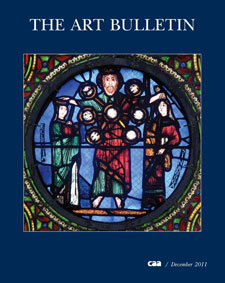 James M. Córdova, “Clad in Flowers: Indigenous Arts and Knowledge in Colonial Mexican Convents,” The Art Bulletin 93 (December 2011): 449-67.
Nuns in New Spain (colonial Mexico) wore spectacular flowery trappings when they professed and again when reposing on their funeral biers. Local artists, commissioned by the nuns’ families and convents, captured these stunning images. Despite differences in ethnicity, religious order, age, and other factors that distinguished these women, their flowery trappings have the effect of establishing an iconic image of the New Spanish nun. Furthermore, their regalia, which combine Euro-Christian and Mesoamerican practices and beliefs, not only represented the preeminence of the “brides of Christ,” they also conjured the spiritual transformations that nuns experienced in their ritual lives.
◊ ◊ ◊ ◊ ◊
Étienne P. H. Jollet, Review of Frank Fehrenbach’s Compendia Mundi: Gianlorenzo Berninis “Fontana dei Quattro Fiumi” (1648-51) und Nicola Salvis “Fontana di Trevi” (1732-62), The Art Bulletin 93 (December 2011): 491-94.
◊ ◊ ◊ ◊ ◊
N.B. — Notice of Jollet’s review did not appear in the original posting from 2 December 2011; it was added on 9 February 2012. I apologize for the initial oversight. -CH
November Issue of ‘The Burlington’
The Burlington Magazine 153 (November 2011)
 Articles
• Gauvin Alexander Bailey and Fernando Guzmán, “The ‘St Sebastian’ of Los Andes: A Chilean Cultural Treasure Re-examined,” pp. 721-26. — A discussion of the polychrome statue of St Sebastian (c.1730-35) in Los Andes, Chile, which is here attributed to Adam Engelhard.
• Chiara Teolato, “Roman Bronzes at the Court of Gustavus III of Sweden: Zoffoli, Valadier and Righetti,” pp. 727-33. — The provenance and installation of Roman bronzes by Giacomo Zoffoli, Luigi Valadier and Giovan Battista Piranesi in the collection of Gustavus II of Sweden.
Reviews
• Tommaso Manfredi, Review of Heather Hyde Minor, The Culture of Architecture in Enlightenment Rome (University Park: Penn State University, 2010), p. 749.
Call for Articles: Excess and Moderation for ‘Frame’
Excess/Moderation Theme for Next Issue of Frame: Journal of Visual and Material Culture
Manuscripts due by 15 November 2011
Frame invites scholarly submissions from a variety of disciplines that engage somehow with visual and/or material culture using unique methodologies. Possible areas of interest include art, architecture, film, visual culture, design, built environment, television, material culture, or other domains that engage with visual content from a variety of perspectives. We are particularly attracted to scholarly work that transverses traditional disciplinary borders and creates fresh approaches to the study of visual art and related areas.
This issue is themed “Excess/Moderation.” A mind-map that serves the function of suggesting topics is available on the Frame website (www.framejournal.org). Please see the website for the style-sheet as well. Papers should not exceed 10,000 words, unless for special exception. Manuscripts should be submitted electronically in .doc or .docx format. A separate document that includes a 200-word abstract, full name, email address, phone number, and institutional affiliation should accompany the article. Send all inquiries to the Managing Editor, Shawn Rice, at editor@framejournal.org.
◊ ◊ ◊ ◊ ◊
Frame is a scholarly, peer-reviewed online publication edited by graduate students of the City University of New York Graduate Center. This journal is a re-imagined, interdisciplinary continuation of PART: The Journal of the Ph.D. Program in Art History at the Graduate Center.
The Eighteenth Century in the October Issue of The Burlington
The Burlington Magazine 153 (October 2011)
◊ ◊ ◊ ◊ ◊
Editorial
• The Holburne Museum, Bath
 . . . Earlier this year, the Museum received extensive publicity when it re-opened after renovation and an extension carried out by Eric Parry Architects. This has included the daring and entirely successful moving of the central staircase of the house, to a few feet to the left, unblocking the vista through the ground-floor entrance to the gardens at the back; a beautiful full-height glass extension to the rear of the building that creates temporary exhibition rooms and a greater feeling of light and air; and the almost complete redisplay of the collections. While it has to be admitted that the Museum is distinctly eclectic and charmingly provincial (and in places still fussily crowded), in its renovated state its former shabby gentility has been vanquished. It now presents itself like Gainsborough’s Lord and Lady Byam, stepping out with the next generation, all in their finery, to greet the future.
The full editorial is available here»
◊ ◊ ◊ ◊ ◊
Articles
• Antonello Cesareo, “New Portraits of Thomas Jenkins, James Byres and Gavin Hamilton” — Two new portraits of Thomas Jenkins and James Byres by Anton von Maron and a self-portrait by Gavin Hamilton.
• Christopher Baker, “Robert Smirke and the Court of the Shah of Persia” — A watercolour study by Robert Smirke in the National Gallery of Scotland, Edinburgh, for a painting of the court of the Shah of Persia.
• Duncan Bull and Anna Krekeler, with Matthias Alfeld, Doris Jik, and Koen Janssens, “An Intrusive Portrait by Goya” — The discovery of an earlier three-quarter length portrait of a man by Goya beneath his Portrait of Ramón Satué (1823) in the Rijksmuseum, Amsterdam.
◊ ◊ ◊ ◊ ◊
Books
• Philip McEvansoneya, Review of N. Glendinning and H. Macartney, eds., Spanish Art in Britain and Ireland, 1750–1920: Studies in Reception in Memory of Enriqueta Harris Frankfort.
• Mark Stocker, Review of M. Kisler, Angels and Aristocrats: Early European Art in New Zealand Public Collections.
• Luke Herrmann, Review of M. and J. Payne, Regarding Thomas Rowlandson (1757–1827): His Life, Art & Acquaintance and P. Phagan, Thomas Rowlandson: Pleasures and Pursuits in Georgian England.
◊ ◊ ◊ ◊ ◊
Exhibitions
• Xavier F. Salomon, Young Tiepolo
In the September 2011 Issue of ‘The Art Bulletin’
The eighteenth century in the latest issue of The Art Bulletin:

Jean-Louis Laneuville, "The Citoyenne Tallien in the Prison of La Force, Holding Her Hair Which Has Just Been Cut," exhibited at the Salon of 1765.
Amy Freund, “The Citoyenne Tallien: Women, Politics, and Portraiture during the French Revolution,” The Art Bulletin 93 (September 2011): 325-44.
Portraiture dominated visual culture in France after 1789 because it addressed the central challenge of the Revolution: how to turn subjects into citizens. Women, however, were rarely included in Revolutionary definitions of citizenship. Jean-Louis Laneuville’s 1796 portrait of Thérésia Cabarrus, better known as Mme Tallien, negotiates female subjectivity and political participation in radically new ways, inserting its sitter into debates about the place of women in the new republic. The ambitions and failures of Cabarrus’s likeness speak to the ambitions and failures of French portraiture after 1789.
July Issue of ‘The Burlington’
The Burlington Magazine 153 (July 2011)
 • Gerlinde Klatte, “New documentation for the ‘Tenture des Indes’ tapestries in Malta” — Unpublished documents on the Anciennes Indes tapestry set (1708–10) woven by Etienne Le Blond for the Order of St John, Valletta, Malta.
Reviews
• Ann Compton, Review of Rune Frederikson and Eckart Marchand, eds., Plaster Casts: Making, Collecting and Displaying from Classical Antiquity to the Present (Berlin and New York, 2010),
• Rose Kerr, Review of Robert Finlay, The Pilgrim Art: Cultures of Porcelain in World History (Berkeley, 2010)
• Humphrey Wine, Review of the exhibitions, Watteau’s Drawings, Watteau and His Circle
• Todd Longstaffe-Gowan, Review of the exhibition, French Romantic Gardens
• Neil Jeffares, Review of the exhibition, Pastel Portraits
May Issue of ‘The Burlington’
This posting on eighteenth-century topics from the May issue of The Burlington is long overdue, but given the discovery of a new Watteau document, I wanted to include it all the same — in hopes of sending good luck to all of you busy in the archives this summer. Good hunting! -CH.
 The Burlington Magazine 153 (May 2011)
• François Marandet, “Jean-Antoine Watteau: The First Documents,” pp. 312-13.
Newly discovered notarial acts from the National Archives in Paris clarify what happened to the painter’s property after his death in 1721, revising Gersaint’s account on two accounts.
• Todd Magreta, “Marius at Minturnae by Jean-Germain Drouais: A Classical Source and the Sublime,” pp. 314-17.
An examination of Marius at Minturnae (1786) by Jean-Germain Drouais.
• Satish Padiyar, “Neoclassicisms,” pp. 357-58.
Review of the exhibition, L’Antiquité rêvée / Antiquity Rediscovered.










 Enfilade
leave a comment