Print Quarterly, June 2024
The long eighteenth century in the latest issue of Print Quarterly:
Print Quarterly 41.2 (June 2024)
a r t i c l e s
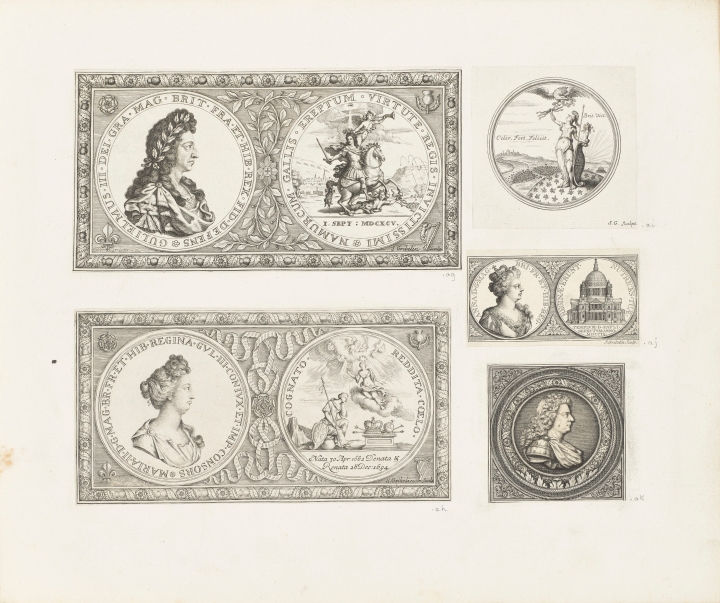
Simon Gribelin, A Medal of William III Commemorating the Fall of Namur, 1695 and other engravings, in the Works of Gribelin album, sheet 311 × 372 mm (Windsor Castle, Royal Collection. Image Royal Collection Trust / © His Majesty King Charles III 2023).
• Rhian Wong, “Simon Gribelin’s Presentation Albums,” pp. 157–71.
The article examines two previously unpublished presentation albums in the Royal Collection, compiled by the engraver Simon Gribelin (1661–1733). The Works of Gribelin album was compiled in 1715 for George II (when Prince of Wales), while an album of prints of the ceiling of the Banqueting House, London was presented around 1720 to George I. A consideration of the contents of the Works of Gribelin album reveals that Gribelin followed a deliberate programme for the arrangement of its contents. The article looks at the purpose of the albums and places their creation in the context of four other albums known to have been assembled by Gribelin.
n o t e s a n d r e v i e w s
• Galina Mardilovich, Review of Julia Khodko, Peterburg Mikhaila Makhaeva. Grafika I zhivopis’ vtoroi poloviny XVIII veka (The State Russian Museum, 2022), pp. 183–85. This is the catalogue for an exhibition addressing the drawings (and resulting prints) of St Petersburg made by Mikhail Makhaev (1717–1770).
• Shijia Yu, Review of The Art of the Deal (Daniel Crouch Rare Books, 2023), pp. 185–87. This is catalogue of the playing card collection assembled by the Dutch collector Frank van den Bergh.
• Thea Goldring, Review of Esther Bell, Sarah Grandin, Corinne Le Bitouzé, and Anne Leonard, Promenades on Paper: Eighteenth-Century French Drawings from the Bibliothèque National de France (Yale University Press, 2022), pp. 188–90.
• Joanna Sheers Seidenstein, Review of Amy Golahny, Rembrandt’s Hundred Guilder Print (Lund Humphries, 2021), pp. 221–26. Includes the reception history of the print, and the section on William Baillie’s restrikes in the 1770s is relevant.
Journal18, Spring 2024 — Color
The latest issue of J18:
Journal18, Issue #17 (Spring 2024) — Color
Issue edited by Ewa Lajer-Burcharth and Thea Goldring
 Color has been at the center of artistic debates at least since the seventeenth century, and it has remained a key issue in the historiography of art. Recent research has largely pursued two directions. First, color has been studied as a material substance and a technology. Scholars have documented the relation between technological, industrial, and commercial developments and the quality, range, and availability of pigments and colorants available to artists, manufacturers, and consumers. A second approach has focused on the key role of color in the construction of social, racial, colonial, and gender hierarchies. Recent scholarship has revealed the intimate connection between aesthetic debates on chroma and the development of the modern discourse of race. The eighteenth century’s feminization of color, linked to make-up and artifice, has also been reexamined. Clearly, it is no longer viable to think of color or its materials, technologies, and processes in purely aesthetic, ideologically innocent terms. This issue of Journal18 considers what is at stake now in reconsidering color in its historical dimensions by bringing these two lines of research together.
The four articles and two notes in this issue explore how the current interest in materiality and the matter of art might be harnessed to alter—enrich, complicate, or challenge—our understanding of the historical functions and socio-cultural meanings of color in the long eighteenth century. . . .
a r t i c l e s
Andrea Feeser — When Blue and White Obscure Black and Red: Conditions of Wedgwood’s 1787 Antislavery Medallion
Caroline Culp — Embalming in Color: John Singleton Copley’s Vital Portraits at the Edge of Empire
Tong Su — Color in Taxidermy at the Eighteenth-Century Qing Court
Melissa Hyde — Men in Pink: The Petit-Maître, Refined Masculinity, and Whiteness
s h o r t e r p i e c e s
Tori Champion — Catherine Perrot: Color, Gender, and Medium in the Seventeenth-Century Académie
Philippe Colomban — The Quest for the Western Colors in China under the Qing Emperors
Écrans, 2024: William Hogarth et le cinéma
From Classiques Garnier, where individual articles are also available for purchase:
Marie Gueden and Pierre Von-Ow, ed., Écrans, Nr. 20: William Hogarth et le cinéma (Paris: Garnier, 2024), 295 pages, French and English, ISBN: 978-2406169727, €25.
 This special issue of Écrans explores the largely overlooked and unexpected connections between William Hogarth and cinema. Frequently mentioned in passing, these links are thoroughly examined here by art historians, film and literary scholars, and a filmmaker. The collection addresses various crucial themes (such as narrative serialization, visual dynamics, and socio-cultural aspects), aiming to showcase the historical significance, artistic richness, and contemporary relevance of the relationship between Hogarth and cinema.
Marie Gueden holds a PhD in film studies from Université Paris 1 Panthéon-Sorbonne. Associate researcher at the Institut ACTE (Université Paris 1 – Panthéon-Sorbonne) and Passages XX-XXI (Université Lumière Lyon 2), lecturer at ENS Lyon and Université Sorbonne Nouvelle-Paris 3, she has published several articles, including studies on Sergei M. Eisenstein and William Hogarth.
Pierre Von-Ow recently received his PhD in History of Art from Yale University. His research focuses primarily on the intersections of arts and sciences in the early modern period. Among his recent projects, he curated in 2022 the virtual exhibition William Hogarth’s Topographies for The Lewis Walpole Library.
s o m m a i r e
• Marie Gueden et Pierre Von-Ow — Introduction: William Hogarth et le cinéma
I Sérialisation narrative et genres / Narrative Serialization and Genres
• Kate Grandjouan — Virtual witnessing in A Harlot’s Progress (1732). Hogarth’s visio-crime media
• Marie Gueden — Progress hogarthien et continuité narrative et morale aux États-Unis. Du pré-cinéma au cinéma des années 1930
• Brian Meacham and Yvonne Noble — An early film adaptation of Henry Fielding’s Tom Jones at Yale University
II Image et mouvement / Image and Movement
• Marie Gueden — « Hogarthisme » outre-Atlantique. Du tournant du XXe siècle aux années 1920–1930
• Marion Sergent — Sur la serpentine. Hogarth et l’abstraction musicaliste de Janin, Béothy et Valensi
• Jordi Xifra — Luis Buñuel, cinéaste hogarthien
• Théo Esparon — Beauté, glamour, baroque dans La Femme et le pantin (1935) de Josef von Sternberg
III Revoir Hogarth / Re-Viewing Hogarth
• Jean-Loup Bourget — Hogarth au cinéma, indice d’anglicité ?
• Pierre Von-Ow — Hogarth through a camera. Bedlam from print to film
• Enrico Camporesi — De Southwark Fair à Tom, Tom, the Piper’s Son. Cinéma des origines et origines du cinéma
• Mike Leigh on Hogarth, Interview by Pierre Von-Ow
Annexes / Appendices
1 Angles and Pyramids (1936)
2 Pierre Kast — De la parodie de « Paméla » à « Tom Jones ». L’Angleterre georgienne, scénario de Henry Fielding, réalisation de Hoggarth (1948)
Filmographie
Résumés / Abstracts
Call for Articles | Anachronisms in Art History
From the Call for Papers / Appel à contributions:
Anachronisms in Art History / Anachronismes en histoire de l’art
Special issue of Perspective: Actualité en histoire de l’art
Edited by Thomas Golsenne, Hélène Leroy, and Hélène Valance
Proposals due by 17 June 2024, with finished articles due by 1 December 2024
Perspective will explore, in its 2025.2 issue—co-edited by Thomas Golsenne (INHA), Hélène Leroy (Musée d’Art Moderne de Paris), and Hélène Valance (université Bourgogne-Franche-Comté/InVisu)—the question of anachronisms in art history.
Since at least the 1960s, a number of critical approaches have emerged with regard to sweeping Western approaches that classified artworks and artists in successive stylistic periods, and even based the discipline on these temporal and formal categories. They made it possible to call into question the 19th-century ‘historism’ that confused the scholars’ temporal categories with the historical phenomena themselves, just as they have redefined periods as designations of time, objects of history. In practice, however, it is clear that the period remains more than ever the temporal unit within which we conceive art history and study it. Even if the subject of anachronism in art history emerged much earlier, for reasons that merit further consideration, it genuinely became worthy of interest for the epistemology of the historical sciences at the turn of the 21st century. What about art history?
To this end, three main topics emerge for proposed articles:
1 Disciplinary Anachronisms
2 Methodological Anachronisms
3 Historical Anachronisms
Additional information (including a bibliography) is available from the full Call for Papers»
Taking care to ground reflections in a historiographic, methodological, or epistemological perspective, please send your proposals (an abstract of 2,000 to 3,000 characters/350 to 500 words, a working title, a short bibliography on the subject, and a biography limited to a few lines) to the editorial email address (revue-perspective@inha.fr) no later than 17 June 2024.
Perspective handles translations; projects will be considered by the committee regardless of language. Authors whose proposals are accepted will be informed of the decision by the editorial committee in July 2024, while articles will be due on 1 December 2024. Submitted texts (between 25,000 and 45,000 characters/ 4,500 or 7,500 words, depending on the intended project) will be formally accepted following an anonymous peer review process.
Published by the Institut national d’histoire de l’art (INHA) since 2006, Perspective is a biannual journal which aims to bring out the diversity of current research in art history, highly situated and explicitly aware of its own historicity.
Call for Articles | Fall 2025 Issue of J18: Clean
From the Call for Papers:
Journal18, Issue #20 (Fall 2025) — Clean
Issue edited by Maarten Delbeke, Noémie Etienne, and Nikos Magouliotis
Proposals due by 1 October 2024; finished articles will be due by 1 April 2025
This issue of Journal18 asks: what we might see if we regard the eighteenth century as possessed by a cleaning frenzy? Cleaning, as a process of removing excess matter to get to the essential or the original, engaged an eighteenth-century obsession with origins and etiology. This type of removal took place in a time of formulations and nebulous debates about race, class, and ethnicity and intersected with attempts to ‘purify’ the urban and rural environment as well as society itself. Cleanliness suggested a particular aesthetic that resonated with the tenets of neoclassicism but also with racialized notions of whiteness, as the opposite of ‘impure’, non-white races, cultures, and objects. In the increasingly disenchanted worldview of elites, cleaning artworks was also a way to annihilate any living presence connected to these objects, from bugs and microorganisms to ancestral spirits to immanent beliefs.
In eighteenth-century Europe, political, cultural, and religious authorities sought to clean artworks and monuments from anything that ‘soiled’ them, whether that was actual dirt, natural traces of use and time, or (hu)man-made ephemera, immaterial rituals, and ideological beliefs. These actions were symptoms of a power struggle between religious institutions and the state and between different cultures and countries, but also between local populations and an increasingly centralized administration. Even when presented as neutral measures of maintenance, such acts of cleaning often led to conflict. This was the case, for example, in late eighteenth-century Naples, when the German painter Jacob Philip Hackert was accused by local artists of disrespecting a number of Italian paintings he had cleaned. What for one cultural milieu diminished artistic value could be, for another, an integral part of the artwork.
This issue of Journal18 invites essays on acts of and discourses around cleaning in the long eighteenth century, particularly cases that address issues of authority and ownership. Who was entitled to touch, handle, modify, or clean an artwork, relic, building, or monument? What/who was allowed to reside within such buildings and objects, and what/who had to be erased or exterminated? What was the significance of defining the ‘pure’ or ‘original’ state of such artworks? What line of separation did actors draw between cleaning and destruction? Was cleaning gendered, and, if so, how? Who was expected to do the cleaning, and who was allowed to produce dirt? What are the connections between racialized ideologies that led to the devastations of ethnic cleansing and eighteenth-century aesthetics of cleaning and cleanliness? Is there a way to contrast the ‘messiness’ of the early modern multi-modal ‘entangled’ historiography with the streamlined ‘cleanliness’ of eighteenth-century historical writing?
Proposals for issue #20 Clean are now being accepted. The deadline for proposals is 1 October 2024. To submit a proposal, please send an abstract (250 words) and brief biography to editor@journal18.org and nikolaos.magouliotis@gta.arch.ethz.ch. Articles should not exceed 6000 words (including footnotes) and will be due by 1 April 2025. For further details on submission and Journal18 house style, see Information for Authors.
Issue Editors
• Maarten Delbeke, ETH, Zurich
• Noémie Etienne, University of Vienna
• Nikos Magouliotis, ETH, Zurich
Print Quarterly, March 2024
The long eighteenth century in the latest issue of Print Quarterly:
Print Quarterly 41.1 (March 2024)
a r t i c l e s
• Przemysław Wątroba, “Jacques Rigaud’s Drawings in Warsaw of the Residences of Louis XIV,” pp. 23–32.
“In the collection of the last king of Poland, Stanisław August Poniatowski (1732–98), kept in the Print Room of the University of Warsaw Library, there is a renowned volume titled Recueil choisi des plus belles vues des palais et maisons royales de Paris et des environs containing a series of 106 engravings by Jacques Rigaud (1681–1754). . . . A set eight hitherto unpublished drawings by Rigaud [also in Warsaw and] formerly kept in Portfolio 174 are here presented as designs” for eight of the prints (23, 25).
n o t e s a n d r e v i e w s

Seven Creamware Plates, ca. 1808–36, diameters 20–23 cm, transfer-printed with various scenes, clockwise from top: Defoe’s Robinson, Choisy factory; Cervantes’s Don Quixote, Montereau factory; Perrault’s Fairies, Montereau factory; Fontaine’s Fable of the Fox and Grapes, Sèvres factory; Ovid’s Metamorphoses, Judgement of Midas, Choisy factory; Chateaubriand’s Atala Found with Chactus by Father Aubry, Choisy factory; and at centre, Cottin’s Matilda Saved by Malek Adhel, Choisy factory (Germany, Peter-Christian Wegner Collection).
• Marzia Faietti, Review of Heather Madar, ed., Prints as Agents of Global Exchange: 1500–1800 (Amsterdam UP, 2021), pp. 37–39.
• Sheila McTighe, Review of Francesco Ceretti and Roberta D’Adda, eds., Immaginario Ceruti: Le stampe nel laboratorio del pittore (Skira, 2023), pp. 42–43. This catalogue accompanied an exhibition that explored the work of the painter Giacomo Ceruti (1698–1767) and his reliance on printed images. “A complementary show of Ceruti’s paintings, Miseria & Nobiltà: Giacomo Ceruti nell’Europa del Settecento was also held in 2023 at the Museo Santa Giulia in Brescia, followed by a reduced version at the J. Paul Getty Museum, Los Angeles during the second half of that year, Giacomo Ceruti: A Compassionate Eye” (42).
• Natasha Ruiz-Gómez, Review of Rebecca Whiteley, Birth Figures: Early Modern Prints and the Pregnant Body (University of Chicago Press, 2023), pp. 43–45.
• Antony Griffiths, Review of Chiara Travisonni with Luca Fiorentino and Andrea Muzzi, Pietro Giacomo Palmieri (Edifir, 2023), pp. 45–46. This monograph on the draughtsman and printmaker, Pietro Giacomo Palmieri (1737–1804), “will become the definitive source of information” for the artist and his work (46).
• Patricia Ferguson, Review of Peter-Christian Wegner, Literatur auf französischen Steingut-Tellern des frühen 19. Jahrhunderts (Georg Olms, 2022), pp. 46–47. Wegner addresses the popularity of subjects drawn from French literature for transfer-printed ceramics, starting in 1808. “While we await a larger in-depth survey of this engaging material, Wegner’s publication is a huge contribution to its appreciation” (46).
• Elizabeth Savage, Review of Christien Melzer and Georg Josef Dietz, Holzschnitt: 1400 bis heute (Hatje Cantz, 2022), pp. 48–50. This is the catalogue for an exhibition that “featured more than 100 prints from the Kupferstichkabinett [in Berlin], as well as what was effectively the first large-scale display of woodblocks from its enormous yet relatively little-known collection” (50).

Johann Christoph Weigel, Sheet for Découpage with Figures on Cloudlike Landscapes and a Fantastical Bird, c. 1700–25, from album Inventions Chinoises V, handcoloured engraving, 216 x 151 mm (Dresden, Kupferstich-Kabinett).
• Brief notice of Katy Barrett, Looking for Longitude: A Cultural History (Liverpool UP, 2022), p. 76. Rather than a retelling of the familiar story of accurately calculating longitude, this book “is a remarkably well-researched account of the ways in which this long-running sage impacted on many areas of public discourse, thought, and imagery” (76).
• Emanuele Lugli, Review of Miriam Vogelaar, The Mokken Collection: Books and Manuscripts on Fencing before 1800 (MMIT Publishing, 2020), pp. 88–92.
• Nadine Orenstein, Review of Maureen Warren, ed., Paper Knives, Paper Crowns: Political Prints in the Dutch Republic (Champaign: Krannert Art Museum, 2022), 92–96. “Never have these prints been so lavishly presented. The beautifully produced catalogue, winner of the 2023 IFPDA Book Award, exceptionally allocates plenty of space to the images. It allows the reader to see entire works along with accompanying text and provides space for multi-plate productions” (93).
• Maureen Cassidy-Geiger, Review of Cordula Bischoff and Petra Kuhlmann-Hodick, eds, La Chine: Die China-Sammlung Des 18. Jahrhunderts Im Dresdner Kupferstich-Kabinett (Sandstein Verlag, 2021), 97–103. This “is the catalogue of an exhibition at the Dresden State Museum devoted to the Chinese works on paper and European chinoiserie prints acquired by the Saxon Electors before 1750” (97). It “was an ambitious project that took many years to come to fruition and required collaboration between colleagues in different disciplines with different working languages” (102).
Oxford Art Journal, December 2023
The 18th century in the latest issue of the Oxford Art Journal:
Oxford Art Journal 46.3 (December 2023)
a r t i c l e s
• Aaron Wile, “Absolutism, the Royal Body, and the Origins of Mythologie galante: Charles de La Fosse at the Trianon,” pp. 327–55.

Charles de La Fosse, The Rest of Diana, 1688, oil on canvas, 128 × 160 cm (Versailles, Châteaux de Versailles et de Trianon).
Mythologie galante, a sensual mode of mythological painting that is one the defining developments of eighteenth-century French art, is usually associated with aristocratic resistance to Louis XIV. This article examines three mythological paintings created by Charles de La Fosse for one of the king’s pleasure palaces in 1688, long identified as a major turning point towards mythologie galante, in order to reassess the origins and meaning of the genre. Situating the paintings within the long arc of Louis XIV’s representational politics, I propose that the collapse of the fiction of the king’s two bodies during the second half of his reign and the subsequent redefinition of the king’s public and private spheres allowed La Fosse to develop a new mythological idiom based in touch, intimacy, and sentiment. The resulting works contravened painting’s traditional role under absolutism to form royal subjects, redefining it as a medium of sympathetic encounter. La Fosse’s paintings open up, from this perspective, an alternate account of modern art and subjectivity—one that took shape not in opposition to absolutist culture but from its very heart.
• Robert Jones, “Joshua Reynolds and Deafness: Listening, Hearing, and Not Hearing in Eighteenth-Century Portraiture,” pp. 357–77.
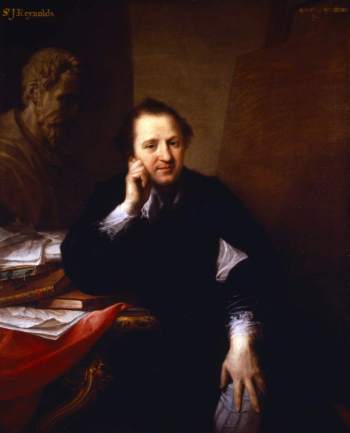
Angelica Kauffman, Portrait of Joshua Reynolds, 1767, oil on canvas, 127 × 102 cm (National Trust, Saltram).
This article examines the significance of deafness in painting and proposes a new trope for the form of picturing undertaken by eighteenth-century art, ‘the listening portrait’. As a first step it recovers and explores the significance of Sir Joshua Reynolds’s own deafness, as represented by his self-portraits as well as images by Nathanial Dance, Angelica Kauffman, and Johan Zoffany. Sound is necessarily absent from painting, audible speech impossible. Having explored these apparent limits (found in eighteenth-century theorizations of art) the essay asks more fundamentally what work is done by the representation of someone striving to listen. By considering this question, it is possible to understand these images as engaging in a more sensitive ethical enquiry concerned with what an aural impairment might mean, and how it is distinct from a refusal or unwillingness to listen. Deafness is consequently shown to be not merely something that paintings show, rather the issue of hearing or not hearing frames their pictorial and moral purpose. Throughout the article recognition of the specificity of Georgian sociability on the one hand, and eighteenth-century artistic theory and practice on the other, seeks to enable the claims of Medical Humanities to recognize previously hidden narratives.
r e v i e w s
• Andrew McClellan, “Purpose, Power, and Possibility: A History of Museums Past and Present,” pp. 493–501.
Review of Krzysztof Pomian, Le musée, une histoire mondiale, 3 volumes (Paris: Gallimard, 2020–22), volume 1: Du trésor au musée, 687 pages, ISBN: 978-2070742370, €35; volume 2: L’ancrage européen, 1789–1850, 546 pages, ISBN: 978-2072924705, €35; volume 3: À la conquête du monde, 1850–2020, 936 pages, ISBN: 978-2072982781, €45.
The Magazine of the Decorative Arts Trust, Winter 2023–24
The Decorative Arts Trust has shared select articles from the winter issue of their member magazine as online articles for all to enjoy. The following articles are related to the 18th century:
The Magazine of the Decorative Arts Trust, Winter 2023–24
 • Catherine Carlisle , “Inspiring Thomas Jefferson: Art and Architecture in France” Link»
• Matthew A. Thurlow, “Papered and Painted in Providence” Link»
• Charles Dawson, “The Finest Regency Porcelain Painter: Thomas Baxter in Worcester” Link»
• Philip D. Zimmerman, “Historic Odessa Collections Published” Link»
• Reed Gochberg, “Interwoven: Women’s Lives Written in Thread” Link»
• Kaila Temple, “‘A Place to Cultivate Her Mind in by Musing’: New Exploration of Anne Emlen’s 1757 Shellwork Grotto” Link»
• Laura Ochoa Rincon, “A Million Hidden Stories: Uncovering Materials at the New Orleans Museum of Art” Link»
• Laura C. Jenkins, “French Interiors for an American Gilded Age” Link»
• Alyse Muller, “18th-Century Marine Imagery in the Sèvres Archive” Link»
The printed Magazine of the Decorative Arts Trust is mailed to Trust members twice per year. Memberships start at $50, with $25 memberships for students.
Pictured: The magazine cover features the front parlor of the Rhode Island Historical Society’s John Brown House, which contains a Providence-made nine-shell desk and bookcase (1760–80) flanked by variants of Providence-made Neoclassical side chairs (1785–1800). The wallpaper is a 1975 reproduction by the Birge Co. of Buffalo, NY, based on a 1790s French example.
Exhibition | Indian Skies: The Howard Hodgkin Collection

An Elephant and Keeper, India, Mughal, ca. 1650–60, opaque color and gold on paper
(New York: The Metropolitan Museum of Art, Howard Hodgkin Collection, 2022.187)
◊ ◊ ◊ ◊ ◊
Opening next month at The Met:
Indian Skies: The Howard Hodgkin Collection of Indian Court Painting
The Metropolitan Museum of Art, New York, 6 February — 9 June 2024
Over the course of sixty years, British artist Howard Hodgkin (1932–2017) formed a collection of Indian paintings and drawings that is recognized as one of the finest of its kind. A highly regarded painter and printmaker, Hodgkin collected works from the Mughal, Deccani, Rajput, and Pahari courts dating from the 16th to the 19th centuries that reflect his personal passion for Indian art. This exhibition presents over 120 of these works, many of which The Met recently acquired, alongside loans from The Howard Hodgkin Indian Collection Trust.
The works on view include stunning portraits, beautifully detailed text illustrations, studies of the natural world, and devotional subjects. The exhibition will also display a painting by Hodgkin, Small Indian Sky, which alludes to the subtle relationship between his own work, India, and his collection. This exhibition is accompanied by an issue of The Metropolitan Museum of Art Bulletin.
The Burlington Magazine, December 2023
The eighteenth century in the December issue of The Burlington, which focuses on Spain:
The Burlington Magazine 165 (December 2023)

Francisco de Goya, Self-Portrait with Dr Arrieta, 1820, oil on canvas, 115 × 77 cm (Minneapolis Institute of Art, 52.14).
a r t i c l e
• Mercedes Cerón Peña, “Goya’s Self-Portrait with Dr Arrieta,” pp. 1300–04.
In 1820 Goya painted a portrait of himself as he had appeared during his serious illness of the year before, attended by his doctor, Eugenio García Arrieta. Newly discovered biographical information about Arrieta suggests that the painting’s red and and green colour scheme may allude to the political views he shared with Goya.
r e v i e w s
• Michael Hall, Review of the new Galería de las Colecciones Reales (Royal Collections Gallery) in Madrid (opened 28 June 2023), pp. 1339–43.
• Stephen Lloyd, Review of the exhibition Return of the Gods (World Museum, Liverpool, (April 2023 — February 2024), pp. 1343–45. “Britain’s largest assemblage of Classical sculpture outside London belongs to National Museums Liverpool . . . In 1959 Liverpool City Council and its museums were gifted the entirety of the Ince Blundell collection—approximately six hundred heavily restored Roman marbles . . . collected by . . . Henry Blundell (1724–1810), a wealthy Catholic landowner, between 1776 and 1809.”
• Humphrey Wine, Review of the catalogue raisonné by Joseph Assémat-Tessandier, Louis Lagrenée, dit l’Aîné (1725–1805) (Arthena, 2022), pp. 1364–65.
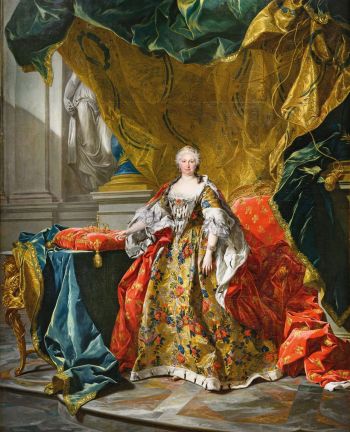
Louis-Michel van Loo, Portrait of Isabel Farnese, 1737, oil on canvas, 341 × 264 cm (Madrid: Galería de las Colecciones Reales).
• Rebeka Hodgkinson, Review of Stephanie Barczewski, How the Country House Became English (Reaktion, 2023), pp. 1370–71.
• Peter Humfrey, Review of Eveline Baseggio, Tiziana Franco, and Luca Molà, eds., La chiesa di Santa Maria dei Servi e la comunità veneziana dei Servi di Maria, secoli XIV–XIX (Viella, 2023), pp. 1374–75. “The demolition of the great fourteenth-century church of the Servi in about 1812–13 represents one of the most grievous of the many losses suffered by Venice’s artistic heritage during the Napoleonic period.”
o b i t u a r y
• Saloni Mathur, Obituary for Kavita Singh (1964–2023), pp. 1379–80.
Professor of art history and Dean of the School of Arts and Aesthetics at Jawaharlal Nehru University, Kavita Singh became internationally known for her publications on the history and politics of museums and the pre-modern art of South Asia. An authority on Indian court paintings, she was an inspiring colleague and teacher who publicly championed both her university and the study of Mughal art in the subcontinent.










 Enfilade
leave a comment