Online Lecture | Amelia Rauser, Black Bodies and Neoclassical Whiteness
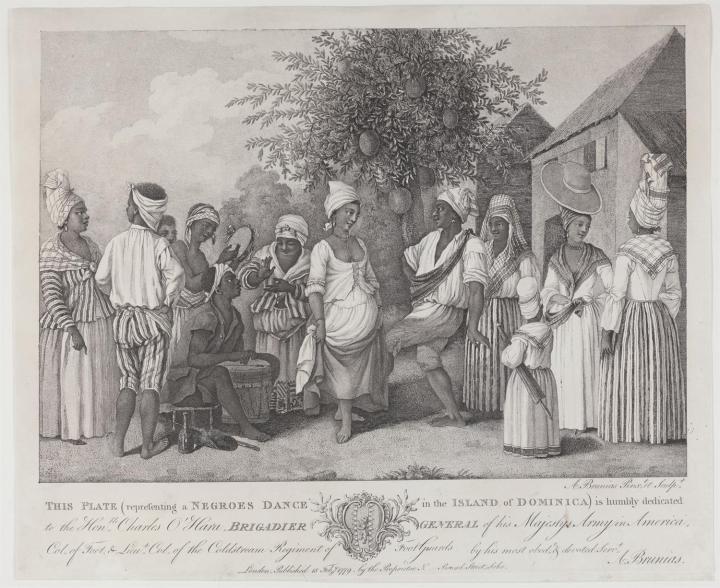
Agostino Brunias, ‘A Negroes Dance in the Island of Dominica’, 1779, engraving on laid paper
(Lewis Walpole Library, 779.02.15.01)
◊ ◊ ◊ ◊ ◊
From the Lewis Walpole Library:
Amelia Rauser, Black Bodies and Neoclassical Whiteness in the Age of Undress
Online lecture organized by the Lewis Walpole Library, 24 June 2020
Registration due by 22 June 2020
Women who wore the high-waisted, white muslin dress fashionable in the 1790s strove to participate in the elevated aesthetics of neoclassicism and to construe themselves as living statues, Pygmalions to their own Galatea. The dress articulated an anti-fashion stance that created space for women’s artistic expression. But neoclassical dress was also enmeshed with emergent concepts of race in the 1790s—not via a simple mapping of whiteness onto classicism, but rather, and perhaps unexpectedly, by invoking the plantation culture of the West Indies. In this talk, Dr. Amelia Rauser, Professor of Art History at Franklin & Marshall College, will argue that several elements of the neoclassical ensemble, including gold earrings, madras-cloth accessories, headwraps, and especially the materiality of muslin itself, specifically articulated the wearer’s racialized whiteness. Yet at the same time, the idea of metamorphosis inherent in the living statue undermined racial binaries and provided space to explore a spectrum of embodiment.
Dr. Rauser will be introduced by Joseph Roach, Sterling Professor Emeritus of Theater, Professor Emeritus of English, Yale University. Panel discussants Dr. Carolyn Day, Associate Professor of History, Furman University, and Dr. Jennifer Germann, Associate Professor and Department Chair, Art History, Ithaca College, will lead a Q&A. Registered attendees will be invited to submit questions and comments through chat.
The lecture is scheduled for Wednesday, 24 June 2020, at 1.00pm EDT; registration is required by Monday, 22 June 2020.
The talk presented in connection with the exhibition Artful Nature: Fashion and Theatricality, 1770–1830, which was co-curated by Laura Engel, Professor of English, Duquesne University, and Amelia Rauser. Other related online content includes:
• Artful Nature exhibition
• Keynote Lecture “Fashionable Friends: Glamour as Argument, 1770–1830,” delivered by Joseph Roach on 6 February 2020
• Exhibition video tour with the curators
Dr. Rauser’s new book, The Age of Undress: Art, Fashion, and the Classical Ideal in the 1790s, is now available from Yale University Press.
Online Lecture | Wolf Burchard on The Met’s New British Galleries
From The Furniture History Society’s Instagram account:
Wolf Burchard, The Metropolitan Museum of Art’s New British Galleries
Online Lecture, 14 June 2020
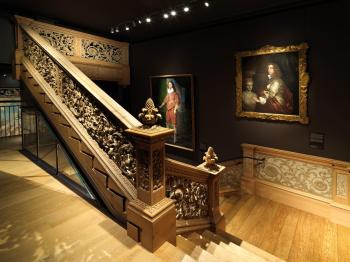
Installation view of the Met’s new British Galleries, featuring the 17th-century Cassiobury Staircase (Photo by Joseph Coscia, February 2020).
Please join us for the free-of-charge inaugural FHS online lecture via Zoom on Sunday, 14 June 2020, at 19.00 British Summer Time (14.00 Eastern Standard Time) with Dr. Wolf Burchard of the Metropolitan Museum of Art, entitled, “The Metropolitan Museum of Art’s New British Galleries.”
The Met’s renovated British Galleries, which opened earlier this year (for the museum’s 150th anniversary) now tell a nuanced story about Britain’s imperial past and its dealings with the rest of the world. Ten galleries, including three historic interiors, devoted to decorative arts and sculpture from the 16th to the 19th century have been completely reimagined. They present British art and design from a fresh perspective, exploring Britain’s creativity and entrepreneurship. The lecture is open to all; for links and passwords, please contact events@furniturehistorysociety.org. Information about joining the FHS is available here.
Wolf Burchard is responsible for British furniture and decorative works of art, with the exception of ceramics and textiles. Prior to joining The Met in 2019, he was furniture research curator at the National Trust of England, Wales, and Northern Ireland (2015–18) and curatorial assistant at the Royal Collection Trust (2009–14), where he co-curated the exhibition The First Georgians: Art & Monarchy, 1714–1760 at The Queen’s Gallery, Buckingham Palace (2014). He studied history of art and architecture at the universities of Tübingen, Vienna, and The Courtauld Institute of Art in London, from which he holds an MA and PhD. He is the author of The Sovereign Artist: Charles Le Brun and the Image of Louis XIV (2016), and sat on the executive committees of the Georgian Group (2014–19) and the Society for Court Studies (2011–17); he is a member of the council and editorial panel of the Furniture History Society.
Online Lecture | Cassidy-Geiger on Friedrich Christian’s Grand Tour
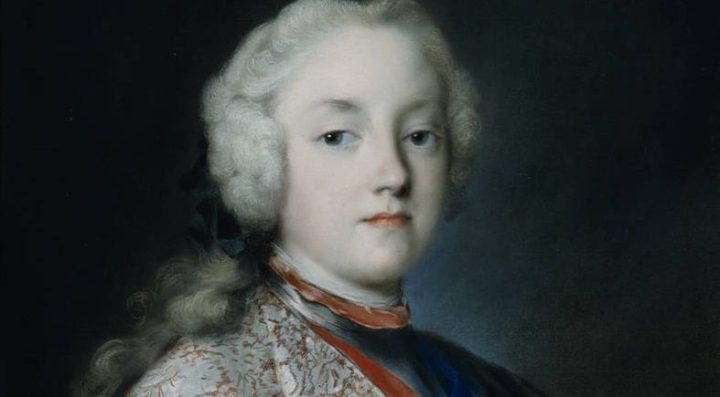
Rosalba Carriera, Portrait of the Elector Frederick Christian of Saxony), 1740, pastel on paper, 63.5 × 51.5 cm
(Dresden: Gemäldegalerie Alte Meister)
◊ ◊ ◊ ◊ ◊
From The French Porcelain Society:
Maureen Cassidy-Geiger, The Grandest of Tours: Fragile Diplomacy Meets the Grand Cure
Online Lecture, 13 June 2020
The French Porcelain Society continues its series of weekly online lectures with Maureen Cassidy-Geiger on the incredible two-year Grand Tour of the Elector Friedrich Christian of Saxony in the mid-eighteenth century. We hope you can join us on Saturday, 13 June 2020, 19:00pm (British Summer Time). Members will receive an email invitation with instructions on how to join the online lecture. If you want to join, please contact us for more details on FPSenquiries@gmail.com.
Elector Friedrich Christian of Saxony (1722–1763), who succeeded King August III in 1763 for just 74 days, was afflicted from birth with profound physical disabilities which prevented him from standing or walking without assistance and made simple tasks like eating and dressing difficult. The marriage of his sister Maria Amalia to the King of Naples in 1738 inspired their parents to send the fifteen-year-old heir to the throne on an impromptu journey to Italy for life-saving medical treatments. This exceptional two-year adventure was amply documented, allowing us to precisely reconstruct the prince’s route and daily experiences as he travelled from Dresden to Naples, Rome, Florence, Milan and Venice along pilgrimage routes and post roads, returning via his mother’s court capital, Vienna. Like the able-bodied Grand Tourists he met along the way, he also travelled incognito (‘Comte de Lusace’) with an entourage, enjoyed celebrity status, and collected art, relics, books and souvenirs for shipment home, many of them gifts from his hosts along the way. A selection was featured together with archival documentation in The Grand Cure / Die Grande Kur 1738–1740 (Staatliche Kunstsammlungen Dresden, 2018). In return, wagonloads of porcelain from the Royal Porcelain Manufactory at Meissen were shipped abroad to serve as thank yous from King August III and to celebrate the Naming Day of dowager Empress Wilhelmine Amalie, the prince’s grandmother. Many of these porcelain gifts have survived and were showcased in the exhibition and catalogue Fragile Diplomacy: Meissen Porcelain for European Courts, ca. 1710–63 (YUP/BGC, New York, 2007–08). Some were customized with coats of arms or apt painterly compositions, a few items were repurposed from Japanese Palace stock, and others were simply on hand and included in the shipments; the Meissen porcelain table service that accompanied the prince across Italy was understandably damaged and depleted from use at the lunches and dinners he routinely hosted so a replacement was sent via courier to meet him in Vienna, together with a selection of the king’s silver plate.
Maureen Cassidy-Geiger has twice driven the prince’s itinerary and has researched his sojourns in Naples, Rome, Venice and Vienna on various residential fellowships. Transcriptions of the travel diaries, composed mostly in French, and related research and documentation are posted on the website comtedelusace.wordpress.com.
Online Public Lecture Course | Georgian Provocations
From PMC:
Georgian Provocations: Six Iconic Works of Art from Eighteenth-Century Britain
Paul Mellon Centre, London, 28 May — 9 July 2020
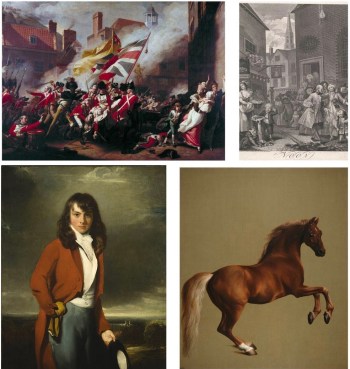 Georgian Provocations is a one-off summer public lecture course, delivered online, and designed to provide an accessible and stimulating introduction to the art of the period. In this series of six 30-minute lectures, Hallett and Postle focus on six seminal paintings from the Georgian era and investigate their contents, contexts, and impact. Together, they reveal many of the ideas and issues that coursed through British visual culture between the 1730s and the 1790s, and demonstrate the riches that continue to be gained from looking intensively at an individual work of art. Lectures will be released weekly from 28 May to 2 July at 3pm (GMT).
An associated conversation on July 9 will be streamed live via Zoom Webinar at 6pm (GMT), providing a Q&A session with series presenters Mark Hallett and Martin Postle, who will talk about the pictures they focused upon in their lectures and their respective approaches to discussing the works in question.
28 May 2020
Mark Hallett, Walking the Streets: William Hogarth’s The Four Times of Day by William Hogarth (1736–38)
4 June 2020
Martin Postle, Variations on a Theme: Richard Wilson’s The White Monk (ca. 1755–65)
11 June 2020
Martin Postle, All Done from Nature: George Stubbs’s Whistlejacket (1762)
18 June 2020
Martin Postle, The Artist as Intellectual: Joshua Reynolds’s Self-Portrait as President of the Royal Academy (1780)
25 June 2020
Mark Hallett, Displaying the Hero: John Singleton Copley’s The Death of Major Peirson (1784)
2 July 2020
Mark Hallett, Making an Impact: Thomas Lawrence’s Arthur Atherley (1792)
9 July 2020
Georgian Provocations: A Conversation, streamed live via Zoom Webinar at 6pm (GMT); register via Eventbrite here.
Open Digital Seminar in Eighteenth-Century Studies, 2020
ODSECS presents live seminars with Q&A opportunities (advance registration required for participation). Recordings remain available after the fact. I would particularly note Freya Gowrley’s talk in July on “Anna Seward and the Poetics of Exchange,” with registration details here. –CH
Open Digital Seminar in Eighteenth-Century Studies
Launched April 2020, ongoing
The Open Digital Seminar in Eighteenth-Century Studies brings together researchers in eighteenth-century literature and culture from across the globe for conversation, debate, and sociability. It aims to make the best new research available to the widest possible audience, and to facilitate a diverse and inclusive research culture.
ODSECS seminars take place live and are also recorded to ensure maximum accessibility. In each seminar, a twenty-minute paper delivered by an expert speaker is followed by a 20- to 30-minute question and answer session. All participants are welcome to contribute to the Q&A using a microphone or the typed chat function.
ODSECS is convened by Dr Rebecca Bullard, Associate Professor of English Literature at the University of Reading, UK. Please send enquiries about ODSECS to r.bullard@reading.ac.uk.
Seminar 1: Sophie Coulombeau (University of York), Unlocking the Mary Hamilton Papers
April 2020
In April 2020, a group of researchers came together to experiment with the format for ODSECS. Dr Sophie Coulombeau gave a wonderful paper about the research project, ‘Unlocking the Mary Hamilton Papers’. On this occasion, only the talk was recorded, not the question and answer session that followed it.
Seminar 2: Eugenia Zuroski (McMaster University), Haywood’s Fascinum
Monday, 18 May 2020, 4.00pm (UK time)
Eliza Haywood’s The Adventures of Eovaai is a curiously elaborate joke: an intricate oriental romance as vehicle for a relatively straightforward satire of Robert Walpole and his political ascendance. As Ros Ballaster has observed, the tale contains “anarchic and perverse comic energies” that tend to overwhelm, even counteract, the story’s political orientations. In this paper, I consider how, in its more anarchic and perverse moments, Eovaai theorizes “unseriousness” as an epistemological and political approach to the world—an unexpected utopian promise in the prospect of being “carried away” by literature’s most fascinating and least plausible objects. Tracing Haywood’s engagement with the Roman fascinum, I show the unexpected conceptual heights a well-deployed penis joke might take us.
Seminar 3: Nicholas Seager (Keele University), ‘The Celebrated Daniel De Foe’: The Reception and Publication History of Defoe’s Non-Fiction
Wednesday 17 June 2020, 4.00pm (UK time)
This paper examines unexplored aspects of Daniel Defoe’s (1660–1731) posthumous publication history in the eighteenth and nineteenth centuries. It challenges prevalent understandings of his reception, as critics have assumed that “Defoe seems to have been little read or remembered in the years after his death,” and that until the twentieth century he was remembered as a “slapdash journalistic hack.” As well as trying to qualify or dispel such views, the paper argues that Defoe’s extensive publication history in numerous non-fiction genres—history, travel-book, conduct writing, journalism, polemical pamphlets, religious treatises, and more—reveals some ways in which generic change occurred across the period. Defoe’s non-fiction was subjected to acts of re-publication that amount to adaptation and appropriation, processes more commonly applied to Defoe’s fiction. Finally, the paper shows how the re-publication of Defoe’s non-fiction repeatedly engaged with British political, social, and economic history, from the Forty-Five to the French Revolution and beyond.
Seminar 4: Freya Gowrley (University of Derby), Anna Seward and the Poetics of Exchange: Portraiture, Poetry, and Gift Culture
Wednesday, 15 July 2020, 4.00pm (UK time)
This paper unpacks the complex networks of emotional, artistic, and poetic exchange that surrounded a highly emotional portrait-object: a printed version of George Romney’s painting Serena given to Lady Eleanor Butler (1739–1829) and Sarah Ponsonby (1755–1831)—the so-called ‘Ladies of Llangollen’—by the poet Anna Seward (1742–1809). Seward identified the image as a ‘perfect similitude’ of her deceased step-sister Honora Sneyd, so much so that the print played an active role in Seward’s commemoration of their lost friendship. Like Butler and Ponsonby’s own infamous ‘romantic friendship’, Seward and Sneyd enjoyed an intensely close and deeply affectionate relationship that flouted social norms, with both Sneyd’s marriage to Richard Edgeworth in 1751, and her eventual death in 1780, devastating the poet.
Discussing both Seward’s copy of the print, as well as Butler and Ponsonby’s facsimile, this paper places the image within two contexts: firstly, in relation to Seward’s volume of poetry, Llangollen Vale with Other Poems (1796), a sentimentalising series of verses dedicated to Seward’s intimate relationships with Butler, Ponsonby, and Sneyd; and secondly, within an intricate display of gifted portraits at Plas Newydd, Butler and Ponsonby’s home at Llangollen in Wales. Using methodologies from the history of the emotions, material culture and literary studies, and art history it will demonstrate the image’s deep embedment within Seward’s emotional and creative consciousness: on the one hand, allowing Seward to actively ruminate and comment upon her close connections with Sneyd, Butler, and Ponsonby; and on the other, functioning within a dynamic web of literary, material, and loving gestures enacted between Seward and her friends. In so doing, the paper will highlight the vibrant intermedial lives of this eighteenth-century print, and the urgency of an interdisciplinary approach to the art of this period.
Book Launch | The Art of the Jewish Family
This month at BGC:
Book Launch—Laura Leibman, The Art of the Jewish Family
Bard Graduate Center, New York, 23 March 2020, 6:00–7:30pm
Author Laura Leibman in conversation with Jonathan Sarna and Barbara Kirshenblatt-Gimblett, moderated by Dean Peter N. Miller, to celebrate the publication of The Art of the Jewish Family: A History of Women in Early New York in Five Objects.
Laura Arnold Leibman, The Art of the Jewish Family: A History of Women in Early New York in Five Objects (Chicago: The University of Chicago Press, 2020), 350 pages, ISBN: 978-1941792209, $35.
 In order to rethink early Jewish American women’s lives, The Art of the Jewish Family examines five objects owned by Jewish women who lived at least a portion of their lives in early New York between 1750 and 1850. Each chapter creates a biography of a single woman through her object, but also uses her story to shed light on larger changes in Jewish American women’s lives. The women Leibman discusses are diverse: some rich, some poor; some Sephardi, some Ashkenazi; some born enslaved, and some who were slave owners themselves. In creating these biographies, Leibman proposes a new methodology for early American Jewish women’s history, one which could be applied to other areas in Jewish history for which records on women are sparse. This method looks at both material objects and fragmentation as important evidence for understanding the past. What social and religious structures, Leibman asks, caused early Jewish women to disappear from the archives?
The objects she considers span the 1750s through the 1850s. They are (1) a letter written in 1761 by an impoverished Hannah Louzada requesting assistance from Congregation Shearith Israel; (2) a famous set of silver cups owned by Reyna Levy Moses (1753–1824); (3) a beautiful ivory miniature of Sarah Brandon Moses (1798–1829), who was born enslaved in Barbados but became one of the wealthiest Jewish women in New York; (4) a commonplace book created by Sarah Ann Hays Mordecai (1805–1894); and (5) a family silhouette of Rebbetzin Jane Symons Isaacs (1823–1884) and her young brood.
Looking past texts to material culture, Leibman expands our ability to understand early Jewish American women’s lives and restores some of their agency as creators of Jewish identity. While the vast majority of early American texts about Jewish women were written by men with men as the primary intended audience, objects made for and by Jewish women help us consider women as consumers and creators of identity. Everyday objects provide windows into those women’s daily lives, highlighting what they themselves valued, how they wanted their contemporaries to see and understand them, and how they passed identity on to their children and grandchildren.
Laura Arnold Leibman is professor of English and humanities at Reed College.
Art of the Jewish Family is published in Cultural Histories of the Material World, a series dedicated to publishing monographs, works in translation, and collective project volumes that mark out the frontiers of BGC’s knowledge map. All books derived from the Leon Levy Foundation lectures in Jewish Material Culture will be published in this series.
Lecture | Wendy Wassyng Roworth on Angelica Kauffman
At SLAM (and conveniently enough, coinciding with ASECS) . . .
Wendy Wassyng Roworth, Angelica Kauffman: An Enterprising Artist in 18th-Century Britain
Saint Louis Art Museum, 20 March 2020
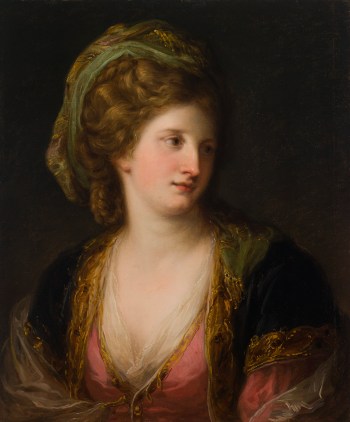
Angelica Kauffman, Woman in Turkish Dress, 1767, oil on canvas, 25 × 20 inches (Saint Louis Art Museum, Funds given by Dr. E. Robert and Carol Sue Schultz 704.2018).
Angelica Kauffman (1741–1807), an Austrian-Swiss artist, began her career in Italy, where her clients included British tourists who encouraged the young painter to pursue her profession in England. Over the fifteen years she worked in London, Kauffman achieved fame and fortune and returned to Italy as an international celebrity. Celebrating a portrait recently acquired by the Museum, this lecture will discuss Kauffman’s life and work in England as a fashionable painter and member of the Royal Academy of Arts, a rare distinction for a woman, and how she used her talents to advantage.
Friday, 20 March 2020, 7pm, Farrell Auditorium at the Saint Louis Art Museum. The lecture is offered free of charge, thanks to the Mary Strauss Women in the Arts Endowment. Tickets are, however, required. Advance tickets are recommended and may be reserved in person at the Museum’s Information Centers or through MetroTix, 314.534.1111 (all tickets reserved through MetroTix incur a service charge).
Wendy Wassyng Roworth is Professor Emerita of Art History, University of Rhode Island.
Lecture | Kate Smith, On Loss and Dispossession
From Eventbrite:
Kate Smith, Loss and Dispossession in the Long Eighteenth Century
University of Edinburgh, 17 March 2020
 Dr Kate Smith (University of Birmingham) delivers the inaugural lecture for the Material Culture in the 17th and 18th Centuries Research Group. Histories of material culture have often focused on questions of presence: how objects in the past were made, purchased, used and repaired. In contrast, Kate Smith’s paper will explore what happened when objects were absent. More particularly, it will examine how eighteenth-century Britons developed systems to deal with loss and what such systems required of them. It will show that, when faced with loss, individuals were called upon to recall their possessions and describe them in full. To make their possessions recognisable to others, and thus increase the possibilities of reclamation, eighteenth-century Britons had to draw out the salient features of missing things. In doing so, they reveal much about what they imagined their possessions to be. The paper considers questions of description, attention, memory and the self to show the complex knowledge, practices and systems constructed and utilised in response to loss. Register here.
Tuesday, 17 March 2020, 17.30–19.00
Playfair Library Hall
South Bridge, Edinburgh
Lecture | Steven Parissien, On George IV and the Horse

George Stubbs, George IV, when Prince of Wales, detail, 1791, oil on canvas, 103 × 128 cm
(Royal Collection Trust, RCIN 400142)
◊ ◊ ◊ ◊ ◊
In connection with the exhibition George IV: Art & Spectacle now on view at Buckingham Palace:
Steven Parissien, George IV and the Horse
The Queen’s Gallery, Buckingham Palace, 26 February 2020
One of George IV’s greatest passions was horseracing. In this lunchtime lecture, Steven Parissien, Chief Executive of Palace House, Newmarket, examines the ways in which George utilised the image of the thoroughbred horse to define and bolster his royal image. 13:00–14:00
Lecture | Jane Raisch on Early Modern Facsimiles

This month at UT Austin’s Ransom Center:
Jane Raisch, Original Copies: The Facsimile before Photography
Harry Ransom Center, The University of Texas at Austin, 27 February 2020
Called “the nightmare of book collectors” by John Carter and Nicolas Barker, facsimiles do not hold a particularly revered position in bibliography and book history. The opposite of the venerated ‘original’, facsimiles are seen as a compromise at best and downright deception at worst. And, yet, people have long been driven to make reliable copies of old documents. Raisch’s lecture will delve into the pre-history of today’s digital reproductions, looking in particular at the creative technical strategies that 16th- through 18th-century scholars and printers devised to reproduce the visual qualities of inscriptions and manuscripts. It will ask how and why early print copied material objects that came before—and, in the process, it will rethink and expand our understanding of what facsimile can mean today. Lecture in the Prothro Theater. Reception to follow. Thursday, 27 February, 4.30–7.00pm.
Jane Raisch, PhD is Lecturer in the Department of English at The University of York in the United Kingdom.










 Enfilade
leave a comment