Exhibition | The Sweetness of Life
From the Norton Simon:
The Sweetness of Life: Three 18th-Century French Paintings from The Frick Collection
Norton Simon Museum, Pasadena, 14 June — 9 September 2019
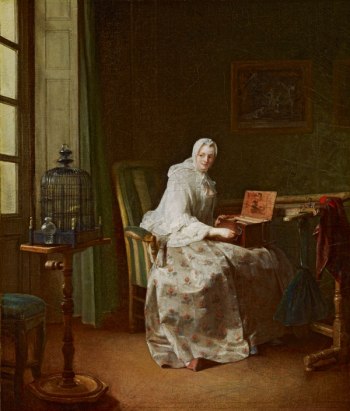
Jean-Siméon Chardin, Lady with a Bird-Organ, 1753 (?), oil on canvas (lined), 20 × 17 inches (New York: The Frick Collection).
Jules and Edmond de Goncourt, the eminent 19th-century historians of French art and society, baptized the 1700s the ‘century of women’. Though 18th-century women did make strides in the sciences, literature, and the arts, they were most often portrayed in genre scenes pursuing leisurely, quotidian pleasures and tasks. Three superb 18th-century French genre paintings from The Frick Collection in New York, part of an ongoing reciprocal exchange program, are on view this summer at the Museum. These artfully constructed visions of contemporary life and fashion, as depicted by François Boucher, Jean-Baptiste Siméon Chardin and Jean-Baptiste Greuze, provide viewers with an intimate look at the lives of middle-class French women of the 1740s and 1750s. The paintings will be installed in the Museum’s 18th-century Rococo gallery among its own works by Chardin and Boucher, as well as paintings by Jean-Antoine Watteau and Jean-Honoré Fragonard.
S E L E C T E D P R O G R A M M I N G
• David Pullins (Assistant Curator, The Frick Collection), Female Models in the ‘Century of Women’: From Fiction to Reality in Chardin, Boucher, and Greuze
Saturday, 15 June, 4:00pm
• Kimberly Chrisman-Campbell (Fashion Historian), Fashioning the Feminine in 18th-Century France: Dress, Desire and Domesticity in Three Works from The Frick Collection
Saturday, 24 August 24, 4:00pm
Seminar | Tim Clayton, Gillray in Grub Street
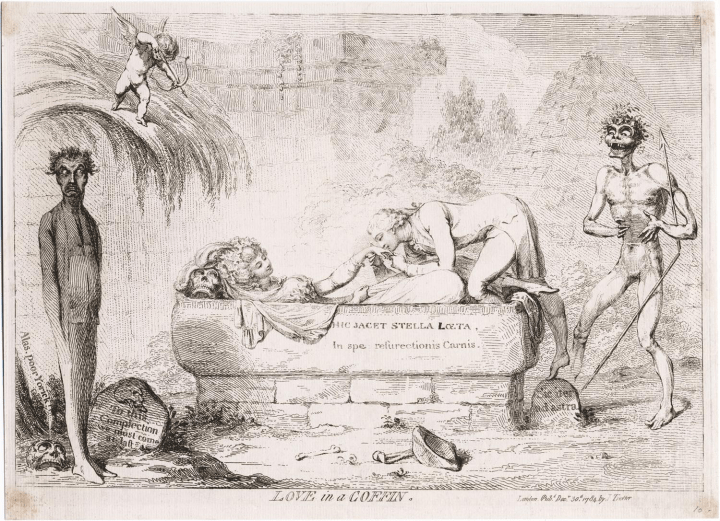
James Gillray, Love in a Coffin, 1784
(The Lewis Walpole Library)
◊ ◊ ◊ ◊ ◊
From the Mellon Centre:
Tim Clayton, Gillray in Grub Street: Some Episodes from the 1780s
Paul Mellon Centre for Studies in British Art, London, 22 May 2019
James Gillray is known for working with Hannah Humphrey from her shop in St James’s Street, but Hannah did not become his dominant publisher until 1791 and they did not move to St James’s Street until 1797. For the first thirteen years of his adult working life Gillray had a number of publishers and at times worked on the margins of what was legally acceptable. This paper addresses some of Gillray’s work during the 1780s with a view to introducing for discussion issues that have proved problematic in the consideration of graphic satire, including authorship and origination, size of editions and prices, and legal sanctions against caricatures. The evening begins with the presentation of the paper at 6:00, followed by discussion and then drinks and nibbles at 7:30.
Tim Clayton is an author and historian who has worked chiefly on print history and military history. His book The English Print 1688–1802 (1997) sought to trace the growth and themes of the London print trade in the eighteenth century; more recent work has concentrated on graphic satire and literary propaganda in Bonaparte and the British: Prints and Propaganda in the Age of Napoleon (2015) and This Dark Business: The Secret War against Napoleon (2018). He is currently working on a book provisionally entitled ‘James Gillray and the Business of Satire’.
Exhibition | Hogarth: Cruelty and Humor
Press release for the exhibition:
Hogarth: Cruelty and Humor
The Morgan Library & Museum, New York, 24 May — 22 September 2019
Curated by Jennifer Tonkovich
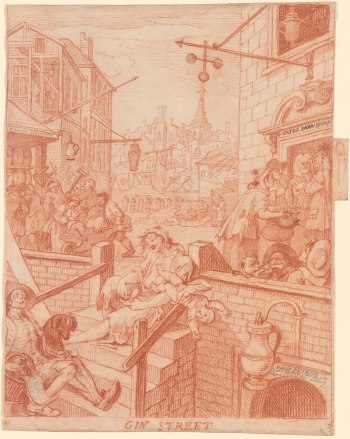
William Hogarth, Gin Street, 1750–51, red chalk, some graphite, on paper, incised with stylus (New York: The Morgan Library & Museum, purchased by Pierpont Morgan in 1909).
The Morgan Library & Museum announces a new exhibition of satirical drawings and prints by renowned artist William Hogarth (1697–1764). Best known for his humorous political commentary, Hogarth’s work engaged a broad audience and agitated for legislative and social change. His intricate drawings and richly anecdotal scenes depict the ills and injustices of eighteenth-century urban life, exploring the connections between violence, crime, alcohol abuse, and cruelty to animals. He hoped his graphic work would amuse, shock, and ultimately edify his audience. Hogarth: Cruelty and Humor tells the story of Hogarth’s iconic images and the social realities of life in Georgian London that inspired him to advocate for reform through popular works of art. It is the first show at the Morgan devoted to this artist, whose style was so influential in British art that the word ‘Hogarthian’ remains a recognizable way of describing works of satire.
Featuring over twenty works, the show investigates Hogarth’s creative process and examines his embrace of humor, highlighting the Morgan’s exceptional cache of preparatory drawings for his two most acclaimed print series from 1751: Beer Street and Gin Lane, and The Stages of Cruelty. Hogarth’s prints documenting the dangerous impact of the gin craze, Beer Street and Gin Lane, generated popular support for the 1751 Gin Act and other reform efforts, while the Stages of Cruelty reflects the growing anxiety about episodes of human brutality in London. Included in the show are the only other two known studies related to the Stages of Cruelty; these works reveal the complex generative process of the series. Also on view are drawings from The Royal Collection Trust that represent Hogarth’s first and last forays into satire.
Fiercely independent, Hogarth was driven to innovate in order to elevate the status of British art, creating new genres and modes of expression in his painting, printmaking, and drawing. His compositions are rich with narrative detail. It was his adoption of such ‘low’ subjects, no less than his use of humor, that led him to struggle to be taken seriously throughout his career.
“William Hogarth’s works should be enjoyed for their artistry, humor, and activism, and as such hold a special place in our drawings and prints collection,” said Colin B. Bailey, director of the museum. “The artist was a keen observer of his city, and his visual anecdotes were a brilliant means of communicating to a wider public.”
“Looking closely at Hogarth’s passion for socially relevant subjects reveals the challenges he faced in being known as a satirical artist,” said Jennifer Tonkovich, Eugene and Clare Thaw Curator of Drawings and Prints. “I think our current appetite for satire allows us to appreciate Hogarth’s tremendous intelligence and ambition in constructing narratives that he hoped would change the world around him.”
S E L E C T E D P R O G R A M M I N G
Laurel Peterson, Crafting Cruelty: Hogarth’s Innovative Drawing Methods
Tuesday, June 18, noon
William Hogarth achieved substantial artistic and commercial success in his lifetime, both as a printmaker and as a painter. Despite his enduring fame, Hogarth’s drawings are today little known and rarely studied. Laurel Peterson, Moore Curatorial Fellow in the Department of Drawings and Prints, will offer new insights into Hogarth’s practice as a draftsman, shedding light on the evolution of his drawing style and the role played by drawings in the development of his most iconic satirical prints. Co-sponsored by the Sir John Soane’s Museum Foundation.
Hogarth’s Gin Craze Festival
Friday, July 19, 6:00pm
Join us for an evening of revelry inspired by the Gin Craze of the 1750s! Enjoy gin-inspired bites and craft cocktails at Morgan Café and curatorial gallery talks at 6:00 and 7:30pm in the exhibition Hogarth: Cruelty and Humor. At 7:00pm we will screen the 1946 film Bedlam, which was inspired by William Hogarth’s A Rake’s Progress.
Bedlam, directed by Mark Robson (1946, 79 minutes)
Friday, July 19, 7:00pm
In 1760s London, an actress campaigns to reform a horrific hospital for the insane, but instead finds herself committed to the institution by the corrupt head of the asylum. Starring Boris Karloff and Anna Lee, Bedlam was the last in a series of stylish horror films produced by Val Lewton for RKO Radio Pictures.
Meredith Gamer, Hogarth: Cruelty and Crime
Thursday, 12 September, 6:30pm
Meredith Gamer, Assistant Professor of Art History at Columbia University, will explore the origins, evolution, and multi-layered meanings of William Hogarth’s The Four Stages of Cruelty (1751). A tale of neglect and abuse, murder and punishment, the series was—by eighteenth-century standards—one of Hogarth’s ‘lowest’ works. Paradoxically, however, it is also one of his most ambitious, for it aims to combat some of our most basic human frailties through the medium of art. Co-sponsored by the Sir John Soane’s Museum Foundation.
Lecture | Wolf Burchard on the Rothschild Savonneries
From Waddesdon Manor:
Wolf Burchard, The Rothschild Savonneries: An Encyclopaedia of French Royal Carpet Weaving
Spencer House, 27 St James’s Place, London, 13 May 2019
 Join Wolf Burchard for this Spencer House Lecture, The Rothschild Savonneries: An Encyclopaedia of French Royal Carpet Weaving. The Rothschild Collection at Waddesdon Manor comprises the largest and most comprehensive collection of Savonnerie carpets and upholstered furniture outside France. Dr Burchard will revisit the history of the Savonnerie manufactory for its beginnings under Henri IV and Louis XIII to the present day, focusing on its major commissions for the Louvre, Versailles, and Notre Dame. His talk will also examine the dispersal of many of these weavings after the French Revolution in 1789, both through sale and as diplomatic gifts, as well as the rising British and American taste for Savonnerie carpets beginning around 1900.
The lecture will take place on Monday, 13 May at 6.30pm (doors open at 6.00pm). It will be followed by drinks and an opportunity to look at the restored 18th-century State Rooms at Spencer House. Adult ticket price (£15) includes one complimentary drink.
Wolf Burchard is Associate Curator of European Sculpture and Decorative Arts at The Metropolitan Museum of Art, New York, formerly Furniture Research Curator at the National Trust. He is the author of The Sovereign Artist: Charles Le Brun and the Image of Louis XIV, which was partly funded by The Rothschild Foundation. Burchard has worked extensively on the Savonnerie manufactory and in 2012 published an update of Pierre Verlet’s catalogue of Louis XIV’s carpets for the Louvre’s Long Gallery, adding newly discovered carpets, carpet fragments, and designs.
Lectures | ‘Orientalism’ after 40, with Elisabeth Fraser and Mary Roberts
During the two-year, £50-million renovation of Somerset House, classes and lectures at The Courtauld are held at Vernon Square, near King’s Cross.
Orientalism after 40, with Elisabeth Fraser and Mary Roberts
The Courtauld Institute of Art, Vernon Square, London, 25 April 2019
This term’s Visiting Expert series is a joint collaboration with Professor Mary Roberts (University of Sydney) and Professor Elisabeth Fraser (University of South Florida). This series of events was curated by The Courtauld Institute of Art’s Dr Sussan Babaie. Whilst our Visiting Experts are here, we will reflect upon the 40th anniversary of the publication of Edward Said’s seminal text Orientalism on Thursday, 25 April, 6:00–7:00pm. The event consists of two separate lectures.
Elisabeth Fraser, The Ottoman Costume Album as Collaborative Object and Agent of Contact
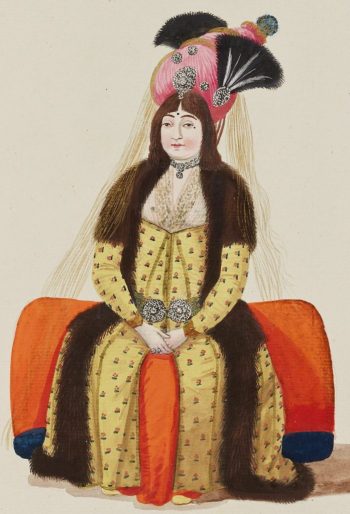 The Ottoman costume album served as a vital agent of contact in the early modern world. Conceived and collected through the movement of people, bound, rebound, sold, gifted, copied and reworked, Ottoman costume albums—produced from the sixteenth through nineteenth centuries—are mobile objects constituted by a flexibility that lends itself to reinvention and reconfiguration. The costume album transcended geographic points of origin, connecting artisans of the book and diverse audiences across time and space in unforeseeable ways. Composed of individual sheets, each bearing a single costumed figure representing variously the Ottoman court, military, professions, and civil society, a costume album was custom made and inflected according to the interests of the owner; the collector and professionals of the book trade determined sequence, thematic emphasis, presentation, and numbers of folios to include. The Ottoman costume album is defined by an essential mutability.
This talk will explore these ideas in relation to one particular eighteenth-century album, Costumes turcs, now in the British Museum, and its connection to a network of other albums and books. Containing 225 costume images painted in Istanbul in the 1780s, this magnificent album was transported to Berlin and then London; at each stop on its journey the album was added to, modified, and redefined. Following the trail of this object reveals the essentially collaborative nature of costume albums.
Elisabeth Fraser is Professor of Art History at the University of South Florida. A specialist of European art and interactions between European and Islamicate cultures, she is the author of Mediterranean Encounters: Artists between Europe and the Ottoman Empire, 1774–1839 and Delacroix, Art and Patrimony in Post-Revolutionary France. She has recently published an essay, “The Color of the Orient: On Ottoman Costume Albums, European Print Culture, and Cross-Cultural Exchange,” in Visual Typologies from the Early Modern to the Contemporary (T. Zanardi and L. Klich, eds., 2018), and edited a volume of essays The Mobility of People and Things in the Early Modern Mediterranean, which will be published by Routledge in 2019. A recipient of an International Scholarship from the Staatliche Museen in Berlin in 2018, she is writing a book on Ottoman costume albums and their relationship to European print culture, Dressing the Ottoman Empire: Early Modern Costume Albums and Transculturation.
Mary Roberts, Edward Said and the Epistolary Interior
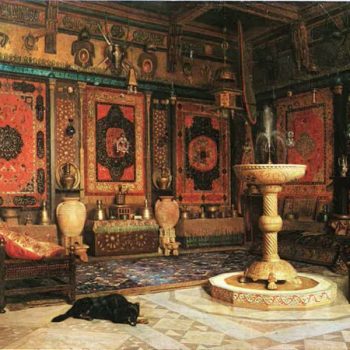 “to [some] theorists of civilization identity is a stable and undisturbed thing, like a room full of furniture at the back of your house. This is extremely far from the truth, not just in the Islamic world but throughout the entire surface of the globe.” –Edward Said, 1996
In histories of modernism the orientalist interior has been consigned like furniture at the back of the house. I resist this formulation by addressing the life of Islamic art as it moved into and out of these spaces. Commencing with Duranton’s painting of Albert Goupil’s Oriental Salon in Paris before the 1888 sale that catalysed movement of his Islamic art into collections across Europe, including the Louvre’s inaugural acquisitions. It is a foundational interior for the history of Islamic art. Goupil’s acquisition channels reveals this interior as the tip of an iceberg that exists in a set of linked relations with Ottoman and Orientalist interiors in Istanbul and Kraków with Polish artist Stanisław Chlebowski as the linchpin. The iceberg, with its north/south axis proves a limited geographic metaphor. It is tempting to construe these Islamic art supply lines through a network model, but that too fails to capture the way these interiors were imagined or lived. In letters to his family in Kraków, written inside the Ottoman Sultan’s Beaux-Arts Palace, Chlebowski articulated one interior within others. I propose that Chlebowski’s epistolary Ottoman and Orientalist interiors exist according to a logic of enfolding. It’s a model for construing the role of historic Islamic art in multiple modernities.
Mary Roberts is John Schaeffer Professor of Art History at the University of Sydney. She specialises in late Ottoman visual culture, British art, and the art of empire and has published extensively on the history of artistic exchanges between the Ottoman Empire and Europe. Her book Istanbul Exchanges: Ottomans, Orientalists and Nineteenth-Century Visual Culture, published by the University of California Press in 2015, was awarded the Art Association of Australia and New Zealand’s Book Prize in 2016 and translated into Turkish the same year. She is also the author of Intimate Outsiders: The Harem in Ottoman and Orientalist Art and Travel Literature (Duke, 2007) and four co-edited books. Mary has been a Getty Scholar, CASVA senior fellow, YCBA fellow, and Clark-Oakley fellow and is currently completing her next book Inside Networks: Orientalist Interiors and Islamic Art in Transit.
Mary Beard to Deliver Gifford Lectures, 2018–19
From The University of Edinburgh:
Mary Beard, The Ancient World and Us: From Fear and Loathing to Enlightenment and Ethics
Sypert Concert Room, St Cecilia’s Hall, The University of Edinburgh, May 2019
This lecture series explores why the classical world still matters and what ethical dilemmas the study of classics raises (and has always raised). Taking six particular themes, it hopes to shows how antiquity can continue to challenge the moral certainties of modernity. The lectures will be recorded and links will be posted in the respective pages of each lecture. All lectures begin at 5.30pm.
 1 Introduction: Murderous Games
Monday, 6 May
2 Whiteness
Tuesday, 7 May
3 Lucretia and the Politics of Sexual Violence
Thursday, 9 May
4 Us and Them
Monday, 27 May
5 Tyranny and Democracy
Tuesday, 28 May
6 Classical Civilisation?
Thursday, 30 May
Mary Beard is one of Britain’s best-known classicists, Professor at the University of Cambridge and Fellow of Newnham College. She has written numerous books on the ancient world including the Wolfson Prize-winning Pompeii: The Life of a Roman Town; has presented highly-acclaimed TV series, Meet the Romans and Rome: Empire without Limit; and is a regular broadcaster and media commentator. Mary is one of the presenters for the BBC’s recent landmark Civilisations series. Mary is also classics editor of the Times Literary Supplement and writes a thought-provoking blog, A Don’s Life. Made an OBE in 2013 for services to classical scholarship, her latest books include the critically-acclaimed SPQR: A History of Ancient Rome and thought-provoking Women & Power: A Manifesto. Most recently Mary was made a Dame in the Queen’s Birthday Honours list 2018.
The prestigious Gifford Lectureships were established by Adam Lord Gifford (1820–1887), a senator of the College of Justice in Scotland. The purpose of Lord Gifford’s bequest to the universities of Edinburgh, Glasgow, St. Andrews and Aberdeen was to sponsor lectures to “promote and diffuse the study of Natural Theology in the widest sense of the term—in other words, the knowledge of God.” Since the first lecture in 1888, Gifford Lecturers have been recognized as pre-eminent thinkers in their respective fields. Among the many gifted lecturers are Hannah Arendt, Noam Chomsky, Stanley Hauerwas, William James, Jean-Luc Marion, Iris Murdoch, Roger Scruton, Eleonore Stump, Charles Taylor, Alfred North Whitehead, and Rowan Williams.
Lecture | Marcia Reed, Engraving China’s Last Golden Age
From Eventbrite:
Engraving China’s Last Golden Age: Qianlong Emperor’s Copper Plates
John Rylands Library, Manchester, 16 May 2019
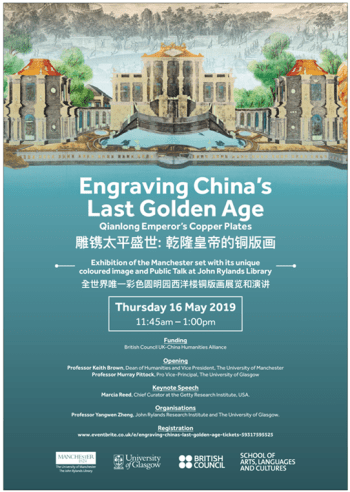 The recent discovery of a complete set of 圆明园西洋楼铜版画 (engravings of European Palaces in Yuan Ming Yuan) at the John Rylands Library, University of Manchester, and the presence of a complete set of 乾隆西征铜版画 (engravings of The Qianlong Emperor’s Western Campaigns) at the Hunterian Museum, University of Glasgow, makes Britain home to two of the most unusual and rare sets of engravings ever made. This is a most significant find, not just for Britain but also—and more importantly—for the study of 18th-century China, its engagement with Europe, and Anglo-Chinese relations in the 19th century and in the future. This discovery also presents challenges, as the two sets need considerable conservation and research.
This public event will digitally showcase some of the known complete sets, and—conservation work permitting—will also physically display the Manchester set, which uniquely contains a hand coloured plate.
Keynote: Marcia Reed (Chief Curator at the Getty Research Institute), followed by a Q&A discussion hosted by Professor Yangwen Zheng (University of Manchester). Thursday, 16 May 2019, 11:45am.
Lecture | Adrian Seville on Georgian Board Games
From the Society of Antiquaries of London:
Adrian Seville, The Shows and Sights of Georgian London: A Board Game Tour of the Metropolis
Society of Antiquaries of London, Burlington House, 7 May 2019
Printed board games—race games, played with dice or a teetotum and offering no choice of move—are a well-recognised feature of Victorian childhood. Yet similar games were also significant in late Georgian England. Of such games printed from 1790 to 1830, over 100 different examples have survived, covering a wide range of cultural themes. The presentation will highlight a group of these games, all with themes relevant to the shows and sights of Georgian London.
A short introduction will trace the history of spiral race games in England, beginning with John Wolfe’s registration of the Game of the Goose at Stationers’ Hall in 1596 up to the publication by John Wallis and Elizabeth Newbery of the New Game of Human Life in 1790, shamelessly copied from the French original, but with variations to suit the English market.
Of the games then to be presented in detail, the earliest is concerned with the first English pantomime, Harlequin and Mother Goose: or, The Golden Egg, first performed in 1806. The others, with dates from 1809 to 1825, each propose a ‘virtual’ sight-seeing tour of London. All these games present finely-detailed hand-coloured engravings of their shows and sights, the choice of subjects indicating the main public attractions of the time. Their rules often hint at how the various attractions were regarded in the affluent society in which these expensive games circulated. And several of the games have booklets giving detailed descriptions and observations, not commonly found elsewhere. Somteimes, as in the games published by the Dartons, a Quaker family, these booklets contain strongly-expressed moral views on such controversial matters as war, colonial exploitation, and wealth: all are the subject of polemics aimed at a junior audience.
This lecture will demonstrate how these simple games, played in the nursery or at the fireside, serve as mirrors of the real world outside, so contributing to the understanding of cultural history in late Georgian England.
Lecture | Robin Myers on Andrew and James Ducarel
From Eventbrite:
Robin Myers, Dr Andrew Ducarel, Lambeth Librarian 1757–85, Seen through His Brother’s Eyes
Lambeth Palace, London, 8 May 2019
 Andrew Ducarel (1713–1785), the eldest of three Huguenot brothers, was a successful ecclesiastical lawyer, Librarian at Lambeth, historian of the palaces of Lambeth and Croydon and of the architecture of Normandy. In Robin Myers’s new book The Two Brothers, it is Andrew’s younger brother James who takes centre stage, writing letters to Andrew in London about his life in France. Wednesday, 8 May 2019, 6pm (admittance not before 5.30pm). Guests should arrive via the main Gatehouse of Lambeth Palace. For any queries, please email melissa.harrison@churchofengland.org.
Robin Myers is a Past President of the Bibliographical Society and Archivist Emeritus of the Worshipful Company of Stationers. Her principal research interests are the history of the Company and its archive, on which she has published widely. She has also worked on Andrew Ducarel for more than twenty years. Her edition, with Gerard de Lisle, of Two Huguenot Brothers: Letters of Andrew and James Coltee Ducarel (1732–1773) has recently been published by Bernard Quaritch.
Lecture | Kevin Salatino, Chasing Casanova
Next month at BGC:
Kevin Salatino, Chasing Casanova: Venice and the Grand Tour
Bard Graduate Center, New York, 3 April 2019
Kevin Salatino will speak at the Seminar in Renaissance and Early Modern Material Culture on Wednesday, April 3, at 6pm. His talk is entitled “Chasing Casanova: Venice and the Grand Tour.”
The Grand Tour was both finishing school and rite of passage for the British (male) aristocrat. As Samuel Johnson noted, “a man who has not been in Italy, is always conscious of an inferiority.” While Rome was “the great object,” Venice was an essential stop on the way. The floating city’s wondrous novelty, its reputation for license and luxury, and its much-touted devotion to liberty were compelling attractions for the Grand Tourist. Famous for its courtesans, its masked revelers, its mystery and secrecy, its appeal inevitably swung toward the sensual and the sexual. This talk addresses the British Grand Tourist’s experience of eighteenth-century Venice in the context of the erotic, through a close examination of that city’s art, as well as texts and cultural artifacts from both sides, Venetian and British.
Kevin Salatino is Chair and Curator of Prints and Drawings at the Art Institute of Chicago. He was previously Director of the Art Collections at the Huntington Library, Art Collections, and Botanical Gardens, San Marino, California; Director of the Bowdoin College Museum of Art, Brunswick, Maine; Curator and Head of the Department of Prints and Drawings at the Los Angeles County Museum of Art; and Curator of Graphic Arts at the Getty Research Institute. Salatino holds a BA from Columbia University and a PhD from the University of Pennsylvania. Among his publications are Incendiary Art: The Representation of Fireworks in Early Modern Europe (a revised French edition of which was recently published); Edward Hopper’s Maine; and Blue Boy and Company: European Art at The Huntington. He has published on artists as diverse as Henry Fuseli, Jacques-Louis David, Francisco Goya, Richard Pousette-Dart, and James Ensor, and has lectured extensively on subjects ranging from fireworks to the Grand Tour. Most recently, he curated the Art Institute exhibitions, Shockingly Mad: Henry Fuseli and the Art of Drawing; Gods and Superheroes: Drawing in an Age of Revolution; and Into the Void: Prints of Lee Bontecou.










leave a comment