New Book | Fashion Prints in the Age of Louis XIV
From Texas Tech UP:
Kathryn Norberg and Sandra Rosenbaum, eds., Fashion Prints in the Age of Louis XIV: Interpreting the Art of Elegance (Lubbock: Texas Tech University Press, 2014), 320 pages, ISBN: 978-0896728578, $46.
 Between 1678 and 1710, Parisian presses printed hundreds of images of elegantly attired men and women dressed in the latest mode, and posed to display every detail of their clothing and accessories. Long used to illustrate dress of the period, these fashion prints have been taken at face value and used uncritically. Drawing on perspectives from art history, costume history, French literature, museum conservation and theatrical costuming, the essays in this volume explore what the prints represent and what they reveal about fashion and culture in the seventeenth century.
With more than one hundred illustrations, Fashion Prints in the Age of Louis XIV constitutes not only an innovative analysis of fashion engravings, but also one of the most comprehensive collections of seventeenth-century fashion images available in print.
Kathryn Norberg is a professor of history and gender studies at the University of California, Los Angeles. She has published on French history and is the coeditor of Furnishing the Eighteenth Century: What Furniture Can Tell Us about the European and American Past.
Sandra Rosenbaum is the retired curator-in-charge of the Doris Stein Research Center for Costume and Textiles, a part of the Department of Costume and Textiles, at the Los Angeles County Museum of Art, for which she developed and supervised an extensive library of primary and secondary source materials.
◊ ◊ ◊ ◊ ◊
C O N T E N T S
Illustrations
Acknowledgments
Introduction: Fashion and Fashion Prints in the Age of Louis XIV
Part One: The Fashion Print
1. The Fashion Print: An Ambiguous Object, Françoise Tétart-Vittu
2. Fashioning Fashionability, Kathleen Nicholson
3. The Cris de Paris in the LACMA Recueil des modes, Paula Rea Radisich
4. Fashions in Prints: Considering the Recueil des modes as an Album of Prints, Marcia Reed
Part Two: Contextualizing the Fashion Print
5. Fashion as Concept and Ethic in Seventeenth-Century France, William Ray
6. The Fashion Run Seen from Backstage: Saint-Simon’s Memoirs of Louis XIV’s Court, Malina Stefanovska
7. Louis XIV: King of Fashion?, Kathryn Norberg
8. Oriental Connections: Merchant Adventurers and the Transmission of Cultural Concepts, Mary Schoeser
Part Three: The Fashion Print as a Historical Resource
9. The LACMA Recueil des modes, Sandra L. Rosenbaum
10. Fashion Illustration from the Reign of Louis XIV: A Technical Study of the Paper and Colorants Used in the LACMA Recueil des modes, Soko Furuhata
11. Performing Fashion, Michael J. Hackett
12. Recreating an Entrée, a Minuet, and a Chaconne, Emma Lewis Thomas
13. Recreating a Grand Habit, Maxwell Barr
14. A Seventeenth-Century Gown Rediscovered: Work in Progress, Catherine McLean, Sandra L. Rosenbaum, and Susan Renate Schmalz
Selected Bibliography
Contributors
Index
Illustrations
New Book | Portraiture and Politics in Revolutionary France
From Penn State UP:
Amy Freund, Portraiture and Politics in Revolutionary France (University Park: The Pennsylvania State University Press, 2014), 312 pages, ISBN: 978-0271061948, $85.
 Portraiture and Politics in Revolutionary France challenges widely held assumptions about both the genre of portraiture and the political and cultural role of images in France at the beginning of the nineteenth century. After 1789, portraiture came to dominate French visual culture because it addressed the central challenge of the Revolution: how to turn subjects into citizens. Revolutionary portraits allowed sitters and artists to appropriate the means of representation, both aesthetic and political, and articulate new forms of selfhood and citizenship, often in astonishingly creative ways. The triumph of revolutionary portraiture also marks a turning point in the history of art, when seriousness of purpose and aesthetic ambition passed from the formulation of historical narratives to the depiction of contemporary individuals. This shift had major consequences for the course of modern art production and its engagement with the political and the contingent.
New Book | Looking Smart: Chardin’s Genre Subjects
From the University of Delaware Press:
Paula Radisich, Pastiche, Fashion, and Galanterie in Chardin’s Genre Subjects: Looking Smart (Newark: University of Delaware Press, 2013), 206 pages, ISBN: 978-1611494242, $75.
 Pastiche, Fashion, and Galanterie in Chardin’s Genre Subjects seeks to understand how Chardin’s genre subjects were composed and constructed to communicate certain things to the elites of Paris in the 1730s and 1740s. The book argues against the conventional view of Chardin as the transparent imitator of bourgeois life and values so ingrained in art history since the nineteenth century. Instead, it makes the case that these pictures were crafted to demonstrate the artist’s wit (esprit) and taste, traits linked to conventions of seventeenth-century galanterie.
Early eighteenth-century Moderns like Jean-Siméon Chardin (1699–1779) embraced an aesthetic grounded upon a notion of beauty that could not be put into words—the je ne sais quoi. Despite its vagueness, this model of beauty was drawn from the present, departed from standards of formal beauty, and could only be known through the critical exercise of taste. Though selecting subjects from the present appears to be a simple matter, it was complicated by the fact that the modernizers expressed themselves through the vehicles of older, established forms. In Chardin’s case, he usually adapted the forms of seventeenth-century Dutch and Flemish genre painting in his genre subjects. This gambit required an audience familiar enough with the conventions of Lowlands art to grasp the play involved in a knowing imitation, or pastiche. Chardin’s first group of enthusiasts accordingly were collectors who bought works of living French artists as well as Dutch and Flemish masters from the previous century, notably aristocratic connoisseurs like the chevalier Antoine de la Roque and Count Carl-Gustaf Tessin.
Paula Radisich is professor of art history at Whittier College.
Lecture | Kimberly Chrisman-Campbell on Bigwigs
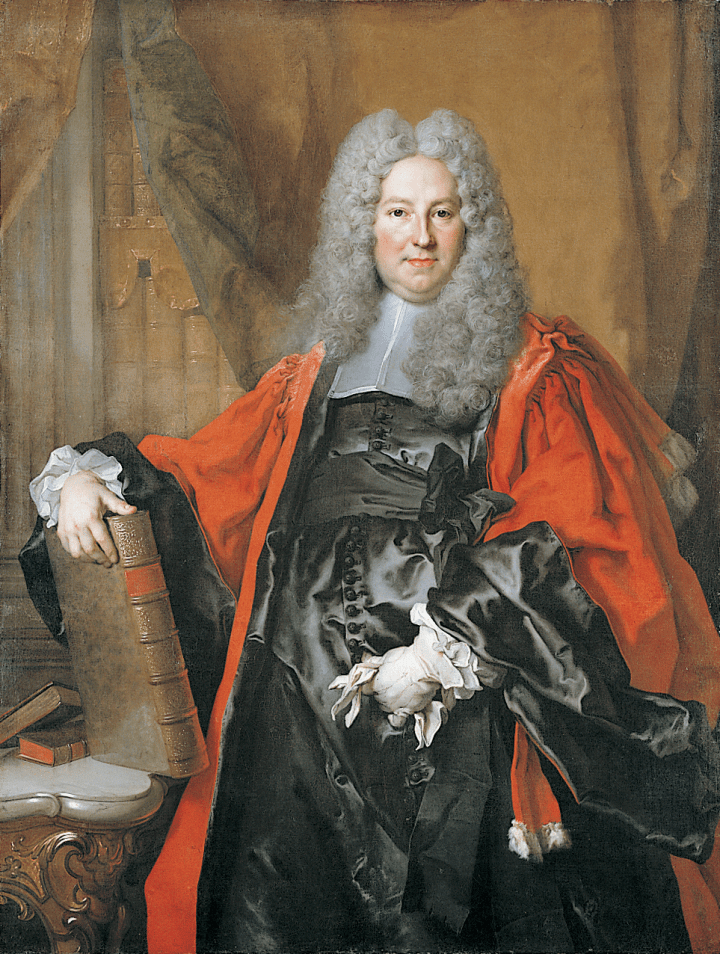
Nicolas de Largillière, Portrait of Barthélemy-Jean-Claude Pupil, 1729
(San Diego: Timken Museum)
◊ ◊ ◊ ◊ ◊
From the Timken:
Kimberly Chrisman-Campbell
Bigwigs: Hair, Fashion, and Power in the 18th-Century Portrait
Timken Museum of Art, San Diego, Monday, 10am, 9 June 2014
Lecture | Kimberly Chrisman-Campbell on the Art of Beauty
From the MIA:
Kimberly Chrisman-Campbell | The Art of Beauty
Minneapolis Institute of Arts, 8 March 2014

Naples, Box for toilet articles, ca. 1745
(Minneapolis Institute of Arts)
Kimberly Chrisman-Campbell reveals four centuries’ worth of beauty secrets using rare surviving toilette objects and images from the MIA and other collections. The tools of the toilette testify to changing tastes and lifestyles as the ostensibly private ritual of dressing has long been a public performance of consumption and display, chronicled in fashion plates, portraits, and caricatures.
Saturday, 8 March 2014 at 11:00am
Kimberly Chrisman-Campbell is an independent scholar and consultant for The Huntington Library Art Collections and Botanical Gardens, and Fashion Institute of Design and Merchandising, and has been a research scholar for the Los Angeles County Museum of Art.
Lecture | Diplomacy and Decoration in France and Siam
From The New School:
Meredith Martin | Mirror Reflections: Diplomacy and Decoration in France and Siam, 1680 / 1860s
Parsons The New School for Design, New York, 25 October 2013

◊ ◊ ◊ ◊ ◊
Friday October 25, 2013 at 6:15 PM
Glass Corner (Room E206), Parsons East Building
25 East 13th Street, 2nd Floor, NYC
This talk given by Meredith Martin, associate professor of Art History at New York University, explores the circulation, use, and interior display of images and art objects associated with diplomatic missions that traveled between France and Siam (Thailand) in the 1680s and 1860s. In analyzing these two different but related episodes of diplomatic and cross-cultural exchange, Martin will show how art and architectural display were crucial to articulating the political and commercial aims of each power as well as how those aims were interpreted by French and Siamese audiences.
Meredith Martin received her M.A. and Ph.D. from Harvard University and her B.A. from Princeton. She is the author of Dairy Queens: The Politics of Pastoral Architecture from Catherine de’ Medici to Marie-Antoinette (Harvard University Press, 2011), and a co-editor of Architectural Space in Eighteenth-Century Europe: Constructing Identities and Interiors (Ashgate, 2010). Martin has published numerous articles, essays, and reviews on 18th and 19th century French architectural history and decoration as well as contemporary art. Her current project focuses on art, diplomacy, and intercultural encounter in France from the reign of Louis XIV to the era of Napoleon.
INSIDE (hi) STORIES is a Histories & Theories series, curated by design historian Sarah Lichtman, assistant professor of Art and Design Studies in the School of Art and Design History and Theory, and architectural historian Ioanna Theocharopoulou, assistant professor of Interior Design in the School of Instructed Environments.
On Site | Bratislava, Slovakia
Eighteenth-Century Encounters: Bratislava, Slovakia
By Michael Yonan
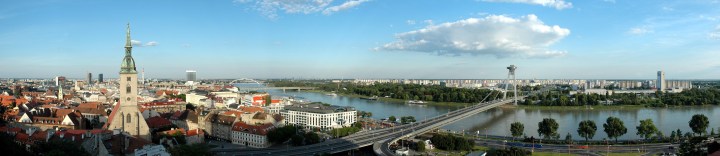
Panorama of Bratislava from the Castle
(Photo by Stano Novak, Wikimedia Commons, 2006)
◊ ◊ ◊ ◊ ◊
Bratislava? Is that in Russia?
It was a typical response to my telling friends that this year’s European peregrinations would take me to Vienna, Paris, and Bratislava. The first two need no introduction; Bratislava does. Despite being the capital and largest city of Slovakia and a cultural center in Central Europe, it is nowhere near as well known as Prague or Budapest, nearby cities with some shared history. Although Bratislava has developed in the two decades since Communism’s fall, it still feels somewhat neglected and lags behind its peers. And yet therein lies Bratislava’s considerable charm. During my week there, I was repeatedly impressed by the beauty of the old city and its many attractions for specialists of eighteenth-century art. I left convinced that it is the forgotten gem among European capitals.
 Today Bratislava is a Slovak city with an appropriately Slavic name. Its cultural history, however, is extraordinarily complex even for this region, and the city displays significant influence from its Czech, Austrian, and Hungarian neighbors. For much of its history, it was known principally by its German name, Pressburg, and it has been home to a sizeable German-speaking minority for centuries. A resident from 1777 to 1783, Franz Xaver Messerschmidt produced many of his ‘Character Heads’ while living there. Under Habsburg leadership, Bratislava was the administrative capital of Hungary, and major Hungarian noble clans – including the Esterházy, Pálffy, and the Erdődy families – built grandiose palaces. Maria Theresa was crowned King of Hungary there (that’s not a misprint: it was King of Hungary), afterward riding on horseback to a nearby hill, where with sword held aloft, she swore to defend the Hungarians against military invasion. She also renovated the local castle with rococo apartments, the most important eighteenth-century Habsburg decorative project outside of Austria. Unfortunately, the apartments burned in a fire at the castle in 1811; we know their appearance today from preparatory drawings. Unlike Budapest, which has a distinctly nineteenth-century look, central Bratislava feels firmly entrenched in earlier eras. Its winding streets, plentiful palaces, church after ornately-adorned church, and mysterious alleyways and staircases provide precisely the historical ambience many of us relish in Europe.
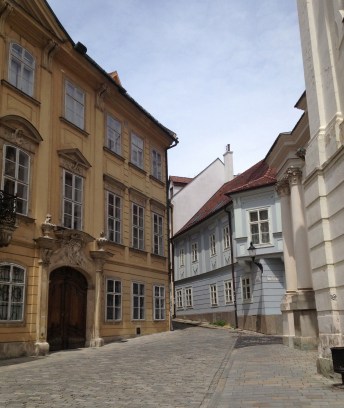
Mirbach Palace, Bratislava
As an example of its eighteenth-century architecture, there is the beautiful Mirbach Palace, located in the city center at Františkánske námestie 11. Its current name comes from a twentieth-century owner, but the building dates from 1768–1770, when the prosperous local brewer Michal Spech built for his family an impressive palatial residence that easily competes with the noble architecture nearby. The architect’s identity is unknown. What I love about this building is the beautiful rococo ornamentation incorporated onto its façade. These forms are lifted directly from prints, particularly by Cuvilliés, but they have a prominence here not always seen on eighteenth-century façades. And, interestingly, the rococo forms are kept rather abstract, with no special iconographical additions that would alert passersby to the inhabitants’ business or pedigree. Its beauty is all the more evocative by being located on a narrow cobblestoned street, a typical streetscape of central Bratislava.

Detail from Mirbach Palace, Bratislava
Inside the Mirbach Palace is the Bratislava City Art Museum, which holds a sizeable collection and mounts rotating exhibitions. Not far away is the Slovak National Gallery, Slovakia’s most important art institution. Here one can enjoy a comprehensive collection of eighteenth-century works by artists including Franz Palko, Franz Anton Maulbertsch, and Johann Michael Rottmayr.
While I’m plugging Bratislava, let me add in closing that the Slovaks give the Czechs some serious competition in the realm of beer (as explored by Mark Pickering earlier this year for The Guardian). With brewing skills of this caliber, it’s no surprise that Michal Spech could afford to build a gorgeous rococo abode.
All photos except the first, panoramic view are by the author.
Call for Papers | ASECS 2014 in Williamsburg
2014 American Society for Eighteenth-Century Studies Conference
Williamsburg, 20–22 March 2014
Proposals due by 15 September 2013
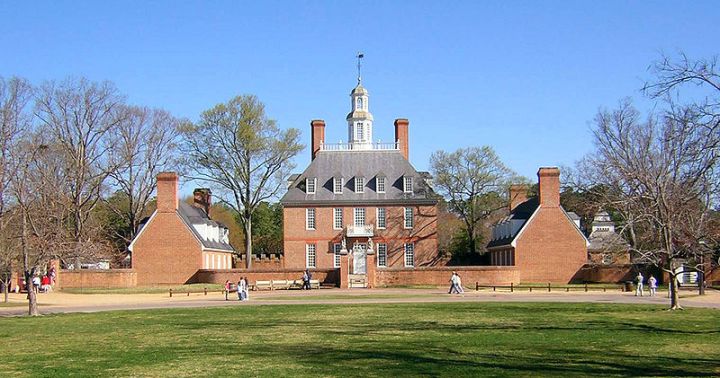
Governor’s Palace in Williamsburg, Virginia. The original structure was built between
1710 and 1722, with further additions made in the 1750s. Fire destroyed the
main house in 1781. The present building was constructed in the early 1930s.
Photo by Larry Pieniazek, 2006, from Wikimedia Commons.
◊ ◊ ◊ ◊ ◊
The 2014 ASECS conference takes place in Williamsburg, 20–22 March. Along with our annual luncheon and business meeting, HECAA will be represented by two panels chaired by Denise Baxter and Amy Freund and Jessica Fripp. In addition to these, a wide selection of sessions that might be relevant for HECAA members are also included below. A full list of panels (68 pages’ worth!) is available as a PDF file here.
◊ ◊ ◊ ◊ ◊
Anne Schroder New Scholar’s Session (Historians of Eighteenth-Century Art and Architecture)
Denise Amy Baxter, 1304 Edgewood Court, Carrollton, TX 75007; denise.baxter@unt.edu
Named in honor of the late Anne Schroder, this seminar will feature outstanding new research by emerging scholars.
◊ ◊ ◊ ◊ ◊
Selfhood and Visual Representation in the Eighteenth Century (Historians of Eighteenth-Century Art and Architecture)
Amy Freund, Texas Christian U. and Jessica Fripp, Parsons The New School for Design; a.freund@tcu.edu and frippj@newschool.edu
This panel will consider the relationship between the visual arts and new ideas of selfhood in the eighteenth century. Enlightenment-era debates about the nature of the self had profound effects on how people imagined the individual’s place in society, how gender, age, and racial difference were framed, how science and medicine conceived of the mind and body, and how emotions such as love and friendship were understood and expressed. Some scholars have approached the question of the eighteenth-century self in terms of the rise of possessive individualism, of secularization, and of consumer culture; others have pointed to the persistence and transformation of traditional hierarchies, of collective identities, and of mysticism and the irrational. We are seeking papers that examine the visual representation of the eighteenth-century self, both in portraiture and in other genres and modes, including (but not limited to) genre and history painting, architecture and the decorative arts, dress, and material culture. We encourage proposals that deal with the eighteenth-century self in Asia, Africa, and the Americas, and with the transformation (or inapplicability) of Enlightenment ideas outside of Europe. (more…)
2012 Dissertation Listings
From caa.reviews:
Dissertation Listings
PhD dissertation authors and titles in art history and visual studies from US and Canadian institutions are published each year in caa.reviews. Titles can be browsed by subject category or year.
Titles are submitted once a year by each institution granting the PhD in art history and/or visual studies. Submissions are not accepted from individuals, who should contact their department chair or secretary for more information. Department chairs: please consult our dissertation submission guidelines for instructions. The annual deadline is January 15 for titles from the preceding year.
In 2003, CAA revised the subject area categories of art history and visual studies used for all our listings, including dissertations. These categories are listed in the Dissertation Submission Guidelines.
◊ ◊ ◊ ◊ ◊
The index for 2012 lists nine eighteenth-century dissertations completed, including:
• Currie, Christopher, “Art, Illusion, and Social Mobility in Eighteenth-Century France: Hyacinthe Rigaud and the Making of the Marquis de Gueidan” (UNC Chapel Hill, M. Sheriff)
• Ferng, Jennifer, “Nature’s Objects: Geology, Aesthetics, and the Understanding of Materiality in Eighteenth-Century Britain and France” (MIT, M. Jarzombek)
• Fripp, Jessica, “Portraits of Artists and the Social Commerce of Friendship in Eighteenth-Century France” (Michigan, S. Siegfried)
• Medakovich, Molly A., “Between Friends: Representations of Female Sociability in French Genre Painting, 1770–1830” (UNC Chapel Hill, M. Sheriff)
• Riggs, Marion, “Architectural Translations: Giuseppe Barberi (1746–1809) between Rome and Paris” (Princeton, J. Pinto)
and forty dissertations in progress, including:
• Beachdel, Thomas, “Landscape Aesthetics and the Sublime in France, 1750–1815” (CUNY, P. Mainardi)
• Bell, Andrea, “French Artist in Rome: An Examination of Eighteenth-Century Drawing Albums” (IFA/NYU, T. Crow)
• Chadwick, Esther, “The Radical Print: Experiments in Liberty, 1760–1830” (Yale, T. Barringer)
• Charuhas, Christina, “Constructing Eighteenth-Century Bermuda: Utopia in the Transatlantic Imagination” (Columbia, E. Hutchinson)
• Contogouris, Ersy, “Of Marble and Flesh: The Attitudes and Representations of Emma Hamilton” (Université de Montréal, T. Porterfield)
• Cox, Alison, “Images of Mourning and Melancholia in France, 1780–1830” (UNC Chapel Hill, M. Sheriff)
• Crawford, Katelyn D., “Transient Painters, Traveling Canvases: Portraiture and Mobility in the British Atlantic, 1750–1780” (Virginia, M. McInnis)
• Fox, Abram, “The Great House of Benjamin West: Family, Workshop, and National Identity in Late Georgian England” (Maryland, College Park, W. Pressly)
• Girard, Catherine, “Hallali! Hunting and the Violence of French Rococo Art, 1699–1755” (Harvard, E. Lajer-Burcharth)
• Gohmann, Joanna M., “Living Together: People and Their Animals in Eighteenth-Century French Art, 1700–1789” (UNC Chapel Hill, M. Sheriff)
• Knowles, Marika, “Pierrot’s Costume: Theater, Curiosity, and the Subject of Art in France, 1665–1860” (Yale, C. Armstrong)
• Laux, Barbara M., “Claude III Audran, Modern Ornemaniste of the Rococo Style” (CUNY, J. Sund)
• Lenhard, Danielle, “Reading with One Hand: Suggestive Folds and Subversive Consumption in Jean-Honore Fragonard’s ‘The Bolt’” (Stony Brook University, J. Monteyne)
• Logie, Rose, “The Self-Conscious Artist: The Strange Formality of Watteau’s Oeuvre” (Toronto, P. Sohm)
• Oliver, Elizabeth Lee, “Mercantile Aesthetics: Art, Science, and Diplomacy in French India (1664–1757)” (Northwestern, S. H. Clayson)
• Sezer, Yavuz, “The Eighteenth-Century Ottoman Library Movement: Architecture, Reading, and the Politics of Knowledge” (MIT, N. Rabbat)
• Smith, Hilary Coe, “The Role of the Auction Catalogue in the Growth of the Parisian Art Market, 1675–1789” (Duke, H. Van Miegroet)
• You, Ji Eun: “The Afterlife of Luxury: the Material Culture of Interior Furnishing during the French Revolution 1789-1795” (UNC Chapel Hill, M. Sheriff) [not included in the 2012 list at caa.reviews, this entry serves as a useful reminder that the list should not be understood to be comprehensive]
• Veen, Kasie, “The Spectacle of New Ruins in Britain and France, 1760–1840: Landscape Gardens and the Diorama” (UT Austin, M. Charlesworth)
• Viggiani, Daniela, “L’édition de L’Abecedario Pittorico de Pietro Maria Guarienti (1678–1753), une source pour l’histoire de l’art portugais” (Université de Montréal, L. De Moura Sobral)
• Wile, Aaron, “Charles de La Fosse and His Generation: Painting, Authority, and Experience at the Twilight of the Grand Siècle, 1680–1715” (Harvard, E. Lajer-Burcharth, H. Zerner)
Reviewed | Extravagant Inventions
Recently added to caa.reviews:
Wolfram Koeppe, Extravagant Inventions: The Princely Furniture of the Roentgens (New York: Metropolitan Museum of Art, 2012), 304 pages, ISBN: 978-0300185027, $75.
Reviewed by Michael Yonan; Department of Art History & Archaeology, University of Missouri; posted 6 June 2013.
Once in a while an exhibition comes along that achieves many things. It illuminates past and present, and does so by creating a viewing experience both beautiful and instructive. All the better when such an exhibition also brightens up a blind spot in the history of art. The exhibition at the Metropolitan Museum of Art entitled ‘Extravagant Inventions: The Princely Furniture of the Roentgens’ achieved this. Curated by Wolfram Koeppe, Maria Kellen French Curator of European Decorative Arts, the show was a monographic investigation of father-and-son furniture makers Abraham (1711–1793) and David Roentgen (1743–1807), whose workshop in the German town of Neuwied produced furniture for the European elite between 1743 and 1800. By my estimation this was the decorative arts show of the decade, an educationally illuminating and utterly enjoyable museum experience whose rewards far
exceeded, in the words of a colleague of mine, the
opportunity to look at ‘old desks’. . . .
The full review is available here» (CAA membership required)










 Enfilade
leave a comment