New Exhibition | Governing the Nation from Fraunces Tavern, 1785–88
From the press release from the Fraunces Tavern Museum:
Governing the Nation from Fraunces Tavern, 1785–88
Fraunces Tavern Museum, New York, opening 22 June 2022
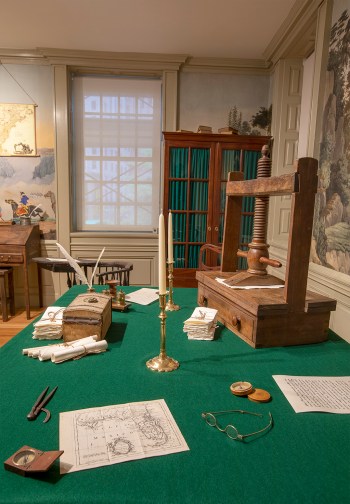
View of the negotiation table inside the Department of Foreign Affairs at Fraunces Tavern with map of east and west Florida in the foreground. Photo: Courtesy of Fraunces Tavern® Museum.
While Fraunces Tavern in New York City is one of the 18th century’s best-known taverns and the site of General George Washington’s famous farewell to his officers at the end of the American Revolution, it is less known that in the late 1700s, the site at 54 Pearl Street in lower Manhattan was also home to the nation’s first executive governmental building that housed three offices of the Confederation Congress. (Although Congress met in City Hall, the space was too small for the government’s departments and other office space had to be leased.) In 1785, the Department of Foreign Affairs, Department of War and offices of the Board of Treasury leased space at the Tavern and remained tenants there until 1788. Thanks to an extraordinary document—a cashbook that detailed the purchases for the Department of Foreign Affairs during its time at the Tavern that is now housed at the National Archives—the Department’s office will be recreated in a new permanent exhibition, Governing the Nation from Fraunces Tavern, set to open on June 22, 2022. Featuring approximately 60 objects, most of which are authentic to the period and many of which have never before been on public display, including tables, chairs, desks, maps, newspapers and other items, visitors will have the opportunity to travel back to post-colonial New York City and enter the Department of Foreign Affairs office as it appeared during a fascinating period in the nation’s history when John Jay was the first Secretary of Foreign Affairs. Visitors will learn about the diplomatic, military and financial challenges that all three departments faced after the Revolutionary War and how those challenges affected the formation of the U.S. Constitution.
“We are in the unique position of having access to a rare, surviving cashbook from the Department of Foreign Affairs,” explains Craig Hamilton Weaver, co-chairman of the Museum and Art Committee at Fraunces Tavern Museum. “We diligently researched each object in the cashbook and acquired authentic items to create an accurate setting that allows the visitor to step back into history. This is indeed a magnificent gift to the nation.”
 After an exhaustive search to locate objects that would have been found in the original office, visitors will not only see an extraordinary assemblage of fine American and British decorative arts, many pieces of which have been donated from private collections, but they will also gain insights into an often-overlooked period in American history. Objects such as A New and Accurate Map of East and West Florida Drawn from the best Authorities, a circa 1700s map engraved by J. Prockter, London, highlighting Spanish-controlled West Florida; a rare copy of the French-language newspaper Courier de L’Europe published in London on 29 September 1786, reporting on America’s diplomatic activities with Prussia and Spain; and an array of directional and mapping compasses will help to illustrate the Department’s first two pressing matters. The Barbary Pirate Crisis, which led to the 1787 diplomatic treaty with Morocco to end pirate seizures of American vessels in the Mediterranean Sea, and negotiations with Spain regarding control of the Mississippi River will be examined in the exhibition to offer visitors insights into what it took to form a new government as well as a deep appreciation for those individuals who rose to the challenge to do so.
“We want visitors to have an immersive experience,” said Scott Dwyer, director of Fraunces Tavern Museum. “The exhibition room was designed and will be arranged to give the sense that John Jay, his under secretary, diplomats, translators, clerks and messengers might enter and resume work at any moment.”
Additionally, the office’s furnishings will illuminate the socioeconomic stratification of the staff who worked in the room. From Henry Remsen, Jr., Jay’s undersecretary for foreign affairs, to the two clerks, a part-time French translator and a messenger, the hierarchy of those employed there will be clearly seen through the caliber of each staffer’s work space in his desk, chair and even desk set; the seniority of the employee’s position correlated to the finery of his work area and accoutrements. For example, Under Secretary Remsen’s desk has a full writing set made of late 18th-century fused Sheffield plate while the clerk’s desk has a pewter inkstand and the messenger’s station has a simple stoneware inkwell. The under secretary’s desk also features examples of Chinese porcelain that would have come to New York aboard the Empress of China, the first American ship to trade with China. The ship returned to New York Harbor and distributed its cargo for local merchants the same year the Department of Foreign Affairs office opened at Fraunces Tavern. Aboard was Samuel Shaw, who would become America’s first Consul to Canton (now Guangzhou), China.

Tea Table, New York, 1770–85, mahogany (New York: Fraunces Tavern Museum, 2022.01.007, gift of Craig Hamilton Weaver; photo by John Bigelow Taylor).
Assembling as many New York- or mid-Atlantic-made furnishings as possible to be seen in Governing the Nation from Fraunces Tavern was another goal in organizing the exhibition to ensure that the room would be authentic to what would likely have been in the original space. One example to be seen at the messenger’s station is a circa 18th-century, brace-back Windsor chair made by Walter MacBride, who worked at 63 Pearl Street in the vicinity of the Tavern. Another such object is a circa 1770–85, mahogany tilt-top tea table, which was likely made in the vicinity of lower Manhattan where many furniture makers were known to have worked at the time. The table features details characteristic of New York style, such as a flat top (rather than the dish top that was popular in other regions), a vase-form pedestal with a cup and square, webbed feet, all of which are typical of New York-made furniture. Although made later than the time period for the office (circa early 19th century), a pair of brass andirons with the rare mark of New York City craftsman David Phillips is included in the exhibition to exemplify other common, locally produced objects during that period. Phillips may have been working earlier as an apprentice near the neighboring South Street Seaport. In a small yet authentic homage to the important document that guided the reconstruction of the office, a leather-bound account book with entries dating from 1765 at the Garret Abel Company of South Street in lower Manhattan, will be seen placed on the clerk’s desk, representing the Foreign Affairs cashbook that informed the object selection for the exhibition. In addition, a facsimile of a page from the actual Foreign Affairs cashbook from 1785 will hang on the wall near the visitor area.
Other featured objects in the exhibition include the negotiation table, made in New York of mahogany and pine in the Chippendale style, circa 1780. The table has carved knees and claw-and-ball legs and is composed of three heavy, solid boards. The strongly carved, original legs have fully developed shells and robust feet. Placed centrally in the room, this is where much of the official business would have been conducted, maps examined and debate likely to have occurred. Another highlight of Governing the Nation from Fraunces Tavern will be found hanging above the clerk’s desk: British engineer Bernard Ratzer’s engraved map, Plan of the City of New York in North America, published in 1776 by Jeffreys & Faden, London, commonly referred to as the ‘Ratzer Map’. One of the best depictions of the city before the Revolutionary War, it was originally issued in 1770 and was heavily influenced by a 1767 map of New York by British engineer John Montresor. The map offers a bird’s-eye view of lower Manhattan Island, eastern New Jersey, and western Brooklyn and includes the city’s important landmarks, many of which are listed in the legend or key. Additionally, an excellent example of a late-18th-century book press with the rare feature of a built-in drawer will also be seen in the office. Such pieces of equipment were used to copy the multitude of correspondence and documents generated by the office.
Governing the Nation from Fraunces Tavern is made possible through a major gift from Stanley and Elizabeth Scott who are longtime supporters of the Museum.
Fraunces Tavern Museum’s mission is to preserve and interpret the history of the American Revolutionary era through public education. This mission is fulfilled through the interpretation and preservation of the Museum’s collections, landmarked buildings, and varied public programs that serve the community. Visit the rooms where General George Washington said farewell to his officers and where John Jay negotiated treaties with foreign nations. Explore six additional galleries focusing on America’s War for Independence and the preservation of early American history.
Versailles Acquires Portrait of Catherine Duchemin
Press release from château de Versailles, via Art Daily (28 May 2022). . .

Unidentified artist, Portrait of Catherine Duchemin, oil on canvas (Palace of Versailles Dist RMN, C. Fouin).
The Palace of Versailles has just acquired an oil on canvas painting of Catherine Duchemin (1630–1698, the first woman to be admitted as a painter to France’s Académie Royale de Peinture et de Sculpture (Royal Academy of Painting and Sculpture) in 1663. Acquiring this rare painting serves to further enrich Versailles’ collection of Académie artists’ portraits, which until now has featured men exclusively.
Catherine Duchemin was one of the rare few female painters working in 17th-century France and known to us today. She stands out from her fellow female artists in her achievement in being the first woman admitted to the Académie Royale de Peinture et de Sculpture on 14 April 1663 upon presenting a painting of flowers that prompted the academy to feel it was a “duty” and an “honour,” “in accordance with the King’s wishes […] to spread her grace among all those who excel in the arts of painting and sculpture […] without regard to differences between the sexes.”
Catherine Duchemin was born in 1630, the daughter of a Parisian painter and decorator who may well have taught her the basics of painting. At the age of 27 in 1657, she married the sculptor François Girardon. Despite a number of pioneering examples at the time, female artists were relatively rare in those days: it would take a further generation for their artistic careers to flourish in Paris. This first admission of a woman to the Académie was of paramount importance, serving as an event that would prompt change beyond Catherine Duchemin’s own life, as others followed in her footsteps up until the early 18th century.
The model’s steady gaze meets the viewer’s eyes as she readies herself to begin painting a bouquet of double-flowered anemones and poppies in a vase. The format of the canvas, the opulence of the armchair, and the elegance of the colourful, black ribbon-embellished clothing are all highly ambitious.
Although the painting is unsigned, cross-referencing it with portraits from the Palace of Versailles’ collection and notably those produced by Académie members may allow for this remarkably well-executed piece to be attributed to a named artist. Catherine Duchemin may have painted the floral composition herself, which would make this portrait the only remaining example of her work. Indeed, the artist “excelled at painting flowers” to the extent that “so real were they, you might almost smell them,” according to her first biographer, Florent Le Comte. The three flowers—one budding, the other in full bloom, and the third a poppy used to symbolise slumber—may be read as an allegory for life.
Once it has been restored, this portrait will fit seamlessly in with the exceptional collection of Académie member portraits that now hang in the Louis XIV rooms. These 17th-century artworks are invaluable testimonies to how the Académie Royale de Peinture et de Sculpture would once have worked: a key component in Louis XIV’s arts promotion policy.
Sweden Nationalmuseum Acquires Four Figurative Table Clocks
Press release (5 May 2022) from Sweden’s Nationalmuseum in Stockholm:

Antoine-André Ravrio, Table Clock with Allegory of the Poet’s Art, ca.1810, gilt and patinated bronze, griotte d’Italie marble (Stockholm: Nationalmuseum, photo by Viktor Fordell).
Nationalmuseum has recently acquired several significant French figurative table clocks dating from the early 19th century. These were an obligatory feature of the interior decoration style that developed during the Empire period, adorning many a mantelpiece and console table. Their primary function was not timekeeping, but rather to serve as covert but elegant propaganda for the French Empire and, later, for the restored Bourbon monarchy. They are described as figurative because the clock forms part of an ensemble including sculptures and decorative elements in gilt bronze.
A taste for bronze ostentation of this kind, which first developed in Paris in the second half of the 18th century, flourished in the Empire period. The luxury goods industry employed over 10,000 people in the French capital. For Napoleon, this was a source of pride for France, demonstrating its superiority to other European nations. But the emperor’s ambitions were equally motivated by economic gain: “Every time you beautify a palace, you should consider how this can benefit the arts and manufacturing.” The year after making this pronouncement, Napoleon launched the Continental Blockade. Although Britain was the target of this trade embargo, the French luxury goods industry was severely affected, and costly state subsidies were needed to prevent the Parisian bronze manufacturers from going out of business.
Prominent manufacturers included Antoine-André Ravrio (1759–1814), one of the bronze founders who had started out before the French Revolution of 1789. Despite difficulties during the revolution, he soon established a successful bronze foundry, specialising in gilt bronze. His table clocks often formed part of a set with other components such as candelabras, urns and perfume burners. The interior decoration style of the time prized the mass effect of brilliant metal artefacts placed in close proximity.
One of Nationalmuseum’s new acquisitions, Table Clock with Allegory of the Poet’s Art, dating from around 1810, is a product of Ravrio’s firm. It is made of gilt and patinated bronze, with a base of red griotte d’Italie marble. The clock features the well-known ancient Greek bust of Homer incorporated into a narrative tableau along with the Roman poet Virgil.
Ravrio often took inspiration from the classical world for both form and subject matter, but in other cases ancient Rome merely served as a disguise for the contemporary world. The anonymous maker of the table clock depicting Caesar made no attempt to conceal the fact that the figure was more like Napoleon than Caesar. Despite the 1814 regime change, table clocks of this kind seem to have been so popular that they remained in production, albeit with the eagles removed and replaced with a wreath of stars, as in this case.
In other cases, the figure of the emperor was simply switched out for the new regime’s mascot, King Henri IV of the House of Bourbon. In troubadour-style painting and the decorative arts, Henri was a popular figure, symbolising a return to the ‘good old days’.
The last of the figurative table clocks portrays another misfortune that befell the House of Bourbon. It features a tableau of Carolina, Duchess of Berry, with her newborn son Henri, Duke of Bordeaux, and her daughter Louise, saying their evening prayers. Atop the clock sits a weeping putto, reminding us of the absent father, the Duke of Berry, who was murdered seven months before his son’s birth. The infant duke, better known as the Count of Chambord, was a pretender to the French throne until his death in 1883. The clock was made by Jean-André Reiche (1752–1817), originally from Leipzig, who opened a bronze foundry in Paris in 1785.
“By acquiring these four superb figurative table clocks, all of which are outstanding examples of the French Empire style of interior decoration, we have significantly enhanced the museum’s collection of a genre that straddles the boundaries between sculpture and applied art, between art and politics,” said Magnus Olausson, head of collections at Nationalmuseum.
The newly acquired mantel clocks are on view in one of the galleries of 19th-century art at Nationalmuseum.
Sneak Preview | Seven Works from the Van Caloen Collection
On view this week in Bruges:
Seven Works from the Van Caloen Collection
Groeninge Museum, Bruges, 17–22 May 2022

François Boucher, Young Woman with a Lace Cap, 24 × 18 cm (Musea Brugge, 2022.GRO0326.II).
On 17 May, the Jean van Caloen Foundation transferred the administration of 1,920 drawing masterpieces and 25 sketchbooks by world famous artists like Michelangelo, Jordaens, and Boucher to the Bruges Print Room. To celebrate this exceptional transfer, we are exhibiting seven top works from the collection during an exclusive sneak preview in the Groeninge Museum together with the Caloen Foundation.
Discover The Priest’s Blessing by Jacques Jordaens and a fine depiction of a young woman by the French master François Boucher. The highlight of the collection is the magnificent Stoning of St. Stephen by Michelangelo Buonarotti. The only drawing of the celebrated Italian Renaissance artist currently held in Belgium, it is a remarkable piece, not least because it is a composition study: a drawing in which Michelangelo set down some of his ideas on paper. Drawings of this kind were used by artists as preparatory sketches for larger final works, such as paintings or sculptures.
The works will be on display from 17 to 22 May, after which they will be given a place with all the collection’s other works in the Bruges Print Room. Once there, they will be registered and digitalized in high resolution, before being made freely available to the public via Musea Brugge’s digital collection database. We will also thoroughly investigate and study the drawings. This research will result in the publication of a scientific catalogue for the collection and an exhibition of works from the collection in the new exhibition space at BRUSK.
At Auction | Chardin’s Basket of Wild Strawberries
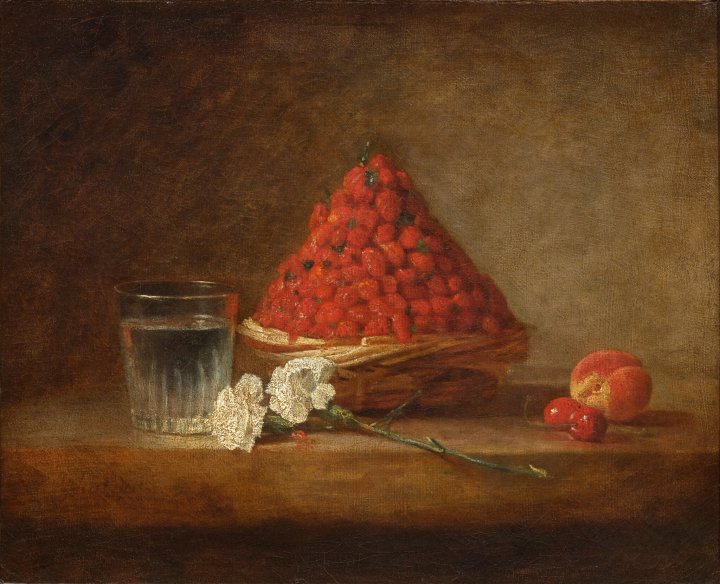
Jean-Siméon Chardin, The Basket of Wild Strawberries, shown at the Salon of 1761, oil on canvas, 38 × 46cm. The painting sold for €24,381,400 on 23 March 2022 at Artcurial in Paris. More information is available here.
◊ ◊ ◊ ◊ ◊
From The New York Times and Art Daily:
Laura Zornosa, “Louvre Bids to Keep a Chardin Bought by U.S. Museum in France,” The New York Times (4 May 2022). The Kimbell Art Museum in Texas is revealed to be the buyer of “Basket of Wild Strawberries,” at auction. The Louvre has been working to name it a national treasure.
On a computer screen, the still life Basket of Wild Strawberries by the 18th-century French painter Jean Siméon Chardin is quiet and unassuming. His talent in capturing the reflection of light off the rim of a water glass is muted in that setting. In person, though, it casts a spell.
“It’s deceptively simple, and it’s absolutely captivating and it’s magical,” said Eric Lee, the director of the Kimbell Art Museum, which bought the work at auction in France in March for more than $22 million. “The painting completely mesmerized me, and it mesmerizes almost anyone who sees it.”
But now the Kimbell, whose successful bid for the work was first reported by the Art Newspaper of France, has to wait to see whether it can actually export the picture, which it purchased at the auction house Artcurial in Paris.
The Louvre has requested that the artwork be classified as “a national treasure” and is looking for sponsorship to purchase it. Under French law, the export can be frozen for 30 months, or 2 1/2 years.
“We are fully mobilized to bring it into the national collection,” Laurence des Cars, president and director of the Louvre, told Le Figaro in March. . . .
The full article is available here»
Abbot Hall Receives Screen Painted by George Romney
From the press release (7 April 2022). . .
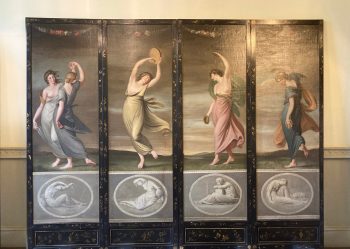
George Romney, Painted Screen, ca. 1760s (Kendal: Abbot Hall Art Gallery and Museum).
Lakeland Arts has received a four-paneled painted screen created by English portrait painter George Romney (1734–1802). The work has been allocated to Lakeland Arts for the nation through HM Government Acceptance in Lieu of Inheritance Tax Scheme by the Estate of Patricia Jaffé, administered by Arts Council England. The painted screen now enters the Abbot Hall Collection permanently, alongside several other Romney pieces acquired by Lakeland Arts throughout its 65-year history.
Dated by Alex Kidson as belonging to the early stages of the painter’s career, the screen is believed to have been painted during Romney’s early years in London, from 1762 onwards. The work takes its inspiration from the publication of engravings of wall paintings discovered in Pompeii in 1749 and circulated throughout Europe in Le Antichità di Ercolano Esposte (Antiquities of Herculaneum Exposed), first published in 1757. Romney has reworked the antique figures into poses of his own devising which echo their classical source. In doing so, the screen anticipates his later preoccupation with classical subject matter.

George Romeny, The Gower Family, The Children of Granville, 2nd Earl Gower, 1776–77, oil on canvas, 203 × 235 cm (Kendal: Abbot Hall Art Gallery and Museum).
Abbot Hall is home to one of the finest collections of Romney paintings in Britain, including the 1759–60 portrait of Captain Robert Banks, the 1796 group portrait The Four Friends, a pastel portrait of the Romantic poet Charlotte Smith, and several sketchbooks. Most significantly, the Collection holds claim to Romney’s masterpiece, the 1776–77 depiction of The Gower Family, the Children of Granville Leveson-Gower, 2nd Earl Gower. A direct line can be drawn between the dancer bearing a tambourine in the second leaf of the painted screen and Lady Anne’s posture in The Gower Family.
Romney was one of the most fashionable and sought-after artists of his time and is known for his engagement with classical themes. The son of a cabinet-maker, Romney was born in Dalton-in-Furness in Lancashire (now Cumbria) and received informal artistic training in his youth. His career began in earnest when he moved to Kendal aged 21 to begin an apprenticeship under the Cumbrian portraitist Christopher Steele and later established his own studio in the town. Romney married the daughter of his landlady, who remained in Kendal with their family when he moved to London to pursue his ambitions. Although he returned sporadically to Cumbria, he moved back permanently towards the end of his working career and was nursed by his wife through two years of ill health before passing away in 1802.
The permanent allocation of the screen will provide an unrivalled opportunity for Abbot Hall visitors to see the development of this important aspect of Romney’s art throughout his working life. The screen may be the earliest surviving piece to illustrate Romney’s exploration of antique themes, and The Gower Family is considered his finest example of this genre, in any UK public collection. It is therefore fitting for both works to be in the care of Lakeland Arts.
Rhian Harris, Chief Executive at Lakeland Arts, said: “We are absolutely delighted the Romney screen has been acquired by Lakeland Arts on a permanent basis. Our thanks go to Arts Council England, the Acceptance in Lieu panel and the Trustees of the Patricia Jaffé Estate for recognising the important connection between George Romney and Kendal in allocating this important piece to Abbot Hall.”
Edward Harley OBE, Chairman of the Acceptance in Lieu Panel said: “I am delighted that this remarkable piece dating from the early stages of George Romney’s career has been allocated to Lakeland Arts for Abbot Hall in Kendal. It is fitting that it returns to the town in which the artist spent the early years of his career. It will allow the work to be compared alongside his masterpiece The Gower Children.”
The screen was accepted in lieu of inheritance tax in the 2020–21 financial year but permanently allocated to Lakeland Arts for Abbot Hall in March 2022. In 2020–21, £54 million worth of objects—paintings, archives, and items of cultural importance—were accepted for the nation through the Acceptance in Lieu and Cultural Gifts Schemes and allocated to museums across the UK.
The British Museum Releases NFTs of Piranesi Drawings

Giovanni Battista Piranesi, A Classical Forum with Steps and a Column, ca.1748–52, pen and brown ink, grey-brown wash, and red chalk
(London: The British Museum, 1908,0616.10)
◊ ◊ ◊ ◊ ◊
From the press release, via Art Daily:
For its latest collaboration with The British Museum, LaCollection has announced a new NFT drop drawn from a selection of 20 pen and chalk drawings from The British Museum’s collection by the Venetian-born artist Giovanni Battista Piranesi (1720–1778).
Piranesi is regarded as one of the greatest Italian printmakers of the 18th century, best known for his atmospheric representations of Roman antiquity, and in later years, his celebrated series of fictional prisons, La Carceri. His exceptional work as a draughtsman is less well known; yet, his drawings reveal the evolution of his practice and the relentless experimentation and innovation that underpinned his virtuoso ability with the etching needle.
Works included in this drop chart the evolution of the artist from early scenographic drawings to his more elaborate fantasy interiors. The selection includes some of the earliest drawings in The British Museum’s collection relating to his Prima Parte (1743) series of etchings of imaginary temples, palaces and the ruins of Rome.
A Monumental Staircase in a Vaulted Interior with Column (1750–55) is one of the most impressive Piranesi drawings in technique and scale found at The British Museum. Showcasing a mastery of craft, Piranesi deconstructed classical architecture language and reinvented it through dynamic compositions that animate and exaggerate the space; the use of red chalk combined with brown ink is unique in the Museum’s collection.
Piranesi’s drawings were investigative tools for experimentation that explore complex exercises in perspective and spatial representation as well as compelling fantasies. One such example is Architectural Fantasy with Monuments, Sculpture, and Ruins (1760–65), a fantasy scene bringing together a creative selection of different Roman monuments interspersed with figures drawn in miniature to accentuate the grandeur of the landscape.
The 20 artworks will be sold across three scarcity levels:
• Six will be Ultra Rare (two editions, one of which will be retained by The British Museum).
• Nine will be Super Rare (ten editions, one of which will be retained by The British Museum).
• Five will be Open Edition (a maximum of 50 editions will be sold with the final edition number set at the end of the primary sales window; one edition will be retained by The British Museum).
Ultra Rare artworks will be sold by auction, with a starting price of €4,000. Super Rare and Open Edition artworks will be sold at fixed price, selling for €2,000 and €499 respectively. Three preview artworks will be available to purchase from 25 April with the main drop starting on 2 May. All public sale artworks will be dropped by 13 May and the primary sales window will close on 30 June; after this point, no further sales of these artworks will be made by The British Museum. There will be a preferential sales window, closing on 15 May, after which the price of each Super Rare artwork will increase to €3,000 and each Open Edition to €749. For all existing NFT collectors there will be a private drop on 28 April and a final one on 16 May; artworks available to purchase in these drops will not be available in the public sale.
◊ ◊ ◊ ◊ ◊
Anyone looking for an introduction to NFTs might start with Kevin Roose, “What are NFTs? The Latecomer’s Guide to Crypto,” The New York Times (18 March 2022). Among the questions critics raise are the environmental impacts; some estimates place the carbon footprint of an NFT as equal to a month’s worth of electrical consumption for a person living in the EU, as noted by Justine Calma, “The Climate Controversy Swirling around NFTs,” Verge (15 March 2021). Also, see Charlotte Kent, “Can You Be an NFT Artist and an Environmentalist?” Wired (17 February 2022). –CH
Exhibition Programming | Jacques Louis David: Radical Draftsman
I noted the exhibition in February but included no programming information. Perrin Stein’s introduction is still available to watch on YouTube, and Daniella Berman will focus on a selection of works in her upcoming “Conversations with a Scholar” sessions. Berman will also lead three public tours. –CH
Virtual Opening | Jacques Louis David: Radical Draftsman
Online, 28 February 2022 [and still available via YouTube]
Join Perrin Stein, Curator, in the Department of Drawings and Prints, for a virtual tour of Jacques Louis David: Radical Draftsman, the first exhibition devoted to works on paper by the celebrated French artist. David navigated vast artistic and political divides throughout his life—from his birth in Paris in 1748 to his death in exile in Brussels in 1825—and his iconic works captured the aspirations and suffering of a nation, while addressing timeless themes that continue to resonate today. Through the lens of his preparatory studies, the exhibition looks beyond his public successes to chart the moments of inspiration and the progress of ideas. Visitors will follow the artist’s process as he gave form to the neoclassical style and created major canvases that shaped the public’s perceptions of historical events in the years before, during, and after the French Revolution. Organized chronologically, the exhibition features more than eighty drawings and oil sketches—including rarely loaned or newly discovered works—drawn from the collections of The Met and dozens of institutional and private lenders.
From The Met:
Conversation with a Scholar | Daniella Berman on Jacques Louis David: Radical Draftsman
The Metropolitan Museum of Art, New York, Mondays, 11 and 25 April 2022, 11.00am
Join Daniella Berman for a lively 30-minute dialogue, exploring a selection of objects from the exhibition Jacques Louis David: Radical Draftsman. Free with museum admission. Please note: Limited space is allotted on a first come, first served basis.
In addition, Berman will lead three public tours of the exhibition on the following dates:
Friday, 22 April 2022, 2.00pm
Friday, 6 May 2022, 10.30am
Monday, 9 May 2022, 2.00pm
Daniella Berman, a doctoral candidate in art history and archaeology at NYU’s Institute of Fine Arts, is the 2019–20 Marica and Jan Vilcek Fellow in the Department of Drawings and Prints at The Met.
The Clark Acquires Tea Service of Famous Women
From the press release (30 March 2022) . . .
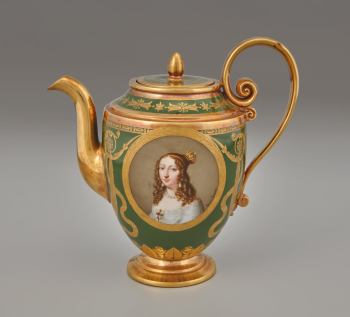
Sèvres Porcelain Manufactory, Teapot and cover (théière Asselin) with portraits of Anne of Austria (1601–1666) and Christina of Sweden (1626–1689) by by Marie-Victoire Jaquotot, 1811–12, hard-paste porcelain (The Clark Art Institute, 2021.3.1a-b).
The Clark Art Institute recently acquired an extremely rare tea service that is noted both for the exceptional craftsmanship on the part of the woman artist who was central to its creation and for its subject matter, a remarkable collection of portraits of women noted in European history. The Tea Service of Famous Women (Cabaret des femmes célèbres) is now on view in the Clark’s permanent collection galleries. With miniature portraits painted by Marie-Victoire Jaquotot between 1811 and 1812 for the Sèvres Porcelain Manufactory, the service is one of only three known sets and features portraits of women noted for their achievements within governance, literature, philosophy, and international relations.
One of the most successful porcelain painters of her time, Marie-Victoire Jaquotot (1772–1855) was both an artist and entrepreneur, achieving great professional success at a time when opportunities for women artists were limited. She was awarded the title premier peintre sur porcelaine du Roi (first porcelain painter to the King) in 1816, which allowed her to open her workshop to students. Jaquotot specialized in miniature portraits and reproductions of famous works of art at a time when these subjects were avidly collected and appreciated across Europe, both as prints and on porcelain. She used engraved portraits as sources for her portraits of the women on the tea service.
Jaquotot painted the three tea services over a five-year period from 1807 to 1812. The porcelain sets were produced by the legendary Sèvres Porcelain Manufactory outside Paris, in a complex process involving multiple specialists, including painters and gilders. The Sèvres factory employed many porcelain painters, both men and women, but few achieved the level of fame and success of Madame Jaquotot, who painted the portraits of the femmes célèbres on all three services at her Paris workshop.
These elaborate porcelain services were intended as special gifts. The set now in the Clark’s collection was originally presented in 1812 by Emperor Napoleon Bonaparte to his first wife, the Empress Josephine, whom he had divorced in 1810. Josephine rejected the gift and returned the service to the factory. It was then presented by Napoleon’s second wife, the Empress Marie-Louise, to her friend the Countess of Ségur in 1813.
“This exquisite tea service has so many stories to tell, with its of portraits of historic women, its technical expertise, and its association with one of the leading porcelain painters of the day—who just happened to be a woman,” said Kathleen Morris, the Clark’s curator of decorative arts and Marx Director of Collections and Exhibitions. “I am so pleased to be able to add this work by a woman artist who represented the pinnacle of her craft to our collection.”
The women represented on each piece in the set include powerful European rulers including Elizabeth I, queen of England (1533–1603); Christina, queen of Sweden (1626–1689); Maria Theresa, archduchess of Austria (1717–1780); and Catherine II, empress of Russia (1729–1796). Medieval warrior and saint Joan of Arc (c. 1412–1431) appears on the milk jug. Several cups feature women who were influential in political, literary, and philosophical circles, including Marie de Rabutin-Chantal, Madame de Sévigné (1626–1696), Hortense Mancini (1646–1699), and Antoinette du Ligier de la Garde Deshouliéres (1638–1694). The center of each saucer is decorated in gold with antique trophies and musical instruments, reinforcing the theme of power and accomplishment.
Harvard Art Museums Receive Important Gift of American Silver

Joseph Richardson Sr., The Hannah Emelen Logan Teapot, ca. 1745, silver and wood (Harvard Art Museums / Fogg Museum, The Pollack Collection, gift of Daniel A. Pollack A.B. ’60 and Susan F. Pollack A.B. ’64, 2020.199).
◊ ◊ ◊ ◊ ◊
From the press release(22 March 2022) . . .
The Harvard Art Museums announce a transformative gift of 21 works of 18th-century American silver from the collection of Daniel A. Pollack and Susan F. Pollack. The gift comprises a range of finely made vessels and table implements intended for domestic use, including cups, bowls, spoons, tankards, and teapots crafted by noted silversmiths from Boston, New York, Philadelphia, and Trenton. There is also a stunning caudle cup, an example of ecclesiastical silver made by Edward Winslow and believed to have been used during communion at First Congregational Church in Milford, Connecticut. The Pollacks’ gift strengthens the museums’ noted holdings of 17th- to 20th-century silver and comes at a time when curators and postdoctoral fellows are working to reimagine the balance among paintings, sculptures, and design objects on view in the galleries.
“The story of silver is in many ways a story of the Americas. Like other commodities such as coffee, mahogany, sugar, and tea, silver helps us unite the known world of the 16th century with our own time,” said Horace D. Ballard, the Theodore E. Stebbins Jr. Associate Curator of American Art at the Harvard Art Museums. “The Pollacks’ generosity allows us to more fully engage the capacious and complex story of European privilege and Afro- and indigenous labor across the Spanish-occupied Americas and British North America during the age of colonialization. It is estimated that 50 to 80 percent of the world’s silver from the 16th to early 19th century came from the infamous silver mines of Potosi in the Viceroyalty of Peru. Silver ore was shipped to China from America’s primary Pacific port in Peru; traded to Europe along with porcelain; melted into coin, plate, or brick; and then traded back to the Americas through the eastern seaboard ports of the Atlantic coast, to be molded, designed, and sold to merchants, religious institutions, and wealthy families. Works by American silversmiths of the 18th and 19th centuries are noted for their innovative silhouettes, turnings, and naturalistic allusions to animals and plants. The Pollack gift and its upcoming installations in our galleries will foreground this global orientation around luxury, leading us to ask new questions about hemispheric identity and aesthetic legacy.”

Paul Revere Jr., Two ragout spoons, 1786, silver (Harvard Art Museums / Fogg Museum, The Pollack Collection, gift of Daniel A. Pollack A.B. ’60 and Susan F. Pollack A.B. ’64, 2020.197.1, 2020.197.2).
Highlights of the gift include, from Boston-based silversmiths, a pair of ragout (serving) spoons from 1786 by Paul Revere, Jr., and a c. 1765 rococo-style cream jug and c. 1775 porringer (small bowl) with a keyhole-pattern handle by Benjamin Burt; a soup ladle with a shell-shaped bowl from c. 1772 and a waiter (small salver) from c. 1765 by the pioneering Jewish silversmith and philanthropist Myer Myers of New York; and an apple-shaped teapot from c. 1745 by Joseph Richardson, Sr., for prominent Quakers Hannah and William Logan, as well as a coffeepot by Richardson’s sons, Joseph Jr. and Nathaniel, both of whom trained with their father in Philadelphia. These are the first works by the Richardsons to enter the museums’ collections. The earliest object from the gift is the aforementioned caudle cup from 1707 by Edward Winslow of Boston.
Over the next six months, select objects from the Pollack gift will be installed in galleries on Level 2 of the museums. By mid-March, the Winslow caudle cup and the Myers soup ladle, among other objects, will be installed in the silver cabinet. By mid-May, the case featuring design objects in the museums’ Atlantic World gallery will highlight a rare two-handled silver punch strainer designed in the 1760s by Daniel Parker of Boston. By late July, the Pollack Arcade gallery on the second floor will host a case of 14 objects from the gift. Interpretive labels for the case will address Daniel Pollack’s longstanding commitment to American art at the Harvard Art Museums while also foregrounding the global threads of racialized labor and colonial trade at the heart of America’s colonization and our national becoming.
This gift of silver follows Daniel Pollack’s passing in October 2019 and builds upon a number of other significant gifts and generous support from the Pollacks over the last 17 years. An ardent supporter of the museums, Daniel was a member of the Director’s Advisory Council and served as chair of the American Art Curatorial Committee. The couple’s commitment also includes contributions toward the renovation and expansion of the Harvard Art Museums (which reopened in the fall of 2014) as well as the naming of four arcade galleries on the second floor overlooking the Calderwood Courtyard.

Edward Winslow, Caudle cup, 1707, silver (Harvard Art Museums / Fogg Museum, The Pollack Collection, gift of Daniel A. Pollack A.B. ’60 and Susan F. Pollack A.B. ’64, 2020.203).
“We are thrilled to be able to honor Dan’s legacy; I’m grateful to Susan for her gracious partnership and support,” said Martha Tedeschi, the Elizabeth and John Moors Cabot Director of the Harvard Art Museums.
Previous gifts of art include a 2016 gift of three pieces of ecclesiastical silver: a beaker (c. 1670) and two tankards (1690; 1759) used by churches in Salem, Massachusetts, for over 300 years. Other gifts have included prized paintings by American artists: Still Life with Pewter Candlestick and Clarinet (1886) by William Michael Harnett; and the trompe l’oeil-style Hanging Woodcock (1897) by George Cope and Theodore Roosevelt’s Cabin Door (1905) by Richard LaBarre Goodwin, the first works by either of these artists to enter the museums’ collections. Through the establishment of the Daniel A. Pollack, Class of 1960, American Art Acquisition Fund, the couple has supported the purchase of 19 paintings, including the highly detailed Still Life with Watermelon (1822) by Sarah Miriam Peale, one of the first professional female artists in the United States; the kaleidoscopic Ventriloquist (1952) by Jacob Lawrence, a prodigy of the Harlem Renaissance; and a stunning littoral scene of Rhode Island by Canadian-born African American painter Edward Mitchell Bannister—the first acquisition for the museums made by new American art curator Horace Ballard.
Daniel A. Pollack (Harvard College A.B. ’60, University of Oxford M.A. ’62, Harvard Law School LL.B. ’65) was a distinguished lawyer who founded and led the Pollack & Kaminsky law firm in New York City for more than 40 years, before joining the New York office of McCarter & English in 2009. Susan F. Pollack (Harvard Radcliffe Class of 1964, Harvard Law School ’67) has served as general counsel to New York City’s Department of Consumer Affairs and as a senior lawyer at Citibank; she has worked with the law firms of Barrett, Smith, Schapiro & Simon as well as Curtis, Mallet-Prevost, Colt & Mosle.










 Enfilade
leave a comment