Exhibition Programming | Jacques Louis David: Radical Draftsman
I noted the exhibition in February but included no programming information. Perrin Stein’s introduction is still available to watch on YouTube, and Daniella Berman will focus on a selection of works in her upcoming “Conversations with a Scholar” sessions. Berman will also lead three public tours. –CH
Virtual Opening | Jacques Louis David: Radical Draftsman
Online, 28 February 2022 [and still available via YouTube]
Join Perrin Stein, Curator, in the Department of Drawings and Prints, for a virtual tour of Jacques Louis David: Radical Draftsman, the first exhibition devoted to works on paper by the celebrated French artist. David navigated vast artistic and political divides throughout his life—from his birth in Paris in 1748 to his death in exile in Brussels in 1825—and his iconic works captured the aspirations and suffering of a nation, while addressing timeless themes that continue to resonate today. Through the lens of his preparatory studies, the exhibition looks beyond his public successes to chart the moments of inspiration and the progress of ideas. Visitors will follow the artist’s process as he gave form to the neoclassical style and created major canvases that shaped the public’s perceptions of historical events in the years before, during, and after the French Revolution. Organized chronologically, the exhibition features more than eighty drawings and oil sketches—including rarely loaned or newly discovered works—drawn from the collections of The Met and dozens of institutional and private lenders.
From The Met:
Conversation with a Scholar | Daniella Berman on Jacques Louis David: Radical Draftsman
The Metropolitan Museum of Art, New York, Mondays, 11 and 25 April 2022, 11.00am
Join Daniella Berman for a lively 30-minute dialogue, exploring a selection of objects from the exhibition Jacques Louis David: Radical Draftsman. Free with museum admission. Please note: Limited space is allotted on a first come, first served basis.
In addition, Berman will lead three public tours of the exhibition on the following dates:
Friday, 22 April 2022, 2.00pm
Friday, 6 May 2022, 10.30am
Monday, 9 May 2022, 2.00pm
Daniella Berman, a doctoral candidate in art history and archaeology at NYU’s Institute of Fine Arts, is the 2019–20 Marica and Jan Vilcek Fellow in the Department of Drawings and Prints at The Met.
The Clark Acquires Tea Service of Famous Women
From the press release (30 March 2022) . . .
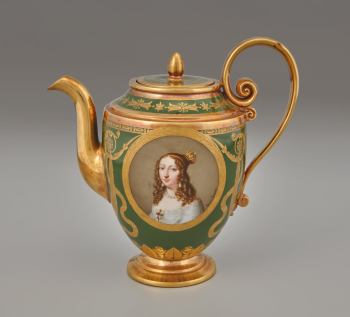
Sèvres Porcelain Manufactory, Teapot and cover (théière Asselin) with portraits of Anne of Austria (1601–1666) and Christina of Sweden (1626–1689) by by Marie-Victoire Jaquotot, 1811–12, hard-paste porcelain (The Clark Art Institute, 2021.3.1a-b).
The Clark Art Institute recently acquired an extremely rare tea service that is noted both for the exceptional craftsmanship on the part of the woman artist who was central to its creation and for its subject matter, a remarkable collection of portraits of women noted in European history. The Tea Service of Famous Women (Cabaret des femmes célèbres) is now on view in the Clark’s permanent collection galleries. With miniature portraits painted by Marie-Victoire Jaquotot between 1811 and 1812 for the Sèvres Porcelain Manufactory, the service is one of only three known sets and features portraits of women noted for their achievements within governance, literature, philosophy, and international relations.
One of the most successful porcelain painters of her time, Marie-Victoire Jaquotot (1772–1855) was both an artist and entrepreneur, achieving great professional success at a time when opportunities for women artists were limited. She was awarded the title premier peintre sur porcelaine du Roi (first porcelain painter to the King) in 1816, which allowed her to open her workshop to students. Jaquotot specialized in miniature portraits and reproductions of famous works of art at a time when these subjects were avidly collected and appreciated across Europe, both as prints and on porcelain. She used engraved portraits as sources for her portraits of the women on the tea service.
Jaquotot painted the three tea services over a five-year period from 1807 to 1812. The porcelain sets were produced by the legendary Sèvres Porcelain Manufactory outside Paris, in a complex process involving multiple specialists, including painters and gilders. The Sèvres factory employed many porcelain painters, both men and women, but few achieved the level of fame and success of Madame Jaquotot, who painted the portraits of the femmes célèbres on all three services at her Paris workshop.
These elaborate porcelain services were intended as special gifts. The set now in the Clark’s collection was originally presented in 1812 by Emperor Napoleon Bonaparte to his first wife, the Empress Josephine, whom he had divorced in 1810. Josephine rejected the gift and returned the service to the factory. It was then presented by Napoleon’s second wife, the Empress Marie-Louise, to her friend the Countess of Ségur in 1813.
“This exquisite tea service has so many stories to tell, with its of portraits of historic women, its technical expertise, and its association with one of the leading porcelain painters of the day—who just happened to be a woman,” said Kathleen Morris, the Clark’s curator of decorative arts and Marx Director of Collections and Exhibitions. “I am so pleased to be able to add this work by a woman artist who represented the pinnacle of her craft to our collection.”
The women represented on each piece in the set include powerful European rulers including Elizabeth I, queen of England (1533–1603); Christina, queen of Sweden (1626–1689); Maria Theresa, archduchess of Austria (1717–1780); and Catherine II, empress of Russia (1729–1796). Medieval warrior and saint Joan of Arc (c. 1412–1431) appears on the milk jug. Several cups feature women who were influential in political, literary, and philosophical circles, including Marie de Rabutin-Chantal, Madame de Sévigné (1626–1696), Hortense Mancini (1646–1699), and Antoinette du Ligier de la Garde Deshouliéres (1638–1694). The center of each saucer is decorated in gold with antique trophies and musical instruments, reinforcing the theme of power and accomplishment.
Harvard Art Museums Receive Important Gift of American Silver

Joseph Richardson Sr., The Hannah Emelen Logan Teapot, ca. 1745, silver and wood (Harvard Art Museums / Fogg Museum, The Pollack Collection, gift of Daniel A. Pollack A.B. ’60 and Susan F. Pollack A.B. ’64, 2020.199).
◊ ◊ ◊ ◊ ◊
From the press release(22 March 2022) . . .
The Harvard Art Museums announce a transformative gift of 21 works of 18th-century American silver from the collection of Daniel A. Pollack and Susan F. Pollack. The gift comprises a range of finely made vessels and table implements intended for domestic use, including cups, bowls, spoons, tankards, and teapots crafted by noted silversmiths from Boston, New York, Philadelphia, and Trenton. There is also a stunning caudle cup, an example of ecclesiastical silver made by Edward Winslow and believed to have been used during communion at First Congregational Church in Milford, Connecticut. The Pollacks’ gift strengthens the museums’ noted holdings of 17th- to 20th-century silver and comes at a time when curators and postdoctoral fellows are working to reimagine the balance among paintings, sculptures, and design objects on view in the galleries.
“The story of silver is in many ways a story of the Americas. Like other commodities such as coffee, mahogany, sugar, and tea, silver helps us unite the known world of the 16th century with our own time,” said Horace D. Ballard, the Theodore E. Stebbins Jr. Associate Curator of American Art at the Harvard Art Museums. “The Pollacks’ generosity allows us to more fully engage the capacious and complex story of European privilege and Afro- and indigenous labor across the Spanish-occupied Americas and British North America during the age of colonialization. It is estimated that 50 to 80 percent of the world’s silver from the 16th to early 19th century came from the infamous silver mines of Potosi in the Viceroyalty of Peru. Silver ore was shipped to China from America’s primary Pacific port in Peru; traded to Europe along with porcelain; melted into coin, plate, or brick; and then traded back to the Americas through the eastern seaboard ports of the Atlantic coast, to be molded, designed, and sold to merchants, religious institutions, and wealthy families. Works by American silversmiths of the 18th and 19th centuries are noted for their innovative silhouettes, turnings, and naturalistic allusions to animals and plants. The Pollack gift and its upcoming installations in our galleries will foreground this global orientation around luxury, leading us to ask new questions about hemispheric identity and aesthetic legacy.”

Paul Revere Jr., Two ragout spoons, 1786, silver (Harvard Art Museums / Fogg Museum, The Pollack Collection, gift of Daniel A. Pollack A.B. ’60 and Susan F. Pollack A.B. ’64, 2020.197.1, 2020.197.2).
Highlights of the gift include, from Boston-based silversmiths, a pair of ragout (serving) spoons from 1786 by Paul Revere, Jr., and a c. 1765 rococo-style cream jug and c. 1775 porringer (small bowl) with a keyhole-pattern handle by Benjamin Burt; a soup ladle with a shell-shaped bowl from c. 1772 and a waiter (small salver) from c. 1765 by the pioneering Jewish silversmith and philanthropist Myer Myers of New York; and an apple-shaped teapot from c. 1745 by Joseph Richardson, Sr., for prominent Quakers Hannah and William Logan, as well as a coffeepot by Richardson’s sons, Joseph Jr. and Nathaniel, both of whom trained with their father in Philadelphia. These are the first works by the Richardsons to enter the museums’ collections. The earliest object from the gift is the aforementioned caudle cup from 1707 by Edward Winslow of Boston.
Over the next six months, select objects from the Pollack gift will be installed in galleries on Level 2 of the museums. By mid-March, the Winslow caudle cup and the Myers soup ladle, among other objects, will be installed in the silver cabinet. By mid-May, the case featuring design objects in the museums’ Atlantic World gallery will highlight a rare two-handled silver punch strainer designed in the 1760s by Daniel Parker of Boston. By late July, the Pollack Arcade gallery on the second floor will host a case of 14 objects from the gift. Interpretive labels for the case will address Daniel Pollack’s longstanding commitment to American art at the Harvard Art Museums while also foregrounding the global threads of racialized labor and colonial trade at the heart of America’s colonization and our national becoming.
This gift of silver follows Daniel Pollack’s passing in October 2019 and builds upon a number of other significant gifts and generous support from the Pollacks over the last 17 years. An ardent supporter of the museums, Daniel was a member of the Director’s Advisory Council and served as chair of the American Art Curatorial Committee. The couple’s commitment also includes contributions toward the renovation and expansion of the Harvard Art Museums (which reopened in the fall of 2014) as well as the naming of four arcade galleries on the second floor overlooking the Calderwood Courtyard.

Edward Winslow, Caudle cup, 1707, silver (Harvard Art Museums / Fogg Museum, The Pollack Collection, gift of Daniel A. Pollack A.B. ’60 and Susan F. Pollack A.B. ’64, 2020.203).
“We are thrilled to be able to honor Dan’s legacy; I’m grateful to Susan for her gracious partnership and support,” said Martha Tedeschi, the Elizabeth and John Moors Cabot Director of the Harvard Art Museums.
Previous gifts of art include a 2016 gift of three pieces of ecclesiastical silver: a beaker (c. 1670) and two tankards (1690; 1759) used by churches in Salem, Massachusetts, for over 300 years. Other gifts have included prized paintings by American artists: Still Life with Pewter Candlestick and Clarinet (1886) by William Michael Harnett; and the trompe l’oeil-style Hanging Woodcock (1897) by George Cope and Theodore Roosevelt’s Cabin Door (1905) by Richard LaBarre Goodwin, the first works by either of these artists to enter the museums’ collections. Through the establishment of the Daniel A. Pollack, Class of 1960, American Art Acquisition Fund, the couple has supported the purchase of 19 paintings, including the highly detailed Still Life with Watermelon (1822) by Sarah Miriam Peale, one of the first professional female artists in the United States; the kaleidoscopic Ventriloquist (1952) by Jacob Lawrence, a prodigy of the Harlem Renaissance; and a stunning littoral scene of Rhode Island by Canadian-born African American painter Edward Mitchell Bannister—the first acquisition for the museums made by new American art curator Horace Ballard.
Daniel A. Pollack (Harvard College A.B. ’60, University of Oxford M.A. ’62, Harvard Law School LL.B. ’65) was a distinguished lawyer who founded and led the Pollack & Kaminsky law firm in New York City for more than 40 years, before joining the New York office of McCarter & English in 2009. Susan F. Pollack (Harvard Radcliffe Class of 1964, Harvard Law School ’67) has served as general counsel to New York City’s Department of Consumer Affairs and as a senior lawyer at Citibank; she has worked with the law firms of Barrett, Smith, Schapiro & Simon as well as Curtis, Mallet-Prevost, Colt & Mosle.
Online Talk | Gus Casely-Hayford on Crafting the New V&A East
From The Institute of Fine Arts:
Gus Casely-Hayford | Making a Museum: Crafting a New V&A for East London
Online, The Institute of Fine Arts, New York University, 21 March 2022, 2pm ET
 The Institute of Fine Arts invites you to a lecture by Dr. Gus Casely-Hayford, Director of the V&A East, a new museum and collection center in London. This virtual program takes place on Monday, 21 March 2022, at 2pm (Eastern Time).
Advanced registration is required–and available here.
A curator and historian who writes, lectures, and broadcasts widely on culture, Dr Gus Casely-Hayford, OBE, Prof by Practice, SOAS, University of London (the leading Higher Education institution in Europe specializing in the study of Asia, Africa, and the Near and Middle East), is the founding Director of V&A East, a museum and collection center presently under construction. He was previously the Director of the Smithsonian National Museum of African Art.
Over the course of his career, Casely-Hayford has been a constant champion for the arts. He has presented two television series of The Lost Kingdoms of Africa for the BBC (and wrote the companion book), two television series of Tate Britain: Great Art Walks for Sky, and has worked for every major British TV channel. His TED talk on Islamic culture has been viewed more than a million times. Former Executive Director of Arts Strategy, Arts Council England (Britain’s major arts funder) and ex-Director of the Institute of International Contemporary Art, he has offered leadership to both large and medium scale organizations. Dr Casely-Hayford has lectured widely on art and culture, including periods at Sotheby’s Institute, Goldsmiths, Birkbeck, City University, University of Westminster, and SOAS. He has advised national and international bodies on heritage and culture including the United Nations and the Canadian, Dutch, and Norwegian Arts Councils. In 2005 he deployed these leadership, curatorial, fundraising, and communications skills to organize the biggest celebration of Africa Britain has ever hosted with Africa 2005 when more than 150 organizations put on over 1000 exhibitions and events to showcase African culture.
Amongst a range of honors, he has been awarded a King’s College cultural fellowship for service to the arts and a SOAS Honorary Fellowship for service to Africa. He speaks widely, gave a SOAS Centenary lecture, judged the Art Fund’s British Museum of the Year award, advised the Royal Shakespeare Company on their production of Hamlet, and is a member of English Heritage’s ‘Blue Plaques Group’.
This program is made possible with generous funding from the Paul Lott Lectureship.

Internal render view of the central public collection hall in new V&A East Storehouse at Here East, designed by Diller Scofidio + Renfro. © Diller Scofidio + Renfro, 2018.
◊ ◊ ◊ ◊ ◊
From the V&A:
One of the world’s most significant new museum projects, V&A East will comprise two sister sites currently under construction in Queen Elizabeth Olympic Park, London. Opening at Here East in 2024, V&A East Storehouse offers a new immersive experience, taking visitors behind the scenes and providing unprecedented public access to V&A collections. A short walk across the park, opening in 2025, V&A East Museum celebrates global creativity and making relevant to today’s world. Both sites are part of East Bank, the Mayor of London’s £1.1 billion Olympic legacy project, which will create a new arts, innovation and education hub in Stratford’s Queen Elizabeth Olympic Park. . . .
Additional information is available here»
The Met Acquires Painting by Poussin on Copper
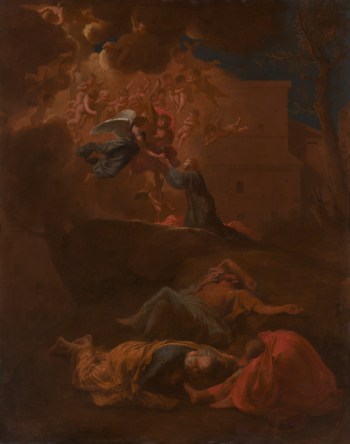
Nicolas Poussin, The Agony in the Garden, 1626–27, oil on copper, 61 × 49 cm (New York: The Met, Gift of Jon and Barbara Landau, in honor of Keith Christiansen, 2021.378).
As reported by Art News (20 January 2022), The Met has recently acquired an exceptional work by Poussin on copper: Agony in the Garden (1626–27), from the collection of Barbara and Jon Landau, one of only two settled works on copper by the painter. As David Pullins notes in his catalogue entry for the piece, this is early Poussin when the artist was still working out his place within line-and-color debates, guided here particularly by the Venetian legacies of Titian and Tintoretto. The painting caught the attention of some of the most artistically attuned visitors to Rome in the seventeenth and eighteenth centuries, including the Swedish diplomat count Nicodemus Tessin; the secretary to Rome’s Accademia di San Luca, Giuseppe Ghezzi; and the director of the Académie de France à Rome, Nicolas Vleughels. The eighteenth- and nineteenth-century provenance is also interesting as the painting moved from Rome to Paris, and then on to London through the American artist John Trumbull (it was part of the Trumbull sale at Christie’s in 1797). That said, the work was—as noted in the press release—rediscovered only in 1985, when it was “heralded as a major addition to Poussin’s corpus.” –CH
IDEAL Internship Grants from Decorative Arts Trust

Hermann-Grima House parlor and dining room, 1831
New Orleans
◊ ◊ ◊ ◊ ◊
From the press release (22 December 2021) . . .
The Decorative Arts Trust announces that four organizations will receive IDEAL Internship Grants for 2022: Drexel’s Lenfest Center for Cultural Partnerships/Atwater Kent Collection and the Museum of the American Revolution in Philadelphia, the Hermann-Grima + Gallier Historic Houses in New Orleans, and the High Museum of Art in Atlanta.
The primary objective of the IDEAL Internship program is to improve access to curatorial careers and mentorship for students of color as a path toward achieving comprehensive change in the museum field. The partners were selected based on the likely impact of the internships, which offer students consequential experience and stipends while providing the host organizations valuable contributions to curatorial projects and to meaningful discussions about inclusion, diversity, and equity.
• Drexel’s Lenfest Center for Cultural Partnerships will receive a second year of internship funding to hire an undergraduate student to assist with the development of two exhibitions highlighting objects from the Atwater Kent Collection.
• The Hermann-Grima + Gallier Historic Houses is creating a year-long internship for a local college student that will focus on the collection at the 1831 Hermann-Grima House, seeking narratives of invisible labor in fine and decorative arts as well as architectural elements to enhance the organization’s successful Urban Enslavement Tours.
• The High Museum will hire a summer intern to develop a gallery rotation after researching objects, rethinking narratives, and drafting labels while also generating a public outreach initiative through a gallery tour, social media campaign, or hosted event.
• The Museum of the American Revolution aims to hire a summer intern to increase awareness of the diverse communities that contributed to the Revolution through research into the permanent collection.
Visit each institution’s website and follow them on social media for updates about internship opportunities. The Trust is committed to offering IDEAL Internship funding in the coming years; visit the Trust’s website for more information.
NGS Acquires Rare Watercolour of a Black Milkmaid by David Allan
From the press release (18 November 2021), via Art Daily:
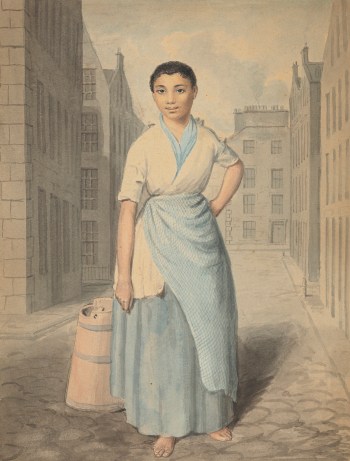
David Allan, Edinburgh Milkmaid with Butter Churn, ca. 1785–95, watercolour on paper, image size: 21 × 16 cm (Edinburgh: National Galleries of Scotland, D 5721, purchased 2019).
One of the earliest known images of a Black person by a Scottish artist has been acquired by the National Galleries of Scotland. Edinburgh Milkmaid with Butter Churn by David Allan (1744–1796) is a beautifully painted watercolour, which is both exceptionally rare and striking. It depicts a Black woman alone and centre stage at a time when Black sitters more often appeared as marginal or subservient figures in group portraits.
Looking directly at the viewer, the woman is shown in working dress, going about her daily duties and set against the backdrop of an elegant Edinburgh street. Her name and life story is unknown, but it is likely that she was a servant, a milkmaid, as suggested by the large vessel or butter churn shown beside her.
Modest in scale, the image is dated to the mid-1780s to early 1790s, a period when Allan created evocative drawings of ordinary people going about their daily lives in Edinburgh, such as soldiers, coalmen, fishwives, sedan chair porters, firemen, and officers of the city guard. These works, known as Allan’s ‘Edinburgh Characters’, suggest a background context for Edinburgh Milkmaid with Butter Churn, but they are generally sketched in a summary way, intended to capture character types, rather than specific personalities, and were often copied and duplicated. The Edinburgh Milkmaid, however, is highly detailed, precisely painted, and clearly a portrait of a specific person. It is hoped that further research may reveal more about the connection between the artist and the young woman and shed some light on her identity.
Director of European and Scottish Art at the National Galleries of Scotland, Christopher Baker, commented: “We are so pleased to bring this remarkable, rare, and extraordinary watercolour into Scotland’s national collection. It is an incredibly striking and special work, one which we believe will be enjoyed by many and, we hope, lead to new research on its background and most importantly the story of the woman depicted.”
Born in Alloa, David Allan was arguably the first Scottish artist to take contemporary life and customs from across the social hierarchy as a subject worthy of art. With the support of his patrons, Lord and Lady Cathcart of Shaw Park, near Alloa, he travelled to Italy around 1767 and remained there for a decade, painting historical pictures and portraits. He became interested in drawing scenes of street life, inspired by the popular print tradition of depicting street criers who called out to advertise their produce or trades. He sketched street vendors, aristocrats on the Grand Tour, coffee house scenes, dances, carnivals, and local costume in Rome and Naples and on a visit to the islands of Procida, Ischia, and Minorca.
These experiences led Allan to take a similar approach after his return to Scotland in 1779. He drew his subject matter from contemporary life, ranging from specific events such as The Ceremony of Laying the Foundation Stone of the New College of Edinburgh (1789) to timeless traditions and customs, such as A Highland Dance and The Penny Wedding. In 1786 Allan was appointed to a teaching post as Master of the Trustees’ Academy and he settled permanently in Edinburgh. The city and its inhabitants became a particular focus for this work. From about 1788 he developed the series of over twenty drawings of workers and traders; often referred to as his ‘Edinburgh Characters’, they typically show an individual or pair of figures with the tools of their trade, set against a simple architectural or rural background.
Allan’s subjects range from higher status figures, such as a Highland officer in uniform and officers of the Town Guard, to those who did the city’s heavy labour, such as the coalmen, chimney sweeps, porters, and water carriers. Female workers are represented by a fishwife, a salt vendor, and a lacemaker. The figures are drawn with strong outlines in ink to enable them to be traced easily, as Allan made multiple versions of his character drawings, several of which are held in the National Galleries of Scotland collection. He also reproduced his Edinburgh characters on a smaller scale as the cast that populate his landscape views of the Royal Mile, such as High Street from the Netherbow, made in 1793. Seen as a group, Allan’s street characters give a broad and fascinating insight into late 1780s Edinburgh as a living, working city.
Edinburgh Milkmaid with Butter Churn is one of several notable acquisitions highlighted in the recently published NGS Annual Review, covering the years 2019–2021. The painting will go on display at a later date following some conservation work, which is currently being prepared. With much still unknown about the painting, the Galleries would welcome information, comments, or feedback about it.
Nationalmuseum Sweden Acquires Gold Box, Gifted by Gustav III

Gold box à deux couleurs, unknown maker, Hanau; guilloché and chased gold in two shades, diamonds, enamel; portrait of Gustav III by Johan Georg Henrichsen, ca. 1778 (Stockholm: Nationalmuseum, NMB 2799). The box sold at Sotheby’s in London on 10 November 2021 as part of the Gold Boxes, Silver and Ceramics sale (Lot 10).
◊ ◊ ◊ ◊ ◊
Press release (8 December 2021) from Sweden’s Nationalmuseum in Stockholm:
Nationalmuseum has acquired a unique gold box bearing a portrait by the court enameller, Johan Georg Henrichsen, of King Gustav III. The box was given by the king as a gift to John Mackenzie, a Scottish officer, when he retired from the Swedish army in 1778. Very few such tokens of royal favour have survived intact, which is what makes this gold box unique.
Jewel-encrusted portraits of the monarch were the most prestigious token of appreciation. The tradition developed at the French court in the 17th century and soon became a model for other European royal houses of the time. These portraits might take the form of a pendant or be mounted in a jewelled setting on the lid of a gold box. Queen Kristina was the first Swedish monarch to adopt this French fashion, which then flourished in the 18th century. Gustav III frequently handed out gold boxes as a sign of royal favour. Contemporary historical sources show that the king took a great personal interest in the design and gave detailed instructions. Sometimes the decoration consisted of his monogram in diamonds, and in other cases his portrait was framed with jewels.
Various specialist craftsmen collaborated to create the boxes. A silversmith would first produce the basic gold box, which would then be decorated by an engraver and adorned with gemstones by a jeweller. A miniaturist then added the portrait, while the case was produced by another specialist, often a bookbinder. There were practitioners of all these crafts in Gustavian Stockholm, but sometimes boxes were imported from Russia, Saxony or France. The gold box in question was made in Hanau, in the present-day German state of Hessen. It is oval in shape and is decorated with a guilloché (engine-turned) wave and circle pattern within a chased (embossed) border. It is also executed à deux couleurs: in a combination of two different gold alloys to produce colour variations. After the box reached Stockholm, the king’s portrait was set on the lid in a frame of diamonds with trailing vines.
The portrait is the work of Johan Georg Henrichsen (1707–1779), the last person in Sweden to hold the position of court enameller, to which he was appointed in 1773. He worked exclusively from originals in pastel or oil created by other artists such as Gustaf Lundberg or, in this case, Lorens Pasch the Younger. The colour palette was often intense, combined with clear use of pointillism. A lesser-known fact is that Henrichsen also produced coats of arms for patents of nobility, painted on parchment using miniature techniques.
The recipient of the gift was a Scottish adventurer: John Mackenzie, Lord Macleod, 4th Earl of Cromartie (1726–1789). He had been loyal to Charles Edward Stuart (Bonnie Prince Charlie), the Young Pretender, and was held prisoner after the British army defeated the Jacobites at the battle of Culloden in 1746. Two years later he was pardoned, but the family had its estates confiscated. In 1750 John Mackenzie joined the Swedish army, ending up as colonel of the Björneborg regiment.
“Mackenzie returned to Britain in 1778, having been granted a full amnesty, and had his estates restored. On the occasion of his departure from Sweden, he received this gold box from King Gustav III. It is one of the very few surviving examples from the time and will soon be on display in Nationalmuseum’s Treasury alongside a miniature portrait of Mackenzie,” explained Magnus Olausson, director of collections at Nationalmuseum.
Nationalmuseum receives no state funds with which to acquire design, applied art and artwork; instead the collections are enriched through donations and gifts from private foundations and trusts. The acquisition has been made possible by a generous donation from the Anna and Hjalmar Wicander Foundation.
Emma’s Songbooks: Rediscovered Music for Nelson

Songbook once owned by Lady Hamilton, which has a cantata composed by G.G. Ferrari and dedicated to Lord Nelson
(Museum of London, 31.17/2)
◊ ◊ ◊ ◊ ◊
From the Museum of London:
Emma’s Songbooks: Rediscovered Music for Nelson
Online, Museum of London Docklands, recording available 21 December 2021 — 11 January 2022
In partnership with the Guildhall School of Music & Drama, the Museum of London Docklands brings to life songs dedicated to Horatio Nelson’s naval victories, recently rediscovered in Emma Hamilton’s songbooks by Museum of London librarian Lluis Tembleque Terés. Terés kicks off the event with a presentation on his finds and their historical context, after which Christopher Suckling, Head of Historical Performance at the Guildhall School of Music & Drama, will give an insight onto the music world at the beginning of the 19th century. Following the talks, performers from the School will play the four rediscovered pieces, along with a number of other relevant scores. Finally, Terés will show items from the Museum collections connected to Lady Hamilton and Lord Nelson—all in the immersive surroundings of the Museum of London Docklands.
Please note that this will be a recording of the live event, which took place on December 11. You will have seven days to access the recording from the date you select as part of the ticket purchase process.

Songbook once owned by Emma Hamilton, here shown by Museum of London librarian Lluis Tembleque Terés
(Museum of London, 31.17/2; photo by John Chase)
◊ ◊ ◊ ◊ ◊
From the press release (via Art Daily) . . .
A recording of an old sea song, one of four recently rediscovered pieces of music paying tribute to Nelson, has been released today by the Museum of London. Brought to life by musicians from Guildhall School of Music & Drama, it marks the first performance of the piece in over 200 years. The extraordinary discovery was made last year by Museum of London librarian Lluis Tembleque Teres who discovered it amongst songbooks belonging to Nelson’s lover, the actress and model Emma Hamilton.
It is thought the song was sung after the battle of Cape St Vincent (1797) and transcribed by Nelson after hearing it chanted by his crew. The lyrics have been known about since a letter from Nelson to William Douglas, 4th Duke of Queensberry, was sold at auction in 2013—the only other known reference to the song. The new discovery points to the addition of new music and a chorus by the Duke, a notorious society figure, whose reputation for gambling and horse racing has long overshadowed his musical ability. A personal friend of Emma Hamilton, his authorship of the piece is recorded in Emma’s own hand.
Lluis Tembleque Teres, librarian, Museum of London, said, “The song was written by Nelson’s crew in one of his early victories. It is fascinating how, some four years later and already a national hero, he recovers the lyrics and sends them to the Duke of Queensberry, almost as if showing off his early successes. The Duke then adds music and a chorus, and gifts the manuscript to Emma Hamilton, thus allowing us exactly 220 years later to relive Nelson’s fame while performing it.”
Dr Christopher Suckling, Head of Historical Performance at the Guildhall School of Music & Drama, said, “Equally as extraordinary is that a man of the Duke of Queensberry’s position should take the time and take the effort to compose at least two pieces of music in Nelson’s honour. That he should choose to express himself through this least gentlemanly of arts speaks to both his strength of feeling for Nelson and his sensibility towards the Admiral’s relationship with Emma Hamilton.”
The original manuscripts reflect the different manner in which music was experienced at the turn of the nineteenth century, its empty staves typical of a time when music could be played by any combination of available musicians. Amongst the upper classes, the function of domestic music was largely seen as a way to kill time and despite some contemporaries considering social music making to be the embodiment of morality, playing and composing was not held in high regard.
The release follows a special one-off live performance of all four songs at the Museum of London Docklands on 11th December, which will be available to watch in full as an online event starting Tuesday, 21 December 2021.
A free copy of the sea song is available for download here»
The Decorative Arts Trust Announces Failey Grant Recipients
From the press release (1 December 2021) . . .
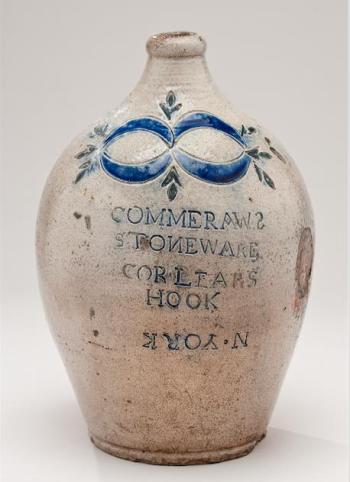
Thomas W. Commeraw, Jug, ca. 1796–1819, stoneware and cobalt oxide. Impressed on front: “COMMERAW’S/STONEWARE / CORLEARS / HOOK / N. YORK” (New-York Historical Society, 1937.820).
The Decorative Arts Trust congratulates author Caitlin Meehye Beach, Historic Rock Ford, and the New-York Historical Society on receiving Failey Grants. The Failey Grant program provides $25,000 in support for noteworthy research, exhibition, publication, and conservation projects through the Dean F. Failey Fund, named in honor of the Trust’s late Governor. Preference is given to projects that employ or are led by emerging professionals in the museum field.
Caitlin Meehye Beach, an assistant professor in the Department of Art History and affiliated faculty in the Department of African and African American Studies at Fordham University, will utilize grant funds for her forthcoming book Sculpture at the Ends of Slavery, which will be published by the University of California Press in 2022. The text will examine how a wide range of works of sculpture and decorative art—from antislavery medallions to statues of bondspeople bearing broken chains—gave visual form to narratives about abolition in the 18th and 19th centuries.
Historic Rock Ford in Lancaster, Pennsylvania, will use grant funding for further research and interpretation of the over 200 objects in their John J. Snyder, Jr. Gallery of Early Lancaster County Decorative Arts. Their goal is to uncover more about the shops, apprentices, laborers, indentured laborers, and enslaved workers who contributed to the Gallery’s collection of furniture, silver, clocks, and paintings from the mid-1700s to the early 1800s.
The New-York Historical Society receives grant funding for the groundbreaking exhibition Crafting Freedom: Uncovering the Life and Legacy of Free Black Potter Thomas Commeraw, to be presented January to June 2023 in their Pam & Scott Schafler Gallery. Crafting Freedom will be the first exhibition focused solely on Commeraw, a free Black craftsman descended from enslaved people, who was active as a master potter from the 1790s through 1819.
The Decorative Arts Trust is a non-profit membership organization that promotes and fosters the appreciation and study of the decorative arts through exchanging information through domestic and international programming; collaborating and partnering with museums and preservation organizations; and underwriting internships, research grants, and scholarships for graduate students and young professionals.










 Enfilade
leave a comment