Sweden Nationalmuseum Acquires Louis Masreliez’s Allegory of War

Louis Masreliez, An Allegory of War, ca.1790–92, oil on canvas, 93 × 132 cm
(Stockholm: Nationalmuseum)
◊ ◊ ◊ ◊ ◊
The American war in Afghanistan ends after two decades. This painting sold at Christie’s New York in April of this year (Sale 19739, Lot 63). From the Nationalmuseum press release (26 August 2021) . . .
Nationalmuseum has acquired An Allegory of War, a painting by Louis Masreliez originally intended to be one of two overdoor pieces for King Gustav III’s bedchamber in the royal palace in Stockholm. The work is of major significance, marking a transition in the artist’s oeuvre from epic historical scenes to more decorative works.
As one of the leading painters and interior designers of the Gustavian period, Louis Masreliez (1748–1810) was equal to the task. Born in Paris, he arrived in Stockholm at the age of five when his father, the ornamental sculptor Adrien Masreliez, was hired to work on the new palace. Young Louis soon proved to be something of an artistic child prodigy. He received the best possible education, which culminated in 1769 in a travel scholarship. Via Paris he travelled to Rome, where he studied for the next 12 years. In this cosmopolitan environment Masreliez mixed with the leading artists of the time, found his niche in the emerging neoclassical style, and drew many studies of Classical and Renaissance motifs to serve as reference material.
On returning to Stockholm in 1782, Masreliez was well equipped to oversee the redecoration of Gustav III’s private apartment at the palace in keeping with contemporary neoclassical interior design trends. Neoclassicism blended the grotesque decorative style of the Renaissance with features inspired by ancient Rome. The best-known example in Sweden today is the interior decoration of Gustav III’s pavilion at Haga. Meanwhile, Masreliez also had a solid grounding in historical painting, the task he was originally destined for in the service of the crown. Here too, he combined various influences from the great masters, all packaged in an elegant neoclassical form. This can be clearly seen in An Allegory of War.
It is conceivable that Gustav III himself chose the subject matter for the two overdoor paintings in his bedchamber. The king was heavily involved and had his own ideas regarding the interior decoration of royal properties, as contemporary sources attest. An Allegory of War and its counterpart, An Allegory of Peace, would promote the image of the king as defender of the realm and ultimate guarantor of peace. The topic was highly relevant, as the works were created in the immediate aftermath of Sweden’s 1788–90 war against Russia. An Allegory of War depicts Minerva alighting from her horse-drawn chariot, holding a shield in one hand and the lightning bolt of Zeus in the other. Above her hovers Boreas, god of the north wind, accompanied by winged zephyrs with snowflakes emanating from their mouths. It is both a dramatic composition and an unusually powerful painting with its grand, sweeping lines. The somewhat explosive colour palette, dominated by earth tones and martial red, reinforces the subject matter.
From an inscription on a preliminary sketch by Masreliez, we know that this image represented the Swedish victory at the battle of Narva in 1700, an event to which Gustav III frequently alluded, since it had secured Sweden’s position as a great power for some years. If Karl XII was explicitly presented here as the warrior king, then Gustav III would implicitly be the prince of peace in the counterpart image. A preliminary study in oils for An Allegory of Peace has been in Nationalmuseum’s collection since 1917. It is believed the ensemble was never completed following the king’s death in 1792, and instead the artist retained ownership of the works.
Nationalmuseum receives no state funds with which to acquire design, applied art and artwork; instead the collections are enriched through donations and gifts from private foundations and trusts. Thanks to a generous donation from the Friends of Nationalmuseum, the museum has been able to repatriate the magnificent Masreliez work to Sweden.
NEH Announces $28.4 Million for 239 Projects
Selections from the press release (17 August 2021):
The National Endowment for the Humanities (NEH) today announced $28.4 million in grants for 239 humanities projects across the country. . . .This round of funding will support vital research, education, preservation, digital, and public programs. These peer-reviewed grants were awarded in addition to $53.2 million in annual operating support provided to the national network of state and jurisdictional humanities councils. . . .
Several projects receiving grants today will help preserve fragile historical and cultural collections and make them more accessible to the broader public, such as grants to safeguard the Providence Atheneum’s collection of rare books, pamphlets, and artwork—which includes rare first editions of works by Walt Whitman, Louisa May Alcott, and Herman Melville, nineteenth-century antislavery and temperance pamphlets, and a 25-volume reference work on Egypt commissioned by Napoleon Bonaparte.
A grant to the Oneida Indian Nation will help preserve tribal archives containing textiles, artifacts, and historical records documenting the Nation’s history, including the personal papers of Chief William Rockwell, who played a pivotal role in a U.S. Supreme Court case preserving the Oneida Reservation, and the pipe of Chief Skenondoa, an American Revolutionary War hero involved in the 1794 Canandaigua Treaty recognizing Oneida sovereignty and land rights.
NEH Preservation Assistance Grants will improve preservation conditions for valuable humanities collections at seventy-one smaller museums, archives, and historical societies across the country. . . .
Forty institutions received grants to support professional development and research opportunities for K–12 and college teachers through summer workshops and institutes on humanities topics such as: the social and cultural history of the space race on Florida’s ‘Space Coast’; the role of books in circulating the ideals of the American Revolution; the twelfth-century migration of Pueblo communities from Chaco Canyon, the hub of Puebloan civilization in northwestern New Mexico, to the Mesa Verde region of southwestern Colorado; the overlooked histories of ten influential African-American women who helped define American ideals from the Revolutionary Era to the early twentieth century; and accounts of the 1918 influenza pandemic in history and literature.
This round of funding also marks the addition of the Boston Public Library as a hub for the National Digital Newspaper project, expanding the reach of the Chronicling America online database of historical American newspapers to include newspapers published in Massachusetts between 1690 and 1963. Additional funding awarded in this round will support ongoing newspaper digitization work in Arkansas, Connecticut, Florida, Georgia, Montana, Rhode Island, Texas, Wisconsin, and Wyoming.
A number of newly funded projects received grant support through NEH’s A More Perfect Union initiative, designed to demonstrate and enhance the critical role the humanities play in our nation and support projects that will help Americans commemorate the 250th anniversary of the Declaration of Independence in 2026. Among these are grants to fund new episodes of the PBS series Poetry in America, a collection of essays on the architecture of the African diaspora in the United States, and preservation planning for the Digital Library of Appalachia.
A full list of the 239 grants by geographic location is available here (these particularly caught my eye -CH) . . .
The Revolution in Books (Adrian Finucane and Victoria Thur), $141,929
A three-week, residential institute for 25 college and university faculty on the history of the book in the American Revolution.
◊ ◊ ◊ ◊ ◊
Bringing Old North to the 21st Century (Nikki Stewart), $75,000
A planning grant to reinterpret the colonial Old North Church in Boston and its congregation’s ties to slavery from the American Revolution to the Civil War.
◊ ◊ ◊ ◊ ◊
Preserving Works on Paper at Historic Deerfield (Amanda Lange), $10,000
Conservation assessment of 350 works of art on paper, including eighteenth-century British portraits, silhouettes, political prints, military and other maps, and other pieces that represent New England life and tastes in the nineteenth and twentieth centuries. The project would also include a workshop on object handling and storage best practices that would be open to staff and volunteers of other local museums and historical societies, as well as the development of a rotation schedule for the light-sensitive pieces in the collection.
◊ ◊ ◊ ◊ ◊
Recovering Black Performance in Early Modern Iberia, 1500–1800 (Nicholas Jones and Elizabeth Wright), $96,347
Planning and holding a conference on Black performance in early modern Iberia and preparation of conference papers for publication in a journal special issue.
◊ ◊ ◊ ◊ ◊
Rehousing and Cataloging the RISD Museum’s Eighteenth- and Nineteenth-Century Wallpaper Collection (Ingrid Neuman), $10,000
The rehousing of approximately 700 historical European and American wallpapers from the late eighteenth century to the mid nineteenth, 500 of which were collected by French artist Charles Huard and his wife, American writer Frances Wilson Huard. The collection includes examples from manufacturers Zuber, Joseph Dufour, and Jean-Baptiste Réveillon that are representations of highly skilled and time-intensive production techniques, including the use of hand-drawn and hand-carved woodblocks for printing.
◊ ◊ ◊ ◊ ◊
Collections Monitoring and Housing Improvement Project at the Old Stone House Museum (Mahala Nyberg), $9,300
Purchases to improve preservation conditions and environmental monitoring at the Old Stone House Museum and Historic Village. The museum, on Vermont’s African-American Heritage Trail, includes buildings significant to the history of Orleans County from the mid eighteenth century through the nineteenth, including the home of Alexander Twilight, an African-American educator and minister and first African American to graduate college in the United States.
◊ ◊ ◊ ◊ ◊
First Family: George Washington’s Heirs and the Making of America (Cassandra Good), $30,000
Research and writing of a history of the heirs of George and Martha Washington between the American Revolution and the Civil War.
◊ ◊ ◊ ◊ ◊
A Plague in New York City: How the City Confronted—and Survived—the Yellow Fever Epidemic in the Founding Era (Carolyn Eastman), $60,000
Research and writing of a book on the yellow fever epidemics of 1795 and 1798 in New York City, emphasizing the experience of doctors and other caregivers, including African Americans.
Colonial Williamsburg Acquires Tankard by Paul Revere
Press release from Colonial Williamsburg (17 August 2021) . . .

Tankard, Marked by Paul Revere, Jr. (1734–1818), Boston, ca. 1795, silver (Colonial Williamsburg Collections Fund, 2021-45).
The Colonial Williamsburg Foundation has added to its renowned American and British silver collection a rare tankard made ca. 1795 by America’s best-known colonial silversmith, Paul Revere (1734–1818) of Boston, Massachusetts. Originally used as communal drinking vessels, tankards are among the largest forms produced in Revere’s shop. Approximately three dozen Revere tankards are known, and this one is typical of those from the 1790s, with tapering sides, midband, tall domed lid, and pinecone form finials.
“Colonial Williamsburg has long sought a significant example of Revere’s work,” said Ronald Hurst, the Foundation’s Carlisle H. Humelsine chief curator and vice president for museums, preservation, and historic resources. “With its impressive size, fine detail, and excellent condition, this tankard fills a significant void in our American silver holdings.”
A beloved American patriot, Revere is well known for his activities during the Revolutionary War. Widely recognized as an exceptional colonial silversmith, Revere also engraved prints and bookplates, ran an import business, established a bell and cannon foundry, and started the first successful copper rolling mills in the new nation. Many of the objects made in his silver shop are well documented today due to the survival of his record books.
Colonial Williamsburg’s Revere tankard stands nearly 10 inches tall and holds 48 ounces of liquid (usually wine, ale or cider), making it weighty to lift when full. Its apparent size is enhanced by a stepped domed lid and an elongated finial. The tankard has a lighter appearance thanks to its scrolled openwork thumbpiece. It lacks engraving, which leaves the identity of the original owner a mystery. Details such as the decorative features and the substantial weight (nearly 34 troy ounces) may one day provide ownership clues through careful study of Revere’s shop records.
“Paul Revere is the best-known and most celebrated American silversmith,” said Janine Skerry, Colonial Williamsburg’s senior curator of metals. “A large, eye-catching object such as this tankard is a great way to connect with the public and draw both children and adults into the story of this amazing material and its role in our early history.”
This Revere tankard was acquired entirely through the generosity of The Friends of Colonial Williamsburg Collections. It is now on view along with a ca. 1765 Revere silver porringer, another recent acquisition from the Joseph H. and June S. Hennage bequest announced earlier this year. Both objects are found in the exhibition Silver from Mine to Masterpiece in the Margaret Moore Hall Gallery at the DeWitt Wallace Decorative Arts Museum, one of the newly expanded Art Museums of Colonial Williamsburg.
Eight Works from Thoma Foundation to Undergo Technical Analysis
Press release (4 August 2021) from Northwestern:

Our Lady of Copocabana, by an unidentified artist, La Paz (possibly), Bolivia, 18th century; oil and gold on embossed, chased, and engraved copper with inlaid mica; approximately 9 × 7 inches (Collection of Carl & Marilynn Thoma Foundation).
Northwestern University materials scientists will examine eight mysterious Bolivian copper artworks from the Carl & Marilynn Thoma Foundation to help piece together the artworks’ unknown origins. The Center for the Scientific Studies in the Arts — a joint venture of Northwestern and the Art Institute of Chicago — selected the Thoma Foundation’s works to undergo scientific analysis, with potential to provide insights into the artworks’ origins and materials and techniques used in their creation.
The Thoma Foundation’s collections contain more than 175 works from the Spanish Americas, primarily 17th- to 19th-century paintings from South America and the Caribbean. Among the collection are eight oil paintings on embossed, chased, and engraved copper thought to originate in the La Paz region of Bolivia. Though made in workshop settings and produced at large scale for export across the South American continent, these artworks are little understood and have received scant scholarly attention.
The partnership between the Thoma Foundation and the Center for the Scientific Studies in the Arts will use advanced imaging techniques, extensive analytical resources, and technical expertise to investigate the works’ facture (the artist’s workmanship), palette, and any connections to printmaking and silversmithing, both of which were practiced contemporaneously in Bolivia. The team hopes to answer various questions, including why one work features green enamel, which is not found in any other piece in the collection, and why another work is framed with wood that is one century older than the rest of the piece.
“It is a central mission of the foundation to support scholarship in the art of the Spanish Americas, and so it is a particular pleasure for us to receive the scientific support of the team at Northwestern to add to the burgeoning body of knowledge on this art,” said Marilynn Thoma, founder of the Thoma Foundation.
This project builds on the Center for Scientific Studies in the Arts’ recent collaborative efforts with the Museo de Arte de Puerto Rico and the National Museum of Mexican Art in Chicago to examine the pigments used in Latin American and Caribbean art, which have received little attention compared to European art of the same period.
“We aim to be a part of the dialogue that recenters the New World to recognize it as a locale of cultural richness, deep indigenous know-how, and importance,” said Marc Walton, a Northwestern materials scientist, who leads the Center for Scientific Studies in the Arts.
Walton’s team will analyze the works at the Thoma Foundation’s Orange Door facility in Chicago’s West Loop neighborhood during the first two weeks of September. It aims to report its findings next year.
Exhibition | Rijksmuseum & Slavery
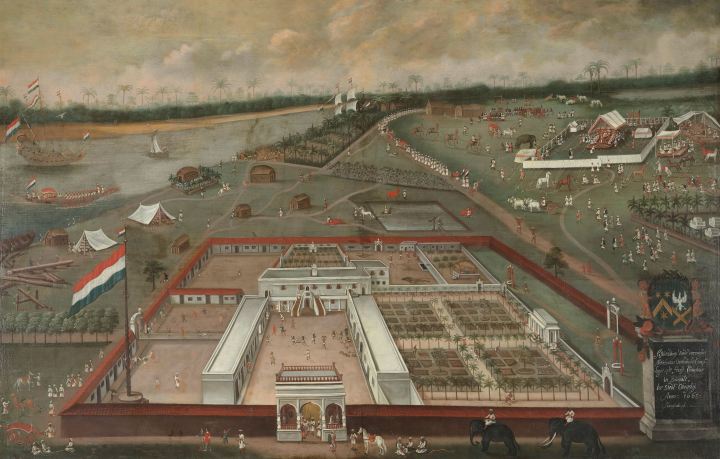
Hendrik van Schuylenburgh, The Trading Post of the Dutch East India Company in Hooghly, Bengal, 1665, oil on canvas, 203 × 316cm
(Amsterdam: Rijksmuseum)
◊ ◊ ◊ ◊ ◊
This project, aimed at reconsidering objects in the permanent collection of the Rijksmuseum, coincides with the major exhibition Slavery: Ten True Stories:
Rijksmuseum & Slavery: New Light on the Permanent Collection
Rijksmuseum, Amsterdam, 18 May 2021 — February 2022
Many of the works in the Rijksmuseum’s permanent collection have links with the Netherlands’ slavery past. It’s a relationship you probably won’t notice at first glance and one you won’t typically read about on a museum label next to an object: from the nutmeg harvested by enslaved people, to an enslaved woman shipped off to the Netherlands; from the image of a dance party on a Surinamese plantation that hides critical messages about the slaveholder, to the pulpit from which an 18th-century legal philosopher made the case for abolishing slavery.
Rijksmuseum & Slavery is adding 77 museum labels to paintings and objects in the permanent collection. The new labels will remain in place for a year, until February 2022. All of them focus on the colonial power of the Netherlands, which from the 17th century onwards was inextricably bound up with a system that included slavery. Some of the labels tell the stories of people who, under Dutch rule, were enslaved and put to work, and had their status reduced to that of objects, while others highlight people who profited from slavery, or spoke out against it.
When the Slavery exhibition and Rijksmuseum & Slavery have ended, the museum will evaluate both the pre-existing labels and the new ones. Wherever possible, the new information will be integrated into the museum in order to do greater justice to the Netherlands’ complicated history. The labels are collected in a booklet available free of charge in the museum. The booklet can also be downloaded here. In addition, all the labelled works are available online as a collection in Rijksstudio (in two parts: 1500–1650 and 1650–1960).
◊ ◊ ◊ ◊ ◊
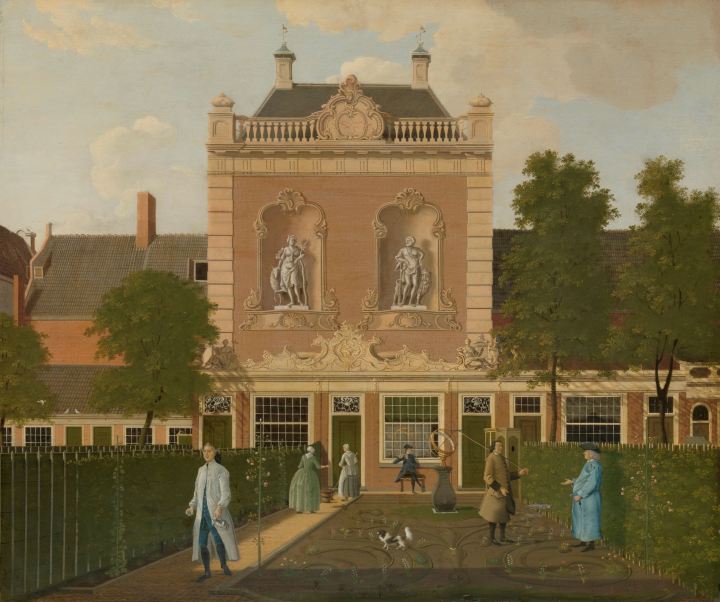
Hendrik Keun, The Garden and Coach House of 524 Keizersgracht in Amsterdam, 1772, oil on panel (Amsterdam: Rijksmuseum).
From the booklet: first the original label and then the newly added one:
Nicolaas Doekscheer, who lived at 524 Keizersgracht, built a grand, Rococo coach house on the Kerkstraat, which adjoined the back of his garden. He is here depicted conversing with the gardener, while his wife speaks to a maidservant. The two young men are Doekscheer’s nephews and heirs. The painting is still in its original Rococo frame.
The 18th-century Dutch elite benefitted greatly from the slavery-based plantation economy.[1] So did Nicolaas Doekscheer and his associate Hendrik Steenbergen, both depicted here in a garden. They financed no less than fifteen plantations in Berbice, Demerary, and Essequebo (all three part of present-day Guyana, South America).[2] Thanks to these loans, plantation owners were able to set up their coffee, cotton, and sugar plantations, while in Amsterdam Doekscheer and Steenbergen made a substantial profit from the interest.[3] See booklet for the footnotes.
Exhibition | Family & Friends: Reynolds at Port Eliot

Joshua Reynolds, Portrait of the Eliot Family, 1746, oil on canvas, 85 × 112 cm (Plymouth: The Box, A16; acquired from the Trustees of Port Eliot Estate through the acceptance in lieu scheme, 2007).
◊ ◊ ◊ ◊ ◊
Press release for the exhibition, via Art Daily. . .
Family & Friends: Reynolds at Port Eliot
The Box, Plymouth, 24 July — 5 September 2021
Curated by Emma Philip
Family & Friends: Reynolds at Port Eliot is a new, free exhibition that draws on The Box’s extensive collection of paintings by Sir Joshua Reynolds (1723–1792)—the UK’s single largest public collection of the artist’s work outside of London—to explore the enduring connection between the Plymouth-born master painter and the Eliot family of Port Eliot in St Germans, Cornwall. On view from 24 July until 5 September, the exhibition paints an intimate picture of how a rare fusion of patronage and genuine friendship supported Plymouth’s most famous portrait painter throughout his life, from budding local artist to founding president of the Royal Academy. Intimate in scale and subject matter, the exhibition is a precursor to a major celebration in 2023 which will mark the 300th anniversary of Reynolds’ birth.
It was Reynolds’s early portraits of naval officers living around Plymouth Dock (Devonport) that caught the attention of Captain John Hamilton, a man Reynolds would paint three times over the course of his life and a close friend of the Eliots who later married into the family.
The Eliot connection proved both lucrative and personally fulfilling as Edward Eliot—later the first Lord Eliot—was one of Reynolds’s repeat patrons and acted as one of the pallbearers at his funeral at St Paul’s Cathedral in 1792. The close bond between the Eliots and Reynolds endured even after his death, with the family continuing to purchase his work when it became available, such as Hope Nursing Love, acquired in 1835.

Joshua Reynolds, Portrait of Lady Anne Bonfoy, née Eliot (1729–1810), oil on canvas, 125 × 101 cm (Plymouth: The Box, A18; acquired from the Trustees of Port Eliot Estate through the acceptance in lieu scheme, 2007).
Perhaps it was Reynolds’s exceptional ability to capture the individual characters of his sitters that first attracted the Eliot family, or perhaps it was this close relationship that gave rise to some of Reynolds’ most eye-catching work. Many of the pieces within the exhibition speak to this mastery, in particular a rare example of an early group portrait in The Eliot Family (1746), which remarkably shows children actually playing and foreshadows Captain John Hamilton’s future role as part of the family, and Lady Anne Bonfoy (née Eliot) (1755), a stunning portrait which depicts the young woman—whom Reynolds had known for a number of years—in the type of dynamic stance previously reserved for portraits of men.
Family & Friends: Reynolds at Port Eliot is an opportunity for the visitors to see 14 of the 23 paintings that were accepted by Plymouth City Council in lieu of inheritance tax in 2007, and which now form part of The Box’s permanent collection. The Box owns a total of 18 autograph works by Reynolds, plus three attributed to or after Reynolds, as well as a number of his personal items.
After visiting the exhibition, visitors can explore additional gallery spaces at The Box displaying work by and objects belonging to Reynolds. The collection features his 1746 Self-Portrait, his 1755 sitter’s book, palettes, mahl sticks, paint box, and sketchbook from 1750–52. Four works are also on display in the Cottonian Research Room: portraits of Reverend Samuel Reynolds (his father), Frances Reynolds (his sister), Charles Rogers, and a further self-portrait.
Emma Philip, Senior Curator at The Box said: “We’re delighted to display these important Reynolds paintings from our collections for our audiences to enjoy this summer. Now, more than ever, we all feel the importance of our family and friends, and of our images of them. This exhibition offers the opportunity to see an intimate, historic set of portraits and examine the relationship between Reynolds and the Eliot family from a new perspective.”
Councillor Mark Deacon, Cabinet Member for Customer Services, Culture, Leisure and Sport said: “Sir Joshua Reynolds is an artist of immense local significance as well as national and international importance and so it’s wonderful to see this intimate celebration of his portraiture of people who meant a great deal to him staged here in Plymouth. The works you’ll see at the exhibition offer a glimpse into those accepted in lieu by Plymouth City Council in 2007 ahead of a more substantial celebration of Reynolds in 2023.”
The Box is Plymouth’s new £46 million cultural destination, proudly led by Plymouth City Council in Britain’s Ocean City. A museum, gallery, and archive. A cafe, shop, and bar. A place that you can make your own, and where there’s always something new to discover. The opening of The Box was one of the most significant cultural events in the UK in 2020. Plymouth’s former Museum and Art Gallery, Central Library and St Luke’s church buildings have been completely transformed with a series of new galleries and exhibition spaces.
Notre Dame Launches New Online Access Platform
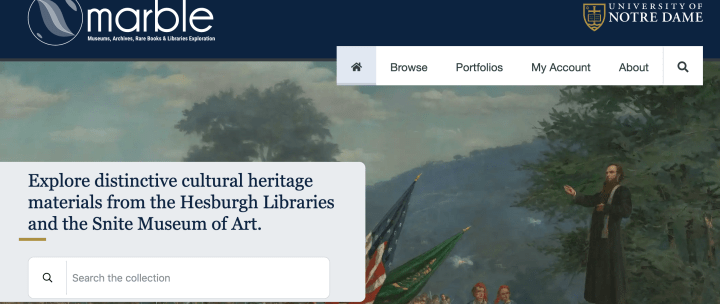
Press release (21 July 2021) from the Snite Museum of Art:
The Hesburgh Libraries and the Snite Museum of Art at the University of Notre Dame have launched Marble (Museum, Archives, Rare Books, and Libraries Exploration)—an online teaching and research platform designed to make distinctive cultural heritage collections from across the University accessible through a single portal.
The development of Marble was made possible, in part, by a three-and-one-half-year grant from The Andrew W. Mellon Foundation to create an open-access, unified software solution that would enable universities to access museum and library holdings through a single online platform.
University libraries, archives, and museums nationwide have been digitizing collections for well over a decade and have long sought collaborative solutions that would enable their respective holdings to be easily discovered online and used for teaching and research. However, there have been many obstacles preventing efficient and expansive research across collections, including disparate technical systems, discipline-specific practices, and descriptive metadata norms. A cross-disciplinary team developed Marble to address this universal challenge and to help transform teaching and research at Notre Dame and other institutions facing similar needs.
“Thanks to the hard work of so many in the Hesburgh Libraries and Snite Museum of Art and the generosity of the Mellon Foundation, Notre Dame is transforming the way scholars on campus and around the world further knowledge and advance research,” said Marie Lynn Miranda, the Charles and Jill Fischer Provost. “It’s a wonderful privilege for Notre Dame to play a role in preserving these important cultural heritage collections and in making those collections easier to access, explore, and investigate.”
The Snite Museum of Art, Rare Books & Special Collections, and the University Archives have historically been independent gateways for faculty and students to engage with research collections, historical information and cultural objects. Users could access the physical collections at different locations and some item descriptions online, but few resources have been made available as digital surrogates, let alone through a single web platform.
In this unified discovery space, users now have open access to a selection of digitized cultural heritage collections that were once inaccessible. While these digitized materials are only a fraction of the University’s holdings, cross-institutional teams will collaborate to add new items regularly.
“The museum is grateful to be a part of this research partnership and the initial phase of the Marble project,” said Joseph Antenucci Becherer, director of the Snite Museum. “Offering the academy, and all users, access to our collections is deeply meaningful and useful in guiding the future of both research and teaching, not to mention pure enjoyment for even the more casual, curious user.”
“Marble offers key features that fundamentally transform the way digital collections can be used for teaching and research,” said Diane Parr Walker, the Edward H. Arnold University Librarian. “The museum and library collaboration and the grant outcomes will have a transformational impact on pedagogical access, scholarly engagement, and research outcomes at Notre Dame.”
Faculty, students, and the general public can browse Marble and download select digitized materials from the Snite Museum of Art, Rare Books & Special Collections, and the University Archives in a single platform—including books, manuscripts, sculptures, paintings, photographs, ephemera, and more. Each item displays one or more images with descriptive information and linked metadata to view related or similar items.
At the heart of Marble is an open-source image sharing standard called IIIF, or the International Image Interoperability Framework. IIIF is a set of universal specifications that provides a standardized way of storing and displaying images. One of the benefits of using IIIF images is that they can be viewed alongside other IIIF-compliant images from institutions around the world. IIIF viewing features include zoom, rotation, color manipulation, comparable viewing, and options for cross-institutional research.
The Portfolio tool turns members of the Notre Dame community into curators, allowing each person to create customized lists and collections of content. Users browse, search, and easily save items of interest into portfolios for future viewing. Portfolios are versatile—they can be shared for teaching, used for course assignments, or annotated for individual research. They can remain private for personal use or be shared with students, campus peers, or the public.
“Marble’s features are designed to facilitate primary resource discovery and streamline the research process. This platform allows for deep integration of the University’s cultural heritage holdings—regardless of where they reside,” said Mikala Narlock, digital collections strategy librarian. “We hope Marble will become an essential and indispensable platform for teaching and learning with digital collections at Notre Dame.”
The University of Notre Dame shares the Mellon Foundation’s commitment to advancing museum-library collaborations through freely available, scalable solutions.
The Marble software has been developed in the cloud, making it more scalable and less costly than software deployed on a local network infrastructure. It uses a harvest model to draw descriptive information from key source systems and features a shared administrative back-end to augment harvested data. This solution is possible due to a shared understanding of different descriptive terms.
In addition to a technical solution, the grant team facilitated critical social infrastructure conversations to optimize collection management and metadata workflows. The development roadmap will enable new features and continue to improve collaboration between libraries and museums.
The code for the Marble project was developed and will be maintained by the Hesburgh Libraries development team. The platform code is openly licensed under an Apache 2.0 license and available on GitHub. Project documentation, technical diagrams, collaborative processes, and best practices are published on the Open Science Framework.
Online access to these selections of distinctive cultural heritage materials at Notre Dame is free and open to the public. Visit marble.nd.edu often to see new materials and featured portfolios published throughout the year.
Commodore Collection Now Preserved in Maryland
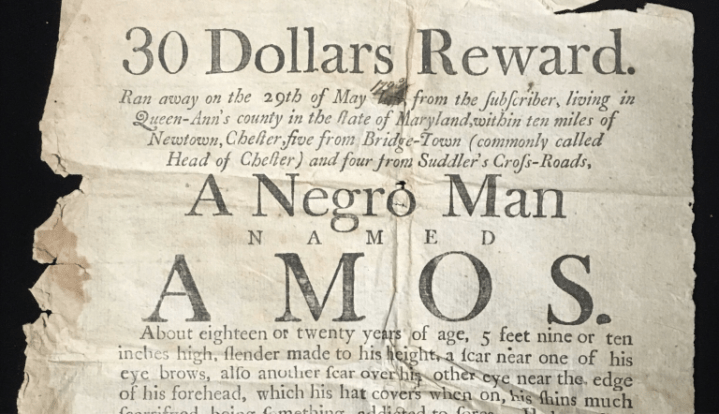
’30 Dollars Reward’ broadside for a man named Amos, detail, 11 February 1793 (Chesterton, Maryland: Commodore Collection). The full document with more information is available here.
◊ ◊ ◊ ◊ ◊
From The Washington Post:
Michael E. Ruane, “A Maryland attic hid a priceless trove of Black history. Historians and activists saved it from auction,” The Washington Post (28 June 2021). Among the artifacts is an account of escape from enslavement that is among the oldest ever found.
The 200-year-old document was torn and wrinkled. It had stains here and there. And it was sitting on a plastic table in the storeroom of an auction house near the Chester River hamlet of Crumpton, on Maryland’s Eastern Shore. Historian Adam Goodheart had seen it before, but only in a blurry website photo. Now, here it was in a simple framed box—a wanted poster for “A Negro Man named Amos” who had fled from his enslaver in Queen Anne’s County.
It was chilling. There, on cheap rag paper, was the story of American slavery. Amos was “a smart fellow,” about 20, who might be headed for his mother in Philadelphia. But in 1793 he was the property of one William Price, who wanted him caught.
The poster, or ‘broadside’, was one of hundreds of rare documents discovered earlier this year in the attic of an old house on the Eastern Shore and saved from the auction block by a group of Washington College historians and local Black activists. And the reward poster turned out to be one of the oldest known, said Goodheart, director of the college’s Starr Center for the Study of the American Experience in Chestertown, Maryland . . . .
The full article is available here»
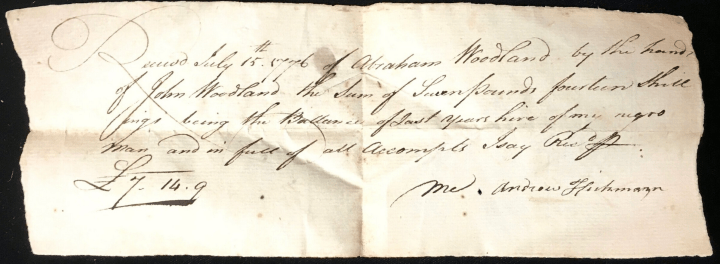
Receipt for the ‘hire’ of an enslaved man, 15 July 1776 (Chesterton, Maryland: Commodore Collection). More information is available here.
◊ ◊ ◊ ◊ ◊
From Sumner Hall:
Sumner Hall is proud to share with our supporters the successful effort to rescue and preserve a significant collection of local records.
“The Commodore Collection of original historical documents on the early experiences of African Americans in Kent and Queen Anne’s counties is a rare find,” according to Dr. Ruth Shoge, First Vice President of Sumner Hall. “The documents, which are intellectually enriching, also evoke an emotional response to the harsh reality of the lives of enslaved and freed Black people in 17th- and 18th-century America,” she continued. “It is very important to Sumner Hall that this collection has been given to us in perpetuity. The ownership of this collection is an honor and, in a special way, a homecoming for the memories of our ancestors. This collection supports our mission of promoting an understanding of the African American experience within the overall context of American history and culture.”
Thanks to the efforts of local Black residents and the Starr Center for the Study of the American Experience at Washington College, approximately 2,000 pages of documents were purchased from Dixon’s Crumpton Auction this spring. The collection, named after Washington College’s first local Black alumnus, Norris Commodore ’73, will belong to Sumner Hall but is being conserved and archived at the school’s Miller Library. Mr. Commodore, who has deep roots here, gave generously toward the acquisition cost and was joined by the Hedgelawn Foundation, the Kent Cultural Alliance and the Andrew W. Mellon Foundation. The papers are being digitized as a part of the Chesapeake Heartland Project, and several can already be viewed online here.
President of Sumner Hall’s Board of Directors, Larry Wilson, says, “The Commodore Collection is a very meaningful record of African American life and survival. I believe that it is very important to know our history and to learn from the lives of our ancestors as we work together for equal rights, justice and freedom in this county and across the country. We look forward to having exhibits at Sumner Hall based on these materials soon.”
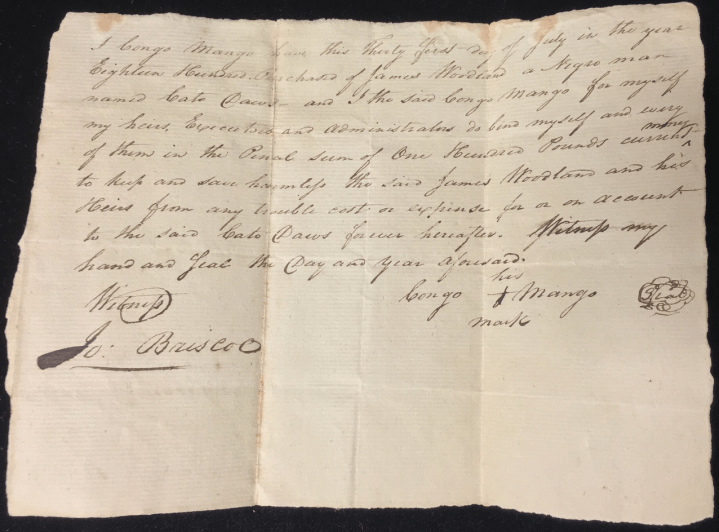
Congo Mango’s bond on behalf of Cato Daws, 31 July 1800. Mango (later known as Congo Mander), a free Black man, purchased Daws in order to grant his freedom (Chesterton, Maryland: Commodore Collection). As noted in the document description, “This small piece of paper opens a window into the life story of a man who was born in Africa, enslaved in Maryland, gained his freedom, and helped others become free. He gave rise to a Black family that can be traced to the present day.” More information is available here.
◊ ◊ ◊ ◊ ◊
Sumner Hall, located in historic Chestertown on Maryland’s Eastern Shore, is one of two existing African American Grand Army of the Republic buildings still standing in the United States. Built circa 1908 and fully restored in 2014, it serves today as a museum, educational site, performance stage, social hall, and gallery. Sumner Hall is a registered 501(c)(3) nonprofit corporation, funded by donations and memberships.
Shaker Museum Scheduled To Open in 2023
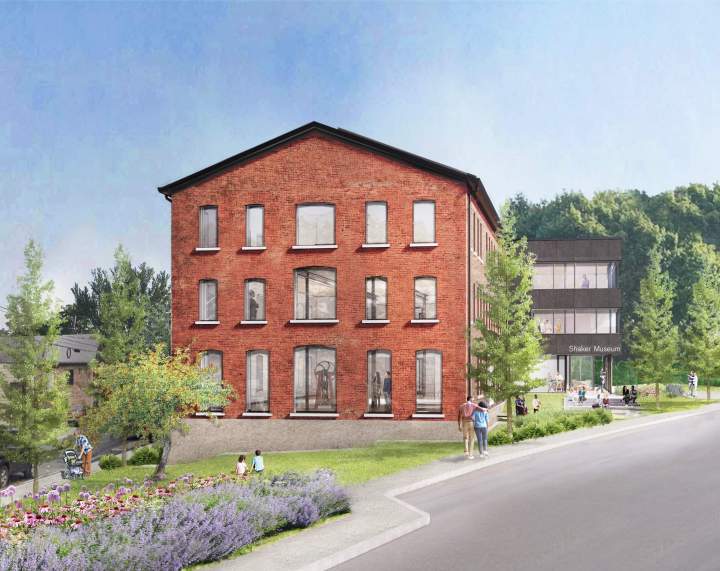
Rendering of the Shaker Museum in the village of Chatham, New York. Selldorf Architects is charged with the design of the $18million museum complex. Renderings are presented alongside select Shaker objects as part of a special pop-up exhibition The Future is a Gift, on view in downtown Chatham through August 29 (Image: Selldorf Architects/Shaker Museum). Additional views are available at The Architect’s Newspaper.
◊ ◊ ◊ ◊ ◊
From The NY Times . . .
Patricia Leigh Brown, “The Shakers Are Movers, Too,” The New York Times (20 June 2021). The country’s most significant collection of Shaker objects, out of public view for a decade, will relocate to an $18 million museum complex designed by Annabelle Selldorf.
In an earlier life, the moribund red brick Victorian at the foot of Main Street in this thriving Columbia County village [of Chatham, NY] had been a sanitarium, a hotel and tavern, a furniture store and an auto dealership. These were the warm-up acts for its latest incarnation: a permanent new home for the Shaker Museum, widely considered the country’s most significant collection of Shaker furniture, objects and archival material. The museum, set to open in 2023 and to include a new addition, is being designed by the architect Annabelle Selldorf, whose current projects include the expansion of The Frick Collection in New York and an addition for The Museum of Contemporary Art San Diego La Jolla. . . .
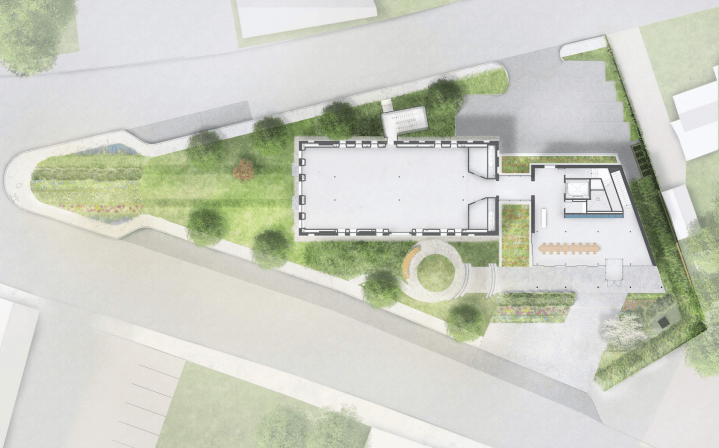
Nelson Byrd Woltz has been tasked to design a Shaker-inspired landscape for the complex, pictured here in the landscape site plan (Nelson Byrd Woltz/Courtesy Shaker Museum).
◊ ◊ ◊ ◊ ◊
The museum’s exhibitions are still in the nascent stages. Maggie Taft, a guest curator, said the permanent exhibition will address the fundamental aspects of Shakerism, which reached its Zenith in the 1840s with 18 villages from Maine to Kentucky, but also the unexpected subtexts. The sect—an international Protestant monastic community—was founded in 1774 by Mother Ann Lee, the charismatic illiterate daughter of an English blacksmith (a swatch of one of her aprons is among the museum’s most prized possessions).
Although the sect was known for gender equality, Ms. Taft noted that women and men were “divided in ways that resembled worldly labor divisions”—with men toiling outside on agriculture and other tasks while the women worked indoors. The exhibition will also explore the different generations of Shakerism, especially the third generation after Mother Ann Lee’s death in 1784, when young women’s ‘encounters’ with her were manifested in drawings and texts thought to be ‘gifts’ from the spirits. . . .
The full article is available here»
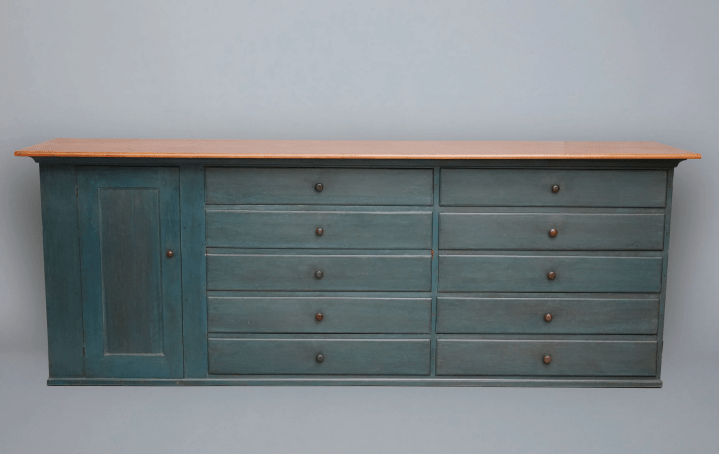
Tailor’s counter painted blue, pinewood, ca. 1815
(Shaker Museum)
Sweden Nationalmuseum Acquires Two Portraits by J. E. Alphen
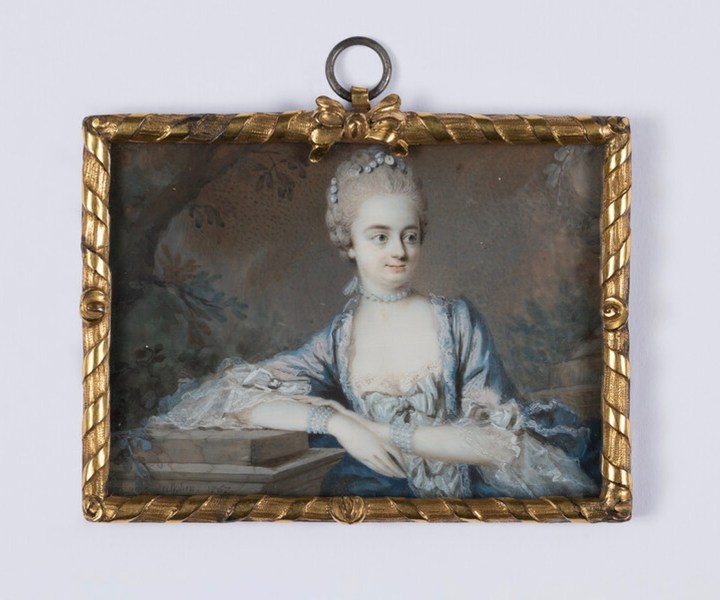
Johann Eusebius Alphen, Portrait of a Lady in a Blue Dress, 1767, watercolour and gouache on ivory
(Stockholm: Nationalmuseum, photo by Anna Danielsson)
◊ ◊ ◊ ◊ ◊
Press release (2 June 2021) from Sweden’s Nationalmuseum in Stockholm:
Nationalmuseum has acquired two portraits of women created by the Austrian court miniaturist Johann Eusebius Alphen in 1767. The portrayals of the models are unusually vivid, and the artist has even been carefully rendering the setting. The two portraits are unique because few signed works by Alphen have survived, as the artist was just 31 years old when he died.
In the mid-18th century, if a young artist wanted to further educate himself in miniature painting, Paris was one of the most interesting places to be. The city’s leading name was Jean-Baptiste Massé, a member of the academy and royal court painter. He revitalised miniature painting with his loose and unconventional brush technique. By this time Massé was no longer active as an artist, because he had started to have problems with his eyesight around 1740 and therefore declined to take on any more royal commissions.
Although Massé had essentially ceased painting, he would continue to play an important role as a teacher. In February 1764, the Austrian Johann Eusebius Alphen (1741–1772) came to Paris and was introduced to the French miniaturist. Yet Alphen was not the only student who quickly rose to favour. That same year, he faced competition from the Dane Cornelius Høyer, who also became a lodger with Massé until the master’s death in 1767. The two young artists, who were even the same age, each acquired the same technique of using loose brushwork. Alphen in particular became a virtuoso, as evidenced by the two recently acquired portraits of women. On their faces, he has combined a refined line and dot technique with a fluid brushstroke to depict clothing and other accessories. White highlights reinforce the sense of materiality and illusionism. This approach is reminiscent of pastel painting, in which Alphen was also skilled. As with his teacher Massé, the red and yellow dyes have faded into carnation, contributing to the unusually bright, powdered look of the faces. Only blue and grey halftones remain.
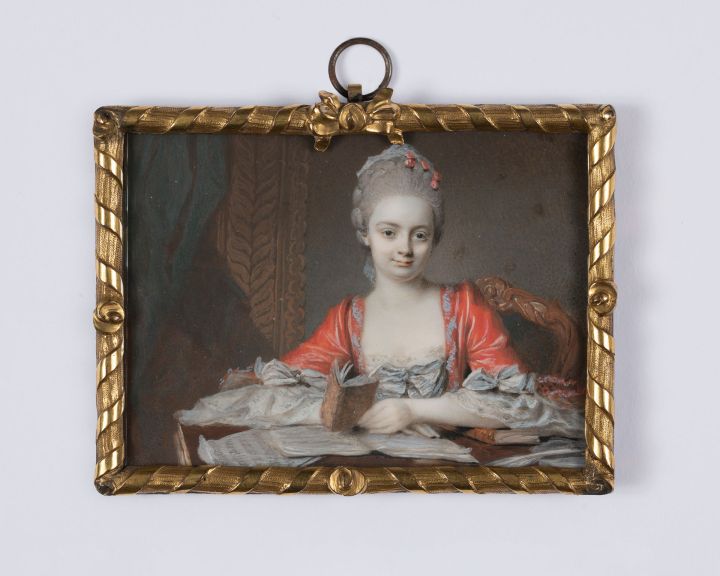
Johann Eusebius Alphen, Portrait of Countess van Lebel, 1767, watercolour and gouache on ivory
(Stockholm: Nationalmuseum, photo by Anna Danielsson)
◊ ◊ ◊ ◊ ◊
Both portraits are signed and dated “Peint par Alphen 1767.” It is unclear whether they were painted while the artist was still in Paris or recently after his arrival in Vienna. The younger lady, dressed in red, sits at a table with notes and a pen in front of her, as well as a book in one hand. The Canadian Mozart specialist Cliff Eisen of King’s College London has floated the theory that this young woman is Wolfgang Amadeus Mozart’s sister Maria Anna, nicknamed Nannerl, who was five years older than the composer. Alphen’s portrait has a direct counterpart in a Swiss private collection. This preliminary study purportedly has ownership-related links to other Mozart portraits. Even if this were not the case, Alphen met the Mozart family on several occasions. The first time was in Brussels in 1763, then three years later in Paris, and finally in Vienna in 1767–68. Their last encounter was in Milan in 1771, where Alphen had a one-on-one rendezvous with Mozart, who mentions their meeting in a letter to his sister Nannerl.
So who is this young woman in red? It is undoubtedly the same model as in the sketch, but is she Maria Anna Mozart? The portrait acquired by Nationalmuseum bears the signature “Comtesse von Lebel.” No countess with this name is known to have lived, but could the name could be a euphemism for the Baroness Berchtold von Sonnenburg, the real Nannerl? In truth, this woman bears little resemblance to other famous representations of Mozart’s sister from around the same time. While this little mystery may never be answered, we can still appreciate the fact that Alphen’s two portraits are unusual examples of the artist’s great virtuosity as a miniaturist.
Nationalmuseum receives no public funding for the acquisition of artworks but relies on donations and gifts from private individuals and foundations to enrich its collections. The acquisition has been made possible by generous contributions from Hjalmar and Anna Wicander’s donation funds.










 Enfilade
leave a comment