Commodore Collection Now Preserved in Maryland
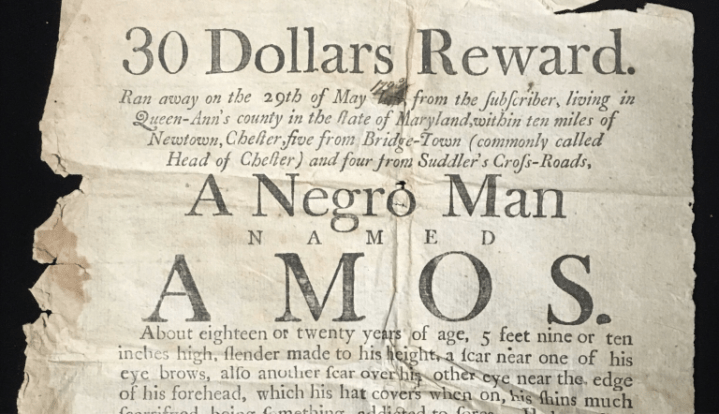
’30 Dollars Reward’ broadside for a man named Amos, detail, 11 February 1793 (Chesterton, Maryland: Commodore Collection). The full document with more information is available here.
◊ ◊ ◊ ◊ ◊
From The Washington Post:
Michael E. Ruane, “A Maryland attic hid a priceless trove of Black history. Historians and activists saved it from auction,” The Washington Post (28 June 2021). Among the artifacts is an account of escape from enslavement that is among the oldest ever found.
The 200-year-old document was torn and wrinkled. It had stains here and there. And it was sitting on a plastic table in the storeroom of an auction house near the Chester River hamlet of Crumpton, on Maryland’s Eastern Shore. Historian Adam Goodheart had seen it before, but only in a blurry website photo. Now, here it was in a simple framed box—a wanted poster for “A Negro Man named Amos” who had fled from his enslaver in Queen Anne’s County.
It was chilling. There, on cheap rag paper, was the story of American slavery. Amos was “a smart fellow,” about 20, who might be headed for his mother in Philadelphia. But in 1793 he was the property of one William Price, who wanted him caught.
The poster, or ‘broadside’, was one of hundreds of rare documents discovered earlier this year in the attic of an old house on the Eastern Shore and saved from the auction block by a group of Washington College historians and local Black activists. And the reward poster turned out to be one of the oldest known, said Goodheart, director of the college’s Starr Center for the Study of the American Experience in Chestertown, Maryland . . . .
The full article is available here»
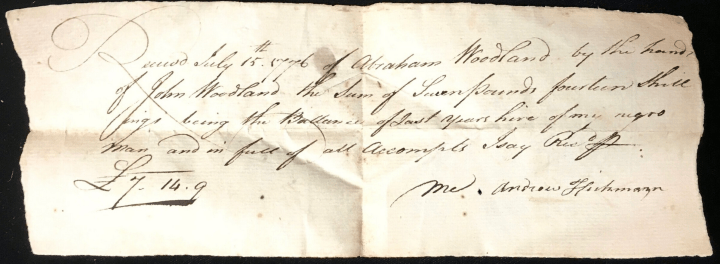
Receipt for the ‘hire’ of an enslaved man, 15 July 1776 (Chesterton, Maryland: Commodore Collection). More information is available here.
◊ ◊ ◊ ◊ ◊
From Sumner Hall:
Sumner Hall is proud to share with our supporters the successful effort to rescue and preserve a significant collection of local records.
“The Commodore Collection of original historical documents on the early experiences of African Americans in Kent and Queen Anne’s counties is a rare find,” according to Dr. Ruth Shoge, First Vice President of Sumner Hall. “The documents, which are intellectually enriching, also evoke an emotional response to the harsh reality of the lives of enslaved and freed Black people in 17th- and 18th-century America,” she continued. “It is very important to Sumner Hall that this collection has been given to us in perpetuity. The ownership of this collection is an honor and, in a special way, a homecoming for the memories of our ancestors. This collection supports our mission of promoting an understanding of the African American experience within the overall context of American history and culture.”
Thanks to the efforts of local Black residents and the Starr Center for the Study of the American Experience at Washington College, approximately 2,000 pages of documents were purchased from Dixon’s Crumpton Auction this spring. The collection, named after Washington College’s first local Black alumnus, Norris Commodore ’73, will belong to Sumner Hall but is being conserved and archived at the school’s Miller Library. Mr. Commodore, who has deep roots here, gave generously toward the acquisition cost and was joined by the Hedgelawn Foundation, the Kent Cultural Alliance and the Andrew W. Mellon Foundation. The papers are being digitized as a part of the Chesapeake Heartland Project, and several can already be viewed online here.
President of Sumner Hall’s Board of Directors, Larry Wilson, says, “The Commodore Collection is a very meaningful record of African American life and survival. I believe that it is very important to know our history and to learn from the lives of our ancestors as we work together for equal rights, justice and freedom in this county and across the country. We look forward to having exhibits at Sumner Hall based on these materials soon.”
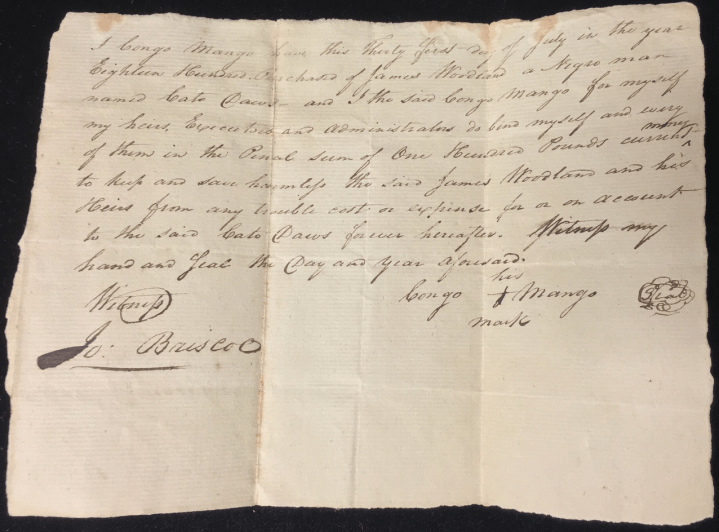
Congo Mango’s bond on behalf of Cato Daws, 31 July 1800. Mango (later known as Congo Mander), a free Black man, purchased Daws in order to grant his freedom (Chesterton, Maryland: Commodore Collection). As noted in the document description, “This small piece of paper opens a window into the life story of a man who was born in Africa, enslaved in Maryland, gained his freedom, and helped others become free. He gave rise to a Black family that can be traced to the present day.” More information is available here.
◊ ◊ ◊ ◊ ◊
Sumner Hall, located in historic Chestertown on Maryland’s Eastern Shore, is one of two existing African American Grand Army of the Republic buildings still standing in the United States. Built circa 1908 and fully restored in 2014, it serves today as a museum, educational site, performance stage, social hall, and gallery. Sumner Hall is a registered 501(c)(3) nonprofit corporation, funded by donations and memberships.
Shaker Museum Scheduled To Open in 2023
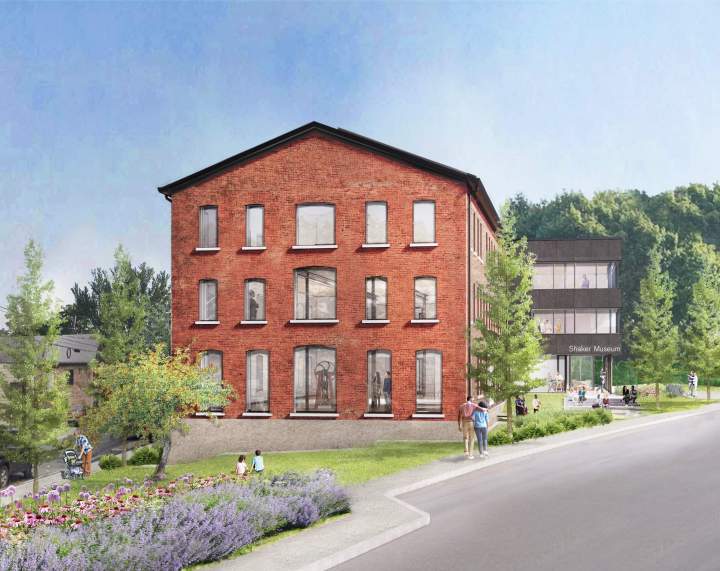
Rendering of the Shaker Museum in the village of Chatham, New York. Selldorf Architects is charged with the design of the $18million museum complex. Renderings are presented alongside select Shaker objects as part of a special pop-up exhibition The Future is a Gift, on view in downtown Chatham through August 29 (Image: Selldorf Architects/Shaker Museum). Additional views are available at The Architect’s Newspaper.
◊ ◊ ◊ ◊ ◊
From The NY Times . . .
Patricia Leigh Brown, “The Shakers Are Movers, Too,” The New York Times (20 June 2021). The country’s most significant collection of Shaker objects, out of public view for a decade, will relocate to an $18 million museum complex designed by Annabelle Selldorf.
In an earlier life, the moribund red brick Victorian at the foot of Main Street in this thriving Columbia County village [of Chatham, NY] had been a sanitarium, a hotel and tavern, a furniture store and an auto dealership. These were the warm-up acts for its latest incarnation: a permanent new home for the Shaker Museum, widely considered the country’s most significant collection of Shaker furniture, objects and archival material. The museum, set to open in 2023 and to include a new addition, is being designed by the architect Annabelle Selldorf, whose current projects include the expansion of The Frick Collection in New York and an addition for The Museum of Contemporary Art San Diego La Jolla. . . .
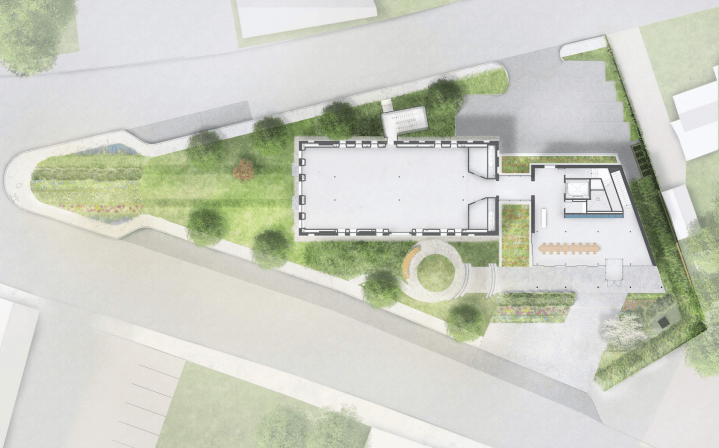
Nelson Byrd Woltz has been tasked to design a Shaker-inspired landscape for the complex, pictured here in the landscape site plan (Nelson Byrd Woltz/Courtesy Shaker Museum).
◊ ◊ ◊ ◊ ◊
The museum’s exhibitions are still in the nascent stages. Maggie Taft, a guest curator, said the permanent exhibition will address the fundamental aspects of Shakerism, which reached its Zenith in the 1840s with 18 villages from Maine to Kentucky, but also the unexpected subtexts. The sect—an international Protestant monastic community—was founded in 1774 by Mother Ann Lee, the charismatic illiterate daughter of an English blacksmith (a swatch of one of her aprons is among the museum’s most prized possessions).
Although the sect was known for gender equality, Ms. Taft noted that women and men were “divided in ways that resembled worldly labor divisions”—with men toiling outside on agriculture and other tasks while the women worked indoors. The exhibition will also explore the different generations of Shakerism, especially the third generation after Mother Ann Lee’s death in 1784, when young women’s ‘encounters’ with her were manifested in drawings and texts thought to be ‘gifts’ from the spirits. . . .
The full article is available here»
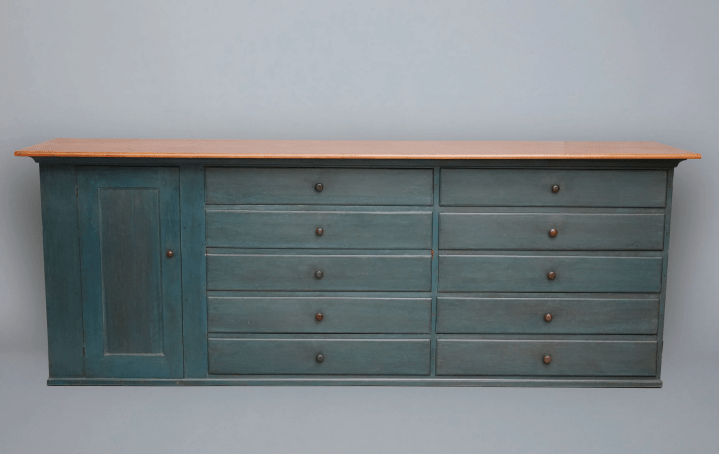
Tailor’s counter painted blue, pinewood, ca. 1815
(Shaker Museum)
Sweden Nationalmuseum Acquires Two Portraits by J. E. Alphen
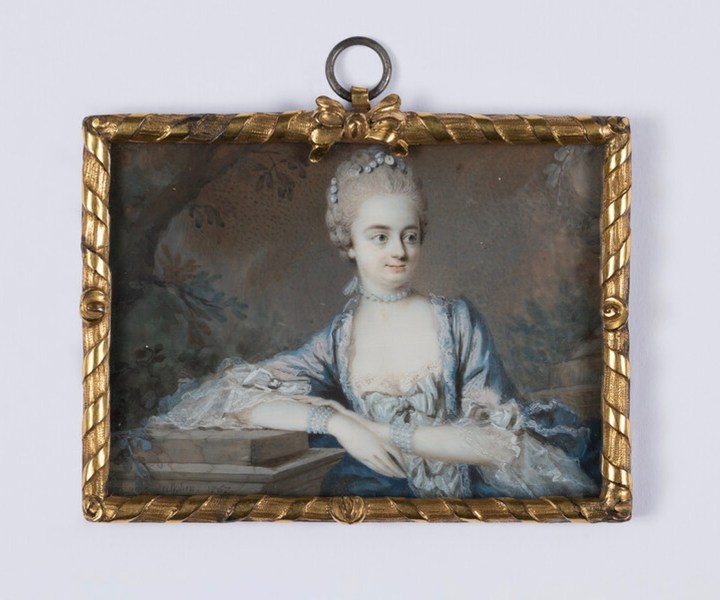
Johann Eusebius Alphen, Portrait of a Lady in a Blue Dress, 1767, watercolour and gouache on ivory
(Stockholm: Nationalmuseum, photo by Anna Danielsson)
◊ ◊ ◊ ◊ ◊
Press release (2 June 2021) from Sweden’s Nationalmuseum in Stockholm:
Nationalmuseum has acquired two portraits of women created by the Austrian court miniaturist Johann Eusebius Alphen in 1767. The portrayals of the models are unusually vivid, and the artist has even been carefully rendering the setting. The two portraits are unique because few signed works by Alphen have survived, as the artist was just 31 years old when he died.
In the mid-18th century, if a young artist wanted to further educate himself in miniature painting, Paris was one of the most interesting places to be. The city’s leading name was Jean-Baptiste Massé, a member of the academy and royal court painter. He revitalised miniature painting with his loose and unconventional brush technique. By this time Massé was no longer active as an artist, because he had started to have problems with his eyesight around 1740 and therefore declined to take on any more royal commissions.
Although Massé had essentially ceased painting, he would continue to play an important role as a teacher. In February 1764, the Austrian Johann Eusebius Alphen (1741–1772) came to Paris and was introduced to the French miniaturist. Yet Alphen was not the only student who quickly rose to favour. That same year, he faced competition from the Dane Cornelius Høyer, who also became a lodger with Massé until the master’s death in 1767. The two young artists, who were even the same age, each acquired the same technique of using loose brushwork. Alphen in particular became a virtuoso, as evidenced by the two recently acquired portraits of women. On their faces, he has combined a refined line and dot technique with a fluid brushstroke to depict clothing and other accessories. White highlights reinforce the sense of materiality and illusionism. This approach is reminiscent of pastel painting, in which Alphen was also skilled. As with his teacher Massé, the red and yellow dyes have faded into carnation, contributing to the unusually bright, powdered look of the faces. Only blue and grey halftones remain.
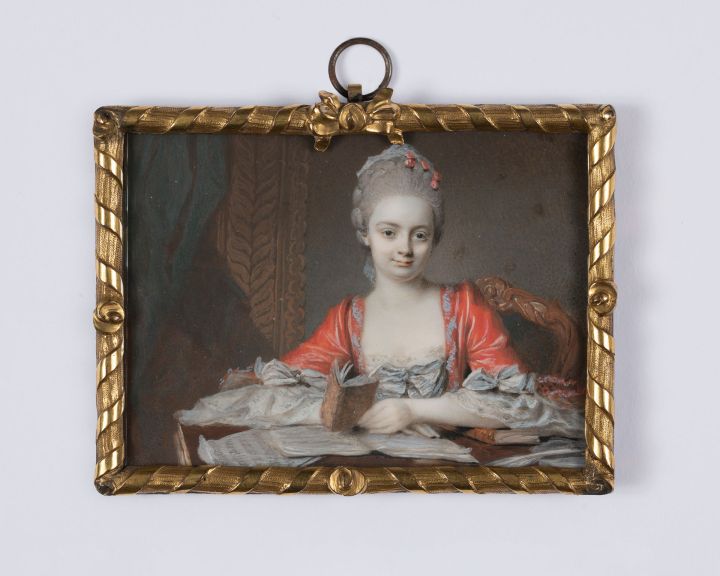
Johann Eusebius Alphen, Portrait of Countess van Lebel, 1767, watercolour and gouache on ivory
(Stockholm: Nationalmuseum, photo by Anna Danielsson)
◊ ◊ ◊ ◊ ◊
Both portraits are signed and dated “Peint par Alphen 1767.” It is unclear whether they were painted while the artist was still in Paris or recently after his arrival in Vienna. The younger lady, dressed in red, sits at a table with notes and a pen in front of her, as well as a book in one hand. The Canadian Mozart specialist Cliff Eisen of King’s College London has floated the theory that this young woman is Wolfgang Amadeus Mozart’s sister Maria Anna, nicknamed Nannerl, who was five years older than the composer. Alphen’s portrait has a direct counterpart in a Swiss private collection. This preliminary study purportedly has ownership-related links to other Mozart portraits. Even if this were not the case, Alphen met the Mozart family on several occasions. The first time was in Brussels in 1763, then three years later in Paris, and finally in Vienna in 1767–68. Their last encounter was in Milan in 1771, where Alphen had a one-on-one rendezvous with Mozart, who mentions their meeting in a letter to his sister Nannerl.
So who is this young woman in red? It is undoubtedly the same model as in the sketch, but is she Maria Anna Mozart? The portrait acquired by Nationalmuseum bears the signature “Comtesse von Lebel.” No countess with this name is known to have lived, but could the name could be a euphemism for the Baroness Berchtold von Sonnenburg, the real Nannerl? In truth, this woman bears little resemblance to other famous representations of Mozart’s sister from around the same time. While this little mystery may never be answered, we can still appreciate the fact that Alphen’s two portraits are unusual examples of the artist’s great virtuosity as a miniaturist.
Nationalmuseum receives no public funding for the acquisition of artworks but relies on donations and gifts from private individuals and foundations to enrich its collections. The acquisition has been made possible by generous contributions from Hjalmar and Anna Wicander’s donation funds.
At Auction | Vase Designed by Thomas Hope

Gilt bronze-mounted patinated copper two-handled vase (detail) by Alexis Decaix, designed by Thomas Hope for his Duchess Street Mansion in London, ca. 1802–03, 26 × 13 × 12 inches (65 × 34 × 31 cm). Heritage Auctions, 18 June 2021, Sale 8046, Lot #61046, estimate: $40,000 to $60,000.
◊ ◊ ◊ ◊ ◊
From the press release, via Art Daily:
An extraordinarily rare and important early 19th-century urn, thought lost to history, was recently discovered by Heritage Auctions and is set to go to auction June 18 in Dallas, Texas (Sale 8046, Lot 61046). Designed by Thomas Hope, the urn was found in Tulsa, Oklahoma, in the collection of David D. Denham, where it had been modified into a side table. Heritage has set a conservative pre-auction estimate of $40,000 to $60,000 on the rare bronze. According to research, the urn’s mate resides in London’s Victoria and Albert Museum (M.33-1983), the world’s largest museum of applied and decorative arts and design.
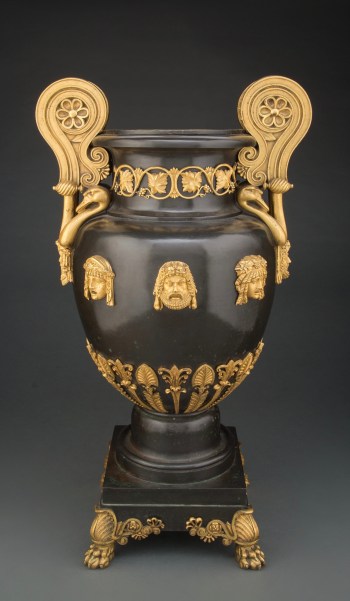
Gilt bronze-mounted patinated copper two-handled vase by Alexis Decaix, designed by Thomas Hope for his Duchess Street Mansion in London, ca. 1802–03.
“This important discovery was a remarkable surprise,” said Karen Rigdon, Director of Fine & Decorative Art at Heritage Auctions. “No one knew where the urn was for decades until we recognized it during a house call.”
Hope commissioned the vase, decorated with ormolu (gilt-bronze) mounts, for the dining room of his mansion located on Duchess Street in London. It was made by acclaimed French artist Alexis Decaix based on Hope’s design, which mirrored a classical volute krater (an ancient Greek vase with two handles which was used for mixing wine and water). Hope likely commissioned the one-of-a-kind pair of bronze urns directly from Decaix. Experts working with Heritage matched the urn’s historical background with telltale details confirming the vase is the pair to the one at the V&A. The newly-discovered vase’s specific placement of the mask mounts at the obverse and reverse matched the vase in the museum’s collection, as does the placement of specific notches and scratches made to each vase.
Hope, the scion of a wealthy banking family, made his London home into an outstanding example of Neo-classical design. In 1807, Hope published in London an illustrated account of the house and its furnishings in a book titled Household Furniture and Interior Decoration. The book had a considerable influence on other architects and designers working in the Greek Revival style.
“The appearance of this second example confirms Hope clearly took great care to ensure the vases would be displayed in perfect harmony, which supports what is known about his incredibly meticulous nature and approach to collecting,” according to Hope experts Philip Hewat-Jaboor and William Iselin, who worked with Heritage to confirm the vase’s authenticity.
Heritage experts discovered the urn in Tulsa in the collection of the late David Denham. “Denham was a well-known social figure in the area and admired for his collector’s eye and meticulous attention to detail,” Rigdon said. “The estate is unsure when the vase first entered Denham’s collection or when it was made into a side table,” she added. “But its discovery closes a chapter on the unknown history of this important artwork.”
NMWA’s Comprehensive Renovation To Begin in August
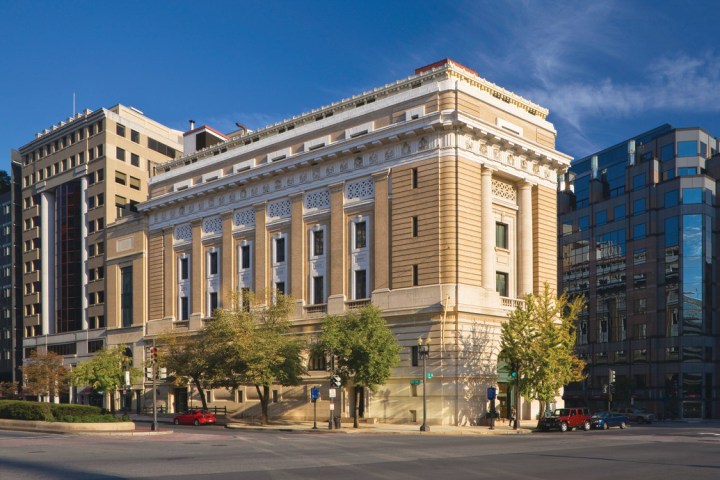
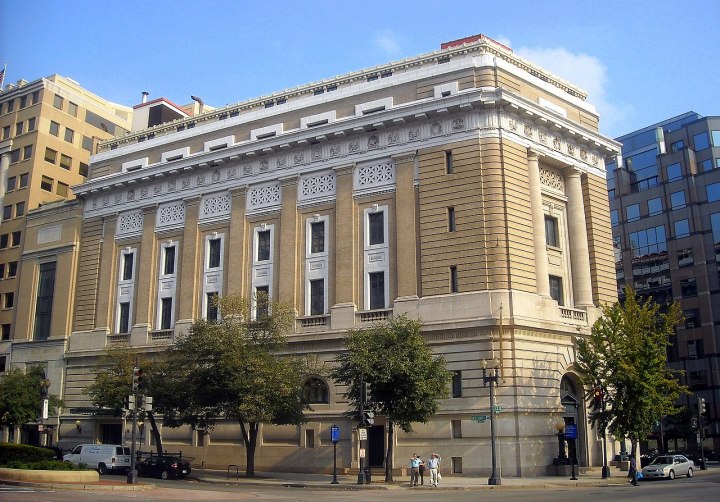
National Museum of Women in the Arts, Exterior, 13th Street and New York Avenue sides, Washington, D.C.
(Photo by Thomas H. Field, September 2008)
◊ ◊ ◊ ◊ ◊
From the museum’s press release (17 May 2021) . . .
Upgrades to historic building will enhance exhibition galleries, programming, scholarship, and accessibility and improve visitor experience.
The National Museum of Women in Arts (NMWA), the world’s only major museum solely dedicated to championing women artists, announces a plan for the comprehensive renovation of the museum’s historic building at 1250 New York Avenue, NW, in Washington, D.C. State-of-the-art upgrades to the museum’s home, a 1908 Classical Revival structure listed on the National Register of Historic Places, will expand NMWA’s exhibition space and enhance its programming, strengthening its work for years to come. The plan requires the building to close to the public beginning 9 August 2021. Construction will commence on 1 September 2021 and will be completed in approximately two years.
The building’s first full renovation since 1987, the $66 million project will honor the structure’s history while improving its interior spaces, mechanical systems, and exterior envelope. The long-planned updates include enlarged gallery space to showcase historic and contemporary artworks and installations; a new destination for researchers and education programs; and enhanced amenities and accessibility for visitors. Infrastructure and storage upgrades will bolster the long-term conservation and security of the museum’s collection of more than 5,500 works.
“From its home in the nation’s capital, NMWA has given deserved prominence to groundbreaking women artists of the past and present for nearly 35 years, but the goal of equity for women through excellence in the arts has yet to be achieved,” said NMWA Director Susan Fisher Sterling. “This renovation will ensure that the museum continues to promote the contributions of women artists in ways that engage audiences and advocates of tomorrow. Thanks to our founder Wilhelmina Cole Holladay and her husband Wallace—whose bold and ambitious vision led them to collect art by women and create a museum for its permanent display—our building is the center of a worldwide movement that champions women in, and through, the arts.”
Beginning in 2015, NMWA undertook a rigorous assessment of the historic building and created an extensive plan for renovations that apply recent advances in engineering, building codes, and sustainability. The Baltimore-based architectural firm Sandra Vicchio & Associates was chosen to lead the project.
“It is a majestic structure—timeless and beautiful,” said Vicchio. “To protect the collection and enable NMWA to educate and engage the world more effectively, we must upgrade the building’s envelope, improve the performance of its systems, and make better use of its interior space. Revitalizing the building is all about positioning the museum for a triumphant future.”
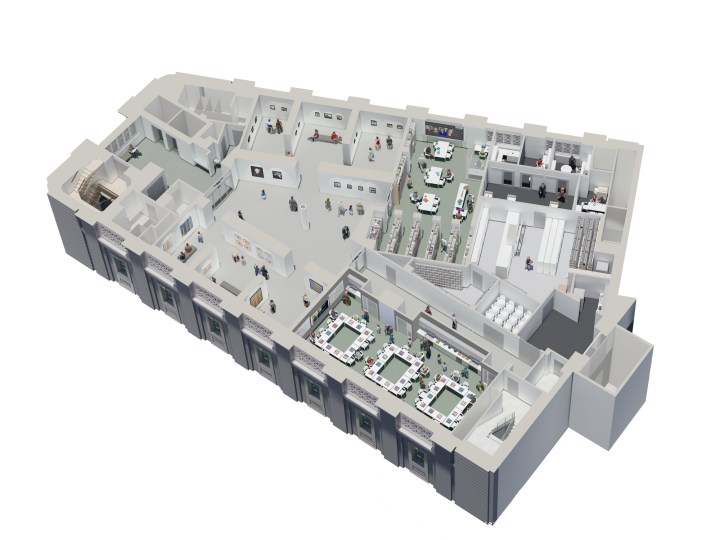
Learning Commons, National Museum of Women in the Arts Renovation Project
(Rendering by Sandra Vicchio & Associates, LLC, with Marshall Craft Associates, Inc.)
The renovation project at NMWA will include
• Transforming the building to provide easier access for all visitors, with upgraded technologies and amenities as well as improved ADA accessibility
• Dedicating a new orientation gallery in the Great Hall that welcomes visitors, introduces the museum’s mission, and tells stories of women artists
• Renovating and enlarging galleries to accommodate historic and contemporary artworks and multifaceted installations
• Creating a new Learning Commons that features a major exhibition gallery, a state-of-the-art Library and Research Center, Reading Room, and an Education Studio for hands-on workshops, curated conversations, and classes, as well as flexible space for rehearsals and other museum events
• Improving wireless and touch-screen technology in galleries, which will enhance visitors’ experiences and learning opportunities with additional connectivity
• Updating the Great Hall and Mezzanine to preserve these iconic spaces while improving their functionality for museum events and facility rentals
• Installing new lighting, climate control, and security technology to support long-term conservation of the art and the overall comfort of visitors
• Enhancing collection storage space to store art more efficiently and care for works of art more effectively
• Improving signage to provide better wayfinding and easy-to-follow pathways throughout the museum
• Restoring the roof, historic cornice, and the building exterior in accordance with the D.C. Historic Preservation Office
During the closure, NMWA will continue to offer a robust slate of online programs and events, virtual exhibitions and digital content. Plans are also underway to present off-site exhibitions and special events.
In less than two years, NMWA has raised over $50 million towards a capital campaign goal of $66 million. With the advent of the COVID-19 pandemic and rising costs in the construction industry, the renovation project costs have grown. Building on the campaign’s robust beginnings, NMWA will continue to solicit gifts throughout the life of the campaign.
“This renovation was the dream of our founder Wilhelmina Cole Holladay, who died on March 6th at age 98,” said Winton S. Holladay, Vice-Chair of the NMWA Board. “In the campaign’s quiet phase, donors and friends have stepped up in wonderful ways, putting us within sight of our campaign goal. With Billie’s passing, we are honored to carry her vision forward by completing this campaign and restoring our building for future generations.”
The museum’s capital campaign is directed by a steering committee of NMWA trustees, advisors, and senior museum staff and is currently supported by gifts from individuals, foundations, and corporations. In addition, the museum has received federal and city funding through competitive grants from the Institute of Museum and Library Services (Museums for America Grant) as well as a first-ever 2020 Cultural Institutions grant from Events DC, a semi-public company supported by D.C. taxpayer funds.
For more information, the capital campaign website displays renderings, tracks project progress, and offers ways to get involved.
About the Historic Building
Designed by the architecture firm Wood, Donn & Deming, the museum’s Classical Revival-style building was completed in 1908 as a temple for the Masons, an organization that did not allow women members. The 78,810-square-foot main building is listed on the DC Inventory of Historic Sites and the National Register of Historic Places. The exterior façade incorporates Tuscan and Mediterranean design elements in addition to Masonic symbolism.
In 1983, Wilhelmina and Wallace Holladay purchased the property to establish a museum dedicated to women artists. The building was refurbished in accordance with the highest design, museum and security standards. After the extensive renovations, which won numerous architectural awards, the National Museum of Women in the Arts opened to the public on 7 April 1987. In 1993, the museum purchased 5,300 square feet of adjacent property, and, following further renovation, the Elisabeth A. Kasser Wing opened in 1997, making the entire facility 84,110 square feet.
On Tour | Jan van Huysum Visits
From the National Gallery’s press release (May 2021). . .

Jan van Huysum, Flowers in a Terracotta Vase, 1736–37, oil on canvas, 134 × 92 cm (London: The National Gallery, NG796).
Following the positive response to Artemisia Visits (2019), the National Gallery is delighted to announce Jan van Huysum Visits which will see Van Huysum’s magnificent Flowers in a Terracotta Vase (1736–37) travel to six locations across the United Kingdom in summer 2021.
The painting will visit Cornwall, Norfolk, the East Midlands, South Yorkshire, Scotland, and Northern Ireland. Each display will explore one of six ‘Ways to Wellbeing’: Connect, Be Active, Take Notice, Keep Learning, Give, and Care (for the Planet). Flowers in a Terracotta Vase will be on tour for approximately three months, from early June.
In each region, the painting will pop up in an unusual or unexpected non-museum venue; locations include a food bank and community library, a covered market, a former department store and community centres. The tour will promote ways in which art and culture can support wellbeing and reach audiences who have been disproportionately affected by Covid-19 and the UK lockdown.
At the heart of Jan van Huysum Visits is engagement with local communities. In each setting the Gallery is working closely with the venue as well as a local museum or gallery to ensure that as many people as possible can engage with the painting and make it come alive in new and different ways.
Jan van Huysum (1682–1749) was a native of Amsterdam and the last of the distinguished still-life painters active in the Northern Netherlands in the 17th and early 18th centuries, an internationally celebrated artist in his lifetime. His spectacular Flowers in a Terracotta Vase—which shows over 30 species of flowers and plants in bloom, unfurling in exquisite detail—is no shy, hide-in-a-corner painting. It’s meant to dazzle and it does. Van Huysum is after, and achieves, excess: a celebration of nature, an entertaining puzzle, and a display of wealth, culture, and fashion.
The vase towers above the viewer who is placed firmly below, looking up at it in a niche suitable for a Classical sculpture. The vase overflows with all types of flowers, from florid roses, peonies, mauve and red poppies to the humbler primroses, apple blossom and bachelor’s buttons. In the Dutch Republic, horticulture was a subject of national pride. This is a rich man’s bouquet made to look winsome and natural, but in reality, it’s carefully orchestrated, displaying not only a passion for flowers but an immense knowledge and understanding of them. Butterflies, a yellow ant, a fly, and hothouse fruit are added to the exotic mix, bringing the garden into the house as was the fashion in interior decoration. But one or two of the luscious grapes are past their best, perhaps suggesting the brevity of life but more likely indicating that a painted picture lives on long after the insects and flowers have vanished. Crystal drops of cool water, feathery leaves, delicate petals breathing their scent, the quivering wings of the red admiral butterfly all evoke the senses of touch, of smell, even of taste.
Flowers in a Terracotta Vase celebrates the longevity of the painted image and enduring impact art can have on our hearts and minds. The Gallery invites audiences from across the nation to engage with this splendid picture during the longer, brighter days that summer will bring. The vibrancy and abundance of Flowers in a Terracotta Vase will resonate with so many who have sought comfort and hope in the natural world during a trying year. Whether it be tending to their own gardens, enjoying the beauty and wildlife of national parks and woodlands, or simply pausing to notice the dewy petals of fresh blooms, visitors will find echoes of that in the vivid colours of Flowers in a Terracotta Vase.
Jan van Huysum Visits is part of the National Gallery’s national touring exhibitions programme, which aims to share paintings across the UK, creating a range of ways for the widest possible audience to explore and be inspired by the collection.
National Gallery Director, Dr Gabriele Finaldi, says, “This astounding, large flower painting will make an unexpected appearance in unexpected venues across the country. I hope it will make people think about art and the beauty of nature, encourage their own creativity, and inspire them to visit their own local museum or art collection.”
PEM Names Lynda Roscoe Hartigan Executive Director and CEO
Press release (22 April 2021) from the museum:
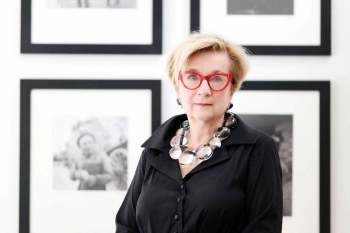
The Peabody Essex Museum today announces that Lynda Roscoe Hartigan will become PEM’s next Rose-Marie and Eijk van Otterloo Executive Director and CEO. Hartigan will assume her role on August 23, 2021 and become the first woman director of the nation’s oldest continuously operating museum.
Currently the Deputy Director for Collections & Research and Chief Innovation Officer at Canada’s largest and most visited museum, the Royal Ontario Museum in Toronto, Hartigan brings unparalleled organizational experience, a track record of excellence, and a progressive vision to advance PEM as a vital and positive force in people’s lives.
“We are thrilled to have Lynda at the helm, leading PEM boldly into the future,” said Stuart W. Pratt, Chair of PEM’s Board of Trustees. “As the Museum emerges from the pandemic and what has been the most extraordinary chapter in its 221-year history, Lynda’s leadership will provide a collaborative, confident spirit and an expansive vision for our staff, supporters, and community at large.”
Appointed as PEM’s first Chief Curator in 2003 and rising to Deputy Director in 2016, Hartigan led an ambitious, award-winning curatorial and exhibition program and reimagined the museum’s exhibition, publishing, and collection strategies. She oversaw the interpretation and reinstallation of PEM’s 40,000-square-foot wing that opened in 2019 and was integral to developing and advancing the museum’s collection stewardship, fundraising, education, digital, and global leadership initiatives.
“It is a tremendous honor to lead PEM, an organization whose focus on the potential of creativity, cultural understanding, and innovation are more relevant and needed than ever,” says Hartigan. “This is a pivotal moment for museums to stimulate conversation and connection with empathy and courage. I am passionate about ensuring that PEM welcomes all people to explore our shared humanity through the power of the arts and cultural expression.”
The leading scholar on American artist Joseph Cornell, Hartigan specializes in American art, especially modern, folk, and Black artists, yielding numerous widely recognized exhibitions and publications. Prior to joining PEM, Hartigan was Chief Curator of the Smithsonian American Art Museum in Washington, D.C., where she built internationally recognized collections by American Black and folk artists and led a major acquisitions initiative for modern and contemporary art.
Hartigan holds a B.A. in art history from Bucknell University and an M.A. in art history from George Washington University; she also attended the Getty Leadership Institute. Currently, she is a board member of the Association of Art Museum Curators.
Photo of Hartigan by Alex Paul, courtesy of the Peabody Essex Museum.
Cecilia Zhou, Nattier Makeup Tutorial
From the Instagram account of the Metropolitan Museum of Art’s European Paintings Department:
Cecilia Zhou, Nattier Makeup Tutorial
21 April 2021
 Get your powder and rouge ready—we’re thrilled to introduce Cecilia Zhou’s makeup tutorial for Jean Marc Nattier’s Portrait of a Woman! In this tutorial, Cecilia provides us with an opportunity for close looking through the application of makeup, as she calls it, ”a kind of painterly reverse engineering.”
Jean Marc Nattier had enormous success portraying French aristocratic women: his innumerable portraits represent contrasting powdered skin and bright blush set against warm landscapes. Follow along as Cecilia explores the relationship between makeup, identity, and beauty in 18th-century France.
Jean Marc Nattier, Portrait of a Woman, 1753, oil on canvas (New York: The Metropolitan Museum of Art, 1982.60.42). More information on the painting is available here»
Louvre Collection Online
As reported by the Agence France-Presse (26 March 2021), via Art Daily:
The Louvre museum in Paris said Friday it has put nearly half a million items from its collection online for the public to visit free of charge. As part of a major revamp of its online presence, the world’s most-visited museum has created a new database of 482,000 items at collections.louvre.fr with more than three-quarters already labelled with information and pictures.
It comes after a year of pandemic-related shutdowns that has seen an explosion in visits to its main website, louvre.fr, which has also been given a major makeover. . .
The full AFP story is available here»

In Memoriam | Wilhelmina Cole Holladay (1922–2021)
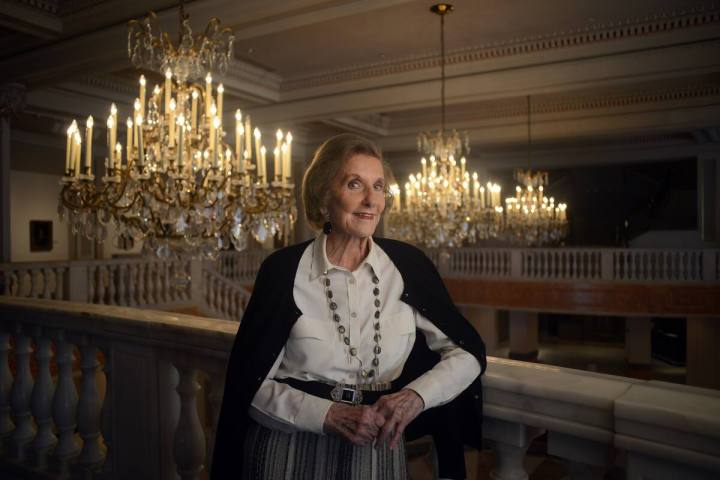
Press release (8 March 2021) from the NMWA:
Wilhelmina Cole Holladay, who founded the National Museum of Women in the Arts (NMWA), the first and only museum solely dedicated to championing women through the arts, died on Saturday, 6 March 2021, at the age of 98 in Washington, D.C. Against tremendous odds and with dedication, drive, and a singular vision, Holladay created a museum to help alleviate the underrepresentation of women artists in museums and galleries worldwide.
“For nearly 40 years, Wilhelmina Holladay has been the guiding light of our museum,” said Director Susan Fisher Sterling. “Mrs. Holladay knew the power of art and the importance of women in art and in the world. Her foresight in recognizing women artists of the past and championing women artists of the present by creating a new museum was visionary—even revolutionary—for the time. Her actions signaled a major shift in our thinking about art and society, and it is her genius and purpose we carry forward with us today.”
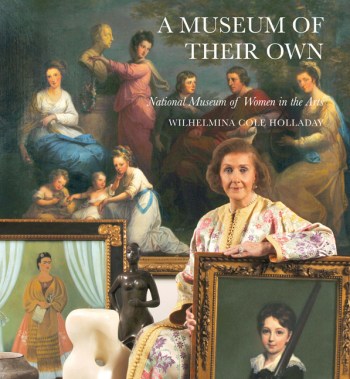
Wilhelmina Cole Holladay, A Museum of Their Own: National Museum of Women in the Arts (New York: Abbeville Press, 2008).
“Wilhelmina, ‘Billie’ as she was known to her friends, believed deeply in philanthropy and volunteerism,” said Board Vice-Chair and daughter-in-law Winton Smoot Holladay. “Her leadership and generosity established the museum, and she worked tirelessly to create an important institution where women artists could fully participate in and shape the national and international cultural conversation. Her unwavering sense of purpose and her love of art enriched the lives of all who were privileged to work alongside her.”
Holladay’s interest in art by women began in the 1970s, when she and her husband Wallace traveled widely to visit museums and galleries. They were particularly drawn to a painting they saw in Vienna, a 1594 still life by Flemish artist Clara Peeters. They saw additional paintings by Peeters at the Prado in Madrid. When Holladay attempted to learn more about the artist, she could find no information on Peeters—or any other female artist—in the standard art history textbook, H. W. Janson’s History of Art. Astonished by this discovery, the Holladays began to search for work by other women artists.
By the 1980s, the Holladay collection had grown to approximately 500 works by 150 artists, from the Renaissance to contemporary times. In addition to artwork, the Holladays kept an archive of catalogues, books, photographs, and biographical information on women artists. Nancy Hanks, then head of the National Endowment for the Arts, encouraged the Holladays to consider establishing a museum, and Holladay focused her considerable organizational and fundraising skills in this direction.
NMWA was incorporated in 1981, and for the next six years, Holladay opened her residence to the public for tours, traveled extensively to garner support for her idea, raised more than $20 million from public and private sources, purchased and renovated a historic building to house the collection, and donated her personal collection and library to the museum. On 7 April 1987, Barbara Bush, wife of the then-Vice President, cut the ribbon to open the museum in a 1907 Renaissance revival landmark building located two blocks from the White House.
NMWA’s collection has grown to include more than 5,500 works by approximately 1,000 artists, such as Louise Bourgeois, Mary Cassatt, Judy Chicago, Frida Kahlo, Georgia O’Keeffe, Faith Ringgold, and Élizabeth Louise Vigée-Lebrun. Special exhibitions have included premier solo showings of work by Camille Claudel (19th-century French), Remedios Varo (20th-century Mexican), Lavinia Fontana (16th-century Italian) and Carrie Mae Weems (contemporary American). The diversity of women’s artistic creativity has been showcased in exhibitions featuring treasures from the Hermitage, pottery by American Indians, theatrical creations by Julie Taymor, representations of the Virgin Mary in Western art, abstract art by Black women artists, and work by emerging artists in the museum’s signature Women to Watch series. These exhibitions have broadened the art historical canon to be more open and inclusive.
The museum is also a leader in online content and arts education, serving the local community through outreach to D.C. public and private charter schools as well as developing an arts education model for schools nationwide. NMWA’s Women, Arts, and Social Change public program initiative offers a platform for speakers and attendees to advance ideas and solutions to society’s most pressing issues—especially those affecting women and girls—and inspires action in the arts and beyond. NMWA also publishes a triennial magazine, serves as a center for the performing and literary arts, and maintains one of the foremost repositories of documents and materials on women artists.
In over 35 years, the museum’s budget has grown to $11 million, and the full-time staff numbers 50. NMWA members and donors—nearly 13,000 strong—come from all over the United States and 21 other countries. Its network of national and international committees has 25 outreach groups with more than 3,000 dedicated members throughout the United States and around the world, including Chile, France, Peru, and the United Kingdom. The committees host regional programs and serve as ambassadors for the museum.
Holladay was born on 10 October 1922, in Elmira, N.Y. She developed an early appreciation of art from her maternal grandmother. She earned a BA degree from Elmira College in 1944, studied art history at Cornell University, and completed postgraduate work in art history at the University of Paris in 1953–54. During World War II, Holladay worked in Washington, D.C., where she met her husband, an officer in the United States Navy. She worked as social secretary to Madame Chiang Kai-Shek from 1945 to 1948, but after the birth of her son Wallace Jr., she dedicated herself to volunteer projects.
In addition to serving as the museum’s chair of the board, Holladay was active in many other ventures, serving on the boards of the National Women’s Economic Alliance, the Adams National Bank, the Corcoran Gallery of Art, the World Service Council of the YWCA, the American Academy in Rome, the United States Capitol Historical Society, the National Gallery of Art’s Collector’s Committee, and the International Women’s Forum. In recognition of her service, Holladay received the National Medal of Arts as well as diplomatic orders from France and Norway. She also was regularly listed as one of the most powerful women in Washington, D.C. and received a lifetime achievement award from the District of Columbia. Among Holladay’s other awards for her service to women include induction into the National Women’s Hall of Fame, a lifetime achievement award from the Women’s Caucus for Art, the Women Who Make a Difference Award from the International Women’s Forum, and the Distinguished Achievement Award from the National League of American Pen Women. She received honorary doctorate degrees from four colleges.
Holladay was predeceased by a son, Scott Cole Holladay and her husband, Wallace F. Holladay. Holladay is survived by a son and daughter-in-law, Wallace ‘Hap’ Holladay Jr. and Winton Holladay; four grandchildren, Brook Holladay Peters (Brian), Fitz Holladay, Jessica Holladay Sterchi (Louis), and Addison Holladay (Eliza); and nine great-grandchildren.
A celebration of life will be announced at a future date. In lieu of flowers, the family requests contributions may be made to the National Museum of Women in the Arts.










 Enfilade
leave a comment