Getty Appoints Naoko Takahatake Curator of Prints and Drawings
Press release (May 2019) from The Getty:
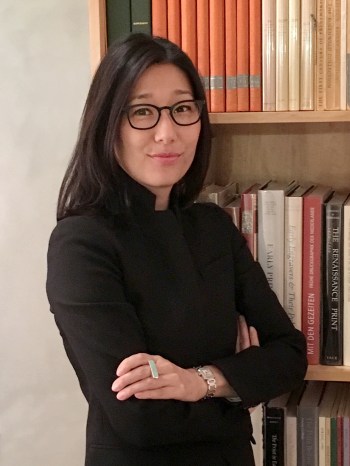 The Getty Research Institute (GRI) announced today the appointment of Naoko Takahatake as Curator of Prints and Drawings.
“Naoko Takahatake is a gifted curator and has extensive expertise working with works on paper of the greatest importance,” said Mary Miller, director of the Getty Research Institute. “She has been a prominent colleague and critical figure in the field here in Los Angeles and internationally. We are excited to welcome her to the GRI, where she will be responsible for our exceptional collection of works on paper. I’m confident she will help us expand and present our already broad holdings in meaningful ways.”
Takahatake comes to the Getty from the Los Angeles County Museum of Art (LACMA), where she has been curator of prints and drawings since 2010, overseeing the collection of Old Master works on paper. At LACMA she curated and co-curated numerous exhibitions of prints and drawings from the Renaissance to the contemporary, most recently The Chiaroscuro Woodcut in Renaissance Italy in 2018, which travelled to the National Gallery of Art, Washington. She also engaged in several collaborative research projects with conservators and conservation scientists, and led a major grant-funded project to reorganize and inventory the entire prints and drawings collection. Before her tenure at LACMA, she was an Andrew W. Mellon Curatorial Fellow in the Department of Old Master Prints at the National Gallery of Art, Washington. She previously served as Research Associate at the Center for Advance Study in the Visual Arts and as Michael Bromberg Fellow in the Department of Prints and Drawings at the British Museum.
“The GRI is home to more than 30,000 works on paper that together illustrate a comprehensive and multi-faceted overview of the history of printmaking from the Renaissance to today,” said Marcia Reed, chief curator at the Getty Research Institute. “Dr. Takahatake has an important role as caretaker of this truly one-of-a-kind collection. I am thrilled that we have found a curator with the knowledge and vision to lead our work in this area.”
Takahatake earned her Bachelor of Arts in Art History and Italian from Vassar College, and her master’s and doctorate degrees from the University of Oxford, the latter with a dissertation on the print industry in 16th- and 17th-century Bologna. A specialist in Italian Renaissance and Baroque print history, her scholarly research interests include the technical study of printmaking processes and the history of print publishing and collecting. Her catalogue on Italian chiaroscuro woodcuts was a finalist for the Alfred H. Barr Jr. Award in 2019. She is a member of the editorial board of Print Quarterly, and has published numerous papers, essays, and articles and participated in major symposia internationally.
”It is an immense pleasure and privilege to be joining the curatorial team at the GRI, with its notable collections and research resources,” said Takahatake. “The Getty’s profound commitment to advancing the appreciation of the history of prints and drawings has inspired audiences in Los Angeles and internationally. I am looking forward to participating in its outstanding programs of exhibitions, education, and scholarship, while helping to expand the collection.”
Takahatake starts at the Getty Research Institute in July.
Hogarth’s ‘William Wollaston and His Family’ to Remain in Leicester
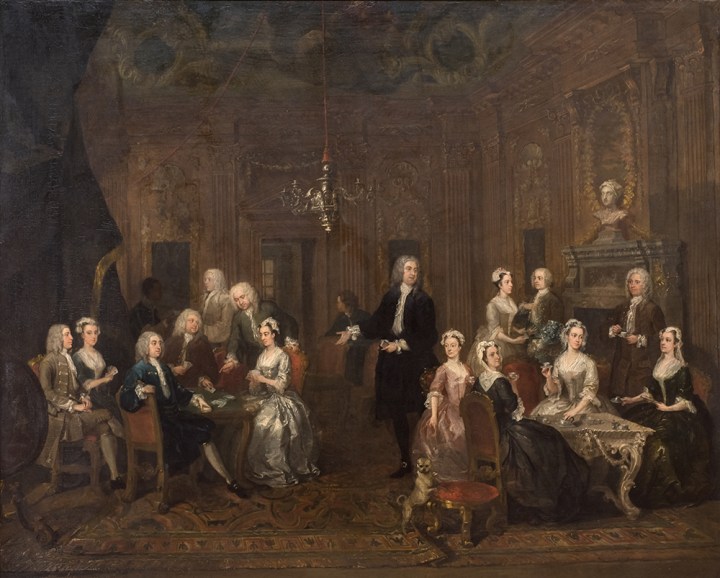
William Hogarth, William Wollaston and His Family in a Grand Interior, signed and dated 1730, oil on canvas, 99 × 125 cm (Leicester: New Walk Museum and Art Gallery).
◊ ◊ ◊ ◊ ◊
Press release (24 May 2019) from the UK’s Art Fund:
An important painting by 18th-century English artist William Hogarth has been saved for the nation following a crowdfunding campaign and support from Art Fund. The painting William Wollaston and His Family in a Grand Interior has been acquired by the New Walk Museum and Art Gallery in Leicester where it has been displayed on a loan basis for 75 years. The work was acquired via the Acceptance in Lieu scheme following the ‘Save the Hogarth Campaign’, which raised over £500,000.
William Hogarth was born in London at the end of the 17th century and is best known for his moral series including A Rake’s Progress and Marriage A-la-Mode and his prints such as Beer Street and Gin Lane. He was also recognised for his ‘conversation pieces’—informal group portraits that depict a large amount of people who were often families.
William Wollaston and His Family in a Grand Interior is a conversation piece that depicts the family of William Wollaston, who was MP for Ipswich from 1733 until 1741. Hogarth was commissioned to paint the piece following a period of mourning for the family after the death of William’s elder brother Charlton Wollaston, the former head of the family. This is reflected in the black clothing of some of the sitters, as well as the cloths hung over the wall decoration and Charlton’s bust on the mantelpiece. The painting has been passed down through the Leicester Wollaston family, who have lived in the county of Leicestershire since 1652.
The work will remain on display to the public until 6 September 2019, before being removed for conservation cleaning in preparation for a series of public events and and an exhibition dedicated to the work and Hogarth in early 2020.
Stephen Deuchar, Director of Art Fund, said: “This is such a great acquisition for Leicester—a real coup to have acquired a work of such landmark significance to both Hogarth’s career and the wider history of 18th-century British art. We are delighted to have helped.”
Lonnie Bunch to Lead the Smithsonian
From the press release (28 May 2019). . .

Photo of Lonnie Bunch III, by Michael Barnes, Smithsonian Institution Archives.
Smithsonian Institution’s Board of Regents announced today it elected Lonnie G. Bunch III, director of the Smithsonian’s National Museum of African American History and Culture, as the 14th Secretary of the Smithsonian, effective June 16.
Bunch is the founding director of the National Museum of African American History and Culture, which opened in September 2016. He oversees the nation’s largest and most comprehensive cultural destination devoted exclusively to exploring, documenting and showcasing the African American story and its impact on American and world history.
Bunch’s election is unprecedented for the Smithsonian: He will be the first African American to lead the Smithsonian, and the first historian elected Secretary. In addition, he will be the first museum director to ascend to Secretary in 74 years.
“Lonnie Bunch guided, from concept to completion, the complex effort to build the premier museum celebrating African American achievements,” said John G. Roberts, Jr., Smithsonian Chancellor and Chief Justice of the United States. “I look forward to working with him as we approach the Smithsonian’s 175th anniversary, to increase its relevance and role as a beloved American institution and public trust.”
Bunch, a public historian, has spent more than 35 years in the museum field, where he is regarded as one of the nation’s leading figures in the historical and museum community. He and the Board of Regents are committed to driving forward the priorities and direction of the Smithsonian’s 2022 strategic plan.
“I am humbled and honored to become the 14th Secretary of the Smithsonian Institution,” Bunch said. “I am excited to work with the Board of Regents and my colleagues throughout the Institution to build upon its legacy and to ensure that the Smithsonian will be even more relevant and more meaningful and reach more people in the future.”
The Regents’ 11-member search committee was co-led by Board Chair David Rubenstein and Board Vice Chair Steve Case.
“Lonnie is a deeply respected scholar, educator and leader,” Rubenstein said. “In looking for someone who would shepherd the Institution into the future, we wanted to find a special person with equal parts talent and passion. Fortunately, the ideal choice for our next Secretary was already an integral part of the Smithsonian family.”
“After working at the Smithsonian in various capacities over three decades, and then birthing a wildly successful startup within the Smithsonian, Lonnie has the benefit of knowing the Smithsonian intimately,” Case said. “Now Lonnie will bring his insights and passion to reimagining the Smithsonian of the future, and creating a culture of agility and innovation to expand the Institution’s impact. The Regents stand ready to support Lonnie’s vision for driving cross-institutional collaboration to create a virtual Smithsonian that can reach everybody, everywhere.”
Under Bunch’s leadership, the National Museum of African American History and Culture came to life. When he started as director in 2005, he had one staff member, no collections, no funding and no site for a museum. Driven by optimism, determination and a commitment to build “a place that would make America better,” Bunch transformed a vision into a bold reality. The museum has welcomed about 4 million visitors and compiled a collection of 40,000 objects. The museum is the first “green building” on the National Mall. He rallied donors of every level and worked with Congress to fund the museum through a public-private collaboration.
Previously, Bunch was the president of the Chicago Historical Society, one of the nation’s oldest museums of history (2001–05). There, he led a successful capital campaign to transform the Historical Society in celebration of its 150th anniversary, managed an institutional reorganization and began an unprecedented outreach initiative to diverse communities.
A prolific and widely published author, Bunch has written on topics ranging from the black military experience to the American presidency to the impact of race in the American West. He has also written extensively about diversity in museum management and the impact of funding and politics on American museums.
Bunch’s Smithsonian experience spans three museums: the National Museum of African American History and Culture, the National Museum of American History and the National Air and Space Museum.
Bunch held a number of positions at the National Museum of American History from 1989 through 2000. As the museum’s associate director for curatorial affairs from 1994 to 2000, he oversaw the curatorial and collections management staff. While assistant director for curatorial affairs (1992–94) at the museum, Bunch supervised the planning and implementation of the museum’s research and collection programs. As a supervising curator for the museum from 1989 to 1992, he oversaw several of the museum’s divisions, including Community Life and Political History.
Bunch began his Smithsonian career as an education specialist and historian at the National Air and Space Museum from 1978 to 1979.
Bunch was curator of history and program manager for the California African American Museum in Los Angeles from 1983 to 1989. While there, he organized several award-winning exhibitions, including The Black Olympians, 1904–1950 and Black Angelenos: The Afro-American in Los Angeles, 1850–1950. He also produced several historical documentaries for public television.
Born and raised in the Newark, New Jersey, area, Bunch has held numerous teaching positions at universities across the country, including American University and George Washington University, both in Washington, D.C.
Bunch has served on the advisory boards of the American Association of Museums, the Association of African American Museums, the American Association for State and Local History and ICOM-US. Among his many awards, he was appointed by President George W. Bush to the Committee for the Preservation of the White House in 2002 and reappointed by President Barack Obama in 2010. In 2005, Bunch was named one of the 100 most influential museum professionals of the 20th century by the American Association of Museums.
In 2017, Bunch was elected a member of the American Academy of Arts and Sciences. That same year, he was given the President’s Award at the NAACP Image Awards, and the Greater Washington Urban League presented him with the Impact Leader Award. In 2018, the Phi Beta Kappa Society presented Bunch with the Phi Beta Kappa Award for Distinguished Service to the Humanities, and the National Education Association honored him with the Award for Distinguished Service to Education.
Bunch received his master’s (1976) and bachelor’s (1974) degrees from American University in Washington, D.C., in African American and American history. He is married to Maria Marable-Bunch, associate director for museum learning and programs at the Smithsonian’s National Museum of the American Indian.
Bunch succeeds David Skorton, a board-certified cardiologist, who is leaving the Smithsonian to become president and CEO of the Association of American Medical Colleges.
The Search Process
In December 2018, the Smithsonian’s Board of Regents formed an 11-member committee to search for a Secretary to succeed Skorton. The committee was assisted by the executive search firm Heidrick & Struggles. Rubenstein and Case co-chaired the committee. The Regents committee and search firm conducted meetings with key Smithsonian stakeholders and employees to solicit their views on the types of skills and experiences the next Secretary would need; they used those conversations to develop a position specification and evaluation framework. The committee conducted interviews in April and May; the full Board of Regents voted on the new Secretary May 28.
About the Board of Regents
The 17-member Board of Regents is the governing body of the Smithsonian. It consists of the Chief Justice of the United States and the Vice President of the United States, both ex officio members of the Board; three members of the Senate; three members of the House of Representatives; and nine citizen members, nominated by the Board and approved by Congress in a joint resolution signed by the President of the United States.
About the Smithsonian
The Smithsonian Institution was founded in 1846, with a generous bequest from British scientist James Smithson (1765–1829) to found at Washington an establishment for “the increase and diffusion of knowledge.” The Smithsonian is the world’s largest museum, education and research complex, with 19 museums and the National Zoological Park. The Smithsonian’s collections document the nation’s history and heritage and represent the world’s natural and cultural diversity. The total number of objects, works of art and specimens at the Smithsonian is estimated at nearly 155 million, including more than 146 million scientific specimens and artifacts at the National Museum of Natural History.
Colonial Williamsburg Acquires Rare 1780 Map
Press release (7 May 2019) from Colonial Williamsburg:

A Map of South Carolina and a Part of Georgia…, published by William Faden (1750–1836) after William Gerard De Brahm (1718–ca. 1799) after Thomas Jeffreys (ca. 1710–1771), London, 1780; black and white line engraving with period hand color on laid paper, in two sheets: top sheet 28 × 48 inches, bottom sheet 28 × 48 inches (Colonial Williamsburg Foundation, Museum Purchase, 2019-59, A&B).
The Colonial Williamsburg Foundation has recently acquired a very rare copy of A Map of South Carolina and a Part of Georgia published in 1780 by William Faden based on a 1757 version made by the cartographers William Gerard De Brahm and published by Thomas Jefferys. Although other copies are known to exist, this example, which is in pristine condition with vibrant original color, is the first known to have become available in several decades. The large-scale map (about 4½ feet tall by 4 feet wide) is a significantly revised version of the 1757 document by De Brahm, and when paired with this earlier version of the map (a copy already exists in the Colonial Williamsburg collection) the two maps tell a compelling story. Together they show a visual comparison about the extent to which the South Carolinians and Georgians settled the western frontiers of their colonies during the period between the French and Indian War and the American Revolution.
“Colonial Williamsburg collects objects such as the Faden map not only for their inherent beauty, but for their intrinsic value as documents of past peoples, places, and events,” said Ronald L. Hurst, the Foundation’s Carlisle H. Humelsine Chief Curator and Vice President for Collections, Conservation, and Museums. “Remarkably well preserved, the Faden map will be used with other cartographic documents and three-dimensional objects to illustrate the movement of cultural groups from the seacoast to the southern backcountry on the eve of the Revolution.”
To best understand why this map is so extraordinary beyond its scarcity, one needs to first understand who made it, how it was originally intended for use and how it came to be revised over time, beginning with the original 1757 version. The story begins with the map’s cartographer, William Gerard De Brahm (1717–1798). Born in southern Germany, he served as a military engineer in the Bavarian army until 1748 and thereafter was expelled from Bavaria for renouncing his Catholic faith in favor of Protestantism. With the encouragement of the Bishop of Augsburg, Samuel Urlsperger, he led a group of 156 German Protestants to settle in the Salzberger community of Ebenezer, Georgia, in 1751. Shortly after his arrival, his skills as a trained surveyor and engineer were recognized in both Georgia and South Carolina, and by 1752 De Brahm was selected by Governor James Glen of South Carolina to design and construct a system of fortifications for Charleston. Two years later, De Brahm was appointed Surveyor General of South Carolina. Realizing that there would be a war with France, the British Board of Trade requested that each colony supply maps of their topographical surveys, the resulting map depicted geography that was vastly superior to any previous map of the region.
De Brahm used his training as an engineer to create a map that aimed to assist colonists in settling the vast wilderness of the region. He meticulously and scientifically represented details, such as settlements, land quality, climate, coastlines, waterways, and the suitability of soil for agricultural growth. The map delineates plantation landscapes belonging to European settlers, while the cartouche depicts the enslaved Africans who would be forced to work the land. Native Americans’ lands in the interior of the Colonies are mentioned sporadically, but much of the map was left blank, suggesting endless possibilities for European settlement. Once all the information was compiled, De Brahm sent the map to the Board of Trade in England, which then approved it and commissioned cartographer, engraver, and map seller Thomas Jeffreys, who served as Geographer to King George III, to publish it. The resulting map, published in London on October 20, 1757 (during the French and Indian War), illustrates the progress as well as the potential of the area.
The second version of the map was published at the height of the Revolution. By 1778, the British had taken Savannah, and in April 1780, once Charleston fell to the British, the focus of the war shifted to the Southern Colonies. Given the contemporary interest in the region, Thomas Jeffreys’s successor, William Faden, altered the 1757 copperplates with updated information on the region, publishing it in June 1780. The revisions were so major that some scholars consider the result to be virtually a new map. This new version included county names, roadways, new place names, and settlements across the entire map, revealing the amount of new information that was gathered over a span of less than 20 years during a time when Britain was focused on expanding and populating its empire in North America and the backcountry of South Carolina was opened up for English settlement. The alterations were largely based on the surveys gathered by John Stuart, the Superintendent of Indian Affairs for the Southern District from the 1760s to his death in 1779. Stuart frequently complained to royal officials in Britain that he lacked accurate maps of the backcountry to conduct his work, which frequently involved boundary disputes between Native Americans and settlers. He provided his findings to the Board of Trade, who, in turn, hired Faden to publish the updated version. The 1780 edition of the map reflects the westward movement of the population.
“De Brahm’s map of South Carolina and Georgia was viewed in the period, as it is today, as a remarkable achievement of eighteenth-century cartography,” said Katie McKinney, Colonial Williamsburg’s assistant curator of maps and prints. “The blank space on the 1757 map is one of its most striking features, which never aimed to detail the backcountry landscape. It makes sense that when looking to publish a map on the region that Faden would use De Brahm’s map as a template to incorporate new information about these Southern colonies. Compared to the earlier version, this map will allow us to better interpret the westward movement of people and objects in the region throughout the eighteenth century.”
The Georgetown Precinct reflects the extensive revisions made to the 1757 map on the 1780 map. The original map primarily illustrated topography and land use as evidenced by the detail, whereas the 1780 map focused on roadways, waterways, landowners and settlement. The 1780 map shows the intricate rivers and streams that made up the Pee Dee River. Georgetown Precinct thrived financially in the eighteenth century as home to some of the wealthiest indigo and rice planting operations in the low country, which relied on the work of enslaved laborers.
The Art Museums of Colonial Williamsburg remain open during construction of an entirely donor-funded $41.7 million expansion. Additional information about the Art Museums and Colonial Williamsburg is available online.
Steven Parissien Named Palace House Chief Executive
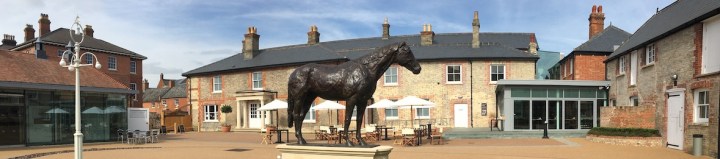
Press release (via ArtDaily). . .
Palace House, The National Heritage Centre for Horseracing and Sporting Art, in Newmarket, announced the appointment of Professor Steven Parissien as its new Chief Executive. Parissien will assume the role in June 2019, taking over from Chris Garibaldi, who is stepping down in order to embark on full-time research at the University of Cambridge.
Beginning in 2010, Garibaldi delivered the ambitious £19m project to create a national gallery of British sporting art—alongside a new national horseracing museum—in the palace that Charles II originally built for himself in Newmarket, Suffolk. In its first year (2016), Palace House attracted around 30,000 visitors, was short-listed for the Art Fund Museum of the Year in 2017, and in 2018 became an Arts Council National Portfolio Organisation.
 Parissien was Director (and subsequently Chief Executive and Artistic Director) of Compton Verney Art Gallery and Park in Warwickshire from 2009 to November 2018. Since then he has completed a project as a directorial consultant at the Bata Museum in Toronto, Canada. Under his leadership, Compton Verney saw its visitor numbers soar, whilst the historic manor house and Lancelot ‘Capability’ Brown landscape were extensively restored. Parissien also introduced a series of critically-acclaimed and hugely popular exhibitions including Turner and Constable (2013), Canaletto in Britain (2015), Britain in the Fifties (2016), and Whistler and Nature (2018). Parissien introduced a number of commercial initiatives, including a lucrative wedding and corporate hire business. At the same time, Compton Verney’s Education and Learning team developed extensive relations with local schools, children’s centres, care homes, and other organisations—enabling under-engaged and under-represented groups to access high-quality artistic experiences on their doorstep. Parissien was also instrumental in building partnerships with museums, galleries, and arts organisations across the UK, whilst also forging strong links with some of the country’s most respected higher education institutions, most notably the Universities of Oxford (whose partnership enabled the re-launch of the Victorian Women’s Library in 2017), Warwick, and Coventry. The latter awarded Parissien a Visiting Professorship in 2015.
Announcing the appointment of his successor, Mr. Garibaldi said: “It has been a true privilege to lead the organisation over the nine years of my tenure, and I am extremely proud of what has been achieved over that time by the incredibly dedicated team at Palace House. It has been an honour to have been part of such an exciting project. I am delighted to be handing over to Professor Parissien whose outstanding work at Compton Verney is well known and makes him, in my opinion, the perfect choice. I couldn’t be more pleased that the Board has recruited Steven to take Palace House through the next stage of its extraordinary history and I wish him every success in his new post.”
Rachel Hood, Chair of Trustees said: “I would like to take this opportunity to reiterate the Trustees’ and my sincere thanks for the tremendous job that Chris has done to produce such a brilliant Museum and we all wish him well on his return to academia. We are absolutely thrilled to have recruited Professor Parissien as our new Chief Executive. We looked far and wide for a suitable candidate and are immensely pleased to have persuaded Steven to return from Canada to take forward our ambitions for the organisation.”
Commenting on his appointment Professor Parissien said: “I am absolutely delighted to be returning to the UK and taking over the reins from Chris at Palace House. They have achieved a vast amount as an organisation over the past nine years with him at the helm, and I am incredibly excited to be bringing my experiences at Compton Verney and in the wider museum sector to help lead them in their—and indeed my—ambitions and plans for the future and growth of Palace House, The National Heritage Centre for Horseracing and Sporting Art.”
DMA Names Julien Domercq Assistant Curator of European Art
Press release (29 April 2019) from the DMA:
 Julien Domercq has been named The Lillian and James H. Clark Assistant Curator of European Art at the Dallas Museum of Art. The appointment was announced today by Dr. Agustín Arteaga, the DMA’s Eugene McDermott Director. Domercq joins the DMA after serving as the Vivmar Curatorial Fellow at the National Gallery in London from 2016 to 2018. He will begin his new role in Dallas on May 14, 2019.
Under the direction of Dr. Nicole R. Myers, the Museum’s Barbara Thomas Lemmon Senior Curator of European Art, Domercq will actively contribute to the European department’s robust research, exhibition, and collection programs. The DMA’s European collection encompasses more than 1,900 paintings, sculptures, and works on paper from the Renaissance to the mid-20th century. Domercq will focus his efforts on the Old Master collection, rethinking its presentation and interpretation in the galleries and strategizing on collection growth in this area. Among his first exhibition projects are focused presentations of master paintings by Caravaggio and Frans Hals.
“Julien is a remarkable young talent, with impressive scholarship and international experience working in one of Europe’s most important public art institutions,” said Arteaga. “He has an incredible passion for making the presentation of European art exciting and accessible to a wide and multi-generational audience. This practice aligns well with the DMA’s mission to connect people and art. As we usher in a dynamic chapter in the European Art Department that was announced by the extraordinarily generous gift in 2013 of the Marguerite and Robert Hoffman Fund for European Art Before 1700, we are excited to welcome Julien to Dallas, and look forward to the work that he and Nicole Myers will accomplish together.”
At the National Gallery, London, Domercq curated the exhibition Drawn in Colour: Degas from the Burrell (2017), a presentation of 23 works by Edgar Degas loaned from the Burrell Collection in Glasgow paired with selections from the National Gallery’s collection. The Guardian praised the exhibition as “a ravishing, revealing window on Degas’s inner world.” He assisted in the final stages of the exhibition Painters’ Paintings: From Freud to Van Dyck (2016) and also worked on major redisplays of the post-1800 and Italian Renaissance galleries, including reimagining the presentation of the National Gallery’s paintings by Titian and Raphael.
“With his breadth in European Old Masters, Julien will bring fresh eyes and new scholarship to the extant collection while expanding our holdings to reflect the DMA’s encyclopedic aim. I am excited for us to work together to reinvigorate the Museum’s Old Master exhibition program, an area that has been relatively underserved,” added Myers. “We are thrilled to welcome him to the curatorial team.”
Additionally, Domercq has contributed to a number of catalogues published by the National Gallery, London; Houghton Hall, Norfolk; and the Royal Academy of Arts, London. He has written articles as well as online reviews for Apollo magazine.
Domercq earned his bachelor’s (with first class honors) and master’s (with distinction) degrees in art history from King’s College, Cambridge, where he is currently completing his PhD. While there, his doctoral research was supported by a prestigious Gates Scholarship. His dissertation research explores shifts in European depictions of indigenous people in the Pacific Islands at the end of the 18th century.
“I am delighted to be moving to Dallas to join the curatorial team of the DMA at a time it is being dynamically reimagined under Dr. Arteaga’s direction,” said Domercq. “From my very first visit to Dallas, I was impressed by the central role the Museum plays for its community. Today, I am thrilled to be joining this great civic institution, with encyclopedic collections that reflect the vibrant multicultural city it serves. I am looking forward to immersing myself in the Dallas community and to devising ambitious Old Master exhibitions in partnership with other institutions internationally, collaborating on innovative programming and research with my new colleagues, and caring for, interpreting, and growing the DMA’s European Old Master collection, making it ever more accessible to the people of Dallas, and beyond.”
Brooklyn Museum Acquires Portrait by Vigée Le Brun
From the press release (26 April 2019) . . .

Elisabeth Louise Vigée Le Brun, Portrait of Countess Maria Theresia Czernin, 1793, oil on canvas, 54 x 39 inches (Brooklyn Museum, Gift of Lilla Brown in memory of her husband John W. Brown, Mrs. Watson B. Dickerman, A. Augustus Healy, Helen Babbott MacDonald, Charles H. Schieren, and L.L. Themal, by exchange, 2018.53).
The Brooklyn Museum announced significant new acquisitions that emphasize the institution’s dedication to presenting diverse narratives through its collection. The artists represented by these acquisitions span a wide range of aesthetic styles, mediums, eras, and nationalities. Highlights include over 3,000 vernacular photographs documenting a century of women’s history from the Kaplan-Henes Collection; a work by eighteenth-century French portrait painter Elisabeth Louise Vigée Le Brun; a portrait gifted by Supreme Court Justice Ruth Bader Ginsburg; a significant gift of over fifty photographs by experimental Chinese contemporary artists; and a painting created specifically for the Brooklyn Museum by one of China’s most important living artists, Xu Bing. Works by Al Held, Chris Martin, and Joan Snyder also join the collection.
Anne Pasternak, Shelby White and Leon Levy Director, Brooklyn Museum, says, “We are so excited by these transformational works of art that add significantly to the strengths of our exceptional collections, and we are tremendously grateful to the generous donors behind them who make it possible for our institution to continue telling trailblazing stories of inclusion through art.”
Portrait of Countess Maria Theresia Czernin by Elisabeth Louise Vigée Le Brun
Elisabeth Louise Vigée Le Brun is one of the most celebrated portrait painters of late eighteenth- and early nineteenth-century Europe. She secured the patronage of the French aristocracy and served as portrait painter to Marie Antoinette. Vigée Le Brun became one of only four women members of the French Royal Academy in 1783 and spent her later years enjoying fame and financial success. This large, striking portrait by Vigée Le Brun is notable for the way it presents the sitter, Countess Maria Theresia Czernin. Vigée Le Brun paints the countess holding an open book about ancient Greece, suggesting that she was engaged in scholarship and history, qualities that were more often seen in portraits of men at the time.
The portrait allows the Brooklyn Museum to present a more inclusive narrative of European art with regard to the contributions of women and to further explore how identity in portraiture is visually constructed and constituted along cultural, class, political, and gender lines. It will strengthen the current presentation of historical portraiture in the Museum’s European Art galleries. It also provides an important link between our historical collections and Judy Chicago’s The Dinner Party, where Vigée Le Brun is referenced on the floor of the work and in the historical timeline. . . .
The full press release is available here»
Portrait of James Adam Acquired by NGS and V&A
Press release (18 April 2019) from the National Galleries of Scotland:

Antonio Zucchi, Portrait of James Adam, oil on canvas, 173 × 123 cm (Purchased jointly by the National Galleries of Scotland and the Victoria and Albert Museum, with assistance from the Art Fund, 2019).
The National Galleries of Scotland (NGS) and the Victoria and Albert Museum (V&A) have jointly acquired the most ambitious and splendid surviving portrait of a member of the Adam family, the great eighteenth-century Scottish architectural dynasty.
The portrait of James Adam (1732–1794) by the Italian artist Antonio Zucchi (1726–1795) becomes the third outstanding artwork to be jointly-acquired by the V&A and NGS after together securing two exceptional sculptures, Antonio Canova’s The Three Graces (purchased 1994) and Lorenzo Bartolini’s The Campbell Sisters (purchased 2015). The Zucchi portrait has been purchased thanks to a major grant from national charity Art Fund.
The newly acquired portrait of James Adam will be shown among the great eighteenth-century collection at the Scottish National Portrait Gallery (SNPG), Edinburgh before going on display in the V&A’s British Galleries in London later this year. It will remain on display at the V&A for one year before returning to be shown in Edinburgh. Thereafter, it will be shown at each institution for a period of seven years, on rotation.
Christopher Baker, Director of European and Scottish Art and Portraiture for the National Galleries of Scotland, commented: “James Adam’s portrait is a work of great swagger and refinement that demonstrates the confidence of the Scottish Adam family as seminal taste makers for eighteenth-century Europe. It represents a splendid addition to the collection of the National Galleries of Scotland and we are immensely grateful to both the Victoria and Albert Museum and the Art Fund for making its joint purchase possible.”
Julius Bryant, Keeper of Word and Image at The Victoria and Albert Museum, said: “Zucchi’s portrait of James Adam depicts one of the leading Scottish exponents of the European Neoclassical movement who played a formative role in developing British architecture. It is an ideal portrait for the Neoclassicism section of the V&A’s British Galleries. We are delighted that it joins the V&A’s collection, together with the two sculptures previously purchased with the National Galleries of Scotland. We are enormously grateful to both the NGS and Art Fund for enabling this joint acquisition.”
Stephen Deuchar, Director of the Art Fund, added: “We are very pleased to be helping both National Galleries Scotland and the V&A in acquiring this fine and important portrait of James Adam. It is fitting addition to both collections, marking the sitter’s legacy as a highly influential Scotsman with great significance to the history of British architecture and design, and we know it will enjoyed by a wide public in both locations.”
The painting depicts James Adam during his grand tour of Italy in 1763, before he returned to London to work with his brother, Robert Adam (1728–1792). Dramatically posed and luxuriously dressed, he is surrounded by objects that refer to the study of the ancient world that inspired the neo-classical designs for which the Adam were renowned.
Robert and James Adam, along with their brothers John and William, were the sons of the mason-architect and entrepreneur William Adam (1689–1748). Together the family enjoyed the status of being Scotland’s foremost architects of the eighteenth century. Their role as designers of neo-classical buildings and interiors was to prove profoundly influential not only in Edinburgh and London but all across Europe, North America and Russia.
Robert and James established their architectural practice in 1758. They not only excelled at designing elegant Palladian buildings but also entire interior decorative schemes, including furniture, so ensuring a unity to their immensely popular neo-classical vision. Between 1773 and 1779 the brothers published The Works in Architecture of Robert and James Adam which played a key role in spreading knowledge of their work internationally.
James undertook a Grand Tour of Italy, to seek inspiration for his work, between 1760 and 1763. This impressive portrait was painted in the final year of his tour. It refers to his profession as an architect, and sees him hold dividers in one hand and paper in the other. However, he is also presented as a man of wealth and discrimination, dressed in a silk and fur trimmed gown, at ease with his knowledge of the remains of the classical world that surround him. This type of magnificent portraiture was commonly associated with travelling aristocrats, rather than architects.
The portrait has the distinction of being the only known work of such a subject by the painter Zucchi, who was born in Venice and later worked on a number of decorative paintings for major interior schemes designed by the Adam brothers, before marrying the painter Angelica Kauffmann (1741–1807) in 1781 and settling with her in Rome.
The sculptures depicted in the painting behind James include the Medici Vase and a variant of the Giustiniani Minerva—revered examples of ancient art which could be studied in Rome and, it was felt, could inspire contemporary design. Panels of so-called grotesque ornament frame the niche in which Minerva stands.
The most significant object depicted is the capital (the sculpted top of a column) in the foreground, on which James rests his left arm. It looks at first like a work from antiquity, but is in fact taken from a sculpture design by James Adam. While in Italy he made detailed plans for re-building the Houses of Parliament in London in a neo-classical style, a project that was never realised. As part of this scheme, he produced detailed drawings for a new British architectural order of columns, and combined on them the Scottish unicorn (clearly visible here) with an English lion. The drawings he made were used as the basis for creating a model made of wax that was coloured bronze—and it is this object, which sadly no longer survives, that is depicted by Zucchi. It acted as an extraordinary advertisement for Adam’s ingenuity as a designer and through the prominence of the unicorn, reminded his clientele of his Scottish heritage.
Until now James Adam has only been represented in the collection of the National Galleries of Scotland through a modest and informal drawing by Allan Ramsay (1713–1784), while Robert Adam is the subject of two paste medallions by James Tassie (1735–1799). Zucchi’s unique painted portrait complements his work as an engraver and decorative painter held in the V&A’s collection.
Courtney Martin Named Director of YCBA
Press release (10 April 2019) from the YCBA:
 Courtney J. Martin ’09 Ph.D., deputy director and chief curator of Dia Art Foundation, will be the next director of the Yale Center for British Art (YCBA), President Peter Salovey announced today.
“I am delighted to announce the appointment of Courtney J. Martin,” Salovey said. “An esteemed scholar of historical and contemporary art, she will use her extensive experience in research, teaching, and curation to further infuse the arts into the university’s work and shape the YCBA’s leadership in the field of British art.”
Martin is familiar with Yale, having earned her doctorate in history of art from the university. As a graduate student, she contributed substantially to the YCBA’s award-winning 2007 exhibition, Art and Emancipation in Jamaica. Her dissertation on British art and artists in the 1970s will soon be published as a book.
Before pursuing her Ph.D., Martin worked in the media, arts, and culture unit of the Ford Foundation in New York City. After receiving her doctorate, she conducted research and taught at Vanderbilt University and then joined the faculty of Brown University where she fostered understanding and appreciation of art, while using the work of artists to launch conversations and inspire discoveries across disciplines, Salovey said. In 2015, Martin joined Dia — a nonprofit organization that supports and presents commissions, exhibitions, and site-specific installations — as adjunct curator for an exhibition of the American painter Robert Ryman at Dia:Chelsea. In 2017, she became the deputy director and chief curator at Dia, where she oversees a complex operation that includes acquisitions, exhibitions, programming, research, and publications.
“With her love of Yale and extensive experience in teaching, research, and leading projects at museums, Courtney is committed to providing outstanding educational opportunities for our students, scholarly material for our faculty, and enriching experiences for the thousands of visitors that enjoy the YCBA every year,” Salovey said. “She is attentive to the core collection of 17th-, 18th-, and mid-19th-century art as well as modern and contemporary British art. I know that she will deftly guide the YCBA’s ever-increasing international prominence in the years ahead.”
Salovey praised current YCBA Director Amy Meyers, who will retire on June 30 after a 17-year tenure, “for making the YCBA one of the foremost destinations in the world for the study of British art and culture and an integral part of Yale and our home city.”
“The center has an amazing wealth of resources, not the least of which is its Louis Kahn building. I am so pleased to be returning to the YCBA and to New Haven,” said Martin. “Amy Meyers has expertly stewarded the collection for nearly 20 years. I look forward to further developing the many enagaging exhibitions, publications, and programs that have earned the center its international acclaim.”
Salovey expressed appreciation to the members of the search committee: Ruth Yeazell, Sterling Professor of English and the committee’s chair; Timothy Barringer, the Paul Mellon Professor in the History of Art; Edward Cooke, the Charles F. Montgomery Professor of the History of Art; Anoka Faruqee, director of graduate studies in painting/printmaking at the Yale School of Art; Susan Gibbons, the Stephen F. Gates ’68 University Librarian; Pericles Lewis, vice president for global strategy and deputy provost for international affairs; Ian McClure, the Susan Morse Hilles Chief Conservator of the Yale University Art Gallery; and Keith Wrightson, the Randolph W. Townsend Jr. Professor of History.
Williamsburg Acquires Its First Judaica Objects

Torah Pointer (Yad), Birmingham, England, 1843–44, silver and gold (gilding) (Courtesy of the Colonial Williamsburg Foundation, Museum Purchase and Hugh Trumbull Adams Fund, 2018-326).
◊ ◊ ◊ ◊ ◊
Press release (2 April 2019) from Colonial Williamsburg:
The Colonial Williamsburg Foundation has recently added several important objects of Judaica to its collections: a sterling silver and gold Kiddush cup and a silver and gold yad (or Torah pointer). These mark the first such objects in the Foundation’s holdings and exemplify the concerted efforts in recent years by the curators to acquire objects and address the stories of all early Americans while remaining true to their long-standing strength in British and American decorative arts. Additionally, objects that represent the early Anglo-American experience have also been acquired. These include an alphabet sampler created by a Jewish schoolgirl that is unique both for who made it and where it was created, as well as Chinese porcelain pieces that were owned by prominent London Jewish families.
“The Colonial Williamsburg Foundation sees the objects in its collections as documents of the people, places, and events of the past,” said Ronald L. Hurst, the Foundation’s Carlisle Humelsine Chief Curator and Vice President for Collections, Conservation, and Museums. “Because we use these objects to tell the compelling stories of early Americans, we seek to acquire things that speak to the full range of their experiences, whatever their race, religion, gender, age, or cultural ethnicity may have been. These latest acquisitions mark important steps toward that goal.”
The silver objects are noteworthy additions to the collections as they represent a faith that was more prevalent in early America than most people realize today. They also span the realms of public and private worship in the Jewish religion. Kiddush cups are used both as part of family worship at home and as part of congregational worship, while the yad is used in congregational worship in a synagogue. The Colonial Williamsburg curators know that these specific examples are representative of what was owned and used in early America.

Kiddush Cup, probably by William Harrison I (active ca. 1758–81), London, ca. 1775, silver (sterling) and gold (Courtesy of the Colonial Williamsburg Foundation, Museum Purchase, The Antique Collectors’ Guild, 2016-1).
The Kiddush cup, which is used while reciting the blessing over wine (the Kiddush), is part of the commandment from the Torah to sanctify the Sabbath (Shabbat). Before the Friday night meal on the eve of Shabbat, the tradition dictates that a family’s Kiddush cup is filled with wine and held as the blessing is spoken, usually by the head of the household. Few ceremonial Jewish objects from the early Anglo-American world are known today. This Kiddush cup, probably made by William Harrison I (active ca. 1758–1781) in London about 1775, was the first piece of silver Judaica to be added to the Colonial Williamsburg collection. It is an elegant example with a circular stepped foot and a tapered stem that supports an egg-shaped cup with a gilded interior. It is engraved with three lines of Hebrew, “Remember the Sabbath day, and sanctify it,” within a shield suspended from a bow-knot and flanked by slender foliate sprays.
The yad, which literally means “hand,” can be interpreted as a representation of the hand of God and is used as a pointer during Torah readings, which allows the rabbi to follow the text without physically touching the sacred scrolls. The chain on the yad was used to suspend it from the Torah scrolls when not in use. This example, made in Birmingham, England, between 1843 and 1844, is made of silver with gilding, which was the predominant material used to make yads since the early 1600s. It features a long wand of quadrangular shape that is engine-turned and engraved with foliage and has a media band also flanked by foliage. One end of the yad has a foliate-engraved knop with a suspension ring and hanging chain. The other end has an applied cast hand with an extended index finger wearing a ring. There are traces of gilding on the hand.
Also providing a glimpse into the Jewish experience in the early Anglo-American world, are a recently acquired schoolgirl sampler and Chinese porcelain objects:

Stand, Jingdezhen, ca. 1795, hard-paste porcelain (Courtesy of the Colonial Williamsburg Foundation, Museum Purchase, The Buddy Taub Foundation, Dennis A. Roach and Jill Roach Directors, 2016-116).
The alphabet sampler by Rachel Cole (1854–1922) is an important addition to the textile collections. The most significant facet of this unique object’s story is its maker. Rachel Cole, who was born on August 18, 1854, in Chicago, was the daughter of one of the city’s earliest Jewish families. Her mother, Sarah Frank, was an immigrant from Germany, her father, Samuel Cole, was an immigrant from Austria who was a co-founder of the Kehilath Anshe Ma’ariv (K.A.M.) congregation, which became Chicago’s first Jewish synagogue. Samuel Cole was also the president of the congregation for approximately one year. The sampler, which Rachel may have made at the K.A.M. school where she studied after graduating from one of Chicago’s public schools, is also unique as it is the only identified sampler marked “Chicago,” and one of just a handful of known samplers created by Jewish schoolgirls. The colorful sampler is marked with the place name of Chicago, Illinois, and with the date 1868. Few, if any, samplers from Chicago are known to survive, probably because of the Great Chicago Fire of 1871, which destroyed much of the city. Ms. Cole lived within just blocks of the approximately 3.3 miles of area consumed by the conflagration.
The prominent Sephardic Jewish D’Aguilar family were London merchants and sugar planters in the eighteenth century. This hard-paste porcelain stand, made in Jingdezhen, China, around 1795, is decorated with the family’s crest and is from just one of several armorial services that was ordered by the family. Most likely it was owned by Solomon, the fifth son of Don Diego D’Aguilar.
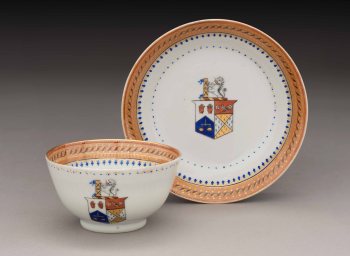
Cup and Saucer, Jingdezhen, ca. 1805, hard-paste porcelain (Courtesy of the Colonial Williamsburg Foundation, Museum Purchase, The Buddy Taub Foundation, Dennis A. Roach and Jill Roach Directors, 2016-117, A&B).
Also made in Jingdezhen, China, around 1805, is this hard-paste porcelain cup and saucer, decorated with the coat of arms of Neilson impaling Goldsmid. Aaron Goldsmid was a merchant in Hamburg and left there in 1765 to settle in London and establish the firm of Aaron Goldsmid & Son. Aaron’s second son, Asher, helped establish Mocatta & Goldsmid, which was a bullion-brokerage firm to the Bank of England. The Goldsmid family was known for its philanthropy and financier endeavors throughout the eighteenth and nineteenth centuries. It is most likely that this cup and saucer were made for a daughter or niece of Asher Goldsmid.
The Kiddush cup was purchased with funds from The Antique Collectors’ Guild. The yad was purchased through the generosity of the Hugh Trumbull Adams Fund. The Chinese porcelain objects were acquired with funds from The Buddy Taub Foundation, Dennis A. Roach and Jill Roach Directors.










 Enfilade
leave a comment