The Morgan Announces Restoration
From the press release (14 February 2019) from The Morgan:

Madison Avenue near East 36th Street, New York. J.P. Morgan Library, Wurts Bros., ca. 1905 (Museum of the City of New York, X2010.7.1.197).
The Morgan Library & Museum announced today the exterior restoration of J. Pierpont Morgan’s Library, designed by McKim, Mead & White. The four-year, $12.5 million project, which marks the first preservation of the landmark library’s exterior in its 112-year history, will restore and conserve one of the finest examples of Neoclassical architecture in the United States, enhance the surrounding grounds, improve the exterior lighting of the building, and increase public access to and appreciation of this historic architectural treasure.
J. Pierpont Morgan’s Library is the heart of the Morgan Library & Museum. Commissioned in 1902 by financier John Pierpont Morgan as his private library, the building was completed in 1906 and is considered one of McKim, Mead & White’s finest works, perfectly embodying the Renaissance ideal of the unity of the arts through the integration of architecture, sculpture, and painting with exceptional craftsmanship and materials. The structure reflects its contents: majestic in design, yet intimate in scale.
In 2010 the Morgan restored the interior rooms of J. Pierpont Morgan’s Library. In 2016 the Morgan began planning for the exterior restoration by engaging Integrated Conservation Resources (ICR), a firm specializing in the restoration of historic structures, to provide an initial needs assessment of the Library’s condition. Following the needs assessment, the Morgan engaged ICR to undertake a more detailed analysis of the building, which resulted in a fully articulated restoration approach. ICR, supported by the architecture firm Beyer Blinder Belle, carefully studied and documented existing conditions, installed data loggers to monitor the performance of the exterior envelope, tested proposed remediations, and finalized the restoration’s details.
The forthcoming restoration will be comprehensive and will address issues such as masonry deterioration, masonry joint failure, roof conditions, deterioration of the fence and other metalwork corrosion, and sculpture conservation.
In conjunction with the restoration, exterior lighting on J. Pierpont Morgan’s Library—currently minimal and ineffective—will be improved by enhancing existing light emanating from the interior, using historic fixtures coupled with new technologies. The scheme will create a painterly effect of layered light at dusk and dark. Developed by Tillett Lighting Design Associates, the new lighting design will give the Library a subtle, timeless, and inviting presence.
Restoring J. Pierpont Morgan’s Library presents a unique opportunity to reimagine the natural setting around it and to provide for visitor access to the site’s exterior for the first time in the institution’s history. The current landscaping—comprising a simple lawn and trees—does little to complement the architecture of the Library, nor does it provide accessible pathways or spaces to encourage visitor interaction with the landmark building’s exterior. By creating new spaces and opportunities for engagement, the project will help to reinvigorate this portion of the Morgan’s campus, which has been less visible to visitors since the Morgan’s entrance shifted from 36th Street to Madison Avenue as part of the 2006 Renzo Piano-designed expansion.
After an extensive search, the Morgan has engaged Todd Longstaffe-Gowan Landscape Design to develop designs to address these issues. An accomplished landscape architect, historian, teacher, and author, Todd Longstaffe-Gowan has led notable projects in the United Kingdom, including for Hampton Court Palace, Kensington Palace Gardens, and the Royal College of Art. This is his first appointment in the United States. Longstaffe-Gowan will collaborate with New York–based Future Green Studio to ensure the development of plantings that will flourish in New York City’s dense, challenging environment.
“Restoring the sublime exterior of J. Pierpont Morgan’s Library is far and away our most important capital project for the next decade,” said Director Colin B. Bailey. “This is our responsibility. And, in many respects, it is our privilege. Once the restoration of the Library is complete and the grounds are revitalized, the public will be able to engage more fully with one of McKim, Mead & White’s most important architectural achievements. The enhanced grounds will create a generous new space for outdoor programming and allow visitors to look closely at the exterior architectural and sculptural details of the Library.”
To date, 74 percent of the required $12.5 million is funded. On-site work will commence in February 2019, directed by Sciame and executed by Nicholson & Galloway, longtime partners in the architectural expansion and stewardship of the Morgan. Restoration of J. Pierpont Morgan’s Library will be completed by December 2019, at which point work will commence on the surrounding grounds. The library will still be open to visitors during the restoration process. The entire restoration and rehabilitation of the grounds will be unveiled to the public and accessible in fall 2020. The unveiling will be accompanied by an exhibition chronicling the history of the Library, as well as a scholarly publication.
Blanton Museum Acquires Major Spanish Colonial Art Collection

Unknown artist, Rest in the Flight into Egypt, Bolivia, 18th century, oil on canvas
(Blanton Museum of Art, The University of Texas at Austin)
◊ ◊ ◊ ◊ ◊
Press release from the Blanton Museum of Art:
The Blanton Museum of Art at The University of Texas at Austin announced that it has acquired the esteemed collection of Roberta and Richard Huber. This world-class collection of art from the Spanish and Portuguese Americas is composed of 119 objects ranging from paintings and sculpture to furniture and silverwork—deepening the Blanton’s extensive holdings of art and objects from Latin America. The Huber Collection is one of the most distinguished private collections of Spanish and Portuguese American art and includes works from countries across modern-day Latin America including Bolivia, Brazil, Ecuador, and Peru. Developed by Roberta and Richard Huber over the past 45 years, the collection showcases artistic practices and visual culture of the socially and ethnically diverse society in the Americas between the late 1600s and the early 1800s.
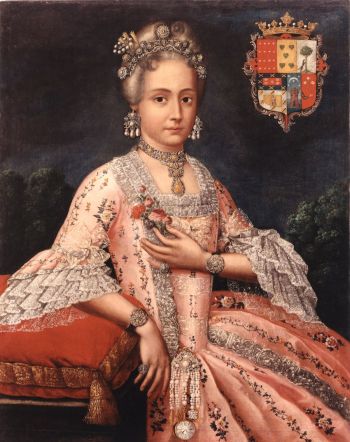
Attributed to Cristóbal Lozano (Lima, Peru 1705–1776), Portrait of Rosa de Salazar y Gabiño, Countess of Monteblanco and Montemar Peru, ca. 1763, oil on canvas (Blanton Museum of Art, The University of Texas at Austin).
“My wife, Roberta, and I couldn’t have hoped for a better steward for our collection than the Blanton, an institution with a long legacy of leadership in the field of Latin American art,” said Richard Huber. “We’re thrilled for the Blanton to present the works to audiences from Austin, the rest of the country, and abroad, and for them to be used in the museum’s robust teaching program on campus and in the community.”
“We are delighted that the Blanton will be the new home of the Huber collection, an incredibly beautiful group of works, which demonstrates the height of artistic achievement of this period,” said Blanton director Simone Wicha. “This acquisition cements our commitment to the study and exhibition of art from the Spanish and Portuguese Americas, which we proudly launched in partnership with the Carl & Marilynn Thoma Art Foundation in 2016. The Huber collection will open up new possibilities for scholarship on this dynamic era of cultural exchange, supported by the unparalleled strength of UT’s Latin American studies program and the Blanton’s renowned expertise and resources in the field of Latin American art,” Wicha continued.
The Blanton began collecting art from Latin America in 1963 and since then has amassed one of the country’s largest and finest collections of Latin American art. The museum’s Latin American collection now includes 2,500 works of modern and contemporary painting, prints, drawing, conceptual art, installation, video, and sculpture, alongside its growing holdings of art of the Spanish and Portuguese Americas. In 1988, the Blanton became the first museum in the United States to establish a curatorial position devoted to modern and contemporary Latin American art.

Unknown artist, Portable Desk, Bolivia, 1751, tempera, oil, and gold on wood (Blanton Museum of Art, The University of Texas at Austin).
“The acquisition of the Huber collection furthers our leadership in the field of Latin American art as a whole,” said Beverly Adams, Blanton curator of Latin American art. “The dialogues between modern and contemporary art with historical material that have emerged in our galleries and in our research over the past few years have been illuminating. We are thrilled to continue to be stewards for the artistic and scholarly value of the art of this significant period, alongside our partners on campus at UT.”
The museum’s expanded focus on art from the colonial period encompasses collecting, researching, and exhibiting. In 2016, the Carl & Marilynn Thoma Art Foundation announced a long-term loan of works from its distinguished collection and a major grant that established a curatorship in Spanish colonial art. In partnership with LLILAS Benson Latin American Studies and Collections at UT, the Blanton launched a cross-campus interdisciplinary program to facilitate object-based teaching, research, and scholarship on visual and material culture from this period. In 2017, the Colección Patricia Phelps de Cisneros gifted a group of 83 Venezuelan works of painting, sculpture, and furniture from the period to the Blanton.
“A unique strength of UT Austin is our commitment and leadership in Latin American scholarship and art. Through world-class collections, like this, the educational benefit to students, faculty, and our community cannot be understated. We are immensely grateful for the Hubers’ vision, and we are excited about the impact this collection will provide for generations to come,” said Maurie McInnis, executive vice president and provost.

Unknown artist, Coquera (coca box), Bolivian, ca. 1730, silver (Blanton Museum of Art, The University of Texas at Austin).
The museum acquisition was funded by the university, with additional support from Judy and David Beck, Leslie and Jack Blanton, Jr., Jeanne and Michael Klein, Judy and Charles Tate, and an anonymous donor. Highlights include an early 18th-century silver coquera box (for the storage of coca leaves) from Bolivia; a gorgeous bust-sized reliquary of St. Augustine from Mexico (ca. 1650); the impressive portrait of Rosa de Salazar y Gabiño, Countess of Monteblanco and Montemar (ca. 1764–71) attributed to Peruvian Cristobal Lozano; and a sculpture of the Virgin Mary attributed to Francisco Xavier de Brito, active in Minas Gerais, Brazil, in the mid 1700s. Among the furniture is a portable desk from the 18th century, which originated at one of the famed Jesuit missions of Chiquitos, in what is now Santa Cruz, Bolivia, and a UNESCO World Heritage Site.
This fall, a selection of objects from the Huber collection will make their debut in the Blanton exhibition Painted Cloth: Fashion and Ritual in Colonial America, which is made possible by lead funding and loans from the Thoma Foundation, as well as other loans from around the world. Painted Cloth examines the social role of textiles and their visual representations in different media produced in Bolivia, Mexico, Peru, and Venezuela during the 1600s and 1700s.
Newberry Library Completes Renovations
The Newberry Library’s nine-month, $12.7 million renovation, including updated exhibition spaces, was completed several months ago, and just announced with a press release, via ArtDaily:
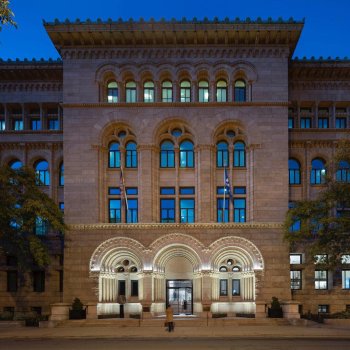 The Newberry Library, one of Chicago’s treasured landmarks, has completed renovations to enhance its public spaces and welcome visitors in new ways. As architect, Ann Beha Architects’ work balances historic preservation with clear and memorable contemporary design.
A world-renowned research library, the Newberry offers an extensive collection of rare books, maps, and manuscripts, with material spanning six centuries. The building was designed by notable Chicago architect Henry Ives Cobb in Romanesque Revival style, and completed in 1893. By renovating its entrance level, the Newberry sought to make the impressive building more accessible and inviting, and to renew historic interior spaces, introducing visitor services and settings for exhibitions and programs.
ABA’s design transforms public spaces and showcases the Library’s collections through its new exhibition galleries. Changes begin at the street, where new lighting, an information kiosk, and an accessible entry welcome the public. Inside, historic spaces have been restored, enhancing their rich details and providing new lighting and acoustical improvements. New spaces welcome and orient visitors, with amenities including an expanded bookstore, seminar and program spaces, and lounge. New galleries display thematic exhibitions, with a unique built-in display case highlighting notable items from the Newberry’s collection on an ongoing basis.
Ann Beha Architects is engaged in contemporary design and in the preservation and adaptive re-use of landmark buildings. Based in Boston and practicing nationally, ABA has led planning and design projects for the Museum of Fine Arts, Boston; Massachusetts Institute of Technology; University of Chicago; the Smithsonian Institution; the US Department of State; and Yale University.
Foundling Museum Acquires Portrait of Duchess of Manchester
From The Foundling Museum:

Andrea Soldi, Portrait of Isabella Duchess of Manchester, 1738 (London: The Foundling Museum).
The Foundling Museum has acquired a painting by celebrated 18th-century artist Andrea Soldi portraying Isabella, Duchess of Manchester, one of Thomas Coram’s key female supporters who provided the catalyst for the establishment of the Foundling Hospital. This is a significant acquisition for the Museum, being the only portrait of a key female supporter of the Foundling Hospital, prior to its foundation in 1739, to enter the Foundling Museum Collection and one of the first paintings of a woman to hang permanently in the Picture Gallery.
On 6 January 1730, the Duchess of Manchester became the fifth Lady to sign Coram’s petition. Her husband would subsequently put his name to the Royal Charter in 1739. This acquisition is complemented by two other paintings of women. A portrait of Charlotte, Duchess of Somerset (the petition’s first signatory) attributed to Charles D’Agar, on loan to the Museum from Lord Egremont, is joined by a portrait of Beatrice Forbes, one of the Foundling Hospital’s five female Governors, painted in 1906 by William Carter. Together, these three paintings are a landmark in the Picture Gallery’s permanent display, which until now has never included a portrait of a woman. Surrounded by paintings of the male governors who were the public face of the charity, these three portraits enable visitors to appreciate the crucial role that women played not only in establishing the Foundling Hospital, but also in shaping British society.
The acquisition follows the success of a year-long programme in 2018 marking the centenary of female suffrage—a programme that included the exhibition Ladies of Quality and Distinction, which featured the portrait of Isabella, Duchess of Manchester, alongside portraits of the other twenty-one Ladies who were Thomas Coram’s first supporters. In the face of male indifference and risking society’s disapproval, these women put their names to the first petition submitted to King George II in 1735 that called for the establishment of a home for “abandoned and deserted young children.” The support of these pioneering women was crucial in overcoming moral concerns about Coram’s project, enabling his campaign to gain the critical momentum that led to the establishment of the UK’s first children’s charity.
The acquisition of the portrait of the Duchess of Manchester has been made possible with the help of Art Fund, the Arts Council England/V&A Purchase Grant Fund, The Friends of Thomas Coram, and a number of generous individuals donors.
Nationalmuseum Sweden Acquires Two Portrait Drawings
Press release (18 January 2019) from Sweden’s Nationalmuseum in Stockholm:
Nationalmuseum has acquired two 18th-century portrait drawings. One is a self-portrait of Louis-Jean-François Lagrenée, while the other, by Johann-Ernst Heinsius, depicts an unknown woman. Both works are fully elaborated and demonstrate a technical virtuosity which captures both the personality and vitality of their subjects.

Louis-Jean-François Lagrenée, Self-Portrait, 23.5 × 17.5 cm (Stockholm: Nationalmuseum, NMH 217/2017; photo by Cecilia Heisser).
Louis-Jean-François Lagrenée (1725–1805) studied under Carle van Loo (1705–1765) in Paris in the late 1740s. In 1749 he won the Royal French Academy of Art’s travel scholarship for studies in Rome, and in the course of the ensuing years spent in Italy he was influenced by Guido Reni (1575–1642) and Francesco Albani (1578–1660), among others. For a period at the beginning of the 1760s, he was Court Painter in Saint Petersburg and also served as the Director of the Imperial Academy of Arts. Much later, between 1781 and 1787, Lagrenée returned to Rome as the Director of the French Academy of Fine Arts.
Lagrenée specialized in mythological motifs characterized by a relatively austere classicism, but also created a smaller number of captivating portraits. The latter include a celebrated self-portrait, now housed in the collections of the Sinebrychoff Art Museum in Helsinki. In the profile portrait drawing recently acquired by Nationalmuseum, Lagrenee seems to depict himself with a certain amount of objectivity—a distance from his own personality and role as an artist. Despite his supposedly young years, he appears both urbane and somewhat sophisticated. This impression may also be amplified by the artist’s technique. While the profile is drawn with distinct contours, in the lines of the work as a whole the artist demonstrates a certain lightness of touch. This is a typical feature of the skillful draughtsmanship that Lagrenée developed during his studies in Italy.

Johann-Ernst Heinsius, Portrait of a Woman Looking to the Right, 35 × 25 cm (Stockholm: Nationalmuseum, NMH 8/2018; photo by Cecilia Heisser).
Like his brother Johann-Julius Heinsius (1740–1812), Johann-Ernst Heinsius (1731–1794) was active as a portrait painter at the princely court in Weimar. Later, Johann-Ernst also worked in Hamburg, where he was commissioned to execute portraits of members of the city’s burghers. Nationalmuseum’s portrait depicts a young, vibrant woman looking over her shoulder to her left (from the viewer’s point of view she looks to the right, and this is the basis for the work’s title). She is dressed in an expensive dress, possibly made of silk and adorned with a lace collar. Her hair is extravagantly styled and graced with a large bow and a cap. With a seemingly light and free hand, the artist has captured the young woman’s lively and cheerful temperament. This applies not only to the slight smile that plays upon her lips, but also to the joy radiated in her gaze. By contrasting sharp contours in black crayon, shaded sections and white highlights, the artist creates volume and texture. Nationalmuseum’s acquisition is an exquisite example of Heinsius’s portrait drawing. He masterfully instils the woman’s gaze with such vitality that she virtually vibrates on the page.
Nationalmuseum receives no state funds with which to acquire design, applied art and artwork; the collections are enriched through donations and funds from private foundations and trusts. The acquisitions were made possible by grants from the Hedda & N.D. Qvist Memorial Fund and the Magda and Max Ettler Fund.
Edinburgh’s Collective Opens on Calton Hill
Press release (via Art Daily) for Collective in Edinburgh:
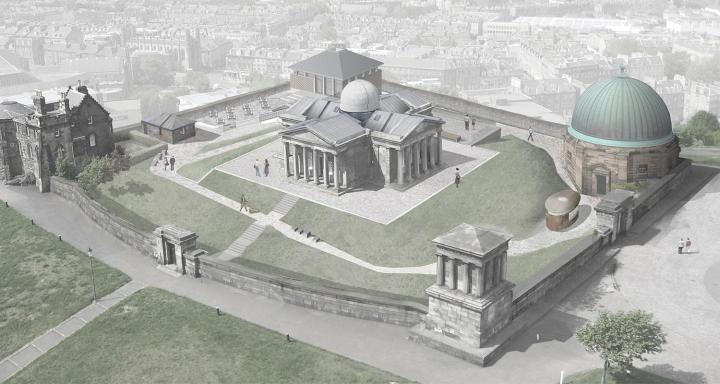
Collective—a new centre for contemporary art—opened in Edinburgh after a major restoration project at one of the capital’s World Heritage sites. Situated on top of Calton Hill, overlooking the city, Collective includes the restored City Observatory, designed by William Playfair in 1818, a new purpose-built exhibition space with panoramic viewing terrace, and a destination restaurant, The Lookout by Gardener’s Cottage. For the first time in its 200-year history the City Observatory site is freely open to the public.
The opening marks a fresh chapter in the history of the Observatory site and for Collective, an organisation active on the Scottish arts scene since 1984. Collective positions itself as a new kind of observatory, inviting the public to view the world around them through the lens of contemporary art. A selection of international and Scotland-based artists, commissioned specially for the opening, are exhibiting their work at Collective as part of an inaugural exhibition. Affinity and Allusion draws on themes connected to Calton Hill’s rich history and features the work of artists Dineo Seshee Bopape, James N Hutchinson, Alexandra Laudo, Tessa Lynch, Catherine Payton, and Klaus Weber.
The City Observatory, designed by William Playfair in 1818, played a key role in the history of astronomy and timekeeping in Edinburgh. The original telescope, installed in the Observatory in 1831, is on display. The Observatory will houses Collective’s new shop, Collective Matter, selling unique artist editions and specially commissioned products.
The Hillside is a brand-new exhibition and office space embedded in the hillside in front of the City Observatory. The space will primarily exhibit work from Collective’s Satellites Programme for emerging artists and producers in Scotland. A panoramic viewing terrace on the roof of The Hillside allows visitors to soak up the stunning views north across Leith and the Firth of Forth. The nearby City Dome, completed in 1895 as a subsidiary to the main Observatory, has been restored and will play host to a changing programme of international artists showing their work in Scotland for the first time.
A purpose-built restaurant, The Lookout, has been constructed on the northeast corner of Collective and is being managed by local partners The Gardener’s Cottage. The Lookout specialises in seasonal cooking using locally-sourced ingredients. Panoramic views from the upper floor dining area, which is cantilevered to partially float above the hillside, complete an extraordinary dining experience.
The final building to be restored as part of Collective is the Transit House. Originally used as an observatory, the building now serves as a learning and education space for visiting schools and groups. The original ‘Politician’s Clock’, so-called because it has two faces, is back on display. Before the installation of the time-ball in the nearby Nelson monument, sailors from the Port of Leith would ascend Calton Hill and use the clock (accurately set by celestial observations) to set their chronometers.
The £4.5m redevelopment is the result of a partnership between Collective and City of Edinburgh Council. Collective moved to the site in 2013 and began fundraising for the project. Funders include City of Edinburgh Council, Creative Scotland, Heritage Lottery Fund, Edinburgh World Heritage, William Grant Foundation, WREN, The Wolfson Foundation, Garfield Weston Foundation, Sylvia Waddilove Foundation UK, Pilgrim Trust, Architectural Heritage Fund, Hope Scott Trust, Idlewild Trust, Craignish Trust, and the invaluable support of many trusts, funds, and individual donors.
Getty Research Institute Acquires Rare Gastronomy Collection
Press release (26 November 2018):
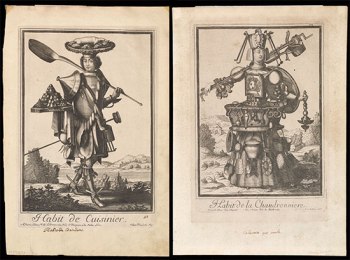
Costume of the Cook (left) and Costume of the Boilermaker (right), Nicolas I de Larmessin, ca. 1690s (Getty Research Institute, 2018.M.15).
The Getty Research Institute announced the acquisition of a collection of hundreds of rare books, prints, and manuscripts related to the culinary arts from the 15th to the 19th centuries assembled by culinary authority Anne Willan and her husband Mark Cherniavsky—the Anne Willan and Mark Cherniavsky Gastronomy Collection. Additionally, a donation from Willan will support ongoing research grants known as the Cherniavsky Library Research Grants.
“Mark had a talent for finding great examples of rare prints and early cookbooks and books about food and has built an exceptional collection,” said Getty Research Institute Chief Curator Marcia Reed. “Over the years Mark and Anne have been wonderful contributors and friends to the GRI, donating important rare books, lending works to our exhibitions, and hosting educational programs. We are grateful to Anne for her generous gift of this collection as well as her support of related scholarship in honor of her late husband, and our friend, Mark.”
Named in honor of Mark Cherniavsky and in celebration of the Anne Willan and Mark Cherniavsky Gastronomy Collection, the Cherniavsky GRI Library Research Grants will support and encourage research relating to antiquarian books, culinary research and other related topics. These grants will be awarded to up to two scholars a year and are made possible by a gift from Anne Willan. Willan is a celebrated author, cooking educator and founder of the prestigious Ecole de Cuisine La Varenne, which operated in Paris and Burgundy, France, from 1975 until 2007.
This extraordinary collection of rare books and prints on gastronomy from the 15th through the 19th century offers unique insight into the visual culture of food. The elaborate art of culinary preparation, consumption, and display reveals food’s status as a symbol of political and social power. Amassed by antiquarian cookbook collectors Anne Willan and Mark Cherniavsky over a period of 50 years, the collection comprises nearly 200 books published before 1830 and hundreds from the 19th and 20th centuries.
Highlights include Johannes Cassianus’s De institutis coenobiorum, Collationes partum (Venice, 1491), which describes fasting and feasting within a monastic order; M. Emy’s L’art de bien faire les glaces d’office (Paris, 1768), which opens with an evocation of cupids making ice cream; and Antonin Carême’s Le Maître d’hôtel francais (Paris, 1823), which contains recipes for dinners given for, among others, Tsar Nicholas I, George IV, and Prince Charles-Maurice de Talleyrand.
The collection’s many early modern books, which illustrate elaborate feasts, celebrations, and processions, complement the Getty Research Institute’s unparalleled festival collection. Also included is Willan’s working library of cookbooks, her professional archives, and the archives of Ecole de Cuisine La Varenne, which she founded.
The Clark Acquires Lethière’s ‘Brutus Condemning His Sons’

Guillaume Lethière, Brutus Condemning His Sons to Death, 1788, oil on canvas, 23 × 39 inches
(Williamstown: The Clark Art Institute, 2018.1.1)
◊ ◊ ◊ ◊ ◊
In May the Clark announced this acquisition; the painting is now on display. From the press release:
For the first time since acquiring Guillaume Guillon Lethière’s masterpiece, Brutus Condemning His Sons to Death, the Clark presents the painting in its permanent collection galleries. The painting was acquired at auction in spring 2018 along with a preparatory drawing by Lethière (c. 1788) and a stipple engraving dated 1794 by Pierre Charles Coqueret (Paris, 1761–1832) after Lethière’s painting. All three works are on view in a special installation in the Clark’s permanent collection galleries. . . .
The full press release is available here
Exhibition | Armenia: Art, Culture, Eternity
Press release (25 October 2018) from the Armenian Museum of America:
Armenia: Art, Culture, Eternity
Armenian Museum of America, Watertown, Massachusetts, exhibition open from November 2018

Kütahya vessel, 18th century, polychrome fritware (Watertown, Massachusetts: Armenian Museum of America).
The Armenian Museum of America is pleased to share its vision for the future. Founded in 1971, the Museum serves as the largest repository of Armenian artifacts in the diaspora, as well as the largest ethnic museum in Massachusetts. As the Museum builds towards the future, it strives to create a stronger, more connected community through shared exploration of Armenian art and history, both for Armenians and those who are new to Armenian culture.
The Museum’s new gallery Armenia: Art, Culture, Eternity provides an overview of Armenian culture from antiquity to present-day Armenian experience here in the United States. Over fifty objects are on display, illustrating Armenia’s origins in the Asian continent, the invention of a unique Indo-European language and alphabet, the early adoption of Christianity, Armenian medieval illuminated manuscripts, interconnected trade routes, and the tragedy of the Genocide.
Armenia: Art, Culture, Eternity is the culmination of twelve months of intense research and design and represents a new level of scholarship and interpretation at the Museum. The project was made possible by the support of the Board of Trustees and was spearheaded by Executive Director Jennifer Liston Munson and architect Virginia Durruty, who worked side-by-side with Michele Kolligian, President of the Board of Trustees, on the inspired design. The gallery represents an incredible achievement and is the start of a holistic consideration of the entire Museum, which will examine everything from the building’s distinctive Brutalist architecture—including how the hard space is a meaningful metaphor for Armenia’s difficult history—to the Museum’s role in telling the modern Armenian-American cultural narrative.
Colonial Williamsburg Acquires Revolutionary War Portrait
Press release (8 November 2018) from the Colonial Williamsburg Foundation, via Art Daily.

Unidentified artist, Portrait of Major Patrick Campbell, 1775–76, oil on canvas (Williamsburg: Colonial Williamsburg Collections, 2018-26).
Likenesses of British officers who served in the Revolutionary War are rare. Therefore, the Colonial Williamsburg Foundation’s recent acquisition of the first bust-length, British military portrait for its collection is significant especially given the connection of this oil on canvas to events that happened nearby. The subject, Major Patrick Campbell, was a Scottish officer who served in the British lines at the Siege of Yorktown. Until the last few decades, the portrait descended through the family of Major Campbell’s sister.
“To be able to accurately depict our nation’s enduring story, especially the individuals who participated in events that happened in such close proximity to Williamsburg, is essential to our mission,” said Mitchell Reiss, president and CEO of the Colonial Williamsburg Foundation. “The exceptional portraits in our collection, such as that of Major Campbell, enable us to fulfill this duty in an authentic way.”
The portrait of Major Campbell joins Colonial Williamsburg’s important collection of militaria pertaining to the Siege and Surrender of Yorktown, which took place approximately 13 miles away. The collection includes maps such as Joseph Frederick Wallet Des Barres’s A Plan of the Posts of York and Gloucester (1782) and Major General Marquis de Lafayette’s manuscript field map used during the Virginia Campaign. Among the paintings are James Peale’s group portrait of George Washington and his generals after the Surrender and two by French artist Louis-Nicholas Van Blarenberghe after drawings from eyewitnesses to the Siege and Surrender. The collection also features objects relating to other regions where the Revolutionary War occurred.
“Our goal is to tell the whole story of the Revolution in Virginia,” said Ronald Hurst, the Foundation’s Carlisle H. Humelsine chief curator and vice president for collections, conservation and museums. “Objects such as the portrait of Patrick Campbell allow us to put faces on the players and therefore humanize these events that changed the course of American history.”
The portrait of Major Campbell was painted in Scotland by an unidentified Scottish artist in late 1775 or early 1776 after Campbell was commissioned into the 71st Regiment to see action in the Revolutionary War. (He also sat for two portraits by John Singleton Copley.) The Major is shown in the uniform of the 71st Regiment prior to receiving command of the Grenadier Company of the 2nd Battalion, at which point a second silver epaulette was added to his uniform. His military career in America was vast: he served in the New York Campaign of 1776, the Philadelphia Campaign of 1777, and sailed to Savannah in late 1778 where he fought in the Campaign of 1779. In December of that year, he was captured aboard a sloop sailing to New York and taken as a prisoner of war to Newport, Rhode Island. He was exchanged back to the British for an American officer of the 2nd Virginia Regiment in 1780. On January 1, 1781, Campbell married Sarah Pearsall, a young woman from a prominent Loyalist Quaker family in New York City, with whom he fathered a son. Major Campbell survived in the British lines at Yorktown in October 1781, where he surrendered as part of the garrison of Redoubt #10, the earthwork fortification in the British defensive line protecting the town. He died in New York City in 1782 and was buried there.
The acquisition of Major Campbell’s portrait also exemplifies the collaborative efforts between two Colonial Williamsburg curators, who each brought forth their expertise in different media: Laura Pass Barry, Juli Granger curator of paintings, drawings and sculpture, and Erik Goldstein, senior curator of mechanical arts and numismatics. “It’s always a win-win situation for Colonial Williamsburg when two specialists can join forces on a project. I am fortunate to be able to rely on Erik for his expertise in military history, especially the people and events of the American Revolution,” said Barry. Added Goldstein, “And, I am appreciative for Laura’s insight into the context for which this portrait was made. Together, we’re able to better understand and therefore tell a more comprehensive story about objects like this in our collection.”
Generous donations by the Friends of Colonial Williamsburg Collections made this acquisition possible.










 Enfilade
leave a comment