Getty Research Institute Acquires Rare Gastronomy Collection
Press release (26 November 2018):
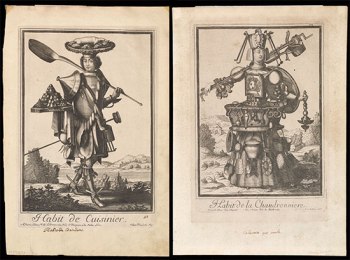
Costume of the Cook (left) and Costume of the Boilermaker (right), Nicolas I de Larmessin, ca. 1690s (Getty Research Institute, 2018.M.15).
The Getty Research Institute announced the acquisition of a collection of hundreds of rare books, prints, and manuscripts related to the culinary arts from the 15th to the 19th centuries assembled by culinary authority Anne Willan and her husband Mark Cherniavsky—the Anne Willan and Mark Cherniavsky Gastronomy Collection. Additionally, a donation from Willan will support ongoing research grants known as the Cherniavsky Library Research Grants.
“Mark had a talent for finding great examples of rare prints and early cookbooks and books about food and has built an exceptional collection,” said Getty Research Institute Chief Curator Marcia Reed. “Over the years Mark and Anne have been wonderful contributors and friends to the GRI, donating important rare books, lending works to our exhibitions, and hosting educational programs. We are grateful to Anne for her generous gift of this collection as well as her support of related scholarship in honor of her late husband, and our friend, Mark.”
Named in honor of Mark Cherniavsky and in celebration of the Anne Willan and Mark Cherniavsky Gastronomy Collection, the Cherniavsky GRI Library Research Grants will support and encourage research relating to antiquarian books, culinary research and other related topics. These grants will be awarded to up to two scholars a year and are made possible by a gift from Anne Willan. Willan is a celebrated author, cooking educator and founder of the prestigious Ecole de Cuisine La Varenne, which operated in Paris and Burgundy, France, from 1975 until 2007.
This extraordinary collection of rare books and prints on gastronomy from the 15th through the 19th century offers unique insight into the visual culture of food. The elaborate art of culinary preparation, consumption, and display reveals food’s status as a symbol of political and social power. Amassed by antiquarian cookbook collectors Anne Willan and Mark Cherniavsky over a period of 50 years, the collection comprises nearly 200 books published before 1830 and hundreds from the 19th and 20th centuries.
Highlights include Johannes Cassianus’s De institutis coenobiorum, Collationes partum (Venice, 1491), which describes fasting and feasting within a monastic order; M. Emy’s L’art de bien faire les glaces d’office (Paris, 1768), which opens with an evocation of cupids making ice cream; and Antonin Carême’s Le Maître d’hôtel francais (Paris, 1823), which contains recipes for dinners given for, among others, Tsar Nicholas I, George IV, and Prince Charles-Maurice de Talleyrand.
The collection’s many early modern books, which illustrate elaborate feasts, celebrations, and processions, complement the Getty Research Institute’s unparalleled festival collection. Also included is Willan’s working library of cookbooks, her professional archives, and the archives of Ecole de Cuisine La Varenne, which she founded.
The Clark Acquires Lethière’s ‘Brutus Condemning His Sons’

Guillaume Lethière, Brutus Condemning His Sons to Death, 1788, oil on canvas, 23 × 39 inches
(Williamstown: The Clark Art Institute, 2018.1.1)
◊ ◊ ◊ ◊ ◊
In May the Clark announced this acquisition; the painting is now on display. From the press release:
For the first time since acquiring Guillaume Guillon Lethière’s masterpiece, Brutus Condemning His Sons to Death, the Clark presents the painting in its permanent collection galleries. The painting was acquired at auction in spring 2018 along with a preparatory drawing by Lethière (c. 1788) and a stipple engraving dated 1794 by Pierre Charles Coqueret (Paris, 1761–1832) after Lethière’s painting. All three works are on view in a special installation in the Clark’s permanent collection galleries. . . .
The full press release is available here
Exhibition | Armenia: Art, Culture, Eternity
Press release (25 October 2018) from the Armenian Museum of America:
Armenia: Art, Culture, Eternity
Armenian Museum of America, Watertown, Massachusetts, exhibition open from November 2018

Kütahya vessel, 18th century, polychrome fritware (Watertown, Massachusetts: Armenian Museum of America).
The Armenian Museum of America is pleased to share its vision for the future. Founded in 1971, the Museum serves as the largest repository of Armenian artifacts in the diaspora, as well as the largest ethnic museum in Massachusetts. As the Museum builds towards the future, it strives to create a stronger, more connected community through shared exploration of Armenian art and history, both for Armenians and those who are new to Armenian culture.
The Museum’s new gallery Armenia: Art, Culture, Eternity provides an overview of Armenian culture from antiquity to present-day Armenian experience here in the United States. Over fifty objects are on display, illustrating Armenia’s origins in the Asian continent, the invention of a unique Indo-European language and alphabet, the early adoption of Christianity, Armenian medieval illuminated manuscripts, interconnected trade routes, and the tragedy of the Genocide.
Armenia: Art, Culture, Eternity is the culmination of twelve months of intense research and design and represents a new level of scholarship and interpretation at the Museum. The project was made possible by the support of the Board of Trustees and was spearheaded by Executive Director Jennifer Liston Munson and architect Virginia Durruty, who worked side-by-side with Michele Kolligian, President of the Board of Trustees, on the inspired design. The gallery represents an incredible achievement and is the start of a holistic consideration of the entire Museum, which will examine everything from the building’s distinctive Brutalist architecture—including how the hard space is a meaningful metaphor for Armenia’s difficult history—to the Museum’s role in telling the modern Armenian-American cultural narrative.
Colonial Williamsburg Acquires Revolutionary War Portrait
Press release (8 November 2018) from the Colonial Williamsburg Foundation, via Art Daily.

Unidentified artist, Portrait of Major Patrick Campbell, 1775–76, oil on canvas (Williamsburg: Colonial Williamsburg Collections, 2018-26).
Likenesses of British officers who served in the Revolutionary War are rare. Therefore, the Colonial Williamsburg Foundation’s recent acquisition of the first bust-length, British military portrait for its collection is significant especially given the connection of this oil on canvas to events that happened nearby. The subject, Major Patrick Campbell, was a Scottish officer who served in the British lines at the Siege of Yorktown. Until the last few decades, the portrait descended through the family of Major Campbell’s sister.
“To be able to accurately depict our nation’s enduring story, especially the individuals who participated in events that happened in such close proximity to Williamsburg, is essential to our mission,” said Mitchell Reiss, president and CEO of the Colonial Williamsburg Foundation. “The exceptional portraits in our collection, such as that of Major Campbell, enable us to fulfill this duty in an authentic way.”
The portrait of Major Campbell joins Colonial Williamsburg’s important collection of militaria pertaining to the Siege and Surrender of Yorktown, which took place approximately 13 miles away. The collection includes maps such as Joseph Frederick Wallet Des Barres’s A Plan of the Posts of York and Gloucester (1782) and Major General Marquis de Lafayette’s manuscript field map used during the Virginia Campaign. Among the paintings are James Peale’s group portrait of George Washington and his generals after the Surrender and two by French artist Louis-Nicholas Van Blarenberghe after drawings from eyewitnesses to the Siege and Surrender. The collection also features objects relating to other regions where the Revolutionary War occurred.
“Our goal is to tell the whole story of the Revolution in Virginia,” said Ronald Hurst, the Foundation’s Carlisle H. Humelsine chief curator and vice president for collections, conservation and museums. “Objects such as the portrait of Patrick Campbell allow us to put faces on the players and therefore humanize these events that changed the course of American history.”
The portrait of Major Campbell was painted in Scotland by an unidentified Scottish artist in late 1775 or early 1776 after Campbell was commissioned into the 71st Regiment to see action in the Revolutionary War. (He also sat for two portraits by John Singleton Copley.) The Major is shown in the uniform of the 71st Regiment prior to receiving command of the Grenadier Company of the 2nd Battalion, at which point a second silver epaulette was added to his uniform. His military career in America was vast: he served in the New York Campaign of 1776, the Philadelphia Campaign of 1777, and sailed to Savannah in late 1778 where he fought in the Campaign of 1779. In December of that year, he was captured aboard a sloop sailing to New York and taken as a prisoner of war to Newport, Rhode Island. He was exchanged back to the British for an American officer of the 2nd Virginia Regiment in 1780. On January 1, 1781, Campbell married Sarah Pearsall, a young woman from a prominent Loyalist Quaker family in New York City, with whom he fathered a son. Major Campbell survived in the British lines at Yorktown in October 1781, where he surrendered as part of the garrison of Redoubt #10, the earthwork fortification in the British defensive line protecting the town. He died in New York City in 1782 and was buried there.
The acquisition of Major Campbell’s portrait also exemplifies the collaborative efforts between two Colonial Williamsburg curators, who each brought forth their expertise in different media: Laura Pass Barry, Juli Granger curator of paintings, drawings and sculpture, and Erik Goldstein, senior curator of mechanical arts and numismatics. “It’s always a win-win situation for Colonial Williamsburg when two specialists can join forces on a project. I am fortunate to be able to rely on Erik for his expertise in military history, especially the people and events of the American Revolution,” said Barry. Added Goldstein, “And, I am appreciative for Laura’s insight into the context for which this portrait was made. Together, we’re able to better understand and therefore tell a more comprehensive story about objects like this in our collection.”
Generous donations by the Friends of Colonial Williamsburg Collections made this acquisition possible.
Met Names Andrea Bayer Deputy Director for Collections, Administration
Press release (8 November 2018) from The Met:
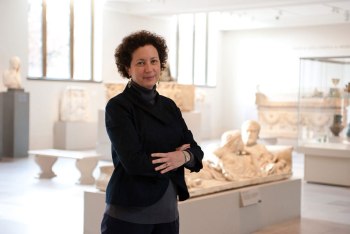
Andrea Bayer (Photo courtesy of The Metropolitan Museum of Art).
Max Hollein, Director of The Metropolitan Museum of Art, announced today that Andrea Bayer has been appointed Deputy Director for Collections and Administration. In May 2018, Dr. Bayer was appointed Interim Deputy Director for Collections and Administration, continuing in her position as Jayne Wrightsman Curator in the Department of European Paintings.
“Andrea Bayer is a highly respected scholar, an imaginative exhibition curator, and an esteemed colleague at The Met,” said Hollein. “Throughout her time as Interim Deputy Director and before, she has shown exceptional leadership and great loyalty to our beloved Museum. I have been deeply impressed by her commitment and capabilities during my first few months as Director of the Museum and am excited that she has just accepted our offer to become Deputy Director.”
“As Curator in the Department of European Paintings, often working on projects that went across multiple departments, I know how rewarding it is to work alongside colleagues throughout the Museum,” said Bayer. “I am thrilled to take on this new role, one which will allow me both to support the Director and continue to collaborate with these colleagues on an institutional level.”
Since joining The Met’s Department of European Paintings in 1990 as a scholar of Italian Renaissance art, Andrea Bayer has curated groundbreaking exhibitions including Dosso Dossi, Court Painter in Renaissance Ferrara (1999); Painters of Reality: The Legacy of Leonardo and Caravaggio in Lombardy (2004); Art and Love in Renaissance Italy (2008–09); and the current exhibition Celebrating Tintoretto: Portrait Paintings and Studio Drawings, with Alison Manges Nogueira, Associate Curator in the Robert Lehman Collection. Bayer also co-curated Unfinished: Thoughts Left Visible, one of the inaugural exhibitions at The Met Breuer.
Bayer was named Curator in European Paintings in 2007 and was appointed Jayne Wrightsman Curator in 2014. She served as Interim Head of Education in 2008–09 and for six years acted as coordinating curator for the Curatorial Studies program with New York University’s Institute of Fine Arts. Bayer is also Co-Chairman of the Director’s Exhibition Committee.
In addition to authoring numerous exhibition catalogs, Bayer has written two Museum Bulletins and recently co-authored two articles for the Metropolitan Museum Journal: “Andrea del Sarto’s Borgherini Holy Family and Charity: Two Intertwined Late Works” and “An Examination of Paolo Veronese’s Portrait of Alessandro Vittoria,” both in volume 52 (2017).
Andrea Bayer studied at Barnard College and Princeton University and received her PhD from Princeton University in 1990.
Thomas Campbell to Direct the Fine Arts Museums of San Francisco
From the FAMSF press release (30 October 2018). . .

Photo by Scott Rudd; courtesy Fine Arts Museums of San Francisco.
The Board of Trustees of the Fine Arts Museums of San Francisco (FAMSF) and the Corporation of the Fine Arts Museums (COFAM) today appointed Thomas P. Campbell as the new director and CEO of the largest public arts institution in Northern California, effective 1 November 2018. As head of FAMSF, which comprise the de Young museum in Golden Gate Park and the Legion of Honor in Lincoln Park, Mr. Campbell will oversee a wide-ranging curatorial program and education programs and will manage a staff of more than 500.
“I am deeply gratified to take up the responsibility of leading the Fine Arts Museums of San Francisco,” Campbell said. “It is a great privilege to become part of an institution with such outstanding curatorial expertise and famously loyal audiences and supporters, and I am especially pleased to have the opportunity to continue the great work done by my friend and predecessor Max Hollein. I am eager to begin collaborating with the Trustees, the staff, and the entire cultural network of San Francisco.”
Mr. Campbell served as Director and CEO of The Metropolitan Museum of Art from 2009 to 2017, having joined the Met as a curator in 1995. During his tenure at the Met, he led a revitalization and modernization achieved through award-winning exhibitions and publications, major capital projects, and historic donations of works of art. Attendance grew by more than 50 percent to a record seven million visitors a year, with audiences that are now more diverse than ever before.
Most recently, from November 2017 through October 2018, he was a Getty/Rothschild Fellow with residencies at the Getty Research Institute in Los Angeles and at Waddesdon Manor in the UK, undertaking independent study of the impact of global changes on museums and cultural life in general. . . .
Over his thirty-year career, Mr. Campbell has dedicated his life to the preservation, study and promotion of art as a gateway to human understanding. A distinguished art historian who was educated at Oxford and the Courtauld Institute, University of London, he joined the Metropolitan Museum of Art in 1995 as an assistant curator in the Department of European Sculpture and Decorative Arts and supervising curator of the Antonio Ratti Textile Center. As curator, he conceived and organized the acclaimed exhibitions Tapestry in the Renaissance: Art and Magnificence (2002) and Tapestry in the Baroque: Threads of Splendor (New York, 2007; Madrid, 2008). The 2002 exhibition was named ‘Exhibition of the Year’ by Apollo Magazine, and its catalogue won the Alfred H. Barr, Jr. Award (College Art Association) for distinguished exhibition catalogue in the history of art (2003). His book, Henry VIII and the Art of Majesty: Tapestries at the Tudor Court, a reappraisal of the art and patronage of the era, was published in 2007.
During his tenure as Director, he elevated the Met’s national and international profile through conservation exchanges in the Middle East and India, ambitious loan exhibitions in China, Japan and Brazil, the launching of a biannual global museum directors’ colloquium, and a new international donor council.
New Acquisitions at the McNay Art Museum
Press release (30 October 2018) from the McNay Art Museum in San Antonio:
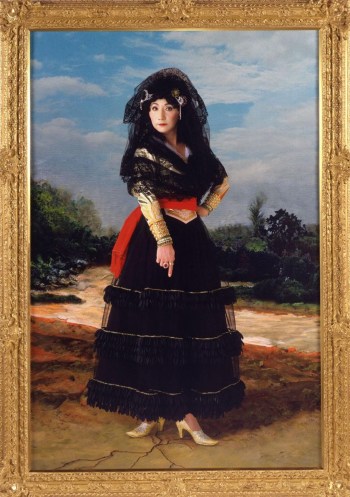
Yasumasa Morimura, ‘Dedicated to La Duquesa de Alba/Black Alba’, 2004, chromogenic print, mounted on canvas (San Antonio: Collection of the McNay Art Museum, 2018.33, ©Yasumasa Morimura).
Richard Aste, Director of the McNay Art Museum, announced today the acquisition of two major works that broaden the McNay’s permanent collection of contemporary art: Dedicated to La Duquesa de Alba/Black Alba by Yasumasa Morimura and Robert by James Gobel.
Funds for these newly acquired works of art were generated by the McNay Contemporary Collectors Forum. The McNay Contemporary Collectors Forum (MCCF) supports contemporary art at the McNay and builds bridges between the Museum and San Antonio’s vibrant art community. In addition to other programs, MCCF initiated the Artists Looking at Art series, which features four artists each year and displays their work in the Museum for three months. MCCF also hosts an annual fundraising event each fall that directly supports the McNay’s art acquisition fund.
“We are thrilled to include the vision of Morimura and Gobel in the collection of the first modern art museum in Texas,” said Aste. “Their works expand the canon of art history and new ideals of beauty and truth in the 21st century.”
“These particular acquisitions enhance two expanding priorities of the McNay’s contemporary holdings—an increasing global presence and greater emphasis on under-recognized communities,” said Head of Curatorial Affairs René Paul Barilleaux. “Together with other judicious purchases made by MCCF since 2003, these artworks demonstrate the ever-expanding ways in which artists communicate their vision through content, subject, materials, and presentation.”
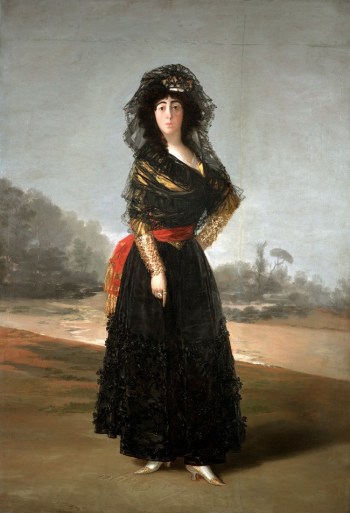
Francisco de Goya, ‘Mourning Portrait of the Duchess of Alba’ (‘The Black Duchess’), 1797, oil on canvas, 77 × 51 inches (New York Hispanic Society).
Both newly acquired works of art will be featured in the McNay’s major summer 2019 exhibition, Transamerica/n: Gender, Identity, Appearance Today. Presented in tandem with Andy Warhol: Portraits and following Warhol’s lead, Transamerica/n is a broad survey of works by visual artists, performers, and self-identified artists who explore gender identity as manifest in outward appearance, individual presentation, and societal perception.
Yasumasa Morimura was born in Osaka, Japan in 1951, and received a BA from Kyoto University of Art in 1978. Morimura is featured in the collections of Carnegie Museum of Art, Pittsburgh; The Museum of Contemporary Art, Los Angeles; The Museum of Fine Arts, Boston; The Museum of Fine Arts, Houston; The San Francisco Museum of Modern Art; and Whitney Museum of American Art, New York. Morimura has composed works of art by referencing seminal paintings by Frida Kahlo, Vincent Van Gogh, Diego Velázquez, and Francisco de Goya, as well as images culled from historical materials, mass media, and popular culture. The artist’s first solo-exhibition at the Japan Society, New York, Yasumasa Morimura: Ego Obscura, is on view through January 13, 2019.
Through extensive use of props, costumes, makeup, and digital manipulation, Morimura masterfully transforms himself into recognizable subjects, often from the Western cultural canon. In Dedicated to La Duquesa de Alba/Black Alba, a self-portrait, Morimura draws reference from Francisco de Goya’s 1797 painting of María Cayetana de Silva, 13th Duchess of Alba. Painted the year after the Duke’s death, this portrait of the Duchess depicts her in mourning black, wearing the traditional costume of a maja. The artist’s reinvention of art historical masterpieces and iconic photographs challenges associations the viewer has with the subjects, while also commenting on Japan’s complex absorption of Western culture.
James Gobel received his BFA in Photography from the University of Nevada, Las Vegas in 1996 and his MFA in Painting from the University of California, Santa Barbara in 1999. Gobel’s work has been featured in Artforum, Art in America, Flash Art, the New York Times, the Los Angeles Times, as well as the Leslie-Lohman Museum of Gay and Lesbian Art, New York (2014); Las Vegas Art Museum (2008); New Museum, New York (2005); and Hammer Museum, Los Angeles (2000).
Gobel begins his process with photographs, either posed or found, and proceeds to make drawings in pencil and yarn, then composes a mosaic of felt pieces. When viewed from a distance, the McNay’s newly acquired work, Robert, could be mistaken for an oil painting, but upon further inspection reveals a fuzzy, warm texture of delicately placed felt. Robert references Giovanni Battista Moroni’s The Tailor (‘Il Tagliapanni’), 1565–70. Although inspired by traditional portraiture, the artist’s interpretation questions the lack of visibility given to heavyset, homosexual bodies. Gobel’s portraits of zaftig male figures blend references to art history with gay culture and break down boundaries between masculine and feminine.
Sweden’s Nationalmuseum Reopens
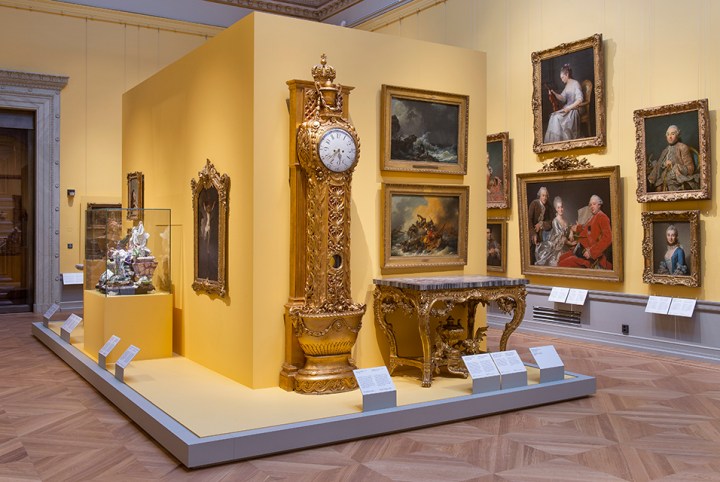
Stockholm: Nationalmuseum
(Photo: Anna Danielsson/Nationalmuseum, 2018)
◊ ◊ ◊ ◊ ◊
After a five-year renovation, Sweden’s Nationalmuseum in Stockholm reopened on Saturday; from the press release, via Art Daily:
In parallel with the renovation of Nationalmuseum, extensive work to create totally new presentations of the museum’s collections has taken place behind the scenes. Among other things, visitors notice that the various art forms are displayed side by side, accompanied by a chronological narrative. In addition to the so-called ‘Timeline’, there are also new spaces such as the Treasury, the Design Depot, Children’s Art World, and the Sculpture Courtyard.
Nationalmuseum has the richest and most extensive collections in the Nordic region, with more than 700,000 objects and works of art. The work with the presentations of the collections began with a desire to be able to display more art and design in the museum building than had previously been possible. It was also important that the collections interacted harmoniously with the building’s original architecture and that daylight was afforded a prominent role, because over 300 big windows were unshuttered. The various art forms—painting, sculpture, art on paper, applied art, and design—would also be integrated.
The largest collection presentation was dubbed the Timeline. Both chronologically and thematically, it traces art and design from 1500 to the present day. Recurring themes include art and politics, nearness to nature, collection history, nationalism and gender. The timeline spirals out through the museum floor plan, and international and Swedish art are displayed side by side, thus encouraging new perspectives and experiences.
Other presentations demonstrate the potential of the collections. In the Treasury, visitors can marvel at the wealth of jewelry, accessories, boxes, and pocket watches, as well as a selection of more than 600 portrait miniatures from the museum’s extensive miniature collection. Many of these objects have never been exhibited before. In the so-called Design Depot on the ground floor, a study collection of ceramics is on display, with more than 1,000 objects from the early 1700s to today. In the depot, the development of the ceramic arts through the ages is depicted, with a focus on materials, technologies and design process. In the Sculpture Garden, visitors can encounter works from the museum’s collection of 19th-century sculpture. Also on the ground floor, a special exhibition called Villa Curiosa is on display in the Children’s Art World. It focuses on our minds and is meant to serve as an introduction to the collections for children and young people. Art from the collections is even on display in the restaurant, where diners can admire Denise Grünstein’s series of photographs entitled 1866, which documents the empty museum building shortly before the renovation was begun.
Dynamism is the guiding principle of the presentation approach. The art will rotate through all or part of the exhibition space, and individual objects will be regularly switched out so that more of the comprehensive collections can be displayed. This also makes it possible to show more light-sensitive art such as drawings and textiles. The collections will also continue to evolve; several large donations received by the museum in recent years, combined with the museum’s own funds, have made it possible to complete a number of acquisitions to complement the collections and fill in some gaps.
Williamsburg Acquires Silver Teapot

Teapot, 1771–72, marked by Andrew Fogelberg, Swedish/English, working ca. 1767–deceased ca. 1815; sterling silver and wood (Colonial Williamsburg, gift of Angus Sladen of Hampshire, England, a descendant of the fourth earl of Dunmore, 2018-128).
◊ ◊ ◊ ◊ ◊
Press release (17 September 2018) from Colonial Williamsburg:
A small, delicately engraved, silver teapot that belonged to the Scottish nobleman John Murray (ca. 1730–1809), fourth earl of Dunmore and Virginia’s last royal governor, which descended through Lord Dunmore’s family, is now part of the Colonial Williamsburg Foundation’s collection. Engraved with the Murray family armorial crest beneath an earl’s coronet, it was made in London in 1771–72 under the sponsorship of the Swedish-born silversmith Andrew Fogelberg. This gift is the first example of silver marked by Fogelberg to enter the collection.
“This remarkable teapot owned by Virginia’s last royal governor represents our nation’s history in a unique way that enables us to authentically tell America’s enduring story,” said Mitchell B. Reiss, president and CEO of the Colonial Williamsburg Foundation. “Gifts such as this one permit us to better convey the human dimension of our country’s history in an exceptional manner.”
Lord Dunmore, a Scottish peer initially sent to the colonies as royal governor of New York, was transferred to Virginia less than one year later as King George III’s representative in the same capacity. He had a strife-filled time in Williamsburg from 1771 to 1776. Dunmore likely acquired the teapot during the earliest years of his residency in the colonies, before his family joined him from Scotland in 1774. Although there is no written documentation to prove that this teapot was used in Virginia, the likelihood that it was is quite strong. The diminutive scale of the teapot would have been suitable for Lord Dunmore’s personal use while in the colonies before his family’s arrival.
All semblance of peaceful governance in Virginia ended when Dunmore seized the colony’s store of gunpowder in April 1775. Notoriously unpopular and sensing the danger of an armed rebellion, Dunmore took his family and some of their small valuables and fled the Governor’s Palace two months later. Lady Dunmore and their children returned to Britain and Dunmore lodged on an English warship anchored in the Chesapeake Bay. In the process, he abandoned most of his household furnishings and personal property. It is believed that the Fogelberg teapot returned to Britain with the family, as it passed down among his descendants until it was given to Colonial Williamsburg recently.
“Only a handful of objects have come down to us from Lord Dunmore’s time in the Governor’s Palace,” said Ronald L. Hurst, the Foundation’s Carlisle H. Humelsine chief curator and vice president for collections, conservation, and museums. “Given his explosive role in Virginia’s Revolutionary uprising, Dunmore’s personal possessions are now powerful interpretive tools. This well-preserved teapot comes as a very important addition to our collections.”
Diminutive in size and cylindrical in shape, the teapot is engraved with arcaded columns beneath a shell and acanthus border. The proper right side is engraved with the Murray family crest as used by the earls of Dunmore: a bearded man holding in his right hand a sword and in his left a key; above is an earl’s coronet with five pearls on raised stalks interspersed with four strawberry leaves. This unique combination of elements, together with the date of the teapot, identifies it as the property of John Murray, the fourth earl of Dunmore and royal governor of Virginia.
The teapot has a loose—rather than hinged—lid, perhaps indicative of the Swedish background of its silversmith/sponsor Andrew Fogelberg, as this feature is more typically found on Scandinavian, Baltic and Continental vessels. Few objects from Fogelberg’s shop survive, and he is best remembered today as the master who trained the better-known English silversmith Paul Storr.
“This teapot tells a fascinating story,” said Janine E. Skerry, senior curator of metals at the Colonial Williamsburg Foundation. “Made in the shop of a Swedish-born craftsman working in London, it was used in Virginia by a Scottish nobleman on the eve of the American Revolution. It then traveled back to Britain only to be rediscovered almost 250 years later.”
The teapot is a gift of Angus Sladen of Hampshire, England, a descendent of the fourth earl of Dunmore. It descended to him via Lady Evelyn Cobbold, née Murray (1867–1963), daughter of the seventh earl of Dunmore and Lady Gertrude Coke, daughter of the second earl of Leicester. “I have a great love of and admiration for the United States,” said Mr. Sladen. “It seemed clear to me that this small object most probably witnessed part of American Revolutionary history. Colonial Williamsburg, with its great collections and knowledgeable curators and experts, seemed the ideal home for it, and I felt it might mean a great deal to [its] visitors.”
The Dunmore teapot will be included in a multimedia exhibition focused on objects made or used in Williamsburg scheduled to open at the Art Museums of Colonial Williamsburg in 2019.
Rijksmuseum Acquires Floral Painting by Gerard van Spaendonck
Press release (29 August 2018) from the Rijksmuseum:
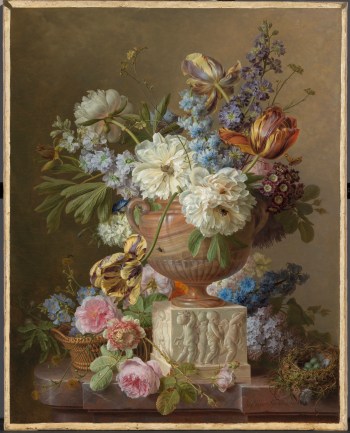
Gerard van Spaendonck, Still Life of Flowers in Alabaster Vase, 1783, oil on canvas, 80 × 64 cm (Amsterdam: Rijksmuseum).
The Rijksmuseum has procured a painting by Gerard van Spaendonck, the most famous painter of floral still lifes of the second half of the 18th century. It was a long-cherished wish of the museum to include in its collection an important work by this Dutch painter of international renown. The Rijksmuseum’s director Taco Dibbits describes this painting as “a radiantly beautiful acquisition.” The purchase of Still Life of Flowers in an Alabaster Vase from a gallery in Paris for €900,000 was made possible in part by participants in the BankGiro Lottery. The painting is now on display in Gallery 1.11.
Gerard van Spaendonck (1746–1822) was born in the southern Dutch city of Tilburg and settled in Paris in the 1760s. He gained fame not only as a painter of floral still lifes, but also as the illustrator of the French king’s botanical collection, a highly prestigious position. He was a leading and active figure in the Parisian art world and a teacher of countless French and foreign artists. Gerard van Spaendonck did not make a great number of paintings, instead devoting much of his time to his watercolours of plants, and to his students. He is nonetheless considered to be his era’s best painter of flowers.
Gerard van Spaendonck exhibited this floral still life at the Salon de 1783 in Paris, and it received great praise from critics, including compliments for his lifelike depictions of insects. The painting shows a bouquet of flowers in an alabaster vase standing atop a marble block on which children are depicted in relief. The painter’s studio window can be seen reflected in the polished surface of the vase. The flowers that feature in this painting include large white and smaller pink peonies, blue delphiniums, purple lilacs, and yellow and purple flamed tulips. Insects can be seen dotted about, and five green blackbird eggs lie in the nest on the right. Even the wicker basket seems almost real enough to touch.










leave a comment