New Expansion Plan for The Frick Unveiled
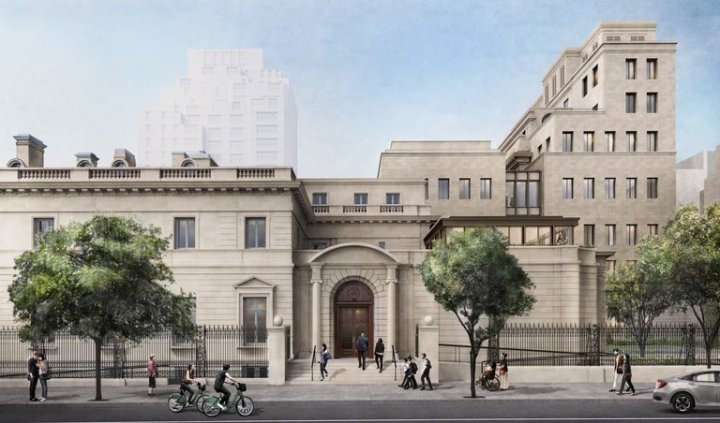
A rendering of The Frick Collection from East 70th Street in New York (Credit: Selldorf Architects). According to the press release from The Frick, the $160million project, scheduled to begin in 2020, “encompasses approximately 60,000 square feet of repurposed space and 27,000 square feet of new construction.”
◊ ◊ ◊ ◊ ◊
From The New York Times:
Robin Pogrebin, “Frick Collection, With Fourth Expansion Plan, Crosses Its Fingers Again,” The New York Times (4 April 2018).
The irony is not lost on Ian Wardropper, the director of the Frick Collection: The very gated garden that upended the museum’s previous attempt to renovate its 1914 Gilded Age mansion is now the centerpiece of its revised design.
In 2015, preservationists, designers, critics and architects successfully opposed the Frick’s plans to remove the garden on East 70th Street, designed by the British landscape architect Russell Page, to make way for a six-story addition, by Davis Brody Bond.
The new plan, by the architect Annabelle Selldorf—which the Frick board approved Wednesday—has situated several new elements precisely so that each provides a tranquil view of the garden: a renovated lobby; a newly created second level above the reception hall; and a new education center, cafe and expanded museum shop.
In addition, the garden will be restored by Lynden B. Miller, a garden designer and preservationist, in keeping with Page’s original vision.
And rather than build over the garden, as previously planned, the Frick will now build beneath it, creating a 220-seat underground auditorium to better accommodate educational and public programs. . .
The full article is available here»
New Skylights for The Met
As Keith Christiansen, John Pope-Hennessy Chairman of the Department of European Paintings at The Met, explains in a blog posting for The Met from 7 December 2017, the museum has embarked on a four-year-long project to replace the building’s skylights, which were originally constructed in 1939. Coverage by James Barron for The New York Times is available here. From Christiansen’s blog posting:
One of my favorite documents (yes, it is possible to have favorite historical documents!) was only discovered in Rome’s dusty state archives five years ago. It notes how the brilliant young Spanish painter Jusepe de Ribera, having found lodgings in which he could paint, received permission from his landlord to create a window in the ceiling of his apartment. The purpose was, he said, “to facilitate painting.” Caravaggio had done the same in his lodgings in 1605.

Giovanni Battista Tiepolo, Allegory of the Planets and Continents, 1752, oil on canvas, 185 × 139 cm (New York: The Metropolitan Museum of Art, gift of Mr. and Mrs. Charles Wrightsman, 1977.1.3).
You see, artists can’t paint without good light—and not just any light, but sunlight (ideally with a northern orientation). Just try to imagine Jan van Eyck trying to paint the minute details of the distant cityscape and mountains in his phenomenal Crucifixion without adequate lighting—which, believe me, could not be obtained with candles.
In an age dominated by the drama of artificial light, it’s all too easy to forget how important daylight has always been to artists: natural light possessing the full color spectrum; light that falls evenly across the surface of the panel or canvas. A beautiful illustration of this is Vermeer’s famous Allegory of Painting in the collection of the Kunsthistorisches Museum in Vienna, where we see the well-dressed artist sitting on his stool in front of his easel while a woman poses, dressed as Clio, the muse of history. The natural light from an unseen but clearly present window falls across her figure and gives an evenly balanced light to the artist’s canvas.
It follows that you cannot judge a painting without good light either. Not surprisingly, the optimal light in which to view a painting is dispersed and even daylight—which is why The Met is embarking on a four-year-long project to replace the skylights in the European Paintings galleries—originally constructed in 1939—and replace them with an up-to-date system; one that will significantly improve the way visitors experience the collection.
On our new web feature, Met Masterpieces in a New Light, you’ll be able to follow the project’s progress over the next four years and discover new ways to engage with our European paintings collection online while the galleries are closed. Be sure to bookmark the page and check in with us every month.
Stephanie Wiles Named Director of the Yale Art Gallery
Press release (28 March 2018) from Yale:

Stephanie Wiles (Photo by Jon Reis Photography).
Stephanie Wiles, currently the Richard J. Schwartz Director of the Herbert F. Johnson Museum of Art at Cornell University, will serve as the next Henry J. Heinz II Director of the Yale University Art Gallery, announced President Peter Salovey. Her appointment will begin July 1.
“I am thrilled to announce the appointment of Stephanie Wiles,” Salovey said. “She is an inspiring leader who is excited by the power of art to help us make connections and spark new ideas. I know she will steward the gallery—one of Yale’s finest treasures—while, together with other arts leaders on campus, envisioning new possibilities for the arts at our university.”
Wiles comes to Yale with over 20 years of experience leading college and university art museums. In her prior roles, Wiles has led efforts to connect the visual arts to other areas of university life by developing interdisciplinary courses, reimagining gallery spaces to be more inviting to visitors from campus and beyond, and spearheading exhibitions and publications to showcase research. She served on several committees at Cornell Tech, a science and technology graduate school in New York City, tasked with bringing art to the campus and into the curriculum. Wiles has successfully created educational and research opportunities across disciplines that take advantage of museum collections. She secured funding from the Andrew W. Mellon Foundation to develop eight semester-long courses that bridged the arts, humanities, science, and engineering.
At Cornell, Ms. Wiles oversaw the negotiation and completion of Cosmos, a site-specific light sculpture by Leo Villareal ’90 comprising 12,000 LED lights. The work, named in honor of scientist Carl Sagan and visible across campus and from many parts of Ithaca, is a beacon attracting visitors to the museum.
“Stephanie shares my commitment to connecting the arts to everything we do at Yale,” Salovey said. “The arts can bring us together, inspiring us to see ourselves and the world with new eyes. As we continue to foster an even more unified Yale, we are imagining new ways to connect the gallery’s magnificent resources to education, research, preservation, and practice. I am confident Stephanie will guide these efforts with enormous wisdom, creativity, and vision.”
Wiles began her career in the department of drawings and prints at the Morgan Library & Museum in New York City; she later assumed leadership positions at Wesleyan University, Oberlin College, and, most recently, Cornell. Wiles received her bachelor’s degree from Hobart and William Smith Colleges, a master’s degree in art history from Hunter College of the City University of New York, and a Ph.D. in art history from the Graduate Center of the City University of New York. Her dissertation surveys the careers of British-born artists Thomas Charles Farrer, a Ruskin admirer and leader of the American Pre-Raphaelites, and his brother Henry Farrer.
In making the announcement, Salovey expressed his deep appreciation to members of the search committee: Mary Miller (committee chair), Sterling Professor of History of Art and senior director of the Institute for the Preservation of Cultural Heritage; Emily Bakemeier, deputy provost and dean of faculty affairs of the Faculty of Arts and Sciences; Tim Barringer, the Paul Mellon Professor in the History of Art and chair of the Department of the History of Art; Deborah Berke, dean of the Yale School of Architecture; Susan Gibbons, the Stephen F. Gates ’68 University Librarian and deputy provost for collections and scholarly communication; Daniel Harrison, the Allen Forte Professor of Music Theory; Roger Horchow ’50, a member of the Yale University Art Gallery Advisory Board; Ian McClure, the Susan Morse Hilles Chief Conservator of the Yale University Art Gallery; and John Walsh ’61, a member of the Yale University Art Gallery Advisory Board and director emeritus of the J. Paul Getty Museum.
Salovey praised the tenure of Jock Reynolds, who will step down as director on June 30, noting that he had led the Yale University Art Gallery “with distinction, energy, and originality for 20 years.”
V&A Cabinet of Curiosity Project, with Artist Victoria Adukwei Bulley
As Eileen Budd writes on the V&A’s blog (28 February 2018) . . .

Cupboard, unknown, 1678–80, possibly Rotterdam, Netherlands (London: Victoria and Albert Museum, W.7-1914).
The Project
The Cabinets of Curiosity project examines the History of Collecting over the centuries, from Early Modern, to 19th Century to Contemporary. Dr Hannah Young is currently undertaking research that seeks to uncover some of the unexplored histories of the V&A, which in many respects became a large-scale nineteenth-century ‘cabinet of curiosity’. In particular, she is investigating some of the links between British slave-ownership and the development of the museum. Her research focuses on absentee slave-owners who used their wealth, rooted in the exploitation of enslaved people, to invest in collections in the metropole. Objects that were once collected by absentees and their descendants can now be found throughout the museum.
Why Involve an Artist in Residence?
There are multiple histories (our histories) that are hidden in plain sight within our collections. Such a wealth of stories, voices and lives that surfacing these and even knowing where to begin, can be challenging. We want to open up a new dialogue around our collections and so it’s vital that we have these conversations beyond academia. Artists are often better able to ask questions beyond historical ones. Inviting an artist to interrogate how this history has (and has not) been remembered and how the legacies of this history continue to shape the world we live in today can help change the way we think about the museum collections. We had an amazing response to our open call, from so many talented artists that selecting the right person for the project was incredibly hard. However, I am now delighted to announce that we have selected Victoria Adukwei Bully.
The Artist
 Victoria Adukwei Bulley is a British-born Ghanaian poet, writer and filmmaker based in London. Her work explores memory and cultural heritage—their loss and (re)creation—from a diasporic vantage point. Engaging with archival texts in addition to oral and indigenous histories, her practice posits memory as a form of creative activism which seeks to revivify bodies of knowledge that face erasure.
An alumna of the Barbican Young Poets programme, Victoria’s work has been commissioned by the Royal Academy of Arts, in addition to featuring on BBC Radio 4 Woman’s Hour. She was shortlisted for the Brunel University African Poetry Prize 2016, and is a Complete Works Poetry fellow. Her debut pamphlet, Girl B, edited by Kwame Dawes, forms part of the 2017 New-Generation African Poets series. Victoria is the director of MOTHER TONGUES, a poetry translation and film initiative supported by Arts Council England and visual arts charity Autograph ABP.
We are excited to be working with her and can’t wait to share the work with you as it progresses.
Cabinets of Curiosity project duration: 2016–18
Project co-leads: Dr Marta Ajmar, Deputy Director VARI, Dr Hannah Young (Maternity cover); Dr Lisa Skogh, external fellow
V&A co-investigator: Dr Martha Fleming, Previous Deputy Director VARI
Artist in Residence: Victoria Adukwei Bulley
Visiting researcher: Earle Havens, William Kurrelmeyer Curator of Rare Books and Manuscripts, Sheridan Libraries and Adjunct Associate Professor, Department of German and Romance Languages and Literatures, Johns Hopkins University
NMWA’s Wikipedia Edit-a-thon, 2018

Today at the NMWA:
Wikipedia Edit-A-Thon 2018
National Museum of Women in the Arts, Washington, D.C., 17 March 2018
Celebrate Women’s History Month and help us improve Wikipedia articles about women artists.
In honor of Women’s History Month, NMWA will host its 5th annual Art+Feminism Edit-A-Thon focused on improving Wikipedia entries related to notable women artists and art world figures. This event is part of a global initiative to help improve Wikipedia’s gender imbalance. A 2010 Wikimedia survey found that less than 13% of its contributors are women. The lack of female participation has contributed to the absence of notable women on Wikipedia. In more than 480 events, over 7,100 people have created and improved more than 11,000 Wikipedia articles.
No experience necessary—just bring a laptop, motivation to combat gender bias, and a belief in equal access to quality information resources. People of all gender identities and expressions are invited to participate.
Schedule
10:00–11:00 Welcome and editing tutorial
11:00–3:00 Research and editing
Lunch at noon
Use the hashtags #ArtAndFeminism and #NowEditingAF to share about the event on social media!
Reservations required—use the passcode ‘AF’. Please bring a laptop with power cord. Extension cords and power strips are highly recommended.
Cleveland Acquires Maratti Portrait
Press release (14 March 2018) from The Cleveland Museum of Art:

Carlo Maratti, Portrait of Francesca Gommi Maratti, ca. 1701, oil on canvas, 98.5 × 74.5 cm (Cleveland Museum of Art).
Recent acquisitions by the Cleveland Museum of Art include a magnificent portrait in oil on canvas by Carlo Maratti, the leading painter in Rome at the end of the 17th century; two key works by American photographer Edward Weston that indicate his transition from pictorialism to modernism; and two large-scale contemporary African sculptures by South African artist Kendell Geers and Cameroonian artist Hervé Youmbi.
Carlo Maratti (1625–1715) is often regarded as the last major exponent of a classical tradition that began with Raphael nearly two centuries earlier. Maratti was the leading painter in Rome in the mid to late seventeenth century. Favored by wealthy patrons, Maratti’s primary achievement lay in his ability to synthesize the light and movement characteristic of the Roman Baroque with classical ideals of beauty.
This portrait was painted shortly after Maratti’s marriage to Francesca Gommi in late 1700 as an homage from the artist to his new wife. Gommi had been Maratti’s mistress and artist’s model since at least the 1670s. She is depicted enveloped in lavender-blue drapery, and her hair is elaborately dressed with ribbons and jewels. In her left hand she holds up a drawing to which she gestures with her right. Introducing an allegorical element into a portrait by means of a painting-within-a-painting was a device that Maratti had employed in portraits as early as the 1650s and was probably inspired by portraits of the High Renaissance. The drawing represents Venus in the workshop of Vulcan, forging the love-darts of her adolescent son Cupid.
Although drawings by Maratti are found in major collections throughout Europe and North America, there are relatively few paintings by the artist in public collections outside Italy. Portrait of Francesca Gommi Maratti, a late work by the artist, is particularly appealing for the identity of its sitter and the charming iconography inspired by the artist’s deep love for his subject. The Cleveland Museum of Art has strong holdings in Italian paintings of the 17th century with religious and historical themes. This work is the first Italian Baroque painted portrait to join the collection. Portrait of Francesca Gommi Maratti will go on view in the museum’s Julia and Larry Pollock Focus Gallery beginning March 17, 2018, as part of the museum’s exhibition Recent Acquisitions 2014–2017. . .
The full press release is available here.
◊ ◊ ◊ ◊ ◊
Maratti’s Portrait of Francesca Gommi Maratti, was part of Nicholas Hall’s exhibition Paintings by Carlo Maratti organized to coincide with TEFAF New York in October of 2017. Previously, in July 2016, it was included in Robilant Voena’s installation for Masterpiece London, and before that, in January 2014, it was shown in New York as part of Sotheby’s selling exhibition Painting Passion: The Baroque in Italy, curated by Scott Schaefer.
Melinda Watt Appointed Curator of Textiles at AIC
Press release (12 March 2018) from the AIC:

Melinda Watt, Chair and Christa C. Mayer Thurman Curator of Textiles at the Art Institute of Chicago (Photo courtesy of The Metropolitan Museum of Art).
James Rondeau, President and Eloise W. Martin Director of the Art Institute of Chicago, announced today the appointment of Melinda Watt as the new Chair and Christa C. Mayer Thurman Curator of Textiles. Watt most recently served as Curator in the Department of European Decorative Arts and Sculpture (2016–18) and supervising curator for the Antonio Ratti Textile Center (2009–18) at The Metropolitan Museum of Art, where she oversaw exhibitions, research, and collections management for over 16,000 Western European textiles and 500 fans and led one of the largest, most technically advanced facilities for the study and storage of textiles in any major art museum in the world. She helped define a comprehensive, inclusive strategy for the care and research of works from all of the world’s civilizations—archaeological fragments, tapestries, carpets, quilts, ecclesiastical vestments, silks, embroideries, laces, velvets, and more—from 3000 BC to the present.
Watt will now lead the Art Institute of Chicago’s internationally renowned Department of Textiles and oversee its extensive collection of more than 13,000 textiles and 66,000 sample swatches ranging from 300 BC to the present, with particular strengths in Pre-Columbian textiles, European vestments, tapestries, woven silks and velvets, printed fabrics, needlework, and lace. The department has also strong holdings in 16th- and 17th-century English needlework, printed and woven materials of the 18th and 19th centuries, American quilts and woven coverlets, Eastern textiles, and 20th-century fiber art.
In announcing this appointment, Rondeau said: “Melinda has an outstanding reputation as a talented curator, an expert researcher and respected scholar, and brilliant administrator and leader. I am thrilled for our museum and our visitors that she is joining us in this crucial position and will re-energize our ambitious efforts to grow and elevate the reputation of our renowned Textiles department and present innovative and dynamic exhibitions.”
Watt shared: “From the earliest days of my career, I have admired the supreme quality and breadth of the textile collection at the Art Institute, so it comes as a great honor to be asked to lead the Department of Textiles. This is truly a unique opportunity to augment the museum’s already stellar collection and to have an impact on the scholarly field at large.”
Watt began her tenure at The Met in 1994, in The Costume Institute as a Study Storage Assistant, and soon took on increasingly complex and leadership roles, culminating in her leadership of the Antonio Ratti Textile Center beginning in 2009 and a curatorial rise within the Department of European Sculpture and Decorative Arts to become a full Curator in 2016. Her exhibitions at The Met include: The Secret Life of Textiles: The Milton Sonday Archive (2017–18), American and European Embroidered Samplers, 1600–1900 (with Amelia Peck, 2015–16), Elaborate Embroidery: Fabrics for Menswear before 1815 (2015), William Morris: Textiles and Wallpapers (with Connie McPhee and Alison Hokanson, 2014), Interwoven Globe: The International Textile Trade, 1500–1800, (co-curator with Amelia Peck et al., 2013–14), An ‘Industrial Museum’: John Forbes Watson’s Indian Textile Collection (2013–14), Renaissance Velvet: Textiles for the Nobility of Florence and Milan (2011–12), and European Textiles from the Collection of Friedrich Fischbach (2010).
Earlier in her career, Watt lectured and instructed at the Bard Graduate Center for Studies in the Decorative Arts, at The Graduate Center at the City University of New York, at New York University, and at the Fashion Institute of Technology in New York, NY. She has also lectured and published widely, from New York to Chicago and Copenhagen to Beijing, on subjects as diverse as Renaissance and Baroque luxury textiles, Anglo-Indian hangings, flora and fauna in English embroidery, Isabella Stewart Gardner’s pearls, mid-century American fashion, nature in western art, and dressing for 17th-century portraiture.
Watt earned her BFA, with a concentration in Art History, at Wittenberg University in Springfield, Ohio. She holds an MA in Costume Studies from New York University.
New Acquisition | Am Not I A Man and a Brother
Press release, via Art Daily (1 March 2018). . .

Am Not I A Man and a Brother, ca. 1800 (Liverpool: International Slavery Museum). The painting is based on a design commissioned by the Committee for the Abolition of the Slave Trade on 5 July 1787.
The International Slavery Museum in Liverpool has been awarded a significant grant to support the acquisition of its first painting to depict the powerful and resonant iconography of abolition. The £50,000 used to acquire Am Not I A Man and a Brother, a painting dating from around 1800, is the result of a joint funding effort, made possible through a generous grant award by Art Fund and the Heritage Lottery Fund’s Collecting Cultures programme.
The painting’s dominant motif is that of an enslaved African, kneeling, bound in chains and set against the backdrop of a Caribbean sugar plantation. It is based on a design commissioned by the Committee for the Abolition of the Slave Trade on 5 July 1787 and is considered to be one of the first instances of a logo designed for a political cause, used famously by the potter Josiah Wedgwood. A significant acquisition for the UK, it is only the second known painting to exist featuring this motif—the only other being The Kneeling Slave at the Wilberforce House Museum in Hull.
Stephen Carl-Lokko, Curator, International Slavery Museum said: “This acquisition represents the first painting ever to be acquired by National Museums Liverpool to depict the powerful and resonant iconography of abolition, and we are very pleased to add it to our collection. Resistance is a key part of the history we bring to life in the International Slavery Museum, and abolition is a very important part of this wider narrative. The painting is a remarkable surviving product of the early phase of the British movement to abolish the transatlantic slave trade during the 18th and 19th century.”
Following restoration and cleaning work to be carried out on the painting, it will go on display in the International Slavery Museum towards the end of 2018. The painting was in a private collection previously.
Stephen Deuchar, Director, Art Fund said: “We are proud to be able to support the International Slavery Museum in acquiring this fascinating version of an iconic image. It will undoubtedly enrich the museum’s narrative around abolition and its important place in British history.”
The painting is another acquisition the International Slavery Museum has announced under the Transatlantic and Contemporary Slavery Collecting Project, part of the Heritage Lottery Fund’s Collecting Cultures programme. Previous announcements under this project have included the acquisition of a copper engraving by the famous British caricaturist James Gillray and the first example of an account by a female anti-slavery campaigner, into the Museum’s collection.
Am Not I a Man and a Brother is one of several iconic paintings relating to all aspects of the transatlantic slave trade, which are now part of the collection at National Museums Liverpool, including The Hunted Slaves by Richard Ansell and The Black Boy by William Windus, both on display at the International Slavery Museum and a 1768 portrait of Liverpool merchant Richard Gildart by Joseph Wright of Derby at the Walker Art Gallery. The first painting to depict the theme of abolition at the International Slavery Museum, Am Not I a Man and a Brother is also part of a wider collection of objects and documents exploring abolition, including a porcelain sugar bowl from 1820–30 inscribed “East India Sugar. The produce of Free Labour”and a 1793 edition of the autobiography of the famous Black anti-slavery campaigner Olaudah Equiano.
The International Slavery Museum highlights the international importance of enslavement and slavery, both in a historic and modern context. Working in partnership with other organisations with a focus on freedom and enslavement, the Museum provides opportunities for greater awareness and understanding of the legacies of enslavement today.
Social Media | Redressing Pleasure
Social media and crowd sourcing campaigns can be daunting tasks for museum professionals. The Museum of London’s recent #redressingpleasure campaign offers an exemplary model. With fashion curator Timothy Long’s Twitter and Instagram videos reaching thousands, their efforts have been both engaging and effective.
–Intern JMB
Timothy Long, our fashion curator, has been posting some selfies from inside our Costume Store, as part of our month-long Redressing Pleasure campaign. He’s highlighting some of the most fascinating fashions from our collection of 18th- and 19th-century clothing and picking the best to include in our new, updated Pleasure Gardens gallery display.
Please join us in #redressingpleasure & help us conserve & exhibit rare 18-19th century artefacts. Go to @artfund @ https://t.co/zJQL6Vmnoa pic.twitter.com/dD8Br0fde6
— Timothy Long (@Fashion_Curator) November 3, 2017
We need your help to conserve & exhibit this late 18th century dress, as part of the #redressingpleasure project 👉🏽 https://t.co/lb7K933Qm9 pic.twitter.com/r2g2TTlOmJ
— Timothy Long (@Fashion_Curator) November 4, 2017
This exquisite c. 1790 dress is one of the artefacts we want to conserve and exhibit as part of #redressingpleasure. The conservation will be done by Textile Conservator @melina.plottu. While the bodice is in near mint condition, the skirt needs attention as it is sewn to a thin and fragile silk ribbon waistband, which is not strong enough to support the weight of the skirt. We need your support to help us conserve the waistband and a few other areas. We also need your support to help us reproduce some petticoats, which is a fun, yet time-consuming process—as the shape must be cut to properly exhibit the skirt (and to fit the mannequin).
Will you help us put our ‘Queen of the Night’ back together again? For more info on #RedressingPleasure @artfund: https://t.co/zJQL6Vmnoa pic.twitter.com/4uGZW18LaZ
— Timothy Long (@Fashion_Curator) November 5, 2017
Oh wow! What a treasure. This late 18th-century dress was donated with dozens of ‘scrap’ pieces. As I started to go through these pieces, I was shocked and delighted to find identifiable parts, giving us glimpses of older incarnations of the dress. While the sleeves and the inner layer of the bodice appear to have remained throughout each upgrade, the exterior to the bodice and parts of the skirt, were cut off and kept. We would like to include this dress in our new Pleasure Gardens display, but it requires some creative solutions to put it back together again and then to build a mannequin to exhibit it properly, including petticoats. Will you help us put the ‘Queen of the Night’ back together again?
A Victorian Archeress 💘 We need your support to complete this ensemble. We must make a skirt & undersleeves & we hope to buy an 1850s archery bow! Will you help us? 👉🏽 https://t.co/zJQL6Vmnoa pic.twitter.com/3xxKscFZsc
— Timothy Long (@Fashion_Curator) November 8, 2017
A Victorian Archeress! It doesn’t get much better than this. This stunning ensemble was donated to the Museum of London in 1954. It was worn by Mrs Fanny Giveen (1833–1863). If you know anything about her, please do get in touch. This ensemble will be our ‘performer’ in the 19th-century side of the gallery. Vauxhall Pleasure Gardens had ‘archery fetes’ in the 19th century, represented by this costume. We are so pleased to have an excuse to exhibit this incredible ensemble. However, we must reproduce her skirt and undersleeves and I hope to buy an original 1850s women’s archery bow, to complete the ensemble.
Thank you for your positive responses to our Archeress. Here are more details of the ensemble. Filled pages, water coloured targets & purple feathers on the arrows 💘 For more info & to donate 👉🏽 https://t.co/zJQL6Vmnoa pic.twitter.com/Vm6o1VR9Kv
— Timothy Long (@Fashion_Curator) November 9, 2017
Our Archeress received such a wonderful response on social media that I recorded a second video. Thank you! I thought you might like to see more of the ensemble. Every page of the notebook is filled with scores, lists and drawings…all appear archery related and all written by Fanny Giveen herself! And then the water coloured targets… I’m in love.
If you ❤menswear, we have some rare 18-19th century examples, which need your support! For info & to donate: https://t.co/zJQL6Vmnoa #style pic.twitter.com/Qk24rNvYjq
— Timothy Long (@Fashion_Curator) November 6, 2017
We hope to exhibit this 1830s pelisse next to the men’s 1830s coat. We are calling this ‘couple’, Jeremiah and Electa. I fell in love with this pelisse immediately. For women’s fashion, I think the period around 1830 is fascinating. The odd proportion in design, enormous sleeves, towering hats, and feathers. We may even get to work with ‘sleeve supporters’ (parts of a costume, not donors to #RedressingPleasure). I am really looking forward to seeing this pelisse conserved and mounted, with all the correct undergarments and accessories.
Wallace Collection Announces £1.2million New Exhibition Space

The Wallace Collection, Manchester Square, London
(Photo: Wikimedia Commons, 2005)
◊ ◊ ◊ ◊ ◊
As announced by The Wallace Collection (13 February 2018) . . .
The Wallace Collection has secured funding to develop expanded exhibition galleries, tripling the capacity of the museum’s existing exhibition space and setting the scene for an ambitious programme of temporary, ticketed [paid] exhibitions. The new space will enable the museum to explore aspects of its existing collection in more depth and collaborate with other institutions, creating partnerships both within the UK and internationally. This transformative project has been made possible by the generosity of The Linbury Trust, the Wolfson Foundation, and an anonymous major donor, creating facilities that reflect the vision and ambition of the Director and Board of Trustees and the growing number of museum visitors.
The new space opens on 19 June 2018 with an inaugural exhibition marking 200 years since the birth of the museum’s founder, Sir Richard Wallace (1818–1890), celebrating him as a great philanthropist and undiscovered cultural luminary. Sir Richard Wallace: The Collector highlights for the first time Sir Richard’s personal contributions to the Collection we know today, focusing on the diverse and idiosyncratic works of art he acquired and his considerable philanthropic legacy. Featuring over twenty works of art collected by Sir Richard, the exhibition explores his eclectic tastes and highlights some of the unexpected treasures of the museum, ranging from a gold trophy head from the Asante Kingdom to imperial ceremonial wine cups from China and a majestic ostrich figure made by the Augsburg silversmith Elias Zorer.
In 2019, Henry Moore: The Helmet Head Series (working title) will be our first paid exhibition, presented in partnership with the Henry Moore Foundation. Moore’s powerful sculptures and drawings will be juxtaposed with Renaissance helmets from the Wallace Collection, which he studied while he was a student at the Royal College in the 1920s. Moore took great inspiration from the Arms and Armour galleries at the Wallace, and this exhibition will demonstrate for the first time a direct connection between Moore’s work and works of art on display within the museum. This inaugural exhibition will be followed by a wide ranging programme of both contemporary and old master exhibitions that will present our extensive collections of paintings, sculpture, armour, and decorative arts in a new light.
Dr Xavier Bray, Director of the Wallace Collection, says: “The Wallace Collection is the greatest gift ever made to the nation, and this new space will enable us to shine a light on the immense quality of our works of art and raise the profile of the museum. The exhibition programme at the Wallace will provide an opportunity to get to know our collection in new ways as well as collaborate with other cultural institutions. Thanks to the generous support of three major donors, who have made it possible to extend our exhibition galleries, we will be able to reach our potential as a truly international institution, sharing the museum with a broader and more diverse audience both at home and abroad.”










 Enfilade
leave a comment