New Acquisition | Am Not I A Man and a Brother
Press release, via Art Daily (1 March 2018). . .

Am Not I A Man and a Brother, ca. 1800 (Liverpool: International Slavery Museum). The painting is based on a design commissioned by the Committee for the Abolition of the Slave Trade on 5 July 1787.
The International Slavery Museum in Liverpool has been awarded a significant grant to support the acquisition of its first painting to depict the powerful and resonant iconography of abolition. The £50,000 used to acquire Am Not I A Man and a Brother, a painting dating from around 1800, is the result of a joint funding effort, made possible through a generous grant award by Art Fund and the Heritage Lottery Fund’s Collecting Cultures programme.
The painting’s dominant motif is that of an enslaved African, kneeling, bound in chains and set against the backdrop of a Caribbean sugar plantation. It is based on a design commissioned by the Committee for the Abolition of the Slave Trade on 5 July 1787 and is considered to be one of the first instances of a logo designed for a political cause, used famously by the potter Josiah Wedgwood. A significant acquisition for the UK, it is only the second known painting to exist featuring this motif—the only other being The Kneeling Slave at the Wilberforce House Museum in Hull.
Stephen Carl-Lokko, Curator, International Slavery Museum said: “This acquisition represents the first painting ever to be acquired by National Museums Liverpool to depict the powerful and resonant iconography of abolition, and we are very pleased to add it to our collection. Resistance is a key part of the history we bring to life in the International Slavery Museum, and abolition is a very important part of this wider narrative. The painting is a remarkable surviving product of the early phase of the British movement to abolish the transatlantic slave trade during the 18th and 19th century.”
Following restoration and cleaning work to be carried out on the painting, it will go on display in the International Slavery Museum towards the end of 2018. The painting was in a private collection previously.
Stephen Deuchar, Director, Art Fund said: “We are proud to be able to support the International Slavery Museum in acquiring this fascinating version of an iconic image. It will undoubtedly enrich the museum’s narrative around abolition and its important place in British history.”
The painting is another acquisition the International Slavery Museum has announced under the Transatlantic and Contemporary Slavery Collecting Project, part of the Heritage Lottery Fund’s Collecting Cultures programme. Previous announcements under this project have included the acquisition of a copper engraving by the famous British caricaturist James Gillray and the first example of an account by a female anti-slavery campaigner, into the Museum’s collection.
Am Not I a Man and a Brother is one of several iconic paintings relating to all aspects of the transatlantic slave trade, which are now part of the collection at National Museums Liverpool, including The Hunted Slaves by Richard Ansell and The Black Boy by William Windus, both on display at the International Slavery Museum and a 1768 portrait of Liverpool merchant Richard Gildart by Joseph Wright of Derby at the Walker Art Gallery. The first painting to depict the theme of abolition at the International Slavery Museum, Am Not I a Man and a Brother is also part of a wider collection of objects and documents exploring abolition, including a porcelain sugar bowl from 1820–30 inscribed “East India Sugar. The produce of Free Labour”and a 1793 edition of the autobiography of the famous Black anti-slavery campaigner Olaudah Equiano.
The International Slavery Museum highlights the international importance of enslavement and slavery, both in a historic and modern context. Working in partnership with other organisations with a focus on freedom and enslavement, the Museum provides opportunities for greater awareness and understanding of the legacies of enslavement today.
Social Media | Redressing Pleasure
Social media and crowd sourcing campaigns can be daunting tasks for museum professionals. The Museum of London’s recent #redressingpleasure campaign offers an exemplary model. With fashion curator Timothy Long’s Twitter and Instagram videos reaching thousands, their efforts have been both engaging and effective.
–Intern JMB
Timothy Long, our fashion curator, has been posting some selfies from inside our Costume Store, as part of our month-long Redressing Pleasure campaign. He’s highlighting some of the most fascinating fashions from our collection of 18th- and 19th-century clothing and picking the best to include in our new, updated Pleasure Gardens gallery display.
Please join us in #redressingpleasure & help us conserve & exhibit rare 18-19th century artefacts. Go to @artfund @ https://t.co/zJQL6Vmnoa pic.twitter.com/dD8Br0fde6
— Timothy Long (@Fashion_Curator) November 3, 2017
We need your help to conserve & exhibit this late 18th century dress, as part of the #redressingpleasure project 👉🏽 https://t.co/lb7K933Qm9 pic.twitter.com/r2g2TTlOmJ
— Timothy Long (@Fashion_Curator) November 4, 2017
This exquisite c. 1790 dress is one of the artefacts we want to conserve and exhibit as part of #redressingpleasure. The conservation will be done by Textile Conservator @melina.plottu. While the bodice is in near mint condition, the skirt needs attention as it is sewn to a thin and fragile silk ribbon waistband, which is not strong enough to support the weight of the skirt. We need your support to help us conserve the waistband and a few other areas. We also need your support to help us reproduce some petticoats, which is a fun, yet time-consuming process—as the shape must be cut to properly exhibit the skirt (and to fit the mannequin).
Will you help us put our ‘Queen of the Night’ back together again? For more info on #RedressingPleasure @artfund: https://t.co/zJQL6Vmnoa pic.twitter.com/4uGZW18LaZ
— Timothy Long (@Fashion_Curator) November 5, 2017
Oh wow! What a treasure. This late 18th-century dress was donated with dozens of ‘scrap’ pieces. As I started to go through these pieces, I was shocked and delighted to find identifiable parts, giving us glimpses of older incarnations of the dress. While the sleeves and the inner layer of the bodice appear to have remained throughout each upgrade, the exterior to the bodice and parts of the skirt, were cut off and kept. We would like to include this dress in our new Pleasure Gardens display, but it requires some creative solutions to put it back together again and then to build a mannequin to exhibit it properly, including petticoats. Will you help us put the ‘Queen of the Night’ back together again?
A Victorian Archeress 💘 We need your support to complete this ensemble. We must make a skirt & undersleeves & we hope to buy an 1850s archery bow! Will you help us? 👉🏽 https://t.co/zJQL6Vmnoa pic.twitter.com/3xxKscFZsc
— Timothy Long (@Fashion_Curator) November 8, 2017
A Victorian Archeress! It doesn’t get much better than this. This stunning ensemble was donated to the Museum of London in 1954. It was worn by Mrs Fanny Giveen (1833–1863). If you know anything about her, please do get in touch. This ensemble will be our ‘performer’ in the 19th-century side of the gallery. Vauxhall Pleasure Gardens had ‘archery fetes’ in the 19th century, represented by this costume. We are so pleased to have an excuse to exhibit this incredible ensemble. However, we must reproduce her skirt and undersleeves and I hope to buy an original 1850s women’s archery bow, to complete the ensemble.
Thank you for your positive responses to our Archeress. Here are more details of the ensemble. Filled pages, water coloured targets & purple feathers on the arrows 💘 For more info & to donate 👉🏽 https://t.co/zJQL6Vmnoa pic.twitter.com/Vm6o1VR9Kv
— Timothy Long (@Fashion_Curator) November 9, 2017
Our Archeress received such a wonderful response on social media that I recorded a second video. Thank you! I thought you might like to see more of the ensemble. Every page of the notebook is filled with scores, lists and drawings…all appear archery related and all written by Fanny Giveen herself! And then the water coloured targets… I’m in love.
If you ❤menswear, we have some rare 18-19th century examples, which need your support! For info & to donate: https://t.co/zJQL6Vmnoa #style pic.twitter.com/Qk24rNvYjq
— Timothy Long (@Fashion_Curator) November 6, 2017
We hope to exhibit this 1830s pelisse next to the men’s 1830s coat. We are calling this ‘couple’, Jeremiah and Electa. I fell in love with this pelisse immediately. For women’s fashion, I think the period around 1830 is fascinating. The odd proportion in design, enormous sleeves, towering hats, and feathers. We may even get to work with ‘sleeve supporters’ (parts of a costume, not donors to #RedressingPleasure). I am really looking forward to seeing this pelisse conserved and mounted, with all the correct undergarments and accessories.
Wallace Collection Announces £1.2million New Exhibition Space

The Wallace Collection, Manchester Square, London
(Photo: Wikimedia Commons, 2005)
◊ ◊ ◊ ◊ ◊
As announced by The Wallace Collection (13 February 2018) . . .
The Wallace Collection has secured funding to develop expanded exhibition galleries, tripling the capacity of the museum’s existing exhibition space and setting the scene for an ambitious programme of temporary, ticketed [paid] exhibitions. The new space will enable the museum to explore aspects of its existing collection in more depth and collaborate with other institutions, creating partnerships both within the UK and internationally. This transformative project has been made possible by the generosity of The Linbury Trust, the Wolfson Foundation, and an anonymous major donor, creating facilities that reflect the vision and ambition of the Director and Board of Trustees and the growing number of museum visitors.
The new space opens on 19 June 2018 with an inaugural exhibition marking 200 years since the birth of the museum’s founder, Sir Richard Wallace (1818–1890), celebrating him as a great philanthropist and undiscovered cultural luminary. Sir Richard Wallace: The Collector highlights for the first time Sir Richard’s personal contributions to the Collection we know today, focusing on the diverse and idiosyncratic works of art he acquired and his considerable philanthropic legacy. Featuring over twenty works of art collected by Sir Richard, the exhibition explores his eclectic tastes and highlights some of the unexpected treasures of the museum, ranging from a gold trophy head from the Asante Kingdom to imperial ceremonial wine cups from China and a majestic ostrich figure made by the Augsburg silversmith Elias Zorer.
In 2019, Henry Moore: The Helmet Head Series (working title) will be our first paid exhibition, presented in partnership with the Henry Moore Foundation. Moore’s powerful sculptures and drawings will be juxtaposed with Renaissance helmets from the Wallace Collection, which he studied while he was a student at the Royal College in the 1920s. Moore took great inspiration from the Arms and Armour galleries at the Wallace, and this exhibition will demonstrate for the first time a direct connection between Moore’s work and works of art on display within the museum. This inaugural exhibition will be followed by a wide ranging programme of both contemporary and old master exhibitions that will present our extensive collections of paintings, sculpture, armour, and decorative arts in a new light.
Dr Xavier Bray, Director of the Wallace Collection, says: “The Wallace Collection is the greatest gift ever made to the nation, and this new space will enable us to shine a light on the immense quality of our works of art and raise the profile of the museum. The exhibition programme at the Wallace will provide an opportunity to get to know our collection in new ways as well as collaborate with other cultural institutions. Thanks to the generous support of three major donors, who have made it possible to extend our exhibition galleries, we will be able to reach our potential as a truly international institution, sharing the museum with a broader and more diverse audience both at home and abroad.”
Rediscovered: Portrait of Saint-Simon-Montbléru
Press release from Art Daily (16 February 2018). . .

Vicente Lopez, Claude-Anne de Rouvroy, Marquis de Saint-Simon-Montbléru, 1815–19 (Washington DC: American Revolution Institute).
The American Revolution Institute of the Society of the Cincinnati in Washington, D.C., is pleased to announce the discovery of a unique portrait of a French general: Claude-Anne de Rouvroy, Marquis de Saint-Simon-Montbléru (1743–1819), who was instrumental in winning the final great battle of the Revolutionary War. The Institute just acquired the painting from a family in Spain. It is now on display at the headquarters of the American Revolution Institute—the first time the painting has been on view in the United States in its two-hundred-year history.
In the fall of 1781, Saint-Simon commanded some 3500 French soldiers. Arriving from the West Indies, they landed at Jamestown, Virginia and joined the much smaller American army under Lafayette near Williamsburg. Together they kept Cornwallis pinned at Yorktown. Washington and Rochambeau arrived with the main French-American army from the north a few weeks later. Saint-Simon commanded the left wing of the allied army at the Siege of Yorktown, barring the roads toward Williamsburg and preventing the British army under Lord Cornwallis from escaping by land. Saint-Simon was wounded but refused to leave the lines until the British army surrendered. Though shot in the leg, he mounted his horse to take part in the surrender ceremonies. Shortly thereafter, he sailed back to the West Indies with the French navy and never returned to the United States.
Americans quickly forgot about him. Other French leaders—Lafayette and Rochambeau, mainly—are remembered today. Mention Saint-Simon and even people who know a good deal about the American Revolution are likely to ask ‘who’?
“One of the main reasons Americans forgot him is that we didn’t know what he looked like,” says Jack Warren, director of the American Revolution Institute. “There wasn’t a single portrait on public display in the United States—or in Europe either.”
That’s changed. The portrait now on display at the Institute was painted between 1815 and 1818 by Vicente Lopez, the greatest Spanish portrait painter of the early nineteenth century. The painting has been in private hands for two hundred years. It was briefly displayed at the Prado in 1902 but hasn’t been seen in public since. It has been the property of a Spanish family for several decades, but even they forgot who the sitter was. It took a good deal of research to confirm his identity.
An aristocrat, Saint-Simon escaped France during the French Revolution and led a small army loyal to the king in a war against the French revolutionary government in the Pyrenees. He was made a general of the Spanish army, and led Spanish troops against Napoleon. Captured by the French, he was sentenced to death for treason. Napoleon commuted his sentence to life imprisonment, from which he was released when Napoleon fell from power. He lived in Spain for the rest of his life.
The portrait tells his story. The old hero wears the elaborate uniform of a Spanish general, with the blue and white sash and star of the Order of Charles III, the highest Spanish military honor of the time. He also wears a gold and silver medal suspended from a yellow ribbon, presented by King Ferdinand VII to soldiers who suffered imprisonment at the hands of the French. And above them all is the eagle insignia of the Society of the Cincinnati, the private patriotic organization founded by George Washington and his officers to perpetuate the memory of the American Revolution. Saint-Simon was an original member. Some thirty-seven years after the Siege of Yorktown, he remembered it as one of the proudest moments of his life.
“We started searching for a portrait of Saint-Simon a decade ago,” Jack Warren says, “when we were planning an exhibition on the Siege of Yorktown. We couldn’t find one. An old and not very good engraving in a mid-nineteenth-century book suggested that there was a portrait, but it seemed to be irretrievably lost. So much art was destroyed, damaged or displaced in Spain during their civil war in the 1930s, that we concluded that it may have gone missing then. Its identity was lost, so that when the portrait finally surfaced last year it took some research to be certain Saint-Simon was the subject.”
“This is the perfect home for this portrait,” says Warren. “The purpose of the American Revolution Institute of the Society of the Cincinnati is to ensure that Americans understand and appreciate the achievements of the American Revolution—the event that gave us our independence, our republic, our national identity, and the ideals of liberty, equality, natural and civil rights and civic participation that shape our country and the world. The Revolution was the great transforming event of modern history. Men like Saint-Simon who participated in it knew that they had been a part of something extraordinary. It’s our job to share their stories.”
The Huntington Acquires Major Collection of Valentines
Press release (12 February 2018) from The Huntington:
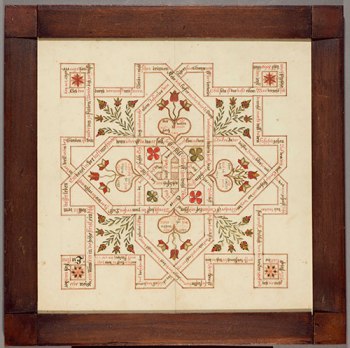
Fraktur labyrinth, Pennsylvania-German folk art, inscribed 1824; drawn and hand-colored on paper. 15½” x 15½” framed; designed as an endless knot with classic Pennsylvania-German motifs including hearts, tulips, and compass roses, and offered as a token of affection (The Huntington Library, Art Collections, and Botanical Gardens).
A spectacular trove of thousands of valentines and related material—some dating as far back as the late 17th century—has been given to The Huntington Library, Art Collections, and Botanical Gardens, the institution announced today. Considered the best private collection of its kind in the world, the Nancy and Henry Rosin Collection of Valentine, Friendship, and Devotional Ephemera contains approximately 12,300 greeting cards, sentimental notes, folk art drawings, and other tokens of affection that trace the evolution of romantic and religious keepsakes made in Europe and North America from 1684 to 1970. The Rosins had given the collection to their son, Bob, who together with his wife, Belle, donated it to The Huntington for safekeeping. “This collection was carefully created by my parents,” he said. “I can’t think of a better place for it to be, given its historical and educational value.”
The Rosin Collection brims with well-preserved paper (and in some cases, vellum or mixed media) materials that range from lacy 18th-century devotional cards, hand-cut by French and German nuns, to elegant Biedermeier-era (1815–1848) greeting cards complete with hand-painted love scenes, gilded embossing, mother-of-pearl ornaments, and silk chiffon. The collection includes cameo-embossed lace paper valentines from England, elaborate three-dimensional and mechanical Victorian paper confections, as well as handmade works of American folk art demonstrating traditional paper-cut techniques (scherenschnitte) and colorful Germanic Fraktur illustrations. Some of the most historically significant items include heartrending Civil War soldiers’ valentines with personal notes detailing the hardship of war and longing for home. The Rosin Collection also contains bitingly satiric ‘vinegar’ valentines, dance cards, memory albums, and watch papers (sentimental notes inserted into pocket watches), among other items relating to the history of love and devotion.
“We are profoundly grateful to Bob and Belle Rosin for this invaluable, and truly beautiful collection that was so carefully developed,” said Sandra L. Brooke, Avery Director of the Library at The Huntington. “It will dramatically enhance our holdings in several areas to which we are committed—especially 19th-century social history and visual culture, and of course, our renowned U.S. Civil War material.”
Nancy Rosin is president of the National Valentine Collectors Association, president emerita of the Ephemera Society of America, and a member of the American Antiquarian Society and The Grolier Club. She says collecting valentines has been her “passionate obsession” for 40 years. “My quest to acquire sentimental expressions of love, especially those celebrating Valentine’s Day—a significant social event that was enjoyed by all strata of society—grew into a desire to share them with the public,” said Rosin. “Bob grew up watching us build this collection piece by piece. I’d long hoped the collection would end up where it would have the most research value and the highest standard of preservation, so it is deeply gratifying to know Bob and Belle have given these works to The Huntington.”
The Huntington’s collection of historical prints and ephemera was begun by its founder, Henry E. Huntington, about 100 years ago, and has since grown to contain hundreds of thousands of items that support public exhibitions and scholars’ research, especially in the areas of British and American cultural history. The Rosin Collection significantly increases the institution’s distinction of being one of the leading archives for ephemera studies.
“This is a collection I’ve been familiar with and admired for many years,” said David Mihaly, Jay T. Last Curator of Graphic Arts and Social History at The Huntington. “It is without a doubt the best in private hands in terms of quality and range within its focus—to say nothing of the sheer wonder and delight the items provide. Pull a string and an ingenious cobweb device lifts to reveal a mouse in a trap; unfold a die-cut valentine and watch a majestic carriage spring to life in 3-D; read a witty poem and realize it’s a hilarious jab at a Victorian-era politician; look closely at a tiny, centuries-old card and see it was delicately perforated with hundreds of tiny pinpricks, and hand painted so expertly. We certainly will enjoy researching and processing this collection—and hope to plan an exhibition in coming years.”
The institution expects to start preserving and cataloguing the Rosin Collection this year, with research access soon to follow.
New Acquisitions at the DIA
Press release (18 December 2017) from the DIA:
Out of the Crate: New Gifts and Purchases
Detroit Institute of Arts, opened January 12
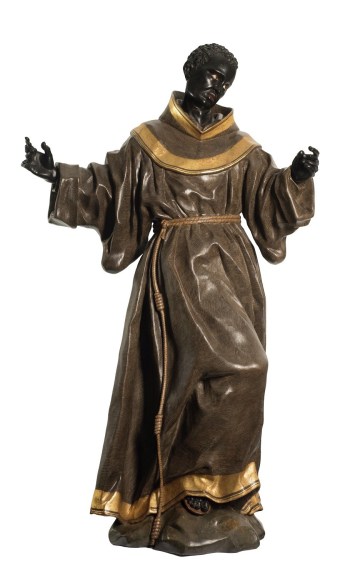
Attributed to Juan Pascual de Mena, Saint Benedict of Palermo, 1770–80, coniferous wood, pigment, gold (Detroit Institute of Art).
The Detroit Institute of Arts opened a gallery dedicated to some of the museum’s newest acquisitions while also providing the public with a look at the art acquisition process. The gallery, called Out of the Crate: New Gifts & Purchases, opened January 12.
A selection of recent purchases and gifts chosen by DIA Director Salvador Salort-Pons are on view for approximately six months, after which they will be replaced with newer acquisitions. “The DIA has one of the most significant art collections in the United States, and one way we maintain this quality is by acquiring new artworks every year,” said Salort-Pons. “Thanks to generous donors, the DIA has been able to establish funds designated for art acquisitions only, with which we are able to strengthen our collection. This gallery offers a transparent look at the DIA’s collecting process and policies while giving visitors a first look at both recent purchases and gifts.”
Before the DIA acquires a work of art, it goes through a rigorous assessment to ensure its quality and authenticity. Informational materials will provide an overview of the entire process, from initial research to approval by the board of directors, and the roles various experts play along the way.
Seven artworks are featured in the first installation:
• Attributed to Juan Pascual de Mena, Saint Benedict of Palermo, 1770–80, coniferous wood, pigment, gold. Museum purchase.
• Unknown artist, Maternity Figure (Obaahemaa), 19th century, Akan (Asante), African, wood with pigment. Museum purchase.
• James Abbott McNeill Whistler, Salute Dawn, 1879, etching with drypoint. Museum purchase.
• Lajos Mack, Vase, ca. 1900, slip-cast ceramic with eosin glazes. Gift of Dr. Theodore and Diana Golden.
• Hiroshi Sugimoto, Fox, Michigan, 1980, gelatin silver print. Museum purchase.
• Cristina Iglesias, Untitled (Room 11 [-1999], edition 1/15, 1999, ink on copper plate. Gift of Janis and William M. Wetsman.
• Cornelia Parker, There must be some kind of way outta here, 2016, mixed media. Museum purchase.
Williamsburg Acquires Rare Danish Abolitionist Medal

Abolition of the Slave Trade Medal, dies by Pietro Leonardo Gianelli, Denmark, bronze, 1792 (Colonial Williamsburg Foundation, Museum Purchase, Lasser Numismatics Fund and Partial Gift, John Kraljevich).

Abolition of the Slave Trade Medal, dies by Pietro Leonardo Gianelli, Denmark, bronze, 1792 (Colonial Williamsburg Foundation, Museum Purchase, Lasser Numismatics Fund and Partial Gift, John Kraljevich).
Press release (10 January 2018). . .
One of the most important medallic items related to the Atlantic slave trade and one of Denmark’s most iconic medals is now part of the Colonial Williamsburg Foundation’s collections. Designed by the Danish artist Nicolai Abildgaard and struck in bronze in 1792 from dies by the Italian medalist Pietro Leonardo Gianelli, the extremely rare piece commemorates that year’s royal edict ending trade in enslaved persons on Danish ships. Only a small handful of these medals produced in a variety of metals are known to exist: white metal examples are in Danish museums and others, held in private collections, were struck in bronze and silver.
“The items of Colonial Williamsburg’s collections capture tangibly our complex, shared history,” said Mitchell B. Reiss, Colonial Williamsburg president and CEO. “In this rare 1792 medal we see an Atlantic power affirming the humanity of a people exploited as property, as well as a foretelling of abolition in America. We welcome our guests 365 days a year—and especially in February during Black History Month—to experience the diverse stories of our nation’s founding.”
In Denmark in 1792, as the move towards banning slavery was taking hold throughout Europe and two years before Congress prohibited the slave trade between the United States and foreign countries, Crown Prince Frederik VI, acting as regent for his mentally unstable father, Christian VII, issued what is considered to be the Prince’s most important proclamation: the Edict of the Abolition of the Slave Trade. This decree made Denmark the first European nation to outlaw trade in enslaved persons on ships flying its flag, though the measure did not fully take effect until 1802. This medal, made at the beginning of the abolitionist movement on the European continent, marks a dramatic shift in the way Denmark sought to treat the enslaved African population in the nation’s Caribbean colonies, the Danish West Indies. The male head depicted in profile on the face of the medal is likely the oldest Danish naturalistic portrait of an African. The Latin phrase ‘Me Miserum’ (‘Woe is me’ or ‘Poor me’) is imprinted as a border around the profile. The reverse image shows the mythological winged goddess Nemesis, who was thought to be the avenging goddess of divine indignation against and retribution for evil deeds and undeserved good fortune. She is depicted seated and facing forward on a platform decorated with a shield that bears her name while holding an apple branch in one hand and touching her wing with the other. The Latin legends indicate the medal was produced under the Danish King’s law and includes the date of the edict, March 16, 1792.
“Objects in the Colonial Williamsburg collection are remarkable not only for their aesthetic qualities, but for the history they illustrate,” said Ronald L. Hurst, the Foundation’s vice president for collections, conservation, and museums and its Carlisle H. Humelsine chief curator. “This medal sheds light on some of the first steps toward the end of slavery, a painful chapter in the Atlantic world’s history.”
“This masterfully executed work of medallic art is a benchmark piece for two reasons,” said Erik Goldstein, Colonial Williamsburg’s senior curator of mechanical arts and numismatics. “Not only does it beautifully and sensitively display the portrait of an African man, it also marks the beginnings of the abolitionist movement in Europe.”
The medal was acquired through the Lasser Numismatics Fund and a partial gift by John Kraljevich. It is scheduled for public display in 2020 following completion of the entirely donor-funded $41.7 million expansion of the Art Museums of Colonial Williamsburg. Both institutions, the DeWitt Wallace Decorative Arts Museum and the Abby Aldrich Rockefeller Folk Art Museum, remain open throughout construction.
Reproduction of Art and Cultural Heritage
Writing for Apollo Magazine (15 December 2017), Maggie Gray suggests “it’s time to talk seriously about digital reproductions.” A version of the declaration signed on 8 December 2017 at the V&A is available as a PDF file here. From the V&A Research Projects / ReACH
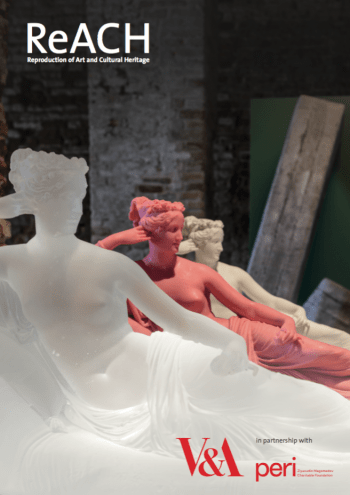 ReACH (Reproduction of Art and Cultural Heritage)
A global research programme exploring the digital reproduction of cultural heritage — #ReACHdialogue
Launched at UNESCO in May 2017, ReACH (Reproduction of Art and Cultural Heritage) is a global initiative spearheaded by the V&A in partnership with the Peri Charitable Foundation that explores how to re-think our approach to reproducing, storing and sharing works of art and cultural heritage.
Digital technologies are changing the cultural landscape, offering new ways to produce, store and share museum and heritage assets. However, there is no clear methodology for how museums and heritage organisations should engage with these technologies. To complicate matters, legal protocols and procedures have not adapted to these new realities, and often act as roadblocks to new practice. ReACH will bring clarity—by highlighting best practices, debating pressing issues, and drafting a convention—and offer our community a useful roadmap for dealing with reproductions in the future.
There are two fundamental goals of the ReACH programme. The first is to share best practices concerning the production, storage and dissemination of digital and physical reproductions. This will be achieved by inviting key speakers to the roundtables to share their professional experiences and to flag some of the broader challenges and opportunities. The second goal is to use the information gathered from the 5 roundtables to draft a new convention concerning the role of museums and other organisations in the reproduction of works of art and cultural heritage, which can be shared and adopted.
The ReACH project coincides with the 150th anniversary of Henry Cole’s 1867 Convention, which helped usher in a period where museums actively engaged in the creation of reproductions of objects from around the world. The document is inspiring in its clarity, practicality and openness to the creation and sharing of reproductions. Along with an updated version of the Convention we will produce a publication that compiles examples of the best practices selected from the roundtable discussions—as a roadmap for museums working with reproductions, as instruments for preservation and accessibility.
Mia Receives Funding for Empathy and Diversity Initiatives

Installation view of Living Rooms: The Many Voices of Colonial America, on view in the Charleston Drawing Room at Mia from 22 April 2017 until 15 April 2018 (Minneapolis Institute of Art)
◊ ◊ ◊ ◊ ◊
Press release (13 December 2017) from Mia:
The Minneapolis Institute of Art (Mia) announced today that it has received two major grants: a $750,000 grant from the Andrew W. Mellon Foundation in support of the museum’s Center for Empathy and the Visual Arts and a $520,000 grant from the Ford Foundation and the Walton Family Foundation supporting Mia’s ongoing Inclusion, Diversity, Equity, and Accessibility (IDEA) initiative.
Center for Empathy and Visual Arts / Andrew W. Mellon Foundation
The Andrew W. Mellon Foundation funding will enable Mia to establish the first-ever Center for Empathy and the Visual Arts (CEVA) within an art museum. Mia is spearheading the project, collaborating with researchers, scholars, philosophers, content experts, artists, thought leaders, and colleagues at other museums to explore and research best practices to foster compassion and enhance related emotional skills. This ambitious initiative will span nearly five years, providing Mia and other art museums ample opportunities to purposefully build empathy into their learning practices as a strategy for impacting positive social change.
Kaywin Feldman, Nivin and Duncan MacMillan Director and President of Mia, said, “A visitor to our museum has the opportunity to experience works of art made over the course of some 5,000 years, from every corner of the globe. One of the most meaningful aspects of this encounter is the awareness it can awaken of a common humanity—an immediate sense of connection between the viewer and someone who may have lived in a very different time and place. Thanks to the Mellon Foundation, we’re proud to take the lead with partners across the country, in studying how to spark and nurture empathy through the visual arts, so that Mia and all art museums can contribute even more toward building a just and harmonious society.”
The first phase of this initiative kicked off in October, when Mia invited experts from fields as diverse as the social sciences, empathy research, virtual reality, and neuroscience fields, as well as museum curators and directors, artists, and educators, to discuss empathy and the art museum at the University of California, Berkeley—a partner in this research project. The ideas generated by the think tank will be developed and tested with the aim of fostering greater awareness and understanding, wonder, and/or global awareness among visitors.
“To be human is to express our emotions in art,” said Dacher Keltner, PhD, Professor of Psychology at University of California, Berkeley, Director of the Berkeley Social Interaction Lab and Co-Director of the Greater Good Science Center. “Aesthetic experiences—in viewing a painting, sculpture, photograph, or dance, or in music—are sources of awe and wonder. They enable us to solve a complex mystery—to understand what our fellow humans think and feel. For these reasons, the museum may be one of the great catalysts of human empathy and compassion. That possibility is the focus of Mia’s new scientific initiative with UC Berkeley and the Greater Good Science Center.”
During the initiative’s second phase, the Center will disseminate easy-to-use tools that guide museum educators and curators in using their collections to foster empathy among their own visitors. The initiative’s leaders at Mia hope that museums across the country and abroad will be inspired to build upon this work by incorporating the key learnings into their own practices, resulting in far-reaching impact inside the field and beyond.
Inclusion, Diversity, Equity, and Accessibility / Ford Foundation and Walton Family Foundation
The Ford Foundation and the Walton Family Foundation will provide resources for Mia’s Inclusion, Diversity, Equity, and Accessibility (IDEA) efforts, which strengthen the pipeline of art museum leadership positions for those who have been historically underrepresented: people of color and indigenous people. With the funding, the museum will hire a Diversity & Inclusion Manager, who will research, develop, and launch a robust fellowship program for college students of diverse cultural backgrounds. The IDEA program expands upon Mia’s current Native American Fellowship Program, which has been active for more than 10 years through financial support from the Shakopee Mdewakanton Sioux Community.
“At Mia, we believe that embracing diversity as a core value, not just as a program, will bring more voices, perspectives, and experiences to the field and its practice,” Feldman said. “Within the next decade, we hope to see a significant impact on young leadership in the museum field.”
Mia will collaborate with Twin Cities’ colleges and other organizations to develop networks to recruit candidates for fellowships, full-time openings, unpaid internships, and volunteer opportunities. To do so, it will work with other institutions’ H.R. and diversity inclusion departments, college career advisors, and campus student groups.
“We are delighted to partner with Mia on this important initiative,” said Patricia Pratt-Cook, Senior Vice President for Human Resources, Equity and Inclusion at St. Catherine University. “St. Kate’s, home to one of the nation’s largest colleges for women and a student population that is 37.7% diverse, serves diverse students with an innovative approach to learning and a faculty that has been recognized nationally for their commitment to teaching. We look forward to supporting Mia’s success through this grant by sharing our experiences with the museum and connecting our students to opportunities available through Mia’s IDEA project.”
Ghislain d’Humieres To Oversee Core Operations at Williamsburg
Press release (via Art Daily). . .
 As part of a streamlining of its leadership team, the Colonial Williamsburg Foundation has named Ghislain d’Humières as its executive director and senior vice president, core operations, a newly created position that will report to President and CEO Mitchell B. Reiss. In this new role, d’Humières will carry out the vision of Reiss and the Foundation’s Board of Trustees to attract new audiences, engage and entertain guests and instill a lifelong love of Colonial Williamsburg and its enduring role in the American story. d’Humières will oversee the Collections, Conservation and Museums Division and Colonial Williamsburg’s Education, Research and Historical Interpretation Division, as well as its Strategic Communications and Development divisions. He will begin his new role on January 15, 2018.
“Colonial Williamsburg’s commitment to history education and the arts is strong,” said Reiss. “We believe that hiring a seasoned arts professional to lead the Foundation’s core experience will further enhance our ability to captivate visitors through even more engaging programming within the Historic Area and the Art Museums. Ghislain’s leadership of day-to-day operations will enable me to foster critical relationships with the community, supporters and other partners to elevate Colonial Williamsburg and its mission to share America’s enduring story.”
Most recently the director and CEO of the Speed Art Museum in Louisville, Kentucky, from 2013 to earlier this year, d’Humières oversaw an extensive $60 million renovation that transformed the state’s only fine arts museum and enabled it to further expand its audience’s diversity. Previously, he served as the director and chief curator of the Fred Jones, Jr. Museum of Art at the University of Oklahoma in Norman from 2007 to 2013; he has also held positions at Sotheby’s, Christies, and Heritage Auctions. d’Humières is a former member of the French armed forces and served as aide-de-camp to the grand chancelier of the Order de La Libération. He was also an assistant curator of Paris’ Ordre de La Libération Museum. He is a graduate of the Sorbonne and Paris Nanterre University.
“Colonial Williamsburg is a treasure that preserves the birthplace of American democracy and enshrines ideals that still guide the nation and world,” d’Humières said. “I am honored to join this institution, especially amid its re-imagination and commitment to engage new and wider audiences. I look forward to sharing the journey with the team, our community, and most of all, our guests.”
Among key areas of the Foundation that will now be included under d’Humières’s umbrella of responsibilities are major areas of investments in the Campaign for History and Citizenship, the $600 million capital campaign initiated to both reinforce and reimagine Colonial Williamsburg’s role in the 21st century as a leader in history education and historical preservation, which was publicly announced in 2014. One such area is the $41.7-million donor-funded expansion of the Art Museums of Colonial Williamsburg, home of the Abby Aldrich Rockefeller Folk Art Museum, the oldest continuously operating institution in the United States dedicated solely to the collection, exhibition and preservation of American folk art now celebrating its 60th anniversary. It is also home to the DeWitt Wallace Decorative Arts Museum, which marked its 30th anniversary in 2015 and features premier examples of British and American fine and decorative arts from 1670 to 1840. Combined, these diverse and extensive collections play critical roles in Colonial Williamsburg’s goal of engaging audiences with the dramatic story of America’s founding. Under the direction of Ronald L. Hurst, Carlisle H. Humelsine chief curator and vice president for collections, conservation and museums, both the Abby Aldrich and DeWitt Wallace museums will remain open through construction, which began on Oct. 1. It will add 60,000 square feet to the building for a 22-percent increase in gallery space, as well as significantly improve public access through a new visitor-friendly entrance and other enhancements. It is projected that by late summer 2018 the enlarged space will be completely enclosed and new climate control systems will be fully functioning. Construction is expected to be complete by late 2019.
Other vital areas of the Foundation’s mission that also are within d’Humières’s area of responsibility include:
• Continued re-imagination of Historic Area programming with diverse, new character interpretation and technology enhancements, including the Colonial Williamsburg Explorer mobile app; supervising 24 historic trades, modern entertainment and tours, signature events (such as Grand Illumination and Fourth of July), the Costume Design Center that crafts and maintains clothing worn by the Historic Area personnel, the Coach and Livestock department that operates the Rare Breeds Program, and the Colonial Williamsburg Fifes & Drums
• Development of compelling outreach programs that reach national and even global audiences, including teacher professional development programs and digital technology initiatives in order for Colonial Williamsburg to continue to support and supplement the teaching of American history and civics in home and school settings
• Directing historical research and training, along with the John D. Rockefeller Jr. Library and the Colonial Williamsburg corporate archives
• Oversight of the departments that conduct archaeological research and care for the more than 60 million archaeological items in the Foundation’s collections
• Leadership of the departments that preserve 88 original and roughly 500 reconstructed Historic Area structures, as well as daily care of Historic Area interiors and collection items on display throughout Colonial Williamsburg properties
• Management of Colonial Williamsburg’s state-of-the-art DeWitt Wallace Collections and Conservation Building, which includes eight discipline-specific labs—Archaeological Materials, Wooden Artifacts, Instruments and Mechanical Arts, Objects, Paintings, Paper, Textiles and Upholstery—as well as the Preventive Conservation group. There, analysis, examination, treatment, and documentation are performed in strict accordance with the Code of Ethics of the American Institute for Conservation of Historic & Artistic Works.










 Enfilade
leave a comment