The Getty Purchases Watteau’s La Surprise and 16 Master Drawings
As reported by Jori Finkel in The New York Times (20 July 2017) . . .
The Getty Museum has made the biggest financial outlay for art in its history . . . . Judging from sales records for several of these artworks during weaker art-market periods, the Getty’s purchase price could have easily topped $100 million. The museum’s director, Timothy Potts, would not confirm the amount except to say that the deal was “the Getty’s biggest in terms of financial value. . . ”
◊ ◊ ◊ ◊ ◊
Paul Jeromack writes in The Art Newspaper (26 July 2017) . . .
According to sources in the field, the windfall comes from the collection of the 62-year-old collector Luca Padulli, the co-founder of the British investment management company Camomille Associates, who bought the works at auction over the last 17 years, through the British Old Master dealer, Jean-Luc Baroni. . .
◊ ◊ ◊ ◊ ◊
La Surprise was believed to have been destroyed until it re-emerged in 2007; it sold at Christie’s in 2008 for over $24million. Press release (20 July 2017) from The Getty:
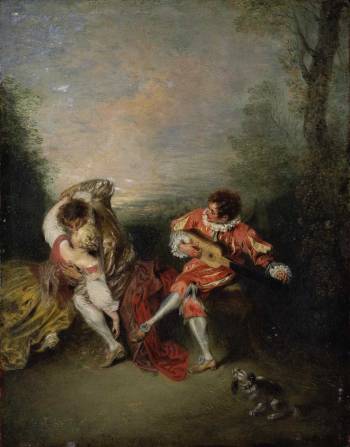
Jean Antoine Watteau, La Surprise, ca. 1718; oil on panel, 36 × 28 cm (Los Angeles: The Getty Museum).
The J. Paul Getty Museum announced today the most important acquisition in the history of the Museum’s Department of Drawings. Acquired as a group from a British private collection, the 16 drawings are by many of the greatest artists of western art history, including Michelangelo, Lorenzo di Credi, Andrea del Sarto, Parmigianino, Rubens, Barocci, Goya, Degas, and others. From the same collection, the Museum has acquired a celebrated painting by the great eighteenth-century French artist Jean Antoine Watteau.
“This acquisition is truly a transformative event in the history of the Getty Museum,” said Timothy Potts, director of the J. Paul Getty Museum. “It brings into our collection many of the finest drawings of the Renaissance through 19th century that have come to market over the past 30 years, including a number of masterpieces that are among the most famous works on paper by these artists: Michelangelo’s Study of a Mourning Woman, Parmigianino’s Head of a Young Man, and Andrea del Sarto’s Study for the Head of St Joseph (the highlight of the Getty’s recent exhibition on that artist). It is very unlikely that there will ever be another opportunity to elevate so significantly our representation of these artists, and, more importantly, the status of the Getty collection overall.”
“Beyond the core of Renaissance through Rococo works, our modern holdings too are magnificently enhanced by one of Goya’s late, bizarre subjects, The Eagle Hunter, and Degas’s majestic pastel After the Bath (Woman Drying Herself).”
Potts added, “No less exciting for the Department of Paintings is the addition of one of Watteau’s most famous and canonical works, La Surprise. It was indeed a very welcome surprise when this lost masterpiece reappeared ten years ago in Britain. And one can see why: the act of seduction portrayed in the painting is matched only by the artist’s delicately flickering brushwork—the combination of titillating subject and charming rendition that made him the most esteemed painter of his day. It will be very much at home at the Getty, where it crowns our other exceptional eighteenth-century French paintings by Lancret, Chardin, Greuze, Fragonard, and Boucher.”
La Surprise is a fête galante, a popular genre depicting outdoor revelry that Watteau invented and which epitomizes the light-hearted spirit of French painting in the early eighteenth century. The scene features a young woman and man in passionate embrace seemingly oblivious to the musician seated next to them. He is Mezzetin, the trouble maker, a stock comic character from the commedia dell’arte. Throughout Watteau’s short but illustrious career—he died when he was only 27 years old—the characters of the commedia dell’arte figured prominently in his paintings, often mingling with elegant contemporary figures in a park or landscape.
Highly admired in the eighteenth century, the painting was thought lost and for centuries was known to art historians only from a 1731 engraving and a copy in the British Royal Collection. In 2007 it was found in an English private collection, becoming the most important work by Watteau to be rediscovered in recent times.
“La Surprise exemplifies Watteau’s delightful pictorial inventions, brilliant brushwork, and refined, elegant compositions,” said Davide Gasparotto, senior curator of paintings at the Getty Museum. “It is undoubtedly one of the most exquisite and important Watteau paintings to become available in modern times. We are now able to present to the public a seminal genre of French eighteenth-century painting in a masterwork by its inventor. La Surprise will no doubt become one of our most beloved and recognizable paintings.”
The painting and all of the 16 drawings were purchased as a group from a British private collection. The drawings are mostly Italian but there are also exceptional works by British, Dutch, Flemish, French, and Spanish artists. A nucleus of Italian Renaissance works anchors the group, including a rare and beautiful ‘cartoon’ (full-sized direct transfer drawing for a painting) by Lorenzo di Credi; one of Andrea del Sarto’s finest drawings (from the collection of artist-writer Giorgio Vasari); and Michelangelo’s powerful pen and ink study of a mourning woman, a famous discovery made at Castle Howard, England in 2000.
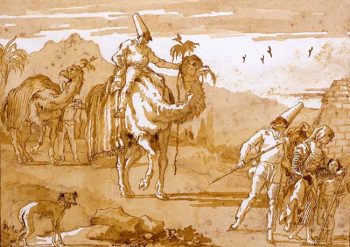
Giovanni Domenico Tiepolo, Punchinello Riding a Camel at the Head of a Caravan, late 1790s (Los Angeles: The Getty Museum).
Other highlights include Parmigianino’s ink drawing of the head of a young man; Savoldo’s Study for St Peter; Beccafumi’s Head of a Youth; and Sebastiano del Piombo’s Study for the Figure of Christ Carrying the Cross. From the post-Renaissance period, the collection features Barocci’s masterful Head Study of St Joseph; Rubens’s powerful oil-on-paper Study of an African Man Wearing a Turban; Cuyp’s panoramic View of Dordrecht, one of the great landscape drawings of the Dutch Golden Age; and Giovanni Domenico Tiepolo’s Punchinello Riding a Camel at the Head of a Caravan, a brilliant example of the narrative mastery for which Tiepolo was admired.
Goya’s The Eagle Hunter, a darkly satirical brush and ink drawing depicts a hunter wearing a metal cooking pot for a helmet while precariously suspending himself over a cliff to try to snatch young eagles from a nest. Degas, arguably the greatest draftsman of the nineteenth century, is represented by two drawings, a sheet with two chalk studies of ballet dancers, used by the artist for no fewer than three paintings, and a large and startlingly bold pastel showing his unrivaled innovation in that medium.
“Any one of these sheets on its own is truly extraordinary and would be a worthy and meaningful acquisition for the Getty. Together, the 16 drawings form an unparalleled roll call of the ‘best of the best,’ with iconic sheets by some of the world’s most celebrated artists,” said Julian Brooks, senior curator of drawings at the Getty Museum. “This powerful group of works represent the finest aspects of Western art history captured on paper. I am eagerly anticipating sharing these masterworks with our visitors as well as our international scholarly and museum community.”
While the majority of works are currently at the Getty Museum, some are still pending export licenses from the U.K. Research on further drawings from the same collection, with a view to possible acquisition, is currently underway. Plans are also proceeding to display the group together at the Getty Museum in a special installation in the near future.
The 16 Drawings
• Study of a Mourning Woman, about 1500-05, by Michelangelo Buonarroti (Italian, 1475–1564)
• Head of a Young Boy Crowned with Laurel, about 1500-05, by Lorenzo di Credi (Italian, c. 1457–1537)
• Heads of Two Dominican Friars, about 1511, by Fra Bartolommeo (Italian, 1472–1517)
• Study for the Head of Saint Joseph, about 1526–27, Andrea del Sarto (Italian, 1486–1530)
• Study for the Figure of Christ Carrying the Cross, about 1513–14, by Sebastiano del Piombo (c. 1485–1547)
• The Head of a Young Man, about 1539–40, by Parmigianino (Girolamo Francesco Maria Mazzola) (Italian, 1503–1540)
• Head of a Youth, about 1530, by Domenico Beccafumi (Italian, 1484–1551)
• Study for Saint Peter, about 1533, by Giovanni Girolamo Savoldo (Italian, c. 1480–1540)
• Head of Saint Joseph, about 1586, by Federico Barocci (Italian, c. 1535–1612)
• Head of an African Man Wearing a Turban, about 1609–13, by Peter Paul Rubens (Flemish, 1577–1640)
• Panoramic View of Dordrecht and the River Maas, about 1645–52, by Aelbert Cuyp (Dutch, 1620–1692)
• Punchinello Riding a Camel at the Head of a Caravan, late 1790s, by Giovanni Domenico Tiepolo (Italian, 1727–1804)
• The Eagle Hunter, about 1812–20, by Francisco Jose de Goya y Lucientes (Spanish, 1746–1828)
• The Destruction of Pharaoh’s Host, 1836, by John Martin (British, 1789–1854)
• Two Studies of Dancers, about 1873, by Edgar Degas (French, 1834–1917)
• After the Bath (Woman Drying Herself), about 1886, by Edgar Degas (French, 1834–1917)
Thomas Campbell Receives Getty/Rothschild Fellowship
Press release (27 July 2017) from The Getty:
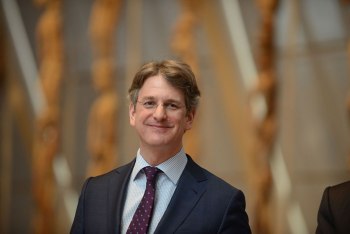 The Getty and the Rothschild Foundation today announced Dr. Thomas P. Campbell as the second recipient of the Getty Rothschild Fellowship. The fellowship supports innovative scholarship in the history of art, collecting, and conservation, using the collection and resources of both institutions. It offers art historians, museum professionals, or conservators the opportunity to research and study at both the Getty in Los Angeles and Waddesdon Manor in Buckinghamshire, England.
As the ninth director of The Metropolitan Museum of Art from 2009 to 2017, Campbell pursued a groundbreaking agenda that combined scholarship with accessibility. He reinforced the Museum’s excellence in its collections, exhibitions, publications and international engagement while reimagining the visitor experience both in the galleries and via an industry-leading digital presence. During his tenure, the museum increased its audience by 40%. His project for the Getty Rothschild fellowship will focus on the changing environment in which museums are operating and the ways art and cultural heritage can be used to promote mutual understanding.
The selection process for the Getty Rothschild fellowship considers a number of criteria, including whether the applicant’s work would benefit from proximity to the Getty and Rothschild collections. Fellowships are for up to eight months, with the time split equally between the Getty and Waddesdon Manor. Campbell will be at the Getty from November 2017 to February 2018 and at Waddesdon Manor from March to June 2018. Fellows also receive a stipend during their time at both locations. The fellowship is administered by the Getty Foundation.
Campbell says of his selection for the fellowship: “I am honored to be named a Getty/Rothschild fellow and to be given the opportunity to devote the coming year to examine, first, the fundamental question of where the cultural sector is heading as it responds to various geo-political, economic and digital challenges. And second, the related question of how we can use art and culture as a gateway to promote understanding in an ever-more connected but ever-more divided world.”
The inaugural recipient of the fellowship was Dr. David Saunders, a foremost expert in the area of conservation science who worked on museum and gallery lighting during the fellowship. In 2014, Lord Jacob Rothschild received the Getty Medal for his contributions to the practice, understanding, and support of the arts.
The Bilbao Fine Arts Museum Acquires Paret’s ‘View of Bermeo’
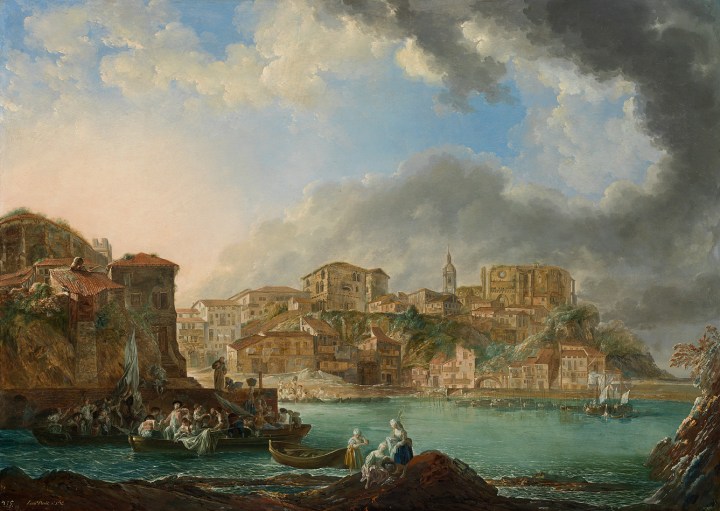
Luis Paret y Alcázar, View of Bermeo, 1783
(Bilbao: El Museo de Bellas Artes)
◊ ◊ ◊ ◊ ◊
The Bilbao Fine Arts Museum presents View of Bermeo of 1783 by Luis Paret y Alcázar (1746–1799), acquired from the heirs of José Luis Várez Fisa. The painting has been obtained with an interest-free loan thanks to the sponsorship of BBK, to be repaid over the following years with the contribution from the Friends of the Museum.
In addition to its undoubted artistic value, View of Bermeo of 1783 is of enormous historical interest given that it is considered the first work in a series of paintings depicting the ports of Cantabria and is the first view of the Basque Country painted by this artist from Madrid. Born in the same year as Goya, Paret led a storied life, resulting in his banishment, first to Puerto Rico and then to Bilbao, which prevented him from maintaining his prominent position at Court, a fact that to some extent favoured Goya’s professional success. At that point the Basque Country had almost no artistic tradition, for which reason the presence of a painter of Paret’s importance can be considered a remarkable artistic event and one that was decisive for its artistic and cultural evolution.
View of Bermeo is one of the most outstanding works of 18th-century Spanish painting and can be considered the first surviving modern and purely artistic image of a location in the Basque Country. This oil, which is in excellent condition despite its delicate copper support, perfectly combines a carefully devised composition and setting with an exquisite, detailed finish. Paret presented the scene as a social encounter in which he dignified local people and customs, offering an unprecedented visual record in the context of the Basque Country. The panel was painted in 1783 for the future Charles IV, son of Charles III and at that date Prince of Asturias, possibly with the aim of facilitating the end of Paret’s banishment which was imposed on him in 1775 due to his involvement in the dissolute life of the Infante don Luis, younger brother of Charles III. Paret’s imposed exile was finally repealed in 1785. The artist conceived the work as a pair to another view of Bermeo (present whereabouts unknown) in which he depicted the port during a squall.
The Bilbao Fine Arts Museum has thus increased its holdings of the work of Luis Paret y Alcázar, and its collection now includes View of El Arenal in Bilbao, 1783–84; Scene of Villagers (fragment), 1786; View of Fuenterrabía (fragment), 1786; The Triumph of Love over War, 1784; The Virgin with the Christ Child and Saint James the Greater, 1786; The Holy Shepherd, 1782; and the recently acquired View of Bermeo, 1783.
More information about the painting and the artist are available here»
Early Gainsborough Drawings Discovered at Windsor
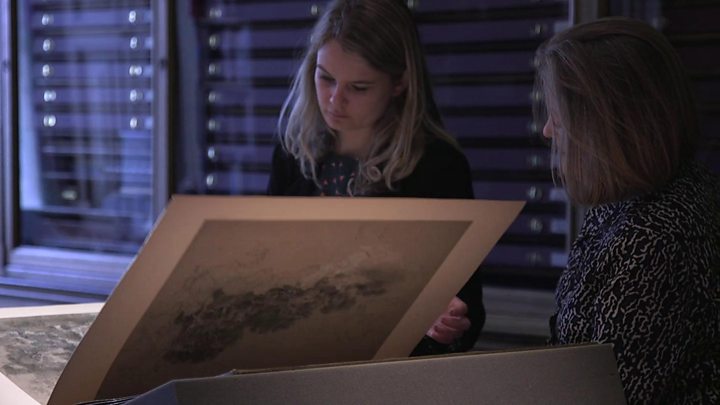
Rosie Razzall (left) and Lindsay Stainton (right) in the Print Room at Windsor Castle. Still from the BBC video describing the discovery (102 seconds), by video journalist Alex Stanger.
◊ ◊ ◊ ◊ ◊
As Rebecca Jones reports for the BBC (10 July 2017). . .
An album of drawings by 18th-century painter Thomas Gainsborough has been discovered in the Royal Collection at Windsor Castle. The drawings had been misattributed to another artist, Sir Edwin Landseer, since the reign of Queen Victoria. But after studying the 25 black-and-white chalk sketches, historian Lindsay Stainton confirmed they are actually early works by one of Britain’s most famous painters.
“It’s thrilling,” she told the BBC. “It’s the very best collection of Gainsborough’s early drawings in existence.” . . .
“We’re very much convinced that these are an important group of early drawings by Thomas Gainsborough,” agrees Rosie Razzall, curator of prints and drawings at the Royal Library. “It’s an extremely significant discovery. It means we are able to re-appraise the early work of Gainsborough.” . . .
The full article and video are available here»
Small Token from Carriera’s ‘Winter’ Recently Discovered
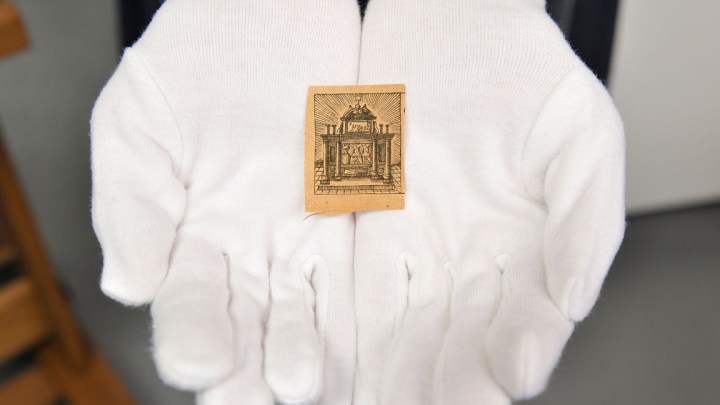
The Three Magi, print, 4.2 cm × 3.3 cm; this small print was sealed inside the frame of Rosalba Carriera’s Personification of Winter (ca. 1726), between the pastel’s wooden support and canvas liner (The Royal Collection Trust).
◊ ◊ ◊ ◊ ◊
From the press release (9 May 2017) describing an extraordinary item discovered as a result of research for the Royal Collection Trust’s exhibition Canaletto and the Art of Venice, now on view at The Queen’s Gallery:
An 18th-century good-luck token has been found hidden inside Rosalba Carriera’s pastel A Personification of Winter by Royal Collection Trust’s conservators. One of the artist’s finest works, Winter was produced around 1726 for Joseph Smith, a British merchant, art collector, and dealer who lived in Venice and acted as agent to many artists, including Carriera and, most famously, Canaletto. Sealed inside the frame between the pastel’s wooden support and canvas liner, the token came to light during conservation of Winter for display in Royal Collection Trust’s exhibition Canaletto & the Art of Venice, which opened at The Queen’s Gallery, Buckingham Palace on 19 May.
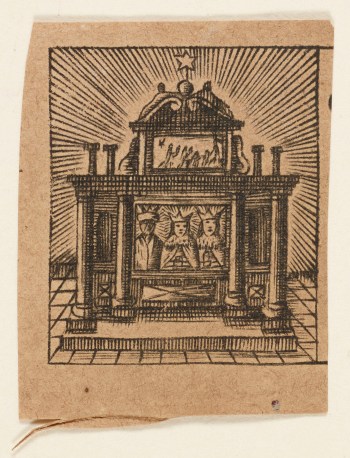 Just 4.2 cm × 3.3 cm in size, the token is in the form of a print of the three Magi and was clearly placed there by Carriera to protect the fragile pastel on its journey to its new owner. In the 18th century these tiny prints, known as santini (‘little saints’), were kept in prayer books or clothing as affordable and portable devotional objects. Rosalba Carriera, a very devout woman, is known to have been particularly fond of images of the three Magi, whose association with arduous journeys made them appropriate guardians for her works. Similar tokens have been found attached to other pastels by the artist.
In a letter to a friend in Florence on 3 December 1729, the Venetian nobleman Pier Caterino Zeno described Carriera’s devotion to the Magi: “Once she gave me a certain portrait to send to my brother in Vienna, and she gave me a little card of the three aforementioned adoring Magi; and said that to these she entrusted the safe outward journey of the portrait; adding that whenever such little images had accompanied her pictures, they had always arrived safely.”
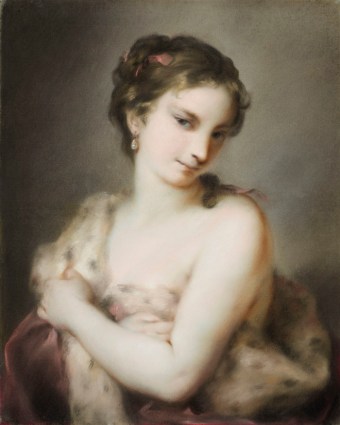
Rosalba Giovanna Carriera, A Personification of Winter, ca. 1726, pastel on paper (London: Royal Collection Trust, 400647).
Rosalba Carriera was one of the most celebrated women artists of her day. Her pastels were highly admired by 18th-century European collectors, and prominent foreign visitors to Venice and Grand Tourists were eager to sit for portraits by her. The soft, velvety texture of pastel was particularly suited to Carriera’s sensual personifications such as Winter, portrayed as a young woman with a fur wrap slipping from her shoulders.
In 1762 the young monarch George III purchased virtually the entire collection of Joseph Smith, including Winter, which was among Smith’s most prized possessions. Thanks to this single acquisition, the Royal Collection contains one of the finest groups of 18th-century Venetian art in the world, including the largest collection of works by Canaletto. Winter hung in George III’s bedchamber at Buckingham House (later Buckingham Palace) alongside Carriera’s pastel of Summer.
Clara de la Peña McTigue, Royal Collection Trust’s Head of Paper Conservation, said, “The conservation of pastels is a very delicate operation, as the pigment surface of these works is so fragile. When we carefully removed the frame, we became very excited when we noticed a small piece of paper in the narrow space between the pastel’s support and the canvas, and suspected it might be one of Carriera’s tokens.”
Rosie Razzall, Royal Collection Trust’s Curator of Prints and Drawings and the exhibition’s co-curator, said, “It was only during conservation treatment that the print came to light. It’s incredible to think that it was put there by Carriera herself nearly 300 years ago to protect the work from ill fortune and has remained undiscovered until now.”
New Acquisition | View of Charleston, ca. 1774
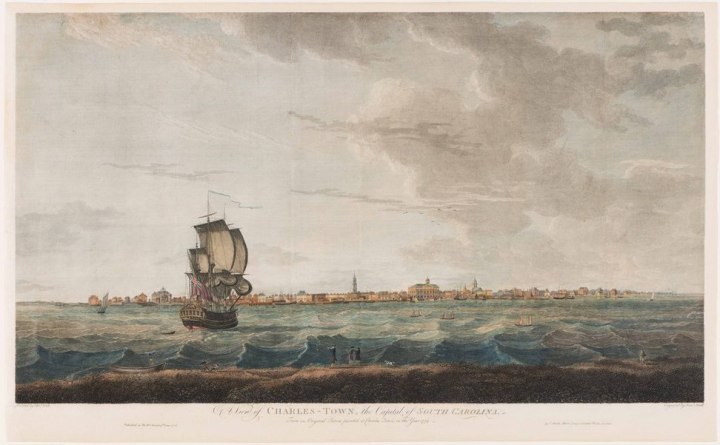
Engraved by Samuel Smith, after Thomas Leitch, A View of CHARLES-TOWN, in the Capital of SOUTH CAROLINA, published in London, 3 June 1776, hand-colored line engraving (Art Museums of Colonial Williamsburg, The Friends of Colonial Williamsburg Collections Fund, 2017-287)
◊ ◊ ◊ ◊ ◊
Press release (11 July 2017) from Colonial Williamsburg:
A rare, historically important view of Charleston, South Carolina, showing its appearance at the time of the American Revolution was recently purchased by the Colonial Williamsburg Foundation for its collection. A View of CHARLES-TOWN, in the Capital of SOUTH CAROLINA, engraved in London by Samuel Smith after a painting by Thomas Leitch, depicts recognizable Charleston landmarks during its peak of prosperity prior to the outbreak of the war.
“Acquisition of this exceptional, pre-Revolutionary view perfectly addresses the Foundation’s core mission, particularly since it furthers our understanding of early America and its Southern colonies,” said Mitchell B. Reiss, president and CEO of Colonial Williamsburg. “I applaud our generous donors for making the purchase a reality.”

“Eighteenth-century views of American cities are relatively rare, and those of southern centers even more so,” said Ronald L. Hurst, the Foundation’s Carlisle Humelsine chief curator and vice president for collections, conservation, and museums. “At nearly three feet in width and retaining its original water coloring, this outstanding view of one of the South’s great seaports is exceptionally rare and important.”
This print, in its full original color, was engraved in 1774 after Leitch painted his scene within a year of his arrival in Charleston from London in 1773 and arranged for it to be shipped back there to be engraved for printing. Although little is known about Leitch, an advertisement that he placed in the South Carolina Gazette soliciting subscribers to assist with the cost of producing the print, and noting that he was sending the painting ‘home’ to have it engraved, confirms he came from London.
The artist rendered his painting in the Dutch panoramic style that enhanced the expanse of the coastline by increasing its width in relation to its height, forcing the viewer’s eye to move back and forth across the canvas. The image is curious, however; while earlier versions of Charleston show calm seas and dozens of merchant ships in the harbor, in this one, Leitch included only one British trading ship in the harbor. Only about six months earlier, Massachusetts traveler Josiah Quincy noted of the Charleston harbor that “the number of shipping far surpassed all I had ever seen in Boston….”
As Colonial Williamsburg’s Deputy Chief Curator Margaret Pritchard speculates, “It is possible that the notable absence of trading vessels venturing into the choppy waters of the Cooper River, under stormy skies, was intended to suggest the political tension between Charlestonians and the Mother country.” In 1773, just months before Leitch painted his view, Britain passed the Tea Act, and Charleston’s outraged citizens left the British-imported tea on the docks to rot. It was the following year in which townspeople elected delegates to the Continental Congress.
Although the print was engraved in 1774, it was not issued until 1776. Other known copies are held at the Yale University Art Gallery, the New York Public Library, and the Gibbes Museum of Art in Charleston. The original painting is in the collection of the Museum of Early Southern Decorative Arts (MESDA). The print was acquired through The Friends of Colonial Williamsburg Collections Fund, which restricts its funds for object purchases.
V&A Opens New Courtyard and Entrance

The V&A’s Aston Webb screen from 1909, modified with five new openings on either side of the central arch, now connects the courtyard to Exhibition Road. Photograph: Hufton+Crow.
◊ ◊ ◊ ◊ ◊
Press release from the Victoria & Albert Museum:
The V&A Exhibition Road Quarter opened to the public on the evening of Friday 30 June 2017, creating a beautiful and unique new civic space for London and a world-class gallery space for the V&A’s internationally acclaimed exhibition programme. The project is designed by Stirling Prize-winning architect Amanda Levete and her practice, AL_A. The launch of the V&A Exhibition Road Quarter marks the beginning of a new era for the Museum as it prepares to expand its UK and international presence. The project is the Museum’s largest architectural intervention in over 100 years and offers a 21st-century interpretation of the V&A’s founding principles: to make works of art and design available to all, to educate, and to inspire designers and manufacturers today and in the future.
 The V&A Exhibition Road Quarter took six years to realise and transforms the V&A’s former boilerhouse yard on London’s great cultural artery, Exhibition Road. This new entrance connects the Museum with its neighbours, reinforcing the Albertopolis vision of intellectual ambition and innovation and creates a sequence of major new spaces:
• The Sainsbury Gallery: a flexible, 1,100sq m column-free exhibition gallery that provides the V&A with a purpose-built space for its world-leading programme of temporary exhibitions
• The Sackler Courtyard: the world’s first porcelain public courtyard, paved in 11,000 handmade tiles that were inspired by the rich tradition of ceramics at the V&A
• The Blavatnik Hall: a new entrance into the V&A from Exhibition Road, which transforms how visitors experience and discover the Museum and its collections
• The Aston Webb Screen: visitors will now enter the V&A from the street through the 11 openings of newly created colonnade formed from the 1909 Aston Webb Screen.
REVEAL, a free, week-long public festival (30 June–7 July) celebrates the opening of the V&A Exhibition Road Quarter and offers a unique opportunity for the public to explore the Museum’s newly designed spaces before exhibition programming begins in the autumn. Art, performance, fashion, and family activities will bring the architecture and collections to life, reflecting on the V&A’s unique combination of heritage, modernity, and technology.
Tristram Hunt, Director of the V&A said: “This is a landmark moment in our history. The V&A Exhibition Road Quarter is both the Museum’s largest architectural intervention in over one hundred years and the start of a new chapter of expansion, returning to our original mission at the same time as opening up the V&A for the future. With its mix of ingenuity and imagination, the V&A has always been a meeting point for historicism and modernity. The V&A Exhibition Road Quarter bridges the two by offering fresh insights into our historic building with pioneering new architecture, creating London’s leading exhibition space.”
The Sackler Courtyard is the world’s first all-porcelain public courtyard and comprises over 11,000 handmade porcelain tiles, inspired by the rich tradition of ceramics at the V&A. This new public space for London also houses a café with furniture designed for the space by AL_A and manufactured by Moroso. The Sackler Courtyard reveals architecturally significant façades and details that have never previously been seen by the public. These include sgraffito decoration on the side of the Henry Cole Wing—a decorative Renaissance technique using multiple layers of coloured plaster created by the first art students at the Museum in the late 19th century. The stonework of the Aston Webb Screen retains the damage that World War II inflicted on the Museum, which is reflected in 11 sets of new metal gates, designed by AL_A. The gates have been manufactured with a pattern of perforations tracing the imprint of the shrapnel damage on the stonework as well as the Royal Crest in the central gate.
The Blavatnik Hall is a new space that will transform how visitors experience and discover the Museum and collections. Connecting the newly displayed Robert H. N. Ho Family Foundation Galleries of Buddhist Art and the Dorothy and Michael Hintze Sculpture Galleries, The Blavatnik Hall gives views through to The John Madejski Garden, leads to a new shop, and connects to the historic Ceramic Staircase as well as the Sackler Centre for arts education, which reopens featuring the new John Lyon’s Charity Community Gallery.
The versatile, 1,100m sq column-free Sainsbury Gallery is one of the largest temporary exhibition galleries in the UK. This flexible exhibition space sits above a floor dedicated to art handling, conservation and preparation space. The new spaces reach as far as 18 metres below ground, directly beneath the Western Range of the V&A’s Grade I listed buildings: a daring engineering and construction challenge that is made visible to the public by steel columns and a beam painted in vivid international orange that are literally holding the weight of history and the Museum’s priceless collections above.
Amanda Levete said: “The V&A Exhibition Road Quarter is a reflection of the pioneering identity of the V&A and continues its mission of innovation into the twenty-first century. The Quarter reimagines the museum as an urban project, creating an exceptional place for London that will redefine the V&A’s relationship with the street and the public.”
Celebrating its 165th anniversary this summer, the V&A is the world’s leading museum of art, design and performance. The completion of this major project marks an exciting moment of evolution for the V&A, a year after winning the Art Fund Museum of the Year 2016, and looking ahead to the opening of the V&A Gallery, Shekou as part of Design Society, in China this autumn and the V&A Museum of Design, Dundee next year.
The V&A Exhibition Road Quarter is the largest construction project undertaken by the V&A since its main buildings in South Kensington were completed in 1909. 22,500 cubic metres of earth were removed from the site and clay from the deepest excavations was carbon-dated to 50 million years old. At the height of construction, up to 60 truckloads of earth were removed from site per day, 99% of which was recycled. The new spaces have created more than 6,000sq m out of 2,200sq m of underused space. AL_A was commissioned to design the V&A Exhibition Road Quarter in 2011 following an international competition. Wates are the lead contractors delivering the project and Arup are the Structural and Building Services engineers.
Over £48 million has been raised for the V&A Exhibition Road Quarter thanks to the generosity of The Monument Trust, The Dr Mortimer and Theresa Sackler Foundation, The Headley Trust, The Blavatnik Family Foundation, the Garfield Weston Foundation, the Heritage Lottery Fund and other donors including Peter Williams and Heather Acton and the Friends of the V&A.
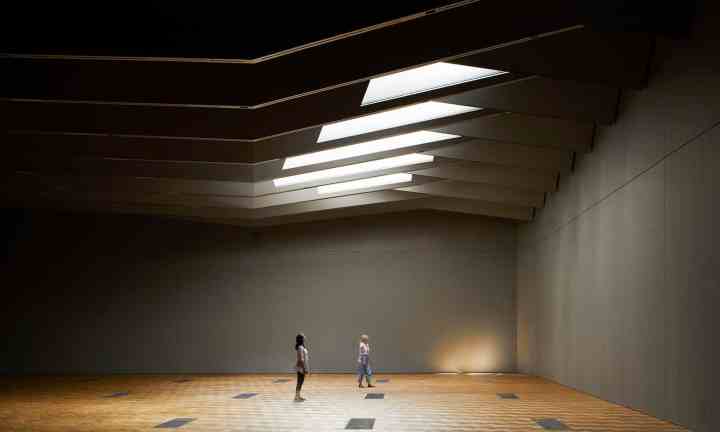
The V&A’s new Sainsbury Gallery, a flexible, 1100sq m column-free gallery for temporary exhibitions. The inaugural exhibition Opera: Passion, Power and Politics opens September 30. Photograph: Hufton+Crow.
◊ ◊ ◊ ◊ ◊
Writing in The Guardian, Oliver Wainwright provides a review of the new space along with context for the expansion, including description of the 1997 proposal by Daniel Liebeskind to build a tower (Spiral) on the site—an idea which, failing to secure funding, was abandoned in 2004. In Wainwright’s words, “Having been drawn, Icarus-like, to the shining promise of starchitecture, and had its wings thoroughly scorched, the V&A decided to opt for the more modest option of going underground.”
New Book | The Collector’s Cabinet and Miniature Pharmacy
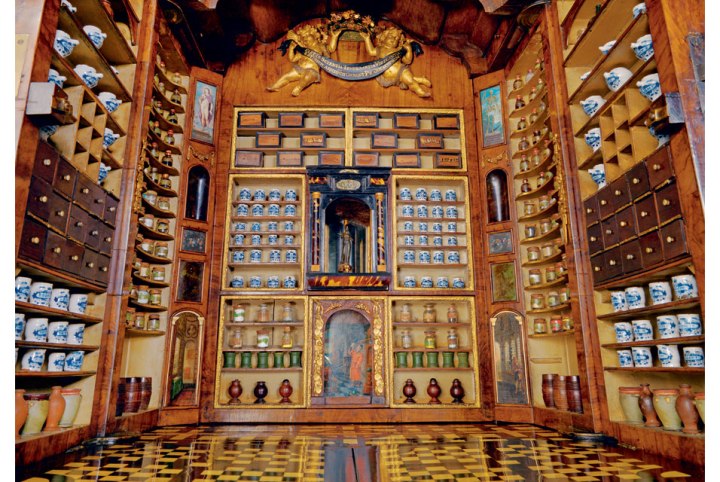
Collector’s Cabinet with Miniature Apothecary’s Shop, 1730
(Amsterdam: Rijksmuseum)
◊ ◊ ◊ ◊ ◊
Press release (23 June 2017) from the Rijksmuseum. The English edition of the book should be be available from Distributed Art Publishers (DAP) in August.
Paul van Duin, ed., The Collector’s Cabinet and Miniature Pharmacy / Verzamelaarskast met miniatuurapotheek (Amsterdam: Rijksmuseum, 2017), 184 pages, ISBN: 978 949171 4610 (Dutch edition) / ISBN: 978 949171 4726 (English edition), 40€ / $60. Essays by Reinier Baarsen, Annette Bierman, Judith van der Brugge-Mulder, Gerhard Cadée, Roelof van Gelder, and Dave van Gompel.
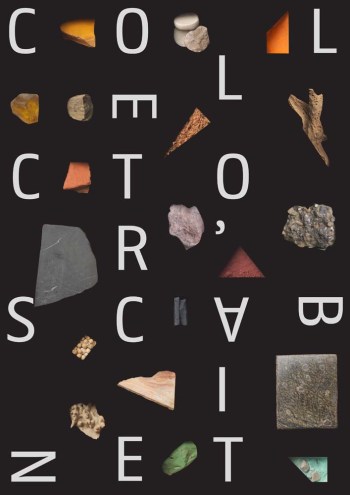 In the last few years no fewer than 50 experts have been involved in conducting research on the only eighteenth-century miniature apothecary’s shop in the Netherlands. The Rijksmuseum is now presenting the results of this research and conservation project in an extensive publication, designed by Irma Boom and showing the miniature pharmacy and 56 secret drawers for the first time, at almost actual size.
This rare collector’s cabinet houses an abundance of curiosities including a fully fitted miniature apothecary’s shop containing more than three hundred Delftware pots, glass bottles, tiny wooden drawers, paintings, and gilded ornaments. Concealed beside and behind the miniature pharmacy are no fewer than 56 secret drawers, all but five of which contain the collection of nearly 2000 varieties of naturalia, including seeds, flowers, roots, animal parts, rocks, minerals, and fossils.
The research has now been completed, providing a far deeper understanding of the cabinet’s origins, its purpose, the exceptional naturalia it contains, and the collectors’ world it inhabited. We can now be fairly certain that the cabinet was made in Amsterdam in 1730 for a wealthy doctor or apothecary, as a curiosity for the entertainment of a select group of friends and fellow collectors. The study also revealed that most of the naturalia items form the original contents of the cabinet. The naturalia even include uraninite and two other minerals containing uranium—for safety reasons, these materials are now safely stored in lead caskets in the Rijksmuseum’s depot, in accordance with the regulations and permit issued under the Dutch Nuclear Energy Act.
The conservation and restoration work have for a large part returned the cabinet and miniature apothecary’s shop to their former glory, and this object is now one of the highlights of the eighteenth-century galleries in the Rijksmuseum.
With thanks to the Cultural Heritage Agency of the Netherlands, Naturalis Biodiversity Center, Leiden University, and the Royal Netherlands Institute of Sea Research. The research, conservation, and publication were made possible by the Bank of America Merrill Lynch Art Conservation Project.
New NGA Online Edition: French Paintings of the Eighteenth Century
◊ ◊ ◊ ◊ ◊
This new online component from the NGA in Washington, D.C. includes convenient access to lots of interesting material, including videos (under ‘related content’). It might be particularly useful for teachers looking to enrich course materials with digital offerings (and plenty of other things). –CH
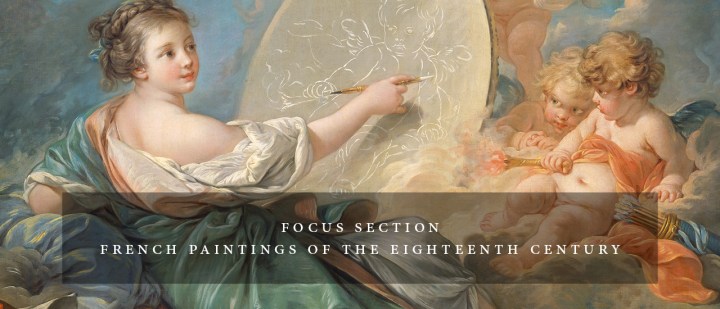
In conjunction with the recently opened exhibition, America Collects Eighteenth-Century French Painting, the National Gallery has released a new offering in its NGA Online Editions series, Focus Section—French Paintings of the Eighteenth Century.
The web-based Online Editions series is part of an ongoing effort to digitize and provide open access to the Gallery’s permanent collection catalogs and will eventually document more than 5,000 works of painting, sculpture, and decorative arts. Focus Section—French Paintings of the Eighteenth Century includes essays devoted to 20 paintings and their four related artists’ biographies. Like other Online Editions, this iteration provides free and open access to illustrated scholarly entries, biographies of the artists, and technical summaries.
Other highlights of the features available to researchers include
• A customized reading environment: An adjustable split-screen ‘reader mode’ allows users to view scholarly text alongside images, notes, and comparative figures or to view them in line with the text.
• Compare and explore images: An image-comparison tool enables users to view primary and comparative images side by side or to explore technical images via overlay and cross-fading techniques.
• Ease of research: The Online Editions toolbar provides preformatted citations for an object or biography, easy export, and quick access to archived pages.
• Archived versions and permanent URLs: Immediate access to PDFs of earlier versions and the assurance of permanent web addresses are a convenience to students and scholars alike.
• Enhanced search capabilities: An interactive search index is driven by an evolving list of terms particular to each area of the collection.
The NGA Online Editions series presents the same authoritative, peer-reviewed scholarship found within the Gallery’s bound volumes but enriched with customized tools for a more dynamic research experience.
Frick Pittsburgh Unveils New Strategic Plan and Acquisitions Program
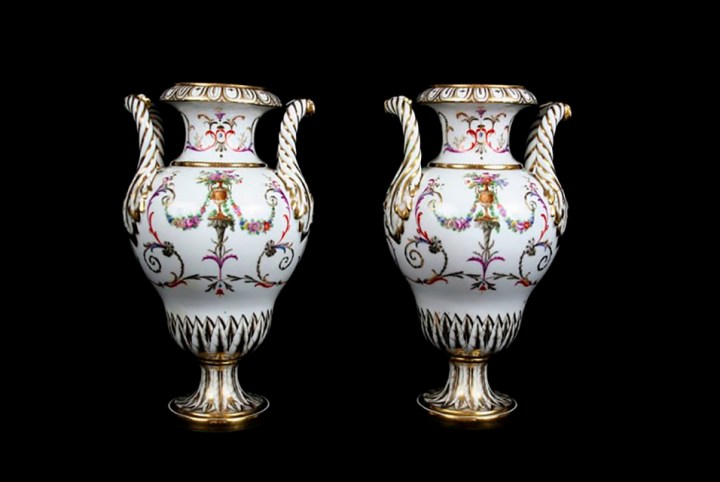
Manufacture de Monsieur le duc d’Angoulême, Paris, Pair of Vases, ca. 1785, porcelain with enamel and gilded decoration; each 9 × 5.5 × 5.25 inches (The Frick Pittsburgh Collection).
◊ ◊ ◊ ◊ ◊
Press release from The Frick Pittsburgh (via Art Daily) . . .
The Board of Trustees of The Frick Pittsburgh announces the adoption of a new five-year strategic plan, 2017–22 and Beyond, and the activation of a new acquisition program, resulting in the recent acquisition of new collection objects.
Strategic Plan
On Tuesday, June 20, Frick Board of Trustees Chair Charles R. (‘Chip’) Burke, Jr. and Executive Director Robin Nicholson presented the museum’s recently adopted strategic plan to more than 20 representatives from regional foundations assembled at The Duquesne Club in Downtown Pittsburgh. 2017–22 and Beyond is the result of a two-year planning process which began shortly after the late 2014 appointment of Mr. Nicholson as the institution’s third executive director. The process was led by the Board’s Strategic Planning Task Force, under the leadership of Chair, Trustee Louis L. Testoni. The new strategic plan features a revised ideology for the organization, encompassing new vision, values, and mission statements. These new guiding principles provide the foundation for three overarching institutional goals: audience growth, organizational efficiency, and long-term planning.
Mr. Burke, Chair of the Board of Trustees says, “We are excited about the clearly defined vision and direction articulated in the new strategic plan. In addition to laying the groundwork for the next 25 years, the plan reflects the commitment of The Frick’s board and staff to leverage and enhance the museum’s assets for the benefit of all visitors and program participants.”
The plan identifies three equal and interwoven components to the unique experience offered by The Frick: art, history, and nature—all of which, in turn, underpin the museum’s core ideology, or three ‘powers’: the power of art to inspire and educate, the power of the past to inform the future, and the power of beauty and place. Five strategies build on these principles with specific calls to action: to define and refine the many experiences that The Frick offers, invest in marketing to build audience and revenue, increase efficiency, acquire better information and data, and to think realistically about the future. The museum’s new mission statement aligns with the newly defined institutional ideology: “Continuing the legacy of Helen Clay Frick, we will offer one of the best experiences of art, history, and nature, in a welcoming environment that inspires and delights.”
Executive Director Nicholson comments, “Planning for the future provides an extraordinary opportunity for innovative and aspirational thinking about the role of museums and culture for future generations. The Frick’s new strategic plan thoughtfully addresses both the short- and long-term challenges faced by all cultural organizations in the United States. At the same time, it recognizes that nothing we do has any value unless it helps to ‘inspire and delight.'”
The complete strategic plan is available on The Frick’s website.
New Acquisition Program
Museum benefactress Helen Clay Frick envisioned The Frick to be a vital, growing museum that continues to acquire items that build on the strength of its collection. Building on the strategic goal of “defining and refining the Frick experience,” the museum recently activated a new acquisition program by holding its inaugural Collectors Dinner on April 25, 2017. Fifty members of The Frick Societies, a recognition group for individuals who support The Frick by contributing $1,000 or more annually, attended a black-tie event at The Frick Art Museum, during which three works of art were presented for potential acquisition. Guests were invited to vote for the objects of their choice. Receiving the most votes were a pair of late-18th-century Angoulême porcelain vases and Cream (2015), a color photographic print by Dutch artist Hendrik Kerstens. At its June 14, 2017 meeting, The Frick’s Board of Trustees approved these two objects for purchase.
Produced around 1785 by Manufacture de Monsieur le duc d’Angoulême, Paris, which operated from 1781 to 1793, the pair of exquisite porcelain vases feature enamel and gilded decoration. The vases are an extraordinary example of Parisian porcelain produced at the end of the ancien régime in France. The Manufacture le duc d’Angoulême was one of the few factories at the end of the 18th century to rival Sèvres in the quality of its porcelain and the technical excellence of its decoration. The vases enhance the museum’s collection of 18th-century French decorative art, complementing the fabulous examples of French furniture and paintings collected by Helen Clay Frick. The Frick owns two examples of furniture by Martin Carlin, which incorporate Sèvres porcelain plaques. Angoulême works are in the collections of other major museums: a vase related to the pair acquired by The Frick is in the collection of The British Museum. Tableware by Angoulême is also part of the collections of museums such as The Metropolitan Museum of Art, the Victoria & Albert Museum, and Winterthur. Mount Vernon owns a service by Angoulême purchased by George Washington in 1790.
Contemporary Dutch artist Hendrik Kerstens creates a dialogue between past and present through an almost hyper-conscious homage to the history of Dutch art combined with a slightly playful subversity. The artist began studying photography at age 40 and quickly became known for his interest in creating large-scale painterly photographs with an emphasis on light effects and the use of poses and props that echo the conventions found in Old Master painting, particularly of the 17th century. He began working with his daughter Paula as his subject in 1994. His 2007 photograph, Bag, in which she is posed with a plastic grocery bag on her head caused a sensation, winning the prestigious Taylor Wessing Photographic Portrait Prize awarded by the National Portrait Gallery, London. Bag also attracted the attention of fashion designer Alexander McQueen, who based his 2009 collection on the image. In Cream, Paula is posed against a dark background and beautifully lit, allowing for a painterly, Baroque sense of chiaroscuro and an emphasis on luminous skin tones. Kerstens typically injects his work with humor and disrupts his emulation of Old Masters through the interjection of unexpected materials or props—in this case, a coiffure of shaving cream. Cream is a compelling photograph that serves as a catalyst for conversation about painting and photography, past and present. Acquisition of this work enables The Frick to further explore ideas of portraiture and representation by providing a contemporary counterpoint to works in the collection, such as the Rubens Portrait of the Princess of Condé, as well as other examples of portraiture in the collection by Nattier, de Troy, Hogarth, Gainsborough, and Reynolds. Since gaining public attention through his Paula pictures, Kerstens has been commissioned to create commercial portraits for Vanity Fair and The New York Times Magazine. His work is widely represented in public and private collections in the Netherlands as well as the Santa Barbara Museum of Art, the Museum of Photographic Art in San Diego, the Pilara Family Foundation Collection in San Francisco, the Elton John Collection, the Alexander McQueen Collection, and others.










 Enfilade
leave a comment