Acquisition Appeal | Admiral Russell’s Frame, 1690s
An appeal from The Fitzwilliam in Cambridge:
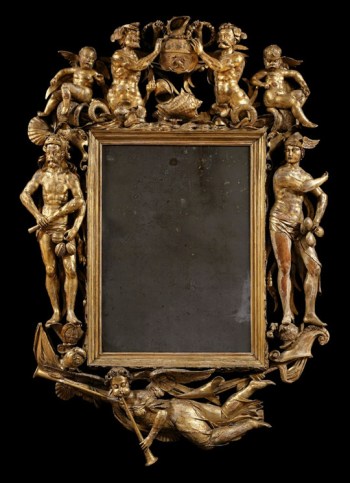
Giltwood frame bearing the arms of Admiral Edward Russell, later 1st Earl of Orford, Admiral of the Fleet; England, ca. 1690s; carved and gilded lime wood with central mirror plate, 182 × 129.5 × 13.5 cm. Provenance: Admiral Russell; private collection, Paris.
To commemorate The Fitzwilliam Museum’s bicentenary, we invite you to support the acquisition of Admiral Russell’s Frame, currently on display at the Museum. The Friends of the Fitzwilliam Museum are able to purchase this magnificent frame at a negotiated price of £345,000. We have until 31st December 2016 to raise the funds. Through the Friends’ acquisition fund, a £50,000 V&A Purchase Grant, and other generous donations, we have raised 80% of the total required. Your support with a personal donation would be truly appreciated as we aim to raise the final £70,000. Please join us in saving this work of local, national and international importance and bring it home to Cambridgeshire for good.
With its local Cambridgeshire connection, highly sophisticated carving and intriguing iconography, this splendid frame will enhance the Museum’s collections for future generations to study and enjoy. The Museum’s Learning Team also sees the great potential of this object’s provenance, mythological figures and Stuart-era history to engage school and community groups alike.
This elaborate mirror frame is a unique survivor from the golden age of English wood carving. It was commissioned by Admiral Edward Russell (1653–1727), the celebrated naval hero best known for his triumphs at the battles of Barfleur and La Hogue in 1692. Russell was a generous patron of architecture and the arts. His Cambridgeshire estate, Chippenham Park, was luxuriously furnished and featured intricately carved woodwork throughout. Almost certainly made between 1693 and 1697 to honour Russell’s achievements and to celebrate his appointment as Admiral of the Fleet and First Lord of the Admiralty, the frame is decorated with symbols representing eternal glory. A personification of Fame with two trumpets flies beneath the mirror, which is flanked by two ancient gods: Mercury representing trade, commerce, and financial gain and Hercules symbolising military strength and triumph.
Sadly, the carvers are unknown. They were probably Dutch or French Huguenots based at Deptford’s naval dockyard, more used to carving elaborate ship prows and interiors than decorative pieces for a country estate.
This magnificent object was probably inherited in 1727 by Admiral Russell’s great-niece, Letitia, who had married the 1st Lord Sandys in 1724. Later the frame was part of M. Michel Dezarnaud’s collection in Neuilly-sur-Seine, Paris, from whom it was bought by a dealer in Belgium in ca. 2015
The frame bears the arms of Admiral Edward Russell, 1st Earl of Orford of the first creation (1653–1727). The marine equivalent of the 1st Duke of Marlborough, Russell is chiefly remembered today for his triumphs at the naval battles of Barfleur and La Hogue on 29 May and 4 June 1692 respectively. These confrontations irreparably damaged the French Atlantic fleet and made the proposed invasion of Britain by Louis XIV and the deposed English King, James II, impossible, thereby securing the position of William III. The scale of this double battle was enormous: 126 ships in total—over twice the size of the Battle of Trafalgar. It was this victory that led to Russell’s promotion to Admiral of the Fleet in November 1693, First Lord of the Admiralty in April 1694, and creation as 1st Earl of Orford in 1697. The imagery of the frame clearly celebrates Russell’s remarkable and unsurpassed naval career.
Edward Russell was a sophisticated and extravagant patron of the arts. This was especially the case at his country estate, Chippenham Park in Cambridgeshire, halfway between Bury St Edmunds and Ely, for which he paid £16,250 in 1689. The house was probably designed by his relative, the architect Thomas Archer (1668–1743) who later designed Russell’s (still surviving) town house in Covent Garden Piazza in 1716–17. Chippenham Park was demolished in 1790 and replaced with a succession of later houses. Drawings of the exterior or interior of the house do not survive, but a map of the estate shows how the trees in the park were planted to evoke the battle formations at La Hogue and Barfleur.
Russell had no direct offspring, and his property was divided between his nieces and nephews. Yet Russell did leave a political legacy; his political protégé Robert Walpole (1676–1745) would become Britain’s first and longest-serving Prime Minister. It was in memory of Russell that Walpole decided to adopt the title of Earl of Orford of the second creation in 1742.
Aimee Marcereau DeGalan Appointed Curator at The Nelson-Atkins
Press release (25 October 2016) from The Nelson-Atkins:
The Nelson-Atkins Museum of Art in Kansas City has hired Dr. Aimee Marcereau DeGalan as the Louis L. and Adelaide C. Ward Senior Curator of European Art. Marcereau DeGalan comes to the Nelson-Atkins from The Dayton Art Institute (DAI), where she was Chief Curator and Curator of European Art.

Aimee Marcereau DeGalan, photo by Chris Dissinger.
“The timing of this important addition to our staff could not be better,” said Julián Zugazagoitia, Menefee D. and Mary Louise Blackwell CEO & Director of the Nelson-Atkins. “Aimee’s scholarship will be immediately called upon as we prepare to open the Bloch Galleries in the spring, and she will continue the important work that has begun on our catalogue of French paintings.”
A specialist in British and French 18th- and 19th-century art, Marcereau DeGalan will lead the European Arts division, which includes the departments of Ancient Art, European Paintings & Sculpture and Architecture, Design and Decorative Arts. She will pursue senior-level research exhibition and catalogue projects, and be responsible for acquisitions, interpretation and presentation of the European collections.
“Aimee’s experience at institutions of varying scale and type has been excellent training for the job at the Nelson-Atkins,” said Catherine Futter, Director of Curatorial Affairs. “A 2014 Center for Curatorial Leadership Fellow, she has worked across many disciplines to engage a wide range of audiences and is also an amazing leader.”
Marcereau DeGalan was hired at the DAI in 2012 as Curator of Collections and Exhibitions. Previously, she held curatorial posts at the Fleming Museum of Art at the University of Vermont, The Cleveland Museum of Art, and The Detroit Institute of Arts. While in Dayton, Marcereau DeGalan raised major funds for conservation treatments to seven significant European paintings, accessioned more than 400 objects, regularly brought scholars into the museum to advise on its different collections, and presented 24 exhibitions during her tenure. Importantly, she worked to broaden the DAI’s engagement with the Dayton community.
“The DAI will forever be grateful for Aimee’s meaningful contributions to the museum and the community,” says Dayton Art Institute Director and CEO Michael R. Roediger. “During her time at the museum, she has led the Curatorial Department and the Collections Committee, been a valued member of the museum’s leadership team, and been an integral part of the development of the museum’s Centennial Plan. The Dayton Art Institute can be proud that one of our own is moving on to such a prestigious organization.”
“I am thrilled to be joining the curatorial team at the Nelson-Atkins,” said Marcereau DeGalan. “It has long been an institution I have admired not only for the scope and depth of its collections, but also for its commitment to research, scholarship, and to broadening its reach within the regional community and on the national and international stage.”
Marcereau DeGalan will begin her position on November 1st.
Aimee Marcereau Degalan completed her PhD in 2007 with Anne Helmreich at Case Western Reserve University with a dissertation entitled “Dangerous Beauty: Painted Canvases and Painted Faces in Eighteenth-Century Britain.”
UK Export Bar Placed on Mazarind Tapestry, ca. 1700

Michael Mazarind Workshop, Chinoiserie Tapestry with Courtly and Hunting Scenes, made in London,
ca. 1696–1702.
◊ ◊ ◊ ◊ ◊
Press release (20 October 2016) from Gov.UK’s Department for Culture, Media & Sport:
Culture Minister Matt Hancock has placed a temporary export bar on a rare tapestry by Michael Mazarind to provide an opportunity to keep it in the country. The tapestry is at risk of being exported from the UK unless a buyer can be found to match the asking price of £67,500. Inspired by Indian, Chinese, and Japanese design, it is the only surviving tapestry to feature Michael Mazarind’s workshop mark [lower right-hand corner]. Little is known of his workshop, but it is believed he was based in Portugal Street, London, between 1696 and 1702. Mazarind was relatively unknown, but is said to have connections to John Vanderbank, the Soho-based weaver. The tapestry includes small groups of oriental figures, buildings, exotic creatures, and plants. This combination of elements was described as ‘in the Indian manner’ and was one of the most popular decorative fashions of the period.
Minister of State for Digital and Culture Matt Hancock said: “This intricate design provides us with a unique opportunity to explore the tapestry workshops of 1600s London. I hope we are able to keep it in the country so we can learn more about our nation’s textile industry, and of the decorative fashions of the time.”
The decision to defer the export licence follows a recommendation by the Reviewing Committee on the Export of Works of Art and Objects of Cultural Interest (RCEWA), administered by The Arts Council. The RCEWA made its recommendation on the grounds of significance for the study of Mazarind’s work, English tapestry of the period, and London’s history.
RCEWA member Christopher Rowell said: “This beautiful blue ground tapestry, with an equally unusual border of Chinese inspiration, dates from the late 1600s and is the only one to bear the woven signature of the mysterious Michael Mazarind, who was a rival of the more well-known London tapestry weaver, John Vanderbank. This type of ‘Indian’ tapestry depicting a Chinoiserie fantasy paradise in Cathay, with courtly and hunting scenes, was devised for the court but soon became more broadly popular. Saving the tapestry for the nation will allow specialists to study it in detail and help to reconstruct Mazarind’s contribution to tapestry production in early-Georgian London.”
The decision on the export licence application for the tapestry will be deferred until 19 January 2017. This may be extended until 19 April 2017 if a serious intention to raise funds to purchase it is made at the recommended price of £67,500. Offers from public bodies for less than the recommended price through the private treaty sale arrangements, where appropriate, may also be considered by Matt Hancock. Such purchases frequently offer substantial financial benefit to a public institution wishing to acquire the item.
Nationalmuseum Releases 3,000 images on Wikimedia Commons

Jean-Baptiste Pater (1695–1736), A Company of Bathers in a Park, oil on canvas, 49 x 59 cm (Stockholm: Nationalmuseum, NM874, photograph by Cecilia Heisser).
◊ ◊ ◊ ◊ ◊
Press release (11 October 2016) from Sweden’s Nationalmuseum:
Nationalmuseum is making 3,000 high-resolution images of its most popular artworks available for free download on Wikimedia Commons. Zoomable images will also be added to the museum’s online database. The digitization project is a major advance in making Nationalmuseum’s collections more accessible.

David von Cöln, Pineapple Plant, 1729, oil on canvas, 112 x 91 cm (Stockholm: Nationalmuseum / Gripsholm Castle).
While the Nationalmuseum building is under renovation, only a small part of the collections is accessible to the public. To provide more opportunity for people to enjoy its artworks, the museum embarked last year on a joint project with Wikimedia Sweden. As a result, high-resolution images of some 3,000 paintings from the collections are now available for download on Wikimedia Commons as public domain. This means they are part of our shared cultural heritage and can be freely used for any purpose. The images are also now zoomable, but not currently downloadable, in Nationalmuseum’s online database.
“We are committed to fulfilling our mission to promote art, interest in art, and art history by making images from our collections an integral part of today’s digital environment,” said Berndt Arell, director general of Nationalmuseum. “We also want to make the point that these artworks belong to and are there for all of us, regardless of how the images are used. We hope our open collection will inspire creative new uses and interpretations of the artworks.”
Nationalmuseum will continue to make its collections more accessible as digitization gathers pace and digital infrastructure improves. The longer-term goal is to create a portal offering quick and easy access to all the museum’s fine art collections and archives. Nationalmuseum joins a growing number of museums that have released images of their collections, including The Royal Armoury and Skokloster Castle with the Hallwyl Museum Foundation in Sweden, the Rijksmuseum in Amsterdam, and the National Gallery of Denmark in Copenhagen. Data on the images in Wikipedia Commons, including links to the zoomable versions, is available on GitHub as raw material for coders taking part in Hack4Heritage—an event being organized by Digisam, the agency coordinating the digitization of Sweden’s cultural heritage, in partnership with the Stockholm City Archives, on 14–16 October.
Research Project | Sir Hans Sloane’s Catalogues
From the project announcement:
Enlightenment Architectures: Sir Hans Sloane’s Catalogues of His Collections
Leverhulme Trust Research Project, Autumn 2016 — 30 September 2019
Applications due by 31 October 2016
We are delighted to be able to announce the inception of Enlightenment Architectures: Sir Hans Sloane’s Catalogues of His Collections, a new research project based at the British Museum in collaboration with the Department of Information Studies at University College London. Enlightenment Architectures will start on 3 October 2016 and will run for three years until 30 September 2019.
The project has received generous funding from the Leverhulme Trust in the form of a Research Project Grant totalling £332,552 awarded to the British Museum, where Dr Kim Sloan is the Principal Investigator. The Co-Investigator on the project is Dr Julianne Nyhan and the Senior Research Assistant is Dr Martha Fleming. The grant will also accommodate two Post Doctoral Research Assistantships and one Doctoral Studentship. The call for applications for the PDRA positions are live now on the British Museum jobs website. The call for applications for the Doctoral Studentship will appear shortly on the University College London jobs website.
The objective of Enlightenment Architectures: Sir Hans Sloane’s Catalogues of His Collections is to understand the intellectual structures of Sloane’s own manuscript catalogues of his collections and with them the origins of the Enlightenment disciplines and information management practices they helped to shape. The project will employ a pioneering interdisciplinary combination of curatorial, traditional humanities and Digital Humanities research to examine Sloane’s catalogues which reveal the way in which he and his contemporaries collected, organised and classified the world, through their descriptions, cross-references and codes. The project will draw on the research framework that emerged from the 2012 AHRC-funded Sloane’s Treasures workshops, and findings will make significant contributions to histories of information science, histories of collections, and philosophy of knowledge, and will benefit a wide range of other disciplines as well.
Six manuscript catalogues created from 1680 to 1753 and selected from across the three institutions now holding Sloane’s materials—the British Museum, the British Library, and the Natural History Museum—will be transcribed and closely analysed by the interdisciplinary research team with the assistance of curatorial support from those three institutions. Regular workshops between curators, humanities researchers, and digital humanities practitioners will produce a deeper understanding of the structure and content of the catalogues. This will be disseminated through
• scholarly publications and conference contributions
• focused workshops and a project website
• a prototype linked data ontology for use in digital analysis of early modern collections
We look forward to communicating with you about our work, and welcome contributions from the wide-ranging scholarly communities whose disciplines will participate in and benefit from this research. We ask you to assist us in disseminating the announcements for the two Post Doctoral Research Associateships and the Doctoral Studentship and would ask you to alert colleagues and students who are eligible and appropriate to apply. As this is a Leverhulme Grant, the Doctoral Studentship is open to the EU as well as to UK applicants. The Research Associateships are open to international applicants.
With very best regards,
Dr Kim Sloan and Dr Julianne Nyhan
Partners
The British Museum
University College London Centre for Digital Humanities
Project Team
Kim Sloan is Curator of British Drawings and Watercolours before 1880 and the Francis Finlay Curator of the Enlightenment Gallery at the British Museum.
Julianne Nyhan is Senior Lecturer (Associate Professor) in Digital Information Studies at UCL’s Department of Information Studies.
Martha Fleming is a specialist in collections-based research and an historian of science.
NMAAHC Opens on Saturday

The Smithsonian National Museum of African American History and Culture
Wikimedia Commons (20 July 2016).
◊ ◊ ◊ ◊ ◊
As Lonnie Bunch, the MNAAHC’s director, repeatedly says, the museum aims, by addressing black experiences and contributions, to expand conceptions of what American history and identities are for all visitors. Part of that necessarily requires seventeenth- and eighteenth-century objects and interpretations. There are slave shackles, even an early nineteenth-century slave cabin, but there are also sources documenting service in the Revolutionary War, Freemasonry objects, and a portrait by Joshua Johnson, the earliest documented professional African American painter. Writing for The New York Times (15 September 2016), Holland Cotter calls it “more than just impressive. It’s a data-packed, engrossing, mood-swinging must-see.” Press release (2 February 2016) . . .
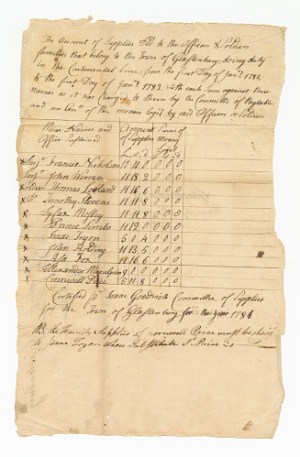
Ledger of supply costs for eleven Revolutionary War soldiers, 1782.
The Smithsonian today announced that the National Museum of African American History and Culture will open to the public Saturday, September 24. The opening will be the focus of a week-long celebration that begins with a dedication ceremony. The celebration continues with extended visiting hours and a three-day festival showcasing popular music, literature, dance and film. Also planned are events co-hosted by other museums around the country and in Africa.
“After 13 years of hard work and dedication on the part of so many, I am thrilled that we now have this good news to share with the nation and the world,” said Lonnie Bunch, the museum’s founding director. “In a few short months visitors will walk through the doors of the museum and see that it is a place for all people. We are prepared to offer exhibitions and programs to unite and capture the attention of millions of people worldwide. It will be a place for healing and reconciliation, a place where everyone can explore the story of America through the lens of the African American experience.”
“We look forward to the opening of this enormously important new museum,” said David Skorton, Smithsonian Secretary. “The National Museum of African American History and Culture furthers the Smithsonian’s commitment to telling America’s story in all its dimensions.”
President George W. Bush signed the legislation establishing the museum in 2003. In 2009, the museum’s architectural team of Freelon Adjaye Bond/SmithGroupJJR was selected, and in 2011 Clarke/Smoot/Russell was chosen as the construction firm. David Adjaye is the lead designer, and Phil Freelon is the lead architect. The landscape design is by the team of Gustafson Guthrie Nichol.
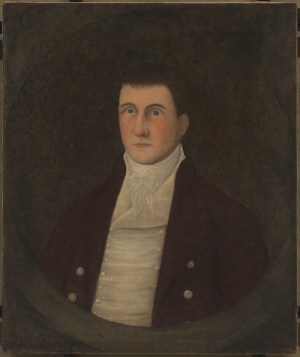
Joshua Johnson, Portrait of John Westwood, ca. 1807–08, oil on canvas (Washington, D.C.: Collection of the Smithsonian National Museum of African American History and Culture, 2010.25ab).
The Smithsonian broke ground for the museum 22 February 2012 on its five-acre site on Constitution Avenue between 14th and 15th streets N.W. The 400,000-square-foot building has five levels above ground and four below. The museum will have exhibition galleries, an education center, a theater, café, and store, as well as staff offices. Among the building’s signature spaces are the Contemplative Court, a water- and light-filled memorial area that offers visitors a quiet space for reflection; the Central Hall, the primary public space in the museum and the point of orientation to building; and a reflecting pool at the south entry of the museum, with calm waters meant to invite all to approach.
The museum also features a series of openings—’lenses’—throughout the exhibition spaces that frame views of the Washington Monument, the White House, and other Smithsonian museums on the National Mall. These framed perspectives remind visitors that the museum presents a view of American through the lens of the African American experience.
The museum will open with 11 inaugural exhibitions that will focus on broad themes of history, culture and community. The exhibitions have been designed by museum historians in collaboration with Ralph Appelbaum Associates. These exhibitions will feature some of the more that 34,000 artifacts the museum has collected since the legislation establishing it was signed in 2003. The museum’s collections are designed to illustrate the major periods of African American history. Highlights include: a segregation-era Southern Railway car (c. 1920), Nat Turner’s Bible (c. 1830s), Michael Jackson’s fedora (c. 1992), a slave cabin from Edisto Island, S.C. plantation (c. early 1800s), Harriet Tubman’s hymnal (c. 1876) and works of art by Charles Alston, Elizabeth Catlett, Romare Bearden, and Henry O. Tanner.
While under construction, the museum has had a gallery at the Smithsonian’s National Museum of American History. Since 2009, the museum has opened seven exhibitions in the space including Through the African American Lens: Selections from the Permanent Collection (on view now), The Scurlock Studio and Black Washington: Picturing the Promise, and Changing America: The Emancipation Proclamation, 1863 and The March on Washington, 1963. The museum’s first exhibition, Let Your Motto Be Resistance: African American Photographs, opened in 2007 at the International Center for Photography in New York and toured 15 cities.
In addition to exhibitions, the museum has also launched several education and research programs. Save Our African American Treasures was launched in Chicago in January 2008 and is one of the museum’s signature programs. Participants work with conservation specialists and historians to learn how to identify and preserve items of historical value, including photographs, jewelry, military uniforms, and textiles.
Frick Announces Gift of Du Paquier Porcelain

Du Paquier Porcelain Manufactory, Elephant Wine Dispenser, ca. 1740 (New York: The Frick Collection, gift of the Melinda and Paul Sullivan Collection, 2016; photo by Michael Bodycomb).
◊ ◊ ◊ ◊ ◊
Press release from The Frick, via Art Daily (16 September 2016). . .
The Frick Collection announced a gift from Paul Sullivan and Trustee Melinda Martin Sullivan of porcelain produced by the Du Paquier manufactory in Vienna. The Sullivans generously permitted the Frick to choose fourteen superb examples from their collection, considered to be the finest private collection in the world from this important early Western manufactory. The objects, dating from about 1720 to 1740, perfectly complement the museum’s porcelain holdings, which have grown since Henry Clay Frick’s day to represent in depth some of the best productions of this prized material. Mr. Frick focused his porcelain collecting on Sèvres, which accompanied beautifully the eighteenth-century French paintings and furniture he acquired. In 1966, his collection of Chinese porcelain was augmented by some two hundred pieces through the bequest of his son, Childs. The museum’s holdings were again extended by recent and promised gifts of Meissen porcelain from Henry Arnhold. Now, the Sullivan’s gift of Du Paquier porcelain adds to the Frick’s already strong assemblage, which illustrates the Western fascination with Eastern models and represents the brilliant and distinctive tradition of porcelain production in Europe. Starting September 28, these stunning works will be on view in the Frick’s Reception Hall, remaining there through March of 2017.
Europe had long sought to duplicate the composition and physical qualities of the ceramics it imported from China; the feat was achieved only in the first decade of the eighteenth century at the Royal Meissen Manufactory outside Dresden, Germany, before being replicated by the Du Paquier manufactory in Vienna, then by the Sèvres manufactory in France, and elsewhere. In 1718, Claudius Innocentius du Paquier, an agent in the Imperial Council of War at the Vienna court, was granted a twenty-five year charter by Emperor Charles VI to operate a porcelain factory in Vienna. Although the secret of making porcelain by combining local clays containing kaolin with ground alabaster was jealously guarded by the Meissen manufactory, Du Paquier used his diplomatic connections to lure several key figures from Germany to Austria. These included Christoph Conrad Hunger, a porcelain painter; Just Friedrich Tiemann, an expert in kiln construction; and Samuel Stöltzel, the Meissen kiln master, who brought with him the formula for porcelain paste. Named for its founder, the Du Paquier manufactory produced a range of tablewares, decorative vases, and smallscale sculpture that found great popularity with the Hapsburg court and the Austrian nobility.
An early work of about 1725 testifies to the Viennese factory’s pride in its achievement. A tulip vase, part of a set of vessels called a garniture, features a fanciful view of Vienna and its spiritual center, St. Stephen’s Cathedral. Circling the frame of this scene is a Latin inscription that translates: “The bowls that Vienna formerly shipped here under a thousand perils of the sea, she now produces for herself.” The legend clearly signals the Du Paquier manufactory’s debt to Asian ware, which the Emperor Charles VI’s Ostend East-India Company had imported to the city since 1722.
A number of Asian motifs cover a Du Paquier tureen and stand of 1730–35, a form common in both European ceramic and silver dinner services of this period. Chinese-inspired handles in the form of leaping fish enliven the vessel. Its cobalt blue underglaze decorated with gold patterns and cherry blossoms reflect color combinations influenced by Imari ware, which was imported to Europe from Japan during the late seventeenth and eighteenth centuries. Within the fan-shaped cartouches, scenes of Chinese figures and temples have been adopted from German engravings published about 1720 in Amsterdam. The variety of sources and inventive adaptations characterize Du Paquier’s spirited production.
As the renown of the Du Paquier manufactory spread, commissions came from capitals throughout Europe; the emperor and members of his court also sent these prized objects as diplomatic gifts to their counterparts in foreign lands. A magnificent tureen—one of more than forty from an extensive service created in 1735 for Czarina Anna Ivanovna—illustrates porcelain’s role in cementing political and dynastic ties. In 1726, Austria and Russia had signed a treaty of mutual defense against military threats from the Ottoman Empire and subsequently were allies during the War of Polish Succession (1733–35). It is likely that to strengthen this alliance, Charles VI sent Anna Ivanovna the Du Paquier service, most of which is still in the State Hermitage Museum in St. Petersburg. The Russian imperial arms are emblazoned in the center of the tureen’s lid, beneath the finial, a gilded statuette of a cross-legged, turbaned man. These two features perfectly illustrate Du Paquier’s brilliant integration of flat, painted decoration with three-dimensional applied forms. Circling the body of the tureen is a modeled garland held in the mouths of grotesque masks, its brightly painted flowers popping from the surface. In contrast, geometrical bands of a type called Laub- und Bandelwerk accent the bottom of the tureen and the lid. This decorative motif consisting of infinite variations based on patterns of trelliswork, angled strapwork, and stylized foliage became a virtual signature of the Viennese porcelain. Painted in a distinctive palette of iron-red with purple, blue, and green, the designs highlight the factory’s use of exuberant colors.
While sculptural forms like fish handles and seated-man finials are a hallmark of Du Paquier’s production, some works take these features to the highest level. One of the most charming is a tankard of 1735–40, the handle of which is in the shape of a cooper. Identified by the leather apron he wears under his coat, the craftsman specialized in making barrels like that which forms the shape he holds. Designed to contain beer, Du Paquier tankards often had lids, but the cooper’s hands grasp the rim, preventing a top from being added. The lively expression of the man, the bold pattern of flowers set off by bands of Laub-und Bandelwerk, and the tankard’s exceptionally large size make it a superb example of these drinking vessels.
Among the rarest of Du Paquier’s sculptural vessels is the elephant wine dispenser featured on the front of this release, one of three known to survive. A colorfully glazed version, in the Hermitage, is part of an elaborate centerpiece made about 1740 for Anna Ivanovna. That elephant stands above a rotating silver platter on which eight dancing figures hold cups ready to receive wine from the elephant’s trunk. The elephant is ridden by a figure of Bacchus, who can be lifted to fill the cavity with wine. The pure white surface of the Frick elephant allows the animal’s sculptural details to be clearly seen. Although it is possible that it was prepared as a spare in the event of breakage during firing, close observation reveals that the figure was once cold-painted (meaning paint was applied to the surface of the object, but it was not fired afterward). Elephants were favorites of the Czarina, who received one as a gift from Persian emissaries in 1736 and who featured a full-size model in a festival she staged on the frozen Neva River in 1740.
The elephant wine service was among the last of the great works produced by the Du Paquier manufactory. By 1744, its founder was overcome with debt and was forced to sell the factory to Empress Maria Theresa. Over its three-decade history, Du Paquier produced a body of work that was inventive and often whimsical, a truly distinctive voice in the evolution of European porcelain.
Comments Frick Director Ian Wardropper, “It gives me great pleasure to see these works come to the Frick. In 1993, while I was the Eloise W. Martin Curator of European Decorative Arts and Sculpture at the Art Institute of Chicago, Melinda and her sister, Joyce Hill, offered to fund an acquisition in honor of their mother, Eloise. Several suggestions were made, one of which was a group of three exquisite pieces of Du Paquier porcelain that the department was very interested in acquiring. Melinda was smitten with these objects, and—after purchasing the group for the Art Institute—she and her husband, Paul, began to acquire their own Du Paquier works. As their collection grew, so too did their interest in the history of the manufactory and its production, which led them to underwrite the research for and publication of Fired by Passion, a definitive three-volume monograph released in 2009. To celebrate its publication, as the head of the Department of European Sculpture and Decorative Arts at The Metropolitan Museum of Art, I initiated an exhibition drawn from the Sullivan’s and the Met’s collection (Imperial Privilege: Vienna Porcelain of Du Paquier, 1718–44). We are now honored to have this exceptional selection of porcelains enter The Frick Collection owing to the Sullivans’ extraordinary generosity.”
Lieke van Deinsen on the ‘Panpoëticon Batavûm’
From the September 2016 Newsletter on Academic Activities at the Rijksmuseum:
As a Johan Huizinga Fellow, Lieke van Deinsen conducted research into a remarkable collection of eighteenth-century portraits of authors, better known as the Panpoëticon Batavûm. Her findings will be published as the first volume in the new book series Rijksmuseum Studies in History, which will be launched 13 October 2016.
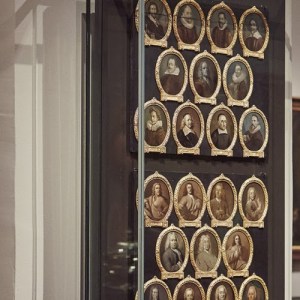 Collecting was extremely fashionable in the eighteenth-century Dutch Republic. Wooden trays and cabinets, made specifically for the purpose, would be filled with collections of coins, stones and shells. The Amsterdam painter, engraver and amateur poet Arnoud van Halen assembled a collection of a different and unique kind. In 1719, he commissioned a cabinet that eventually served as the repository of over three hundred little portraits of Dutch poets past and present. The formal enshrinement of this remarkable collection did not, however, mark its beginning—or its end. Van Halen had started accumulating his Panpoeticon Batavum at the turn of the eighteenth century, and after his death the cabinet and its contents changed hands several times as lovers of literature and literary societies sought to acquire the Panpoëticon. The collection also inspired dozens of poets to articulate their highly emotional reactions on seeing this ground-breaking image of Dutch literary history. The wooden cabinet became the tangible monument to the Dutch literary canon at a time when Dutch culture was primarily described in terms of decline, Frenchification and the waning of the Golden Age.
The history of the Panpoëticon Batavûm literally ended with a bang. The wooden cabinet was severely damaged when a ship filled with gunpowder exploded in the centre of Leiden. In the aftermath of the disaster, the remaining portraits were sold separately and ended up all over Europe. Nowadays, eighty-three of the original portraits can be found in the Rijksmuseum’s collection.
Read more here»
Nicholas Serota To Step Down as Tate Director
From the Tate press release (8 September 2016). . .
Tate’s Board of Trustees today announced that Nicholas Serota will step down as Director of Tate next year. The process of finding a new director will begin immediately and is being guided by a specially appointed committee of trustees and external advisers including senior artists.

Nicholas Serota, © Hugo Glendinning, 2016
Tate’s Chairman, Lord Browne said: “We have been privileged to have in Nicholas Serota one of the world’s greatest museum directors and a leader for the visual arts on a global stage. Under his leadership Tate has become a preeminent cultural organisation nationally and internationally and one of the most visited in the world. He has championed British art and artists throughout the world while at the same time ensuring that Tate has become a much loved, open and accessible institution for the public. He leaves Tate in a strong position on which to build for the future. We wish him well as he takes on new responsibilities which will be for the benefit of all the arts.”
Nicholas Serota said: “It has been an exciting challenge to work with successive Chairmen, trustees and groups of extremely talented colleagues to develop the role of Tate in the study, presentation and promotion of British, modern and international art. Over the past thirty years there has been a sea-change in public appreciation of the visual arts in this country. Tate is proud to have played a part in this transformation alongside other national and regional museums and the new galleries that have opened across the country in places like Walsall, Margate, Wakefield, Gateshead and Nottingham. Tate has always been fortunate to have enjoyed the support of artists and to have benefitted from the international acclaim for the work of British artists in recent years. I leave an institution that has the potential to reach broad audiences across the UK and abroad, through its own programmes, partnerships and online.”
Nicholas Serota is a champion of visual arts throughout the UK and abroad. During his 28 years at Tate, he has helped to make Tate an organisation respected throughout the world. It was his vision that led to the creation of Tate Modern and the redefinition of the original gallery at Millbank as Tate Britain. He led the creation of Tate St Ives and has also sought to strengthen the role of Tate as a national institution through the further development of Tate Liverpool in taking a leading part in the celebration of the city as European City of Culture in 2008 and by establishing partnerships with galleries across the country through the Plus Tate programme.
During his term the range of Tate’s collection has broadened to include photography and the geographical reach has been extended across the world, taking a more global view. The collection has also been strengthened by major acquisitions of historic British art, including Wright of Derby’s An Iron Forge 1772, Reynolds’s The Archers 1769, Turner’s Blue Rigi 1842 and Constable’s Salisbury Cathedral from the Meadows 1831. Additions to the modern collection have included major works by Bacon, Beuys, Bourgeois, Brancusi, Duchamp, Horn, Mondrian, Richter and Twombly, amongst many others. The contemporary collection has been developed into one of the strongest in the world. He was instrumental in helping to secure the ARTIST ROOMS collection given to Tate and the National Galleries of Scotland by Anthony d’Offay as a collection to be shown across the UK. In the past ten years, he has curated some of Tate’s most acclaimed and popular exhibitions including Donald Judd, Howard Hodgkin, Cy Twombly, Gerhard Richter and Henri Matisse: The Cut-Outs.
He will take up the part-time role of Chairman of the Arts Council on 1 February 2017 and will continue at Tate until later in the year.
Martin Roth To Step Down as V&A Director
From the V&A press release(5 September 2016). . .
Martin Roth, Director of the V&A since September 2011, has announced to staff today he will leave his role in the Autumn after five years in post. Martin has presided over a succession of critically acclaimed exhibitions, most notably David Bowie is and Alexander McQueen: Savage Beauty, achieving record visitor numbers, which last year reached the highest level in the Museum’s 150 year history—as well as the ambitious refurbishment of multiple galleries showcasing the V&A’s world-leading collections, including most recently the new Europe 1600–1815 galleries. He has also overseen major developments including construction of the new Exhibition Road entrance, courtyard and gallery, due to open in 2017, as well as developing significant strategic partnerships in Shenzhen, Dundee and with V&A East in the Queen Elizabeth Park, East London.
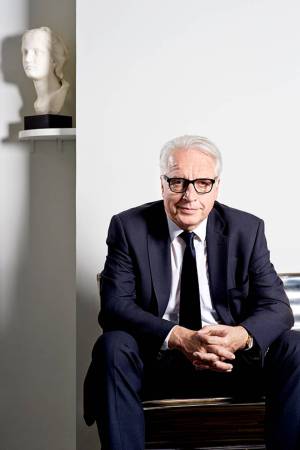
Martin Roth, © Victoria & Albert Museum, London.
Under his directorship, Martin has established the new Design, Architecture and Digital Department and spearheaded new and socially responsive programming, from the Disobedient Objects exhibition to the current Engineering Season. He has also forged many innovative new partnerships, not least with the Venice Biennale, World Economic Forum and International Olympic Committee. The Museum was recently awarded Art Fund Museum of the Year 2016, the biggest museum prize in the world, and praised for its “exceptional imagination, innovation and achievement across the previous 12 months.”
Martin Roth said: “It’s been an enormous privilege and tremendously exciting to lead this great museum, with its outstanding staff and collections, and I’m proud to have steered it to new successes and a period of growth and expansion, including new partnerships around the UK and internationally. Our recent accolade as Art Fund Museum of the Year feels like the perfect moment to draw to a close my mission in London and hand over to a new director to take the V&A forward to an exciting future.”
Nicholas Coleridge, Chairman of the Trustees of the V&A said: “Martin’s tenure as Director has been marked by a highly successful period of creativity, expansion and reorganisation of the V&A. He has made a significant contribution to the success of this museum, and the Trustees are immensely grateful for all that he has achieved here. We are now starting the process of looking
for someone to take on the role and are fortunate to have an exceptional team in place to lead its activities and help build its future with the new Director.”
Martin intends to devote more time to various international cultural consultancies and plans to spend more time with his wife Harriet and their children, in Berlin and Vancouver. The V&A’s Board of Trustees will now begin the search to find a new Director.










 Enfilade
leave a comment