Jonathan Bober Named Senior Curator of Prints and Drawing at NGA
Press release (6 May 2016) from the NGA:

Jonathan Bober in the prints and drawings study room at the National Gallery of Art, Washington (Photo by Division of Imaging and Visual Services)
Jonathan Bober has been named the National Gallery of Art’s Andrew W. Mellon Senior Curator of Prints and Drawings. Bober’s appointment becomes effective on October 1, 2016, when he succeeds Andrew Robison, who retires from the position on September 30, 2016. Bober will oversee the continuing work and growth of the Gallery’s three departments of prints and drawings that Robison cultivated and nurtured for more than 40 years.
“Jonathan Bober is a brilliant curator and connoisseur with an outstanding track record of exhibitions and publications, and a remarkable degree of knowledge about both prints and drawings,” said Earl A. Powell III, director, National Gallery of Art. “We are delighted that he is assuming this prestigious role in our curatorial ranks.”
Since 2011 Bober has served as curator and head of old master prints at the National Gallery of Art and has played a very active role across the institution, from key acquisitions to mentoring emerging scholars. Bober led the acquisition of some 2,000 prints by purchase, gift, and promised gift, most notably 18th-century Venetian and 19th-century Italian, making the Gallery’s holdings the most significant in the U.S. During his tenure at the Gallery, Bober organized four Gallery exhibitions: The Baroque Genius of Giovanni Benedetto Castiglione (2012), Northern Mannerist Prints from the Kainen Collection (2013), From Neoclassicism to Futurism: Italian Prints and Drawings, 1800–1925 (2014), and Recent Acquisitions of Italian Renaissance Prints: Ideas Made Flesh (2015). Since 2015, Bober has been the Gallery’s curatorial liaison to the Center for Advanced Study in the Visual Arts (CASVA).
The Gallery’s division of old master and modern prints and drawings, with nine curators, oversees one of the nation’s finest collections of works on paper. In total, the Gallery’s collection of prints, drawings, and illustrated books contains approximately 121,000 Western European and American works on paper and vellum dating from the 11th century to the present day.
Bober came to the Gallery in 2011 from the Blanton Museum at the University of Texas at Austin, where he served as a curator since 1987, first as curator of prints and drawings; from 1998 as curator of prints, drawings, and European painting; and from 2010 as senior curator of European art. Prior to his work at the Blanton Museum, he was curatorial associate in the print department of the Fogg Art Museum, Harvard University, from 1984 to 1987, where he completed his graduate work with Sydney Freedberg and Henri Zerner.
Over the course of Bober’s career his exhibitions and publications have focused on old master paintings and old master and modern prints and drawings. They include Luca Cambiaso, 1527–1585, the international loan exhibition of the paintings, drawings, and prints of Luca Cambiaso and his Genoese contemporaries, (co-organized with the Palazzo Ducale, Genoa; Austin, September 2006–January 2007, and Genoa, March–July 2007), and Capolavori della Suida-Manning Collection (co-organized with Giulio Bora, Museo Civico, Cremona, October 2001–April 2002). In addition to catalogs of the Italian drawings in the Fogg Art Museum (1988) and Blanton Museum (2001), and numerous exhibition catalogs at the Blanton, Bober is the author of many catalog essays and scholarly articles appearing in such periodicals as Master Drawings, The Burlington Magazine, and Arte Lombarda. These concern painting and drawing as well as printmaking in 16th- and 17th-century Milan, Cremona, Venice, and Genoa.
Bober acquired for the Blanton Museum 11,000 of its 18,000 works (most with private support), including the extraordinary Suida-Manning Collection of old master paintings and drawings, art critic Leo Steinberg’s extensive collection of old master prints, and many outstanding individual works in the field, including modern and contemporary. In addition to organizing exhibitions from the Blanton Museum’s collection, such as Prints of the Ancien Régime (1996) and The Language of Prints (2008), Bober maintained a rotation of prints and drawings from the permanent collection in seven dedicated galleries. He helped develop the design of the new Blanton Museum and oversaw the creation of a new center for prints and drawings, which opened in April 2006.
Andrew Robison joined the curatorial staff of the National Gallery of Art in 1974, becoming Senior Curator in 1983 and A. W. Mellon Senior Curator in 1991. Over four decades Robison has curated dozens of exhibitions on art from the 15th through the 20th centuries, especially drawings and prints by early German artists, Rembrandt, 18th-century Venetian artists, German expressionists, and Pablo Picasso, as well as the multimedia exhibitions Art for the Nation: Gifts in Honor of the 50th Anniversary of the National Gallery of Art (1991), The Glory of Venice: Art in the Eighteenth Century (1994–1995), Ernst Ludwig Kirchner: 1880–1938 (2003), and Albrecht Dürer: Master Drawings, Watercolors, and Prints from the Albertina (2013).
National Gallery of Denmark’s Plans for Digitizing Its Collection
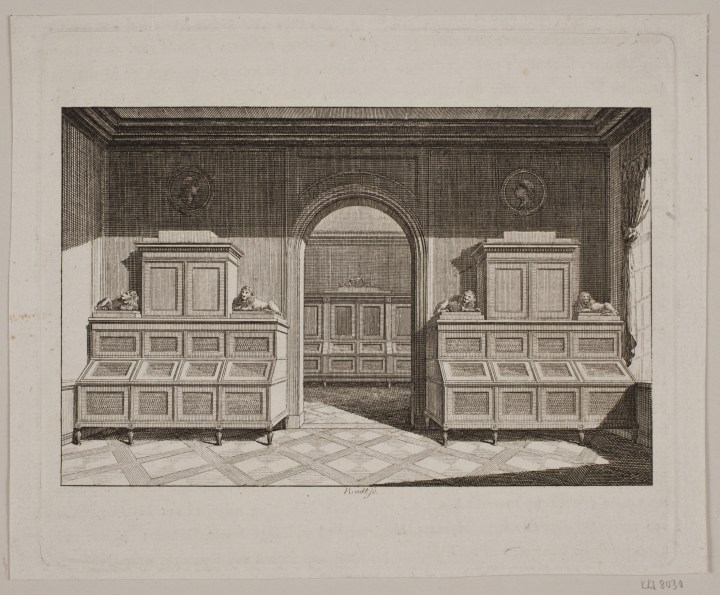
Frederik Ludvig Bradt (1747–1829), Coin Cabinet at Rosenborg, etching, 1791
(Copenhagen: SMK / The National Gallery of Denmark, KKS8030)
◊ ◊ ◊ ◊ ◊
As of today, a search of the SMK collection with the filter for 1700 to 1800 turns up 8204 works. From the press release (2 May 2016). . .
The SMK, The National Gallery of Denmark, launches a digital project that will, over the course of the next four years, make the National Gallery’s art collection freely available to everyone—for any purpose, ranging from fun to serious production. The objective is to make art relevant to more people. The project is made possible by a generous donation from the Nordea Foundation of DKK 11.7 million (EUR 1.6 million).
In countries such as The Netherlands, the USA and the UK, large museums have digitised their collections and made them available to everyone for years now, thereby endeavouring to meet the demands of present and future consumers of art and culture who are no longer satisfied with being spectators. They want to participate actively, and they want to put culture to use in their own lives. The lessons learned from these efforts are clear: being able to actively select, re-purpose, remix, and share works means that far more people access and use the collections. Including people who would not usually have visited or used the museum.
The SMK collection comprises more than 250,000 works of art. Approximately one per cent of that collection is on display and can be accessed by visitors to the museum in Copenhagen. In recent years the SMK has launched a range of pilot projects to explore how the museum’s digital treasures can be used in new ways, in new contexts and by all users. These initiatives have progressed by increments and been modest in scale, but the results have shown that there is demand for such activities. In fact, the findings proved so promising that the SMK will now, thanks to a generous donation of DKK 11.7 million (EUR 1.6 million) from the Nordea Foundation, embark on a new project: SMK Open. Scheduled to run until 2020, the SMK Open project will pave the way for truly democratic use of the museum’s art collections.
The history and many stories of art will continue to be explored and presented by the museum’s in-house experts. At the same time the SMK will open up its collection in digital form, offering a huge toolbox full of building blocks in the form of high-quality image files that can be used by anyone for any purpose—for example for books, education materials, online blogs, Wikipedia articles, film and TV productions, interior design and outdoor decoration—the only limit is the users’ imagination.
“SMK Open makes the National Gallery of Denmark’s art collection—which belongs to us all—available to anyone at all times. There will be no admission fee, but plenty of excellent and informative presentation materials and a warm invitation to have fun, play around and explore the wondrous world of art. The project will make even more people co-owners and co-producers of our shared art heritage,” says Henrik Lehmann Andersen, director of the Nordea Foundation, which aims to support and enhance ‘the good life’ for everyone.
The SMK Open project gives each work its own digital webpage that can also contain materials such as film footage, articles, audio tracks, x-rays of the work, and information on any future events or exhibitions at the museum which feature that work. In addition to this, thousands of photographs of art works will be made available in the highest possible resolution and quality. All works on which no copyright restrictions apply can be used by anyone for any purpose.
Users can also comment on each work, contribute their own information and insights or enter into a dialogue with the museum staff. Users are also invited to take part in the project’s development and will be involved in shaping and defining the end result right from the outset.
“In recent years we at the SMK have worked to offer many different gateways to the world of art. Our experience tells us that art becomes relevant to more people when they can approach it in their own way. Many wish to actively use art in their own lives. SMK Open will make it possible to download and use a wealth of information from the SMK toolbox—and at the same time we want to incorporate the users’ insights and information about the collection in that toolbox. This is because we want to forge closer links between our collection—which belongs to public—and the greatest possible number of people we can—of any age, gender, level of education and social or cultural background,” says Mikkel Bogh, director of the SMK.
Scottish NPG Acquires Ramsay’s Portrait of Bonnie Prince Charlie
On this day (16 April) in 1746, the armies of Charles Edward Stuart were defeated at Culloden. From the Scottish National Portrait Gallery:

Allan Ramsay, Portrait of Prince Charles Edward Stuart, 1745 (Scottish National Portrait Gallery)
A hugely significant portrait of Bonnie Prince Charlie by the greatest Scottish portrait painter of the eighteenth century has been acquired by the Scottish National Portrait Gallery thanks to the AIL (Acceptance in Lieu of Tax) Scheme.
Prince Charles Edward Stuart (1720–1788), later known as Bonnie Prince Charlie, was the Jacobite hero who sought to re-capture the British throne for the House of Stuart during the ill-fated Rising of 1745. He landed in Scotland on the 23rd of July, and marched to Edinburgh, defeating a government army at the Battle of Prestonpans. Charles then travelled south as far as Derbyshire, before returning to Scotland; his army was eventually crushed at the Battle of Culloden on the 16th of April 1746. The Jacobite cause was lost and he fled to exile.
This portrait is thought to have been created at Holyrood in Edinburgh during Bonnie Prince Charlie’s short time in the city at the height of the Rising, by the most accomplished Scottish portrait painter of the period, Allan Ramsay (1713–1784). Ramsay was born in Edinburgh, the son of a poet of the same name, and studied in London, Rome and Naples, before returning to Scotland in 1738. He worked for the grandest patrons both north and south of the border, creating a reputation for displaying great sensitivity to the characters of his sitters and masterly renderings of their clothes and poses in his paintings.
His portrait of Bonnie Prince Charlie is an accomplished early work, created when the sitter was 25 and the artist 32. Charles is depicted in half-length format, turning to confront the viewer directly. He wears a powdered wig, has a velvet robe fringed with ermine, and the blue riband and star of the Order of the Garter. The portrait was used as a prototype for painted and engraved versions, which were employed to promote the Jacobite cause.
Since the eighteenth century, the painting has formed part of a collection outside Edinburgh; it has come from the Wemyss Heirlooms Trust and was last exhibited in the city in 1946. Recently attention was drawn to its status by a BBC 2 Culture Show Special, presented by Dr. Bendor Grosvenor (22 February 2014). The painting will be displayed in Gallery 4 of the Scottish National Portrait Gallery as a centrepiece to the Gallery’s outstanding collection of Jacobite art which is one of the great strengths of the collection. The National Galleries of Scotland houses an unsurpassed collection of Ramsay’s drawings and paintings. The amount of tax settled by the acceptance of the portrait through the AIL system is £1,122,838.33.
Christopher Baker, Director of the Scottish National Portrait Gallery, commented “This meticulous and dashing portrait is a work of great historical resonance, which in a real sense has now come home, as it will be celebrated as a key work in the nation’s Jacobite collection and as such become widely accessible. We are immensely grateful to everyone who has made its transference to public ownership, through the AIL scheme, possible.”
Edward Harley, the Acceptance in Lieu Panel Chairman, noted “The Acceptance in Lieu Panel is pleased to have helped this iconic image of Bonnie Prince Charlie return to the city in which it was painted 270 years ago. It now takes its fitting place as one of the highlights of the great collection of the Scottish National Portrait Gallery where it can be enjoyed by all. This is indeed a unique moment in Scottish history.”
Royal Collection Trust Announces £37-Million ‘Future Programme’

Windsor Castle, Upper Ward Quadrangle panoramic view, with the State Entrance shown in the center (Wikimedia Commons: Diliff, 4 November 2006).
◊ ◊ ◊ ◊ ◊
For anyone who has ever been bewildered by the plan and circulation route at Windsor, this is excellent news! The State Apartments will make much more sense with the alignment of the visitor’s entrance and the State Entrance (pictured under the clock in the photo above). The project also serves as a useful reminder that the palace today looks like the ‘perfect’ medieval castle largely because of renovations undertaken by George III and even more so by George IV in the late eighteenth and early nineteenth centuries. –CH
Press release from The Royal Collection Trust (5 April 2016). . .
The Royal Collection Trust today announced a £37-million investment at Windsor Castle and the Palace of Holyroodhouse to fund a series of projects that will transform the experience of visitors. Collectively known as Future Programme, the projects will deliver significant improvements to the way visitors are welcomed on arrival, interpret the buildings in new ways, create dedicated Learning Centres and open up new spaces to the public. Work will begin on site in 2017 and is scheduled to be completed at the end of 2018. Both palaces will remain open to visitors throughout the development.
Windsor Castle and Holyroodhouse have been royal palaces since the 12th century and have welcomed visitors for hundreds of years. Today they are official residences of Her Majesty The Queen and in full use as the setting for State Visits, Investitures and Garden Parties. One and a half million people visit the palaces each year, enjoying these historic buildings and the great works of art from the Royal Collection.
At Windsor Castle, Future Programme will
• Increase public access to the ground floor of the State Apartments, incorporating the State Entrance into the visit and for the first time opening up the 14th-century Undercroft to the public as the Castle’s first café
• Reinstate the Castle’s Georgian Entrance Hall, creating a proper sense of arrival and linking the current visitor entrance on the North Terrace with the State Entrance on the south side of the Castle
• Introduce new interpretation and a choice of thematic routes through the State Apartments, replacing the current single, linear route
• Create a dedicated Learning Centre to enable more schoolchildren, families and adults to engage with the Palaces and Royal Collection first hand
At the Palace of Holyroodhouse, Future Programme will
• Introduce new interpretation in the State Apartments, exploring the rich history of the Palace, from its foundation by King David I in the 12th century and occupation by Mary, Queen of Scots and Bonnie Prince Charlie, to the role of the Palace today
• Introduce a new Family Room inside the Palace, and restore the interiors of the Abbey Strand buildings, just outside the Palace gates, creating a Learning Centre within them
• Include plans to make more of the Palace’s outside spaces, in partnership with Historic Environment Scotland, including the Abbey, the grounds and Forecourt, re-connecting the Palace to the city
Funded by The Royal Collection Trust from admissions to the official residences of The Queen and associated retail income, Future Programme is part of the continuing investment by the charity in the presentation and interpretation of the royal palaces and the Royal Collection. Future Programme is the most significant investment by The Trust since the creation of The Queen’s Galleries at Buckingham Palace and the Palace of Holyroodhouse, which opened to the public in 2002.
Today’s announcement coincides with the appointment of the architectural practices Purcell and Burd Haward Architects as the Lead Designers for Future Programme at Windsor Castle and the Palace of Holyroodhouse respectively.
Jonathan Marsden, Director, Royal Collection Trust, said, “Windsor Castle and the Palace of Holyroodhouse, Edinburgh’s royal palace, are two of the most important historic buildings in Britain and home to some of the greatest works of art. Future Programme represents an important investment to enhance everyone’s enjoyment of the Palaces and the Royal Collection and to deliver the best-possible experience of visiting these royal residences.”
Andrew Clark, Chairman, Purcell, said, “It is a great privilege to be appointed as Lead Designer for Future Programme at Windsor Castle. We are excited to be part of the work which will celebrate this royal residence, improve the presentation of the spectacular collections on display there, and transform the experience of visiting this wonderful historic building for the hundreds of thousands of people who do so each year.”
Catherine Burd, Director, Burd Haward Architects, said, “We are delighted to be appointed Lead Designer for Future Programme at the Palace of Holyroodhouse and to be working with Royal Collection Trust across a number of projects that will enable this hugely important building and the works of art on display there to be better understood and enjoyed by all.”
Sir Neil Cossons OBE, former Chairman, English Heritage and a member of the Master Plan Steering Group for Windsor Castle, said, “Windsor Castle is the most important—and perhaps best-known—secular building in England. Twenty years after the completion of the exemplary restoration work following the near-catastrophic fire in 1992, this new investment will introduce an outstanding programme of improvements to increase everyone’s understanding of the Castle and all that it represents as part of the nation’s history, and their enjoyment of the spectacular works of art from the Royal Collection.”
Ian Rankin OBE, author and a member of the Master Plan Steering Group for the Palace of Holyroodhouse, said, “As an Edinburgh resident and a visitor to the Palace of Holyroodhouse (often in the role of amateur guide for visiting friends), I am delighted that there are to be significant developments with the onus on education and information. This will prove invaluable, I hope, to visitors, no matter how much (or how little) they already know or think they know!”
Huntington’s American Art Galleries to Open in June and October
Press Release (24 March 2016) from The Huntington:

Portrait of a Woman with a Bowl of Cherries, ca. 1770–80, oil on panel, 28 × 23 × 2 1/2 in. (San Marino: The Huntington Library, Art Collections, and Botanical Gardens; Jonathan and Karin Fielding Collection; photo by Fredrik Nilsen)
The Huntington Library, Art Collections, and Botanical Gardens in San Marino, California announced today that its new 8,600 square-foot addition to the Virginia Steele Scott Galleries of American Art will open on October 22. Named after the lead donors for the $10.3 million building project, the Jonathan and Karin Fielding Wing includes 5,000 square feet of gallery space with an inaugural exhibition of more than 200 works from the Fieldings’ esteemed collection of 18th- and early19th-century American works—including paintings, furniture, and related decorative art—some of which are promised gifts to The Huntington. The exhibition will offer important insights into the world of American art practice and culture of the time.
“The collection, display, and contextualization of historical American art is among our chief priorities,” said Laura Skandera Trombley, president of The Huntington. “And the educational and inspirational value of the new wing is immeasurable. It will bring to light unforgettable works made with American originality, and is sure to delight and surprise visitors of all ages. We are profoundly grateful to Jonathan and Karin Fielding for their vision and generosity.”
In related news, the original portion of the Scott Galleries, which has been undergoing reconfiguration and reinstallation, will reopen on June 18. It will feature a new room highlighting works from the Gail-Oxford Collection, a recent bequest to The Huntington of 18th-century works of American decorative art; a redesigned Dorothy Collis Brown Wing displaying works by Arts and Crafts architects Charles and Henry Greene; sweeping, long sightlines across galleries; and improved visitor flow. Also opening in the original portion of the building on June 18 is a focused loan exhibition, Yasuhiro Ishimoto: Bilingual Photography and the Architecture of Greene & Greene in the Susan and Stephen Chandler Wing (on view through October 3).
Designed by Frederick Fisher and Partners, who also designed the Lois and Robert F. Erburu Gallery (a 2005 addition to the same building), the new Fielding Wing features eight new rooms for art display as well as a stately glass entrance and lobby on the south side of the building that mirrors those on the north side. The entrance, along with a reconfiguration of some of the rooms of the existing building, will improve visitor flow and make entering the galleries (that will total 26,000 square feet of display space) more inviting and intuitive. The new entry will draw visitors to the galleries naturally, with the glass lobby serving as a beacon from a popular path that leads through the Shakespeare Garden from the Huntington Art Gallery, where the renowned European art collection is displayed. In addition, the entry allows easy access to and from the historic Rose Garden Tea Room and Café. Frederick Fisher and Partners also are designing the inaugural exhibition. With this expansion of the Scott Galleries (the third since 2009), The Huntington will be the home of one of the largest displays of historic American art in the Western United States.
“While the Fieldings have been collecting American art for a relatively short time, they have developed a focused and important body of historical works,” said Kevin Salatino, Hannah and Russel Kully Director of the Art Collections at The Huntington. “We plan to highlight these in a creative installation that enhances their educational content as well as their powerful aesthetic qualities.”
With more than 700 examples of American painting, sculpture, furniture, ceramics, metal, needlework, and other related decorative arts, the Fieldings’ collection is widely regarded as one of the most significant of its kind in the United Sates. The initial display of works will be grouped variously by the function of the objects, the materials from which they are made, and through the themes that they embody.
In its rich diversity, the Fielding Collection offers a rare opportunity to explore early American history through objects made for daily use and through images of the everyday people who used them. Highlights of the collection include a rare painting on panel made about 1834 by Sheldon Peck (1797–1868) portraying Samuel and Eunice Judkins, residents of Ulster County, New York; a striking portrait of a woman with a bowl of cherries, painted on panel about 1770 to 1780; a high chest of drawers made about 1774 by the Connecticut-based Eliphalet Chapin (1741–1807); a Windsor low-back settee with distinctive steam-bent arm rail made in Lancaster County, Pa., between 1760 and 1780; a rare pair of needlework pockets from about 1775, used by a woman to carry sewing implements and other items; and a Connecticut tall-case clock, with richly painted decoration and wooden works, signed by Riley Whiting (1785–1835) and made in Windsor, Conn., between 1819 and about 1828.
Begun in earnest in 1979, when the Virginia Steele Scott Foundation of Pasadena made a major gift to The Huntington in memory of art collector, patron, and philanthropist Virginia Steele Scott (1905-1975), The Huntington’s collection of American art has grown from an initial 50 paintings to nearly 13,000 objects. Recent acquisitions include works by Milton Avery (1885-1965), Richard Estes (b. 1932), Sargent Claude Johnson (1888–1967), and Helen Lundeberg (1908–1999), as well as the Gail-Oxford Collection of 18th-century decorative art.
First opened in 1984 with 6,800 square feet of gallery space, the Scott Galleries were expanded to 16,300 square feet with the addition of the Lois and Robert F. Erburu Gallery and completely reinstalled in 2009 to cover the history of art in the United States from the colonial period to the mid-20th century. In July of 2014, The Huntington expanded the display of American art further by opening more than 5,000 feet of gallery space focusing on works of 20th-century art in an area previously used for storage.
Expansion Plans for The Frick Collection, Part II
Press release (24 March 2016) from The Frick:

The Frick Collection’s Fifth Avenue garden and facade, looking toward 70th St. (Photo: Galen Lee, The Frick Collection)
The Frick Collection announced that it is entering into the next phase of planning for the upgrade and enhancement of its facility, which encompasses a constellation of buildings, wings, and additions constructed between 1914 and 2011. Following the withdrawal of the 2014 design proposal and a subsequent period of extensive study, Frick leadership has developed a new approach to upgrading and expanding its facilities that enhances opportunities for intimate engagement with great works of art and preserves the Frick’s gardens. The ongoing planning includes the creation of new exhibition, programming, and conservation spaces within the institution’s built footprint.
As the next step in this process, the Frick is issuing a request for qualifications (RFQ) to select architectural firms, which are being invited to submit their credentials based on their relevant experience and expertise. The institution is planning to announce a finalist later this year and will work together with the selected architect to further define the expansion program, with initial designs expected to be unveiled in 2017.
Home to one of the world’s leading collections of fine and decorative arts, The Frick Collection is noted for the contemplative atmosphere of its galleries, which were previously the principal rooms of the private residence of Henry Clay Frick. It also houses the Frick Art Reference Library, one of the top five art historical research centers in the world. Although its collections, attendance, and public programs have grown significantly over the past decades, the Frick’s facilities have not undergone a significant upgrade since the 1970s. Many of the Frick’s critical functions are currently constrained—from the presentation, care, and conservation of its collections, to education programs and basic visitor services—having been retrofitted into spaces in and adjacent to the former residence.
The project will open to the public—for the first time—new areas of the historic Frick home, reorganize and upgrade existing spaces in the Frick’s buildings, and renovate underground facilities. It will create a more natural flow for visitors throughout the buildings, while enhancing and upgrading the behind-the scenes facilities to enable professional staff to work more efficiently and effectively. At the same time, the expansion will preserve the distinctively residential character and intimate scale of the house and its gardens, both those original to the residence and in more recent additions.
“We enter the next phase of our expansion process energized by the promise of an enhanced facility that will address the Frick’s urgent programmatic and museological needs, while ensuring that the institution will continue to do what it does best—provide intimate encounters with exceptional artworks in spaces designed for tranquil contemplation,” said Dr. Ian Wardropper, Director of The Frick Collection. “We look forward to developing a design that advances these goals and reflects our passion for preserving the unique character and qualities that define the Frick experience.”
The project will include:
• The opening to the public—for the first time—of a suite of rooms on the second floor of the historic house for use as exhibition galleries. Originally the private living quarters of the Frick family, these rooms will retain their residential scale and are uniquely suited to the presentation of small-scale objects from the Frick’s permanent collection.
• The creation of a new gallery within the 1935 building for the presentation of special exhibitions. This new space, contiguous to the permanent collection galleries on the main floor, will help to facilitate a dialogue between the Frick’s holdings and works in loan shows, and will enable the Frick to keep more of its permanent collection on view throughout the year.
• The creation of dedicated, purpose-built spaces to accommodate the Frick’s roster of educational and public programming, scaled to the institution’s programs and mission.
• The reconfiguration of existing visitor amenities to create more streamlined circulation, offer a clearer public connection between the museum and Frick Art Reference Library, and ensuring easy access for the Frick’s audiences, including those with disabilities.
• The establishment of state-of-the-art conservation spaces to ensure that the former house and the Frick’s esteemed art and research collections will continue to receive the highest caliber of professional care.
Further details on the enhancement and expansion plan, including square footage and project cost, will be determined together with the architectural team that is selected.
Originally constructed in 1913–14 by Carrère and Hastings, the Frick house has been expanded several times in response to the growth of its collections and the needs of the public. In the 1930s, architect John Russell Pope undertook the conversion of the family home into a public museum, nearly doubling its original size, and demolishing the adjoining library building that had been added in 1924 in order to construct a larger library to accommodate its growing collections. An additional expansion occurred in 1977, which included the creation of the 70th Street Garden. In 2011, the Portico Gallery was created by enclosing an existing loggia.
New Harley Gallery Showcases The Portland Collection
A new building at The Harley Gallery (Welbeck, Nottinghamshire) opens on Sunday to showcase The Portland Collection. . .
The Harley Gallery and Foundation is delighted to announce a new building which will display historic works from The Portland Collection, the historic fine and decorative arts collections of the Cavendish-Bentinck family. The family, currently headed by William Parente, grandson of the 7th Duke of Portland, have lived at Welbeck for over 400 years and through the generations have developed a beautiful and intriguing collection. The Portland Collection includes examples from some of the most highly regarded artists of each era.

George Stubbs, 3rd Duke of Portland, Welbeck Abbey, 1766 (The Portland Collection)
Hugh Broughton Architects were appointed to design the new building after a tightly fought architectural competition. The new building will consist of a glazed entrance pavilion and two gallery spaces, with a fresh new look for the courtyard itself. The main gallery spaces will be housed in a new structure, nestled between the Victorian walls. A top lit, barrel vaulted roof will filter light into the long gallery. A broad variety of pieces from the beautiful Portland Collection will be on show in a large gallery space.
The new building will be situated next to the existing Harley Gallery, within the walls of the Victorian Tan Gallop. Recently, this area has been used for storage. It was originally built as a covered area where the Welbeck Estate’s race horses could be trained in winter or poor weather. The name ‘Tan Gallop’ comes from the oak chippings that were used to cover the floor. By-products of the tanning process, these chippings were soft and provided a good surface for the horses to run on. A portion of the Tan Gallop, further away from The Harley Gallery, was converted into artists studios by the Harley Foundation in 1980.
Curatorial Advisory Panel
Karen Hearn, Honorary Professor, UCL
Alex Farquharson, Director, Nottingham Contemporary
Tim Knox, Director, The Fitzwilliam Museum
Hannah Obee, Curator, Chatsworth House Trust
Michael Hall, Architectural Historian and Journalist
Conference | Creating the Europe 1600–1815 Galleries at the V&A
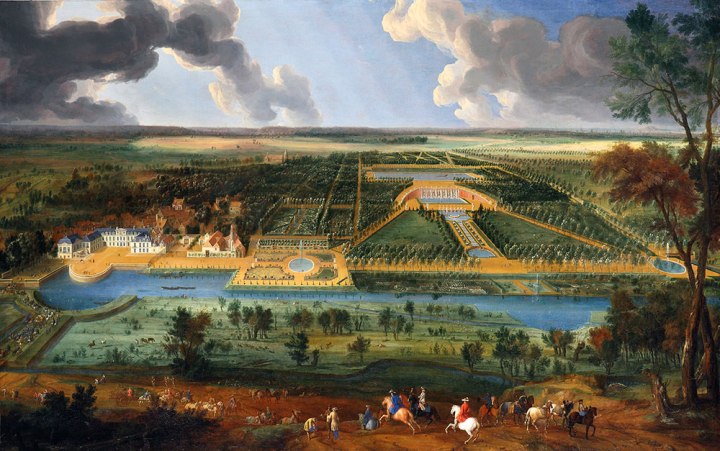
Pierre-Denis Martin, The Château de Juvisy,
165cm x 265cm, ca. 1700 (London: V&A)
◊ ◊ ◊ ◊ ◊
From H-ArtHist:
Creating the Europe 1600–1815 Galleries
Victoria and Albert Museum, London, 8 April 2016
This conference celebrates the opening of the V&A’s new Europe 1600–1815 Galleries. It will introduce some of the new patterns of living that laid the foundations for our modern world. The papers will be presented according to the three main themes that create a narrative structure for the displays and interpretation in the galleries: first, that, for the first time ever, Europeans systematically explored, exploited, and collected resources from Africa, Asia and the Americas in their art and design; second, that France took over from Italy as leader of fashion and art in the second half of the 17th century; and third, that ways of living came to resemble those we know today. The conference is supported by The Heritage Lottery Fund.
Booking information is available here»
◊ ◊ ◊ ◊ ◊
P R O G R A M M E
10.00 Registration
10.30 Welcome by Bill Sherman (Head of Collections and Research, V&A)
10.40 Session One: The Europe Galleries 1600–1815 at the V&A
• Why Does 17th- and 18th-century Europe Matter Now?, John Styles (Professor of History, University of Hertfordshire, Senior Research Fellow, V&A)
• Creating the Europe 1600–1815 Galleries, Lesley Miller (Lead Curator, Europe 1600–1815 Galleries, V&A) and Lucy Trench (Head of Interpretation, Science Museum, formerly Lead Educator, Europe 1600–1815 Galleries, V&A)
11.40 Session Two: Explored and Exploited
• A Global Context for Europe, Beverly Lemire (Henry Marshall Tory Chair, Department of History and Classics, University of Alberta)
• The Cabinet: Collecting Art and Science, Eric Jorink (Tylers Professor of Enlightenment and Religion, Leiden University and a Research Professor, Department of History of Science and Scholarship, Huygens Institute for the History of the Netherlands, The Hague)
• Displaying Spain and Spanish America, 1600–1720, Kirstin Kennedy (Curator of Metalwork, V&A)
13.15 Lunch
14:00 Session Three: The Rise of France
• The Invention of Comfort in the Modern City, Joan DeJean, (Trustee Professor of Romance Languages, University of Pennsylvania)
• Luxury and Shopping in the Long Eighteenth Century, Natacha Coquery (Professor of History, University of Lyon II; INHA, Paris)
• Displaying French Historical Interiors: La Tournerie and the Serilly Cabinet, Joanna Norman (Senior Curator, Research Department, V&A)
15.15 Refreshments
15:45 Session Four: Then and Now
• The Impact of the Enlightenment, Colin Jones (Professor of History, Queen Mary’s, University of London)
• Fashion in Print, Patrick Steorn (Director, Thielska Galleriet, Stockholm; participant in HERA Fashioning the Early Modern Research Project)
• Bringing Interactivity into the Galleries: The Masquerade, Dawn Hoskin and Nadine Langford (Assistant Curator and Assistant Educator, Europe 1600–1815, V&A)
16:45 Closing Remarks on V&A’s Approach to Gallery Development, Sofía Rodriguez Bernis (Director of Museo Nacional de Artes Decorativas, Madrid)
Snite Museum Acquires Early Portrait of Josephine de Beauharnais
Among the recent acquisitions at the Snite Museum of Art, University of Notre Dame:

Michel Garnier, Portrait of Josephine de Beauharnais, 1790, oil on mahogany panel, 12.75 x 10.5 inches (Snite Museum of Art, University of Notre Dame; gift of Michael and Susie McLoughlin, 2015.079)
This unusual portrait of Josephine de Beauharnais (1763–1814), the future wife of Napoleon Bonaparte and empress of France, joins depictions of other political figures in the Snite Museum’s collections. This may be the earliest known portrait of the young socialite, probably commissioned by her first husband Alexandre de Beauharnais.
Josephine was born to a plantation owner on the island of Martinique and married the governor’s son, who served as an officer in both the American Revolution and the French Revolutionary Army, in 1779. Running afoul of Robespierre, both Alexandre and Josephine were imprisoned during the Reign of Terror; Josephine alone escaped the guillotine. The widow with two children married Napoleon in 1796 but bore him no children. Concerned for the succession of the throne, Napoleon divorced her in 1809.
Painted on the occasion of the Fête de la Federation (the anniversary of the fall of the Bastille on July 14), the artist shows Josephine in an oval, à l’antique (in profile) against a fairly simple background dressed in a fashionable red, white, and blue ensemble that suggests her solidarity with the revolutionaries. During the festivities, she and her husband represented the Island of Martinique, signaled by her exotic headgear described as à la créole. Seventy years later this work served as a model for another painting made by the artist Hector Viger who used it as a source for his fictionalized scene of Josephine and their two children visiting Alexandre in the Luxembourg prison.
Exhibition | Scots in Italy: Artists and Adventurers
Press release, via Art Daily, for the exhibition now on view at the Scottish National Portrait Gallery:
Scots in Italy: Artists and Adventurers
Scottish National Portrait Gallery, Edinburgh, 5 March 2016 — 3 March 2019
Curated by Lucinda Lax
An enthralling new exhibition set to open at the Scottish National Portrait Gallery this spring will highlight Scotland’s fascination with Italy during the eighteenth century. Featuring a selection of stunning works from across the National Galleries of Scotland’s collection, Scots in Italy: Artists and Adventurers will bring to life the experiences of the numerous individuals who travelled in pursuit of the unique cultural and professional opportunities that the experience of Italian life and art offered over this period. A series of paintings, sculptures, drawings and prints will show the impact the journey made on scores of Scots, documenting their experiences and charting their influence, both in Italy and in Scotland.

Gavin Hamilton, Portrait of Douglas Hamilton, 8th Duke of Hamilton and 5th Duke of Brandon, with Dr John Moore and Sir John Moore as a Young Boy, 1775–77 (Edinburgh: Scottish National Portrait Gallery)
Celebrated as the centre of classical and modern European civilisation, Italy’s matchless heritage made it the foremost destination for lovers of art and architecture, history and literature. Artists and architects came to hone their skills in the studios and academies of Rome, Florence and Naples. Wealthy young aristocrats refined their manners and broadened their minds in the hope of preparing themselves for life in high society and government. Adventurers and loyalists—intent upon seeing a Jacobite restoration—flocked to the court of the exiled Stuart monarchy in Rome. Dealers and entrepreneurs, meanwhile, exploited a seemingly endless supply of artistic treasures.
Scots in Italy will focus on the striking Scottish personalities who played a key role in the cultural life of the two countries, and especially on their activities in the great cities of Rome and Naples. They included the painter Gavin Hamilton (1730–1803), who helped launch a revolutionary new artistic style, neo-classicism, that would soon spread across Europe; James Byres (1733–1817) of Tonley, who became the leading expert on the art and antiquities of Rome; Sir William Hamilton (1730–1803), a diplomat, collector and patron of the arts who was a central figure in the social and cultural life of Naples; and Robert Adam (1728–92), the leading Scottish architect, whose experience of ancient Roman architecture would help him transform the appearance of the Scottish capital.

Nathaniel Dance, Portrait of Angelica Kauffmann, watercolour, ca. 1764–66 (Edinburgh: Scottish National Portrait Gallery)
In addition, it reveals the close social, personal and professional networks that emerged around these key figures. Bonded by common loyalties, experiences and family connections, the Scots who travelled to Italy in this period formed a remarkably tight-knit and supportive group. Among the highlights of the exhibition will be some of the most stylish and striking images from the National Galleries’ rich collections of eighteenth-century paintings, sculptures, prints and drawings. Key examples include Gavin Hamilton’s outstanding portrait of Douglas Hamilton, 8th Duke of Hamilton and 5th Duke of Brandon with his tutor, Dr John Moore, and Moore’s son. Painted in Rome in 1775–77, it is one of the artist’s most important works. Brilliantly evoking its three sitters and their shared interest in the classical past, it shows the elegantly poised young duke at its centre, while Dr Moore gestures to the ancient ruins of the Roman Forum and the Temple of Concord. The duke, the artist implies, is not simply in Rome for pleasure, but to learn the lessons of history.
Also on show will be Pompeo Batoni’s magnificent full-length portrait of the 4th Duke of Gordon. Commissioned by the sitter during his visit to Rome of 1762–63, it is one of the finest portraits commissioned by a Scottish traveller from an Italian painter of the period. Other major works on display include Andrea Soldi’s depiction of the great Italian-trained Scottish architect, James Gibbs, standing before his most important commission, the Radcliffe Camera in Oxford; Franciszek Smuglevicz’s portrait of James Byres and his family, painted in Rome in the late 1770s; Domenico Corvi’s portrait of Scottish artist David Allan, who is shown painting from a cast of the Borghese Gladiator; and Paolo Monaldi’s spectacular view of the Palazzo del Re and the celebrations held to mark Henry Benedict’s appointment as a cardinal deacon in July 1747.
The exhibition has been curated by Dr Lucinda Lax, Senior Curator of Eighteenth-Century Collections at the Scottish National Portrait Gallery, where she is responsible for researching and presenting the Gallery’s outstanding collection of portraits between 1700 and 1830.










 Enfilade
leave a comment