LACMA’s New Vicente Albán Paintings

Vicente Albán, Indian Woman in Special Attire (India en traje de gala), ca. 1783, Los Angeles County Museum of Art, purchased with funds provided by the Bernard and Edith Lewin Collection of Mexican Art Deaccession Fund.
◊ ◊ ◊ ◊ ◊
From LACMA’s Unframed (28 January 2015) . . .
LACMA’s New Vicente Albán Paintings from Ecuador Now on View
Ilona Katzew, Curator and Department Head, Latin American Art
Back in 1996, when I organized my first exhibition of Spanish colonial art in New York City, I included a group of fascinating works portraying racial types from Ecuador. The paintings were part of a set of six canvases, four of which had just been acquired by a private collector. The whereabouts of the two missing canvases was at the time unknown. Inscribed with the numeral 1 in the lower center, it was clear that this set was the first of two. The other series (bearing the numeral 2) is now in the Museo de América in Madrid and was shipped to Spain’s Royal Cabinet of Natural History in the late 18th century. It is signed by the Quito master Vicente Albán (active 1767–96). LACMA’s recent acquisition of the two missing paintings from the first set is thrilling. What makes these paintings exceptional? To start, there were only two sets created of Ecuadorean racial types (in contrast to the over 120 sets of the popular Mexican casta paintings that I have identified to date). Striking for their meticulous portrayal of local bounty and combination of indigenous and European textiles and jewels, the works are also eloquent documents of the Hispanic Enlightenment.

Vicente Albán, Noble Woman with Her Black Slave (Sra. principal con su negra esclava), ca. 1783, Los Angeles County Museum of Art, purchased with funds provided by the Bernard and Edith Lewin Collection of Mexican Art Deaccession Fund.
In Noble Woman with Her Black Slave, the white (or Spanish) woman wears an array of exquisite textiles, a string of pearls, and other jewels such as a gold crucifix and oval reliquary to signal that she is Catholic (and hence ‘civilized’). Her black slave (a conventional status symbol) is more modestly, if still lavishly, bedecked and is depicted barefoot. Worth noting are the ‘black’ flowers of the noblewoman’s skirt and hat. Scientific analysis has shown that they were originally painted in silver—a feature that would have bolstered the image of the colony as a land of unsurpassable riches. Though now irreversibly tarnished, it is not hard to imagine the impact that the painting once caused, peppered with abundant touches of gold and silver.
In Indian Woman in Special Attire, ancient indigenous costume elements—including a tupu (metal pin) fastening her lliclla (shoulder mantle), a belt with tocapus (geometric motifs associated with rank), which was an essential part of a coya, or queen’s dress, and a small chu’spa (a bag to carry coca leaves that gave energy and staved off hunger)—are combined with elements of European dress, such as the lavishly ornamented lace collar and sleeves of her blouse. Noticeable, too, is the black fabric laid over her skirt, fastened with a black sash. The X-radiograph clearly shows the large-sized pin, which is difficult to see due to the tarnishing of the metallic silver paint. It also reveals a delicate herringbone pattern on the woman’s mantle, now virtually undetectable to the naked eye. The pattern may suggest that this is a textile type known as tornasol (literally meaning ‘turns to the sun’). These shimmering silk fabrics were highly coveted in Europe and favored by the Spanish nobility. Colonial Andean weavers skillfully adapted them to their ancient textile traditions by combining a dark fiber warp (usually made of alpaca) and brighter contrasting weft (commonly silk). When the fabrics moved, they caught the light and created a glimmering two-tone effect. Contemporaneous travelers described this kind of pleated mantle as a distinct costume element worn by noble Indians.
One of the most salient elements of the paintings is the gigantic fruit placed next to the figures, making an explicit connection between the region’s inhabitants and its flora. The works convey a sense of American nature as extravagantly fertile. In Europe there existed the widespread idea that the Americas were an unusually hot place where nature and people—regardless of their racial makeup—ripened and spoiled quickly. These paintings counter such notion by representing local types from Ecuador dressed in lavish clothing and standing next to an assortment of giant tropical fruits, emphasizing the abundance of the land. An elaborate key in the lower section describes the trees and fruits, directing the viewer to selected parts of the canvases. This technology of production and reception of meaning was amply used in New World pictures (though it was by no means exclusive to it) to render ‘difference’ clear, transmit specific information, and reinforce the overall efficacy of messages.
Several scholars have linked the set at the Museo de América in Madrid with the Spanish botanist José Celestino Mutis (1732–1808), who led an important royal-sponsored expedition to the viceroyalty of Nueva Granada (1783–1816), and produced thousands of images of the region’s flora. (Nueva Granada refers to the Spanish colonial jurisdiction in northern South America, corresponding mainly to modern Colombia, Ecuador, Panama, and Venezuela.) This would explain the equal emphasis lavished on the racial types of the region and the precise botanical renditions that show both the exterior and the interior of local fruits. Throughout the 18th century, the Spanish Crown sponsored a number of expeditions to the Americas to gain better knowledge of their natural resources and exploit them for commercial ends. The production of images became an inherent part of these Enlightenment-era imperial taxonomic projects.
Despite the scant information about Vicente Albán (who signed the Madrid set), we know that he often collaborated with his brother, Francisco (1742–88), and that they both were regarded among the most prominent Quito painters of the day. Mutis may have commissioned Vicente to paint the Madrid set as a gift for Madrid’s Royal Natural History Cabinet, which was established in 1771. LACMA’s paintings, which are not signed, are very similar to the works in Madrid. But they also present intriguing formal and stylistic differences. The Madrid set, for example, is painted more freely and possibly by more than one hand, suggesting that it was created with workshop assistance. The figures in the LACMA pictures, on the other hand, seem to sit better in space and are more restrained in their handling of details (check back next week on Unframed to read more about the conservation process of these paintings). It is likely that Mutis also commissioned the set to which LACMA’s paintings belong as a gift for another important patron who supported his expedition. It is important to keep in mind, however, that LACMA’s set also could have been commissioned by another Enlightened royal functionary that remains unidentified. Commissioning replicas was part and parcel of the culture of image making at the time, and it was not uncommon among Spanish functionaries to request copies of the same image. In addition, artists often copied their own paintings, which had an important place in their workshops. Rich in detail, these two extraordinary pictures add an important dimension to our collection of viceregal art. A more complete study of the works will soon be published in a handbook of LACMA’s growing Spanish colonial collection.
The Prado Acquires the Juan Bordes Library
Press release (27 January 2015) from the Prado:

Trattato della Pittura di Leonardo da Vinci . . . di Stefano della Bella (Florence, 1792).
The Museo del Prado is providing detailed information on the content of one of its most recent acquisitions: the Juan Bordes Library. This is one of the most important bibliographical holdings in the world for the study of the human figure, consisting of treatises and drawing manuals from the 16th to the 20th centuries. Within this acquisition, the Museum has received as a donation a sketchbook by the studio of Rubens. It is currently considered the closest to the lost original by the master and also includes two original works by his hand.
The Juan Bordes Library is a unique example of a bibliographical holding specialised in the key areas within artists’ training and the theory of the human figure. Comprising around 600 volumes assembled by Bordes, the library focuses on texts and manuscripts that were used in the training of artists from the 16th to the 20th centuries. Due to their functional nature, these texts have not in the past merited the attention of bibliophiles or art historians. As Gombrich noted in his book Art and Illusion: “it is no mere paradox to say that the rarity of these books in our libraries is symptomatic of their past importance. They were simply, used, torn and handled in workshops and studios, and even surviving ones are often poorly bound and incomplete.” As a result, these manuals and treatises constitute an extremely valuable holding for a knowledge of the methods employed in the training of artists and amateurs in studios and academies. They also tell us about the evolution of aesthetics and the dissemination of artistic models.
 The Bordes Library is structured into six large sections, organised to reflect the key disciplines in an artist’s training, in addition to a group of manuscripts of different types, notably the sketchbook by Rubens received as a donation. The importance of this library is reflected in Juan Bordes’s own 2003 book, Historia de las teorías de la figura humana. El dibujo, la anatomía, la proporción, la fisionomía (History of the Theories of the Human Figure: Drawing, Anatomy, Proportion and Physiognomy), in which he studied the function and history of these books and their role and significance in artists’ training.
This bibliographic holding now joins other specialist libraries acquired by the Prado in recent years: the Cervelló Library, specialising in art theory and celebrations; the Correa Library, which focuses on the art of printmaking and the illustrated book; the Madrazo Library, an example of a library belonging to a dynasty of artists; the libraries of José Álvarez Lopera and Julian Gallego, which are characteristics libraries of art historians who primarily specialised in Spanish art; and the library of Félix de Azúa, centred on aesthetics and the philosophy of art. Through this strategy of acquiring specialist libraries, the Museo del Prado is not only helping to preserve the Spanish bibliographical heritage but also to provide its Study Centre with the research tools necessary for fulfilling its primary mission.
◊ ◊ ◊ ◊ ◊
S T R U C T U R E O F T H E B O R D E S L I B R A R Y
1. Drawing Manuals
This is undoubtedly one of the most important and valuable areas within the Bordes Library, both for the number of items and their rarity. The eminently functional nature of these manuals means that very few of them survived, on occasions only as single copies. Given that they were copied or republished in response to the different requirements of each moment, on many occasions they varied from one edition to another, so that each surviving copy is now almost unique. As a whole this group is extremely important as the study of it will reveal not only differences in the way of teaching drawing at different historical periods but also the models selected,thus reflecting taste of the time. It can be said that this group represents the systematic assembly of the largest surviving group of drawing manuals. Among its contents are three of the founding texts of this type by Fialetti, Cousin and Carracci, as well as examples of the most important ones from later centuries by Rubens, Ribera, Bloemaert etc.
2. Artistic Anatomies
Combining scientific knowledge and art, from Vesalius’s pioneering text onwards, treatises on anatomy reveal the key role of the study of the human figure in artists’ training. Together with life drawing and the copying of plaster casts, the study of anatomy through printed treatises, with particular attention to the study of bones and muscles, was one of the basic principles of an artist’s training. The increasing availability of images in the 19th century made high quality visual media available to students, encouraging a naturalistic approach to the representation of the human body in art. The Bordes Library is particularly rich in treatises from that century, copiously illustrated and with colour assuming a key role. Their relationship with the art of their time is striking, as evident, for example,in the numerous drawings by José Madrazo in the Prado’s collection. Particularly important was the interest in “anatomising classical sculptures,” in other words, anatomical models based on the great paradigms of classical sculpture, once again indicating the close links between science and art.
3. Proportion
As Michelangelo noted, having a compass in one’s eye for constructing harmonious, well-proportioned figures was one of the basic principles of artistic creation. Since Alberti and Dürer’s fundamental treatises, the quest for ideal human proportions within the variety of the human body has been an ongoing interest of artists, evolving in parallel to aesthetic changes. As a result, over the course of the centuries numerous treatises were published that offered artists a repertoire of proportions, either of real human models or of classical sculptures, determining the principles that should govern the construction of the human figure. Although fewer in number than the works in the previous sections, the Bordes Library has examples from different periods and centres, ranging from the 17th to the 20th centuries and from Europe to South America. These texts reveal the spread of a teaching model based on mathematics.
4. Physiognomy
Facial expressions were the subject of the fourth area of an artist’s training. Starting in the Renaissance with Della Porta’s Della Fisionomia dell’ Huomo, followed by the works of Le Brun and Lavater (also represented in this library by a manuscript) and concluding with 19th-century treatises such as Duchenne’s, physiognomy has been a subject of interest both to artists and writers. The Bordes Library contains a notable group of these works, with the principal authors represented by several different editions, allowing for an understanding of the evolution of artistic concerns.
5. Treatises on Painting and Drawing
Complementing the four fundamental areas outlined above, the Bordes Library also has treatises on the practice of drawing and painting, in which these disciplines are related to anatomy, proportion and physiognomy. These varied treatises were widely disseminated and of enormous theoretical importance. Leonardo, Alberti and Hogarth are among the authors represented in different editions. In other cases these treatises, published in different European countries, have hardly been the subject of study, although they must have provided the theoretical bases for many artists. The importance placed on art theory in recent years means that not only the major treatises but other works represented by fine copies in the Bordes Library are of enormous scholarly value.
6. Iconography
Repertoires of portraits and works of art, both paintings and sculptures, make up the smallest section within the library although one that represents a type of publication which was widely disseminated in the past. The fact that repertoires of this type were normally costly, large-format publications and thus not within the reach of all artists led Juan Bordes to focus on books which were more accessible to them, normally in small format and simply illustrated. Nonetheless, the library contains notable examples of visual repertoires, including Perrier’s on classical sculpture and Padre Nadal’s Imágines de la Historia Evangélica, which was exceptionally important for the dissemination of Counter-Reformation models.
7. Manuscripts
The Bordes Library includes a small but exceptional group of manuscript treaties. They are of equal rarity to many of the manuals referred to in the first section and can be classified into two principal groups: manuscripts that constitute the original of a subsequently published or unpublished text (Lavater and his treatise on physiognomy), and those that take the form of notebooks made in the context of the artist’s studio, copying sketches or other notebooks by the master.
Outstanding among them is the above-mentioned notebook by Rubens, known as the Bordes Manuscript. This is a remarkably important example as it constitutes the first proof of the existence of a lost notebook by Rubens in which he set out his ideas on anatomy, proportion, symmetry, optics, architecture and physiognomy and also made numerous drawings. The Bordes Manuscript is the most important of the four known copies, given that in addition to being a direct copy of the original it contains two drawings by Rubens himself. The Museo del Prado houses the largest and finest collection of paintings by Rubens.
London’s Guildhall Art Gallery Reopens with New Installations

The London Guildhall, photo from Wikimedia Commons, 2014.
◊ ◊ ◊ ◊ ◊
From Chloé Nelkin Consulting:
Guildhall Art Gallery has undergone a transformational rehang for the first time in 15 years [opening Friday, 16 January 2015]. Many of the works have never been on show before. In the Victorian display alone, 70% of works represent a completely new curatorial selection; through imaginative use of space, the overall number of paintings on show has been doubled.
This £600,000 renovation project will improve visitor experience with a new state-of-the-art lighting system and more flexible exhibition spaces. As well as more paintings and new lighting, the choice of Aesthetic Movement green as the new wall colour enhances the period feel of the space and the impact of the individual artworks.
The new thematic rehang comprises a radical redisplay of the Victorian Gallery as well as sections on ‘City of London: Plenty and Progress’, ‘Picturing London: 400 Years’, and ‘Landscapes of Sir Matthew Smith’.
By introducing focused thematic displays on everyday subjects such as the home, work and leisure the rehang challenges preconceptions about Victorian art being ‘dated’ and actively seeks to engage modern viewers. The paintings highlight how many aspects of our lives today originate in the Victorian times, for example outdoor recreation such as sports and public parks, affordable home decoration, or office work. The rehang of the Victorian works also demonstrates how the approach to fine art fundamentally changed in the 19th century, with artists turning to the depiction of contemporary life as their main inspiration.
Julia Dudkiewicz, Principal Curator of Guildhall Art Gallery, says “The rehang has been a labour of love and it has been a great privilege to work with such outstanding and internationally significant collections. The Guildhall Art Gallery is a real hidden gem in the heart of the City. It was one of the first public galleries in London, predating Tate Britain by 15 years, and today houses one of the largest and best collections of Victorian art in the world.”
Guildhall Art Gallery, housed in a purpose-built space designed by Richard Gilbert Scott, showcases the extensive art treasures of the City of London Corporation, spanning 400 years of collecting and numbering some 4,500 works. The new ‘City of London: Plenty and Progress’ display will offer an introduction to the City of London Corporation, exploring the often controversial themes of money, commerce and capitalism, with a combination of contemporary and historic works by artists as diverse as William Hogarth, William Logsdail, Ken Howard, and Mark Titchner.
David Pearson, the City of London’s Director of Culture, Heritage and Libraries, said: “As the relaunch is progressing, everyone in the City of London Corporation has been amazed and delighted with the ongoing results. The new colour scheme, and the paintings being seen for the first time in many years, will really transform the display of a collection which is a key part of City heritage. Whether you are an old friend of the Gallery, or have not been before, make sure you come to see it!”
The rehang has been conceived and developed by Julia Dudkiewicz, working with Exhibitions Curator Katty Pearce. The new interpretation and branding has been developed in close collaboration with Crescent Lodge Design, and aims to enhance creative learning opportunities at the Gallery, by introducing original ‘icon’ designs, text panels and new captions.
◊ ◊ ◊ ◊ ◊

Guildhall Art Gallery, relaunch, 2014. ©Sam Roberts for the Guildhall Art Gallery. Pictured is John Singleton Copley’s Defeat of the Floating Batteries at Gibraltar, with General Sir George Eliott on horseback pointing to the battle between the British and the Spanish land and sea forces, 1783–1791.
◊ ◊ ◊ ◊ ◊
From the Guildhall Art Gallery:
In 1670, the Court of Aldermen commissioned twenty-two paintings to hang in their newly restored Guildhall. These were portraits of the Fire Judges; men who had been appointed to assess compensation claims after the Great Fire of London in 1666. The Corporation of London’s art collection grew from this initial commission and now numbers approximately 4,500 works of art. Twenty of the Fire Judges’ portraits were damaged in December 1940 when the gallery was bombed during a World War II air raid. Two survived, and you can see the portrait of Sir Hugh Wyndham on display in the galleries today.
The Corporation continued to commission and purchase early portraits of royalty and individual benefactors of the City of London. Surviving works include portraits of William III and Queen Mary (1690) by the Dutch painter Jan van der Vaardt and portraits of George II and Queen Caroline (1727) by Jervas. The collections have since been shaped by bequests from individuals, as described below, as well as acquisitions of new material. The Gallery’s first Director, the dynamic Sir Alfred Temple, developed its popular collection of Victorian paintings. Crowds gathered to see Temple’s groundbreaking loan exhibitions, filling Guildhall Yard and forming a queue “reaching… almost to the Bank of England.” Since the Second World War, the Gallery has concentrated on expanding its unique collection of London pictures. . .
Search the collection here»
Rebecca Long Appointed Curator at the Art Institute of Chicago

◊ ◊ ◊ ◊ ◊
From the press release (9 January 2015) . . .
The Art Institute of Chicago announces the appointment of Rebecca Long as the Patrick G. and Shirley W. Ryan Associate Curator in the Department of Medieval to Modern European Painting and Sculpture. She will be responsible for Italian and Spanish painting and sculpture before 1750.
A specialist in the art of 16th- and 17th-century Spain and Italy, Long is currently Associate Curator of European Painting and Sculpture before 1800 at the Indianapolis Museum of Art. There she spearheaded work on the forthcoming catalogue of the museum’s Clowes Collection, offering the first scholarly and technical analysis of that important collection of masterworks of the Italian, Spanish, Netherlandish and German schools. She will assume her Art Institute duties on February 27, 2015.
“We are delighted to welcome Rebecca to the Art Institute,” said Sylvain Bellenger, Searle Chair and Curator, Medieval to Modern European Painting and Sculpture. “She is not just a scholar; she enjoys sharing her knowledge and passion to reveal the freshness in a work of art and to enlighten our diverse audiences, one of the museum’s key missions. Every Old Master was once a contemporary artist. Rebecca approaches the art of the Italian Renaissance with the aim of awakening for us the energy and immediacy the works held for the patrons and creators of their time.”
Long will be receiving her Ph.D. from New York University’s Institute of Fine Arts in early 2015, with a dissertation on Bartolomé Carducho and the role of Italian artists in the Spanish court during the Renaissance. She received her M.A. in art history and archaeology from New York University and her B.A. (magna cum laude), in the history of art and architecture as well as business administration, from the University of Pittsburgh. She has been awarded multiple prestigious fellowships, including those at the Metropolitan Museum of Art, the Villa La Pietra in Florence, and, most recently, the Harvard University Center for Italian Renaissance Studies at the Villa I Tatti, also in Florence. Long has actively presented her research at such venues as the National Gallery of Art’s Center for Advanced Studies in the Visual Arts and the annual conferences of the College Art Association, the Renaissance Society of America, and the Sixteenth Century Society. Forthcoming publications include the Catalogue of the Clowes Collection at the Indianapolis Museum of Art and essays in After Trent: Rethinking Art around 1600 and Sobre Vicente Carducho: Diálogos de la Pintura.
“I am thrilled to be joining the Art Institute,” said Long. “For a curator, the opportunity to work in a museum environment that combines a strong commitment to scholarship with an equal commitment to engaging visitors is a dream come true. I look forward to getting to work.”
Historic New England’s Wallpaper Collection Now Available Digitally
◊ ◊ ◊ ◊ ◊
Press release via Art Daily (29 December 2014). . .
Thanks in part to a grant from the Institute of Museum and Library Services, Historic New England announces the completion of a digitization project that makes its extensive wallpaper collection more accessible. For the past two years, Historic New England has been cataloguing and digitizing its wallpaper collection. Now, more than 6,000 samples have been electronically catalogued and are available at WallpaperHistory.org. The collection includes rolled, flat, oversize, and three-dimensional materials, which each require unique handling and digitization methods.
The project makes accessible a collection that spans three centuries and ranges from very early imported items to William Morris designs to vinyl wallpapers from mid-1960s. The entire Waterhouse Archive of Historic Wallpapers has been newly catalogued and digitized, and there are upgrades and a redesign to 4,800 additional records that improve image quality and data content.
“Now the collection is searchable by date, location, and manufacturer, and by keywords like color and type of pattern”, says cataloguer Peggy Wishart. “You can zoom in to see every detail.”
Historic New England extensive wallpaper collection contains individual samples, historic photographs of wallpaper in situ, and ephemera dealing with the wallpaper industry. The wallpapers range from pristine examples with complete repeats to small fragments that are part of a sequence in a particular room and also includes scrapbooks, borders, bandboxes, fireboards, and scenic panels, many of which are accessible online for the first time. Historic New England is the oldest, largest, and most comprehensive regional heritage organization in the nation. We bring history to life while preserving the past for everyone interested in exploring the New England experience from the seventeenth century to today. Historic New England owns and operates thirty-six historic homes and landscapes spanning five states. We share the region’s history through vast collections, publications, programs, museum properties, archives, and family stories that document more than 400 years of life in New England.
More information is available here»
Early Flight Collection Lands at the National Air and Space Museum

Miniature watercolor painting of a balloon over a French military camp, ca.1794 (Smithsonian Institution: Evelyn Way Kendall Ballooning and Early Aviation Collection, NASM2014-06559)
◊ ◊ ◊ ◊ ◊
Press release (19 December 2014) from The Smithsonian:
The Smithsonian’s National Air and Space Museum has acquired the Evelyn Way Kendall Ballooning and Early Aviation Collection. The collection has more than a thousand works of art, prints, objects, books, photos, and manuscript materials documenting the history of flight from the late 18th to the early 20th century, most of which have never been exhibited. This rare collection was donated to the museum by the Norfolk Charitable Trust.
The sight of the first colorful balloons rising into the air in 1783 generated an unprecedented wave of excitement across Europe. Tens of thousands of spectators crowded the streets of Paris to catch a glimpse of human beings in flight. Due to this excitement, people flocked to print shops to obtain images of the balloons and the men and women who flew them, and consumers rushed to buy memorabilia featuring balloon motifs.
Beginning in the 1920s, Evelyn Way Kendall (1893–1979), the wife of textile manufacturer Henry P. Kendall, began to search antique shops and auction catalogs on two continents for items commemorating the birth of flight. By the 1960s, she had built one of the largest, most diverse and comprehensive collections of historic art and artifacts documenting the birth of the air age in private hands. Highlights of the collection include oil-and-water color paintings of balloon flights in Europe, America and Japan. More than 400 historic prints and engravings depict early flights and the men and women who first braved the skies. Other treasures include 18th-century miniature paintings of the first balloon flights on a variety of small objects; delicately painted ladies fans created in Paris before the French Revolution; a large oil painting showing T. S. C. Lowe’s Civil War balloon equipment during the Peninsula Campaign of 1862; a colorful hatbox covered in wallpaper commemorating a balloon flight from Cincinnati in 1835; and scrapbooks filled with newspaper clippings chronicling the history of ballooning from the 1780s to the 1890s.
The Ontario-born Kendall and her husband, world-class collectors with broad interests, have donated other collections of art, artifacts and manuscripts to the Royal Ontario Museum, the University of South Carolina and the New Bedford Whaling Museum. With the support of the Norfolk Charitable Trust, work is underway at the museum to catalog and conserve the collection. Plans for exhibition of the collection are underway but a definitive date has not been determined.
“We look forward to sharing the riches of the Kendall Collection with the millions of visitors who pass through the doors of the museum each year,” said Tom Crouch, the museum’s senior curator of aeronautics. “It will enable us to present the story of the birth of flight through objects that communicate the sense of wonder that inspired those who witnessed those first forays into the air.”
Louvre Aims to Purchase the Teschen Table
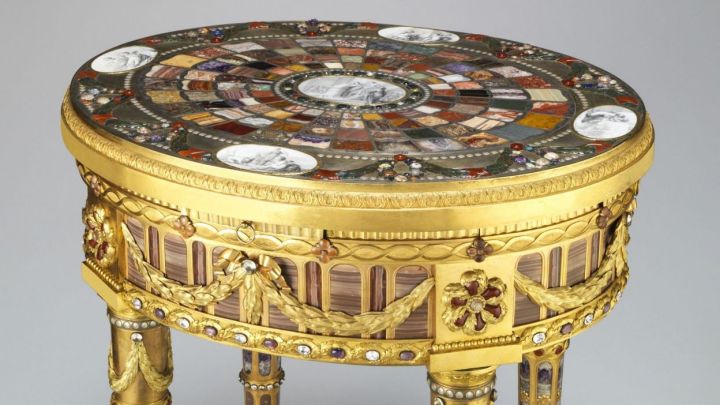
Johann Christian Neuber, Teschen Table, 1779, H. 81.5 cm; W. of tabletop: 70.5 cm, wooden core clad with gilt bronze, hardstones, Saxony porcelain (Photo by Philippe Fuzeau for the Musée du Louvre)
◊ ◊ ◊ ◊ ◊
Included in the exhibition Gold, Jasper, and Carnelian: Johann Christian Neuber at the Saxon Court, the Teschen Table was on view in 2012 at the Grünes Gewölbe (Dresden), the Frick Collection (New York), and the Galerie Kugel (Paris). The Louvre’s campaign to raise acquisition funds for the table runs until the end of January 2015.
Press release (17 October 2014) from the Louvre:
New Donation Campaign for the Acquisition of a ‘Work of Major Heritage Value’
In the wake of the Tous mécènes! (Become a patron!) donation campaigns launched by the museum in 2010 for a painting by Cranach, in 2011 for the restoration of two treasures from Cairo, in 2012 for the acquisition of two magnificent ivory statuettes thought lost, and in 2013 for the restoration of the Winged Victory of Samothrace, the Louvre is once again appealing to the generosity of the general public to raise one million euros to add to its national collection with the purchase of the famous Teschen Table, a masterpiece of 18th-century decorative arts and monument commemorating a key moment in European history.
 The Teschen Table, also known as the Breteuil Table or the Table of Peace, is the only work of its kind, made unique by its illustrious past and virtuoso craftsmanship. Both a table and a piece of jewelry, it was listed as a ‘National Treasure’ then as a ‘Work of Major Heritage Value’ by the French Consultative Commission for National Treasures. The table’s wooden structure, clad with gilt bronze, is inset with 128 numbered samples of semiprecious stones representing Saxony’s geological riches and Saxony porcelain medallions, allegorical celebrations of peace, on the table’s oval top. A booklet from 1780, kept in a drawer beneath the tabletop, identifies each numbered stone. By the precious nature of the materials used, likening it to the work of a jeweler, and the ‘stone cabinet’ layout of the tabletop, the table is a surprising and spectacular display of the rise and development of the natural sciences during the Enlightenment. It masterfully illustrates the secular tradition of decorative furniture made to the glory of European sovereigns.
The total budget for this exceptional acquisition is 12.5 million euros. Every donation, regardless of the amount, will be crucial to the success of the campaign to give the Teschen Table its rightful place in the Department of Decorative Arts. The Louvre is thus appealing to the generosity of the general public once again to raise one million euros before January 31, 2015. At the same time, the museum continues to seek funding from corporations and major donors, and will draw significantly on its own acquisition funds.
A Monument Commemorating European History
 The War of Bavarian Succession broke out in 1778, when Maximilian Joseph, Elector of Bavaria, died without a legitimate heir on December 30, 1777. The clash between contenders to the Bavarian throne, which also threatened the interests of the Prince-Elector of Saxony, centered round the rivalry between the Holy Roman Emperor Joseph II and King Frederick II of Prussia. For six months this conflict, gravely threatening the balance of European power, prompted impressive troop movements and intense diplomatic negotiations. The emperor’s brother-in-law Louis XVI played a dominant role in the ‘diplomatic war’ led by the French foreign minister, the Comte de Vergennes. The king wisely refused to involve France in an armed conflict. Louis-Auguste Le Tonnelier, Baron de Breteuil, his ambassador in Vienna, was charged with vigorously affirming France’s neutrality and offering to mediate.
During the peace negotiations in Teschen, a city now divided into two towns in the Czech Republic and Poland, Breteuil conducted himself courteously, discreetly, and skillfully. The Teschen Peace Treaty was signed on May 13, 1779, under the successful joint mediation of France and Russia. As a mark of gratitude for his ministrations, and particularly for safeguarding the interests of Saxony, Baron de Breteuil received as a gift from Frederick Augustus III, Elector of Saxony, this table decorated with semiprecious stones. The Teschen Table or Table of Peace, a genuine monument commemorating a key event in European history, has remained with his descendants until today. To many historians, the Teschen Table immortalizes the Treaty of Teschen, considered by diplomats to be the first modern treaty in which two nations, France and Russia, served as guarantors of peace between Austria and Prussia and, more globally, collective security in Europe.
A Masterpiece by Johann Christian Neuber, Goldsmith and Mineralogist
Johann Christian Neuber (1736–1808), a hardstone merchant and principal jeweler to the court of Saxony, finished his career as curator of the royal collections amassed in the Grünes Gewölbe (Green Vault) in Dresden by the electors of Saxony since the Renaissance. Herein undoubtedly lies the originality of an artist who was also a man of science and inventor of the ‘Zellenmosaic’ technique, or mosaic composed of hardstones and semiprecious stones extracted from Saxony’s mineral deposits. Neuber was renowned for his snuffboxes, genuine miniature mineral display cabinets captioned with numbers and accompanied with an explanatory booklet, keenly collected by scientists and scholars. The Louvre has twelve of these exceptional Steinkabinett Tabatieren on display in the new Department of Decorative Arts galleries devoted to the 18th century (room 56).
During the Enlightenment, while Paris was the undisputed capital of taste and fashion in Europe, Neuber distinguished himself by his personal, innovative style. With the Teschen Table, Neuber created one of the first neoclassical masterpieces in Germany: shaped feet, garland decoration, palmette friezes, fluted legs reinterpreted to exalt the goût grec (Greek taste). The grisaille medallions painted on Saxony porcelain by Johann Eleazar Zeissig, known as Schenau, are still in keeping with the rococo tradition, but the iconography is clearly inspired by the Antiquity and neoclassical in nature, particularly the central medallion depicting the closing gates of the temple of war and the flame reignited over the altar of Peace.
A New Masterpiece for the Recently Inaugurated 18th-Century Decorative Arts Galleries
Solemnly presented on January 1, 1780 to the Court of Dresden, and celebrated as far as Versailles upon its arrival in France in August, the Teschen Table has remained in the Breteuil family since the 18th century, and has rarely been exhibited outside the Château de Breteuil, in the Chevreuse Valley, 40 km west of Paris. In 2012, it was the focus of remarkable exhibitions at the Grünes Gewölbe (Dresden), the Frick Collection (New York), and the Galerie Kugel (Paris).
The addition of this exceptional table to the Louvre’s new 18th-century decorative arts galleries inaugurated in June 2014 would be a highlight of the museum. Showcased within the revamped museum space, the artwork would be given a worthy setting at the center of the neoclassical masterpieces. Its acquisition is a unique opportunity to welcome a masterpiece whose symbolic, historical, and artistic dimensions naturally resonate with the Louvre’s vocation as a national museum.
18th- and 19th-Century American Galleries Reopen at Delaware
Press release (24 November 2014) from the Delaware Art Museum:

Raphaelle Peale, Portrait of the Reverend Absalom Jones, 1810 (Delaware Art Museum, Gift of Absalom Jones School)
The Delaware Art Museum is pleased to unveil its renovated and reinstalled 18th- and 19th-century American Art galleries—Galleries 1, 2, and 3—to the public on Friday, November 28. Just in time for the holiday season, the beautifully redesigned space will display over 50 works of art, including many permanent collection objects that have not been on view for over 10 years. As part of this reinstallation, the galleries will highlight 150 years of portraiture, sculpture, landscape painting, still life, and history painting.
“I am excited to be able to present our regional history within the context of the dynamic national art scene,” explains Heather Campbell Coyle, Curator of American Art at the Delaware Art Museum. “The product of more than two years of research and planning, the redesigned space gives us the opportunity to showcase the Museum’s outstanding collection of American art to the local community, visitors, and school groups in new and exciting ways.”
The first gallery presents portraits that span 1757 through 1856, featuring familiar favorites by Benjamin West (1738–1820), Thomas Sully (1783–1872), and Raphaelle Peale (1774–1825). Two images of Delawarean women, five-year-old Anna Walraven (1846–1927) and Sally Ann Ross Paynter (1812– 1866), will also be on view. These portraits, all produced within a 50-mile radius of the Delaware Art Museum, reflect the aspirations and accomplishments of local families.
The second gallery introduces landscape painting, which became very popular during the mid-1800. The loan of Michele Felice Cornè’s romantic overmantel painting (circa 1800), which hung in the main house at Mount Cuba Center in recent decades, provides a prelude to the meticulous landscape paintings of the Hudson River School. These evocative landscapes are joined by history paintings, sculptures, and a luscious still life by Severin Roesen (1815–1872).
In the third gallery, the story of landscape painting continues with works by George Inness (1825–1894) and John Twachtman (1853–1902), which now hang near an early painting by Robert Henri (1865–1929) and a pair of etchings by Thomas Moran (1837–1926) and local printmaker Robert Shaw (1859–1912). One wall has been hung salon-style, creating an interesting juxtaposition of 16 works of art from the Museum’s 12,500-object permanent collection and select loans.
In November 2013, the Museum underwent a major renovation and reinstallation of its gallery dedicated to contemporary American art, which nearly doubled the amount of objects on view from the permanent collection. The reinterpretation of the permanent collection galleries allows the Museum to find new ways to present its history and material culture to visitors of all ages.
About the portrait of Absalom Jones:
The Reverend Absalom Jones was the prominent minister of St. Thomas African Episcopal Church in Philadelphia. Born a slave in Sussex, Delaware, Jones eventually won his freedom, became a founding member of the Free African Society, was ordained the first African American minister of the Episcopal denomination, and helped to organize a school for African American children. His church congregation may have commissioned this painting from noted Philadelphia painter Raphaelle Peale.
Cooper Hewitt to Reopen on December 12th

With the newly renovated Cooper Hewitt opening December 12th, you’ll have to visit the museum’s website to make sense of it all, everything from a specially commissioned typeface (Cooper Hewitt, which you can download for free here) to an interactive pen. I’ve noted one exhibition below, but presumably there are lots of eighteenth-century attractions. –CH
From Cooper Hewitt:
 Caroline Baumann, director of Cooper Hewitt, Smithsonian Design Museum (formerly Cooper-Hewitt, National Design Museum), has announced plans for the opening of the renovated and restored Carnegie Mansion and the 10 exhibitions that will inaugurate the revamped and expanded gallery spaces. The nation’s only museum devoted exclusively to historic and contemporary design, Cooper Hewitt will open its doors to the public on Friday, December 12. The museum will boast 60 percent more gallery space to present its important collection and temporary exhibitions and will offer an entirely new and invigorated visitor experience, with interactive, immersive creative technologies.
Cooper Hewitt’s renovation provides the opportunity to redefine today’s museum experience and inspire each visitor to play designer before, during and after their visit. Visitors will explore the museum’s collections and exhibitions using groundbreaking technologies that inspire learning and experimentation. This new participatory experience is specifically designed to engage all audiences—students, teachers, families, young children, designers and the general public.
All visitors will be given a newly developed interactive Pen to collect and create. They will be able to digitally collect design objects on view, as well as additional objects from the ultra-high-definition interactive tables. Visitors will become designers in their own right by creating their own designs with the Pen. Symbolizing and embodying human creativity, the Pen is a key part of every visitor’s experience. With it, they will be able to record their visit, which can be viewed and shared online and supplemented during future visits. . .
The largest initiative in Cooper Hewitt’s history, the renovation and expansion of the entire campus on New York’s Museum Mile—the Carnegie Mansion, Arthur Ross Terrace and Garden and the museum’s two townhouses on East 90th Street—have been achieved through a successful $91 million capital and endowment campaign.
“With four floors of exhibition galleries that can now stay open 12 months of the year, free garden access, extended garden and café hours, an inviting new street entrance and the digitization of our collections, Cooper Hewitt will reach a broader audience and be more accessible than ever before,” said Baumann. “We have created a 21st-century museum that will bring our collections to life and make design even more relevant and exciting to today’s audiences, while continuing to respect the history of this museum and the integrity of the much-treasured Carnegie Mansion.”
In addition to Cooper Hewitt’s physical transformation, the museum now has a new name, graphic identity, website and custom typeface. Formally the “Cooper-Hewitt, National Design Museum,” the museum has been renamed “Cooper Hewitt, Smithsonian Design Museum,” emphasizing the museum’s heritage. The museum has taken on a bold new graphic identity designed by Pentagram and the typeface “Cooper Hewitt” designed by Chester Jenkins of Village [available for free download here; see Michael Silverberg’s discussion here] . . . .
◊ ◊ ◊ ◊ ◊
About The Models & Prototypes Gallery:

Staircase model, France, late 18th century; Joined, bent and carved pear, wrought brass wire; 75 x 67.3 x 67 cm (NY: Cooper Hewitt, Smithsonian Design Museum; photo by James Hart)
This new second-floor gallery will be home to rotating installations showcasing the important role of design models and prototypes. For the opening installation, the gallery will present the exceptional 18th- and 19th-century models of staircases and some significant architectural models donated to Cooper Hewitt by Eugene V. and Clare E. Thaw (16 models altogether with four accompanying drawings).
The models represent a range of design styles and techniques, but most of the staircase models were designed in the compagnonnage tradition. Compagnonnage, meaning ‘group of companions’, is a type of design practice that combined formal study with practical training from masters. Apprentices honed their skills in a workshop during the day, taking courses in the art of geometrical drawing and design in the evening, living together in a boarding house. First, concepts were taught, then the handiwork, both of which became increasingly sophisticated. Each successful member made a ‘tour de France’, working and studying under masters in major cities. At each stage of the learning process (acceptance, reception, mastership), apprentices created models, leading them to become masters of their craft and design. Most of the staircase models produced in this tradition were made by masters of woodworking—joiners, cabinetmakers, and/or carpenters.
Thankful for Saved Collections: Wedgwood and the DIA
Announced 3 October 2014, from Save the Wedgwood Collection:
The Wedgwood Collection—one of the most important industrial archives in the world and a unique record of 250 years of British art—has been saved for future generations. The Art Fund raised £15.75m in total, including £2.74m through a public appeal that reached its target within a month of launching. Donations were matched pound-for-pound by a private charitable trust. Thank you to everyone who donated to and supported the appeal!
◊ ◊ ◊ ◊ ◊
From the Detroit Free Press:
Mark Stryker, “With Its Art Collection Saved, DIA Looks to the Future,” Detroit Free Press (9 November 2014)
Museum leaders spent the past year and a half fighting to prevent the sale of any of its irreplaceable treasures to satisfy city creditors—an epic battle for its life that ended with Friday’s [November 7’s] court approval of the bankruptcy restructuring plan that preserved the DIA collection. . . . The grand bargain granted the DIA its freedom from city ownership for the first time in nearly a century. The move, which will take effect in the coming weeks, ensures that its collection will never again be held hostage to municipal debt or the vagaries of city government. . .










 Enfilade
leave a comment