The Morgan Library’s Drawings Online

Giovanni Domenico Tiepolo, Visit to a Lawyer, Pen and brown ink, with brown and brown-black wash, over black chalk, on laid paper, 1791 (New York: The Morgan Library & Museum). More information is available here»
◊ ◊ ◊ ◊ ◊
As noted by Lucy Vivante at her blog Vivante Drawings (7 July 2014), The Morgan recently launched its Drawings Online, with 2000 images now available and the entire collection of 12,000 scheduled to be available by the end of the year. In addition to the scholarly value, there must also be useful teaching possibilities. –CH
From The Morgan Library & Museum:

Georg Dionysius Ehret, Chenopodium bonus henricus, watercolor on vellum (New York: The Morgan Library & Museum).
For nearly a century, the Morgan Library & Museum has played a leading role in the field of master drawings. All the major European schools are represented in the collection, with particular strengths in Italian, French, British, Dutch, Flemish, and German masters. The collection also includes drawings by American artists as well as a growing number of modern and contemporary works on paper. The Morgan’s collection is thus unusual in that it represents, in increasing depth, continuity as well as innovation throughout the entire history of drawing.
Drawings Online aims to provide the public and specialists with a digital library of over 12,000 images, representing works of art spanning the fifteenth through twenty-first centuries. Included are approximately 2,000 images of versos of drawings that contain rarely seen sketches or inscriptions by the artist. Debuting on 15 June 2014 with nearly 2,000 images, Drawings Online will provide comprehensive imaging of the Morgan’s drawing collection by the end of the year.
Drawings Online is generously underwritten by the Joseph F. McCrindle Foundation and the Samuel H. Kress Foundation, with additional funding from the David L. Klein, Jr. Foundation.
The Met Welcomes New Curator of The American Wing

Sylvia L. Yount,
Photo by David Stover for VMFA.
◊ ◊ ◊ ◊ ◊
Press release (11 June 2014) from The Met:
Thomas P. Campbell, Director and CEO of The Metropolitan Museum of Art, announced today that preeminent American art scholar Morrison H. Heckscher will retire on June 30, following 13 years as Lawrence A. Fleischman Chairman of The American Wing and a distinguished curatorial career at the Museum that spanned nearly five decades. He will become Curator Emeritus of The American Wing on July 1.
Mr. Campbell announced further that Sylvia L. Yount—currently Chief Curator as well as the Louise B. and J. Harwood Cochrane Curator of American Art and Department Head at the Virginia Museum of Fine Arts (VMFA)—will become the Lawrence A. Fleischman Curator in Charge of The American Wing this fall. She was elected to her new position at the June 10 meeting of the Executive Committee of the Museum’s Board of Trustees.
In making the announcement, Mr. Campbell said: “Morrie Heckscher has had a long and distinguished career at the Met with many landmark scholarly accomplishments. Perhaps the most significant has been his supervision of the decade-long renovation and reinstallation of the entire American Wing, which involved every aspect of our American art collection and every member of his superb staff. The new galleries, which opened in phases culminating with the inauguration of the American Paintings and Sculpture Galleries in 2012, have been a resounding success with millions of visitors to date. Through his exhibitions, acquisitions, lectures, and writings, Morrie has championed such important and diverse topics as architecture, landscape, and American furniture and interiors. I’m pleased that he will continue to share his expertise with the Museum as Curator Emeritus, working on various projects, including a book on the architectural and cultural history of the Met.”
Mr. Campbell continued: “I am also delighted that Sylvia Yount will join the Met to assume leadership of The American Wing this fall. She is a talented curator and energetic administrator who, for the past two decades, has applied scholarship and vision to organizing exhibitions, writing catalogues, and overseeing several important, extensive collections of American art that—like the Met’s—cover the colonial period through the early 20th century. With her wide-ranging background and special interest in 19th- and early-20th-century art, I am certain that Sylvia will lead the distinguished staff of the Wing to further accomplishments in the years to come.”
Morrison H. Heckscher
 Morrison H. Heckscher joined the Metropolitan Museum in 1966 as a Chester Dale Fellow in the Prints Department. From 1968 to 1978, he was an Assistant Curator, Associate Curator, and Curator in The American Wing; from 1978 to 1998, he was Curator of American Decorative Arts. In 1998, he was appointed the Anthony W. and Lulu C. Wang Curator of American Decorative Arts, and assumed chairmanship of The American Wing in 2001. As chairman, he conceived and initiated the redesign and reinstallation of the entire Wing.
During his first decade in The American Wing, Mr. Heckscher was involved in preparations for an extension to the Wing that opened in 1980. He planned and oversaw the rearrangement and reinstallation of the period rooms in the original 1924 American Wing. He also acquired late-19th- and early-20th-century architectural elements—notably the cast-iron staircases from Louis Sullivan’s 1893 Chicago Stock Exchange—and entire rooms (Shaker, Classic Revival, Gothic Revival, and Frank Lloyd Wright) that provide Museum visitors with an unparalleled means of experiencing and appreciating American domestic architecture and interior design.
The first two exhibitions he organized at the Metropolitan—In Quest of Comfort: The Easy Chair in America (1971) and An Architect and His Client: Frank Lloyd Wright and Francis W. Little (1973)—expressed Mr. Heckscher’s interest in both furniture and architecture. The latter exhibition was organized in conjunction with the landmark acquisition of a 1912–14 living room, including many original furnishings and accessories—designed by Wright for the Little family—that remains a cornerstone of the Museum’s collection of American period rooms. Mr. Heckscher researched and wrote the catalogue of the Museum’s late Colonial furniture, 1730–1790 (1985). He also acquired noteworthy examples of American furniture, such as a mahogany chest-on-chest made in 1778 by Thomas Townsend of Newport, Rhode Island, for the Gardiner family of Long Island, and a carved mahogany armchair made around 1765 by Thomas Affleck of Philadelphia for John Penn, one of the signers of the Declaration of Independence.

Now available digitally for free from The Met; click on the image for more information.
Mr. Heckscher has been the curator of a number of important exhibitions at the Metropolitan, including: The Architecture of Richard Morris Hunt (1986), American Rococo: Elegance in Ornament, 1750–1775 (with Leslie Greene Bowman, 1992), The Architecture of The Metropolitan Museum of Art (1995), Central Park–A Sesquicentennial Celebration (2003), and John Townsend, Newport Cabinetmaker (2005).
His recent awards include: Antique Dealers Association of America Award of Merit (2011); the Frederic E. Church Award (awarded jointly to Mr. Heckscher and Martha Stewart by The Olana Partnership, 2012); Lawrence A. Fleischman Award for Scholarly Excellence in the Field of American Art History (The Smithsonian Institution, Archives of American Art, 2012); and Iris Foundation Award for Outstanding Achievement in Scholarship (Bard Graduate Center, 2013).
He was educated at Wesleyan University (B.A.); The Winterthur Program in Early American Culture, University of Delaware (M.A.);
and Columbia University (Ph.D.).
Sylvia L. Yount
Prior to her seven-year tenure at the Virginia Museum of Fine Arts, Sylvia L. Yount was the Margaret and Terry Stent Curator of American Art and Department Head at the High Museum of Art in Atlanta from 2001 to 2007. She also served on the staff of the Pennsylvania Academy of the Fine Arts in Philadelphia as Curator of Collections (1993–99) and Chief Curator (1999–2001).
In addition to organizing landmark exhibitions on American modernism, Maxfield Parrish, and Cecilia Beaux at the Academy and the High, Ms. Yount has strengthened and diversified VMFA’s American holdings through purchases and gifts. She has also presented exhibitions of work by the Anglo-American printmaker Clare Leighton and the celebrated African American modernist Jacob Lawrence. Currently, she is organizing a reappraisal of the Colonial Revival phenomenon, Making America: Myth, Memory, Identity.
She has been the recipient of numerous grants and awards, primarily for research, exhibitions, and catalogues. In 2008, she was awarded the Victorian Society of America’s William E. Fischelis Award for the exhibition catalogue Cecilia Beaux, American Figure Painter.
Ms. Yount was educated at New York University (B.A.) and the University of Pennsylvania (M.A. and Ph.D.). Her dissertation was on the late-19th-century American Aesthetic Movement, New York art worlds, and consumer culture.
The Frick Collection Announces Expansion Plans
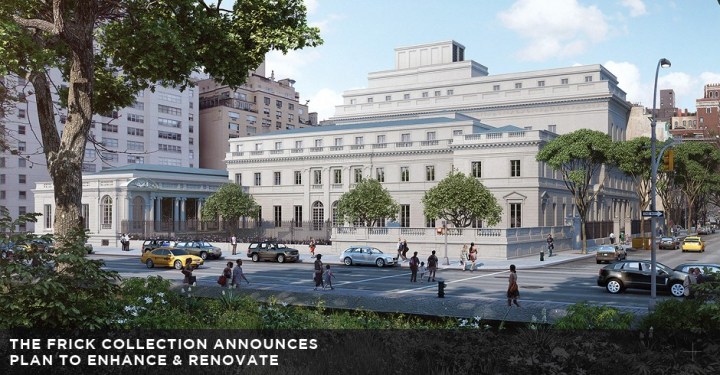
Rendering of The Frick Collection plan from Fifth Avenue
Neoscape Inc., 2014
◊ ◊ ◊ ◊ ◊
Press release (10 June 2014) from The Frick:
The Frick Collection today unveiled a plan to enhance and renovate its museum and library to further fulfill founder Henry Clay Frick’s long-standing vision to offer public access to its works of art and educational programs. The proposal derives from the Frick’s history of architecturally cohesive expansions and alterations. It includes the construction of a new addition in keeping with the scale and design of the original house and the library wing, and the renovation and expansion of interior spaces added in the 1930s and 1970s. A centerpiece of the new plan will be the opening of the museum’s second floor to the public for the first time. The result will preserve the intimate visitor experience in an extraordinary mansion that has delighted art lovers for nearly eight decades. Davis Brody Bond Architects and Planners, the New York–based firm that was responsible for the 2011 award-winning transformation of an exterior loggia into the museum’s Portico Gallery, will design the project.
In addition to converting several of the museum’s historic second-floor rooms into galleries, the Frick’s proposal calls for the construction of an architecturally respectful addition to the East 70th Street side of the museum, consistent with the style, history, and design of the original 1913–14 mansion and previous expansions. The new addition, which will provide the institution with a net gain of 42,000 square feet, will house more gallery space, an expanded entrance hall, additional space for the Frick’s world-renowned art reference library, new classrooms, a 220-seat auditorium, expanded administrative space, and updated conservation laboratories, as well as a rooftop garden terrace for museum visitors. The addition will match the heights of the Frick’s historic wings, including the three-story original house and the six-story library building constructed in 1935. The project will undergo all necessary public reviews, including that of the New York City Landmarks Preservation Commission.
“Since The Frick Collection opened as a museum nearly eighty years ago, we have been guided by Henry Clay Frick’s mandate that his home and exquisite collection offer inspiration and enjoyment to the public,” said Frick Director Ian Wardropper. “Today, Mr. Frick’s wishes continue to guide our Trustees and Administration as we seek to further realize his vision and, at the same time, secure the institution’s future through a sensitive plan that is respectful of the museum’s tradition and the community.”
“To improve service to our audiences, we wish to make an already great institution even better,” said Margot Bogert, Chair of the Frick Board of Trustees. “We occupy a structure and property that has evolved numerous times since the passing of Henry Clay Frick in 1919, with each occurrence conceived to better meet the needs of the institution and its public. We are driven by our mission once more with this plan.”
“We approach this project with reverence for the 1913–14 Frick mansion and the 1935 additions, including the Frick Art Reference Library,” said Carl Krebs, a partner at Davis Brody Bond. “The evolution of the Frick has been marked by a combination of a consistent design vocabulary, high architectural quality, and respectful additions and alterations. Our design speaks to all of these themes.”
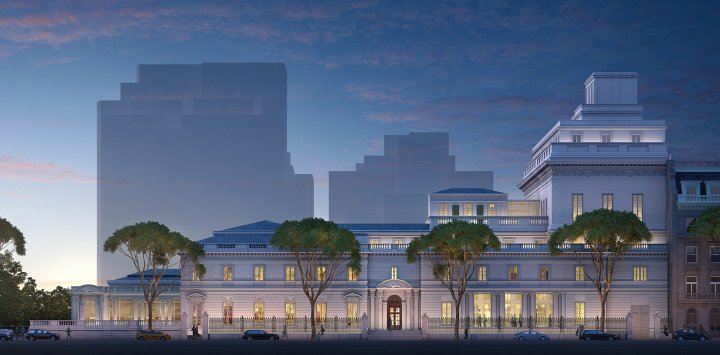
Elevation of The Frick Collection plan from 70th Street
Neoscape Inc., 2014
◊ ◊ ◊ ◊ ◊
The project primarily focuses on three areas:
Expanding Gallery Space
• The Frick will open several second-floor rooms to museum visitors for the first time ever, including what were formerly bedrooms, a study, and a breakfast room. This will enable more objects from the permanent collection to be exhibited and will offer visitors a greater sense of how the Frick family lived in the Gilded-Age house.
• The plan calls for the construction of an addition that will match the heights of the existing house and library to create more than 42,000 square feet of new space, including an additional exhibition gallery on the museum’s first floor. The new gallery will allow the museum to better accommodate popular special exhibitions without having to take works from the permanent collection off public view, as it often does currently.
Enhancing Educational Offerings
• The Frick’s educational programming will expand with a new education center including two dedicated classrooms and an auditorium capable of accommodating 220 visitors, a 30% capacity increase. The Frick’s education programming already serves more than 25,000 adults and children through lectures and symposia, school group visits, and an acclaimed concert series. The new education center will expand the Frick’s ability to cultivate these lifelong students of art.
• A dedicated study room for visiting scholars and public seminars will be added.
• Additional space for the Frick Art Reference Library will be created, as well as barrier-free access between it and the museum’s galleries on the ground floor.
• Also included will be an enlarged, updated lab where the Frick’s world-class conservators will work to preserve the Collection’s masterpieces.
Improving the Visitor Experience
• The entrance hall will be enlarged to approximately three times its current size, thereby reducing the time visitors wait in line outside the Frick and providing them with a smoother, more comfortable arrival.
• Two new elevators and a ramp will be constructed to provide improved barrier-free access.
• Four new restrooms and larger coat-check facilities will be added.
• The plan will create a larger shop to allow visitors more space to browse and purchase an expanded array of books, images, and merchandise related to the collection and exhibitions.
• The new building will feature a meditative rooftop garden terrace accessible to museum visitors.
Construction is expected to start in the spring of 2017, with completion as early as 2020. The museum and library are anticipated to remain open throughout the construction process.

Rendering of The Frick Collection plan from 70th Street looking West, Neoscape Inc., 2014
As with all of the Frick’s previous renovations and expansions, Davis Brody Bond’s approach to the Frick project will remain true to the neoclassical building constructed in 1913–14 by Carrère and Hastings. Since Mr. Frick’s death in 1919, the museum has continued to acquire works of art, expanding the permanent collection holdings of paintings by more than one-third. To accommodate this growth and the needs of the public, the building’s public spaces have been enlarged several times (in 1924, 1931–35, 1977, and 2011). Visitors to The Frick Collection are often surprised to learn that many of the museum’s architectural features were not part of the original Frick family home. In 1924, a single-story library was constructed on 71st Street, adjoining the mansion. In the 1930s architect John Russell Pope undertook the conversion of the family home into a public museum, nearly doubling its original size, and demolishing the 1924 building to construct a larger, six-story library. As the institution continues to grow, the need for additional gallery space and expanded facilities for education, conservation, and other activities is paramount.
The addition to the museum―which will feature a rooftop garden terrace for visitors―will be constructed on Frick property that includes the 1977 addition and a gated side garden on East 70th Street, also from 1977, which has always been inaccessible to the public. Originally the site of three unrelated townhouses, the property was acquired by the Frick over a period of decades beginning in the 1940s with an eye towards expanding the building to better serve the public. But, due to a lack of funds, in 1977, the Frick was only able to build a structure with a small reception hall, coat check, and shop on the ground-floor level, and two small rooms in the basement, with the gated private garden occupying the remaining space.
Several critically acclaimed exhibitions, including last year’s Vermeer, Rembrandt, and Hals: Masterpieces of Dutch Painting from the Mauritshuis (which attracted more than 235,000 visitors), have underscored the strong public demand and the need for additional space in order to continue to fulfill the Frick’s mission of providing the public easy access to the institution’s offerings.
Davis Brody Bond is one of the nation’s leading design firms with capabilities in urban design, architecture, master planning, historic preservation, and interior design. It is the recipient of more than 200 awards of excellence and has a unique design style that responds to the physical, cultural, and historical contexts of each project and site. Many of Davis Brody Bond’s iconic structures are enduringly relevant and have earned the firm a reputation for innovation and design excellence. Current cultural projects include the National September 11 Memorial Museum at the World Trade Center; the Smithsonian Institution’s National Museum of African American History and Culture, under construction on the National Mall in Washington, D.C.; the Embassy of South Africa in Washington, D.C.; and the Portico Gallery at The Frick Collection in New York City, which was completed in 2011.
◊ ◊ ◊ ◊ ◊
Note (added 13 June 2014) — In her article “Frick Seeks to Expand Beyond Jewel-Box Spaces” for The New York Times (9 June 2014), Robin Pogrebin notes that
Critics of other expansions—like MoMA’s—have called them unnecessary, too expensive or even hubristic. As the Frick rolls out its plans, it could face opposition for altering one of New York’s beloved historic buildings, a late Gilded Age mansion designed by Thomas Hastings for the industrialist Henry Clay Frick, where visitors can view a world-class assemblage of old master paintings, European sculpture and decorative arts. . .
Right on cue, David Masello, the executive editor of the design magazine Milieu, weighs in with an Op-Ed for The New York Times (12 June 2014), “Save the Frick Collection” . . .
America has few mansions built by a family with an art collection they meant to share with the public. So when word came this week that the Frick Collection, on the Upper East Side of Manhattan, was planning to expand and build a tower where there is now a discreet garden and a splashing fountain with lily pads—one of those few places in the cityscape where we are allowed to stop and breathe—I felt blunt disappointment, as well as betrayal. . .
The full editorial is available here»
◊ ◊ ◊ ◊ ◊
Note (added 30 July 2014) — Michael Kimmelman weighs in against the project: “The Case Against a Mammoth Frick Collection Addition,” The New York Times (30 July 2014), available here»
◊ ◊ ◊ ◊ ◊
Note (added 4 June 2015) — Michael Kimmelman notes the demise of the project, “Frick Collection Returns to Square One, a Prized Garden Intact,” The New York Times (4 June 2015) . . .
The administration of Mayor Bill de Blasio let the Frick know that the proposal couldn’t survive the gantlet of the Landmarks Preservation Commission. The museum had no choice. It issued a gracious statement on Thursday morning, thanking everyone, including opponents “who share a great deal of affection and respect for the institution.” The museum promised to come up with a new plan, one that would spare the Russell Page-designed garden. . . .
The full piece is available here»
The Louvre Reopens Eighteenth-Century Decorative Arts Galleries
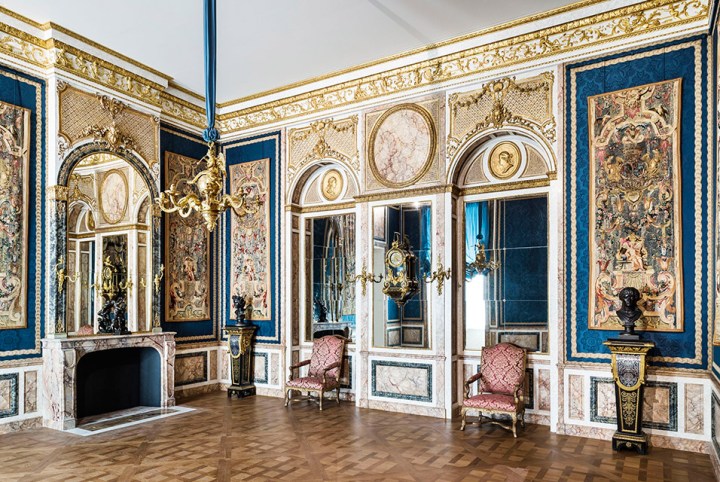
Paneling from the hôtel Le Bas de Montargis, place Vendôme, Paris, ca. 1705 (Musée du Louvre / Olivier Ouadah).
◊ ◊ ◊ ◊ ◊
Press release posted at ArtDaily (with additional coverage and images at ArtNet News and by Didier Rykner at La Tribune de l’Art) . . .
The Louvre has announced the June 6, 2014 reopening of its newly restored and reinstalled 18th-Century Decorative Arts Galleries. One of the most comprehensive collections of 18th-century French decorative arts in world, the collection is on view to the public for the first time since 2005. The 35 galleries—which span 23,000 square feet—display over 2,000 pieces in object-focused galleries and period-room settings. The new installation traces the evolution of French taste and the decorative arts, emphasize the major artisans and artists of the period, and highlight the renowned collectors and patrons of the era.
The exhibition design was conceived collaboratively by interior designer and French decorative-arts connoisseur Jacques Garcia and the curators in the Department of Decorative Arts under the direction of Marc Bascou. The architectural project management for the new galleries was entrusted to Michel Goutal, the Louvre’s senior historical monument architect, with technical assistance provided by the Louvre’s Department of Project Planning and Management. American Friends of the Louvre (AFL) has played a vital role in the renovation by raising $4 million in support of the project and one of its key period rooms—the restoration of l’Hôtel Dangé-Villemaré drawing room which has not been exhibited in its entirety since its 19th-century acquisition by the Louvre. In addition, AFL also raised funds for the restoration and first ever public presentation of a magnificent cupola painted by Antoine François Callet which will be installed in the galleries and for the English-language edition of the book of the Louvre’s decorative arts collection whose publication will celebrate the opening (see below).
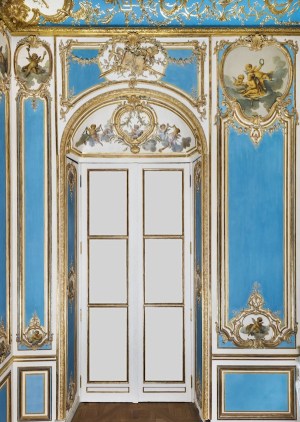
Interior architecture from the assembly room of l’hôtel Dangé. Paris, ca. 1750, with modern additions. Height to the cornice, 15’ Paris, Musée du Louvre / Olivier Ouadah).
L’Hôtel Dangé-Villemaré’s drawing room, built in 1709 and redecorated in 1750, is one of the most important surviving examples of an interior by a Louis XV-era Parisian workshop. The room’s decorative paneling, for which it is noteworthy, has undergone extensive conservation to reveal its original color and various tones of gilding. The alternating wide and narrow panels are also notable for their elegant motifs, which include symbols of the arts, sciences, and commerce. Medallions at the tops and the bases of the panels feature delightfully painted images of children at play. The drawing room will also feature Versailles parquet floors, sumptuous furniture pieces, and bronze furnishings.
“The 18th-Century Decorative Arts Galleries have always been a particular favorite of American visitors, who appreciate the opulence and craftsmanship of this work,” said Executive Director of AFL Sue Devine. “AFL’s support of the renovation of l’Hôtel Dangé-Villemaré’s drawing room seemed like a natural progression in the United States’ long tradition of support for and appreciation of French art and culture. We are proud to be a part of this major moment in the Louvre’s history.”
When the Louvre closed the decorative arts galleries on the first floor of the Cour Carrée’s north wing to bring them in compliance with current safety regulations, the museum seized the opportunity to revisit the installation of the galleries, which had not been appreciably updated since 1966. Under the direction of Marc Bascou and Jannic Durand, former and current Directors of the Department of Decorative Arts respectively, and in collaboration with the curators in the Department of Decorative Arts, the Louvre has reinterpreted its collections and reinstalled them as a series of period rooms and themed galleries, which allows closer examination of the museum’s collection. The galleries are grouped into three main chronological and stylistic moments:
• 1660–1725, The reign of Louis XIV and the Regency
• 1725–1755, The height of the Rococo style
• 1755–1790, Return to classicism and the reign of Louis XVI
“We wanted to achieve a happy medium between period rooms and exhibition galleries,” said Jannic Durand, Director of the Department of Decorative Arts. “Each object benefits from being in relationship with other objects. In some cases, this means creating a period room so our visitors can understand how people lived with these objects or so they can appreciate holistically the elegance and refinement of the 18th century. In other instances, it means curating display cases devoted entirely to porcelain, silverware, and even some pieces of furniture to underscore the history of techniques and styles.”
When possible, the Louvre has reconstructed documented decorative groupings, accompanied by period furniture, such as the drawing room and library of l’Hôtel Dangé-Villemaré, the Grand Salon of the Château d’Abondant, and the ceremonial bedchamber at the Hôtel de Chevreuse. Other rooms bring together “recollections of interiors,” in Jacques Garcia’s words, which are stylistically coherent groupings of furniture and objects within a recreated decorative setting. “The Louvre’s new decorative arts galleries will embody the constant evolution of taste, flowing in a coherent movement from the ascension of a new style during Louis XIV’s reign to the time of Marie- Antoinette at the end of the Ancien Régime,” said Jacques Garcia. “The galleries will display a multitude of atmospheres, but will always remain true to the sense of the innovation and beauty that characterizes the Grand Siècle of decorative arts which, in France, was the 18th century.”

Faience dishes and pottery depicting scenes from history, in the tradition of Castelli Maiolica earthenware, Pavie and Nevers (France) 1650–1700
(Paris, Musée du Louvre / Olivier Ouadah).
Using objects and furnishings, the reinstallation also introduces visitors to members of the royal family, including: Louis XIV, Louis XV and Louis XVI, the Prince de Condé, the Comte d’Artois, Mesdames de France (the king’s daughters), and Marie-Antoinette, as well as Louis XV’s mistresses Madame de Pompadour and Madame du Barry, nobles of the royal court such as the duc de Chevreuse and the marquis de Sourches, and wealthy financiers such as the keeper of the royal treasure Claude Le Bas de Montargis, and the tax collector François-Balthazar Dangé. Particular emphasis has been given to artisans with royal patronage—the most celebrated of whom were granted free lodgings in the Galerie du Louvre alongside their workshops. Such examples include André- Charles Boulle and Thomas Germain, whose workshops served not only French kings and courtiers, but also Europe’s elite, contributing to the dissemination of French culture and setting fashions throughout the continent. The installation also highlights the period’s master craftsmen, including: cabinet-makers André-Charles Boulle, Charles Cressent, Bernard II van Risemburgh, Jean-François Oeben, Martin Carlin, and Jean-Henri Riesener; the silver- and goldsmiths Thomas and François-Thomas Germain, Nicolas Besnier, Jacques Roëttiers and son, and Robert-Joseph Auguste; and the painters and decorators Charles Le Brun, Jean-Baptiste Oudry, and Charles-Antoine Coypel. The visitor experience in the galleries is further enriched through multimedia aids and new interpretative materials that contextualize the works on view and give insight into the evolution of taste, methods of production, the patronage system, and how the objects were used
◊ ◊ ◊ ◊ ◊
Somogy published the catalogue, available in both French and English:
Jannic Durand, Michèle Bimbenet-Privat, and Frédéric Dassas, Décors, Mobilier et Objets d’Art du Musée du Louvre: De Louis XIV à Marie-Antoinette (Paris: Somogy, 2014), 554 pages, ISBN: 978-2757206027, €45.
Jannic Durand, Michèle Bimbenet-Privat, and Frédéric Dassas, Decorative Furnishings and Objets d’Art in the Louvre from Louis XIV to Marie-Antoinette (Paris: Somogy, 2014), 568 pages, ISBN: 978-2757206034, €45.
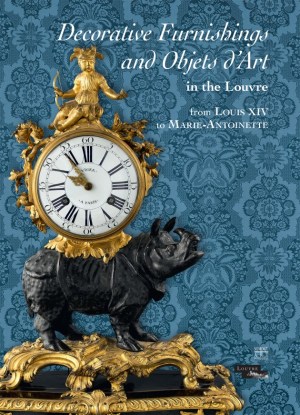 Over two hundred and fifty masterpieces from one of the most magnificent eras in the decorative arts are featured in this book, ranging from the splendors of courtly art under Louis XIV to the dazzling creations inspired first by Madame de Pompadour under Louis XV and then by Queen Marie-Antoinette under Louis XVI. A broad perspective on interior decoration, luxury goods, and the art market is offered through lavish furniture by the likes of André-Charles Boulle and Charles Cressent during the Régence, through extravagant dinner services, and through the magnificent porcelain and tapestries produced by the royal manufactories, constituting a “moment of perfection in French art” that lasted until the Revolution.
The Louvre’s new rooms devoted to seventeenth- and eighteenth-century decorative arts opened in May 2014. Some two thousand items are displayed in nearly twenty thousand square feet of exhibition space, representing one of the world’s finest collections of furnishings and objets d’art from the reign of Louis XIV through that of Louis XVI. The new galleries are organized chronologically and are punctuated by spectacular period rooms that recreate the magnificent wood-paneled interiors of lavish residences and princely palaces in eighteenth-century Paris. These reconstitutions of a bygone period provide the setting for truly remarkable objets d’art from the Louvre’s Department of Decorative Arts—now placed in their original intellectual and material context, these items recreate a vanished atmosphere and finally reveal their full meaning as well as their full beauty.
Yorktown Museum Acquires Portrait of Ayuba Suleiman Diallo
Another portrait of Ayuba Suleiman Diallo by William Hoare. . . From the press release (6 June 2014). . .
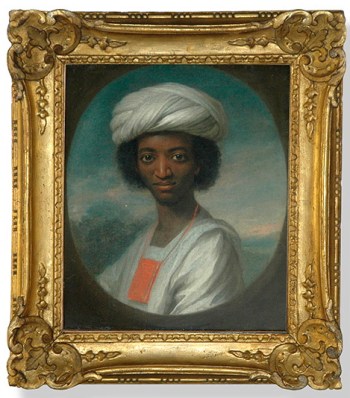
William Hoare, Portrait of Ayuba Suleiman Diallo, ca. 1733
(Jamestown-Yorktown Foundation)
The Jamestown-Yorktown Foundation, a Virginia state agency that operates Jamestown Settlement and Yorktown Victory Center history museums, has acquired a previously unknown oil portrait of Ayuba Suleiman Diallo, a freeborn, educated African who was kidnapped in Africa and sold as a slave in Maryland during the colonial era. Before taking its place as a centerpiece of the future American Revolution Museum at Yorktown (opening late 2016), the rare portrait (ca. 1733) goes on view at the Yorktown Victory Center this summer from June 14 through August 3.
Ayuba Suleiman Diallo was catapulted into fame in the 1730s when the remarkable story of his enslavement and redemption in the North American British colonies was published. From almost the moment he touched ground in London in April 1733, he won the respect of the leading lights of advanced learning in England and ultimately entered the annals of history as a figure embraced by the global abolitionist movement.

William Hoare, Portrait of Ayuba Suleiman Diallo (Job ben Solomon), 1733 (NPG L245, Lent by Qatar Museums Authority/Orientalist Museum, Doha, 2010)
Showing Diallo in a white robe and turban, wearing around his neck a bright red leather pouch probably containing texts from the Qur’an, the Jamestown-Yorktown Foundation portrait is one of two versions painted by William Hoare of Bath, a leading English portrait painter of the 18th century. They are the earliest known portraits done from life of an African individual who was held as a slave in the 13 British colonies that would become the United States of America. The other is currently on view in the National Portrait Gallery of London, on long-term loan following its purchase by the Qatar Museums Authority in 2009.
In a private collection since the 19th century, the Foundation’s portrait came to light following the publicity surrounding an appeal to the British public to keep the Qatar portrait in England. The Jamestown-Yorktown Foundation, Inc., purchased the oil-on-canvas painting with funds raised privately, including a lead gift from Foundation trustee Fred D. Thompson, Jr., of Thompson Hospitality, the country’s largest minority-owned food service company. “This portrait is a powerful symbol of the diversity of colonial America’s population, which included people from many different African cultures,” says Thompson. “Diallo—his image and story—is an ideal teaching opportunity for the American Revolution Museum at Yorktown galleries.”
“For approximately three years now, the Foundation has been in confidential negotiations to acquire this important portrait,” says Thomas E. Davidson, Jamestown-Yorktown Foundation senior curator. “Diallo’s visage speaks for the hundreds of thousands of enslaved Africans and African Americans who remain largely unknown, yet who constituted a major part of late-colonial America’s population.”
“As we plan for the new museum,” Davidson continued, “we hope to convey the way in which the American Revolution represented the beginning of the end for slavery in the United States. While the Revolution did not end slavery by itself, it created an intellectual, moral and political climate in which the practice could not and did not continue forever.”
While there are similarities, neither Hoare portrait is a copy of the other. The painting of Diallo that will be exhibited at the American Revolution Museum at Yorktown is 14 by 12 inches, with the subject’s upper body turned toward his right, against a landscape background, within a painted oval. In the other portrait, Diallo is turned toward his left against a solid background. (more…)
Robin Nicholson Named Director of The Frick, Pittsburgh
Press release (4 June 2014) from Pittsburgh’s Frick Art & Historical Center:
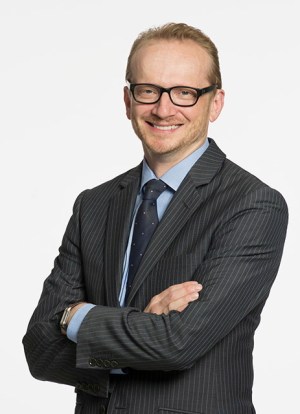 The Board of Trustees of the Frick Art & Historical Center announces the appointment of Robin Nicholson as the institution’s third director. Currently Deputy Director for Art and Education at the Virginia Museum of Fine Arts (VMFA) in Richmond, Virginia, Mr. Nicholson will assume his new post in Pittsburgh on September 2.
Mr. Nicholson’s appointment is the result of an intensive national search, conducted by a Search Committee that was formed immediately following the October 2013 retirement announcement of current Director Bill Bodine, whose 12-year tenure began in 2002. The seven-member Search Committee worked in collaboration with Management Consultants for the Arts, Inc. Search Committee Chair Betsy Watkins comments, “The Search Committee enthusiastically recommended Mr. Nicholson to the Board. We are impressed by his creative energy, his scholarship, his appreciation for our collections, and his ideas about programming at the Frick. We feel fortunate to have attracted someone of his caliber to the Frick and are confident that
he will bring inspired leadership to the institution.”
Carolyn ‘Cary’ Reed, Chair of the Frick’s Board of Trustees, says, “We are excited about welcoming Mr. Nicholson to the Frick in September. He joins us at an important time in the Center’s history, as we open a new Orientation Center and break ground for renovated spaces for our education programs, a new carriage gallery and a community center.”
This summer the Frick will open an Orientation Center, which will serve as a point of entry for visitors. The completion of this new facility marks the culmination of the first phase of a site-wide expansion project that began in 2012. The second phase of the project is planned to begin this summer.
Robin Nicholson has served as Deputy Director for Art and Education at the Virginia Museum of Fine Arts since 2010. In this post, he has overseen the museum’s curatorial, exhibitions, education, statewide partnerships, publications, and library departments. Mr. Nicholson began his tenure at the VMFA in 2006 as director for exhibitions. Prior to joining the staff of the VMFA, he spent 14 years as director and curator of the corporate art collection of the Drambuie Corporation, headquartered in Edinburgh, Scotland, and with corporate offices in England and the United States.
 A renowned scholar of the art of the eighteenth-century Stuart royal courts in Paris and Rome, Robin Nicholson was educated at Queen’s University, Ontario, Canada, and the University of Cambridge, England, where he earned an MA degree. He has published and lectured extensively on eighteenth- and nineteenth-century European art. Mr. Nicholson is the author of a book on the portraiture of Prince Charles Edward Stuart that was published by Bucknell University Press in 2002.
At the VMFA, he oversaw a number of major exhibition projects, including Picasso: Masterpieces from the Musée Picasso, Paris, the most ambitious exhibition in the VMFA’s history. A 2008 alumni of the Getty Museum Leadership Program and past Chair of the Scottish Society for Art History, Mr. Nicholson served as cultural representative on the Presidential Bilateral Commission on US-Russia Relations.
In discussing his appointment as the Frick’s third director, Mr. Nicholson says, “I am thrilled to take on the leadership of an organization that is poised to take its place as a true icon in the dynamic Pittsburgh cultural landscape. The legacy of two inspirational previous directors has transformed the Frick and placed it in a position of strength where anything is possible—with collections, exhibition, collaborations, interpretation, education, programs, and a great historic green space in the heart of the city. The Frick has many compelling stories to tell, a great staff, and an extraordinarily supportive board leadership; it is a unique institution with unique opportunities at a key moment in its history.”
Frick Board of Trustees Chair Cary Reed remarks, “In its relatively short history, the Frick is fortunate to have had two extraordinary directors—Dick McIntosh and Bill Bodine—each of whom made significant contributions to the institution’s development. We are confident that Robin Nicholson will build on these great legacies as we continue and expand the quality exhibitions and programs which have been the hallmarks of the Frick Art & Historical Center.”
Abraham Thomas as New Director of Sir John Soane’s Museum
I’m afraid this posting should have run six months ago. The press release dates to last July, though Thomas has been in the position only since December.
It perhaps, however, can serve as a useful reminder of how many things slip by me. Particularly with summer here (or at least summer in the northern hemisphere) and so many of you doing fascinating things around the world, please don’t be bashful in writing to share news. All the best for the next few months, -Craig Hanson
◊ ◊ ◊ ◊ ◊
 The Trustees of Sir John Soane’s Museum are pleased to announce the appointment of Abraham Thomas as the next Director of the Museum. He will take up the appointment on 3 December 2013. Announcing the appointment, Guy Elliott, Chairman of the Trustees, said, “The Trustees have appointed Abraham Thomas to be their next Director on the unanimous recommendation of their search committee, which included senior external members, as well as four Trustees. The decision has been endorsed by the Royal Academy of Arts, as required by our governing legislation.
“Mr Thomas comes to us from The Victoria and Albert Museum, where, as Curator of Designs, he was responsible for, amongst other exhibitions, the brilliant and much praised Heatherwick Studio: Designing the Extraordinary. He joins the Soane Museum at a particularly creative and challenging time in its history. The immediate priority is to complete the museum’s acclaimed Opening up the Soane project, which has already delivered a new exhibition gallery, conservation studios, disability access, and shop. Sir John Soane’s private apartments, not seen since 1837,
will feature prominently once the current phase concludes in 2014.
The new Director will build upon recent successes to lead The Soane’s talented staff and volunteer force in realizing the fullest potential of the museum as an ‘academy’, as Soane described it, that is, a centre of learning. The work and reputation of Sir John Soane himself, the unique atmosphere of his former home and its unparalleled collections have the ‘permanently magical’ power to inspire and inform all those who seek knowledge and understanding of the story of architecture.”
Responding, Mr Thomas said “I am delighted to be appointed the next Director of Sir John Soane’s Museum. It’s a great honour to be invited to lead this unique institution, and I look forward to building upon the fantastic work carried out by my predecessor, Tim Knox, and the staff, in order to create an exciting future for the Museum. I have always considered the Soane to be an extraordinary container of ideas, and I’m thrilled at the prospect of working closely with the staff and Trustees to explore boldly Sir John Soane’s original vision for his building and wide-ranging collections—a legacy which I believe can offer immeasurable relevance for today’s world.”
Abraham Thomas was Curator of Designs, and lead curator for architecture, at the V&A. During his eight years at the Museum he made an outstanding contribution to the public programme, working across historical and contemporary architecture and design with responsibility for the V&A’s collection of approximately 200,000 design drawings, maquettes and models. This collection ranges in scope from the 16th century to the present day and across disciplines such as architecture, furniture, sculpture, metalwork and ceramics, all of which are represented at the Soane.
Thomas has played a key role as lead curator in the V&A + RIBA Architecture Partnership. In addition to curating such acclaimed exhibitions as Heatherwick Studio: Designing the Extraordinary and 1:1 – Architects Build Small Spaces, he was the curator of the V&A’s bicentenary retrospective on the 19th-century designer, Owen Jones, A Higher Ambition and co-curator of an expanded version which later toured internationally. He has subsequently published related research on Owen Jones, who, like Soane, broke the mould by proposing a modern style unique to the nineteenth century, as well as on James Wild (curator of Sir John Soane’s Museum from 1878 to his death in 1892) and other key 19th-century artists working in the Middle East. Thomas succeeds Tim Knox, who was with the Soane for almost eight years before being appointed Director and Marlay Curator of the Fitzwilliam Museum in Cambridge.
Bill Griswold Named Director of the Cleveland Museum of Art
Press release from The Cleveland Museum of Art:
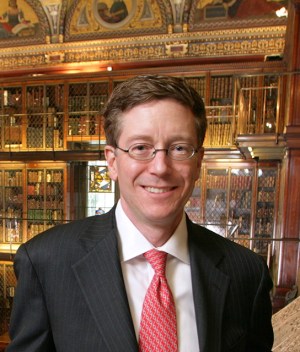 In May 2014, Dr. William M. Griswold became the 10th director of the Cleveland Museum of Art since its founding in 1916. Dr. Griswold enters the life of the museum at a dynamic moment—with a newly completed expansion project increasing its capacity and significance, and a centennial anniversary approaching. His ambition is to build the museum’s strong relevance throughout the region, the nation and the world, capitalize on its long-standing community engagement legacy and enhance the quality and breadth of its well-known collection.
Dr. Griswold’s tenure at the Cleveland Museum of Art follows his term as the fifth Director of The Morgan Library & Museum since the institution’s founding in 1924. During his seven years of leadership there, Dr. Griswold spearheaded the growth of the Morgan’s collections, exhibition program and curatorial departments, most recently adding Photography as a focus. He oversaw a number of important exhibitions and scholarly exchanges with leading international museums, including the Louvre, London’s Courtauld Institute, Munich’s Graphische Sammlung and Turin’s Biblioteca Reale.
In 2010, Dr. Griswold initiated the first interior restoration of the Morgan’s historic McKim building since its construction as Pierpont Morgan’s private study and library more than a century ago. He also oversaw a project to digitize the Morgan’s renowned collections, beginning with its holdings of drawings and music manuscripts, two of its most important. In 2011, he supervised the establishment of the innovative Morgan Drawing Institute to advance the study of drawings of all periods and schools. As a result of these initiatives, and many more, the Morgan over the last several years has seen some of the most robust donor support and attendance in its history.
Dr. Griswold had previously served as Director and President of the Minneapolis Institute of Arts, from 2005 to 2007; Acting Director and Chief Curator of the J. Paul Getty Museum, 2004 to 2005; and Associate Director for Collections at the Getty, beginning in 2001. Prior to joining the Getty, Dr. Griswold had been Charles W. Engelhard Curator and Head of the Department of Drawings and Prints at the Morgan Library since 1995. From 1988 to 1995, he was on the staff of the Metropolitan Museum of Art, first as Assistant and then as Associate Curator in the Department of Drawings and Prints.
Dr. Griswold was the co-author with Jacob Bean of 18th-Century Italian Drawings in the Metropolitan Museum of Art and has written extensively on Florentine drawings of the early Renaissance. He oversaw the design and creation of the Morgan’s Drawing Study Center, and in 1998 curated a historically significant exchange of exhibitions between the Morgan and The State Hermitage Museum, St. Petersburg, and the Pushkin State Museum of Fine Arts, Moscow. In 1999 he co-curated New York Collects, the Morgan’s first major exhibition devoted to twentieth-century art, and in 2002 he was co-author with Jennifer Tonkovich of Pierre Matisse and His Artists.
Formerly a member of the board of directors of The Courtauld Institute of Art, Dr. Griswold currently serves on the boards of the American Federation of Arts, American Friends of the Shanghai Museum, and American Trust for the British Library. He is a member of the Association of Art Museum Directors and President of Master Drawings Association, which publishes the scholarly journal Master Drawings. In 2008, he was awarded the insignia of Chevalier of the French Order of Arts and Letters.
Dr. Griswold earned his bachelor’s degree at Trinity College, Hartford, Connecticut, and his Ph.D. at The Courtauld Institute of Art, London.
Carol Vogel reports on Griswold’s appointment for The New York Times (20 May 2014), here»
Met Initiative Provides Free Access to 400,000 Digital Images

Lock, 18th century, French, gilt bronze, 7 x 8 inches (New York: Metropolitian Museum of Art, Gift of J. Pierpont Morgan, 1906, #07.225.510.1). For more information, click here»
◊ ◊ ◊ ◊ ◊
Press release (16 May 2014) from The Met:
Thomas P. Campbell, Director and CEO of The Metropolitan Museum of Art, announced today that more than 400,000 high-resolution digital images of public domain works in the Museum’s world-renowned collection may be downloaded directly from the Museum’s website for non-commercial use—including in scholarly publications in any media—without permission from the Museum and without a fee. The number of available images will increase as new digital files are added on a regular basis.
In making the announcement, Mr. Campbell said: “Through this new, open-access policy, we join a growing number of museums that provide free access to images of art in the public domain. I am delighted that digital technology can open the doors to this trove of images from our encyclopedic collection.”
The Metropolitan Museum’s initiative—called Open Access for Scholarly Content (OASC)—provides access to images of art in its collection that the Museum believes to be in the public domain and free of other known restrictions; these images are now available for scholarly use in any media. Works that are covered by the new policy are identified on the Museum’s website with the acronym OASC. (Certain works are not available through the initiative for one or more of the following reasons: the work is still under copyright, or the copyright status is unclear; privacy or publicity issues; the work is owned by a person or an institution other than the Metropolitan Museum; restrictions by the artist, donor, or lender; or lack of a digital image of suitable quality.)
OASC was developed as a resource for students, educators, researchers, curators, academic publishers, non-commercial documentary filmmakers, and others involved in scholarly or cultural work. Prior to the establishment of OASC, the Metropolitan Museum provided images upon request, for a fee, and authorization was subject to terms and conditions. Additional information and instructions on OASC can be found here.
The Golden Room of the Mauritshuis Restored
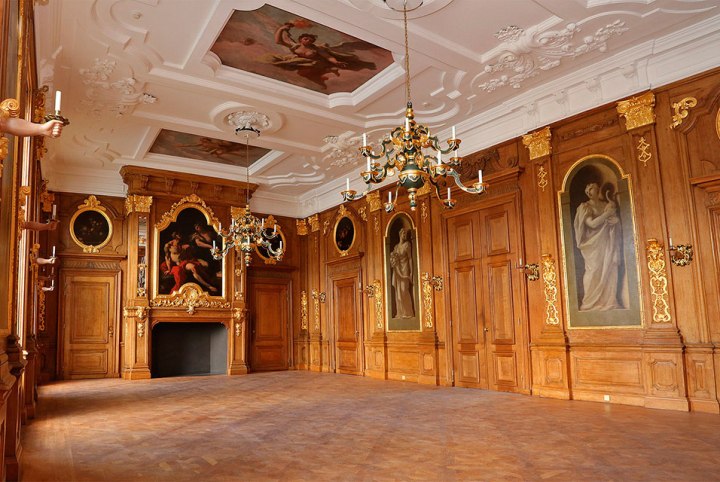
Restoration of the Pellegrini paintings in the Golden Room of the Mauritshuis has just been completed in time for the re-opening of the museum in June. As noted at ArtDaily:
The Golden Room, a spectacular 18th-century room in the Mauritshuis , which includes a series of paintings by Italian painter Giovanni Antonio Pellegrini (1675–1741) has been restored. The 15 wall and ceiling paintings were treated as part of the museum’s larger building project. The restoration of the Pellegrini paintings was undertaken with the support of the Shell Technology Centre Amsterdam. The pictures from the Golden Room are the first to have been returned to the renovated Mauritshuis. The museum will reopen after a two-year renovation on the evening of Friday 27 June.
The restoration of the Golden Room is an important component of the museum’s large scale project to renovate and expand the building. The restoration of the 15 monumental paintings by Pellegrini in the Golden Room was necessary. Although the pictures were not seriously damaged, they had been painted over several times, and the canvas was stained and showed strong yellow discoloration. The Johan Mauritshuis Compagnie Foundation provided the funding to realise the restoration.
Once the varnish had been removed, an unknown grey haze was discovered on the paintings. According to Carol Pottasch, Mauritshuis conservator who led this sizable restoration project: “We couldn’t figure out what this haze was initially; clearly, it wasn’t paint. In order to be able to bring the paintings back to their optimal condition, we had to find out the composition of this haze, so that it could be removed. Thankfully, the staff of the Shell Technology Centre, who have the equipment necessary to conduct the chemical analysis that we needed, were able to help us.” The Mauritshuis and Shell have been collaborating closely as ‘Partners in Science’ in the field of technical research since 2012, focussing on paintings by Pellegrini and Jan Steen. The partnership has already proved invaluable: together, they were able to establish that the cause of the grey haze was the wood- and coal-burning stoves used to heat the Golden Room.
In 1704 a fire reduced the whole interior of the 17th century Mauritshuis building to ashes. The interior had to be completely refurnished and redecorated. Italian painter Giovanni Antonio Pellegrini (1675–1741) was asked to decorate the Grote Benedenzaal, as the Golden Room was called at the time. Pellegrini was one of the most important Venetian painters of the early 18th century. The paintings are special: they are the only Italian pieces on display in the Mauritshuis and they are still on site, unlike most Pellegrini paintings.










 Enfilade
leave a comment