MFA Appoints Benjamin Weiss as Chair, Prints, Drawings, & Photographs
Press release (27 February 2014) from Boston’s MFA:
Benjamin Weiss has been named Chair, Prints, Drawings and Photographs at the Museum of Fine Arts, Boston (MFA). Weiss will continue to serve in his current position, Leonard A. Lauder Curator of Visual Culture, which he has held since 2011. In that role, he co-curated The Postcard Age: Selections from the Leonard A. Lauder Collection (2012) and most recently organized Audubon’s Birds, Audubon’s Words (2013); he is currently preparing further exhibitions and publications drawn from the Leonard A. Lauder Postcard Archive, including an exhibition devoted to “real photo” postcards of the early 20th century. In addition to the Lauder Archive, Weiss has had responsibility for the MFA’s other collections of posters, postcards, illustrated books, graphic design and ephemera of all sorts.
Prior to taking his current position in Prints, Drawings and Photographs, Weiss spent seven years in the MFA’s Education Department as Head of Interpretation (2009–2012) and Manager of Adult Learning Resources (2005–2009). He was integral to the opening of the Art of the Americas Wing in 2010, when he was responsible for interpretation for 5,000 objects on view. He also oversaw the written and educational materials for all special exhibitions and installations of the collection, including brochures, multimedia tours and in-gallery wall texts and labels.
Weiss holds a Master of Arts in History from Princeton University (1991) and a Bachelor of Arts from Harvard College (1989). Before coming to the MFA, he worked at the Burndy Library, of the Dibner Institute for the History of Science and Technology at MIT for seven years, where he was Curator of Rare Books and Head of Exhibitions and Publications. While at Burndy, he curated more than a dozen exhibitions, on subjects as varied as color theory, 19th-century American bridge engineering and the history of obelisks. That last exhibition resulted in the collaborative monograph Obelisk: A History, co-written with Anthony Grafton, Pamela O. Long and Brian Curran, and published by MIT Press. A Renaissance historian by training, with a specialty in the history of cartography, Weiss maintains an interest in the history of maps, and specifically in the history of ancient geographical texts in the 15th and 16th centuries.
Exhibition | Anglo-American Portraiture in an Era of Revolution
From the Louvre:
Anglo-American Portraiture in an Age of Revolution
Musée du Louvre, Paris, 1 February — 28 April 2014
Crystal Bridges Museum of American Art, Bentonville, Arkansas, 17 May — 15 September 2014
High Museum of Art, Atlanta, 28 September 2014 — 18 January 2015
Curated by Guillaume Faroult
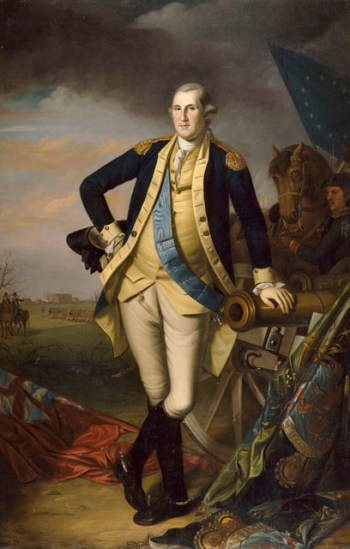
Attributed to Charles Wilson Peale, George Washington after the Battle of Princeton, 3 January 1777, ca. 1779 (National Museum of the Palace of Versailles and the Trianons)
The Louvre continues its exploration of the history of painting in America with a third special exhibition that compares and contrasts five Anglo-American portraits from 1780 to 1800 and slightly later, produced in the midst of a revolution that would lead to the independence and creation of the United States of America. The selected artworks revolve around the guardian and emblematic figure of General George Washington (1732–1799), elected first president of the United States in 1789.
The exhibition features three portraits of the Father of the Country, including one attributed to Charles Wilson Peale (1741–1827) depicting him as Commander in Chief of the Continental Army, on special loan from the Musée du Château de Versailles. Portraits of the opposing belligerents, notably a stunning, newly restored portrait of Captain Robert Hay of Spot by Scottish painter Sir Henry Raeburn (1756–1823), are presented in response to the magnificent portrait of Washington as president of the young nation painted in 1797 by Gilbert Stuart (1755–1828)—one of the most talented American portrait artists—on loan from the Crystal Bridges Museum.
This special exhibition is part of a long-term partnership with the Crystal Bridges Museum of American Art, the High Museum of Art, Atlanta, and the Terra Foundation for American Art, and was made possible through their generous support.
Digital Plans at the Reynolda House Museum of American Art
Press release (12 February 2014) from the Reynolda House Museum of American Art in Winston-Salem, North Carolina:

Joseph Blackburn, Portrait of Elizabeth Browne Rogers, 1761, oil on canvas (Reynolda House Museum of American Art)
As metropolitan museums across the country begin to focus personnel resources on digital content and new media strategies, Reynolda House Museum of American Art has created a new position to develop the extension of the museum’s desired impact and mission to an online audience. Trish Oxford has been named Assistant Director of Marketing & Communications, a position that will focus on the evolving need for digital communications. In this role she will create synergy between on-site experiences and virtual experiences through management of the Museum’s new website, email, social media, and other digital platforms. Oxford will also work closely with the curatorial staff to explore ways to enhance the visitor experience. She first joined the museum part-time in 2012 as Audience Engagement and Communications Specialist.
Oxford’s new position is part of a larger Reynolda House initiative called the Digital Engagement Project launched in 2010 with the digitizing of the museum’s collections. The federally funded project included cataloging each object in the museum’s collections, redesigning the museum’s website to facilitate access to collections, and creating new opportunities for people to interact with the museum online. Allison Perkins, Reynolda House executive director, said in her new position Oxford will invite museum visitors, online and in-person, to contribute their own interpretations and ideas, making all interactions with Reynolda House more impactful. (more…)
MoMA Appoints First Director of Digital Content and Strategy
Arriving at MoMA from the Royal Museums Greenwich, Fiona Romeo steps into a position that will, I imagine, become increasingly common if not essential for museums in the years ahead. Given her role, it’s especially interesting to see what her own web presence looks like. -CH
From the press release (7 February 2014). . .
 The Museum of Modern Art has appointed Fiona Romeo as Director of Digital Content and Strategy, a newly created position in which Ms. Romeo will provide vision and leadership across the organization to enable the Museum to build on its existing digital initiatives and refine its strategic direction and goals. Under the direction of Peter Reed, Senior Deputy Director for Curatorial Affairs, she will actively work with senior leadership to develop and grow digital engagement with MoMA’s diverse audiences, both on site and online. She will lead the Digital Media Department, overseeing a team of digital producers, developers, and designers. Ms. Romeo will join the Museum in April.
In her new role, Ms. Romeo will create a clear and achievable strategy that will connect all areas of the Museum and build upon the success of existing programs. Her purview will include MoMA’s website, MoMA.org, including the online collection and exhibition subsites; and digital tools and resources, such as mobile applications, digital in-gallery displays, and live-streamed events.
“Fiona’s appointment builds upon the Museum’s pioneering work in the digital realm, and is a reflection of the dynamic and vital role that digital content plays in the way people can participate in the life of the Museum,” said Glenn D. Lowry, Director of The Museum of Modern Art. “Her extensive museum experience and her background in social and interactive digital platforms makes her particularly well suited to lead MoMA’s innovative and multifaceted initiatives, which engage individuals with the richness of our collection and programs.” (more…)
DIA to Raise $100 Million for Its Independence
For the most recent developments leading up to this announcement, Lee Rosenbaum provides useful coverage at CutureGrrl). Also, see Julia Halperin’s article at The Art Newspaper. From the DIA press release (29 January 2014)…
Detroit Institute of Arts to raise $100 Million toward Detroit’s Revitalization
As an anchor and investor in Detroit’s Midtown neighborhood, an educational resource for students and residents of Detroit, the tri-county area and all of Michigan and a provider of creative programs for numerous social service and community organizations in the City of Detroit and beyond, the Detroit Institute of Arts (DIA) is pleased to confirm its participation in the plan being facilitated by Judge Gerald Rosen, Chief Judge of the U.S. District Court for the Eastern District of Michigan, to help bring an end to the City’s bankruptcy, expand support for Detroit’s pensioners and protect the museum’s collection for the public in perpetuity. (more…)
Exhibition | The Monuments Men of the Nelson-Atkins
Press release (21 January 2014) from the Nelson-Atkins:
The Monuments Men of the Nelson-Atkins
The Nelson-Atkins Museum of Art, Kansas City, 5 February — 9 March 2014
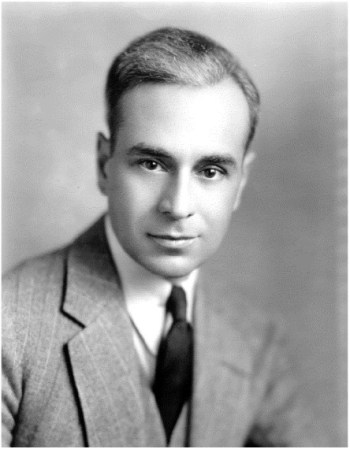
Paul Gardner (1894–1972), director of the Nelson-Atkins Museum of art from 1933 to 1953 (Nelson-Atkins Archive)
As excitement builds for the release of the Sony film The Monuments Men, The Nelson-Atkins Museum of Art applauds six real-life Monuments Men who either worked in or closely with the museum. Monuments men and women, commissioned by Franklin D. Roosevelt during World War II, were tasked with the protection, recovery, and preservation of millions of Europe’s masterpieces during the Nazi occupation.
“The men and women involved in this selfless effort to keep art objects safe during a dangerous time in history showed immense courage,” said Julián Zugazagoitia, CEO and Director of the Nelson-Atkins. “We are deeply in their debt for preserving these treasures for humanity.”
A display of archival materials will be on view in Bloch Lobby that includes postcards, manuscripts, newspaper clippings, and biographies of the Nelson-Atkins’ Monuments Men.
“My research has shown that these six men brought to their military duties the same passion for art and culture that made them so valuable to the Nelson-Atkins,” said MacKenzie Mallon, a researcher in the European Painting & Sculpture Department who has been working on this project for many months. “They took their responsibilities as protectors of these monuments very seriously.”
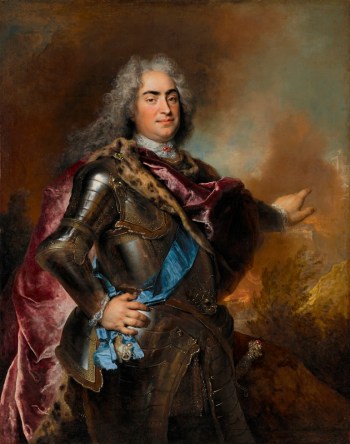
Nicolas de Largillière, Augustus the Strong, Elector of Saxony and King of Poland, ca. 1714–15. Oil on canvas, 58 x 46 inches (146 x 116 cm)
The Nelson-Atkins Museum of Art, Kansas City.
The museum employed four of the Monuments Men and maintained strong ties with two others. Paul Gardner, the first director of the Nelson-Atkins, served as Director of the Fine Arts Section of the Allied Military Government in Italy. Another former director, Laurence Sickman, was assigned to General Douglas MacArthur’s Tokyo headquarters after the Japanese surrender and served as a technical advisor on collections and monuments, making trips to China and Korea to assess the level of damage to monuments in those countries. He was awarded the Legion of Merit for his war services.
The first curator of European Art at the museum, Patrick J. Kelleher, served as the head of the Greater Hesse Division of the Monuments, Fine Arts and Archives section. Otto Wittmann, Jr., the first curator of Prints for the museum, was part of the OSS Art Looting and Investigation Unit (ALIU).
Langdon Warner served as the Asian art advisor to the Trustees of the Nelson-Atkins in 1930 and was a close colleague of Sickman. He helped found the American Defense-Harvard Group, a precursor of the Roberts Commission, Roosevelt’s task force. James A. Reeds served with the Monuments, Fine Arts and Archives section in France in 1944. He taught linguistics at University of Missouri at Kansas City and served as a docent for the Nelson-Atkins.
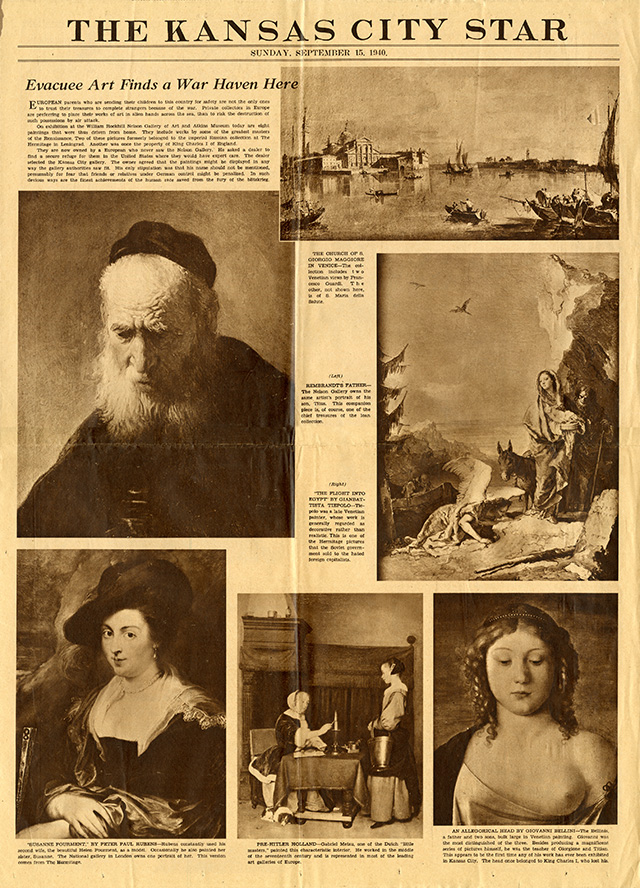
The Kansas City Star (Sunday, 15 September 1940).
One of the finest examples of 18th-century portraiture at the Nelson-Atkins, Nicolas de Largillière’s Augustus the Strong, Elector of Saxony and King of Poland, was found by the Monuments Men in a bomb-rigged salt mine in Alt Aussee, Austria and returned to Clarice de Rothschild, whose family owned the painting. It was purchased by the Nelson-Atkins in 1954 after Rothschild sold it to an art dealer in New York. During World War II, the Nelson-Atkins also served as a safe house for more than 150 paintings and tapestries from collections on the East and West coasts.
U.S. Senator Roy Blunt from Missouri recently introduced a bipartisan bill that would award Congressional Gold Medals to all 350 of the men and women referred to as Monuments Men. “The Nelson-Atkins has a rich history which is only enhanced by the individuals who have worked there,” said Senator Blunt. “These Monuments Men protected historical artifacts from destruction and saved these treasures for future generations. I am proud to introduce legislation to award the Congressional Gold Medal to the men and women who fought to preserve this priceless history.”
The Monuments Men, starring George Clooney and Matt Damon, will be released nationally on February 7. The film is based on the book The Monuments Men: Allied Heroes, Nazi Thieves and the Greatest Treasure Hunt in History by Robert M. Edsel, who continued his investigation into the soldiers who rescued cultural treasures in Saving Italy. The latter book discusses the heroism of former Nelson-Atkins director Paul Gardner. Edsel has created the Monuments Men Foundation for the Preservation of Art, which honors the legacy of the Monuments Men. For more information, visit monumentsmenfoundation.org.
◊ ◊ ◊ ◊ ◊
◊ ◊ ◊ ◊ ◊
Writing about the film for The NY Times, Tom Mashberg offers this important reminder:
Tom Mashberg, “Not All Monuments Men Were Men,” The New York Times (29 January 2014).
The art-hunting team, officially known as the Monuments, Fine Arts and Archives Section, grew to more than 300 people in the postwar years. The women never numbered more than a few dozen, but, like the men, they were dedicated scholars and at times notable heroes.
Rose Valland, whose role is depicted briefly by Cate Blanchett in the film, was a French Resistance operative who spied on the Nazis and showed herself able to shoot and drink with the boys. Edith A. Standen was a captain in the Women’s Army Corps who went on to a career at the Metropolitan Museum of Art [serving as curator of textiles from 1940 to 1970]. And Ms. Hall was a Smith College graduate who came to the task from a career focused on the study of Asian art. . . .
The full article is available here»
Alexander Sturgis Appointed Director of the Ashmolean
From the press release (January 2014) . . .
 The University of Oxford is pleased to announce the appointment of Dr Alexander Sturgis as the new Director of the Ashmolean Museum of Art and Archaeology. He will take up the appoint- ment on 1 October 2014, succeeding Professor Christopher Brown CBE, who has been the Museum’s Director since 1998.
Dr Sturgis has had a distinguished career as the Director of the Holburne Museum, Bath, since 2005 and previously held various posts over 15 years at the National Gallery, London, including Exhibitions and Programmes Curator from 1999 to 2005.
Welcoming the appointment of Dr Sturgis, the University’s Vice-Chancellor, Professor Andrew Hamilton, said: “We are delighted that Dr Sturgis has agreed to come to Oxford to lead the Ashmolean. The Museum has undergone a substantial transformation in recent years under the outstanding leadership of Christopher Brown. I am fully confident that Dr Sturgis will take forward with equal distinction the next stage of the Ashmolean’s development.”
Professor Ian Walmsley, Pro-Vice-Chancellor (Academic Services and University Collections), said: “I am looking forward very much to working with Dr Sturgis as he develops a strategy for the Ashmolean that continues its exceptional trajectory and maximises the contribution of its outstanding collections, both to the teaching and research of the University and to the Museum’s exciting range of activities involving the general public.”
Mr Bernard Taylor, Chairman of the Board of Visitors of the Ashmolean Museum, said: “I am so pleased that Xa Sturgis has decided to come to the Ashmolean. His great success at the Holburne Museum and his previous time at the National Gallery, working closely with Neil McGregor, prepares him well for leadership of this great museum. His past work in the use of collections in education, in arranging successful exhibitions, and in raising visitor numbers six-fold at the Holburne gives him the experience base to build upon the considerable success the Ashmolean has enjoyed in recent times.”
Responding to his appointment, Dr Sturgis said: “I am thrilled to be appointed the next Director of the Ashmolean. It is a huge honour to be given the chance to lead one of the country’s great museums, however hard it will be to leave the Holburne after eight exceptionally happy and eventful years. I look forward to working with the Ashmolean team and Oxford University to build on all that has been achieved at the Museum in recent years.”
◊ ◊ ◊ ◊ ◊
Sturgis’s bio from the Holburne Museum:
Alexander Sturgis studied Modern History at Oxford (1982–85) before completing a PhD in Art History at the Courtauld Institute, London (1985–90).
He joined the National Gallery, London in 1991 where he spent 14 years first as Education Officer (1991–99) and then as Exhibitions and Programmes Curator (1999–2005). During this time he also served as the Director’s Curatorial Assistant helping to set up the Regional Museums Task Force. His exhibition credits at the National Gallery include Seeing Salvation (2000), Telling Time (2000), Bill Viola: The Passions (2003), and Rebels and Martyrs: The Artist in the Nineteenth Century (2006). His list of publications includes Faces (1999) Telling Time (2000) Understanding Paintings: Themes in Art Explored and Explained (2000), and Rebels and Martyrs: The Artist in the Nineteenth Century (2006). He was appointed Director of the Holburne Museum in 2005.
Winterthur Acquires Fraktur Collection
Recently noted at ArtDaily:

Andreas Kolb, Fraktur, ca. 1785 (Winterthur Museum)
Photo by Jim Schneck
◊ ◊ ◊ ◊ ◊
Winterthur Museum, Garden & Library announces a landmark acquisition from the estate of Pastor Frederick S. Weiser (1935‒2009) containing a large religious text signed by Andreas Kolb that is widely regarded by scholars and collectors as one of the greatest Pennsylvania German fraktur ever made. Fraktur is a Germanic style of decorative work on paper. As one of the largest acquisitions in the museum’s history, it includes 121 fraktur plus nearly 200 textiles and other items in addition to Pastor Weiser’s extensive research papers.
“Winterthur is honored to have acquired this exceedingly important collection. We thus preserve the legacy of an extraordinary scholar and establish Winterthur’s already excellent collection of Pennsylvania German decorative arts as among the top few institutional holdings,” said Winterthur Director Dr. David P. Roselle.
A prolific writer and longtime editor of the Pennsylvania German Society, Pastor Weiser is considered one of the foremost scholars and collectors of Pennsylvania German decorative arts. He published numerous books and articles on Pennsylvania German arts and culture in addition to directing several major research projects that resulted in publications and exhibitions. “Pastor Weiser’s exceptional collection will be preserved largely in its entirety at Winterthur, where it can be studied alongside his extensive research files, which were donated by his estate to the Winterthur Library,” said J. Thomas Savage, director of museum affairs at Winterthur.
Assembled by Pastor Weiser over a span of more than forty years and with a careful eye to collecting the most significant or rare examples, the collection includes many objects acquired directly from descendants of the original owner or maker. Many objects were featured in Pastor Weiser’s publications, exhibitions, and lectures and represent a core group of well-documented pieces on which scholars rely. Linda Eaton, Winterthur’s John L. and Marjorie P. McGraw director of collections and senior curator of textiles, added, “We are thrilled to bring the Weiser collection to Winterthur, where the historical and artistic significance of this exceptional collection will be preserved and made accessible to a broad audience.”
Additional highlights from the Weiser fraktur collection include a large alphabet made in 1795 by Jacob Otto, a joiner and fraktur artist who worked in Lancaster County; a spiritual clockworks attributed to itinerant artist Friedrich Krebs; several dozen small drawings that were given to students by their schoolmasters as rewards for good behavior or academic performance; certificates for birth, baptism, and confirmation; bookplates, writing samples (Vorschriften), and cutworks (Scherenschnitte); religious texts, tunebooks, and hymnals; and New Year’s greetings, valentines, and assorted drawings of buildings, people, flowers, and animals. (more…)
Neapolitan Crèche at The Met
From The Met:
Christmas Tree and Neapolitan Baroque Crèche
The Metropolitan Museum of Art, New York, 26 November 2013 — 6 January 2014
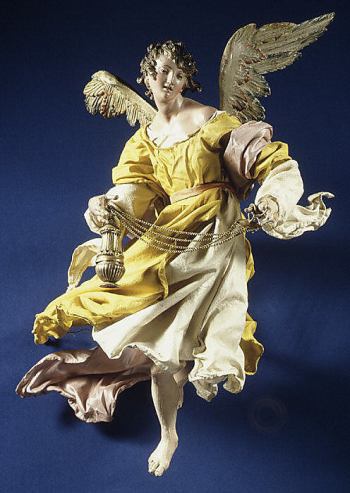
Angel, attributed to Giuseppe Sanmartino (Italian, 1720–1793), polychromed terracotta head; wooden limbs and wings; body of wire wrapped in tow; various fabrics, 14 inches (NY: The Met)
The Museum continues a longstanding holiday tradition with the presentation of its Christmas tree, a favorite of New Yorkers and visitors from around the world. A vivid eighteenth-century Neapolitan Nativity scene—embellished with a profuse array of diminutive, lifelike attendant figures and silk-robed angels hovering above—adorns the candlelit spruce. Recorded music and lighting ceremonies add to the enjoyment of the holiday display.
The annual Christmas installation is the result of the generosity, enthusiasm, and dedication of the late Loretta Hines Howard, who began collecting crèche figures in 1925 and soon after conceived the idea of combining the Roman Catholic custom of elaborate Nativity scenes with the tradition of decorated Christmas trees that had developed among the largely Protestant people of northern Europe. This unusual combination was presented to the public for the first time in 1957, when the Metropolitan Museum initially exhibited Mrs. Howard’s collection. More than two hundred eighteenth-century Neapolitan crèche figures were given to the Museum by Loretta Hines Howard starting in 1964, and they have been displayed each holiday season for nearly forty years. Linn Howard, Mrs. Howard’s daughter, worked with her mother for many years on the annual installation. Since her mother’s death in 1982, she has continued to create new settings for the Museum’s ensemble. In keeping with family tradition, Linn Howard’s daughter, artist Andrea Selby Rossi, joins her mother again this year in creating the display.

The exhibit of the crèche is made possible by gifts to The Christmas Tree Fund and the Loretta Hines Howard Fund.
The Museum’s towering tree, glowing with light, is adorned with cherubs and some fifty gracefully suspended angels. The landscape at the base presents the figures and scenery of the Neapolitan Christmas crib. This display mingles three basic elements that are traditional to eighteenth-century Naples: the Nativity, with adoring shepherds and their flocks; the procession of the three Magi, whose exotically dressed retinue echoes the merchants and travelers one may have encountered in bustling Naples at the time of the crèche’s creation; and, most distinctive, colorful peasants and townspeople engaged in their quotidian tasks. The theatrical scene is enhanced by a charming assortment of animals—sheep, goats, horses, a camel, and an elephant—and by background pieces serving as the dramatic setting for the Nativity, including the ruins of a Roman temple, several quaint houses, and a typical Italian fountain with a lion’s-mask waterspout.
The origin of the popular Christmas custom of restaging the Nativity traditionally is credited to Saint Francis of Assisi. The employment of manmade figures to reenact the hallowed events soon developed and reached its height of complexity and artistic excellence in eighteenth-century Naples. There, local families vied to outdo each other in presenting elaborate and theatrical crèche displays, often assisted by professional stage directors. The finest sculptors of the period—including Giuseppe Sammartino and his pupils Salvatore di Franco, Giuseppe Gori, and Angelo Viva—were called on to model the terracotta heads and shoulders of the extraordinary crèche figures. The Howard collection includes numerous examples of works attributed to them as well as to other prominent artists.
The Museum’s crèche figures, each a work of art, range from six to twenty inches in height. They have articulated bodies of tow and wire, heads and shoulders modeled in terracotta and polychromed to perfection. The luxurious and colorful costumes, many of which are original, were often sewn by ladies of the collecting families and enriched by jewels, embroideries, and elaborate accessories, including gilded censers, scimitars and daggers, and silver filigree baskets. The placement of the approximately fifty large angels on the Christmas tree and the composition of the crèche figures and landscape vary slightly from year to year as new figures are added.
From the V&A: The Château de Juvisy Appeal

Pierre-Denis Martin, The Château de Juvisy,
165cm x 265cm, ca. 1700
◊ ◊ ◊ ◊ ◊
From the V&A:
We need your help to raise £500,000 to make this significant acquisition in time for the opening of the Europe 1600–1800 galleries.
The next stage of the V&A’s FuturePlan sees the opening of our redeveloped Europe 1600–1800 galleries. To complete these galleries we need your help to make one of our most ambitious acquisitions to date—a major Baroque oil painting of the Château de Juvisy, by Pierre-Denis Martin, court painter to Louis XIV. An accurate depiction of a French château and gardens from the 17th century is very rare, and unusually for an architectural portrait of this kind, the scene is bursting with human activity. Martin provides an extraordinary and vivid insight into the many aspects of château life and there are currently no paintings like it in any museum in the UK.
 The painting will play a pivotal role in Gallery 5 of our seven redeveloped Europe 1600–1800 galleries, which will focus on the rise of France during 1660–1720. The painting will be displayed in a prominent position and the vast panorama, measuring 165cm x 265cm, will be the first thing you will see as you enter the space, setting the tone for the whole gallery. The arrival of Louis XIV is believed to be depicted in the foreground, and the gallery will explore the tastes and styles of his regency.
With the design of the new galleries complete and the building work now under way, we urgently need your support to ensure that we can purchase this significant centrepiece. The V&A has already managed to secure a large proportion of the £1,300,000 it will cost to purchase the painting, but we are not there yet. We urgently need your support to help raise £500,000 for this important painting to become a part of our collection. Your contribution towards this appeal, however large or small, will be vital to ensuring that we can make this ambitious acquisition in time.
Donate here»
The painting was only recently recognized as the work of Pierre-Denis Martin by Alan Rubin of Pelham Galleries; more information is available in this article, “Going Dutch: Buyers Aplenty at the Maastricht Art Fair,” The Economist (17 March 2010).










 Enfilade
leave a comment