The Met Acquires Work by William Theed
As noted at Art Daily (14 March 2013) . . .
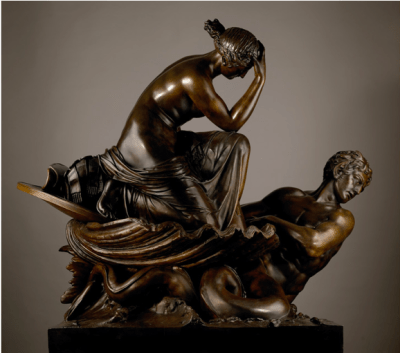
William Theed the Elder (1764-1817), Thetis Returning from Vulcan with the Armour of Achilles. Bronze, cast, chased and patinated, on an integral rectangular plinth. Height: 128 cm; width: 120 cm; length: 143 cm.
For over a year, Tomasso Brothers, the internationally renowned dealers in European sculpture, paintings, furniture and the decorative arts, has been searching for an elegant space in London. Dino and Raffaello are now delighted to announce that from 1 May 2013 they can be found at their new gallery at 12 Duke Street , St James’s. Established in 1993 and based at Bardon Hall, Leeds, Tomasso Brothers is pleased to also have a presence in the heart of London ’s traditional art market where they will showcase exciting pieces from their extensive portfolio.
The two Tomasso brothers are especially renowned for their expertise in European sculpture and boast a number of the world’s greatest museums amongst their clients. Recent sales include a major bronze to the Metropolitan Museum of Art, New York, Thetis Returning from Vulcan with the Armour of Achilles by William Theed the Elder (1764-1817), which was unveiled at the inaugural Frieze Masters in October 2012. This remarkable, almost life-size, bronze depicts the ‘divine Thetis of the silver feet’, most famous of the Nereids in Homer’s Iliad, kneeling by the shield of her son Achilles with the hero’s armour in a giant cockle shell. This spectacular sculpture, described by Sir Timothy Clifford as ‘undoubtedly Theed’s most ambitious work’, was almost certainly originally supplied to the author, philosopher, interior designer and art collector, Thomas Hope (1769-1831) for Duchess Street, London, or his country house Deepdene in Surrey. William Theed was born in London and entered the Royal Academy Schools in 1786. He went to Italy in 1790, returning in 1796. He began his artistic career as a painter but was befriended by the sculptor John Flaxman whilst in Rome and took up sculpture. Flaxman’s designs for Homer’s Iliad clearly made a powerful and lasting impression on the young Theed. Dino Tomasso said: ‘It is hugely gratifying when such a superb sculpture ends up in one of the world’s leading museums’. Dino and Raffaello Tomasso take great pride and pleasure in helping connoisseurs and museums in Europe and America to enhance their collections. In addition the company has promoted and supported through loans and exhibitions major international institutions such as the Fitzwilliam Museum, Cambridge, the Centro Internazionale, Carrara, the National Gallery, Prague, and the Kunsthistorisches Museum, Vienna. Most recently they were one of the sponsors of the landmark show Bronze at the Royal Academy of Arts, London , in 2012.
Tomasso Brothers will be exhibiting at TEFAF, 15 to 24 March 2013, Stand 165, Masterpiece London, 27 June to 3 July 2013, Stand C2, and also joining Master Drawings and Sculpture Week from 28 June to 5 July 2013.
Paper-Cut Project
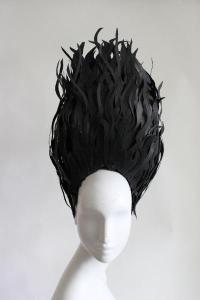
Amy Flurry and Nikki Nye, Marie Antoinette (2006), paper, 2012
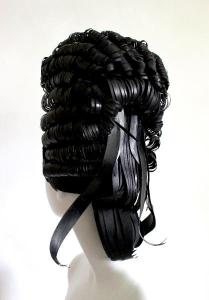
Amy Flurry and Nikki Nye, Marie Antoinette (1938), paper, 2012
As profiled by Rinne Allen and Lucy Allen Gillis in the recent issue of Selvedge Magazine 50 (Jan/Feb 2013), Amy Flurry and Nikki Nye, co-founders of the Atlanta-based company Paper-Cut Project, contributed sixteen paper wigs for the V&A’s recent exhibition Hollywood Costume. Given that notice of Isabelle de Borchgrave’s paper dresses exhibited in San Francisco in 2011 remains one of the most popular postings here at Enfilade, I would expect readers to be similarly interested in these paper hair pieces.
–CH
The Nelson-Atkins Names Antonia Boström as Curatorial Director
Press release (27 February 2013) from the museum:
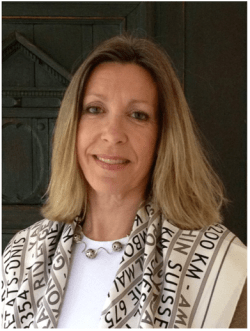 Following an international search, The Nelson-Atkins Museum of Art in Kansas City today announced the appointment of Antonia Boström as Director of Curatorial Affairs, a position that will lead the Nelson-Atkins’s dynamic curatorial team. Boström brings a wealth of experience from art museums in London and the United States, including her current leadership position at the J. Paul Getty Museum, Los Angeles. She will begin her new post at the Nelson-Atkins in May.
“Dr. Boström’s wealth of experience across continents and in institutions with world-class collections made her unequivocally the ideal candidate for this position,” said Julián Zugazagoitia, Director & CEO of the Nelson-Atkins. “She brings a depth of scholarship and invaluable skills that will advance the curatorial voice of the Nelson-Atkins toward even higher levels of excellence.”
Boström has pursued art throughout her life, and her scholarship and management skills have led her to the Getty Museum, the Detroit Institute of Arts, the Royal Academy of Art, London, and the Victoria and Albert Museum, London, among others. She is excited to come to Kansas City and work with the esteemed collection at the Nelson-Atkins.
“The museum is at a great moment of transition, with the exquisite new Bloch Building, a gem of architecture, and with the leadership of Julián Zugazagoitia,” Boström said. “I am interested in working with a collection that is so renowned, but that perhaps is not widely enough known, and in discovering what the museum means to Kansas City. I look forward to working with a talented group of curators as we strive to reach new audiences.”
Born and raised in London, the daughter of a paintings conservator, she received her B.A. (1979) in the History of Art from the Courtauld Institute of Art, London University, and obtained her PhD in 1996 from the same institution. She worked in London as museum assistant at the National Portrait Gallery (1980), in the National Art Library and as an assistant curator at the Victoria and Albert Museum (1980-1985), as a commissioning editor at the Grove Dictionary of Art for Macmillan Publishers (1985-1988), and as acting curator of the Permanent Collection of Paintings and Sculpture at the Royal Academy of Arts (1995-96).
Boström, fluent in five languages, spent important years at the Detroit Institute of Arts from 1996 to 2004, working with that institution’s rich collection as an assistant, then associate curator in the Department of European Sculpture and Decorative Arts. While there she was co-author of Catalogue of Italian Sculpture in the Detroit Institute of Arts, and she was an adjunct professor at Wayne State University.
Since 2004 she has been the Senior Curator and Department Head, Sculpture and Decorative Arts Department at the J. Paul Getty Museum. Boström led the installation of the Fran and Ray Stark Sculpture Garden and Terrace in collaboration with Richard Meier Architects & Olin Patnership, plus the reinstallation of several Sculpture and Decorative Arts galleries. Among the many she has been involved with are two recent exhibitions at the Getty Museum – Messerschmidt and Modernity and Cast in Bronze: French Sculpture from Renaissance to Revolution. (more…)
Nationalmuseum acquires Miniature Portrait by Adélaïde Labille-Guiard
Press release (February 2013) from the Nationalmuseum in Stockholm:

Adélaïde Labille-Guiard, Madame Lefranc Painting a Portrait of Her Husband Charles Lefranc, watercolour and gouache on ivory, 1779 (Stockholm: Nationalmuseum, NMB 2625) Photo: Bodil Karlsson
The Nationalmuseum has acquired a spectacular miniature by Adélaïde Labille-Guiard. One of the most important women artists in late 18th-century France, she was not previously represented in the museum’s collections. The work is interesting on account of the motif alone, depicting a woman, albeit an amateur, in the role of artist.
Miniature portraits by Adélaïde Labille-Guiard (1749–1803) are extraordinarily rare. Her depiction of Madame Lefranc Painting a Portrait of Her Husband Charles Lefranc was painted five years after she made her debut (1779). Like many other female artists, she realized early on that miniature portraits offered a steady source of income. She was a pupil of the Swiss enamellist François-Élie Vincent, a neighbour of her father’s fashion shop in Paris. Gradually Labille-Guiard also took up working with pastels. She frequently reproduced these works in a smaller format as miniatures. After her election to the French Royal Academy of Art in 1783, she switched over completely to large-scale oil portraits. By then, Labille-Guiard had acquired pupils such as Marie-Gabrielle Capet and Marie-Thérèse de Noireterre. It became their job to translate her portraits into miniature format to satisfy the ever-changing demands of customers.
The acquisition of this spectacular work by Adélaïde Labille-Guiard, made possible by a generous donation from the Hjalmar and Anna Wicander Foundation, has filled a major gap in Nationalmuseum’s world-renowned miniatures collection. Madame Lefranc Painting a Portrait of Her Husband Charles Lefranc also documents a time when women began to emerge as serious artists.
Getty Research Institute Acquires a Rare Set of Chinese Battle Prints
Press release (17 January 2013) from The Getty:

Ping ding Kuoerke zhan tu, or Pictures of the Campaigns against the Gurkhas
(i.e., Nepalese), China, ca. 1793 (LA: The Getty Research Institute)
◊ ◊ ◊ ◊ ◊
The Getty Research Institute (GRI) has acquired an extraordinarily rare suite of battle prints from about 1793 that depict the Chinese Emperor Qianlong’s (reign era, 1736–1795) successful military campaign against invading armies from Nepal. These eight large-format copper engravings represent the complete set of prints commissioned by the Emperor to commemorate his 1792 victory. Printed in China, this set is one of seven so-called ‘Conquest’ suites.
“The rarity of these prints makes them an extraordinary addition to the GRI’s stellar collections depicting ‘China on Paper,’ highlighting cross-cultural relationships between Europeans and Chinese,” said Marcia Reed, Chief Curator at the Getty Research Institute. “Because the GRI holds strong collections of related works, it’s extremely beneficial to bring the collections already in place and these prints together for future research and publication.”
The scenes show dynamic landscapes of undulating mountains which seem to envelope the troops marching and fighting amidst their peaks and valleys. One plate depicts the victorious emperor being carried towards a yurt in front of a grand hall. The defeated soldiers of the enemy are grouped on the left, all on their knees. Each print includes a poem at the top of the engraved print; the poems were based on the Emperor’s own personal commentary on the scenes.
Prints such as these made their way into China from Europe in the 1700s and the emperor would have been given gifts of panoramic battle prints by visiting European dignitaries. In 1765 he ordered drawings to be made from monumental paintings commemorating his recent victories. These drawings, made by Jesuits employed by Qianlong’s court, were sent to Paris for engraving and printing. Created by Europeans for a Chinese audience, the prints were very European in appearance, with Chinese visual tropes incorporated in the drawings. When the prints were received at court, poetry was added to them—a very Chinese touch.
The Pictures of the Campaigns against the Gurkhas break away from this hybrid imagery. Though inspired by a European tradition and using French printing techniques, the drawings are notably Chinese in composition and style.
As part of the GRI’s special collection, these prints will now be available for scholarly research. The GRI’s vaults hold rare and unique collections in art history and visual culture from around the world, including more than 27,000 prints ranging from the Renaissance to the present.
◊ ◊ ◊ ◊ ◊
Additional information and illustrations are available at Amy Hood’s posting on the Getty’s blog, The Iris»
Peabody Essex Museum Appoints Its First Curator of American Art
Press release (6 October 2012) from the Peabody Essex Museum in Salem, MA:
 The Peabody Essex Museum announced the appointment of Austen Barron Bailly as the museum’s first George Putnam Curator of American Art. Bailly joins PEM’s curatorial team following her post as the head of the American Art department at the Los Angeles County Museum of Art (LACMA) and previous positions held at the Metropolitan Museum of Art and Wildenstein & Co., Inc. in New York.
Selected for her interdisciplinary and adventuresome curatorial approach, Bailly joins PEM at the cusp of the museum’s landmark $650 million campaign and expansion project. In her curatorial capacity at PEM, Bailly will lead the development of a multi-faceted American art program focusing on exhibitions, new interpretation in the galleries, and expanding the museum’s collection which currently includes paintings, decorative arts, photographs, folk art, and textiles representing over 300 years of New England and American art and culture.
“Austen brings a fresh and exciting perspective to the field that will greatly accelerate and enhance the museum’s presentation of American Art in the years to come,” said Lynda Roscoe Hartigan, PEM’s James B. and Mary Lou Hawkes Chief Curator.
A native of New Orleans, Bailly earned her PhD in art history from the University of California, Santa Barbara and her MA from Williams College. She will begin her new position as PEM’s George Putnam Curator of American Art in January, 2013. George and Nancy Putnam are long-time PEM Trustees who have made an indelible contribution to the museum’s future with their endowment of Bailly’s position, and that of a future Curator of Fashion and Textiles, for whom a national search is in progress.
PEM announced a comprehensive $650 million Campaign in October 2011, designed to advance the museum’s mission to celebrate outstanding artistic and cultural creativity in ways that transform people’s lives. To date, the museum has received gifts and pledges totaling $570 million. The Campaign includes a $350 million addition to the current $280 million endowment, $200 million for a 175,000-square-foot expansion designed by Rick Mather Architects, and $100 million to support creative new installations of the collection, several infrastructure improvements to existing facilities and other advancement initiatives. The $350 million endowment increase will cover all increased operating and program costs for an expanded facility; support continued development of the museum’s distinctive exhibitions, publications, curatorial and education programs; and enable continuation of a strong financial base. The expansion, set to open in 2017, will add up to 75,000 square feet of new galleries; a new restaurant and roof garden; new public program and education space; and essential improvements to collections storage, exhibition processing and conservation functions.
TEFAF Museum Restoration Fund Announces 2013 Grants
Good news for a few eighteenth-century holdings at the Worcester Art Museum and the Ashmolean, announced by the TEFAF Museum Restoration Fund ahead of this year’s art fair at Maastricht (15-24 March 2013) . . .
◊ ◊ ◊ ◊ ◊
The Worcester Art Museum in the United States and the Ashmolean Museum in the United Kingdom are to receive grants from the TEFAF Museum Restoration Fund to help them carry out important conservation projects. The Fund was set up by TEFAF Maastricht, as one of its 2012 Silver Jubilee initiatives and provides up to €50,000 each year to help institutions around the world conserve works of art in their collections. A panel of independent, international experts considered many applications from museums before selecting the two winning projects, which will each receive €25,000.

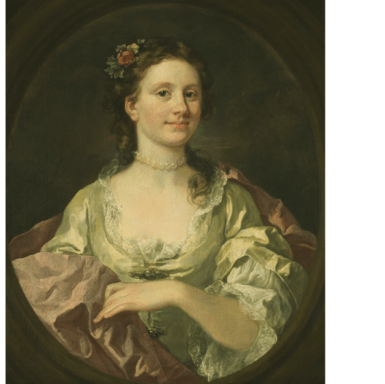
William Hogarth, Portraits of William and Elizabeth James,
1744 (Worcester Art Museum)
◊ ◊ ◊ ◊ ◊
The Worcester Art Museum in Worcester, Massachusetts is to restore a pair of portraits by the eighteenth-century British artist William Hogarth. The pendant portraits of William and Elizabeth James, painted by Hogarth in 1744, were acquired by the museum more than a century ago but have never been comprehensively treated or technically evaluated and will benefit greatly from a conservation project. The work will enable the Worcester Art Museum to feature them prominently in Hogarth and the English Character, an exhibition planned for 2016, and ultimately to return these cornerstone works to its permanent galleries. The restoration will allow those viewing them to experience the full impact of the paintings as exquisite works of art without any concerns about their condition. The newly conserved pictures will reveal more authentic palettes and broader tonal ranges that, when reunited with their newly conserved frames, will enable viewers to have the pleasing experience intended by Hogarth.
William Hogarth (1697-1764) was one of the masters of British painting. Although best known for his biting satires of society that were popularised in engravings, he was also a skilled portraitist. In these paintings he captured the confidence of William James, a country squire from the English county of Kent, and his wife Elizabeth, both proud of their fashionable London clothes.
◊ ◊ ◊ ◊ ◊
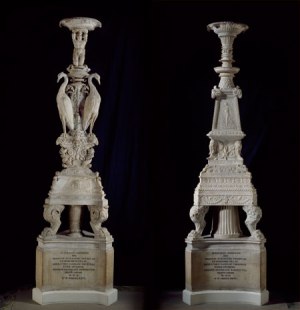 The Ashmolean Museum in Oxford is to carry out a conservation project on two candelabra by the Italian artist Giovanni Battista Piranesi (1720-78). The intricately carved candelabra are some of the finest examples of neo-classical sculpture in the United Kingdom. They form a key element of the collections displayed in the Ashmolean’s impressive Randolph Sculpture Gallery and are of international significance. They were purchased from Piranesi by Sir Roger Newdigate, who made two Grand Tours in 1739-40 and 1774-75. The candelabra were shipped in component form from Italy to Oxford with instructions for their re-assembly provided by Piranesi. The candelabra have become structurally unsound because the plaster bonding in the joints between each vertical section has failed during the 100 years since they were last restored. Until they were re-plinthed on pallets in 1991, these vulnerable objects were traditionally moved by masons dragging them across the floor, using winches, rather than lifting them. Although they are now mounted on pallets, disguised as plinths, moving them still puts them at risk as they comprise many loose components. For that reason the museum has developed this project to dismantle, conserve and structurally stabilize these remarkable objects.
Imperial Apartments at the Correr Museum Restored
This article by Gildas le Roux from the AFP appeared on Sunday, 16 December 2012 at ArtDaily:

Piazza San Marco with View of Museo Correr
(Photo March 2007 by Andrew Balet, Wikimedia Commons)
◊ ◊ ◊ ◊ ◊
After a century of neglect, a magnificent palace built by Napoleon in Venice has re-opened its doors to the public on the island city’s famous St Mark’s Square thanks to a French restoration effort. The reasons for the long abandonment are easily explained — Venice is not Napoleon’s biggest fan. Nor do canal residents have fond memories of the Royal Palace’s most famous resident — 19th-century Austrian empress Elisabeth or ‘Sisi’ — a symbol of the city’s imperial domination. “In popular consciousness, Napoleon is primarily the man who ended the glorious republic of Venice (697-1797),” said Andrea Bellieni, director of the Correr Museum which oversees the Royal Palace.
A group called French Committee for Safeguarding Venice [Comité Français de Sauvegarde de Venise in partnership with the Napoleon Foundation] has financed the restoration of this sumptuous palace, which was in a pitiful state. With a budget of 2.5 million euros ($3.2 million) from private donors, the committee has restored the main halls and the empress’s apartment to its old-time splendour when a 19-year-old ‘Sisi’ and her husband, Emperor Franz Joseph I, stayed there. The furniture decorating the restored chambers is in the same neo-Baroque style popular at the imperial court in Vienna at the time. The empress’s boudoir is a highlight with its images of feminine allegories and flowery garlands.
Napoleon proclaimed himself King of Italy in 1805 and ordered the palace built in 1807 in front of the iconic St Mark’s Basilica after visiting Venice, but never actually lived in it. Built in six years and decorated by French-inspired painter Giuseppe Borsato, the structure is now the only neo-Classical royal palace in Italy. . .
The full article is available here»
Birmingham Acquires Reynolds’s Portrait of Dr. John Ash
Press release from the Birmingham Museum & Art Gallery (2 October 2012) . . .

Sir Joshua Reynolds, Portrait of Dr John Ash, 1788 (Birmingham Museum & Art Gallery)
Director Ann Sumner today announces that Birmingham Museums has been successful in raising funds to acquire Sir Joshua Reynolds’ iconic portrait of Dr John Ash. The magnificent work, currently owned by Queen Elizabeth Birmingham Hospitals Charity, has been on loan to Birmingham Museum & Art Gallery since 1993. This acquisition secures the painting for the city, ensuring that future generations can continue to enjoy the masterpiece.
The portrait of Dr Ash by the celebrated eighteenth-century portrait painter Reynolds is valued at £900,000 but the Queen Elizabeth Birmingham Hospitals Charity has generously agreed to reduce this to £875,000 to enable Birmingham Museums to successfully complete the acquisition. Professor Sumner comments, “”We are delighted to announce that Birmingham Museums will be acquiring this significant work. The portrait is one of Reynolds’ late, great works, and its combined historic and artistic qualities make it one of the most important cultural icons of the city of Birmingham. The acquisition comes at a particularly opportune time for the city, and will be presented as part of a larger celebration of portraiture from Birmingham’s collections in 2013.”
Councillor Ian Ward, deputy leader of Birmingham City Council said: “This painting has real importance for the city’s heritage, and I’m delighted that Birmingham Museums have raised the necessary funds in addition to the lottery fund grant. I would like to thank everyone who played a part in securing this wonderful painting which the people of Birmingham – and visitors to our city – will be able to enjoy and appreciate.”
Birmingham Museums Trust was awarded a grant of £675,000 from the Heritage Lottery Fund and £100,000 from The Art Fund to support the acquisition. The Museums Trust has successfully raised a further £100,000 through grants from organisations including the Museum Development Trust, Public Picture Gallery Fund, the Friends of Birmingham Museum & Art Gallery, William A Cadbury Trust and John Feeney Trust.
Although Birmingham Museums Trusts has successfully raised the money to acquire the portrait, the public appeal will continue in order to raise the funds to undertake minor conservation works to the painting, not least having it reglazed with non-reflective glass so visitors can better appreciate the Reynolds’ masterpiece.
John Ash (1723–98) was an eminent physician who built up a successful medical practice from his house in Temple Row in Birmingham. Ash was a co-founder of the Birmingham General Hospital, and the portrait commissioned by the governors of the Hospital in honour of his services to the people of Birmingham. The first installment of 100 guineas (half payment) was paid to Reynolds by George Birch on behalf of the governors in April 1788. The eleven sittings with Ash are recorded in the artist’s pocket book between 28th April and 7th July the same year.
MetPublications
From MetPublications:

◊ ◊ ◊ ◊ ◊
About MetPublications
MetPublications is a portal to the Met’s comprehensive publishing program. Beginning with nearly 650 titles published from 1964 to the present, this resource will continue to expand and could eventually offer access to nearly all books, Bulletins, and Journals published by the Metropolitan Museum since the Met’s founding in 1870. It will also include online publications.
MetPublications includes a description and table of contents for almost every title, as well as information about the authors, reviews, awards, and links to related Met bibliographies by author, theme, or keyword. Current titles that are in-print may be previewed and fully searched online, with a link to purchase the book. The full contents of almost all other titles may be read online, searched, or downloaded as a PDF, at no cost. Books can be previewed or read and searched through the Google Books program. Many out-of-print books are available for purchase, when rights permit, through print-on-demand capabilities in association with Yale University Press.
Readers may also locate works of art from the Met’s collections that are included within each title and access the most recent information about these works in Collections. Readers are also directed to every title located in library catalogues on WATSONLINE and WorldCat. Please check back frequently for updates and new book titles. MetPublications is made possible by Hunt & Betsy Lawrence.
About the Met’s Publishing Program
From its founding in 1870, the Metropolitan Museum has published exhibition catalogues, collection catalogues, and guides to the collections. Today it is one of the leading museum publishers in the world, and its award-winning books consistently set the standard for scholarship, production values, and elegant design. Each year, the Met produces about thirty exhibition and collection catalogues and general-audience books, as well as informative periodicals such as the quarterly Metropolitan Museum of Art Bulletin and the annual Metropolitan Museum Journal.
Beginning in 2000, the Met developed two groundbreaking online publications: the Heilbrunn Timeline of Art History, with 300 chronologies, 900+ essays, and close to 7,000 works of art written by Museum specialists; and Connections, which offers personal perspectives on works in the collections.
The Met’s print and online publications program will continue to expand in scope in order to reach the broadest possible audience, thus fulfilling its mission to increase public awareness of and appreciation for art, presenting insightful scholarly discussions and diverse Museum voices on works of art, art history, and especially the Museum’s collections and exhibitions.










 Enfilade
leave a comment