The Huntington Acquires Portrait by Antoine-François Callet
From the press release (28 August 2024) . . .
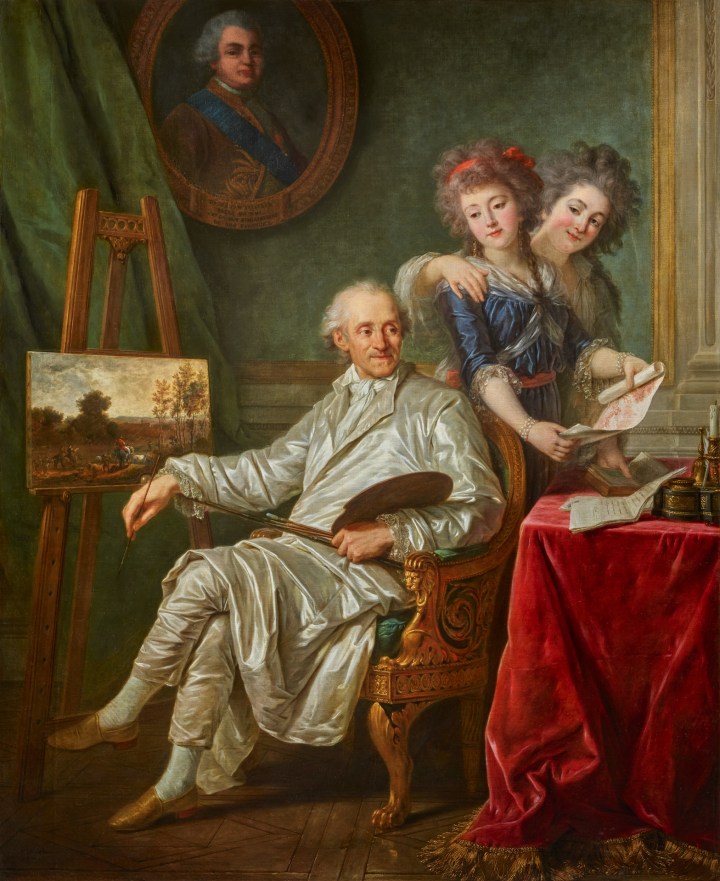
Antoine-François Callet, Portrait of the Comte de Cromot, Superintendent of the Comte de Provence, at an easel, accompanied by his two daughters-in-law, 1787, oil on canvas, 78 × 64 inches (San Marino: The Huntington Library, Art Museum, and Botanical Gardens).
The Huntington Library, Art Museum, and Botanical Gardens has acquired an ambitious, large-scale masterpiece by 18th-century French portraitist Antoine-François Callet (1741–1823), the official painter of Louis XVI. The work is the fourth in a series of acquisitions made possible by The Ahmanson Foundation.
Painted at the height of the artist’s career, Portrait of the Comte de Cromot, Superintendent of the Comte de Provence, at an easel, accompanied by his two daughters-in-law is a unique Old Master work that contains a painting within a painting. The small landscape on the easel adjacent to the sitter was painted on a separate canvas and signed by the Comte de Cromot himself, known to be an amateur painter, and then inserted into the overall composition by Callet. The complex portrait will go on view in the Huntington Art Gallery this fall as an important counterpart to the institution’s world-class collection of 18th-century French decorative arts, complementing the recent addition of Joseph Hyacinthe François-de-Paule de Rigaud, comte de Vaudreuil by Élisabeth Louise Vigée Le Brun, which also became part of the collection through a gift from The Ahmanson Foundation.
“This historically significant work by Antoine-François Callet is an extraordinary addition to our signature portrait collection and will be vital in our interpretive work as we draw connections to our related French holdings,” Huntington President Karen Lawrence said. “We are immensely grateful to The Ahmanson Foundation for their support in strengthening The Huntington’s collection of European art with this masterpiece.”
Antoine-François Callet was born in Paris in 1741. In 1764, at the age of 23, he won the Prix de Rome and completed his artistic education at the Académie de France in Rome. In the late 1770s, he returned to Paris to begin work on a ceiling painting for the Louvre, which earned him admission to the Académie Royale. He received patronage and the protection of King Louis XVI and the monarch’s brothers. As the official painter of Louis XVI, he painted the famous portrait of the king in his coronation robes. Callet was also the First Painter to ‘Monsieur’ (Comte de Provence) and the official painter to the Comte d’Artois, who were the king’s brothers. During the turbulent 18th and 19th centuries, Callet regularly exhibited at the Salon of the Académie des Beaux-Arts in Paris.
“The portrait of the Comte de Cromot is exceptional both historically and artistically,” said Christina Nielsen, Hannah and Russel Kully Director of the Art Museum at The Huntington. “It has tremendous presence—great not only in scale but also in ambition as it contains four portraits in one: that of the Comte de Cromot, his two daughters-in-law, and the future King Louis XVIII, seen in a roundel on the wall in the background.”
The primary sitter, the Comte de Cromot, was Jules-David Cromot du Bourg, superintendent of finances to the Comte de Provence, who was the brother of Louis XVI and the future king of France. The frame of the portrait of the Comte de Provence is inscribed with the words “Donné par Mr. frère du Roi au Grand Surintendant de ses finances,” acknowledging that the monumental work was commissioned by the future king for the model. The Comte de Cromot died in 1786, which makes the portrait the last representation of this important 18th-century figure. The two daughters-in-law in the painting are Marie Sophie Guillauden du Plessis and Sophie de Barral. “The Comte de Cromot is rendered as an accomplished artist, while his daughters-in-law are pictured reading letters and books and considering drawings, signifying the importance of the arts across the spectrum of intellectual life in French society,” Nielsen said.
Through its partnership with The Ahmanson Foundation, The Huntington has acquired Portrait of José Antonio Caballero, Second Marqués de Caballero, Secretary of Grace and Justice (1807) by Francisco de Goya in 2023; Portrait of Joseph Hyacinthe François-de-Paule de Rigaud, comte de Vaudreuil (ca. 1784) by Vigée Le Brun, the most important female artist of 18th-century France, in 2022; and the monumental Portage Falls on the Genesee (ca. 1839) by Anglo American painter Thomas Cole in 2021.
◊ ◊ ◊ ◊ ◊
On 25 January 2023, the portrait was sold at Christie’s in New York as lot 55 of Remastered: Old Masters from the Collection of J.E. Safra for $201,600, well under its low estimate of $300,000. –CH
Uffizi Acquires Subleyras’s Mystical Marriage of St. Catherine de’ Ricci
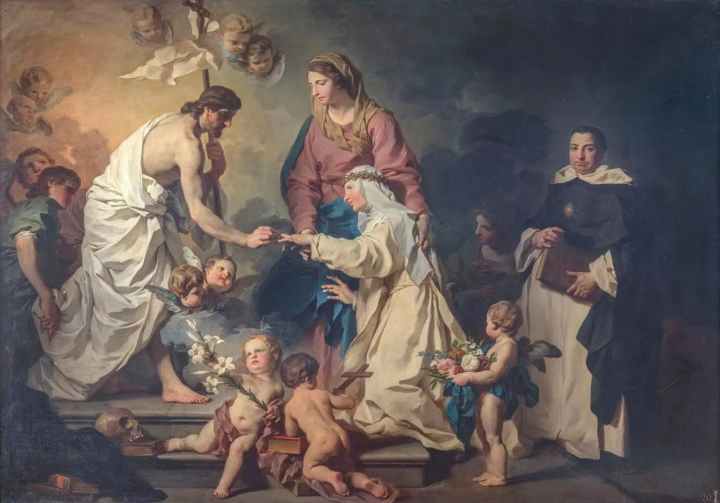
Pierre Subleyras, The Mystical Marriage of St Catherine de’ Ricci, 1746, oil on canvas, 75 × 250 cm
(Florence: Uffizi)
◊ ◊ ◊ ◊ ◊
From the recent press release (as noted at Art History News) . . .
A majestic masterpiece of 18th-century French art is set to become a highlight in the Uffizi collection: the large canvas The Mystical Marriage of Saint Catherine de’ Ricci, signed by the renowned Occitan painter Pierre Hubert Subleyras (1675–1758) and dated 1746. Historians attribute significant importance to this painting for its quality, prestigious commission, and collection history. It was acquired by the museum director, Simone Verde, at the international TEFAF fair in Maastricht in February 2024. Upon its arrival in Florence, it will be restored and prominently displayed in the gallery spaces dedicated to 18th-century painting.
In 1763, the canvas—created for the canonization of Saint Catherine de’ Ricci—was part of Girolamo Colonna di Sciarra’s collection, then Lorenzo Onofrio Colonna’s, followed by Filippo III Colonna’s. Between 1812 and 1935, it was housed in the Barberini collection in the namesake Roman palace. That same year, it was auctioned and bought by the Marquis Sacchetti, from whom it was inherited by the current owners.
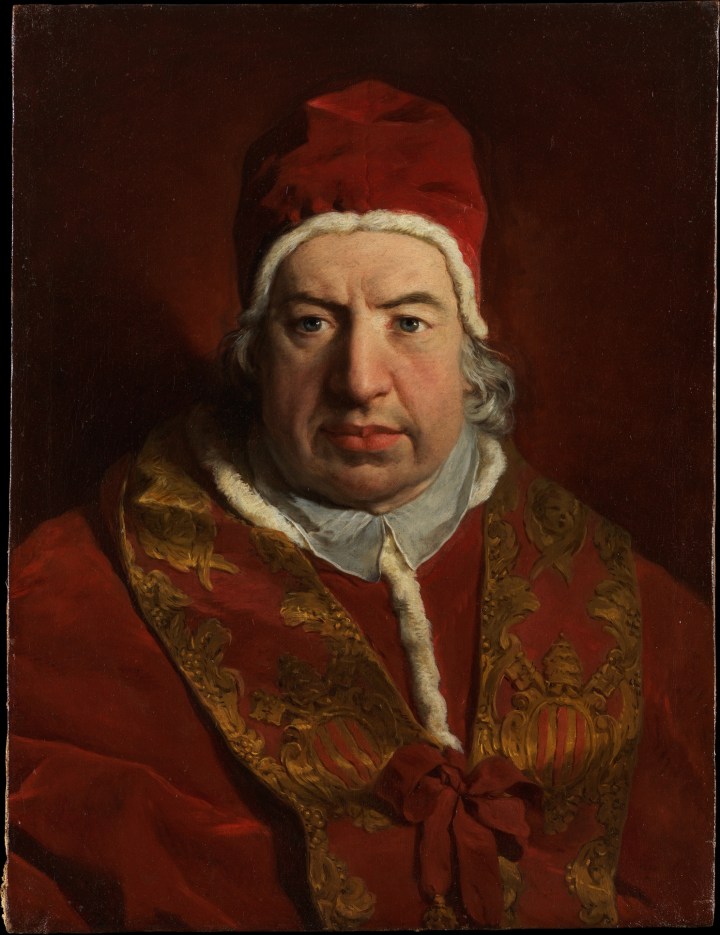
Pierre Subleyras, Portrait of Pope Benedict XIV (Prospero Lambertini, 1675–1758), 1746, oil on canvas, 64 × 49 cm (New York: The Metropolitan Museum of Art, 2009.145).
As was customary, religious orders presented the Pope with artworks celebrating the figures about to be canonized, but the choice of subject and artist was reserved for the Pope. In this case, Pope Benedict XIV Lambertini chose Subleyras, a painter gaining great success in Rome. The Bolognese Pope had entrusted him with his portrait in 1746, now housed in the Metropolitan Museum of New York.
Subleyras’ purism, the monumental quality of figures with marble-like white complexions still retaining a rocaille style, is already moving towards Neoclassicism, aligning with modernity. The solemn yet composed sacred scene in The Mystical Marriage owes much to the classicism of Poussin and his interpretation of Roman Baroque models. The reference to 17th-century classicist masters is enriched by the airy colors typical of the 18th century. The movement around the mystical marriage scene is conveyed through a multitude of putti and cherubic heads, where the artist showcases his virtuosity with still life elements such as the white lily branch or the floral arrangement held by the winged putto depicted in profile.
Subleyras distinguished himself as a painter of histories and portraits, but among his greatest masterpieces is one of the most beautiful nudes in art history, the Female Nude kept in the Barberini Gallery in Rome (ca. 1740). The French painter, who later died in Rome, was trained by his father (also a painter) and went to Paris in 1726, where he won the prestigious Prix de Rome scholarship in 1728 as a resident of the French Academy in Rome. In 1736, he married Maria Felice Tibaldi, a miniaturist who often reproduced her husband’s works in miniature. In 1748, Cardinal Silvio Valenti Gonzaga introduced the artist to Pope Benedict XIV, for whom he painted not only his portrait but also the Mass of Saint Basil for St. Peter’s Basilica (now in Santa Maria degli Angeli). During the same period, he painted the Miracle of Saint Benedict for the Olivetani church in Perugia (Rome, Santa Francesca Romana) and Saint Ambrose and Theodosius (Perugia, National Gallery of Umbria).

Pierre Subleyras, Female Nude Seen from the Back, ca. 1732, oil on canvas, 74 × 136 cm (Rome: Palazzo Barberini).
The Director of the Uffizi Galleries, Simone Verde, stated: “The Mystical Marriage is a work of primary importance for 18th-century art and will be a prominent new addition to the museum’s 18th-century rooms. Besides its refined aesthetics and compositional elegance, it significantly reflects the taste of the circle of nobles and intellectuals around the Roman Curia in the mid-18th century. It is a true masterpiece, rare to find on the market, that will enrich the Uffizi’s 18th-century collections, filling a significant gap and representing another step towards completing the pictorial history of Italy pursued by Luigi Lanzi, a mission that remains central to the museum today due to its national and international collection significance.”
Colonial Williamsburg Acquires Rare Charleston ‘Free’ Badge
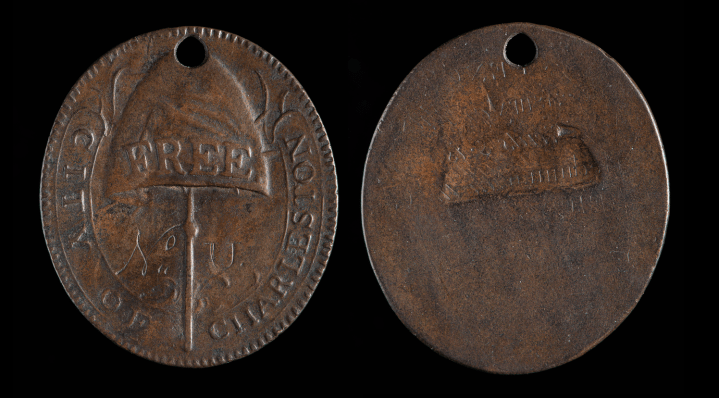
City of Charleston ‘Free’ Badge with Phrygian Cap and Pole, marked ‘No. U’, engraved by Thomas Albernethie, ca. 1787–89, copper
(Colonial Williamsburg: Museum Purchase, The Friends of Colonial Williamsburg Collections Fund and Partial Gift of John Kraljevich, 2024-171).
◊ ◊ ◊ ◊ ◊
From the press release (30 July 2024). . .
Colonial Williamsburg Acquires Rare Charleston ‘Free’ Badge
New research shows the previously unknown numismatic origins of ‘U’ and ‘X’ badges.
Weeks after the Revolutionary War ended by the terms of the Treaty of Paris in 1783, the newly incorporated city of Charleston, South Carolina began to pass laws. The population of the city was overwhelmingly African American with more than 8,000 people in the community, and the vast majority of them were enslaved; only about 600 were living there as free citizens. Ever fearful of insurrection, the city’s administration continued to implement policies designed to constrain the lives of all of its African American residents. An ordinance from 22 November 1783 regulated the employment or ‘hiring out’ of skilled and unskilled enslaved workers in which an individual went to work for an entity other than their enslaver, who was paid a fee for the service provided. An annual fee of five to forty shillings was to be paid to the city by the enslaver for the right of an enslaved person to be hired out, and a badge or ticket was required to be worn by the laborer. [The law also required free African American residents to wear badges.]
While no examples of ‘slave’ badges dating to 1783 are known to exist today, 10 ‘free’ badges from later in the 1780s have been identified in museums and private collections. The Colonial Williamsburg Foundation has recently acquired one of these ‘free’ badges, and it is now on view in the Lowcountry section of the exhibition A Rich and Varied Culture in the Nancy N. and Colin G. Campbell Gallery of the DeWitt Wallace Decorative Arts Museum, one of the Art Museums of Colonial Williamsburg.
“It’s an important piece—and an emotional one,” said J. Grahame Long, The Colonial Williamsburg Foundation’s executive director of collections and deputy chief curator. “Obviously, it’s a terrific addition to Colonial Williamsburg’s permanent collection, but it goes much further than that. It’s a critical component in telling America’s whole story.”
The Charleston ‘hiring out’ law pertained not only to enslaved workers. It went further to affect the free African American population as well, stating that
“…every free negro, mulatto or [mestizo] living or residing within this City, shall be obliged … to register him, her or themselves, in the office of the City Clerk, with the number of their respective families and places of residence … every free negro, mulatto, or mestizo, above the age of fifteen years, shall be obliged to obtain a badge from the Corporation of the City, for which badge every such person shall pay into the City Treasury the sum of Five Shillings, and shall wear it suspended by a string or ribband, and exposed to view on his breast.”
Through these dehumanizing requirements, the city of Charleston levied a fee on the right of free people of color to live and work there—a stinging irony given the root causes of the American Revolution. The penalties for breaking this law were harsh: failure to comply could cause a free person to be fined £3, which if not paid within 10 days could force the person to the workhouse (jail) and work for up to 30 days. Enslaved individuals caught wearing a ‘free’ badge were subject to whipping, by up to 39 lashes, followed by an hour in the stocks.
“I can’t help but see the parallels between these 18th-century ‘free’ badges and the yellow stars worn by Jews during the Holocaust,” said Erik Goldstein, Colonial Williamsburg’s senior curator of mechanical arts, metals, and numismatics. “Both survive as reminders of horrific ideologies, and how humanity must do better going forward.”

City of Charleston ‘Free’ Badge with Phrygian Cap and Pole, marked ‘No. X’, copper (Winston-Salem: Museum of Early Southern Decorative Arts; acquired in 2024, photo by Lea Lane).
Of the 10 known ‘free’ badges, with one exception, all are made of copper. Their iconography is misleadingly uplifting: they featured the ‘Phrygian’ cap and pole, symbolizing the lofty ideals of liberty since ancient times and were rendered in high relief and emblazoned ‘FREE’. Each of these badges carries a unique sequential designator as they were intended to be instruments of tracking, control, and a revenue source. The badge acquired by Colonial Williamsburg is engraved ‘No. U’ and is part of a succession, possibly limited to 26 or fewer badges with letters instead of numbers. To date, the only other badge inscribed with a letter is ‘No. X’, and the other eight examples are numbered between 14 and 341.
Research conducted by Goldstein at Colonial Williamsburg reveals new insights into how these badges were made. What further unites badges ‘U’ and ‘X’ are the copper pieces, or planchets, that they were struck on. Both exhibit portions of text engraved in retrograde or ‘mirror image’ on their backs, showing that they had previously been part of a printing plate relating to money. Once reversed, the readable portions contain words like ‘PENCE’, ‘TREASURY’, ‘DEPOSIT’, and ‘RENTS’. This detail offers a surprising clue to their numismatic origin; the only paper currency circulating in South Carolina in the 1780s that carried these specific terms were the City of Charleston’s emissions of 12 July and 20 October 1786, only current until 21 July 1788. It can therefore be said with certainty that the badges ‘U’ and ‘X’ were made of copper recycled from the out-of-date printing plates for these two issues. As of mid-2024, unique examples of only the ‘Two Pence’ and the ‘Five Shillings & Three Pence’ bills from the 1786 issues of Charleston’s paper money have been recorded. Given that the text engraved on the reverses of badges ‘U’ and ‘X’ match neither, they were for the printing of bills of unknown denominations that are not known to survive.
“The fact that two of the ‘free’ badges were made from re-used copper printing plates is an exciting discovery, since few printing plates from 18th-century American currency issues survive, in any form. But it also makes sense, using governmentally owned material for an official purpose,” said Goldstein.
A law passed on 16 June 1789, eliminated both of Charleston’s badge programs for African Americans. When the city reimplemented a significantly enlarged system of regulation in 1800, it required the purchase and wearing of badges for enslaved people only. Between then and the end of the Civil War in 1865, more than 187,000 ‘slave badges’ were made, sold, and worn by Charleston’s ‘hired out’ enslaved workers. Though ‘free’ badges were never again mandated by the city, the poor condition of some of the surviving examples suggests they may have been worn well past their obsolescence. It is speculated that their owners sought to display their status as dignified, free individuals in an open and proud manner for all to see.
◊ ◊ ◊ ◊ ◊
As reported by Michaela Ratliff for WGHP Fox News 8 (27 July 2024), the Museum of Early Southern Decorative Arts in Winston-Salem, North Carolina, also recently acquired a Charleston ‘free’ badge (as pictured above); theirs is marked ‘No. X’. More information is available at MESDA’s Facebook page.
Cleveland Museum of Art Acquires Delftware Flower Pyramid
From the press release (9 July 2024). . .
The Cleveland Museum of Art (CMA) announces the acquisition of six new pieces including a Dutch tin-glazed earthenware vase produced by the Greek A Factory; a pen and ink drawing by Maarten van Heemskerck; and drawings by Maarten van Heemskerck, Fernand Léger, Gustave Moreau, Joseph Stella, and Sophie Taeuber-Arp.

Flower Pyramid, ca. 1690, Adrianus Kocx (Dutch, active 1686–1701), De Grieksche A (The Greek A) Factory (Dutch, active 1658–1811), tin-glazed earthenware, painted in blue, 95 cm (The Cleveland Museum of Art, Severance and Greta Millikin Purchase Fund 2024.27).
A trademark of Dutch material culture, blue-and-white pottery had its heyday during the reign of William III and Mary II. Mary contributed to the international spread of the fashion for Delft ceramics. She commissioned pieces from the Greek A Factory—the most prestigious of 34 workshops and potteries active in Delft at the end of the 17th century. Among the most complex and luxurious forms made in Delft were flower pyramids, consisting of stacked tiers with spouts in which flowers were placed.
This piece represents a beautiful hexagonal type of pyramid and is marked by Adrianus Kocx, the owner of the Greek A Factory. It was likely produced for the English market—a desirable product for English aristocrats supporting the Dutch Stadtholder, later William III of England, and his wife Mary. It was acquired at TEFAF Maastricht from Aronson Delftware Antiquairs, Amsterdam.
Other acquisitions
• Maarten van Heemskerck, Jonah Cast Out by the Whale onto the Shore of Nineveh, 1566, pen and brown ink over indications in black chalk, within brown ink framing lines; indented for transfer, 20 × 25 cm.
• Gustave Moreau, The Good Samaritan, ca. 1865–70, watercolor, gouache, and graphite on paper, 21 × 29 cm.
• Sophie Taeuber-Arp, Free Horizontal-Vertical Rhythms, 1919, gouache on paper, 30 × 22 cm.
• Fernand Léger, Still Life with Bottle, 1923, graphite on tan wove paper, 25 × 32 cm.
• Joseph Stella, Man Reading a Newspaper, 1918, charcoal and newspaper collage on modern laid paper, 39 × 40 cm.
The full press release is available here»
Andalusia Acquires Portrait of Adèle Sigoigne by Bass Otis
From the press release from Andalusia Historic House, Gardens & Arboretum:
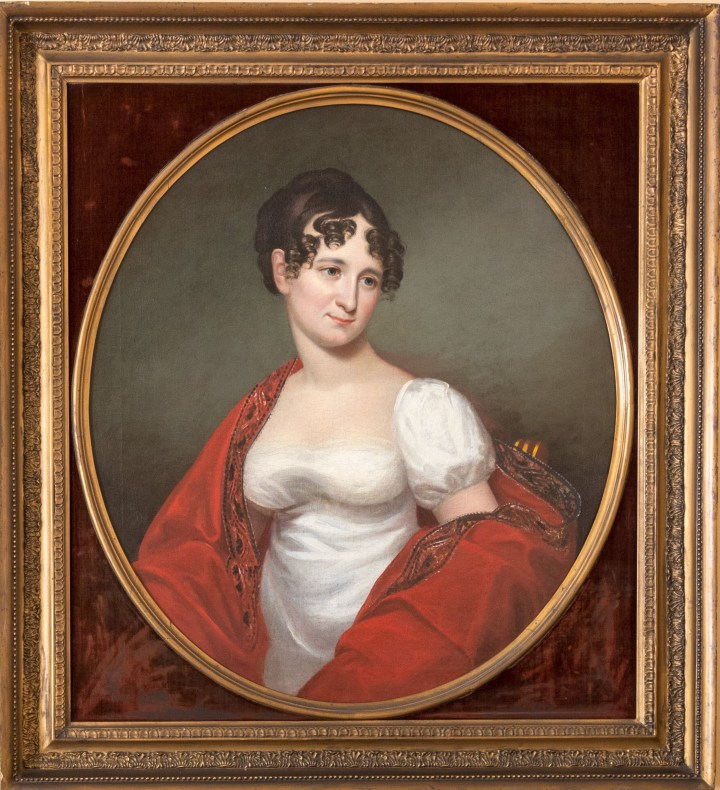
Bass Otis, Portrait of Miss Adèle Sigoine, 1815, oil on canvas (Bensalem, Pennsylvania: The Andalusia Foundation).
An oil painting by Philadelphia artist Bass Otis (1784–1861), Portrait of Miss Adèle Sigoigne (1815)—which has been on view at Andalusia Historic House, Gardens & Arboretum (Andalusia) in Bensalem, Pennsylvania since 2014 as a long-term loan from the Independence Seaport Museum (ISM) in Philadelphia—now joins Andalusia’s permanent collection in an act of collegial partnership. Adèle Sigoigne was a good friend of Jane Craig Biddle (1793–1856) who lived at Andalusia with her husband, Nicholas Biddle (1786–1844). ISM has deaccessioned the painting and transferred its ownership to Andalusia.
“We are overjoyed to have Adèle’s portrait now part of our permanent collection,” said Andalusia’s executive director John Vick. “Every piece of art in the historic house has a unique story to tell about the property and the people who lived here or visited. Adèle was practically family to the Biddles, making this a fitting home for her portrait. We are grateful to our partners at Independence Seaport Museum for recognizing what the painting means to Andalusia and for making this momentous transfer possible.”
“Our staff and Board were unanimous in wanting to transfer this painting permanently to Andalusia,” said Peter Seibert, ISM’s president and chief executive officer. “Its history and associations with the Biddle family are significant, and thus the painting is imminently relevant to their mission. For us, the transfer is a visible reminder of how two museums can come together to ensure that the history and heritage of our community is preserved in public trust for future generations.”
Although it is unclear how or when Jane and Adèle met, their lasting friendship is certain. Close in age and of similar social standing, the two women came from very different backgrounds, however. Jane was a Philadelphian by birth, the only daughter of John and Margaret Craig, the couple who first established Andalusia as a country estate in 1795. Adèle, by contrast, was French-born and had lived in Haiti. After the Haitian Revolution began in 1791, she moved to Philadelphia with her mother, Aimée Sigoigne, who started a school for young women at 128 Pine Street. Adele was one of a few guests who attended Jane’s wedding to Nicholas Biddle, held at Andalusia on 3 October 1811. The Biddles’ three daughters would later attend Madame Sigoigne’s school, including Adèle who was named for her mother’s dear friend. (The name Adèle remained popular for several generations of Biddle descendants.)
Although the portrait is unsigned, its attribution is firm; it is nearly certain that the Biddles commissioned Bass Otis to paint Adèle’s portrait as he also painted Jane’s portrait around 1815. (This painting is in the collection of the Second Bank of the United States Portrait Gallery in Philadelphia.) Both women are shown in fashionable, Empire-style dresses with luxurious fabrics draped over their shoulders: Jane’s is white and sheer while Adèle’s is a vibrant red. Their hair is also similarly styled in an updo with ringlets framing their faces. Nicholas Biddle conveyed his appreciation of Adèle’s portrait to Otis in a letter, which remains with and will be transferred with the painting from ISM.
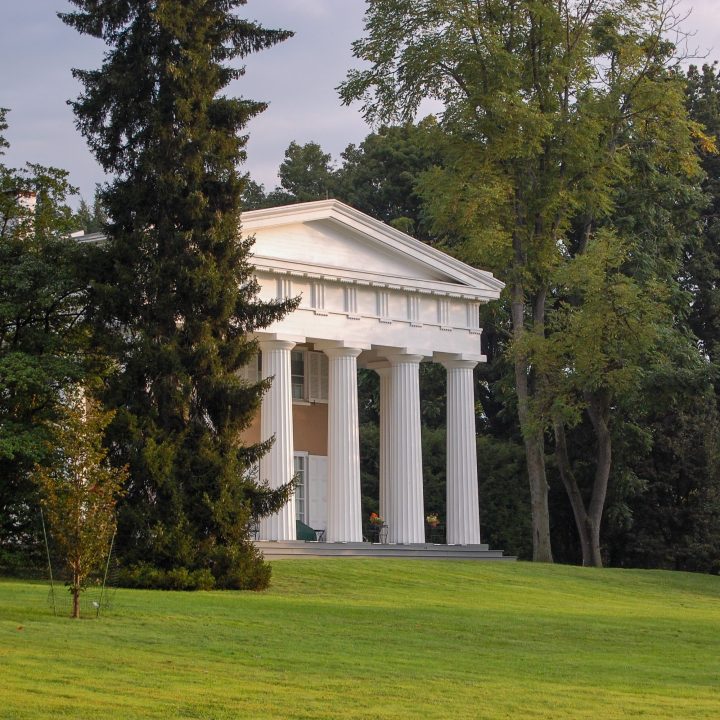
With its oldest portions dating to the 1790s, the house at Andalusia was expanded by Benjamin Latrobe in 1806 and then again in the 1830s, when an addition with a Doric columned porch was constructed according to designs by Thomas Ustick Walter (Walter had trained under William Strickland).
Since the portrait of Sigoigne has been on loan at Andalusia, it has been on view in the historic house’s library, which was part of the 1830s addition designed by architect Thomas Walter. Now in Andalusia’s permanent collection, it will be moved to what is known as the Painted Floor Bedroom. This room is part of the original 1797 construction and could have been where Adèle stayed when she visited Jane around the time that the portrait was made.
The Biddles’ patronage of Bass Otis continued for many years. In 1827, Nicholas Biddle commissioned the artist to paint a copy of Jacques-Louis David’s famous scene Napolean Crossing the Alps (1801). The oil on canvas copy, also on view at Andalusia, was owned by Napoleon’s brother Joseph Bonaparte, who knew the Biddles, lived near them in Philadelphia, and owned a country estate (Point Breeze) near Andalusia. By the 1820s, however, the Biddles began to favor another Philadelphia artist, Thomas Sully, who painted the couple’s portraits in 1826, both of which are on view at Andalusia. In 1829 the Biddles commissioned him to paint another portrait of Adèle Sigoigne, which is in the collection of The Huntington Library, Art Museum and Botanical Gardens in San Marino, California.
◊ ◊ ◊ ◊ ◊
Andalusia Historic House, Gardens & Arboretum is a non-profit organization and a scenic 50-acre property overlooking the Delaware River in Bensalem, Pennsylvania. Established more than 225 years ago, the site is a natural paradise of preserved native woodlands and spectacular gardens, as well as museum with an exceptional collection of paintings, sculptures, decorative art, and rare books and manuscripts.
The Kimbell Acquires Stubbs’s Mares and Foals
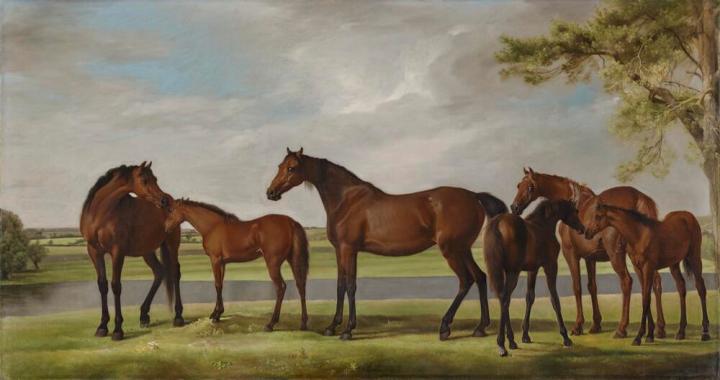
George Stubbs, Mares and Foals Belonging to the 2nd Viscount Bolingbroke, ca. 1761–62, oil on canvas, 99 × 187 cm
(Fort Worth: Kimbell Art Museum, acquired in memory of Ben J. Fortson)
◊ ◊ ◊ ◊ ◊
From the press release (28 June 2024), as noted at Art History News:
The Kimbell Art Museum today announced the acquisition of George Stubbs’s Mares and Foals Belonging to the 2nd Viscount Bolingbroke, painted between about 1761 and 1762. Widely regarded as the finest painter of animals in the history of European art, Stubbs is best known for his paintings of horses, which transcend historical genres to achieve rare pictorial refinement and emotional resonance. The painting entering the Kimbell’s collection is one of the principal, and likely earliest, in a celebrated, innovative series that has been called the artist’s crowning achievement: paintings depicting friezes of brood mares and their offspring. The acquisition, along with that of Thomas Gainsborough’s painting Going to Market, Early Morning (ca. 1773), purchased by the Kimbell in 2023, significantly elevates the Kimbell’s holdings of eighteenth-century British paintings, which Velma and Kay Kimbell favored when initially building their collection. The painting will be on view in the Kimbell’s Louis I. Kahn Building beginning 28 June 2024.
“With a mandate to collect only works of major historical and aesthetic importance, the Kimbell is the natural home for this masterpiece,” said Eric Lee, director of the Kimbell Art Museum. “I am sure that it will become an audience favorite. Visitors to the museum will relish the multidimensional depiction of mares and foals—alive with subtle drama, imbued with tenderness, and fascinating in its expression of the individual personalities of each horse.”
In this picture, which is slightly more than six feet long by three feet tall, a mature bay mare commands the center of a group of two other mares and three foals, who nuzzle close to their mothers. The composition is set within a springtime landscape at what is probably the viscount’s family estate of Lydiard Tregoze, Wiltshire, now Borough of Swindon, with verdant green parkland, cloudy sky, and a broad, dark gray stretch of water providing spatial interest beyond the long, slender legs of the horses. Highly naturalistic, the horses are lifelike in their anatomical forms and poses. While the overall mood is tranquil and domestic as the horses gently commune with each other, the cloudy sky and the wide, sparkling eyes of the mares add an element of drama and nobility to the composition.
The titular 2nd Viscount Bolingbroke, Frederick St. John (1732–1787), was one of Stubbs’s most important early patrons. The Kimbell painting seems to be the earliest commission of this virtually unprecedented subject; it is probably the work that Stubbs exhibited at the Society of Artists in 1762. Soon, other members of Bolingbroke’s circle of aristocratic horse enthusiasts and fellow statesmen of the Whig political party commissioned similar compositions on the theme of brood mares and their offspring, many doubtless depicting the patrons’ own horses. Stubbs’s equestrian paintings—along with his portrayals of rural life and of other animals—were an especially delightful and sophisticated expression of the pastimes of the British nobility and landed gentry. Patrons could hang such works alongside fashionable portraits and Old Master paintings in their town or country houses, where vast fields, parklands, stables, and studs reflected their love of hunting and sporting life.
Stubbs was then, and is today, recognized for his unrivaled understanding of equine anatomy and unsurpassed ability to record not only the appearance of individual animals but also their temperaments. His genius in understanding the horse arose from anatomical study and from his apparent empathy for the character of each horse and his ability to express its exquisite beauty. His skill extended to landscapes that enhanced the mood, composition, and legibility of the animal subjects.
Mares and Foals Belonging to the 2nd Viscount Bolingbroke remained in the family collection at Lydiard Tregoze until it was sold at auction in 1943 and shortly thereafter entered the collection of Mrs. John Arthur Dewar, of the whisky distillery family, who also owned Henry Raeburn’s Allen Brothers (Portrait of James and John Lee Allen), which entered the Kimbell collection in 2002. The Kimbell acquired Mares and Foals Belonging to the 2nd Viscount Bolingbroke from a private collection through London-based art dealers Simon C. Dickinson Ltd. At the museum, the painting joins Stubbs’s Lord Grosvenor’s Arabian Stallion with a Groom, a work acquired by the Kimbell in 1981. Mares and Foals Belonging to the 2nd Viscount Bolingbroke was previously on view at the Kimbell in 2004–05, when it was on loan to the exhibition Stubbs and the Horse.
The Kimbell Art Foundation acquired Mares and Foals Belonging to the 2nd Viscount Bolingbroke in memory of Ben J. Fortson (1932–2024), who passed away in May and whose leadership was instrumental in the Kimbell’s growth. Mr. Fortson served on the Board of Directors of the Kimbell Art Foundation from 1964 until his death and was the Foundation’s longtime Executive Vice President and Chief Financial Officer. He will be forever remembered for stewarding the Kimbell’s investments and finances and for being the driving force behind the building of the museum’s Renzo Piano Pavilion, which opened in 2013 and houses the museum’s temporary exhibitions and permanent collections of Asian, African, and ancient American art.
New Book Series | Gender and Art in the Museum: The Prado Collection

Peter Paul Rubens and Jan Brueghel the Elder, The Infanta Isabel Clara Eugenia, ca. 1615, oil on canvas, 113 × 176 cm
(Madrid: Prado)
◊ ◊ ◊ ◊ ◊
From the Prado’s press release announcing this series from Amsterdam University Press:
This ambitious new series from Amsterdam University Press approaches the study of the collections in the Prado Museum from a gender perspective, exploring the women who became artists and the many women who promoted artists and collected works of art, as well as the women who inspired some of the masterpieces in this institution. It will offer new insights on a wide range of topics on art and women and their interactions with politics, money, and power.
Edited by Noelia García Pérez, director of The Female Perspective project, the series arises from the Prado’s firm commitment to making the role of women in the world of art visible. Studies will address the output of women artists and their presence or absence in the galleries, links between the formation of the Prado’s collections and women artistic promoters, and the role of women in inspiring some of the Prado’s masterpieces.
While women patrons and artists have motivated a significant number of publications in recent decades, this is the first series to address the study of the creation of one of the largest art collections in the world, now housed in the Museo del Prado, through a gender perspective, focusing on the women who promoted, inspired, created, donated, and conserved many of the works preserved and displayed in the institution in order to demonstrate the crucial role that they played in the production, promotion, dissemination, and conservation of art. With a broad chronology corresponding to the Prado’s collections, the series will foreground the role of women and their relationship with the arts, as well as the evolution of this important institution and its connection with them.
The editorial committee includes Estrella de Diego (Universidad Complutense de Madrid), Sheila Ffolliott (George Mason University), M. José Rodríguez Salgado (The London School of Economics and Political Sience-Oxford University), Alejandro Vergara (Museo del Prado), Carmen Gaitán (CSIC), and Sheila Barker (director of the prestigious Jane Fortune Research Program on Women Artists / Medici Archive Project).
Zoë Colbeck Named Director of Strawberry Hill
From the press release, via Art Daily (8 June 2024) . . .
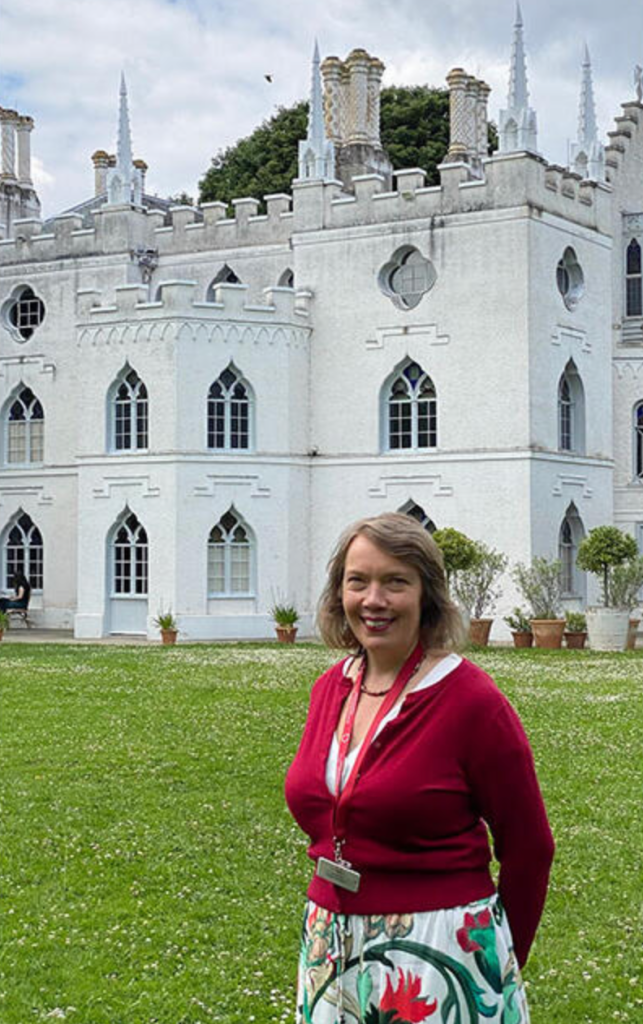 Strawberry Hill House announced that Zoë Colbeck will succeed Derek Purnell as Executive Director of the historic South West London attraction. Zoë joins the team from her previous role as Project Manager at the Solent Cluster, a major decarbonisation initiative based in Hampshire, bringing over 20 years of experience in the heritage sector to Strawberry Hill House and Garden.
Having read chemistry at university, Zoë worked for one of the UK’s largest retailers, specialising in logistics and people management, before joining the National Trust (NT) to combine her passion for heritage with her commercial background. She left the NT in 2021 after 18 years, ultimately as General Manager of the Chartwell Portfolio, one of the NT’s top properties. More recently, she was Commercial and Operations Director with the Mary Rose Trust in Portsmouth.
Zoë took up her new position at Strawberry Hill on 3 June—after her predecessor, Derek Purnell, left to take up an opportunity with the Frederick Ashton Foundation, based at the Royal Opera House in Covent Garden.
Announcing the appointment, Paul Kafka, Chairman of Strawberry Hill Trust, said: “During her time at the National Trust, Zoë led three transformational projects, which, in turn gave her extensive knowledge and vital experience in the fields of climate change mitigation, sustainable management, and heritage conservation. She has a passion for working collaboratively and making a difference for museums, communities, and the planet.” He added: “I am delighted that Zoe is joining Strawberry Hill at this moment in our history. 2024 is going to be a year of change and new directions. Our quest for a sustainable business model continues, even as our reputation as a museum and cultural destination continues to grow.”
Zoë commented: “I am passionate about making a difference for our history and heritage and making it relevant for different audiences. Horace Walpole is such an interesting character, and I am looking forward to leading the team at Strawberry Hill House and Garden through the next stage of development, preserving his legacy and contributing to its future.”
Museum of the American Revolution Acquires Continental Army Drawing
Press release (26 March) from the Museum of the American Revolution, with coverage appearing in The Washington Post over the weekend (14 April 2024) . . .

Attributed to Pierre Eugène du Simitière, Soldiers and Camp Followers of the Continental Army’s North Carolina Brigade Marching through Philadelphia on 25 August 1777, pen and ink on paper (Philadelphia: Museum of the American Revolution).
◊ ◊ ◊ ◊ ◊
An eyewitness pen-and-ink sketch depicting Continental Army soldiers and camp followers marching through Philadelphia on 25 August 1777, which has never been documented or published by historians, has been donated to the Museum of the American Revolution. This sketch is the first wartime depiction of North Carolina troops known to exist, and only the second-known depiction of female camp followers of the Continental Army drawn by an eyewitness.
“This sketch is extremely important to our understanding of the daily operations of the Continental Army,” said Matthew Skic, Curator of Exhibitions at the Museum, who worked to authenticate the sketch and identify its creator after discovering it in a private collection. “It helps us visualize the everyday lives of these troops—the joyous, the difficult, and the mundane.”
This discovery brings to light a lively scene that newspaper accounts confirm occurred the morning of 25 August 1777, as the North Carolina Brigade and its commander, Brigadier General Francis Nash, marched to join the rest of General George Washington’s army before seeing action in both the Battle of Brandywine (11 September 1777) and the Battle of Germantown (4 October 1777).
The drawing shows two soldiers marching alongside an open-sided wagon, as well as a commissioned officer and a wagon driver mounted on horseback. Inside the wagon sit two women, one holding an infant, amongst various equipment and baggage of the brigade. Two men are also depicted riding on the back of the wagon. The inclusion of female camp followers—who shared life on campaign with enlisted husbands and fathers and supported the troops by sewing, doing laundry, and selling food—exemplifies a direct defiance of known regulations at the time about how women following the army could use wagons. Earlier in August, before the march depicted in the sketch took place, Washington himself brought up issues of women and children slowing down his troops, calling them “a clog upon every movement.”

Reverse side of the sketch of the North Carolina Brigade showing five male figure studies.
◊ ◊ ◊ ◊ ◊
On the reverse of the North Carolina Brigade sketch are five studies of two male figures, one brandishing a sword and the other engaged in a fist fight. Artists frequently sketched studies like these when they were working on larger works, as it allowed them to try out different poses or details and to get a sense of the scale of the larger drawing or painting.
The sketch was acquired by Judith Hernstadt, a Manhattan-based urban and regional planner and former television executive, in the late 1970s from a New York City antiques dealer. Hernstadt donated the sketch to the Museum in 2023, but at the time, the identity of the artist who drew it was still unknown. An ink inscription below the vignette of the North Carolina Brigade reads, “an exact representation of a waggon belonging to the north carolina brigade of continental troops which passed thro Philadelphia august done by …” with the rest of the lettering cut away due to an old paper repair.
After detailed research, handwriting analysis, and comparison to similar sketches, Skic identified the sketch’s creator as Switzerland-born artist and collector Pierre Eugène du Simitière (1737–1784), who settled in Philadelphia in about 1774 and is now known for documenting the rising American Revolution as it happened. Du Simitière went on to create from-life profile portraits of prominent Revolutionary leaders including Washington and he suggested the motto “E Pluribus Unum” through his rejected design for the Great Seal of the United States in 1776. In 1782, he founded the first museum in the United States that was open to the public.
Many of Du Simitière’s significant manuscripts and drawings still exist and are available for researchers to study at both The Library Company of Philadelphia and the Library of Congress. It is yet to be determined if either sketch relates to another work by du Simitière, but research is ongoing.
We were thrilled to piece together the many illuminating and significant parts of this sketch’s history through our unparalleled scholarship here at the Museum of the American Revolution,” said Dr. R. Scott Stephenson, President and CEO of the Museum. “As we round out our celebration of Women’s History Month, we revel in the discovery of this new depiction of female camp followers as highlighting the lesser-known stories and critical roles of women throughout the American Revolution are at the heart of the Museum’s offerings.”
The sketch was conserved due to generous contributions from the North Carolina Society of the Cincinnati, which is comprised of descendants of officers of the North Carolina Continental Line.
“The North Carolina Society of Cincinnati is proud to support the conservation and framing of this important discovery, which serves as an important reminder that the intricate history of both our state and our nation is still unfolding,” said Society President George Lennon.
Telescope by James Short on Display at the Herschel Museum
On a day when many of us are looking to the skies . . . Press release from Bath’s Herschel Museum of Astronomy:

James Short, Gregorian reflector telescope, 1738–68 (Collection of Richard Blythe, on loan to the Herschel Museum of Astronomy).
The Herschel Museum of Astronomy recently revealed a new display: a Gregorian Reflector telescope created by James Short, the preeminent telescope maker of the 18th century. The brass telescope, on long-term loan to the museum from Richard N. Blythe of Shropshire, was created between 1738 and 1768. It has a focal length of 18 inches and sits on an equatorial mount. Similar telescopes made by Short were used to observe the transit of Venus in 1761 and 1769.
Gregorian Reflector telescopes are constructed with two concave mirrors. The primary mirror collects incoming light and brings it to a focal point. This focused light is then reflected off the secondary mirror, after which the light passes through a central aperture within the primary mirror. Ultimately, the light emerges from the bottom of the instrument, facilitating observation through the eyepiece.
In his 30-year career, Short made at least 1300 telescopes. Considered the finest available, they were sought after by observatories and customers all over the world. Short had no assistant, and when he died in 1768 his method of polishing mirrors was lost. Separately, William Herschel started experimenting with making telescopes in 1773 and went on to produce telescopes of even greater quality than those by Short.

Herschel Museum of Astronomy, 19 New King Street, Bath (Photo by Nick Veitch, Wikimedia Commons, August 2005). Brother and sister, William and Caroline Herschel moved into what was then a new town house in 1777, just a few years before William discovered Uranus (in March 1781). The Herschel museum was established in 1981.
Patrizia Ribul, Director of Museums for Bath Preservation Trust says: “The story of the Herschel siblings William and Caroline is very special, and our acquisitions policy is focused on objects that either belonged to them, or that add important context from the time. The James Short telescope provides visitors with an excellent example of the type of telescope that would have been known to William Herschel. The fact that William, with Caroline’s assistance, went on to create telescopes superior even to this excellent example by James Short, really underlines his expertise and dedication in the field of astronomy.”
The James Short telescope is the latest in a line of exciting long-term loans and acquisitions at the museum, including Caroline’s visitor book, a full-sized replica of William’s seven-foot reflecting telescope, and Caroline’s original memoir manuscript.
The Herschel Museum of Astronomy is dedicated to the achievements of the Herschels: distinguished astronomers and talented musicians. It was from this house that William discovered Uranus in 1781.










 Enfilade
leave a comment