Opinion | Patricia Marroquin Norby on Nuance and Repatriation
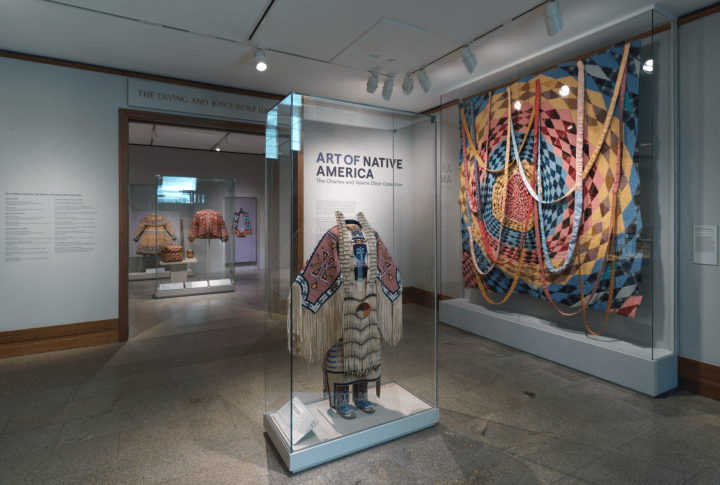
2021–22 entrance to The Met’s long-term exhibition Art of Native America: The Charles and Valerie Diker Collection.
◊ ◊ ◊ ◊ ◊
From Hyperallergic:
Patricia Marroquin Norby, “We Need More Nuance When Talking about Repatriation,” Hyperallergic (19 April 2023). Norby, the Met Museum’s curator of Native American Art, reflects on the lesser-discussed everyday challenges of repatriation work.
. . . The Met and I were both keenly aware that my appointment [as its first curator for Native American Art three years ago] was a milestone moment for the museum and the field. This curatorial position came about because of the promised gift of a prominent Native American collection of works from Charles and Valerie Diker. It’s a collection that had already been well-researched and exhibited at numerous institutions nationwide including the Smithsonian’s National Museum of the American Indian, the Seattle Art Museum, and the Amon Carter Museum of American Art. The gift and landmark curatorial role propelled significant changes at The Met, specifically, foregrounding the voices of Native peoples and presenting their historical and contemporary creative expressions to an international audience in a world-class institution. More important, but less visible to the public, were the much-needed collaborations with Native American source communities regarding the items currently in The Met’s care.
As the museum began exhibiting Native American collections in its American Wing for the first time, we also began working more collaboratively with source communities as exhibition advisors, co-curators, authors, and installation contributors. We listened. We learned. We are still learning.
Native American and Indigenous museum collections necessitate a commitment to long-term relationships with source communities. These relationships have provided some of the most meaningful experiences of my career. When I joined The Met, I emphasized the importance of meeting the needs of Native American communities. I worked to prioritize Indigenous voices in our exhibitions, programs, and collections care. As a woman of Purépecha descent, I understand feeling marginalized. I also understand the simultaneous sense of connection and loss toward items that embody cultural ties to my maternal ancestral community on view in museums. Such experiences are magnified in a historically colonial institution like The Met. . . .
As connections with source communities grew, some colleagues shared their surprise at how repatriation attitudes regarding specific items can differ. Some tribes seek repatriation, while others favor a co-stewardship approach or prefer that works remain at the museum. Community needs are diverse, yet very specific. One commonality across communities and cultures is the desire for a say in how and if works are publicly presented, and how they are cared for. The founding director of the Smithsonian’s National Museum of the American Indian in Washington DC, Richard West Jr., said it best: Indians love and hate museums because “they have our stuff.” For many Indigenous peoples, museums can awaken inner tensions and traumatic histories. For Indigenous museum professionals, these painful pasts are always present. . . .
The full essay is available here»
New Book | Native American Art from the Weisel Collection
From the FAMSF press release for the catalogue, co-published with DelMonico Books:
Bruce Bernstein, Hillary C. Olcott, Christina Hellmich, Deana Dartt, and Jill D’Alessandro, eds., Native American Art from the Thomas W. Weisel Family Collection (New York: DelMonico Books, 2023), 432 pages, ISBN: 978-1636810966, $85.
 The Fine Arts Museums of San Francisco are pleased to announce the publication of Native American Art: From the Thomas W. Weisel Family Collection, co-published with DelMonico Books, and co-edited by Bruce Bernstein, Hillary C. Olcott, Christina Hellmich, and Deana Dartt with Jill D’Alessandro. The expansive 432-page catalogue celebrates a transformative gift to the Museums that spans nearly one thousand years of artistic creativity by Native American artists.
The volume brings together 206 works of art, exemplifying the exquisite artistry and rich cultural histories represented therein. Highlights of objects researched and presented in the book include 19th-century Diné/Navajo weavings, Ancestral and historic Pueblo pottery, Hopi and Zuni carved figures, and Yavapai and Apache basketry, as well as works from the Pacific Northwest and the Plains. Developed in collaboration with cultural advisors, including Joseph R. Aguilar (San Ildefonso), Stewart B. Koyiyumptewa (Hopi), Arden Kucate (Zuni), Christopher Toya (Jemez) and Brian Vallo (Acoma), the catalogue reflects the complex and multilayered nature of the works in the collection and, more broadly, the field of Native American art.
“The publication of Native American Art has been a monumental, five-year undertaking for the Fine Arts Museums of San Francisco,” said Thomas P. Campbell, Director and CEO of FAMSF. “Our team has worked directly with communities of origin represented in the collection, cultural practitioners, artists, art historians, and museum professionals to share different perspectives on the objects in this collection. We are enormously proud of this collaboration and grateful to each of our authors and advisors for the care they have extended to this project and the knowledge they have shared with us.”
Building upon the Fine Arts Museums’ first publication on the Thomas W. Weisel Family Collection, Lines on the Horizon (2014), Native American Art is an expanded scholarly catalogue that features new research, 30 specially commissioned essays, and 100 extended captions. Contributions by more than 80 authors from different disciplines and cultural backgrounds illuminate details about the living histories of the works. The multitude of perspectives and voices offered here embraces the complexity of the dialogue surrounding Native works past and present, ensuring that Native American Art will be a cornerstone publication in the field of Native American art history.
“The gift of the Thomas W. Weisel Family Collection of Native American Art to the Fine Arts Museums of San Francisco provided the extraordinary opportunity for an open-ended, two-year-long conversation between the Museums and Native communities about the display, imaging, care, and disposition of our Ancestral pottery.” write Joseph R. Aguilar, Stewart B. Koyiyumptewa, Arden Kucate, Christopher Toya and Brian Vallo in their introduction. The results of the dialogue are in this catalogue, including a culturally sensitive approach to reproducing Ancestral pottery images. Every pot was individually considered, most generating lively discussions, and others soliciting respectful silence. The work we have been doing together has been an opportunity to learn from one another.”
Among the important scholarly innovations in Native American Art is the representation of Mimbres bowls and other Ancestral Pueblo pottery forms. Working closely with cultural advisors from five Pueblo communities, the editors and advisory group developed three representative styles for the Mimbres bowls and other Ancestral pottery reproduced in the catalogue. A screen of gold dots takes the place of objects that are culturally sensitive; while drawings made by Acoma artist Michelle Lowden represent bowls that were determined to be from burial contexts but do not feature culturally sensitive imagery. Photography is used when objects are not culturally sensitive.
The catalogue was designed by James Brendan Williams of The Common Era.
A free, public launch event celebrating Native American Art was held Saturday, April 22 at the de Young’s Koret Auditorium. The program included an introduction by volume co-editor Deana Dartt (Coastal Band, Chumash), followed by presentations about Ancestral and historic Pueblo pottery by project contributors Bobby Silas (Hopi-Tewa) and Deborah A. Jojola (Isleta/Jemez Pueblo). The program concluded with a panel discussion between members of the book’s Pueblo Advisors group, Governor Arden Kucate (Zuni), Brian Vallo (Acoma), and Joseph R. Aguilar (San Ildefonso), with volume co-editor Bruce Bernstein.
Sweden Nationalmuseum Acquires Self-Portrait by Périn-Salbreux
From the press release (1 March 2023) . . .

Lié-Louis Périn-Salbreux, Self-Portrait, ca. 1800–10, black crayon, stumped and elevated with white crayon, on paper, 26.5 × 22 cm (Stockholm: Nationalmuseum NMB 2819; photo by Anna Danielsson).
Nationalmuseum has acquired a self-portrait by Lié-Louis Périn-Salbreux, a French miniaturist. The piece is one of the artist’s later works and, unlike many of his other self-portraits, is unusually modest and largely free from affectation. Périn was heavily influenced by the Swedish artist Peter Adolf Hall and enjoyed his greatest success during the years immediately before and after the French Revolution.
Lié-Louis Périn-Salbreux (1753–1817) was born in Reims, the son of a wool manufacturer. At the age of 19, he arrived in Paris to be a pupil in the studio of Jean-Baptiste Vien. By the following year, 1773, he had already been admitted to the academy of fine arts as a student, as Vien was the academy’s director. There, Périn encountered other influential artists, including Alexander Roslin, the Swedish-born portrait painter. His friendship with Roslin was to prove crucial to his future success, giving him access to several high-ranking clients, including members of the royal family, of whom Périn painted small, intimate portraits in oils. But it was as a miniature portraitist that Périn was to make his name. His training in this art form was acquired privately rather than at the academy, and the best-known of his teachers was Louis Marie Sicardi.
Roslin was generous with his support, not only referring clients but also commissioning Périn to paint portraits of Roslin himself and his wife, Marie Suzanne Giroust, which are now in the Nationalmuseum collection. The miniaturist also painted other family members, including Roslin’s daughter-in-law Adélaïde and grandson Abraham—a portrait acquired by Nationalmuseum fairly recently. What was more, Roslin entrusted Périn with creating miniature replicas of Roslin’s own oil portraits. Quite frequently, clients simply wanted a reduced version of their existing portrait, and it fell to Roslin’s younger colleague to carry out the job. One such example is a miniature replica of Roslin’s pastel portrait of the ill-fated Crown Prince Louis. Throughout the 1780s, Périn enjoyed a productive and successful career as a miniaturist without being elected to the academy. When the art world became more democratic during the Revolutionary period, he was able to exhibit at the Salon for eight years from 1791.
Périn soon adopted the free style of Swedish miniaturist Peter Adolf Hall, with its vibrating brushwork, and through Roslin he made direct contact with Hall. Like Hall, Périn employed elegant accents in the form of clothing and draperies. Both also liked to place their models in natural or parkland settings. However, Périn’s depiction of the models’ faces was more affected, with distinctive, almond-shaped eyes. Like Hall, Périn suffered when his wealthy clients emigrated during the French Revolution. As a result of monetary depreciation, Périn lost his capital and left Paris in 1799 to take charge of his family’s woollen mill in Reims. The newly married artist appended his wife’s maiden surname, Salbreux, to his own. Back in his hometown, he continued working as a portraitist, but mainly in oils and pastels. Hence his choice of technique for the self-portrait in black crayon, drawn sometime between 1800 and 1810, which was recently acquired by Nationalmuseum. Over many years, Périn produced self-portraits using various techniques, both in oils and in miniature format. These were often somewhat pretentious, indicating that the artist had a good conceit of himself, but in this relatively late work he takes a more restrained approach. The image is drawn with fine gradations in black crayon, stumped with elevations in white. Given the palpably graphic nature of the work, it is not surprising that it later provided the basis for an engraving by Henri-Joseph Dubouchet, many years after Périn’s death.
“In this sensitive self-portrait by Lie-Louis Perin-Salbreux, we see an artist with no great pretensions, with a gentle, understanding expression. This new acquisition joins Nationalmuseum’s collection of self-portraits by miniaturists, which is the only one of its kind in the world. So we are delighted to put this significant artwork on display in the Treasury,” said Magnus Olausson, director of collections.
Nationalmuseum receives no state funds with which to acquire design, applied art and artwork; instead the collections are enriched through donations and gifts from private foundations and trusts. This acquisition has been made possible by a generous donation from the Hjalmar and Anna Wicander Foundation.
Sweden Nationalmuseum Acquires Three Garden Views
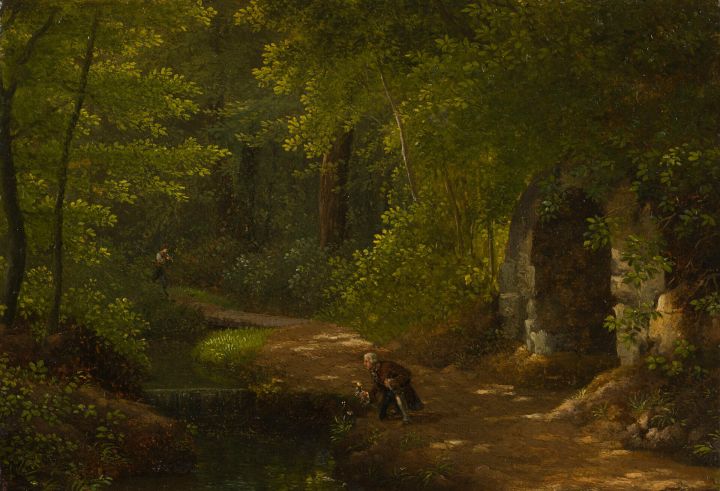
Alexandre Dunouy, Rousseau Picking Flowers near the Banc des Vieillards, View of the Park at Ermenonville, ca.1800, oil on paper mounted on canvas, 13 × 18.5 cm (Stockholm: Nationalmuseum 7607; photo by Anna Danielsson).
◊ ◊ ◊ ◊ ◊
From the press release:
Nationalmuseum has acquired three views of French gardens and parks painted in the latter half of the 18th century by Louis-Gabriel Moreau and Alexandre Dunouy. Building on the proud tradition of topographical depictions in 17th-century French art, these artists catered to the early Romantic penchant for dense foliage and picturesque dilapidation. The park at Ermenonville features in two of the paintings, one of which shows the philosopher Jean-Jacques Rousseau picking flowers.
One of Rousseau’s disciples was Marquis René-Louis de Girardin, who in 1766 began constructing a landscaped park on his estate at Ermenonville, 40 km northeast of Paris. For the marquis, landscape gardening represented a blend of art and poetry, where drawings or paintings served as patterns for creating scenic variety. For this purpose, he seems to have engaged the services of Hubert Robert, the noted painter of ruins. In the summer of 1778, as the park at Ermenonville was nearing completion, Rousseau came to visit. As fate would have it, the famous philosopher died there just three weeks later. His pupil and patron, Marquis de Girardin, seized the opportunity and arranged for Rousseau to be buried on a poplar-covered island in a sarcophagus designed by Hubert Robert. Rousseau soon became a cult figure, and many admirers made the pilgrimage to his grave, including King Gustav III of Sweden. The philosopher lay at rest in Ermenonville until France’s new republican rulers had his remains transferred to the Panthéon in Paris in 1794. Among those who sought to profit from Rousseau’s tremendous popularity was the landscape painter Alexandre Dunouy (1757–1841). One of Nationalmuseum’s two recently acquired paintings by Dunouy is an anecdotal image of the philosopher picking flowers near the Banc des vieillards in the park, which is believed to have been painted around 1800.
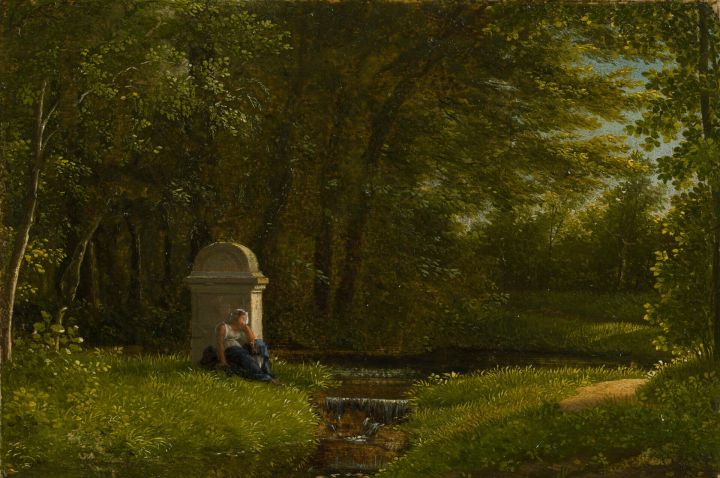
Alexandre Dunouy, La Fontaine du Bocage, View of the Park at Ermenonville, ca. 1800, oil on paper mounted on canvas, 13 × 18.5 cm (Stockholm: Nationalmuseum 7608; photo by Anna Danielsson).
◊ ◊ ◊ ◊ ◊
The second of the acquired views of Ermenonville by Dunouy depicts a spot known as la Fontaine de Bocage, a woodland grove in the section of park north of the chateau. As the painting shows, the grove was traversed by a stream, and by a small waterfall the marquis had erected an altar with a love poem by Petrarch. In Dunouy’s composition, we can see a woman resting in deep contemplation beside this diminutive monument. Despite the small scale, both here and in the image of Rousseau, the artist has managed to capture all the small details without being overly finicky. He reproduces the play of light in the branches and the reflections in the water surface using finely tuned colour values and a number of coloristic accents.
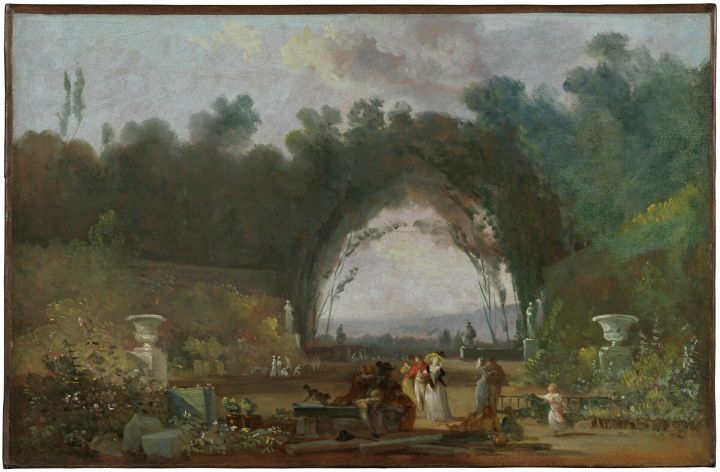
Louis-Gabriel Moreau the Elder, Terrace in the Park of Saint-Cloud, ca. 1780s, oil on paper mounted on canvas (Stockholm: Nationalmuseum 7653; photo by Anna Danielsson).
◊ ◊ ◊ ◊ ◊
Slightly older than Dunouy, Louis-Gabriel Moreau the elder (1740–1806) had specialised much earlier in painting views, especially of gardens and parks in Paris and the surrounding area. He was a pupil of another of the city’s more prominent topographical artists, Pierre-Antoine Demachy. They soon realised there was a market for motifs of this kind, either as small, delicate images on snuff boxes or as cabinet paintings. But commercially viable motifs were not a given route to election to the French academy of fine arts. Moreau made two attempts to be elected, in 1787 and 1788, but was unsuccessful because the members considered his motifs too trivial. However, he found greater favour with one of the king’s brothers, the Count of Artois, who appointed Moreau as his court painter.
Unsurprisingly, Moreau drew many of his motifs from the old royal pleasure gardens and parks, several of which were in a state of picturesque dilapidation by the late 18th century. One such place was the baroque garden at Saint-Cloud near Paris, which provides the motif for the third of Nationalmuseum’s recent acquisitions. Another version by Moreau can be found in the Louvre, likewise depicting the majestic trees in this pleasure garden which, along with the associated chateau, was sold by the Duke of Chartres to his relative King Louis XVI in 1785. The buildings were damaged in the Franco-German war of 1870 and later demolished, but the garden designed by André Le Nôtre survives to this day.
“The acquisition of Dunouy’s rare and unique depictions of Ermenonville and Moreau’s view of Saint-Cloud introduces a category of painting that was previously largely absent from the Nationalmuseum collection. And we are delighted to have the opportunity to put them on display in the exhibition The Garden: Six Centuries of Art and Nature, which opens to the public on 23 February,” said Magnus Olausson, head of collections at Nationalmuseum and exhibition curator.
Nationalmuseum receives no state funds with which to acquire design, applied art and artwork; instead the collections are enriched through donations and gifts from private foundations and trusts. The acquisition of Dunouy’s views of Ermenonville was generously funded by the Hedda and N.D. Qvist Foundation, while Moreau’s view of the Saint-Cloud park was purchased with a generous donation from the Lars Vogel bequest.
All three paintings will be on display in the exhibition The Garden from 23 February 2023 until 7 January 2024.
Amanda Dotseth Named Director of SMU’s Meadows Museum
From the press release (10 February 2023) . . .

Amanda W. Dolseth (Photo by Tamytha Cameron).
SMU has named Amanda W. Dotseth Linda P. and William A. Custard Director of the Meadows Museum. Dotseth, who will be the first female director of the Meadows Museum, served as the director ad interim and curator of the Museum since the passing of its previous director, Mark A. Roglán, in 2021. Dotseth assumes the role on 1 March 2023.
“As a scholar, collaborator, and arts leader, Amanda Dotseth brings a unique understanding of the important mission and role of the Meadows Museum,” said SMU President R. Gerald Turner. “In addition, her many years as curator, then interim director has prepared her to position the Museum for the future while understanding its legacy.”
In her combined 19 years of experience with the Museum, Dotseth published extensively on Spanish art, contributed to and curated more than 30 exhibitions, and oversaw the acquisition of major additions to the Meadows collection. Notably, Dotseth was an instrumental participant in the early development of the historic partnership between the Meadows Museum and Madrid’s Museo Nacional del Prado in 2009, in which the Prado loaned three major paintings and exchanged curatorial fellows between the institutions. She played an integral role in the pioneering collaboration with Fundación ARCO in 2019 as well. By initiating and cultivating partnerships with international art institutions from the Rijksmuseum and National Gallery of Ireland to the Museo del Traje in Madrid and the Museo del Arte Abstracto Español (Fundación Juan March), Dotseth has expanded the reach and profile of the Meadows Museum and of SMU. Dotseth’s existing partnerships with academic and art institutions around the world, including the Spanish National Research Council, will be a tremendous asset for the Museum as she continues its mission to advance the knowledge, understanding and appreciation of the arts and culture of Spain in the US.
In addition to her nearly two decades with the Museum, Dotseth is also an alumna of SMU Meadows School of the Arts, receiving her master’s degree in art history from the University in 2006. She later completed her Ph.D. at the Courtauld Institute of Art (University of London) in medieval Spanish art in 2015.
“After an extensive international search, I am thrilled that the best person to serve as the next director of the Meadows Museum is an extremely accomplished member of the SMU Meadows community,” said Samuel S. Holland, Algur H. Meadows Dean for SMU Meadows School of the Arts. “I look forward to seeing the new directions in which Dr. Dotseth will take the Museum, through her collaborative and innovative leadership, and strong curatorial voice.”
“The Meadows Museum has been a part of my professional DNA for two decades; to now be at the helm of the institution as the Linda P. and William A. Custard Director during the next phase of the museum’s life is a great honor,” said Dotseth. “I look forward to building upon and expanding the Museum’s existing strengths as we reach out to the next generation of scholars, students, and museum-goers.”
The Meadows Museum is the leading U.S. institution focused on the study and presentation of the art of Spain. In 1962, Dallas businessman and philanthropist Algur H. Meadows donated his private collection of Spanish paintings, as well as funds to start a museum, to Southern Methodist University. The museum opened to the public in 1965, marking the first step in fulfilling Meadows’s vision to create “a small Prado for Texas.” Today, the Meadows is home to one of the largest and most comprehensive collections of Spanish art outside of Spain. The collection spans from the 10th to the 21st centuries and includes medieval objects, Renaissance and Baroque sculptures, and major paintings by Golden Age and modern masters.
Cleveland Announces New Acquisitions
From the CMA press release (17 January 2023). . .
Recent acquisitions by the Cleveland Museum of Art (CMA) include a Korean abstract expressionist painting by Yun Hyong-keun 윤형근; a ten-panel folding screen by Kim Yoon-bo 김윤보; an early masterpiece by James Tissot from his English period; and a recently discovered full-length pastel portrait by Hugh Douglas Hamilton, the most celebrated Irish portraitist of the Grand Tour. . . .
Hugh Douglas Hamilton’s Portrait of George Clavering Cowper

Hugh Douglas Hamilton, Portrait of George Clavering Cowper, 3rd Earl Cowper, 1785, pastel on paper stretched on linen; sheet: 94 × 69 cm (The Cleveland Museum of Art, Leonard C. Hanna Jr. Fund).
Preserved in remarkable condition, this portrait has remained in the sitter’s family—and was discovered only recently in the collection of the descendants of its sitter, George Clavering Cowper, 3rd Earl Cowper (1738–1789), of Great Britain. The full-length pastel was a type developed during the 18th century that appealed to English tourists on the Grand Tour to Italy. The earl, a cultural paragon in Italy and a patron of artists and composers, sat for the most celebrated Irish portraitist of the Grand Tour, Hugh Douglas Hamilton, in Florence, where he made his home.
Cowper prominently wears the sash and star of the which he had received in March 1785. The Order of Saint Hubertus was founded in 1695, a knightly order of aristocratic hunters from throughout the Hapsburg empire, whose motto was “Honoring God by Honoring his Creatures.” Evoking the emotion of this motto, Hamilton featured Cowper’s hunting dog, who receives a tender pat on the head and wears a collar inscribed with Cowper’s name.
The portrait enhances the CMA’s collection of pastels, a strength of its drawings collection. The acquisition was made possible by the Leonard C. Hanna Jr. Fund.
More information on the portrait is available at Lowell Libson & Jonny Yarker.
The full press release describing the other three acquisitions is available here»
Dulwich Loans over 50 Paintings to Strawberry Hill
From the press release, via Art Daily and Richmond.gov.uk:
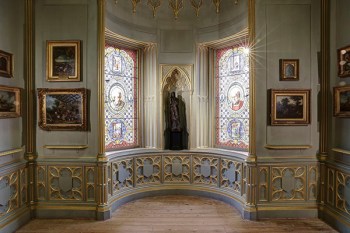
The Tribune, Strawberry Hill House, with loans from Dulwich Picture Gallery (Photo by Matt Chung).
Over fifty Old Master paintings on long-term loan from Dulwich Picture Gallery—and a further eight works from a private English collection—have just gone on display at Strawberry Hill House, helping to recreate the atmosphere of how the house would have appeared over 250 years ago.
As part of an ambitious project—through acquisitions and loan agreements, including the partnership with Dulwich Picture Gallery—Strawberry Hill House, the remarkable former home of the writer, antiquarian, and politician, Horace Walpole (1717–1797) is endeavouring to return some of the 6000 objects from the collection that Walpole amassed during his lifetime and, where possible, to recreate the original atmosphere of the house, when the rooms were filled with fantastic works of art.
In 1842, following Walpole’s death, the contents of the house were dispersed in a famous auction, known as the Great Sale. Since then, it has been a long-held desire of the Strawberry Hill Trust to bring as many pieces possible back to the historic villa in Twickenham. Indeed, its efforts have recently seen the acquisitions of an extraordinary portrait of Catherine de Medici and a celebrated Chinese ceramic fish tub with a macabre past. This appetite to acquire original objects and to display contemporaneous artworks has helped to create an atmosphere that would be familiar to Walpole were he alive today.
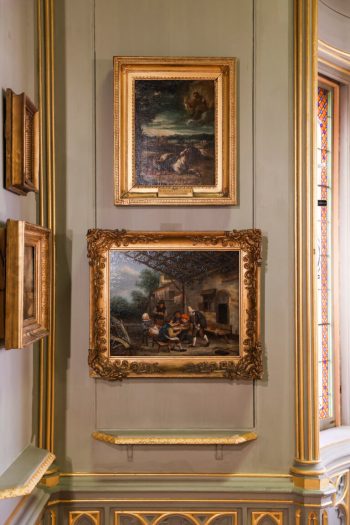
Detail of the Tribune, Strawberry Hill House, with loans from Dulwich Picture Gallery (Photo by Matt Chung).
The relationship between Strawberry Hill House and Dulwich Picture Gallery began in 2011 with the long-term loan of the portrait of Dorothy, Viscountess Townshend, ca. 1718 by Charles Jervas. Dorothy Walpole (1628–1726) was the sister of Sir Robert Walpole, Horace’s father. This portrait of his great aunt now hangs in its original position in the Great Parlour, where Walpole displayed portraits of both his family and some of his closest friends.
Among the paintings from the latest loan is a set of twenty-six British monarchs, assembled by the founder of Dulwich College, Edward Alleyn. These include Henry VIII, ca. 1618; Queen Anne Boleyn, ca. 1618; and Queen Mary, ca. 1618. These royal portraits have been hung in the Holbein Chamber, reflecting Walpole’s passion for history and its protagonists, which also influenced the overall arrangement of the artworks throughout the house. As an antiquarian and writer possessed of a vivid imagination, Walpole had a deep interest in royal and historical figures, evident throughout his collection, as well as in the designs of the house itself. The ceiling in the Holbein Chamber is a copy of the Queen’s Dressing Room in Windsor Castle, while the one in the Library is decorated with heraldic emblems, mythical beasts, coats of arms, and images of mounted crusaders, all reflecting Walpole’s various interests in the medieval period.
Dr Silvia Davoli, Strawberry Hill House Curator says: “Our collaboration with Dulwich Picture Gallery offers us the unique opportunity to borrow a substantial number of paintings that are very similar in style, period, and schools to those once collected by Horace Walpole; and it is thanks to these artworks that the rooms of Strawberry Hill finally appear to us in all their glory, much as they did in Walpole’s time.”
Online Catalogue | The Nelson-Atkins Museum of Art, French Paintings

From The Nelson-Atkins:
The Nelson-Atkins Museum of Art
French Paintings Catalogue
Learn more about the remarkable French paintings and pastels at the Nelson-Atkins Museum of Art. View the entire collection online, delve into recent scholarly insights and technical discoveries, or read about the history of collecting French art in Kansas City. Art historians and conservators provide fresh perspectives on the French collection, and comprehensive research sheds new light on the provenance (ownership history), exhibition history, and publication history of each work. Whether you are seeking a quick overview or deep dive, the French Paintings Catalogue is the perfect place to explore and learn more.
The French Paintings Catalogue is generously supported by The Marion and Henry Bloch Family Foundation, The National Endowment for the Humanities, Adelaide Cobb Ward in honor of Donald J. Hall’s retirement, The Mellon Endowment for Scientific Research, The National Endowment for the Arts, The James Sight Fund, and The Samuel H. Kress Foundation.
C O N T E N T S
Publication Installments
Director’s Foreword — Julián Zugazagoitia
Preface and Acknowledgments — Aimee Marcereau DeGalan
Timeline — Meghan L. Gray and Glynnis Stevenson
The Collecting of French Paintings in Kansas City — Aimee Marcereau DeGalan
Conservation Introductory Essay — Mary Schafer, Rachel Freeman, and John Twilley
Notes to Reader
Seventeenth Century, 1600–1699
Eighteenth Century and Pre-Revolution, 1700–1789
Neoclassicism and Romanticism, 1790–1860
Nineteenth Century, Realism, Barbizon, 1830–1890
Impressionism, 1860–1900s
Post-Impressionism, 1886–1900s
A Modern World, 1900–1945
Appendix I: Other Works in the Bloch Collection of The Nelson-Atkins Museum of Art
Appendix II: Other French Works in the Collection of The Nelson-Atkins Museum of Art
Glossary
About
Contributors
Photograph Credits
Anne Helmreich Named Director of the Archives of American Art
From the press release (15 December 2022) . . .
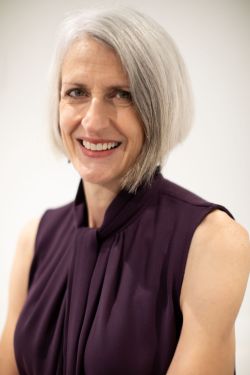
Anne Helmreich, the incoming director of the Smithsonian’s Archives of American Art (Photo by Loli Kantor).
Anne Helmreich has been named the director of the Smithsonian’s Archives of American Art, effective 27 February 2023. Helmreich is currently the associate director of grants programming at the Getty Foundation and brings 35 years of experience in higher education and arts administration to this new role.
The Archives of American Art fosters advanced research by accumulating and disseminating primary sources that document more than 200 years of the nation’s artists and art communities. Helmreich will oversee its Washington, D.C., headquarters and research center, New York City research center, and Lawrence A. Fleischman Gallery. She will also oversee its collections development, exhibitions, and publications, including the Archives of American Art Journal, the longest-running scholarly journal in the field of American art. Additionally, Helmreich will lead the Archives’ digitization program and the stewardship of its holdings consisting of some 30 million items and an oral-history collection of more than 2,500 audio and video interviews, the largest accumulation of in-depth, first-person accounts of the American art world.
“Anne understands how effective and impactful art can be in recording and expressing the American story,” said Kevin Gover, the Smithsonian’s Under Secretary for Museums and Culture. “Her track record as a successful administrator, educator and user of the Archives of American Art made her the obvious choice to conserve this vital collection and to make its holdings even more accessible to the art world and beyond.”
As associate director of grants programming at the Getty Foundation, Helmreich supports individuals and institutions committed to advancing the greater understanding and preservation of the visual arts in Los Angeles and throughout the world. Through strategic grant initiatives, it strengthens art history as a global discipline, promotes the interdisciplinary practice of conservation, increases access to museum and archival collections and develops current and future leaders in the visual arts.
She also represents the Getty Foundation in the LA Arts Recovery Fund, which supports small to mid-sized arts organizations in Los Angeles.
Helmreich has been awarded over two dozen grants, published two books, edited five collections, written 19 book chapters, published 20 scholarly papers, and contributed to over half a dozen exhibition catalogs. At the Archives of American Art, Helmreich aims to expand its digital offerings, foster an inclusive and diverse culture that represents the many communities and histories that make up the United States and establish the Archives as America’s preeminent storyteller for the arts.
“I am very excited to help move the Archives of American Art into the future by making it more accessible to more researchers from all backgrounds and by expanding public engagement,” Helmreich said. “The Archives’ unique collections have helped generations of art historians record and study American art, and by digitizing and diversifying our collections and our programming for new audiences, we will continue to reflect the history and future of America through this important lens.”
Previously, Helmreich served as the inaugural co-chair of the Getty DEAI Council, the associate director of digital initiatives at the Getty Research Institute, the dean of the College of Fine Arts at Texas Christian University, and director of the Baker-Nord Center for the Humanities and associate professor of art history at Case Western Reserve University. Helmreich holds a Bachelor of Arts from Dickinson College, a Master of Arts in art history from the University of Pittsburgh, and a doctorate in art history from Northwestern University.
Liza Kirwin, deputy director of the Archives of American Art, has served as interim director.
Sweden Nationalmuseum Acquires Portrait of Marie-Gabrielle Capet
From the press release:
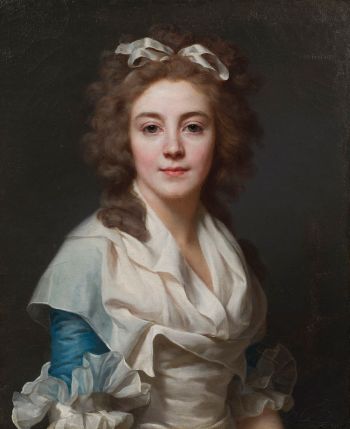
Unknown French artist, Portrait of Marie-Gabrielle-Capet, 1780s, oil on canvas (Stockholm: Nationalmuseum, 7658).
Nationalmuseum has acquired a portrait of Marie-Gabrielle Capet, a French painter of pastels and miniatures. The portrait depicts the artist in the 1780s, when she was a close associate of Adélaïde Labille-Guiard, one of the most celebrated portrait painters of the day, and her future husband François-André Vincent. There is ample evidence to suggest that it was Vincent who painted this portrait of the young Capet.
Marie-Gabrielle Capet (1761–1818) was born in Lyon in humble circumstances. Thanks to well-connected acquaintances, in her twenties she became a pupil of the portrait painter Adélaïde Labille-Guiard, who was known for taking on female pupils only. Evidence of their close relationship can be seen in Labille-Guiard’s large self-portrait from 1785, now in the Metropolitan Museum of Art in New York. Capet appears beside her teacher, along with another pupil, Marie Marguerite Carreaux de Rosemond. Labille-Guiard was one of the few female members of the French academy of fine arts, where she was a tireless advocate for women’s rights. In her personal life, she had a long-term relationship with her colleague François-André Vincent. In 1792 they bought a house together, where Capet also moved in.
The recently acquired portrait was likely painted a few years earlier. Labille-Guiard and Vincent both used their protégée Capet as a model, and there are several sketches of her as such, although none can be directly tied to the painting acquired by Nationalmuseum. The portrait shows her in a near-frontal pose, turning slightly to meet the onlooker with a piercing but gentle gaze, which betrays the close relationship between model and artist. The saturated colours and cohesive, symmetrical composition point to Vincent as the likely creator; these stylistic features had long made him Jacques-Louis David’s main rival in neoclassical painting.
In many respects, this portrait of Marie-Gabrielle Capet is a representation of a remarkable home, where artistic coworking and domestic roles were commingled. In an artistic sense, Capet seems to have been wholly dependent on her teacher Labille-Guiard. After the latter’s death in 1808, Capet continued looking after Vincent, whom she called ‘father’, until he died in 1816. Capet herself died only two years later, at the age of just 57, apparently from a broken heart and incapable of continuing her painting career.
“This portrait of Marie-Gabrielle Capet is notable for its unusually strong sense of presence. We really get the feeling of standing eye to eye with the model,” said Magnus Olausson, head of collections at Nationalmuseum. “With this acquisition, we can add another piece of the puzzle to the others in our collection spotlighting the great French female artists of the 18th century. So we are delighted that this significant work will shortly go on display at Nationalmuseum.”
The portrait of Marie-Gabrielle Capet will be on display in the 18th-century painting gallery from 1 February 2023.
Nationalmuseum receives no state funds with which to acquire design, applied art and artwork; instead the collections are enriched through donations and gifts from private foundations and trusts. This acquisition has been funded by a generous donation from the Sophia Giesecke bequest.










 Enfilade
leave a comment