In Memoriam | David Bindman (1940–2025)
Posted recently (3 June) by the Paul Mellon Centre:
David Bindman (1940–2025)
by Sarah Victoria Turner
 We are saddened to hear that David Bindman (1940–2025) Emeritus Professor of the History of Art at University College London and Fellow of the Hutchins Center for African and African American Research, Harvard University, has passed away after a short illness.
David has been an immensely influential figure in British art over the last sixty years, writing on Blake (the subject of his first published article in 1966), Hogarth, Roubiliac, the French Revolution and caricature, and race and representation. His book Blake as an Artist (1977) endures as a key text, while his Hogarth for the World in Art series (1981) remains a standard introduction to the artist. His publications for the Paul Mellon Centre (PMC) include Karl Friedrich Schinkel ‘The English Journey’ (with Gottfried Reimann, 1993) and the multiple-award-winning Roubiliac and the Eighteenth-Century Monument (with Malcolm Baker, 1995). He was a founding figure in the multi-volume project Image of the Black in Western Art (2006 to date) and co-editor of thirteen volumes in the series. . .
Keep reading here»
In Memoriam | Rosalind Savill (1951–2024)
Dame Rosalind Savill (1951–2024), DBE, FSA, FBA
A memorial service is being planned for Dame Rosalind Savill by her daughter Isabella Calkin and brother Hugh Savill, to take place in London on a week day in late spring or early summer. So that an appropriate venue can be found, it would be incredibly helpful for Isabella and Hugh to have an idea of the number of people who would like to attend. If you hope to come, could you kindly register your interest as soon as possible at the following email address: RosMemorial@outlook.com. Please feel free to share the news with anyone you think may also be interested in attending.
From The Wallace Collection:
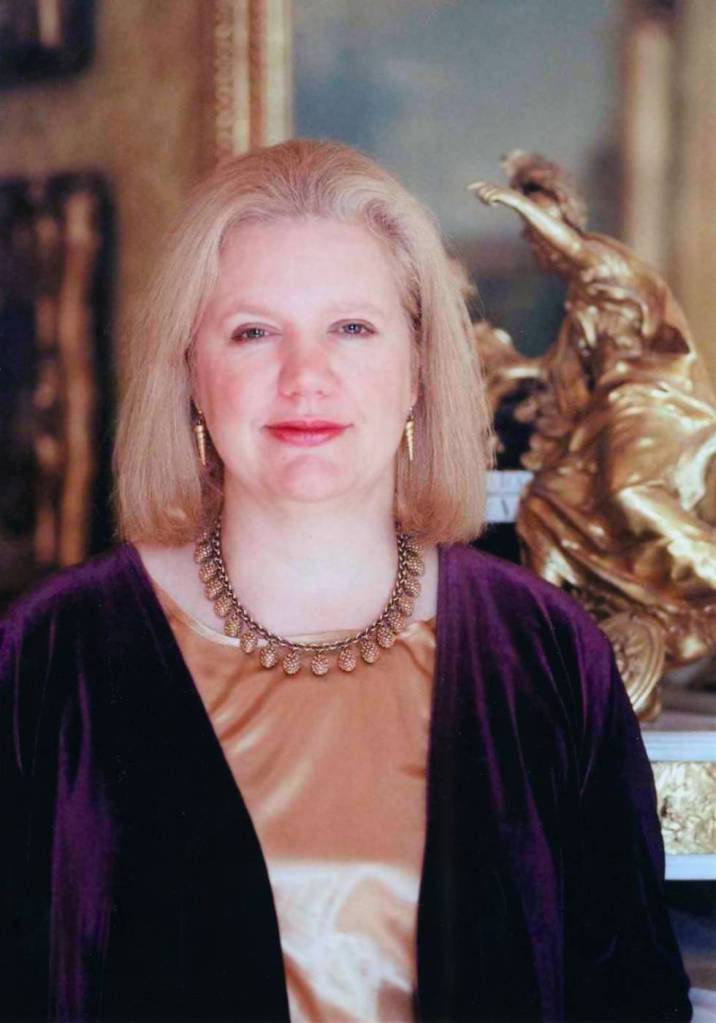 The Wallace Collection is deeply saddened by the recent passing of Dame Rosalind Savill, who was Director of the museum from 1992 until 2011.
Following her studies at the University of Leeds and a position in the ceramics department at the Victoria and Albert Museum, Dame Rosalind joined the Wallace Collection in 1974 as a museum assistant. In 1978, she became Assistant to the Director and further developed her life-long passion for the Collection’s outstanding 18th-century French decorative arts, particularly the sumptuous porcelain created by the Sèvres Manufactory. Many years of research culminated in Dame Rosalind’s publication of these treasures in her 1988 Catalogue of Sèvres Porcelain, which remains a ground-breaking work of reference for French ceramic studies.
From here, Dame Rosalind was appointed Director of the Wallace Collection in 1992. With great energy and tenacity, she brought vital change to the museum, transforming it from an undervisited and underappreciated institution into a cultural landmark, made open and relevant to all. Her most ambitious undertaking was developing the Centenary Project. With generous funding from the Heritage Lottery Fund, the Monument Trust, the Wolfson Foundation, and private individuals, this created a glazed courtyard, as well as new exhibition, learning, library, and event spaces, while securing the very foundations of the building itself. Dame Rosalind breathed new life into the galleries, too, by leading on their refurbishment and rehanging, giving them the splendid character that is much loved today. These galleries also played host to daring exhibitions under her leadership, including showing works by Lucian Freud in 2006 and Damien Hirst in 2009, which looked to reframe the museum within contemporary contexts and led to an unprecedented rise in visitor numbers.
Dame Rosalind’s extraordinary achievements and expertise were recognised far beyond the Wallace Collection. She was awarded a National Art Collection Fund Prize in 1990, appointed a CBE in 2000 and a DBE in 2009 for her services to the arts, and most recently made an officer of the Ordre des Arts et Lettres in 2014. She also served as a trustee to numerous institutions, including the Royal Collection, the Samuel Courtauld Trust, and the Buccleuch Living Heritage Trust, as well as on the advisory committees of the Royal Mint and English Heritage and the academic committee of Waddesdon Manor. In 2011, Dame Rosalind retired from the museum but continued her research on Sèvres, publishing in 2021 Everyday Rococo, a magisterial study of Madame de Pompadour and her patronage of the porcelain factory. Objects were always at the very centre of Dame Rosalind’s work, and she had an insatiable desire to understand them, through close looking and handling, and strongly encouraged others to do so, too. Above all, she was an inspiring communicator and teacher, playing a pivotal role for generations of art lovers, historians, and critics.
The Wallace Collection wishes to celebrate Dame Rosalind’s unwavering commitment and contribution to this remarkable museum and extends heartfelt condolences to her family and friends.
In memory of Dame Rosalind’s profound contribution to the study of French decorative arts, in 2025 the Collection will inaugurate an annual memorial lecture in her name. In the spirit of her passion for sharing her knowledge with the public, each year the Dame Rosalind Savill Memorial Lecture will enable a leading scholar to share new insights into the world of 18th-century French arts and culture.
–Xavier Bray, Director, on behalf of all the Trustees and Staff at The Wallace Collection
The Burlington Magazine, October 2024
The long 18th century in the October issue of The Burlington:
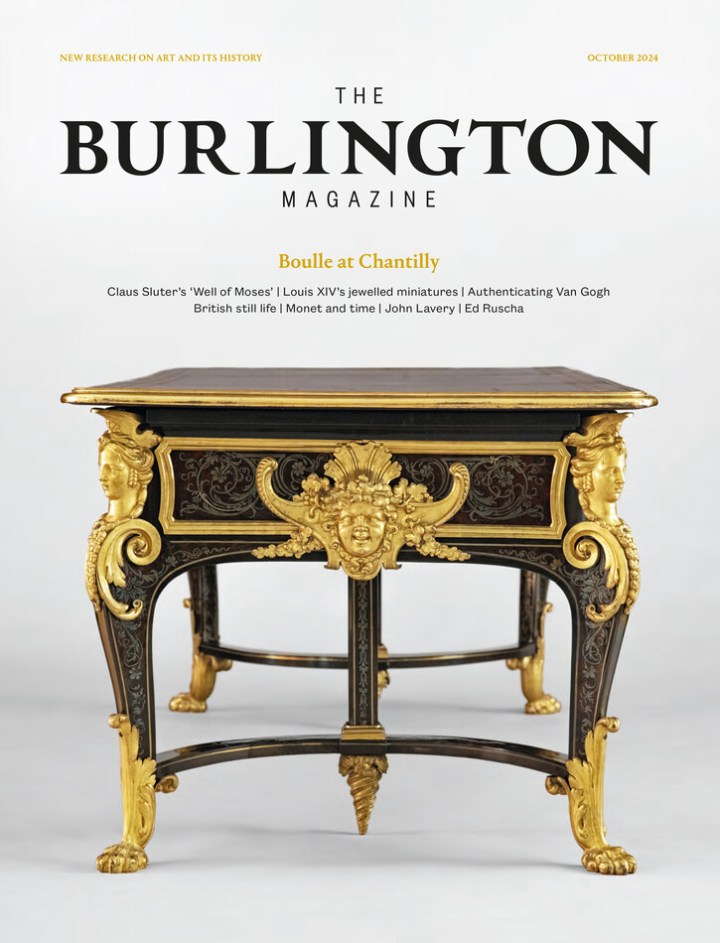
The Burlington Magazine 166 (October 2024)
 e d i t o r i a l
• “Restoring the ‘belle époque’,” pp. 995–96.
The Musee Jacquemart-André is a treasure house that graces the Haussmann boulevards in Paris and is perhaps not nearly as well-known as it should be. The recent re-opening of the museum on 6th September, following a period of closure for conservation, therefore provides a welcome opportunity to draw fresh attention to this most romantic and beguiling of collections and the elegant building that houses it.
a r t i c l e s
• Jacob Willer, “Annibale Carracci and the Forgotten Magdalene,” pp. 1028–35.
A painting the collection of the National Trust at Kedleston Hall, Derbyshire, is published here as a work of Annibale Carracci’s maturity. Related to comparable compositions which derive from it, in collections in Rome and Cambridge, it was acquired in Florence in 1758 for the 1st Baron Scarsdale.
• Samantha Happé, “Portable Diplomacy: Louis XIV’s ‘boîtes à portrait’,” pp. 1036–43.
Louix XIV’s ambitious and carefully orchestrated diplomatic programme included gifts of jewelled miniature portraits known as ‘boîtes à portrait’. Using the ‘Présents du Roi’, the circumstances around the commissioning and creation of these precious objects can be explored and a possible recipient suggested for a well-preserved example now in the Musée du Louvre, Paris.
r e v i e w s
• Alexander Collins, Review of the exhibition André Charles Boulle (Musée Condé, Château de Chantilly, 2024), pp. 1056–59.
• Claudia Tobin, Review of the exhibition The Shape of Things: Still Life in Britain (Pallant House Gallery, 2024), pp. 1067–69.
Helen Hillyard, Review of of the recently renovated galleries of the Barber Institute of Fine Arts, Birmingham, pp. 1077–79.
• Colin Thom, Review of Steven Brindle, Architecture in Britain and Ireland, 1530–1830 (Paul Mellon Centre, 2024), pp. 1080–81.
• Christopher Baker, Review of Bruce Boucher, John Soane’s Cabinet of Curiosities: Reflections on an Architect and His Collection (Yale University Press, 2024), pp. 1087–88.
o b i t u a r y
• Christopher Rowell, Obituary for Alastair David Laing (1944–2024), pp. 1094–96.
Although renowned in particular for his expertise on the art of François Boucher, Alastair Laing had very wide-ranging art historical taste and knowledge, which he shared with great generosity of spirit. He curated some important exhibitions and brought scholarly rigour to his inspired custodianship of the art collections of the National Trust.
The Burlington Magazine, May 2024
From the May issue of The Burlington, which is dedicated to French art — and please note that Yuriko Jackall’s important article is currently available for free, even without a subscription.
Burlington Magazine 166 (May 2024)

Jean-Honoré Fragonard, The Swing, 1767, oil on canvas, 81 × 64 cm (London: Wallace Collection).
a r t i c l e s
• Ludovic Jouvet, “A Medal of the Sun King by Claude I Ballin,” pp. 440–45.
• Yuriko Jackall, “The Swing by Jean-Honoré Fragonard: New Hypotheses,” pp. 446–69.
• Thadeus Dowad, “Dāvūd Gürcü, Ottoman Refugee, and Girodet’s First Mamluk Model,” pp. 479–87.
• Humphrey Wine, “The Paintings Collection of Denis Mariette,” pp. 488–92.
r e v i e w s
• Richard Stemp, Review of Ingenious Women: Women Artists and their Companions (Hamburg: Bucerius Kunst Forum / Basel: Kunstmuseum, 2023–24), pp. 501–04.
• Christoph Martin Vogtherr, Review of Louis XV: Passion d’un roi (Château de Versailles, 2022), pp. 508–10.
• Eric Zafran, Review of The Hub of the World: Art in Eighteenth-Century Rome (Nicholas Hall, 2023), pp. 515–18.
• Saffron East, Review of Black Atlantic: Power, People, Resistance (Cambridge: Fitzwilliam, 2023), 523–25.
• Gauvin Alexander Bailey, Review of Marsely Kehoe, Trade, Globalization, and Dutch Art and Architecture:
Interrogating Dutchness and the Golden Age (Amsterdam UP, 2023), pp. 534–35.
• Helen Clifford, Review of Vanessa Brett, Knick-Knackery: The Deards’ Family and Their Luxury Shops, 1685–1785 (2023) pp. 535–37.
o b i t u a r y
• Michael Hall, Obituary for Jacob Rothschild (1936–2024), pp. 538–40.
One of the leading public figures in the arts in the United Kingdom, Lord Rothschild was a major collector of historic art and a patron of contemporary artists and architects. His principal focus was Waddesdon Manor, his family’s Victorian country house and estate in Buckinghamshire.
◊ ◊ ◊ ◊ ◊
Jean-Honoré Fragonard was one of the supreme exponents of the French Rococo style and his painting The Swing in the Wallace Collection, London, is perhaps his most famous work. Yet despite this elevated status, mystery surrounds its origins. New documentary and technical research presented here by Yuriko Jackall may, however, have finally established for whom it was painted and why the painting was hidden away for the first few years of its existence.
The May issue also includes the publication by Ludovic Jouvet of a previously unknown and spectacular medal of the Sun King, Louis XIV, as well as Humphrey Wine’s study of the intriguing collection of the publisher Denis Mariette (the uncle of the more famous Pierre-Jean Mariette). Other articles feature the work of French Romantic painters: Andrew Watson establishes the early history of Delacroix’s The Death of Sardanapalus in the Musée du Louvre, Paris, and Thadeus Dowad identifies Girodet’s first Mamluk model.
Exhibition reviews include Sarah Whitfield discussing Bonnard’s Worlds (Kimbell Art Museum, Fort Worth, and the Phillips Collection, Washington) and Lisa Stein assessing Saul Leiter (MK Gallery, Milton Keynes). Catalogue reviews feature Christoph Martin Vogtherr on Louis XV, Lunarita Sterpetti on Eleonora of Toledo, and Eric M. Zafran surveying art in eighteenth-century Rome. Meanwhile, an impressive and wide range of new books are examined: these feature Megan McNamee on diagrams in medieval manuscripts, Christine Gardner-Dseagu on photographing Pompeii and Richard Thomson on Henry Lerolle.
◊ ◊ ◊ ◊ ◊
Note (added 31 July 2024) — The posting was updated to include additional content.
The Burlington Magazine, December 2023
The eighteenth century in the December issue of The Burlington, which focuses on Spain:
The Burlington Magazine 165 (December 2023)

Francisco de Goya, Self-Portrait with Dr Arrieta, 1820, oil on canvas, 115 × 77 cm (Minneapolis Institute of Art, 52.14).
a r t i c l e
• Mercedes Cerón Peña, “Goya’s Self-Portrait with Dr Arrieta,” pp. 1300–04.
In 1820 Goya painted a portrait of himself as he had appeared during his serious illness of the year before, attended by his doctor, Eugenio García Arrieta. Newly discovered biographical information about Arrieta suggests that the painting’s red and and green colour scheme may allude to the political views he shared with Goya.
r e v i e w s
• Michael Hall, Review of the new Galería de las Colecciones Reales (Royal Collections Gallery) in Madrid (opened 28 June 2023), pp. 1339–43.
• Stephen Lloyd, Review of the exhibition Return of the Gods (World Museum, Liverpool, (April 2023 — February 2024), pp. 1343–45. “Britain’s largest assemblage of Classical sculpture outside London belongs to National Museums Liverpool . . . In 1959 Liverpool City Council and its museums were gifted the entirety of the Ince Blundell collection—approximately six hundred heavily restored Roman marbles . . . collected by . . . Henry Blundell (1724–1810), a wealthy Catholic landowner, between 1776 and 1809.”
• Humphrey Wine, Review of the catalogue raisonné by Joseph Assémat-Tessandier, Louis Lagrenée, dit l’Aîné (1725–1805) (Arthena, 2022), pp. 1364–65.

Louis-Michel van Loo, Portrait of Isabel Farnese, 1737, oil on canvas, 341 × 264 cm (Madrid: Galería de las Colecciones Reales).
• Rebeka Hodgkinson, Review of Stephanie Barczewski, How the Country House Became English (Reaktion, 2023), pp. 1370–71.
• Peter Humfrey, Review of Eveline Baseggio, Tiziana Franco, and Luca Molà, eds., La chiesa di Santa Maria dei Servi e la comunità veneziana dei Servi di Maria, secoli XIV–XIX (Viella, 2023), pp. 1374–75. “The demolition of the great fourteenth-century church of the Servi in about 1812–13 represents one of the most grievous of the many losses suffered by Venice’s artistic heritage during the Napoleonic period.”
o b i t u a r y
• Saloni Mathur, Obituary for Kavita Singh (1964–2023), pp. 1379–80.
Professor of art history and Dean of the School of Arts and Aesthetics at Jawaharlal Nehru University, Kavita Singh became internationally known for her publications on the history and politics of museums and the pre-modern art of South Asia. An authority on Indian court paintings, she was an inspiring colleague and teacher who publicly championed both her university and the study of Mughal art in the subcontinent.
Book Launch in Honour of Peter Borsay
From Eventbrite:
Book Launch in Honour of Peter Borsay
Online and in-person, University of Leicester, 29 September 2023, 3pm
The Centre for Urban History at the University of Leicester will mark the publication of Peter Borsay’s last book, The Invention of the English Landscape c. 1700–1939, with a symposium in honour of the late professor, who passed away in 2020. Free and open to all, the event will take place on Friday, 29th September 2023, from 15.00 until 17.00, via Teams Live and in person in the Attenborough Film Theatre. Please contact hypirfinance@le.ac.uk with any questions.
The symposium will be chaired by Professor Rosemary Sweet with the following panel of speakers:
• Penelope J. Corfield (President of the International Society of Eighteenth-Century Studies)
• Richard Coopey (Emeritus Senior Lecturer, Department of History & Welsh History, Aberystwyth University)
• Katy Layton Jones (School of History, Open University)
• Keith Snell (Emeritus Professor of English Local History, University of Leicester)
The Burlington Magazine, May 2023
The eighteenth century in the May issue of The Burlington . . .
The Burlington Magazine 165 (May 2023)
E D I T O R I A L
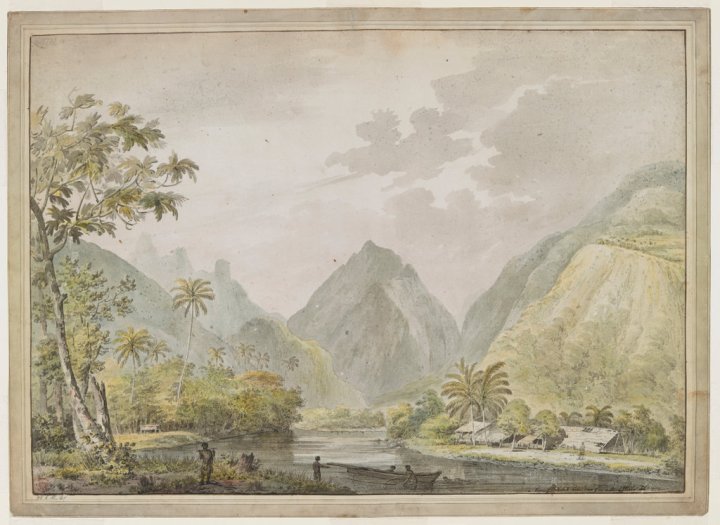
John Webber, A View Looking up the Vaitepiha River with Two Tahitians in a Canoe in the Foreground and Two Others on the Bank with Tahitian Houses to the Right. August 1777, 1777, pen, wash, and watercolour, 45 × 63 cm (London: British Library, Add. 15513, No.13).
• Digitizing the Conway and Witt Libraries, p. 491.
L E T T E R S
• Peter Barber, “The Background of Portrait of Mai,” pp. 492–93.
“Given Reynolds’s lack of interest in landscape painting, but the special place of the portrait of Mai in his oeuvre, it is at least possible that Reynolds may have decided to paint an authentically Tahitian background in order to add further ‘authenticity’. Given his high opinion of [John] Webber, it would have been natural to have copied the scene from one of his friend’s ‘excellent’ paintings of Vaitepiha Bay” (493).
• Christina Strunck, “Laguerre’s Painted Hall at Chatsworth,” p. 493.
“Since in his article ‘A Modello by Louis Laguerre and the Programme of the Painted Hall at Chatsworth’, published in The Burlington Magazine in August 2022 (pp. 760–67), François Marandet came to the same conclusions [that I did in my 2021 monograph Britain and the Continent, 1660–1727: Political Crisis and Conflict Resolution in Mural Paintings at Windsor, Chelsea, Chatsworth, Hampton Court and Greenwich], I thought your readers might like to be referred to the more extended analysis of the programme in both my book and an article I published in January 2022 that discusses the channels through which the two versions of Maratta’s painting may have been known to Laguerre and his patron, William Cavendish.”

Jean Massard, after Jean Baptiste Greuze, A Woman (Madame Greuze) with a Fur-trimmed Hood Drawn over Her Head, Detail from Greuze’s ‘La Dame de Charité’ above a Sketch of the Painting, 1772, etching and engraving, 24 × 16 cm (London: British Museum, 1978,0121.291).
R E V I E W S
• Mark Evans, Review of Leopoldine van Hogendorp Prosperetti, Woodland Imagery in Northern Art, c.1500–1800: Poetry and Ecology (Lund Humphries, 2022), pp. 568–69.
• Alastair Lang, Review of Yuriko Jackall, Jean-Baptiste Greuze et ses têtes d’expression: La fortune d’une genre (CTHS and INHA, 2022), pp. 569–71.
• Lisa Monnas, Review of Michael Peter, Gewebtes Gold: Eine Kleine Geschichte der Metallfadenweberei von der Antike bis um 1800 (Abegg-Stiftung, 2022), p. 576.
• Alexandre Maral, Review of Christopher Tadgell, The Louvre and Versailles: The Evolution of the Proto-Typical Palace in the Age of Absolutism (Routledge, 2020), pp. 576–77.
• Wim Nys, Review of Beatriz Chadour-Sampson, Sandra Hindman, and Carla Van De Puttelaar, eds., Liber Amicorum in Honour of Diana Scarisbrick: A Life in Jewels (Ad Ilissvm, 2022), p. 577.
O B I T U A R Y
• Elizabeth Pergam, Obituary for Duncan Robinson (1943–2022), p. 578–79.
Successively the Director of the Yale Center for British Art, New Haven, and the Fitzwilliam Museum, Cambridge, Duncan Robinson had a major influence on the appreciation, study, and collecting of historic and modern British art in both the United States and the United Kingdom.
The Burlington Magazine, April 2023

View of Fort Christiansborg [Christiansborg Castle, Osu] from the Shore, March 1764, ink and coloured wash on paper
(Danish National Archives)
◊ ◊ ◊ ◊ ◊
The eighteenth century in the April issue of The Burlington . . .
The Burlington Magazine 165 (April 2023)
A R T I C L E S
• Gauvin Alexander Bailey, “The Design of Cape Coast Castle and Dixcove Fort, Ghana,” pp. 378–93.
The first analysis of the design of two of the principal eighteenth-century British slave castles and forts of the Gold Coast reveals the Western engravings used as prototypes but also acknowledges these buildings’ engagement with African cultures and forms. Identifying the people who built them and assessing the forts’ association with the coastal African community challenges the popular misconception that they were no more than European transplants.
R E V I E W S
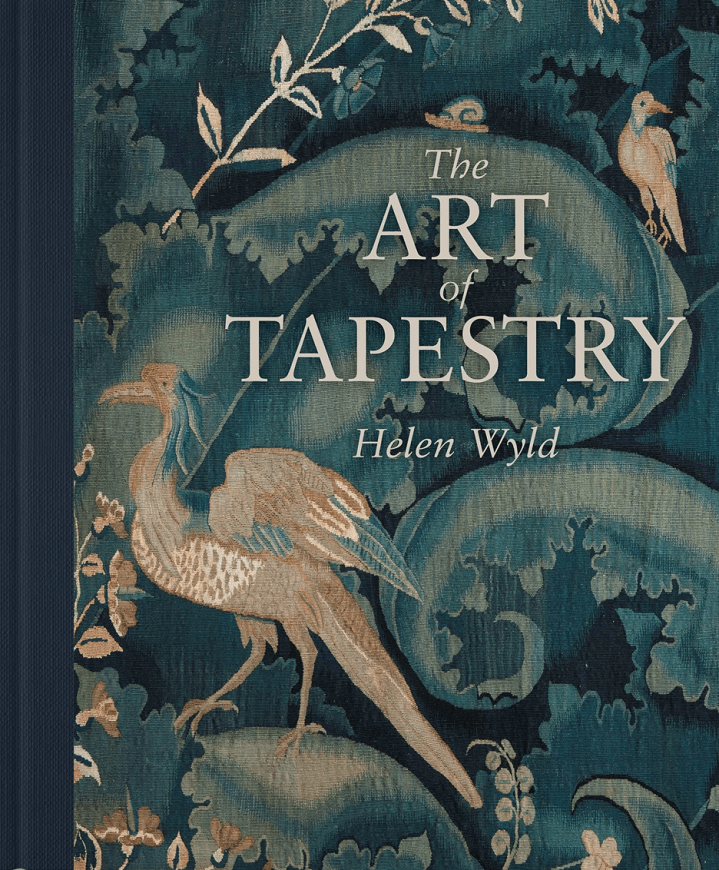 • Morlin Ellis, Review of the exhibition Spain and the Hispanic World: Treasures from the Hispanic Society Museum and Library (Royal Academy of Arts, 2023), pp. 442–45.
• Simon Jervis, Review of the exhibition catalogue, Reinier Baarsen, Process: Design Drawings from the Rijksmuseum 1500–1900 (Rotterdam: 2022), pp. 456–58.
• Philip Ward-Jackson, Review of the exhibition catalogue, Yvette Deseyve, ed., Johann Gottfried Schadow: Embracing Forms (Hirmer Verlag, 2023), pp. 463–66.
• Thomas P. Campbell, Review of Helen Wyld, The Art of Tapestry (Philip Wilson Publishers, 2022), pp. 472–75.
• Charles Saumarez Smith, Review of András Szántó, Imagining the Future Museum: 21 Dialogues with Architects (Hatje Cantz, 2022), pp. 482–83.
• John Martin Robinson, Review of Dudley Dodd, Stourhead: Henry Hoare’s Paradise Revisited (Head of Zeus, 2021), pp. 484–85.
O B I T U A R I E S
• Christopher Wood, Obituary for Hans Belting (1935–2023), pp. 486–88.
The Burlington Magazine, August 2022
The August issue of The Burlington is rich for the eighteenth century, including Karin Wolfe’s obituary for Christopher Johns (details for his memorial service, on 17 September, are emerging here).
The Burlington Magazine 164 (August 2022)
 A R T I C L E S
• Gauvin Alexander Bailey, “A Borromini-Inspired Church Plan in Eighteenth-Century Lima,” pp. 740–51.
Built in 1758–66, the Church of Los Huérfanos, Lima, is unique in Spanish South America for its oval plan. Its designer is her identified as a master builder, Cristóbal de Vergas, who was inspired by prints of Francesco Borromini’s S. Carlo alle Quattro Fontane, Rome, exemplifying the revival of interest during the Rococo perios in Roman Baroque precedents.
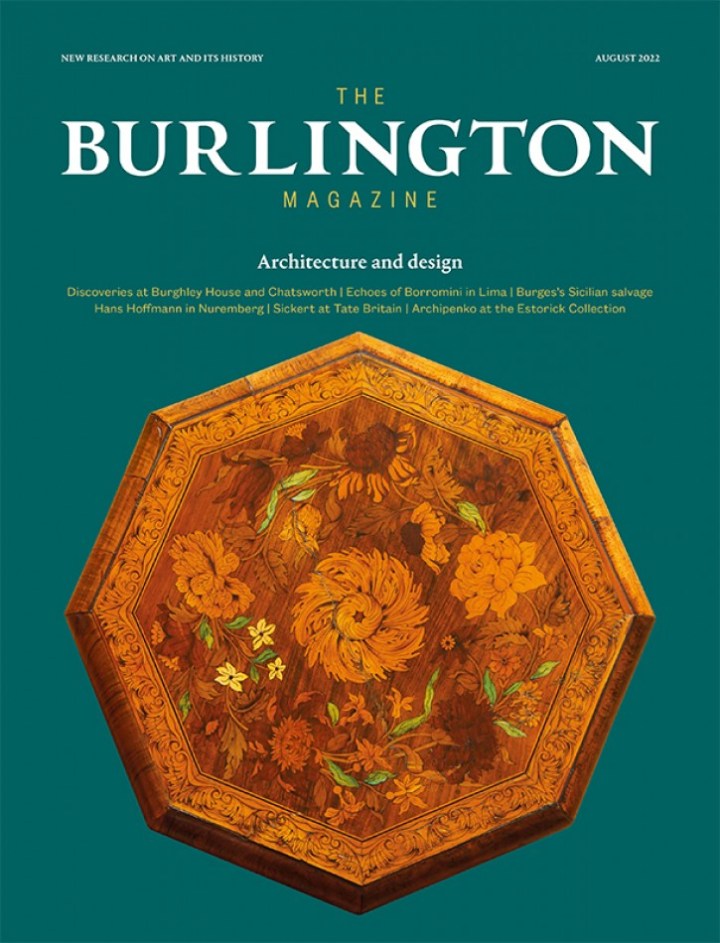
• Adam Bowett, “The Floral Marquetry Floor at Burghley House,” pp. 752–59.
The possibility that five pieces of eighteenth-century furniture at Burghley House, Stamford, incorporate maquetry made for a floor in the house c.1685 is here confirmed by references in inventories. The marquetry can be linked to furniture in the Royal Collection, raising the possibility that the floor was mdade by Gerrit Jensen incorporating marquetry supplied by Jasper Braems.
• François Marandet, “A Modello by Louis Laguerre and the Programme of the Painted Hall at Chatsworth,” pp. 760–67.
With the help of a recently discovered modello, the subject of Louis Laguerre’s monumental painting on the east wall of the Painted Hall, Chatsworth, is here identified as Augustus Ordering the Closing of the Doors of the Temple of Janus. This allows the political allegory of the room’s decoration, completed in 1694, to be fully understood for the first time.
R E V I E W S
• Neil Jeffares, “Pastels in the Pandemic,” pp. 780–87.
The notoriously fragile medium of pastel has not been out of the public eye during the difficult circumstances of the past two years. Exhibition in San Francisco and Munich and a biography of Rosalba Carriera invite comparisons between the major pastellists of the eighteenth century: Joseph Vivien, Maurice-Quentin de La Tour, and Jean-Étienne Liotard, as well as Carriera.
• Reinier Baarsen, Review of Calin Demetrescu, Les ébénistes de la Couronne sous le règne de Louis XIV (La Bibliothèque des Arts, 2021), pp. 818–19.
• Daniel Fulco, Review of Andreas Schumacher, ed., Venezianische Malerei: Staatsgalerie in der Residenz Würzburg (Schnell & Steiner, 2021), pp. 819–21.
• Howard Coutts, Review of Patricia Ferguson, ed., Pots, Prints, and Politics: Ceramics with an Agenda, from the 14th to the 20th Century (British Museum Press, 2021), pp. 821–22.
• Sophie Rhodes, Review of Tessa Murdoch, Europe Divided: Huguenot Refugee Art and Culture (V&A Museum, 2021), pp. 827–28.
• Patrick Bade, Review of Charles Dellheim, Belonging and Betrayal: How Jews Made the Art World Modern (Brandeis University Press, 2021), p. 828.
O B I T U A R I E S
• Karin Wolfe, Obituary for Christopher M.S. Johns (1955–2022), pp. 829–31.
Professor of History of Art at Vanderbilt University, Nashville, since 2003, Christopher M.S. Johns published widely on Italian art of the seventeenth and eighteenth centuries. His determination to demonstrate the falsity of the belief that the settecento was a period of cultural decline had a substantial influence on both scholarship and academic curricula.
Memorial Service for Christopher Johns
From Vanderbilt University . . . (the event may be live-streamed or at least recorded; I’ll update this posting as details emerge, and please feel free to add comments if you have more information. –CH)
Memorial Service for Christopher M. S. Johns
Cohen Memorial Hall, Vanderbilt University, Nashville, Saturday, 17 September 2022
A memorial service and reception for Christopher M. S. Johns, the Norman L. and Roselea J. Goldberg Professor of Fine Arts and professor of history of art and architecture, will be held on Saturday, 17 September, from 2 to 4pm in the atrium of Cohen Memorial Hall on the Peabody College campus. The memorial program will begin at 2:30pm, with the reception to follow. Johns died May 8 following an extended illness. He was 67.
The event is hosted by the College of Arts and Science and the Department of History of Art and Architecture.
◊ ◊ ◊ ◊ ◊
Note (added 12 September 2022) — Event organizers plan to live-stream the event via Zoom with the following link:
https://vanderbilt.zoom.us/j/8816519966
As ASECS president, Wendy Wassying Roworth has contributed the following statement, which will be read alongside other tributes: “Christopher was a longtime active member of the American Society for Eighteenth-Century Studies. A generous scholar, editor, mentor, and friend, he was always willing to share his vast knowledge of Italian art and culture with colleagues and students. He will be missed, but his significant contributions to eighteenth-century studies will continue to inform and inspire.”










 Enfilade
2 comments