Exhibition: Toile de Jouy, Printed Gardens and Fields
I’m happy to welcome one more addition to the Enfilade team! The Paris-based Ph.D. student Hélène Bremer will be weighing in with occasional contributions. She completed her M.A. in Art History at the University of Leiden in 2000 and is now working on her dissertation (also at Leiden) “Grand Tour, Grand collections: The Influence of the Grand Tour Experience on Collection Display in the Eighteenth Century.” She’ll be reporting not only on events in France but also sharing news from the Netherlands. We start things off with an exhibition sketch in response to the Musée de la Toile de Jouy. -CH
◊ ◊ ◊ ◊ ◊
Parties de Campagne, Jardins et champs dans la toile imprimée XVIIIe-XIXe siècle
Musée de la Toile de Jouy, Jouy-en-Josas, 29 April — 20 November 2011
Exhibition sketch by Hélène Bremer

Founded in 1977, the Musée de la Toile de Jouy moved into its current home, the nineteenth-century Château d'Eglantine in 1991. The museum's holdings include some 5000 objects.
The Musée de la Toile de Jouy at Jouy-en-Josas is an ideal destination for anyone taken with wonderful fabrics and eighteenth-century history. Just a few kilometers from the Château de Versailles (though far from its tourist throngs), the museum is located at the Château d’Eglantine. While this charming setting is alone worth a visit, the museum’s interiors offer lovely rooms full of toile-covered furniture. Not only do you find here a vast collection of Toile de Jouy, the displays explain the industrialization of toile-making, particularly the printing innovations of factory founder Christophe-Philippe Oberkampf, the German immigrant who introduced to Jouy-en-Josas, the use of engraved copper plates (1770) and then copper rollers (1797), replacing the older wood blocks.
 For the spring and summer, the staff of the museum have organized a delightful exhibition, Parties de Campagne, Jardins et champs dans la toile imprimée XVIIIe-XIXe siècles. The curators have assembled over 200 examples of fabrics depicting a wide variety of subjects: the four seasons, workers in the fields, shepherds and hunting scenes, children playing, landscapes with ruins, and fête champêtre motifs. There is also a nice, small fabric-covered balloon — to my mind, just begging to be shown with the fabric, Le Ballon de Gonesse, an example of which can be found nearby in the museum’s permanent display.
The sheer quantity of fabrics on display is impressive, suggesting at times the feel of a densely packed closet. The quantity indicates how much there is to explore on this interesting topic of la vie champêtre and how rich the museum’s holdings are, given that all the material comes from the museum’s own collection.
Having seen the exhibition, I’m curious about the accompanying book, edited by Anne de Thoisy-Dallem, which unfortunately was not yet available when I visited in early May. It promises to be a useful publication with two fully-illustrated volumes, addressing not only the exhibition themes but also outlining new research on rare costumes, the gardens of Toile de Jouy, and precious botanical books that provided inspiration for the pattern designers.
For more information, including terrific images, the press release (in French) is available here»
On Site: Looking for the Habsburgs in Serbia
Eighteenth-Century Encounters: Novi Sad, Serbia
By Michael Yonan
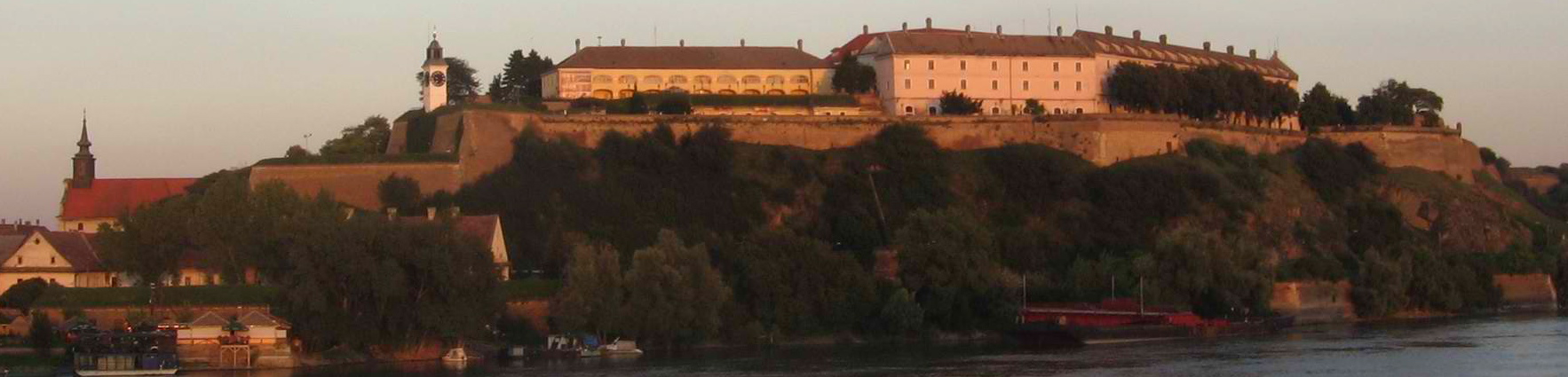
Petrovaradin Fortress, Serbia (Photo: Wikimedia Commons)
THANKS TO THE hospitality of a former student, Višnja Kisić, this year’s summer travels took me into a region of the former Habsburg Empire much less well known than Bohemia or Hungary. This is Vojvodina, a flat, largely agricultural area that forms an autonomous province within modern Serbia.

Plan of Novi Sad (Ratzenstadt in archaic German) and the Petrovaradin fortress, 1745
Vojvodina is not too familiar to English-language art historians. Mentioning Serbia might bring to mind the rich legacy of medieval monasteries in the country’s south, the scattered Ottoman architecture that remains after centuries of Turkish rule, or perhaps Belgrade’s extensive heritage of Communist architecture. Imagine my surprise when I discovered substantial eighteenth-century sights in and around the regional capital of Novi Sad, Serbia’s second largest city.
The city itself has an almost perfect eighteenth-century pedigree. It was founded in 1694 as a new settlement across the Danube from the Petrovaradin Fortress, a large military structure that was instrumental in the Austrian army’s defense against the Ottomans. Novi Sad developed rapidly in the eighteenth century and still maintains its historical core with beautiful civic, domestic, and religious edifices. Unlike Belgrade, a sprawling and rather hectic place, Novi Sad has a much more relaxed feel that recalls Vienna or Budapest and bespeaks its Habsburg heritage.
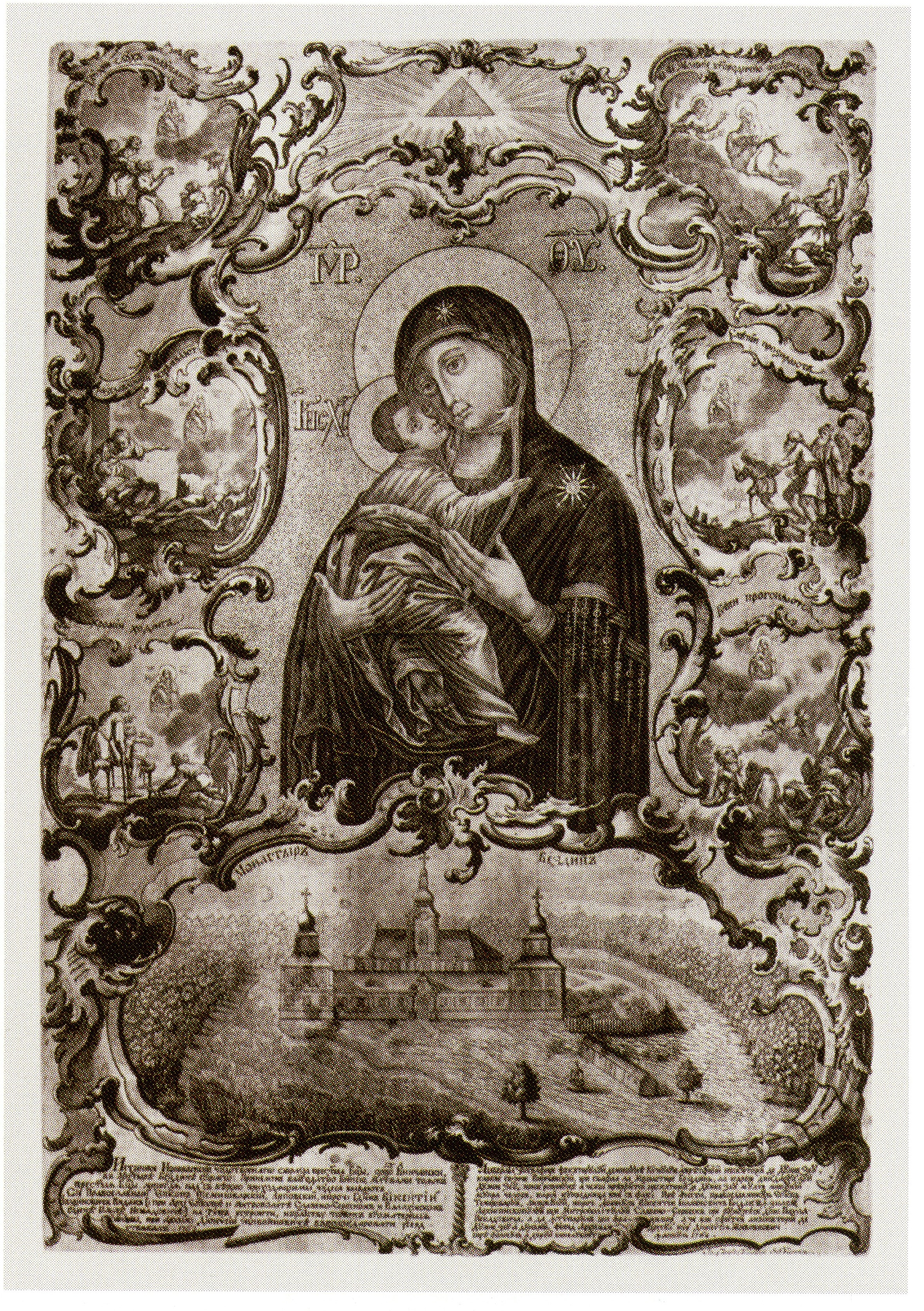
J. K. Winkler, Virgin and Child, print, 1762
There are excellent museums in Novi Sad that would be of great interest to American scholars. For eighteenth-century specialists, the highlight certainly is the Gallery of Matica Srpska, where I was privileged to give a lecture on July 19. The gallery is the most important museum of Serbian art, and the quality of its holdings is impressive (“Matica” means “queen bee” and is used in Slavic countries to designate institutions of cultural promotion and scholarship). The museum is home to a gorgeous collection of painted religious images and carved wooden church outfittings, as well as an extensive group of eighteenth-century Serbian Orthodox prints. In addition, there are numerous painted portraits from the eighteenth through twentieth centuries, academic history paintings by Serbian artists, and galleries of modern art. The real standouts for me were the beautiful Orthodox rococo church outfittings. These are composite constructions of gilded wood and paint that adorned Orthodox churches, usually altars and iconostases.

Teodor Kračun, "The Prophet Gideon," 1776
Orthodox Rococo? For many Enfilade readers, this must come as a huge surprise. I suspected that such art existed at the point where Catholic regions abutted Orthodox ones, but had never encountered it in person, nor knew much about it. Art Historian Dr. Branka Kulić has researched this material extensively and written about how local painters worked with craftsmen trained in Vienna to produce a fascinating synthesis of rococo and Byzantine traditions. Later examples break somewhat with the strict rules of icon representation to incorporate greater three-dimensionality and naturalism into their works, and these traditions continued well into the nineteenth century. As Dr. Kulić has noted, artists produced such imagery for churches across the region, not just in Novi Sad, and they can perhaps be understood as visual manifestations of this region’s multivalent social, economic, and religious structure.
Personally, I was struck by of how many fascinating things remain to be encountered in eighteenth-century art, how much can still surprise the curious investigator, and how diverse this century’s visual and material production really was. It also brought to mind how inconsistent the narratives we tell about art’s history can be, and how the desire to see some
things clearly necessitates obscuring others from view.

Teodor Kračun and Arsenije Marković, "The Descent of the Holy Spirit and The Council of Prophets with the Holy Virgin," 1775-1780
There are also significant eighteenth- and early nineteenth-century sights in the nearby cities of Sremski Karlovci and Zemun, as well as the more distant town of Vršac, all of which have preserved pockets of eighteenth-century architecture. And in Novi Sad there is yet another museum worth visiting, this one for modern art: the Pavle Beljanski Memorial Collection, a fascinating example of a high-quality private art collection installed and housed entirely according to its collector’s wishes.
◊ ◊ ◊ ◊ ◊
Michael Yonan is Associate Professor of Art History at the University of Missouri-Columbia. His book, Empress Maria Theresa and the Politics of Habsburg Imperial Art, appeared earlier this year from Penn State University Press.
Searching for Shelley’s Ghost on Shelley’s Birthday
The storied poet, Percy Bysshe Shelley, was born on this day in 1792. This exhibition helps explain how some of those stories were framed by his grieving wife in the wake of his death. From Dove Cottage and the Wordsworth Museum:
Shelley’s Ghost: Reshaping the Image of a Literary Family
Wordsworth Museum and Art Gallery, Grasmere, Cumbria, 7 July — 30 October 2011
Curated by Stephen Hebron
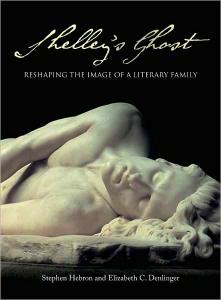
ISBN: 9781851243396, $35
Few families have such a remarkable reputation for their contribution to the literary and intellectual life of Britain as the Godwins and the Shelleys. In the course of their lives, each of the important writers in these families accumulated an archive of letters, notebooks and literary papers. After their death, surviving family members pored over this material, publishing some records and withholding others in an attempt to control that reputation.
Now, parts of this archive material are being brought together for display from two great Shelley collections – the Bodleian Libraries in Oxford and the New York Public Library, home of the Carl H. Pforzheimer Collection of Shelley and his Circle. Shelley’s Ghost will open in the Wordsworth Museum on 7 July 2011, and show until 31 October. The exhibition provides a fascinating insight into the real lives of three generations of a family that was blessed with genius, marred by tragedy, and often surrounded by scandal. It begins with the relationship between Wordsworth’s radical friend William Godwin and the feminist campaigner Mary Wollstonecraft; it goes on to cover their daughter Mary’s elopement and subsequent relationship with the poet Percy Bysshe Shelley, whose expulsion from Oxford for the publication of The Necessity of Atheism and elopement four months later with the 16-year-old Harriet Westbrook had already caused notoriety; and it concludes with the roles played by the Shelleys’ only surviving child, Sir Percy Florence Shelley, and his wife Jane, Lady Shelley, as the guardians of the family papers.
A central theme of the exhibition is the effort made by the grieving Mary Shelley in 1822, immediately after Shelley drowned aged 29 in the Bay of Lerici, to collect and edit his work and create a compelling image of his character. Shelley expected posterity to judge him as a poet: the court, he said, was ‘a very severe one’, and he feared the verdict would be ‘guilty death’. Sir Percy and Lady Shelley went on to house the family manuscripts in a special ‘Shelley Sanctum’ alongside treasured family relics such as portraits, personal possessions and locks of hair. For years they guarded them closely, seeking to protect the images of Shelley and Mary that we see in the portraits: smiling, ethereal, other worldly. Much of this archive remained intact when it was gifted to the Bodleian in 1893, as a collection which now enables us to see the dramas of these years preserved in private letters and journals, written in times of great stress and recording the most painful emotions. The exhibition will therefore show how the deliberately selective release of the manuscripts on display, which have been the basis of many biographies, has shaped public knowledge of this great literary family. The exhibition will also include rare books and family possessions, the first draft of Mary Shelley’s Frankenstein, and the best-known portrait of Shelley, painted in Rome by the amateur artist Amelia Curran in 1819.
The exhibition’s interactive website is available here»
◊ ◊ ◊ ◊ ◊
About Dove Cottage:
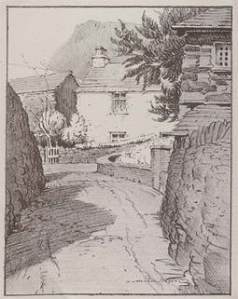 Dove Cottage was the home of William Wordsworth from December 1799 to May 1808, the years of his supreme work as a poet. As with many old buildings, the early history of Dove Cottage is difficult to trace accurately; although the date of its construction is not recorded, this is likely to have been during the early 17th century. Its original use is also unknown, but during the second half of the 18th century it became an inn called the Dove and Olive. Many of the building’s distinctive features date from this time; its white-washed walls, flagstone floors and dark, wood panelling. However, in the early 1790s, the Dove Cottage was closed down. It seems likely that the building remained empty for the next few years, until William and Dorothy Wordsworth arrived as tenants on 20th December 1799.
In the building’s time as a pub, the downstairs bedroom would have been used as a drinking room, but for the Wordsworths, it was always used as a bedroom. Initially this is where Dorothy slept and it would have been here that she wrote much of her ‘Grasmere Journals’. In the summer of 1802 this became William’s bedroom in preparation for his marriage to Mary Hutchinson in October. The washstand displayed in this room belonged to William and Mary and is a rare example of a double washstand. (more…)
On Site: Washington, D.C.’s Old Stone House
I’ve no doubt that with many of HECAA’s members scattered across the globe, lots of you have made terrific discoveries over the summer. Some of these will lead to new areas of research, publications, and teaching ideas. Others, however, might simply stand out as interesting. There are plenty of venues for the big finds, but it seems to me the more modest — often just personally satisfying — discoveries usually just fade quietly into the background of memory. As a means of countering the tendency, I would encourage HECAA members to share some of the curious gems you’ve stumbled across recently — perhaps an exhibition, an unfamiliar collection, a less than famous country house, or a small museum, maybe a site that came as a total surprise or maybe something you’ve been meaning to visit for a long time.
As proof of just how unassuming such ‘discoveries’ might be, I’m contributing the first installment in the series. So don’t be bashful, send in your own contribution as well. I’m happy to help with logistics of the posting. Best, -CH
◊ ◊ ◊ ◊ ◊
 Last week I was in Washington, D.C. for a couple of meetings, and though I didn’t have lots of time for research and museum visits, I spent a balmy evening walking from the White House to Georgetown. At 3051 M. Street, just across from a Barnes & Noble bookstore, stands the Old Stone House. Built in 1765, it is the oldest surviving building in the Washington metropolitan area. At least according to my guidebook, it is, in fact, the city’s only colonial building still standing. Administered by the National Park Services, the house, with its six rooms and garden, is open to the public for free tours (I was unfortunately too late to see inside).
 Built by Christopher Layman, a joiner from Pennsylvania, who lived there briefly with his wife Rachael and their two sons, the house was expanded after being purchased by Cassandra Chew in 1767; it remained in the family until the nineteenth century. Paneling was added in 1775 along with an Adams style mantel in the 1790s. Inventories of the Chew family’s possessions also list slaves.
In this city that so depends upon giving visual form to eighteenth-century ideals — from L’Enfant’s 1791 plan to the towering sculpture of a standing Jefferson peering out across the Tidal Basin — it is remarkable to me that this small house built by a carpenter is the only tangible bit of architecture connecting us to the pre-revolutionary period.
-Craig Hanson
Exhibition: French Landscape Prints at the Château de Sceaux
In the eighteenth century the Château de Sceaux was home to Louis Auguste de Bourbon, the Duke of Maine (the son of Louis XIV and his royal mistress, Madame de Montespan). The Duchess of Maine, Louise-Bénédicte de Bourbon-Condé, had her children raised at the nearby Petit Château, the building now serving as an exhibition venue for the Musée de l’Île-de-France. Just south of Paris, the commune of Sceaux is served by the RER Line B. From the website of the Domaine de Sceaux:

Le Dessin français de paysage aux XVIIe et XVIIIe siècles
Musée de l’Île-de-France, Petit Château du Domaine de Sceaux (near Paris), 14 May — 15 August 2011
Donnant sur la ville côté cour, partie intégrante du parc départemental côté jardin, le Petit Château du Domaine de Sceaux complète désormais les espaces du musée de l’Île-de-France ouverts au public. Il devient aujourd’hui le lieu de rendez-vous des amateurs d’arts graphiques. Une première exposition consacrée au Dessin français de paysage aux XVIIe et XVIIIe siècles s’y déroule du 14 mai au 15 août.
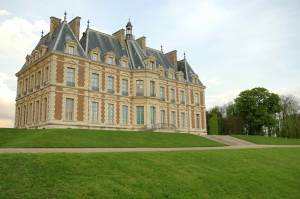
The Château de Sceaux (ca. 1860) houses the Musée de l'Île-de-France. The current château replaced a seventeenth-century house destroyed in the French Revolution. The gardens were laid out by André Le Nôtre in the 1670s.
Préfiguration de la vocation nouvelle du Petit Château, l’exposition consacrée au dessin français de paysage des XVIIe et XVIIIe siècles a permis la réunion d’une cinquantaine d’œuvres provenant de plusieurs grands musées (Besançon, Dijon, Epinal, Marseille, Montpellier, Quimper, Rennes), le Louvre consentant pour sa part à un ensemble de prêts particulièrement important. Le fonds propre du musée de l’Île-de-France vient compléter une sélection valorisant différents types de paysage, servis par une grande diversité de techniques graphiques (pierre noire, sanguine, lavis d’encre, aquarelle…). Que la représentation porte sur des sites rustiques ou urbains, que le cadrage en soit panoramique ou resserré, que l’élément humain y trouve ou non sa place, ces
feuilles se livrent comme autant de visions singulières du
monde, soutenues par des principes esthétiques très affirmés.

Site of the current exhibition of landscape prints, the Petit Château (ca. 1661) is one of the oldest buildings in the park.
Ainsi les dessins de Claude Gellée, de Sébastien Bourdon ou de Pierre Patel, au XVIIe siècle, véhiculent une pensée résolument classique, nourrie de poésie virgilienne appelant à une méditation sereine, tandis que ceux de François Boucher, de Jean-Honoré Fragonard ou d’Hubert Robert, au siècle suivant, cherchent davantage, par leurs rythmes puissants et presque musicaux, à surprendre et déstabiliser le spectateur. Quelques dessins s’imposeront comme d’évidents chefs-d’œuvre, tel l’Ermitage sur un rocher de Jacques Callot, la Vue de Marseille d’Israël Silvestre, ou celle de Rouen par Charles-Nicolas Cochin… Un rendez-vous à ne pas manquer !
En écho à cette exposition, une sélection de 13 dessins du XIXe siècle, issue des collections du musée de l’Ile-de-France, est présentée 1er étage du Château. Avec des feuilles de François-Edme Ricois, Jean-Jacques Champin, Jean-Marie Morel, Jean-Charles Develly, Paul Huet, Jean-Charles Develly, Jean-Lubin Vauzelle et Antoine-Patrice Guyot, la diversité technique et esthétique de la représentation du paysage au XIXe siècle permet de compléter le panorama esquissé au Petit Château.
◊ ◊ ◊ ◊ ◊
More information on the château and the exhibition (including a brief video) is available here»
The Irish Georgian Society to Restore Dublin’s City Assembly House
From the Irish Georgian Society:
 One of the most exciting developments in the history of the Irish Georgian Society has been its acquisition of the old City Assembly House, on South William Street, on a lease from Dublin City Council. In partnership with the Council, the Society aims to restore and revitalise this landmark building as a centre for its heritage and cultural activities but also, and most importantly, to give back to the life of the city one of its long forgotten but once venerable public spaces — the octagonal Exhibition Room of the former Society of Artists.
Over fifty years the Irish Georgian Society has established an unparalleled reputation for rescuing and restoring historic buildings throughout Ireland. In turning its attention to the City Assembly House, the IGS, in partnership with Dublin City Council, aims to restore this historically and architecturally significant building to its former glory. To achieve this the Irish Georgian Society, through its international membership in Ireland, the UK and the US, need to raise €2,000,000 over three years. Significant fundraising has already taken place on both sides of the Atlantic.

Once fully restored, the City Assembly House will become:
- An incomparable middle sized venue for exhibitions, lectures, musical performances and for other public gatherings.
- Headquarters for the Irish Georgian Society A centre for those interested in the Society’s activities relating to the preservation and conservation of our built heritage and support for the nation’s heritage in the decorative arts.
- A venue for other organizations active in the architectural conservation and heritage fields.
- A significant addition to the amenities of one of the oldest streets in Dublin, of the local community and as a new tourist destination for visitors to Dublin.
Please join with us in this amazing adventure. Our ambition is to complete this task in time for the building’s 250th anniversary in 2016 and for this we need your support. Information about how you can donate is available here»
◊ ◊ ◊ ◊ ◊
On Sunday, 3 July 2011, from 2-4pm, the City Assembly House (58 South William Street) will be open to visitors. Staff and the IGS Committee will be on hand to guide you around the house.
New House Museum in Amsterdam: Het Grachtenhuis
The seventeenth century in the Netherlands — the ‘Dutch Golden Age’ — overshadows the history of the United Provinces in the eighteenth century, and it’s easy to forget that the built environment of a city like Amsterdam continued to play a vital role in international politics. The opening this past April of Het Grachtenhuis (The Canal House Museum) offers a useful reminder. As noted at Holland’s official website:
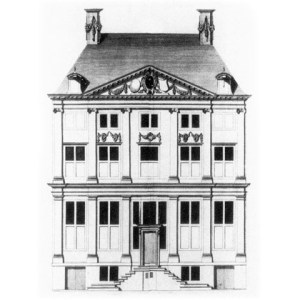 Het Grachtenhuis is a 17th-century mansion located at Herengracht 386 in Amsterdam, designed by Philips Vingboons, the most famous Dutch architect in the Golden Age. The owner of this home was the banker Jan Willink, who gathered the loans that President John Adams used to build New York City and help win the War of Independence against the British. President Adams visited to this canal house in Holland to collect the loans that totaled 29 million Dutch florins (the Dutch currency at the time) from Mr. Willink several times, and used the Dutch funds to establish the foundation for the independence of the United States. John Adams, co-author of the Declaration of Independence and later president of the United States of America, lived in Amsterdam on the nearby Keizersgracht between 1780 and 1782.
The house is now used to introduce visitors to the history of the canals over the past 400 years. Since 1613 marks the year when this extraordinary ring canal expansion began, we’re likely to hear much more in the coming months.
London Shh . . . small historic houses
 Thanks to Alicia Weisberg-Roberts who draws our attention to London Shh. . . “a tiny museum association of tiny house museums, mostly Georgian in theme or fabric.” From the association’s website:
London Shh… is a collection of the city’s hidden-gems; small historic houses which tell the stories of fascinating and famous former residents. Tucked away down intriguing streets and alleys, off the beaten tourist track you will find some of the city’s best kept secrets. London Shh… formed in 2008 with a view to encourage more people to discover and enjoy these beautiful houses. To step through one of our front doors is to be transported back in time and experience first-hand the places which famous names from Freud to Franklin chose to call home. So come and visit us and get closer to the people whose innovations and actions changed the world we live in. All the houses are independent registered charities and generate their own income through exciting programmes of exhibitions, events and more.
◊ ◊ ◊ ◊ ◊
In addition to coordinating digital access for the properties, the association’s site also provides a single point of access for upcoming events. On May 19, for instance, at the Handel House Museum
Jennifer Bennett (baroque violin) and Dan Tidhar (harpsichord) will explore the evolution of the sonata in the 18th century starting with J.S. Bach via his son C.P.E. Bach and ending with Mozart.
And on May 23, at the Benjamin Franklin House,
Dr Allan, historian of the Royal Society of Arts (RSA) and Honorary President of the William Shipley Group for RSA History, will highlight the friendship between Franklin and RSA Founder William Shipley and his family. For over fifty years, Dr. Allan has lectured and written extensively on aspects of the Society’s history, including the Benjamin Franklin connection, and he remains involved in its affairs.
◊ ◊ ◊ ◊ ◊
The houses currently represented include:
- Freud Museum London
- Benjamin Franklin House
- Kelmscott House
- Dr Johnson’s House
- Handel House Museum
- Burgh House & Hampstead Museum
- Emery Walker House
- Wesley House
- Keats House
Opening this Weekend: Hepworth Wakefield Gallery in Yorkshire
The new Hepworth Wakefield Gallery opens this weekend (21 May 2010). As described at the museum’s website:
This stunning building, designed by the award-winning David Chipperfield Architects, will be a place to explore art, architecture and your imagination. With over 1,600 square metres of light-filled gallery spaces, The Hepworth Wakefield will be the largest purpose-built exhibition space outside London. The gallery will bring together work from Wakefield’s art collection, exhibitions by contemporary artists and rarely seen works by Barbara Hepworth, one of the 20th century’s most important artists who was born and grew up in Wakefield.

Other recent projects by David Chipperfield include the Turner Contemporary in Margate and renovations of the Neues Museum in Berlin and the St Louis Art Museum. While the twentieth-century collections are sure to be the focus of the Hepworth Wakefield’s opening, the Gott Collection is also finally getting its due:
An important attraction for visitors will be the rarely seen Gott Collection, gifted to the City’s art collection in 1930. The Gott Collection was assembled in the 19th century by John Gott (1830-1906), Vicar of Leeds and later Bishop of Truro, and his father William (1797-1863), a wool merchant. It was presented to Wakefield Art Gallery in 1930 by Frank Green, a Yorkshire industrialist and philanthropist. The bound 10-volume collection includes 1,200 images, consisting of 65 watercolours, 315 drawings, 749 prints (including hand-coloured prints and one albumen print) and 50 double-sided letterpress pages from a book. It is arguably the finest surviving collection in the region, with over 200 Yorkshire villages, towns and cities depicted within its pages. Through funding by the Esmée Fairbairn Foundation this unique resource including maps, topographical drawings and watercolours will be made publicly accessible. Collectively they show how Yorkshire has long been a place of artistic inspiration. . .
For the Season of Fashion and Horses
The following piece, “Hats, Horses, and History,” by Kimberly Chrisman-Campbell on the conjunction of sartorial and equestrian displays at Longchamp appears at WornThrough — as posted by Heather Vaughan. Thanks to Kimberly for passing it along . . . -CH.
◊ ◊ ◊ ◊ ◊
I’m pleased to be able to share with you, this guest post by Dr. Kimberly Chrisman-Campbell. She is an independent fashion and textile historian and occasional contributor to WornThrough. Her work on eighteenth- and nineteenth-century French fashion has also appeared in Costume, Textile History, PieceWork, and Dress, as well as in several books and exhibition catalogs, most recently Paris: Life & Luxury in the Eighteenth Century (Getty Publications, May 17, 2011).
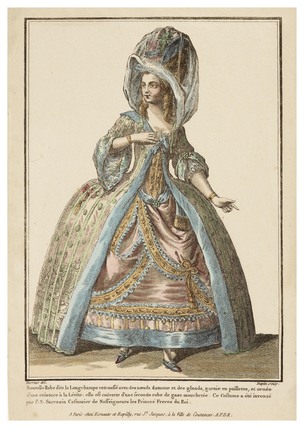
Nouvelle Robe dite la Longchamps retroussee avec des noeuds damour et des galands: 1779, Gallerie des Modes, Desrais, Dupin, via Museum of London.
Before Philip Treacy and Stephen Jones, before Royal Ascot and the Kentucky Derby, and even before the sport of horseracing itself, there was the promenade de Longchamp, a three-day spectacle of fashion and horseflesh. The modern-day romance between outlandish hats and world-class horsemanship has its roots in this eighteenth-century Parisian ritual, as does the American tradition of the “Easter Parade.”
About four miles from central Paris, in the Bois de Boulogne, lay the medieval village of Longchamp. Since 1256, it had been home to a convent that served as a popular destination for pilgrims for hundreds of years before the phenomenon known as the promenade de Longchamp began in the late seventeenth century.
The promenade was not an authorized religious pilgrimage, but a spontaneous, secular one, taking place on the Wednesday, Thursday, and Friday before Easter—the final days of Lent. Musical members of high society began to make the annual trip to Longchamp in the seventeenth century, drawn by the convent’s sung Holy Week services. By the mid-1700s, the sleepy village in the woods had become the epicenter of French society,
if only for a few days each year. . . .
The full article (including a reading list) is available here»










 Enfilade
1 comment