A Fine Time to Be in the Netherlands
This annual event (second weekend in September) includes sites all over the Netherlands; this year’s theme in Amsterdam is On the Map while the overall theme focuses on The Nineteenth Century. The following description comes from the Amsterdam pages:
Open Monumentendag / Heritage Days
The Netherlands, 11-12 September 2010
 Open Monumentendag (Heritage Days) annually explores and celebrates architecture, both in Amsterdam and the country at large. It is aimed at bringing people into contact with their heritage, and to stir interest in and an understanding of preserving historical monuments. From 11 to 12 September, thousands of historical buildings and sites (about 4,000) are open to the public free of charge. This year’s theme is On the Map.
With a city like Amsterdam that’s partially built on sand, the event gives history lovers a golden opportunity to dip their toes into its architectural sandbox. From Gothic revival and Berlage to modern industrial, what’s not to stop and admire. The focal point this year is On the Map, referring to a variety of maps, topography and architectural plans of buildings that are particularly striking, and which form the subject of the city’s views, postcards and inspiration for drawings, paintings and poems.
 Buildings open to the public include listed (graded) churches and castles, monuments due for restoration and icons long gone from Amsterdam’s skyline. On the Map also highlights structure: the relationship between the monument and its surroundings; and the site of the building in relation to the growth of the city.
Besides opening their doors, many locations also organise on-site activities like exhibitions, music and guided tours. Each year around 80 to 85 percent of Dutch municipalities participate in the Open Monumentendag, organised by local committees. In recent years around 900,000 visitors have participated annually, making the Open Monumentendag one of the Netherlands’ premier cultural events.
A Fine Time to Be in London
From LondonTown.com:
London Open House Weekend
London, 18-19 September 2010
 So many of London’s architectural landmarks are closely guarded secrets, off-limits to Joe Public. It’s tantalising to imagine what goes on behind those closed doors. Well, thanks to the hugely popular London Open House Weekend , we need wonder no more. Almost 700 of the city’s buildings – including the Bank of England – take part in this fantastic, free yearly event, now in its 17th year, by opening their doors to everyone. London Open House Weekend offers a wealth of historical landmarks to choose from including some of the most beautiful architectural achievements in the city. You can also get inside some of the grandest private homes in your own neighbourhood – it’s a voyeur’s dream come true. For the more serious students of contemporary design, this is a chance to visit spaces by famous modern architects. An inspired idea and a real treat whether
you’re a lover of architecture or just plain nosy. . .
◊ ◊ ◊ ◊ ◊
Well-known Georgian buildings — Chiswick House, Handel House Museum, Dr. Johnson’s House, Osterley Park House, &c. — are open for free, but the real opportunities lie in visiting sites that are usually closed (or open only for group tours). A search by period turns up 98 matches. Here’s just a sampling, with descriptions from the Open House site:
Bower House — Grade I listed Mansion House commanding the most extensive southerly views over Essex towards Kent. Leading landscape designer Charles Bridgman and Sir James Thornhill (best known for his wall paintings at Blenheim Palace) were involved with the design.
Dover House, Office of the Secretary of State for Scotland — Elegant Whitehall facade and domed entrance commissioned by the Duke of York. Interesting original interiors.
The House of St Barnabas — Soho’s grandest Grade I listed Georgian townhouse. Fine Roccoco plasterwork commissioned 1754. Victorian Oxford Movement Chapel built 1862 by Joseph Clarke. Owned by the House of St Barnabas, a charity assisting vulnerable people back to independent living.
The Lansdowne Club — Robert Adam house, partly demolished in 1931 and reconstructed as a club house in the Art Deco style, retaining 5 original rooms. Restoration work ongoing.
The Naval Club — Grade II listed Georgian town house c1748-1750 reputed to have been 18C residence of William Pitt the Younger. First floor suite decorated in ornate white and gold ‘Louis XVI’ style. Dark stock brick building with Ionic porch and moulded architraves to sash windows.
Nonsuch Mansion — Tudor Gothic mansion, designed for wealthy merchant Samuel Farmer, in the style later used at Windsor Castle (ca. 1740 and 1806). The service wing has been restored and includes dairy, kitchen, scullery, larders and laundry.
Watermen’s Hall — Only remaining Georgian Hall in the City of London, and perfect example of domestic architecture of the period.
Details and full listings are available here»
Wilton House Takes Restoration Award
From Art Daily (10 August 2010) . . .
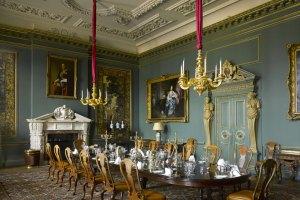 The Historic Houses Association (HHA) and Sotheby’s announced that the winning entry of their Restoration Award for 2010 — an award now in its third year — is Wilton House near Salisbury in Wiltshire. Wilton’s winning project is its spectacular private Dining Room, which is the centerpiece of an extensive programme of exceptional restoration projects at the house in recent years, which has also seen the Library, North Ante Library, Smoking Rooms, Cloisters, Gothic Hall, Inner Courtyard and North Forecourt brought back to their former glory. Three commendations are also announced by the HHA and Sotheby’s: Ballywalter Park in Newtownards, Northern Ireland; Thorpe Hall in Wycliffe, County Durham; and The Stables at Penpont in Brecon, Wales. The previous winners of the award were Markenfield Hall in Yorkshire and Chillington Hall in Staffordshire. . . .
William Herbert, the 18th Earl of Pembroke, inherited the title and the Wilton estate in 2005, since when – with the assistance of the Wilton House Trustees and the interior designer David Mlinaric – he has initiated an extensive programme of restoration projects. The overriding aim of all these projects has been to restore the parts of the house that it was felt had lost their historical integrity or which had been neglected during previous structural repairs. Both traditional and modern methods of restoration have been used and, wherever possible, the work has been undertaken by estate and local craftsmen.* Renovations undertaken, so far, include the Cloisters, the Gothic Hall, the Eastern and Western Cloister Oriel windows, the Courtyard, the Smoking Room, the Library and the North Forecourt, and works are still ongoing in other parts of the house. The sensitive revival of the spectacular private Dining Room forms the centerpiece of the extensive renovations on the estate to date.
For many years the Dining Room was used as a games room and general storage room but in 2008 the 18th Earl commenced the major restoration efforts to return it to its former glory. This work has taken local craftsmen many months to complete. The work undertaken:
- The walls were painted in a dark blueish green to match an existing paint sample and the ceiling and paneling mouldings in a stone colour, which were subsequently part-gilded by Hare & Humphreys.
- Two new caryatids were created from those in the Library by Coade Ltd, to stand either side of the doorway.
- Antiqued-looking glass panels were set between the windows on the north wall, and new metal radiator covers were made.
- The furnishings underwent major conservation work – two giltwood torcheres, three tapestries, the table, two large Reynolds portraits. Two new chandeliers were also made by Coade Ltd and subsequently gilded by Lord Pemboke’s sister.
- The walls were painted in a dark blueish green to match an existing paint sample
Discussing Wilton House’s winning entry, Edward Harley, President of the Historic Houses Association, states: ‘‘Lord Pembroke is to be congratulated on the superb restoration of these fine rooms, as well as the courtyards which form part of the setting of this great house, home of his family for over 450 years. Sensitively but dramatically restored, Wilton House has entered a new chapter in its long history. This great restoration project also reflects more widely the work being carried out by private owners throughout the country to preserve their historic properties. By attracting increasing numbers of visitors historic houses make a critical contribution to the economies of fragile rural areas.’’ . . .
Resource: ‘Treasure Hunt’ and the National Trust
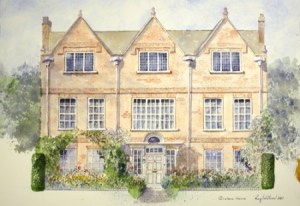
Quebec House, by Roy Willard. ©Estate of Roy Willard
As noted in previous postings, the blog format seems to lend itself nicely to acquisition news. Emile de Bruijn of the National Trust edits a terrific site for just such a purpose. Treasure Hunt regularly includes fascinating postings, often with information that one would be hard-pressed to find elsewhere (or at least hard-pressed to know one should look for such things anywhere). A recent posting, for instance, addresses Quebec House, in Westerham, Kent, “the childhood home of James Wolfe, who was born there in 1727 and spent the first 11 years of his life there.” As is often the case with historic properties, one faces the vexing dilemma of choosing a particular period to present over others: in this case, should the Trust go with the a newly-discovered 1630s scheme for the main bedroom or maintain the mid-eighteenth-century presentation that prevails throughout the rest of the house?
A number of recent postings also address Emile’s experience at this year’s Ashridge Garden History Summer School (30 July — 4 August). It looks like an amazing program.
An Eighteenth-Century Synagogue from Suriname in Jerusalem
Press release (24 May 2010) from the Israel Museum:
Rare and Newly Restored 18th-Century Synagogue from Suriname to be Highlight of Israel Museum’s New Synagogue Route

Interior of the 18th-century Suriname Synagogue Zedek-ve-Shalom at the Israel Museum. Photo by Eli Posner. Courtesy of the Israel Museum, Jerusalem.
A newly restored 18th-century synagogue from Suriname – one of only two remaining examples – will be a highlight of the Israel Museum’s newly installed Mandel Wing for Jewish Art and Life, on view beginning July 26, 2010, when the Museum opens its expanded and renewed campus to the public. This rare and striking South American synagogue will stand alongside synagogue interiors from Italy, Germany, and India as part of the Museum’s new Synagogue Route, which will offer visitors the opportunity for a notably rich experience with Jewish ritual traditions from around the world. On display with its original furniture and decorations and a sand floor, the Tzedek ve-Shalom Synagogue will offer visitors a glimpse into Suriname’s once vibrant Jewish community.
Built in 1736 in the capital city of Paramaribo, Suriname, Tzedek ve-Shalom ceased to function as a place of worship in the 1990s. In order to rescue this important example of the Jewish life of this remote Jewish community, the Israel Museum approached its leaders with the aim of restoring and preserving the synagogue on its campus for the benefit of future generations of visitors from around the world. The synagogue’s interior and its original ceremonial objects and furnishings were transferred to the Museum in 1999, where it has now been meticulously refurbished. (more…)
Frick Addition Approved by Landmarks Preservation Commission
Press release (23 June 2010) from The Frick:

Model of the proposed Portico for Decorative Arts and Sculpture at The Frick Collection, south façade (Davis Brody Bond Aedas Architects and Planners)
Visitors at The Frick Collection find it difficult to believe that the Garden Court—a signature gallery considered by many to be the heart of the former mansion—was never enjoyed by its original resident, industrialist Henry Clay Frick (1849–1919). Indeed, it was created by enclosing a former carriage-way roughly fifteen years after his death, when in the 1930s architect John Russell Pope undertook the conversion of the Frick family home into a public museum, nearly doubling its size. The presentation of works of art within the mansion never remained static either, as Frick was an extremely active collector through his final days. His taste broadened from paintings to include sculpture and decorative arts, and only a year after moving into the residence, he began discussions with his original architect, Thomas Hastings of Carrère and Hastings, asking him to draw up plans for an extension that included a gallery devoted to the display of sculpture. The Frick Collection now returns to that idea. On June 22, 2010, at a meeting of the Landmarks Preservation Commission, a plan was approved, as submitted, to enclose an underutilized portion of the property, the portico in the Fifth Avenue Garden, which is viewable from inside the house but not open to the general public. The highly transparent enclosure of the portico, set back from the original limestone columns and cornice, will create a new gallery within the existing footprint of the institution. Construction is anticipated to begin in the fall of 2010, with an expected completion date of September 2011. (more…)
Alstublieft
From the Editor
My trip to the Netherlands was even better than I had hoped. The HNA Conference was outstanding, and the Attingham Program for the Study of Dutch Historic Houses exceeded my highest expectations (which is saying a lot). Over the course of nine days, the thirty-one participants visited some 26 houses: canal houses in Amsterdam, hofjes (almshouses) in Amsterdam and Haarlem, country houses in the provinces of Utrecht, Gelderland, and Overijssel, and even a few royal residences. While some of the houses are privately owned and only rarely open to visitors, many are accessible to the public, including the following:
- Geelvinck Hinlopen Huis in Amsterdam
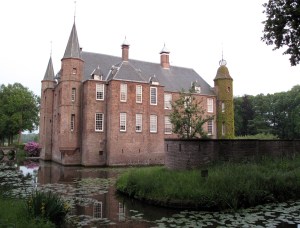
Slot Zuylen on the River Vecht, Utrecht Province. The Enlightenment author Isabelle de Charrière, known in the Netherlands as Belle van Zuylen, was born here in 1740.
- Museum Willet-Holthuysen in Amsterdam
- Museum Van Loon in Amsterdam
- Working windmill at Loenen, ‘De Hoop’
- Slot Zuylen on the River Vecht
- The Teylers Museum in Haarlem
- St Hubertus Hunting Lodge
- Rosendael
- Paleis Het Loo
Many thanks to Annabel Westman and Jo Ballingal for leading the trip, to the Attingham Trust generally for its commitment to historic houses, and to the American Friends of Attingham for funding (I’m especially grateful to Dick Button whose financial support made the trip possible for me).
As terrific as the trip was, I know I’m not the only one doing exciting things this summer. Please don’t be shy or modest: fellow HECAA members would enjoy hearing what you’ve been up to! -Craig Hanson
‘Curious Specimens’ and the Great Volcanic Cloud

Rooftop of Strawberry Hill, April 2010. The new Gothic pinnacles have been recreated from oak. The chimney pots date from the 19th century; they, like the rest of the exterior, will be painted the same original white as the wooden ornaments; yes, it's going to be bright.

The Strawberry Hill Trust was formed in August of 2002 to restore Horace Walpole's Gothic Villa at Twickenham, just outside of London. With a budget of £8.2 million ($13million), the project is scheduled to be finished by the end of the year.
Good News: The Curious Specimens conference in London was even better than I had expected (and I expected a lot). The Walpole and Mrs. Delany exhibitions are both stunning as installed, respectively, at the V&A and Soane’s Museum. The conference panels were stimulating, and Saturday’s visit to Strawberry Hill was thrilling (hard to beat a rooftop tour). Many thanks to the organizers, especially Luisa Calè and Lisa Ford but also Michael Snodin, Amy Meyers, Margaret Powell, Alicia Weisberg-Roberts, and Brian Allen.
Bad News: Because I’m caught in the UK under a massive cloud of ash, with irregular access to email, Enfilade will be updated less frequently than normal during the next few days. ‘Caught’ hardly conveys my joy at having a few extra days in London; nor does talk of the ash cloud conjure the wonderful sunny weather that the city is currently experiencing, but it does perhaps suggest the utter strangeness of the situation (and to be fair, for untold numbers of people, the travel freeze is proving to be an horrendous ordeal). Please feel free to continue sending details for any announcements or news items you would like to see posted. I’ll add them as soon as I can. Thanks for your patience. -CH
Ship Models from the Permanent Collection of the AGO
Ship Models: Thomson Collection
Art Gallery of Ontario, Toronto

Two-decker Warship rigged with original sails Prisoner of War Model, 1794-1815 Great Britain, probably by French sailors Bone, brass, silk (9½ x 11 x 3½ ins)
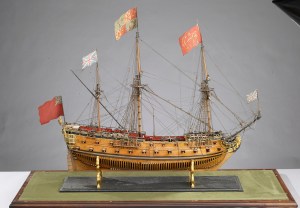
British Two-decker 50/54-Gun Warship Navy Board Model, Great Britain, c. 1703 Wood, paper, paint, gilding, glass (32½ x 40½ x 15¼ ins)
The Thomson Collection at the AGO spans some 350 years and contains examples of exquisite workmanship and some of the masterpieces of the genre.
Foremost are rare late 17th- and 18th-century British dockyard models, made to scale for the Royal Navy and wealthy individuals. There is also a large number of models made by some of the 120,000 prisoners of the Napoleonic Wars. These models, made from wood and bone, with rigging of silk and human hair, were produced by teams of skilled craftsmen and sold to local British collectors who gathered at the prison gates. The shipbuilders’ models extend from the mid 19th century to the Second World War, representing a diversity of both model style and ship type ranging from tugs, dredgers and trawlers to cargo vessels, passenger steamers, private yachts, corvettes, battleships, cruisers, torpedo boats, destroyers and two aircraft carriers.
Restoration of James Wyatt’s Darnley Mausoleum Recognized
Now in the hands of the UK’s National Trust, the Darnley Mausoleum at Cobham Park is the recipient of this year’s Country House of the Year Award from from Country Life (2 December 2009). From the magazine’s website:
Country House of the Year — The Darnley Mausoleum, Cobham, Kent
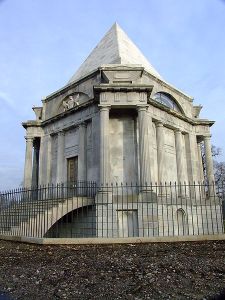
James Wyatt, Darnley Mausoleum at Cobham Park 1786 (Photo: Wikimedia Commons)
Built on the instructions of the 3rd Earl of Darnley in 1786, this mausoleum is one of the great masterpieces of the architect James Wyatt. The story of its recent restoration as part of an £8 million project to revive the whole park at Cobham is one of the most heartening of recent years. It has been effected through a remarkably complex partnership of bodies, including Gravesham Borough Council, Cobham Hall, English Heritage, Union Railways, Natural England, Kent County Council, the Woodland Trust and the National Trust. Following the break-up of the Cobham estate in 1957, the mausoleum became neglected, and the construction of the M2 motorway in 1963 made it a magnet for joyriders and vandals. The nadir of its fortunes came on Guy Fawkes Night in 1980, when the crypt was packed with petrol cans and tyres and ignited. The subsequent explosion reduced the interior to ruin. Stimulus for the project came from compensation money paid out when the Channel Tunnel Railway Link cut through the northern edge of Cobham Park. A trust was set up to drive forward the restoration as part of a more ambitious park project. The architect for the restoration was Purcell Miller Tritton, the main contractor was Paye, and Worthington Stone Carving has been responsible for the admirable masonry repairs and replacements to the mausoleum. The architectural work was underpinned by historical research by Roger Bowdler of English Heritage. Having been awarded Heritage Lottery funding in 2003, the restored mausoleum was handed over to the National Trust this year and is open to the public.










 Enfilade
leave a comment