Thomas Wright’s Menagerie & Gervase Jackson-Stops
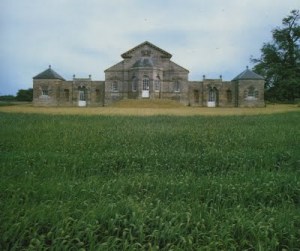
Thomas Wright, The Menagerie, Horton Park, Northamptonshire, 1750s (Photo: Bruno de Hamel, "Architectural Digest: Chateaux and Villas," 1982)
Earlier in the week, An Aesthete’s Lament included a posting on The Menagerie, the Grade II listed building acquired by Gervase Jackson-Stops (1947-95) in the 1970s. After a three-year studentship at the Victoria and Albert Museum, Jackson-Stops joined the National Trust, first as a research assistant and then (starting in 1975) as an architectural advisor. It’s difficult to overstate his importance for the organization. As noted in numerous obituaries — including those from the Society of Antiquaries of London, The Independent, and Architectural History (available through JStor) — he played important roles in the Trust’s acquisition of Canons Ashby House, Kedleston Hall, and Fountains Abbey. His commitments to restoration were evinced not only at Stowe but also at his personal labor of love, The Menagerie.
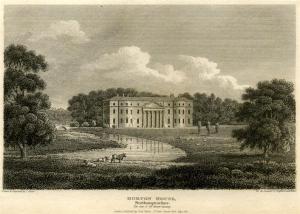
Horton Hall, destroyed 1936
This mid-eighteenth-century banqueting house, by Thomas Wright (1711-86), at Horton Park, Northamptonshire is actually just one of just thirteen listed buildings attached to the property (the main house, Horton Hall, was destroyed in the 1930s). The Horton Park Conservation Group (HPCG) was founded in 2008 to campaign for the ongoing conservation of the park and these structures. The park is likely to receive increased attention over the next two years as Wright’s three-hundredth birthday approaches.
The Menagerie appears in Paige Rense, Architectural Digest: Chateaux and Villas (Knapp, 1982); Timothy Mowl and Claire Hickman, Historic Gardens of England: Northamptonshire (History Press, 2008), and Chippy Irvine, The English Room (Bullfinch Press, 2001). For details regarding visits, see The Menagerie website.
 Finally, no evocation of Jackson-Stops is complete without mention of his role in organizing the seminal Treasure Houses of Britain exhibition at the National Gallery of Art in Washington (1985-86). For his work on the show, he received the Presidential Award for Design in 1986 and was made an Officer of the British Empire (O.B.E.) — all before turning 40! A full list of publications, including dozens of contributions for Country Life, can be found at the end of the obituary compiled by Oliver Garnett and Tim Knox for Architectural History 39 (1996): 222-35.
[The photograph of The Menagerie comes from An Aesthete’s Lament; the print of Horton Hall comes from the website of the Horton Park Conservation Group. Thanks to both.]
Getting away for the Weekend
Editor’s Note
Rather perversely, I typically begin the first class session of a new semester by having students introduce themselves and then share one place they would like to be — anywhere in the world — at that particular moment. Just when I’m supposed to get everyone back on board with the routines of academic life, it’s just much more fun to indulge in a bit of daydreaming. My pedagogical rationale goes something like this: art history may begin with slides in a dark lecture hall, but it ultimately requires a curiosity and fascination about the world that will take students far and wide. And indeed, for the course to work, imagination (maybe even desire) turns out to be vital.
So on this Labor Day Weekend, I thought that I myself might indulge in a game of ‘where would I like to be?’ The UK’s Landmark Trust rents some remarkable historic properties — from three days to three weeks. As noted on the organization’s website, the Trust “is a building preservation charity, founded in 1965 by the late Sir John Smith and Lady Smith. It was established to rescue historic and architecturally interesting buildings and their surroundings from neglect and, when restored, to give them new life by letting them as places to experience for holidays.” Here’s a sampling (photos and descriptions come from the Trust website, though the italicized bits are my additions). I’m not sure I can narrow it down any further, but maybe if I think about it just a bit longer . . .
◊ ◊ ◊ ◊ ◊
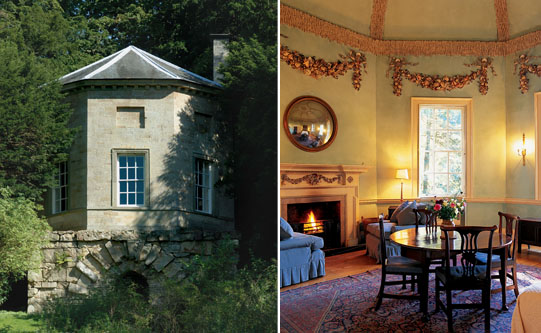
The Bath House, near Stratford-upon-Avon
Just right to prepare oneself for the upcoming Delany exhibition
The benefits of a cold bath were held to be almost limitless by medical opinion of the eighteenth century and many country houses were equipped with one. The Bath House here, it is thought, was designed in 1748 by the gentleman-architect Sanderson Miller for his friend Sir Charles Mordaunt. Good historical fun was had by all: the rough masonry of Antiquity, used for the bath chamber, is contrasted with the polished smoothness of the new Augustan age seen in the room above, where the bathers recovered. Even in the upper room there is a hint of the subterranean, with a dome hung with coolly dripping icicles. Here the walls have also been frosted with shells, arranged in festoons as if ‘by some invisible sea-nymph or triton for their private amusement’. This was the idea of Mrs Delany, better known for her flower pictures, who advised the Mordaunt daughters on where to find the shells. Their work was skilfully reproduced by Diana Reynell, after terrible damage by vandals. The Bath House, at the end of a long and gated drive, has one main room to live in, but in its deep woodland setting, so near to the Forest of Arden, ‘you may fleet the time carelessly, as they did in the golden world’.
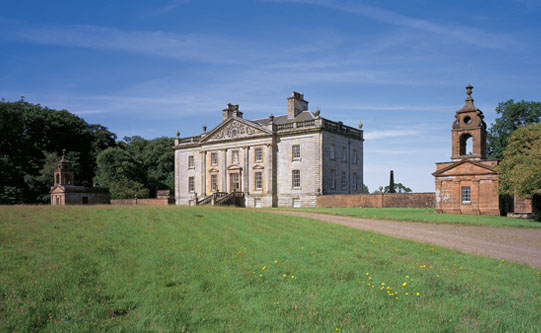 Auchinleck House, Ochiltree, Ayrshire
The perfect place to celebrate Johnson’s 300th birthday (September 18th)
Perhaps the finest example of an eighteenth-century country villa to survive in Scotland, Auchinleck House is where the renowned biographer James Boswell indulged his penchant for ‘old laird and family ideas’. Built around 1760 by Boswell’s father Lord Auchinleck, its architect is unknown; it seems likely that Lord Auchinleck himself had a hand in the neo-Classical design, perhaps influenced by the Adam brothers. Boswell’s friend and mentor Dr. Samuel Johnson famously argued over politics with Lord Auchinleck in the library here, when they visited at the end of their tour of the Hebrides in 1773. Once inherited by Boswell, the house was host to much ‘social glee’, which he recorded in his Book of Company and Liquors. Auchinleck House itself expresses the rich spirit of the Scottish Enlightenment, combining Classical purity in the main elevation with a baroque exuberance in the pavilions and the elaborately carved pediment. We have restored not only the house with its magnificent library looking across to Arran, but also the pavilions, the obelisks and the great bridge across the Dippol Burn, on whose picturesque banks are an ice-house and grotto. Visitors to the house pass beneath an extract, chosen from Horace by Lord Auchinleck, carved into the pediment: Quod petis, hic est, Est Ulubris, animus si te non deficit aequus (‘Whatever you seek is here, in this remote place, if only you have a good firm mind’). We are sure this will speak as clearly to those who stay at Auchinleck today as it did to James Boswell himself.
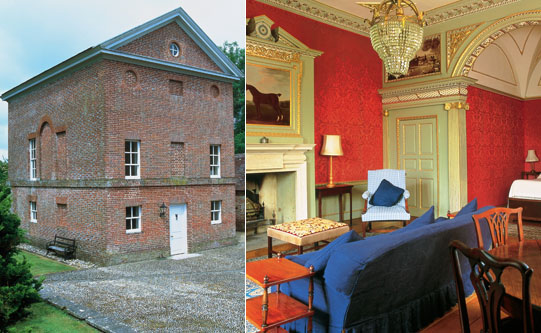 Fox Hall, Charlton, West Sussex
A Palladian idyll perhaps?
Charlton is just a small village, but at one time, when the Charlton Hunt was famous and fashionable, its name was familiar and dear to every sportsman in England. Even Goodwood was described as ‘near Charlton’. The hunt was founded in the 1670s by the Duke of Monmouth and was continued after his death by his son-in-law the Duke of Bolton and then by the Duke of Richmond. Apart from the sport, what attracted highspirited noblemen here, surely, was that they could live in lodgings away from the constraints of home. They clubbed together and built a dining-room for themselves, which they christened ‘Fox Hall’, designed by Lord Burlington, no less, and here ‘these votaries of Diana feasted after the chase and recounted the feats of the day’. Not to miss such affairs and to be in good time for the meets, the Duke of Richmond commissioned the small Palladian building that we now possess. The designer of this rich sample of architecture, built in 1730, was most probably Lord Burlington’s assistant Roger Morris. It consists of a plain brick box with a small stylish hall and staircase leading to one magnificent room above, undoubtedly Britain’s premier bedsit. There is a gilded alcove for the Duke’s bed and in the pediment over the fireplace an indicator shows the direction of the wind, important information for the fox hunter. The front door to all this grandeur leads very sensibly straight to the stable yard. In the 1750s the Hunt was moved away from Charlton to Goodwood. The old Fox Hall disappeared and somehow its name was transferred to our building a few yards off, which, grievously altered, for a long time housed the manager of the Duke of Richmond’s sawmill. So far as possible we have given it back its original form.
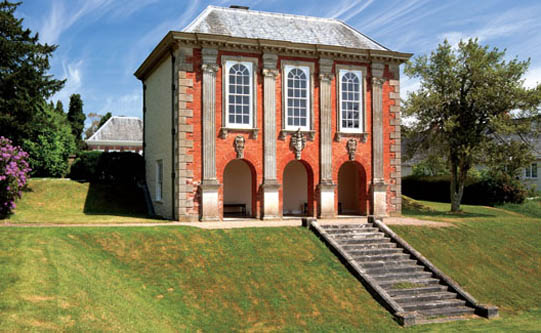 The Library, Stevenstone, near Great Torrington, Devon
A lovely place to finish that article
The Library, and its smaller companion the Orangery, stand in well-mannered incongruity beside the ruins of Victorian Stevenstone, with the remains of a grand arboretum around them. Stevenstone was rebuilt by the very last of the Rolles in 1870, but these two pavilions survive from an earlier remodelling of 1710–20. The façade of the Library, with its giant order and modillion cornice, looks like the work of a lively, probably local, mason-architect, familiar with the work of such as Talman and Wren. Why a library in the garden? It probably started life as a perfectly ordinary banqueting house and only assumed its more learned character later on. Why it should have done so is a mystery, of a pleasantly unimportant kind. By the time we first saw it, when it came up for sale in 1978, the bookshelves had been dispersed and the Library had been a house for many years, the fine upper room divided and the loggia closed in, while the Orangery was about to collapse altogether. We put new roofs on both buildings and, on the Library, a new eaves cornice carved from 170 feet of yellow pine by a local craftsman, Richard Barnett. The loggia is open again, and the main room has returned to its full size. To stay in this particularly handsome building, even without the books, is an enlightening experience.
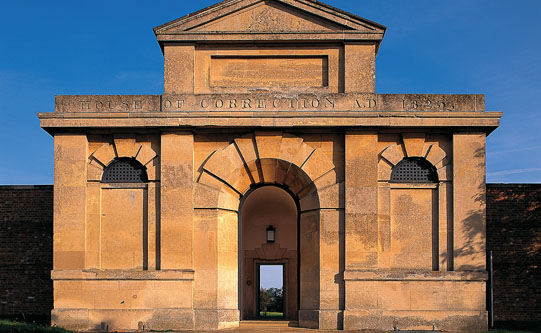 The House of Correction, Folkingham, Lincolnshire
For fantasies of a Sadean bent?
Folkingham is one of those agreeable places that are less important than they used to be. It has a single very wide street, lined on each side by handsome buildings, with a large eighteenth-century inn across the top end. Behind the houses, to the east, lie the moat and earthworks of a big medieval castle. The House of Correction occupies the site of this castle. These minor prisons were originally intended for minor offenders – the idle (regarded as subversive) and the disorderly. Folkingham had a house of correction by 1611, replaced in 1808 by a new one built inside the castle moat and intended to serve the whole of Kesteven. This was enlarged in 1825 and given a grand new entrance. In 1878 the prison was closed and the inner buildings converted into ten dwellings, all demolished in 1955. The grand entrance alone survives. It was designed by Bryan Browning, an original and scholarly Lincolnshire architect also responsible for the Sessions House at Bourne. It is a bold and monumental work, borrowing from the styles of Vanbrugh, Sanmichele and Ledoux. Apart from cowing the malefactor it was intended to house the turnkey, and the Governor’s horses and carriage. Now it gives entrance only to a moated expanse of grass – a noble piece of architecture in a beautiful and interesting place.
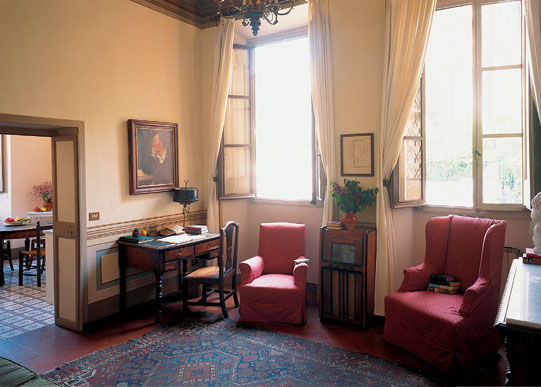 Piazza di Spagna, Rome
An ideal base for tracking the footsteps of Keats and Shelley (although most of the properties are in the UK, there are some notable exceptions)
All architects, and many artists, owe a debt to Rome, and we had long wanted a foothold there. So when the Keats-Shelley Memorial Association launched an appeal for funds to maintain 26 Piazza di Spagna, we asked whether there was a part of it that we could occupy in return for helping them. Happily there was, a flat on the third floor, now restored by us to its condition in about 1800 – spacious rooms with tiled floors and high, beamed ceilings painted in soft colours. The house itself was built around 1600, but owes its external appearence today to changes made by Francesco de Sanctis in 1724–5. Our apartment is not the rooms in which Keats died in 1821 – those are on the floor below – but they are identical in form and layout, and are more in a condition he would recognise. Every tall shuttered window has a view unchanged almost since the days of the Grand Tour, and the sitting-room looks up the Spanish Steps – certainly the world’s grandest and most sophisticated outdoor staircase – to the church of S. Trinita dei Monti at the top. At the front door is Bernini’s fountain in the form of a stone boat sinking into the Piazza di Spagna. There is hardly any motor traffic, but instead all the noises of humanity, some of them very unusual – for example when the steps are cleared by water-cannon, or when the horsedrawn cabs, which form a rank at the far end of the Piazza, arrive over the cobbles, seemingly at dawn and at a gallop. The Steps were designed in 1721 by Francesco de Sanctis, who also designed this house to fit in with his plan. It was probably apartments from the first, in a part of the city long frequented by foreign and particularly English visitors. There can be few places in Rome available to their successors so central, so handsome, so famous or so unaltered as this.
◊ ◊ ◊ ◊ ◊
Enjoy the weekend. Enfilade will be back on Tuesday.
-Craig Hanson
Swedish Neoclassicism
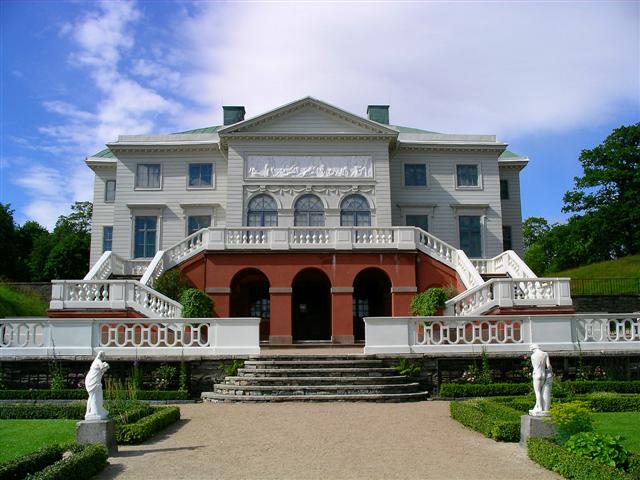
Carl Wilhelm Carlberg, Gunnebo House, ca. 1780s (Photo by Tor Svensson, Wikimedia Commons)
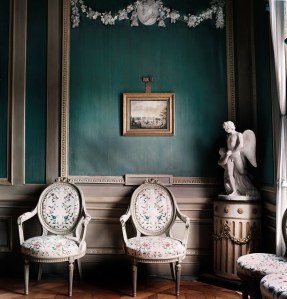
Interior of Gunnebo House (Photo by Christopher Flach, courtesy of Gunnebo Slott och Trädgårdar AB)
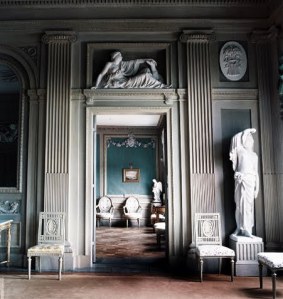
Interior of Gunnebo House (Photo by Christopher Flach, courtesy of Gunnebo Slott och Trädgårdar AB)
This week, Diane Dorrans Saeks – author of The Style Saloniste along with twenty books, including one with Michael Smith (the interior designer for the Obama White House) – turns her attention to Gunnebo House and Gardens, just south of Gothenburg. Now open to the public, Gunnebo was built in the late eighteenth century as a summer residence for the merchant John Hall. The architect was Carl Wilhelm Carlberg.
The handsome interior photos from Saeks’s site were taken by Christopher Flach, who kindly granted permission for two to be reproduced here as well (for more information, see his website: www.chrisflach.com)
On Haydn’s Trail: Eszterháza Palace, Hungary
By MICHAEL YONAN

Thomas Hardy, "Portrait of Joseph Haydn," 1791 (London: Royal College of Music) – click on the image for more information
2009 marks the 200th anniversary of the death of composer Joseph Haydn (1732–1809), a musical titan and key figure in the modern development of the string quartet and symphony. Musical significance aside, Haydn’s biography is a compelling one. Born into humble circumstances in the eastern Austrian village of Rohrau, he accomplished an internationally significant career without the benefit of birthright or privilege. Nor, for that matter, was he a shooting star: His career developed slowly over decades, and for much of it he lived and worked in relative isolation, a fact he himself credited with stimulating his creative impulses. From 1766 to 1790 he was resident at Eszterháza, the summer palace of the Esterházy noble family located in the village of Fertöd, 7 kilometers from the Austrian border in western Hungary. Seeing this palace has been a decade-long desire of mine, not just because I love Haydn’s music, but also because its architecture is grand enough to have earned it the epithet “The Hungarian Versailles.” In June I finally made it there, fittingly enough in the Haydn anniversary year.

Eszterháza Palace, from the courtyard
Though not far from Vienna, Eszterháza is hard to reach without a car. Train access to Fertöd is nonexistent, and anyone wishing to brave the rural Hungarian bus system is bolder than I. Comparisons to Versailles notwithstanding, the building’s obvious inspiration is Schönbrunn, the Habsburg summer palace in Vienna, a legacy one notices in the bright yellow used for the palace’s exterior color.
Visiting this palace, I was reminded of the great difficulties facing cultural sites in former communist nations like Hungary. Whereas Austria approached the Haydn celebratory year with multiple aggressive tourist-centered advertising campaigns, at Eszterhaza, probably the most important extant building associated with Haydn, there was little visible indication of 2009’s importance. One small exhibition devoted to Haydn’s patron, Prince Nikolaus Esterházy (1714–1790), was on display, but it contained few artifacts of the composer and in fact barely mentioned him! Lack of resources is certainly the reason for this.

Detail from Ceremonial Hall, Eszterháza
The palace’s greatest glories for me were its rococo rooms. One enters the grounds via a large square forecourt, notable for its curved corner facades, and walks past sculptures glorifying the Esterházy family’s conquests over the Ottomans. Inside, visitors are treated to a breathtaking succession of rooms treating varied subjects through intelligently designed rococo ornamental programs. The most impressive to me was the Ceremonial Hall, a large two-storied space at the palace’s center that was the site for large festivities. Here, the polychrome rocaille boiserie amazed with its elegant beauty and complex melding of forms. The room’s tonalities are built upon a white and pink base, with gold and silver ornamental filigree, and the decoration likewise featured putti, emblems, and multicolored flowers. The color scheme reminded me of certain Sèvres porcelains. Each ceiling corner featured a differently colored standard–orangey red, blue, green, and yellow—and overhead hung a Tiepolo-like ceiling painting.

Detail from first-floor salon, Eszterháza
On the ground floor, a semi-open garden space contained more rococo rooms, here in matte textures and featuring horticultural themes. There were frescoes too, one particularly funny one depicting putti twisting a garland of flowers into an ‘E’, for Esterházy of course. In several of the palace’s apartments, the prince’s artists created amazing chinoiserie frescoes modeled obviously on prints by Lajoue and Audran. Not all of the palace’s rooms have retained their original decoration, and the degree of repainting and alteration is an open question. The grounds certainly are much simplified over their likely eighteenth-century appearance. The tours were available in Hungarian only (!), but even with some sleuthing in the palace bookstore and elsewhere, it became clear that this building’s decorative history desperately needs additional study.

Chinoiserie wall decoration, Prince's apartments, Eszterháza
Ironically, in this place that was so central to Haydn’s activities, I found few traces of him and little official recognition of his accomplishments. But I did glean a vital sense of setting, and I understood how the dichotomies of a place like this could be conducive to creativity. Eszterháza is distant yet chic, quiet yet busy, and filled with abundant beauty both artistic and natural. Some lovely things came out of this obscure Hungarian place, and I am delighted to have finally seen it for myself.
♦ HECAA Member, Michael Yonan, is Assistant Professor of Art History at the University of Missouri-Columbia. He’s a great fan, as well as a scholar, of Central European rococo
palaces. Email: YonanM@missouri.edu
© All rights reserved










 Enfilade
leave a comment