Conference | Working Wood in the 18th Century: By the Book

From Colonial Williamsburg:
Working Wood in the 18th Century: By the Book
Online and in-person, Colonial Williamsburg, 25–28 January 2024
Registration due by 1 January 2024
Printed words and images: How did 18th-century craftspeople turn them into actions and objects? How did craftspeople fill in the blanks left by what was unwritten or unillustrated? And how can the ink they left on paper inform our understanding of a past in which most craft knowledge was shared orally? Join tradespeople and scholars from Colonial Williamsburg and esteemed guest presenters as they explore woodworking by the book.
All lectures will take place in the Hennage Auditorium, at the Art Museums of Colonial Williamsburg. In-person capacity is limited and those on the waitlist will be notified via email should space become available. Virtual capacity is unlimited.
Christopher Schwarz—woodworker, author, and publisher of Lost Art Press—will open the conference with a keynote on the long historical arc of woodworking books. Later, he’ll demonstrate the low workbench illustrated by M. Hulot in L’Art du Tourneur Mécanicien (1775) to explore how the design has persisted among chairmakers up to the present. Chairmaking of a different flavor will be the focus of demonstrations by master cabinetmaker and educator Dan Faia, who will explore the structure and ornament of a high-style neoclassical chair design published by George and Alice Hepplewhite in The Cabinet-maker and Upholsterer’s Guide (1789). Colonial Williamsburg cabinetmakers Bill Pavlak and John Peeler will explore how 18th-century craftspeople could use Thomas Chippendale’s elaborate published patterns as a springboard for designing and building chairs in the ’plain and neat’ manner favored by colonial Virginia’s fashion-conscious consumers.
In the realm of architectural woodworking, Colonial Williamsburg’s joiners Brian Weldy and Peter Hudson will employ a variety of 18th-century pattern books to design and build a door, its frame, and the decorative woodwork that surrounds it. In a panel moderated by supervisor-journeyman Matt Sanbury, apprentice carpenters Harold Caldwell, Mary Lawrence Herbert, and McKinley Groves will crack open Joseph Moxon’s late 17th-century work Mechanick’s Exercises to put his lessons in carpentry to the test. Does Moxon’s writing accurately reflect the practices of carpenters?
Decorative techniques are discussed at length in period writings, though usually in an incomplete manner. Conservators Chris Swan and Sarah Towers will introduce their recent exploration into traditional silvering techniques for carved picture frames. Harpsichord makers Edward Wright and Melanie Belongia will explore decorative veneering methods that are useful for furniture and musical instruments alike. In both cases, presenters will show how the written word combined with hours of experimentation at the bench led to successful results.
In addition to bringing the techniques and designs from books to life, we’ll also explore books themselves from a variety of perspectives. Whitney L.B. Miller, author of Henry Boyd’s Freedom Bed, will share how she was inspired to turn her research on Henry Boyd—a free Black furniture maker, inventor, and abolitionist who was born into enslavement—into a book for today’s children. Colonial Williamsburg’s curator of furniture Tara Chicirda will introduce the role that pattern books and price books played in the cabinetmaker’s trade. To learn about what went into making detailed printed illustrations, master engraver Lynn Zelesnikar will demonstrate her craft while reproducing a plate from Chippendale. She and Bill Pavlak will also compare notes on how to turn the same ornamental pattern into a two-dimensional engraving or a three-dimensional wood carving. Any collection of books needs shelves, and decorative arts historian Thomas Savage will deliver our banquet keynote on the acclaimed Holmes-Edwards library bookcase, a beautifully crafted home for books with a compelling story of its own.
Conference | Women in Architecture before 1800

From the conference website:
WoArch 2024: Women as Builders, Designers, and Critics of the Built Environment before 1800
Online and in-person, Palazzo Taverna, Rome, 25–27 January 2024
Organized by Shelley Roff, Consuelo Lollobrigida, and Francesca Riccardo
We are pleased to announce the first edition of the conference series WoArch (Women in Architecture) as an international symposium entitled Women as Builders, Designers, and Critics of the Built Environment before 1800, which will take place in Rome, 25–27 January 2024. Organized by the University of Arkansas Rome Center in collaboration with the School of Architecture + Planning at the University of Texas at San Antonio, this symposium is also supported by the Women in Architecture Affiliate Group of the Society of Architectural Historians. The event will be hosted in person at the Rome Center in Palazzo Taverna, Rome, and will be live-streamed on the Rome Center YouTube channels.
For almost 30 years, the literature investigating women and the built environment before the modern era has focused on women’s patronage of architecture. This symposium is designed to open a discussion about what is missing from this conversation and yet can be found in the historical record: the roles that women of various social classes played in shaping architecture, landscapes, and cities in diverse parts of the world and the cultural and political implications of their activities. In part, the symposium calls for a re-interpretation of patronizing activities by women; and, from another point of view, it directs the spotlight toward women engaging in socio-political urban reform, creating networks of design influence, managing and participating in construction, and serving as the designer of the built environment across a broad geographic scope before modern industrialization.
For program details and speakers’ abstracts, please visit our webpage. For other queries, please write to Shelley Roff, shelley.roff@utsa.edu.
2 5 j a n u a r y | w o m e n a s b u i l d e r s a n d d e s i g n e r s
9.00 Introduction by Shelley E. Roff, Consuelo Lollobrigida, and Francesca Riccardo
9.20 Session 1: A Passion for Design
Moderator: Francesca Riccardo
• Alba Carballeira (Private Foundation, Spain), Building Knowledge: Princesse des Ursins’ Gesamtkunstwerk for Philip the V
• Rebecca Shields (Virginia Commonwealth University), Frances Stewart, the Duchess of Lennox and Richmond, and Richmond House
• Consuelo Lollobrigida (University of Arkansas Rome Center), The Influence of Borromini in Bricci’s Architectural Apprenticeship and Background
• Laura Hindelang (University of Bern), Female Architectural Agency Pre-1900: Conceptualizing Cross-Cultural Perspectives
• Izabela Kopania (Institute of Art, Polish Academy of Sciences), Dutch-British Style for Cottage Architecture: Magdalena Morska’s Aesthetic Vision of Zarzecze Village
12.30 Archive Oratorio dei Filippini
14.20 Lunch
16.00 Session 2: Women Building the City
Moderator: María Elena Díez Jorge
• Mariana de Moura (Universidade Federal de Minas Gerais, Brazil), Women and Construction Know-How: Critical Fabulations from Self-Produced Sites
• Barry Stiefel (College of Charleston), To Carry Forty Pounds of Clay: Enslaved Black Women and Children Building Trades Workers in Early America
• Elizabeth Biggs (Trinity College Dublin) and Kirsty Wright (Historic Royal Palaces), Women Shaping the Palace of Westminster, ca. 1290–1700
• Nicoletta Marconi (Università degli Studi di Roma Tor Vergata), Unsuspected Presences: Women Workers on 16th–18th Century Roman Building Sites
• Gül Kale (Carleton University, Canada), Women as Shapers of Spatial Practices in Ottoman Istanbul
2 6 j a n u a r y | c o n n e c t i n g s p h e r e s o f i n f l u e n c e
9.00 Session 3: Critical Agents of Transformation
Moderator: Alba Carballeira
• Julie Beckers (University of Leuven), Rebuilding for Observance: Architectural Changes to Santa Maria di Monteluce in Perugia post Reform, ca. 1448–1485
• Sol Pérez Martinez (ETH Zürich), Nuns Reporting the City: Convents, Urban Life, and Female Experiences of 1700s Chile
• Elena Rieger (ETH Zürich), Urban Living: Emilie von Berlepsch and the Late 18th-Century City
• Christina Contandriopoulos and Étienne Morasse-Choquette (Université du Québec à Montréal), “Woman Writing on the Art and Architecture in 18th-Century Paris
• Anne Hultzsch (ETH Zürich), Conversations at the Tea Table: Eliza Haywood and the Sites of Criticism
11.50 San Giovanni dei Fiorentini, Galleria Spada, Palazzo Falconieri
13.45 Lunch
15.30 Session 4: The Politics of Gender in Building
Moderator: Consuelo Lollobrigida
• María Elena Díez Jorge (Universidad de Granada), The Prestige of Women through Architecture in 16th-Century Spain
• Ceren Göğüş (İstanbul Kültür University), Self-Representation of Ottoman Women through Public Projects
• Jaroslaw Pietrzak (University of the National Education Commission, Krakow), Polish Abbesses as Restorers of Churches and Monasteries in the 18th Century in the Light of Monastery Chronicles
• Konrad Niemira, (Museum of Literature / Polish Academy of Sciences, Warsaw)
• Sigrid de Jong (ETH Zürich), Women as Agents of Change: Female Interventions in Parisian Architecture
18.10 Keynote Address
• Anuradha Chatterjee (Dean of the School of Design and Innovation, RV University, India), Remembering (and Forgetting) Ahilya Bai Holkar’s Architectural Legacy
2 7 j a n u a r y | m a t r o n a g e i n a n e w l i g h t
9.30 Roundtable
Moderator: Shelley Roff
• Shelley Roff (University of Texas at San Antonio), Introduction: Matronage in a New Light
• Margaret Woodhull (University of Colorado, Denver), Women and Public Buildings around the Ancient Mediterranean: Some Thoughts on What and Why They Built
• Jyoti Pandey Sharma (School of Planning and Architecture, Delhi), Invisible Patrons and Stewardship of the Faith: The Begami Masjids (Mosques built by Mughal Ladies) of the Mughal Badshahi Shahar (Imperial City) Shahjanahabad
• Alper Metin (Università di Bologna ), Women Shaping the Ottoman Capital, from Saliha to Nakşıdil Sultan, 1730–1817
• Hannah Mawdsley and Eleanor Harding (National Trust, UK), Unpicking the Evidence of Elizabeth Murray’s Role in the Expansion of Ham House
• Mercedes Simal López (Universidad de Jaén), Elizabeth Farnese, Builder of the Majesty of Philip V
• Priscilla Sonnier (University College Dublin), ‘Noble Minded Sister’: Grizelda Steevens and Dublin’s Steevens’ Hospital, 1717–1733
• Danielle Willkens (Georgia Institute of Technology), Paper Patrons: Women of the Transatlantic Design Network
10.50 Discussion
11.30 Closing Remarks
Online Talk | Julie Park, Lady Scott’s Landscape in a Dark Room

Paul Sandby, Roslin Castle, Midlothian, ca. 1780, gouache on medium laid paper, mounted on board, sheet: 46 × 68 cm
(New Haven: Yale Center for British Art, Paul Mellon Collection, B1975.4.1877)
◊ ◊ ◊ ◊ ◊
This afternoon from 12.30 to 1.00, from the Yale Center for British Art:
Julie Park | Lady Scott’s Landscape in a Dark Room
Online, Tuesday, 5 December 2023, 12.30pm
Julie Park will discuss the role of the camera obscura used by Lady Frances Scott as depicted in Paul Sandby’s landscape painting Roslin Castle, Midlothian (ca. 1780) and the dynamics of interiority and looking that it mediates. Park chose a detail from this painting for the cover of her recent monograph My Dark Room, which explores the camera obscura as a paradigm for the designs and experiences of interiority in eighteenth-century England’s spaces of the built environment. Please register here»
Julie Park is Paterno Family Librarian for Literature and professor of English at Pennsylvania State University. She is the author of My Dark Room (2023) and The Self and It (2009).
Exhibition | Pleasing Truths: Power and Portraits in the American Home
Closing this month at the DAR Museum, with a curatorial talk scheduled for the 12th.
Pleasing Truths: Power and Portraits in the American Home
Daughters of the American Revolution Museum, Washington, DC, 17 March — 31 December 2023
Curated by William Strollo

Unidentified French artist, Portrait of Elisabeth Has Haley, ca. 1810, oil on canvas, 32 × 38 inches (Washington, DC: DAR Museum, Gift of Sarah Hawkes Thornton, 75.189.2).
In 1754, artist Lawrence Kilburn advertised that “all Gentlemen and Ladies inclined to favour him in having their pictures drawn, that he don’t doubt of pleasing them in taking a true Likeness.” Kilburn’s advertisement, loaded with meaning, is one of many examples of advertisements placed by artists in the 18th and 19th centuries to garner portrait commissions. This ad reveals a lot about his, and other artists, potential clients, and their desires for being represented on canvas. In looking closer at portraits, subjects, artists, and the context in which they were produced, a deeper understanding of society is revealed—a society that valued power, personal leisure, and prescribed gender roles. This exhibition takes a deeper dive into the context and symbolism of early portraits to better understand the transmission of ideas and their impact on people over time.
William Strollo, Pleasing Truths: Power and Portraits in the American Home (Washington, DC: Daughters of the American Revolution Museum, 2023), 135 pages, $35.
◊ ◊ ◊ ◊ ◊
As noted at Events in the Field, the calendar maintained by The Decorative Arts Trust:
Curator’s Talk: William Strollo on Pleasing Truths
Online and in-person, DAR Museum, Washington, DC, 12 December 2023, noon
The exhibition Pleasing Truths: Power and Portraits in the American Home features over 50 portraits from the DAR Museum’s collection, dating from the 17th to the 19th centuries. In this talk, William Strollo, Curator of Exhibitions, will discuss the use of portraits to convey power and prestige and to reinforce traditional gender roles in the early American home. This free event will take place in-person and will also be streamed online; pre-registration is requested.
Lecture | Maxime Georges Métraux on Jean-Michel Papillon
As noted at the blog for the ApAhAu:
Maxime Georges Métraux | Jean-Michel Papillon: Artiste, encyclopédiste et historien de l’estampe
Online and in-person, École du Louvre, Paris, 6 December 2023, 10am
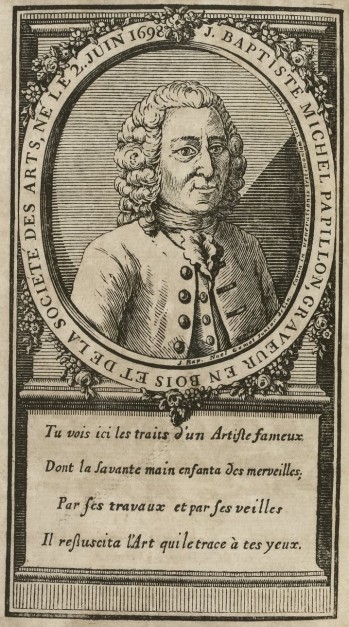 Issu d’une importante dynastie de graveurs, Jean-Michel Papillon (1698–1776) ambitionne de redonner du prestige à la gravure sur bois durant la première moitié du XVIIIe siècle. Outre sa foisonnante production graphique, cette entreprise se concrétise principalement par une volonté de transmettre les savoirs liés à son art. Il s’est notamment fait théoricien en rédigeant un imposant Traité historique et pratique de la gravure en bois. Bien qu’à manier aujourd’hui avec parcimonie, celui-ci n’en demeure pas moins une ressource extraordinaire et constitue une référence essentielle pour l’histoire de l’estampe et plus largement pour la culture visuelle du XVIIIe siècle.
Cette vaste somme de connaissances n’est pourtant pas sa seule contribution à l’histoire de l’art puisque Jean-Michel Papillon est aussi rédacteur de nombreuses entrées dans l’Encyclopédie de Diderot et d’Alembert. Il est non seulement l’auteur de plusieurs articles dédiés à la gravure mais il fournit également des ornements typographiques pour celle-ci.
Conscient de l’importance de l’accès au savoir et du rôle de l’écrit dans la transmission des techniques artistiques, Jean-Michel Papillon est une figure dont l’étude permet de saisir pleinement le phénomène de « réduction en art », concept théorisé par Hélène Vérin et Pascal Dubourg-Glatigny. Membre de la Société des Arts, le graveur s’est grandement intéressé aux monogrammes mais aussi à de nombreux domaines en lien avec la pratique de la gravure. Son riche témoignage sur sa formation d’historien autodidacte renseigne avec précision sur sa manière d’acquérir ses connaissances, de restituer son savoir et d’écrire sur son art en tant que praticien, dans un champ alors majoritairement dominé par les hommes de lettres.
Séminaire de recherche en partenariat entre l’École du Louvre, l’Université de Poitiers (Criham) et l’Université Rennes 2, adossé au projet « Amateurs et réseaux savants en France (1700–1914). Histoire intellectuelle, culturelle et sociale des amateurs et collectionneurs d’images gravées et enluminées » (UR Histoire et critique des Arts, Université Rennes 2). Les séances ont lieu simultanément à l’École du Louvre et en visio-conférence. Pour tout renseignement et inscription, merci d’écrire à pascale.cugy@univ-rennes2.fr.
Organisation
• Pascale Cugy (Université Rennes 2)
• Estelle Leutrat (Université de Poitiers, Criham)
• François-René Martin (École du Louvre)
Colloquium | Secrets of Painting
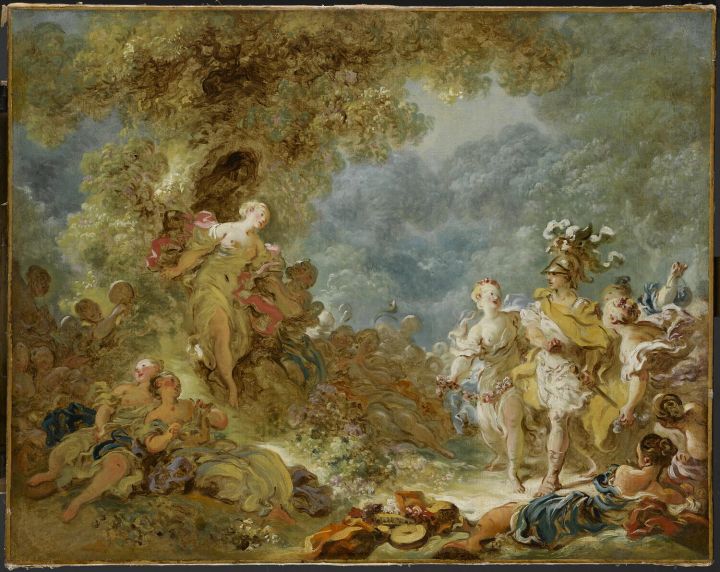
Jean-Honoré Fragonard, Renaud in the Gardens of Armide / Renaud dans les jardins d’Armide, ca. 1761–65, oil on canvas, 72 × 91 cm
(Paris, Musée du Louvre, RF2003 11)
◊ ◊ ◊ ◊ ◊
From ArtHist.net and the DFK:
Les Secrets de la peinture: Pratique et théorie de la peinture, de la manière et de la matérialité dans l’art du XVIIIe siècle français
Les Secrets de la peinture: Zu Praxis und Theorie von Malfarbe, Manier und Materialität in der Kunst des französischen 18. Jahrhunderts
Online and in-person, Deutsches Forum für Kunstgeschichte, Paris, 7–8 December 2023
Que peut légitimement dire la peinture, en tant que travail artistique technique, des conditions sociologiques de l’art, et que dit de la peinture des tableaux, du fecit, la réflexion théorique formulée dans les témoignages critiques—salons, conférences d’académie, traités ? Le colloque se consacre, à l’exemple de la peinture française du XVIIIe siècle, aux questions de la théorie et de la pratique de l’image et de la description de l’image. Il se veut une première tentative de reset de la perspective empirique dans le regard porté sur la peinture en tant que legs matériel spécifique des beaux-arts. Participation en ligne ou sur place au DFK Paris, pas d’inscription nécessaire.
j e u d i , 7 d é c e m b r e 2 0 2 3
10.00 Ouverture par Léa Kuhn (directrice adjointe du DFK Paris)
Introduction par les organisateurs — Markus Castor (DFK Paris), Deborah Schlauch (HAB Wolfenbüttel/ Université Marbourg), et Marie Isabell Wetcholowsky (Université Marbourg)
10.30 Théorie et langage autour de la peinture
• Comment la reconnaissance de la matière en peinture a renversé les paradigmes de la théorie artistique — Jérôme Delaplanche (Paris)
• The Sublime: Theory and Practice in French Painting after Charles Le Brun — Aaron Wile (Washington DC)
• Une Relation Instructive: Aesthetic and Socio-Political Dimensions of the ‘tout ensemble’ in Fête Galante Paintings — Elisabeth Fritz (Berlin)
12.45 Déjeuner
13.45 Visite du Salon Louis XV au Musée de la BnF site Richelieu
15.00 Les artistes et la pratique de la peinture
• Le rythme du ‘repos’ en peinture: Entre contemplation esthétique et expérience vécue — Susanna Caviglia (Durham/Milan)
• Les secrets d’un père à son fils: L’Epître à mon fils sur la peinture d’Antoine Coypel (1721) et sa postérité — Anthony Saudrais (Rouen)
• Dans l’atelier des fêtes galantes: Antoine Watteau, maître de Lancret et Pater — Axel Moulinier (Paris)
• Antonio Pellegrini, François Lemoyne et l’adaptation de la sprezzatura vénitienne: Le décor de la Galerie des Mississipiens et la critique du comte de Caylus — Marie Isabell Wetcholowsky (Paris/Marbourg)
• Au service de Dieu, la peinture selon Louis Galloche — Marine Roberton (Dijon)
18.45 Buffet dinatoire
v e n d r e d i , 8 d é c e m b r e 2 0 2 3
9.00 Visite du choeur de la Basilique Notre-Dame-des-Victoires de Paris La diversité de la couleur, des pigments et de la matérialité
10.00 Les artistes et la pratique de la peinture
• Learning How to Paint, Pigment by Pigment: Catherine Perrot’s Leçons Royales (1686) — Tori Champion (St Andrews)
• Fragonard’s Stalled Cart and Formless Landscape in 18th-Century France — Camilla Pietrabissa (Venise)
• Pigment, Puder, poussière précieuse: Metaphorik und visuelle Topik in der Pastellmalerei des 18. Jahrhunderts — Iris Brahms (Tübingen)
• « Fille de la peinture » Farbdruck von Le Blon bis Bonnet — Astrid Reuter (Francfort-sur-le-Main)
13.00 Déjeuner
14.00 La critique de la peinture
• “’Un des plus grans coloristes de l’école Francoise.’ He might be so and not very excellent”: English Critiques of French Painters in Britain after 1700 — Deborah Schlauch (Marbourg/Wolfenbüttel)
• Le langage des arts: Kunstkritik am Beispiel von Gemälden zu antiken Themen der Salons, 1747–1789 — Alexandra Röckel (Munich)
• La capacité olfactive de la couleur et la langue: Les taches de Bachelier, l’attaque de Diderot et les propos de Caylus sur la couleur — Markus Castor (Paris)
• « Fondre les effets » Diderot et la loi des nuances — Marie Schiele (Paris)
Online Conversation | The Van de Veldes at the Queen’s House
In connection with the exhibition at Greenwich; from The Warburg Institute:
Curatorial Conversation | The Van de Veldes at the Queen’s House, Greenwich
Online, 17 October 2023, 5.30pm
Curators Allison Goudie and Imogen Tedbury in conversation with Bill Sherman (Warburg Institute Director) and Gregory Perry (CEO, Association for Art History)
For almost 20 years in the late 17th century the Queen’s House at Greenwich was the studio address of the marine painters Willem van de Velde the Elder (1610/11–1693) and his son, Willem the Younger (1633–1707). Although the building itself bears little trace of the Van de Veldes’ presence, in the 20th century the Queen’s House once again became a home for their work, as the dedicated art gallery of the National Maritime Museum, custodian of the world’s largest collection of works by the Van de Veldes. Spanning scores of oil and pen paintings, a tapestry, and some 1,500 drawings, the collection is unique in what it can tell us about how a 17th-century artist’s studio functioned. The physical evidence provided by this collection proved invaluable for the evocation of the Van de Velde studio that forms a centrepiece of the current exhibition, The Van de Veldes: Greenwich, Art, and the Sea, marking 350 years since the Van de Veldes moved to England from the Dutch Republic. Showcasing major conservation projects on important works in the Greenwich collection that have their origin point in the Queen’s House studio, and notwithstanding a select number very generous loans, the exhibition was also a pragmatic solution to some of the challenges facing museums as they emerged from Covid, particularly how to make an event out of a permanent collection.
Online attendance is free, with advanced booking available here»
Allison Goudie is Curator of Art (pre-1800) at Royal Museums Greenwich. Before coming to Greenwich, she was Curator of Kenwood House and previously held curatorial positions at the National Gallery and the National Trust. She completed her PhD on the subject of royal portraiture during the Revolutionary and Napoleonic wars at the University of Oxford in 2014. She is the recipient of a Getty Paper Project grant to bring to life the collection of Van de Velde drawings at Greenwich and is leading on RMG’s programme in 2023 marking 350 years since the Van de Veldes arrived in England, the centrepiece of which is the exhibition in the Queen’s House co-curated with Imogen Tedbury.
Imogen Tedbury is an art historian and curator. She has held curatorial positions at Royal Holloway, University of London, the National Gallery, London, and the Queen’s House, Royal Museums Greenwich, where she was the co-curator of The Van de Veldes: Greenwich, Art, and the Sea. Her PhD (2018) explored the reception of Sienese painting, and her research has been supported by fellowships and grants from the Getty Research Institute, the Metropolitan Museum of Art, the Paul Mellon Centre, and the Warburg Institute. She is currently undertaking research for the early Italian paintings catalogue of the Norton Simon Museum.
This event is organised by the Association for Art History in conjunction with The Warburg Institute, University of London. Curatorial Conversations invites museum directors and makers of recent exhibitions at world-leading museums and galleries to the Warburg to discuss their work. The conversations, led by academics at the Warburg Institute, discuss the issues of setting the directorial or curatorial agenda and staging meaningful encounters with objects. The series is designed to draw out discussion of the discoveries made, challenges tackled and the lessons learned in heading a collection and putting together internationally renowned exhibitions.
Talk and Exhibition | The Jews, the Medici, and the Ghetto of Florence
From the Medici Archive Project (MAP):
Piergabriele Mancuso and Alice S. Legé | The Jews, the Medici, and the Ghetto of Florence: History and Challenges of an Exhibition
Online, The Medici Archive Project, 10 October 2023, 5pm (EDT)

Ketubah (Marriage Contract), 1739 (Archivio di Stato di Firenze)
The exhibition The Jews, the Medici, and the Ghetto of Florence (Gli ebrei, i Medici, e il Ghetto di Firenze)—on view from 23 October 2023 until 20 January 2024 at the Palazzo Pitti—offers a comprehensive exploration of a relatively understudied aspect of the Medici and Jewish history. Delving into the intricate evolution of the Florentine Ghetto, the exhibition traces the site’s history from its establishment under the Grand Duke Cosimo I de’ Medici in 1570 to its eventual dissolution in the 19th century. Visitors will see a rich array of artifacts, including illuminated manuscripts, paintings, archival documents, photographs, maps, and sculptures. These items provide insights into the complex relationship between the Jewish community and the Grand Duchy of Tuscany.
This talk by the exhibition’s curators will focus on the creation of the exhibition, prompting important inquiries into topics such as segregation, protective measures, urban integration, and the invaluable cultural contributions made by the Jewish populace during the Florentine Renaissance.
To watch this talk, click here on Tuesday, 10 October, at 5pm (EDT).
Online Book Launch | Pevsner’s Oxfordshire
From The Mellon Centre:
Simon Bradley, Nikolaus Pevsner, and Jennifer Sherwood, Oxfordshire: Oxford and the South-East, Pevsner Architectural Guides: Buildings of England (New Haven: Yale University Press, 2024), 800 pages, ISBN: 978-0300209297, $85.
Book Launch with Simon Bradley, Geoffrey Tyack, and James Davies
Online, Paul Mellon Centre for Studies in British Art, London, 2 November 2023, 6pm
 Simon Bradley, series editor of the Pevsner Architectural Guides, will discuss the latest volume in the series with Geoffrey Tyack of Kellogg College, Oxford. The book addresses half a century of change and development since the original edition of 1974 by Nikolaus Pevsner and Jennifer Sherwood, completing the revision of Oxfordshire initiated with Alan Brooks’s North and West volume of 2017. Fresh accounts are provided of the many ambitious new buildings for the university and its colleges, familiar landmarks such as the Bodleian Library and the Radcliffe Camera are reinterpreted and the many renovations and extensions are described and assessed. Oxford’s commercial buildings, suburbs, and houses are explored in depth, including much that is published here for the first time. The accompanying county area extends from the outskirts of Oxford to Henley-on-Thames, following the historic Thames-side boundary of Oxfordshire and taking in the hills of the southern Chilterns. Here the volume includes enhanced accounts of major country houses such as Nuneham Courtenay and Thame Park, new assessments of church restorations, furnishings and stained glass, more inclusive coverage of post-war buildings, and a fuller selection of vernacular and rural architecture across the whole of this attractive and rewarding quarter of rural England. The evening will also include a contribution from James O. Davies, who will talk about the challenges and rewards of taking photographs of the region’s best buildings for the new volume.
Yale University Press is delighted to offer attendees of the virtual launch a special discount price for the new Pevsner guide to Oxfordshire. Attendees will receive a discount code with their Eventbrite confirmation email.
Book online tickets here»
Simon Bradley is series editor of the Pevsner Architectural Guides and co-author of four other Buildings of England volumes: London 1: The City, London 6: Westminster, Cambridgeshire, and Berkshire.
Geoffrey Tyack is Fellow Emeritus of Kellogg College, Oxford, where he has taught urban and architectural history for many years. He is co-author of the Pevsner Architectural Guides’ Berkshire volume and has also published widely on 19th- and 20th-century architectural subjects. His recent books include The Historic Heart of Oxford University (2022).
James Davies has worked as an architectural photographer for thirty years. He has published widely, with books on English prisons, tin mining, post-war buildings, Stonehenge, and many Pevsner volumes, as well as in magazines including Wallpaper, The World of Interiors, Country Life, and Blueprint.
Online Talks from The Library Company of Philadelphia
Two upcoming online events from the Visual Culture Program of The Library Company of Philadelphia:
Prints of a New Kind: Political Caricature in the United States, 1789–1828
A book talk by Dr. Allison Stagg
Friday, 20 October 2023, 1.30pm ET
Prints of a New Kind details the political strategies and scandals that inspired the first generation of American caricaturists. It examines the caricatures that mocked events reported in newspapers and politicians, the reactions captured in personal papers of the politicians being satirized, and the lives of the artists who satirized them.
Allison M. Stagg is a specialist in 18th- and 19th-century American and British visual culture and has published widely on the subject of American historical caricature. She was the Library Company 2017–18 William H. Helfand Fellow in American Visual Culture.
More information and registration details are available here»
◊ ◊ ◊ ◊ ◊
The Complexities of Phillis Wheatley’s Portrait
A guest lecture by Dr. Jennifer Chuong
Wednesday, 25 October 2023, 1.00pm ET
In the fall of 1773, Phillis Wheatley became the first Black woman to publish a book in the transatlantic world. Poems on Various Subjects, Religious and Moral features an engraved frontispiece portrait of the author. This portrait aimed to portray an enslaved person who, by virtue of her intelligence, erudition, and imagination, exploded slavery’s foundational claim that enslaved persons were objects to be bought and sold. This talk explores how the portrait both supports and undercuts this aim.
Jennifer Y. Chuong is an art historian whose research centers on the art, architecture, and material culture of the transatlantic world in the 18th and 19th centuries as they relate to histories of environment and race.
More information and registration details are available here»










leave a comment