Online Talk | Imagining the Etruscans: Modern European Perceptions
The keynote talk for this year’s New York Workshop of Etruscan Art, given by Maurizio Harari, addresses reception history, including the eighteenth century:
Maurizio Harari, Imagining the Etruscans: Modern European Perceptions of an Ancient Italian Civilization
Online, Thursday, 29 April 2021, noon (ET)
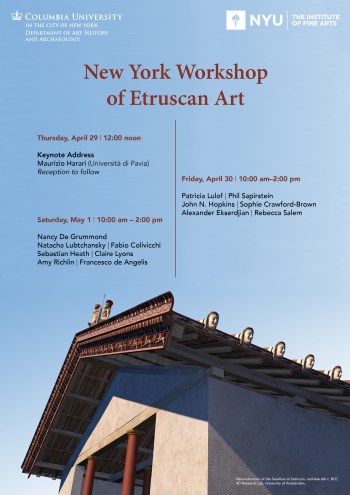 Since the late rise of humanism and through a real crescendo in the 18th to 20th centuries, the Etruscans, an ancient people of pre-Roman Italy, became (and remain) a subject of lively discussions among scholars, as they saw a wide popularity in pseudo-scientific exploration and publication. This lecture aims to explore the ideological features of the foundation process of a highly specialized, but often self-referential discipline, so-called ‘Etruscology’, which only saw its real scholarly development in the first half of the 20th century. In that context, this major branch of scholarship was created with its roots in the rather complicated connections between the Italian territorial situation of Etruscan civilization and the European dimension of its reception and popularization.
Maurizio Harari is Professor of Etruscan and Italic Archaeology and Director of the Archaeological Museum at the University of Pavia, Italy. Author of over 200 publications, his reach focuses on Etruscan and Italic art and archaeology, especially issues of image making and meaning, wall painting, Etruscans of the Po-River region, and the sacred and political institutions of Etruscan cities. Co-Director of excavations at the Italian site of Verucchio since 2011, he is also a specialist in the historiography of Etruscology and its situation within the archaeological disciplines of Europe and the Mediterranean. He has collaborated widely across Europe, including with the European Research Council and on publication of the Enciclopedia dell’arte antica classica e orientale and the Lexicon Iconographicum Mythologiae Classicae, and he is fellow and member of multiple institutions, including the Istituto Nazionale di Studi Etruschi ed Italici.
The New York Workshop of Etruscan Art is an initiative promoted jointly by Columbia University and New York University. The ambition of the workshop is to advance our understanding of the artistic and visual dimensions of pre-Roman Italy by promoting discussion and sustained reflection on their role within the field of Etruscan studies, but it does not prescribe a specific intellectual agenda. This year, the workshop will: advance discussion of buildings, their roofs and decoration and the avenues they provide to investigate production processes, networks of interaction and creation, the sacred image and the porousness of Italic arts; reflect on the impact of 3D-modeling and reconstructions on our understanding of Etruscan aesthetics; present new findings from the Corpus Speculorum Etruscorum; present unpublished bronze figurines of subordinate characters; explore the relation with comedy of the imagery of Praenestine cistae.
Please join us for the keynote talk of this year’s New York Workshop of Etruscan Art given by Maurizio Harari. The event will be live-streamed; RSVP to receive the webinar link.
Online Talk | Helen Jacobsen on the Château de Bagatelle

François-Joseph Bélanger, Château de Bagatelle, 1777, Bois de Boulogne, Paris.
◊ ◊ ◊ ◊ ◊
This upcoming talk is the final installment of the Attingham Trust Spring Lecture Series. Annabel Westman—after more than 40 years of being involved with Attingham—recently announced that she is retiring from her position as executive director, to be succeeded by Helen Jacobsen. (You’re able to stage a virtual passing of the baton by watching a recording of Annabel’s March 8 talk for the lecture series— “What tone is salmon-coloured? Interpreting documentation in historic textile furnishing schemes” —just before you tune in for Helen’s.)
Helen Jacobsen, The Château of Bagatelle: The Story of a Remarkable House and Its Collections
Online, Wednesday, 28 April 2021, 6pm (BST)
Helen Jacobsen, the Director of the Attingham French Eighteenth-Century Studies course, looks at the absorbing story of the Château of Bagatelle, the former hunting lodge in the Bois de Boulogne that was transformed into a jewel of French neoclassicism as the result of a bet between Marie-Antoinette and her brother-in-law, the Comte d’Artois. Much more than a plaything, Bagatelle survived the Revolution and became the much-loved home of two more of the greatest patrons of French art, the 4th Marquess of Hertford and Sir Richard Wallace. Helen, who is also the Curator of French 18th-century decorative art at the Wallace Collection, will chart the life of the house under all three owners, and investigate the continuing connections between Bagatelle and Hertford House.
Online Talks | HECAA Emerging Scholars Showcase
HECAA Emerging Scholars Showcase
Online, Saturday, 17 April 2021, 2:00–3:30pm (EST)
Our next HECAA Emerging Scholars Showcase is on Saturday, April 17, 2–3:30pm EST. Please join us via zoom to hear our final seven emerging scholars present their research. Each participant will present for 3–5 minutes, and after the presentations, we will host a question-and-answer session. If you have any questions or concerns, please contact Dani Ezor (dezor@smu.edu).
Best regards,
HECAA Board
◊ ◊ ◊ ◊ ◊
Zoom: https://smu.zoom.us/j/96125021098
• Carla Hermann (Rio de Janeiro State University), Robert Barker’s Panoramas and Virtual Images of Places
• Chih-En Chen (SOAS, University of London), Trompe l’Oeil Porcelain and Feminine Space in High Qing China
• Jed Surio (Tulane University), A Kingdom of Curious Beasts: Charles Le Brun’s Drawings from the Royal Menagerie
• Megan Baker (University of Delaware), Crayon Rebellion: The Politics of Pastel Portraits in Colonial North America
• Tori Champion (University of Washington), Pinceau à la main: The Intertwined Lives and Careers of Madeleine Françoise Basseporte and Marie-Thérèse Reboul Vien
• Kaitlin Grimes (University of Missouri-Columbia), The Material Politics of Ivory in Early Modern Europe
• Aleksander Musiał (Princeton University), Immersion: Classical Reception and Eastern-European Transformations of Hygiene Architecture, 1680–1830
Online Talk | Juliet Carey on Baron Edmond’s Boxes
Next month from Waddesdon Manor, from the programme flyer:
Juliet Carey, Storing and Staging: Baron Edmond’s Boxes
Online, Monday, 10 May 2021, 6pm
 Join Senior Curator Juliet Carey to explore the surprising, beautiful boxes in which some of Waddesdon’s most precious objects live when out of the public eye.
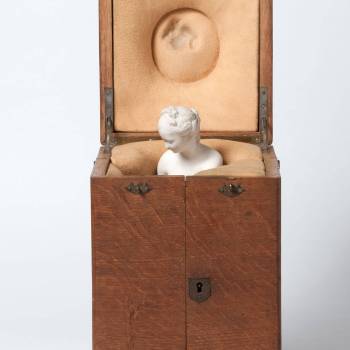
We still use the boxes that Baron Edmond de Rothschild (1845–1934) commissioned for the storage of Sèvres porcelain and small sculptures and antiquities. Their unusually sophisticated fabrication relates to bookbinding, the covers of scientific instruments, etuis for princely treasures, and longstanding Parisian expertise in the protection and transportation of precious things. Far from being neutral or invisible spaces, Edmond’s boxes construct new ways of experiencing their contents—from those that help one to study and categorise vases, Roman glass, and even furniture, to a box that transforms into a stage, creating a private drama of enclosure and revelation around a little marble nymph.
For all their aesthetic and tactile appeal, the protective role of these boxes is underlined by the turbulence of the times that they survived, from revolutions and siege in 19th- century Paris to the Nazi occupation. A recent work by Edmund de Waal responds to this history and provides an intriguing postscript.
Standard registration is £10. Students, please email enquiries@waddesdon.org.uk from your academic email to register for a free place. A zoom link will be emailed to participants 24 hours before the event.
New Book | Culloden: Battle & Aftermath
Friday is the 275th anniversary of the battle of Culloden (fought on 16 April 1746). To mark the anniversary, the National Trust for Scotland will present a series of online events on Saturday, 17 April, entitled Culloden: A Place Worth Protecting. Paul O’Keeffe’s book is the latest to tackle the subject; from Penguin Press:
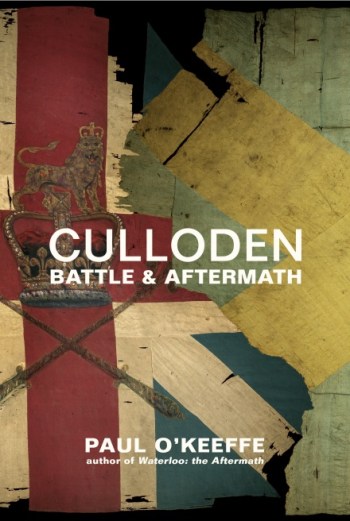
Paul O’Keeffe, Culloden: Battle & Aftermath (London: Bodley Head, 2021), 432 pages, ISBN: 978-1847924124, £25.
 Charles Edward Stuart’s campaign to seize the British throne on behalf of his exiled father ended with one of the quickest defeats in history: on 16 April 1746, at Culloden, his 5,000-strong Jacobite army was decisively overpowered in under forty minutes. Its brutal repercussions, however, endured for months and years, its legacy for centuries.
Paul O’Keeffe follows the Jacobite army, from its initial victories over Hanoverian troops at Prestonpans, Clifton and Falkirk to their calamitous defeat on the field of Culloden. He explores the battle’s aftermath which claimed the lives, not only of helpless wounded summarily executed and fugitives cut down by pursuing dragoons, but also of civilians slaughtered by vengeful government patrols as they ‘pacified’ the Highlands. He chronicles the wild, nationwide celebration greeting news of the government victory, the London stage catering to patriotic fervour with new songs like ‘God Save the King’, popular musical theatre, and operas by Gluck and Handel. Meanwhile, the public was also treated to the grimmer spectacle of Jacobite prisoners, tried for high treason, paying for their participation on block and gibbet throughout the country. Many others—granted ‘the King’s mercy’—suffered the lingering fate of forced labour on fever-ridden plantations in the West Indies and Virginia.
O’Keeffe reveals the unexpected consequences of the rising—mapping the Scottish Highlands to aid military subjugation would eventually lead to the foundation of the Ordnance Survey—and traces the later careers of the battle’s protagonists: the Duke of Cumberland’s transformation from idolised national hero to discredited ‘butcher’ and Charles Edward Stuart’s from ‘Bonny Prince’ to embittered alcoholic invalid.
While in the long term the doomed Stuart cause acquired an aura of romanticism, the Jacobite Rising of 1745–46 remains one of the most bloody and divisive conflicts in British domestic history, which resonates to this day.
Paul O’Keeffe is a freelance lecturer and writer based in Liverpool. He gained his PhD with a scholarly edition of Wyndham Lewis’s Tarr, and won critical acclaim with his 2000 study of Lewis, Some Sort of Genius.
Online Roundtable | Teaching the Long 18th Century
From the roundtable flyer:
Teaching the ‘Long’ 18th Century
Online, Friday, 23 April 2021, 9–11am (EST)
Organized by Sarah Betzer and Dipti Khera
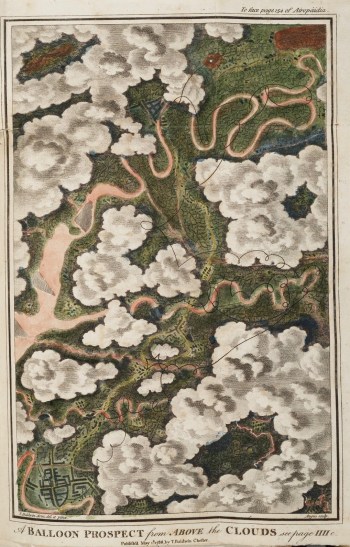
After Thomas Baldwin, A Balloon-Prospect from above the Clouds, plate from Thomas Baldwin, ‘Airopaidia’ (London, 1786), opposite p. 154.
Roundtable featuring:
• Anna Arabindan-Kesson, Princeton University
• Nebahat Avcıoğlu, Hunter College, City University of New York
• Emma Barker, The Open University, London
• Ananda Cohen-Aponte, Cornell University
• Prita Meier, Art History and Institute of Fine Arts, New York University
• Nancy Um, Binghamton University, State University of New York
• Stephen Whiteman, The Courtauld Institute of Art, London
This roundtable brings together scholars from a broad array of geographical foci and institutional perspectives who have been at the forefront of efforts to rethink approaches to thinking, researching, and, crucially, teaching the art and material culture of an interconnected ‘long’ eighteenth century. Convened in conjunction with a session at the 2021 College Art Association conference, the roundtable will appear in distilled form in a dedicated issue of Journal18, forthcoming in Fall 2021. Two key aims animate the roundtable and its afterlife in Journal18: 1) to reflect upon teaching the ‘long’ eighteenth century, particularly in light of renewed debates on the reparation of objects, revision of histories, and inclusion of colonized and enslaved voices in museums, plantation sites, and public squares; and 2) to compile a list of resources and open-access supporting materials that are pragmatically useful for colleagues engaged in teaching the ‘long’ and ‘broad’ eighteenth century.
Organized by Sarah Betzer, University of Virginia, and Dipti Khera, Art History and Institute of Fine Arts, New York University
ASECS 2021, Online
Starting Wednesday, with sessions running until Sunday evening!
2021 American Society for Eighteenth-Century Studies Conference
Online, 7–11 April 2021
The 51st annual meeting of the American Society for Eighteenth-Century Studies takes place online. HECAA will be represented by the Anne Schroder New Scholars’ Session, chaired by Susanna Caviglia and scheduled for Saturday afternoon at 2:50 and the annual business meeting, right after that, starting at 3:55. A selection of 33 additional panels is included below (of the 182 sessions scheduled, many others will, of course, interest HECAA members). For the full slate of offerings, see the program. Regular registration is $80; discounted rates are $35. All times are Eastern Standard Time.
◊ ◊ ◊ ◊ ◊
W E D N E S D A Y , 7 A P R I L 2 0 2 1
Spanish Sensorium
Wednesday, 12:10–1:10
Chair: Elena DEANDA-CAMACHO, Washington College
1. Lilian BRINGAS SILVA, Georgetown University, “Los bodegones de Goya”
2. Karissa BUSHMAN, Quinnipiac University, “Goya’s Illnesses and Deafness and the Impact on his Senses”
3. Meira GOLDBERG, Fashion Institute of Technology, CUNY, “The Space of Perfect Rhythm: Experiencing the Flamenco Circle”
4. Rachael Givens JOHNSON, University of Virginia, “Moving the Faithful: Hearing, Seeing, and Feeling in Eighteenth-Century Spanish- Atlantic Religious Festivals”
◊ ◊ ◊ ◊ ◊
Publishing Natural History
Wednesday, 12:10–1:10
Chairs: Eleanore NEUMANN, University of Virginia, and Agnieszka Anna FICEK, CUNY
1. April SHELFORD, American University, “More Estimable than Sloane? Patrick Browne’s Civil and Natural History of Jamaica (1756)”
2. Marianne VOLLE, York University/Paris 1 Panthéon-Sorbonne, “Natural History in the Making: Exploring the Network and Botanical Collection of Fougeroux de Bondaroy (1732–1789)”
3. Taylin NELSON, Rice University, “The ‘Totality’ of the Animal: Systems of Classification and Domestication”
4. Demetra VOGIATZAKI, Harvard University, “Three Allegorical Caves in Choiseul-Gouffier’s Voyage Pittoresque de la Grèce (1782)”
◊ ◊ ◊ ◊ ◊
Built Form in the Long Eighteenth Century
Wednesday, 1:20–2:20
Chair: Janet WHITE, UNLV
1. Luis J. GORDO PELAEZ, California State University, “Grain Architecture in Bourbon New Spain”
2. Paul HOLMQUIST, Louisiana State University, “Une autre nature: Aristotelian Strains in Ledoux’s Theory of Architecture as Legislation”
3. Dylan Wayne SPIVEY, University of Virginia, “Building from a Book: James Gibb’s Book of Architecture and the Commodification of Architectural Style”
4. Miguel VALERIO, Washington University in St. Louis, “Architecture of Devotions: The Churches Afro-Brazilian Religious Brotherhoods Built in the Eighteenth Century”
◊ ◊ ◊ ◊ ◊
Canada or the Tower: Finding, Depicting, and Imagining Canada
Wednesday, 2:50–3:50
Chair: Cristina S. MARTINEZ, University of Ottawa
1. Georgiana UHLYARIK, Art Gallery of Ontario, “Kanata: Indigenous Sovereignty and the Canadian Imagination”
2. Dominic HARDY, Université du Québec à Montréal, “Thomas Davies’ Watercolours of Québec under British Colonial Rule (1760–1812), Iconographies of Landscape, Identity, and Memory”
3. Marjolaine POIRIER, Université du Québec à Montréal, “Space, Place, and the figurant: Looking at Quebec City in 3D during the American Revolution”
4. Isabelle MASSE, UCLA and Concordia University, “Lower Canada or the Debtors’ Prison: Insolvent Portraitists on the Run”
◊ ◊ ◊ ◊ ◊
Imagining the Future in Ruins
Wednesday, 2:50–3:50
Chair: Thomas BEACHDEL, Hostos, CUNY
1. Amy DUNAGIN, Kennesaw State University, “Rosamund’s Bower, Addison’s Rosamond, and Whig Visions of British Ruin”
2. Anne Betty WEINSHENKER, Montclair State University, “Freemasonic Elements in the Tombeaux des princes
3. Jason BIRCEA, University of California, Berkeley, “The Sound of Depopulation in Oliver Goldsmith’s The Deserted Village”
4. Susannah B. SANFORD, Texas Christian University, “Birds and the Bees: Clara and Environmental Ruin in Sansay’s Secret History”
◊ ◊ ◊ ◊ ◊
Playing with Pigments: Color Experiments in the Visual Arts
Wednesday, 4:00–5:00
Chairs: Daniella BERMAN, New York University, and Caroline M. CULP, Stanford University
1. Alicia MCGEACHY, Northwestern University/Art Institute of Chicago Center for Scientific Studies in the Arts, “Through the Colored Glaze: Multi-analytical Studies of Eighteenth-Century Chelsea Ceramics”
2. Thea GOLDRING, Harvard University, “Printing Nature’s Taches: The Invention of Aquatint and the Depiction of Human Varieties”
3. Colleen STOCKMANN, Gustavus Adolphus College, “Climate and the Spectrum of Indigo Production in the Americas, 1740–1780”
◊ ◊ ◊ ◊ ◊
From Tabula Rasa to Terra Incognita: Landscape and Identity in the Enlightenment
Wednesday, 4:00–5:00
Chair: Shirley TUNG, Kansas State University
1. Michael BROWN, University of Aberdeen, “Locating Britain: The English Geographies of Daniel Defoe”
2. John DAVENPORT, Missouri Southern State University, “Topographical Dialogues and Competing Claims to Selfhood in Eighteenth-Century Travel Writing”
3. Kasie ALT, Georgia Southern University, “Negotiating the Self through Landscape Design and Representation: Thomas Anson’s Estate at Shugborough”
4. Julia SIENKEWICZ, Roanoke College, “Landscape and Alterity: Encounters with Virginia and South Africa”
◊ ◊ ◊ ◊ ◊
Amateur or Professional? Reconsidering the Language of Artistic Status
Wednesday, 5:10–6:10
Chairs: Paris SPIES-GANS, Harvard Society of Fellows, and Laurel PETERSON, Independent Scholar
1. Laura ENGEL, Duquesne University, “Fashioning Fairies: Lady Diana Beauclerk’s Watercolors”
2. Luke FREEMAN, University of Minnesota, “Engraving Authority: Bernard Picart’s Status and the ‘Leading Hands of Europe’”
3. Maura GLEESON, Independent Scholar, “Picturing La Créatrice: Image, Imagination, and Artistic Practice in Napoleonic France”
4. Cynthia ROMAN, The Lewis Walpole Library, “‘Not Artists’: Horace Walpole’s Hyperbolic Praise of Prints by Persons of Rank and Quality”
◊ ◊ ◊ ◊ ◊
Colonial Matter in the Eighteenth-Century World
Wednesday, 5:10–6:10
Chairs: Danielle EZOR, Southern Methodist University, and Kaitlin GRIMES, University of Missouri-Columbia
1. Amelia RAUSER, Franklin & Marshall College, “Madras Cloth: Currency, Costume, and Enslavement”
2. Kelly FLEMING, University of Virginia, “Empire, Satire, and the Regency Cap in The Adventures of an Ostrich Feather of Quality (1812)”
3. Yiyun HUANG, University of Tennessee, Knoxville, “‘Nothing but large potions of tea could extinguish it’: Chinese Knowledge and Discourse of Tea in Colonial America”
◊ ◊ ◊ ◊ ◊
T H U R S D A Y , 8 A P R I L 2 0 2 1
Roundtable: Scholarly Tourism: Traveling to Research the Eighteenth Century
Thursday, 11:00–noon
Chair: Ula Lukszo KLEIN, University of Wisconsin-Oshkosh
1. Meg KOBZA, Newcastle University, “Places of Privilege: Price and Practice in Private Archives”
2. Caroline GONDA, Cambridge University, “Strawberry Hill and Shibden Hall: Anne Damer and Anne Lister”
3. Laura ENGEL, Duquesne University, “The Archival Tourist”
4. Fiona RITCHIE, McGill University, “Mentoring Student Researchers in the Archives”
5. Yvonne FUENTES, University of West Georgia, “Eighteenth-Century Gossip and News: The Archives of Spanish Parish Churches, Cathedrals, and Basilicas”
◊ ◊ ◊ ◊ ◊
Roundtable: Methods for Bibliography and Eighteenth-Century Studies
Thursday, 12:10–1:10
Chair: J. P. ASCHER, University of Virginia
1. Mathieu BOUCHARD, McGill University, “Beaumont and Fletcher in 1711: The Bibliographical Analysis of an Anonymous Editor”
2. Ashley CATALDO, American Antiquarian Society, “Bradstreet’s Pastedowns: De(bri)s Bibliography”
3. David LEVY, Writer, “Collateral Bibliography: Are Hoyle Collections Separate Issues?”
4. Nina M. SCHNEIDER, William Andrews Clark Memorial Library, UCLA, “Three-Dimensional Bibliography: Plaster Casts in the Sir John Soane Museum”
5. Michael VANHOOSE, University of Virginia, “A Rationale for Cliometric Bibliography, with Applications to British Papermaking, 1782–1837”
◊ ◊ ◊ ◊ ◊
Vital Matters: Materialism(s) in the Eighteenth Century and Beyond
Thursday, 12:10–1:10
Chair: Pichaya (Mint) DAMRONGPIWAT, Cornell University.
1. Jess KEISER, Tufts University, “Cavendish contra New Materialism; or, Anthropomorphism in Lyric and Panpsychism”
2. Susan EGENOLF, Texas A&M University, “Josiah Wedgwood, Thomas Griffiths, and the Mystique of Cherokee Clay”
3. Roger MAIOLI, University of Florida, “England’s First Atheistic Manifesto”
Respondent: Lucinda COLE, University of Illinois
◊ ◊ ◊ ◊ ◊
The Sister Arts in Eighteenth-Century Ireland
Thursday, 12:10–1:10
Chair: Michael GRIFFIN, University of Limerick
1. Scott BREUNINGER, Virginia Commonwealth University, “Improvement and the Arts during the Early Irish Enlightenment”
2. Tríona O’HANLON, Independent Scholar, “The Violinist in Eighteenth-Century Dublin: A Case Study Addressing the Connection between Cultural Activity and Political Agendas in Eighteenth-Century Ireland”
3. David BURROW, University of South Dakota, “Assessing Russia: Artistic Taste and Civilizational Values”
◊ ◊ ◊ ◊ ◊
‘Too Political, Too Big, No Good’: Picturing Politics
Thursday, 3:40–4:40
Chair: Jessica L. FRIPP, Texas Christian University
1. Alexandra CALDON, Graduate Center, CUNY, “Engaging the Public: The Rejection of Mythology in Royal Almanac Prints, 1695–1715”
2. J. Patrick MULLINS, Marquette University, “Thomas Hollis’s ‘Liberty Prints’ and the Transatlantic Cult of Tyrannicide”
3. Thomas BUSCIGLIO-RITTER, University of Delaware, “Denis Volozan’s Portrait of George Washington in an Atlantic Context”
4. Marina KLINGER, New York University/The Metropolitan Museum of Art, “From ‘Great Men’ to ‘Women’s Influence’: Retelling the Story of Louis Ducis’s Tasso and Eleonora d’Este from the Empire to the Restoration”
◊ ◊ ◊ ◊ ◊
Visualizing the French Empire
Thursday, 4:50–5:50
Chairs: Philippe HALBERT, Yale University, and Izabel GASS, Yale University
1. Alexandre DUBÉ, Université du Québec à Chicoutimi, and Sophie WHITE, University of Notre Dame, “The Stuff of Conviction”
2. Agnieszka Anna FICEK, CUNY, “Picturing the Péruvienne: The Exotic and Erotic in the Illustrations to Mme. de Graffigny’s Lettres d’une Péruvienne”
3. Joseph LITTS, Princeton University, “Materials, Race, and the Body in the Franco-Swiss Atlantic World”
4. Thomas BEACHDEL, Hostos, CUNY, “The Sublime Future of Ruins”
◊ ◊ ◊ ◊ ◊
2020 Presidential Session: The Carbon Footprint of ASECS: What to Do?
Thursday, 4:50–5:50
Organizer: Jeffrey S. RAVEL, MIT
ASECS can no longer ignore its contributions to climate change. Given the rapidly increasing rate of natural disasters around the globe, each of us has an ethical responsibility to reduce their carbon footprint. We will all have to make painful sacrifices to repair the damage already done to the environment. ASECS has one built-in advantage that we can leverage—our roster of regional affiliate societies. We might, for example, hold the annual meeting every other year, and then encourage attendance at the meetings of the regional societies in years when we did not convene the national meeting. For both the national and regional conferences, we might build a more robust remote system that would allow members without funding or those who do not wish to travel by plane or car to participate virtually. In this session, the chair would like to start a conversation with all concerned members of the Society about responsible steps ASECS can take going forward.
◊ ◊ ◊ ◊ ◊
F R I D A Y , 9 A P R I L 2 0 2 1
Roundtable: Cultural Histories of Fame and Celebrity in the Age of Enlightenment
Friday, 11:00–noon
Chair: Brian COWAN, McGill University
1. Meghan ROBERTS, Bowdoin College, “Fame and the French Enlightenment”
2. Heather MCPHERSON, University of Alabama at Birmingham, “The Visual Arts and Modern Celebrity in Georgian England”
3. Ted MCCORMICK, Concordia University (Montreal), “Fame and Celebrity in Eighteenth-Century Science”
4. Pascal BASTIEN, Université de Quebec à Montréal, “Infamy in Eighteenth-Century France”
5. Sydney AYRES, Institute of Advanced Study, Edinburgh University, “Contemporary Celebrity vs. Posthumous Fame in Britain, c.1790–1820”
6. Antoine LILTI, EHESS (Paris), “Eighteenth-Century Celebrity”
◊ ◊ ◊ ◊ ◊
Collecting, Antiquities, and Eighteenth-Century Art
Friday, 12:10–1:10
Chairs: Katherine ISELIN, University of Missouri-Columbia, and Lauren DISALVO, Dixie State University
1. Freya GOWRLEY, University of Derby, “Classical Specimens and Fragmentary Histories: The Specimen Table as Part and Whole”
2. Josh HAINY, Truman State University, “For Their Mutual Benefit: John Flaxman’s Recreation of the Belvedere Torso for Thomas Hope”
3. Katherine CALVIN, Kenyon College, “Collecting on Credit: The British Levant Company in Aleppo’s Art and Money Markets”
◊ ◊ ◊ ◊ ◊
ASECS Listening Session
Friday, 1:20–2:20
Presiding: Nyree GRAY, ASECS Ombuds and Associate Vice President / Chief Civil Rights Officer, Claremont McKenna College
The many ASECS members who have recently contacted the Executive Board are concerned about a range of issues regarding the Society. Therefore, the Board has decided to devote the Friday plenary to a Listening Session, at which ASECS members are invited to share their thoughts and suggestions. Another Listening Session will be held during the 5:10–6:10 time slot on Friday evening. Through these meetings, members can help develop an agenda for a Town Hall Meeting, to be held on April 23.
◊ ◊ ◊ ◊ ◊
William Hogarth in the Twenty-First Century
Friday, 2:50–3:50
Chair: Nick ALLRED, Rutgers University
1. Ann VON MEHREN, University of Memphis, “Black Children in Hogarth’s ‘Modern Morality’ Art”
2. Corey GOERGEN, Georgia Institute of Technology, “‘Makes Human Race a Prey’: Hogarth’s Gin Lane in Twenty-First-Century Public Health Campaigns”
3. Debra BOURDEAU, Embry-Riddle Aeronautical University, “Hogarth’s Bedlam: A Rake’s Progress and Britain’s Mental Health Crisis”
◊ ◊ ◊ ◊ ◊
Roundtable: Reflections on David Gies and Cynthia Wall, eds., The Eighteenth Centuries: Global Networks of Enlightenment
Friday, 2:50–3:50
Chair: Elizabeth Franklin LEWIS, University of Mary Washington
1. Jeanne BRITTON, University of South Carolina, “Using Global Networks of Enlightenment: Giovanni Piranesi and the Digital Eighteenth Centuries”
2. Valentina TIKOFF, DePaul University, “Using Global Networks of Enlightenment: How Interdisciplinary Perspectives, Multiple Geographies, and Linguistic Perspectives Help Us Navigate and Teach the Age of Enlightenment”
3. Carol GUARNIERI, University of Virginia, “Creating a Digital Companion to Global Networks of Enlightenment: ‘The Digital Eighteenth Centuries’ on mapscholar.org”
4. Cynthia WALL, University of Virginia, and David GIES, University of Virginia, “Editing Global Networks of Enlightenment”
◊ ◊ ◊ ◊ ◊
Networks and Practices of Connoisseurship in the Global Eighteenth Century
Friday, 4:00–5:00
Chairs: Kristel SMENTEK, MIT, and Valérie KOBI, Universität Hamburg
1. Ünver RÜSTEM, Johns Hopkins University, “Connoisseurship and the Art of Synthesis in Eighteenth-Century Istanbul: Ottoman Engagements with Western Architectural Books and Prints”
2. Michele MATTEINI, New York University, “Western Painting Inside Out: Pak Chiwon and the Connoisseurship of Western Painting in Eighteenth-Century East Asia”
3. Elizabeth Saari BROWNE, MIT, “Discernment or Devotion: Egypt and Sculptural Politics in Eighteenth-Century France”
◊ ◊ ◊ ◊ ◊
Art Professions
Friday, 5:10–6:10
Chair: Carole PAUL, University of California, Santa Barbara
1. Heidi A. STROBEL, University of Evansville, “Terminology and its Limitations”
2. Anne Nellis RICHTER, Independent Scholar, “‘Yr Obedient, Grateful, and Dutiful Servant’: Hierarchies of Work in a Private Art Gallery”
3. Rachel HARMEYER, Rice University, “Emulating Angelica: Decorative and Amateur Art after Kauffman”
4. Kristin O’ROURKE, Dartmouth College, “From Connoisseur to Professional: The Metamorphosis of Art Criticism”
◊ ◊ ◊ ◊ ◊
ASECS Listening Session
Friday, 5:10–6:10
Presiding: Nyree GRAY, ASECS Ombuds and Associate Vice President / Chief Civil Rights Officer, Claremont McKenna College
The many ASECS members who have recently contacted the Executive Board are concerned about a range of issues regarding the Society. Therefore, the Board has decided to devote the Friday plenary to a Listening Session, along with this evening slot. Through these meetings, members can help develop an agenda for a Town Hall Meeting, to be held on April 23.
◊ ◊ ◊ ◊ ◊
S A T U R D A Y , 1 0 A P R I L 2 0 2 1
The 37th James L. Clifford Memorial Lecture
Anne LAFONT, École des hautes études en sciences sociales de Paris (EHESS), Winckelmann Congo: Blackness in the Age of White Marble
Saturday, 11:30–12:30
Presiding: Melissa HYDE, University of Florida
This lecture will address the rise of African Art History—in the broadest sense—during the long eighteenth-century. During this period, notions of African art and its history were entangled with the idea of diasporic Africa or Blackness, as conceptualized by a diverse ensemble of European textual sources, most of them not concerned with art. The line of argument to be pursued here is that many of these early modern texts, ought, nonetheless, to be understood as a historical discourse on art—whether they describe African geography, natural history or commerce; narrate African history or catalogue its objects in Cabinets de Curiosités. Of course, these narratives, which are more or less connected with African material culture and ritual performances, eventually would be articulated in art theoretical publications properly speaking, as eighteenth-century authors such as abbé du Bos or Winckelmann began to include Africa in their ambition to write a comprehensive, comparative art history grounded on a climatic explanation of style. This approach to art history understood artistic style, form and content as products of the natural climate and atmosphere in which art was created. Recent scholarship has demonstrated the centrality of Whiteness to archeology’s emergence in the mid-eighteenth century. Adding to our understanding of the racial implications of whiteness and color in art history, this lecture will show, how, at the very same historical moment, Blackness was being constructed, both as a counterpart to Whiteness but also, more generally as a means of inscribing African rites and objects into the domain of European Fine Arts.
The Clifford Lecture series honors James L. Clifford, founder of the Johnsonian News-Letter, biographer of Samuel Johnson, and third President of the American Society for Eighteenth-Century Studies. The first lecture was presented in 1984 and since 1987 the Clifford Lecture has been delivered at every ASECS Annual Meeting.
◊ ◊ ◊ ◊ ◊
The Enlightened Mind: Education in the Long Eighteenth Century
Saturday, 1:20–2:20
Chairs: Karissa BUSHMAN, Quinnipiac University, and Amanda STRASIK, Eastern Kentucky University
1. Franny BROCK, University of North Carolina, Chapel Hill, “Madame de Genlis’ ‘New Method’ and Teaching Drawing to Children in Eighteenth-Century France”
2. Dorothy JOHNSON, University of Iowa, “Bodies of Knowledge? Teaching Anatomy to Artists in Enlightenment France”
3. Madeline SUTHERLAND-MEIER, University of Texas, Austin, “Raising and Educating Children in Eighteenth-Century Spain: Padre Sarmiento’s Discurso sobre el método que debia guardarse en la primera educación de la juventud”
4. Brigitte WELTMAN-ARON, University of Florida, “Exercising Body and Mind in Madame d’Epinay’s Conversations d’Emilie”
◊ ◊ ◊ ◊ ◊
Anne Schroder New Scholars Session (HECAA)
Saturday, 2:50–3:50
Chair: Susanna CAVIGLIA, Duke University
1. Isabel BALDRICH, University of Iowa, “Black Skin, White Hands: Ambivalence in Girodet’s Portrait of Belley”
2. Alicia CATICHA, Northwestern University, “Sculpting Whiteness: Marble, Porcelain, and Sugar in Eighteenth-Century Peru”
3. Xena FITZGERALD, Southern Methodist University, “Between Frame and Stage: Viewing a Historical Marriage in Eighteenth-Century”
4. Philippe HALBERT, Yale University, “La Belle Créole: Identity, Race, and the Dressing Table in the French Atlantic World”
◊ ◊ ◊ ◊ ◊
HECAA Business Meeting
Saturday, 3:55–4:55
◊ ◊ ◊ ◊ ◊
Do-Overs: Repetition and Revision
Saturday, 5:00–6:00
Chair: Elizabeth MANSFIELD, Penn State University
1. Servanne WOODWARD, University of Western Ontario, “Transitions from Rococo to Neo-Classical Illustration with Moreau le jeune”
2. Amy FREUND, Southern Methodist University, “Jean-Baptiste Oudry and Canine Repetition”
3. Daniella BERMAN, New York University, “‘d’après David’: Variations on Portraiture”
4. Wendy BELLION, University of Delaware, “The Eighteenth Brumaire of King George III”
◊ ◊ ◊ ◊ ◊
S U N D A Y , 1 1 A P R I L 2 0 2 1
Material Forms
Sunday, 11:00–noon
Chair: Chloe WIGSTON SMITH, University of York
1. David A. BREWER, The Ohio State University, “Charles II in Aurangabad”
2. Allison LEIGH, University of Louisiana at Lafayette, “Cultural Bilingualism in Eighteenth-Century Russian Portraiture”
3. Laura AURICCHIO, Fordham University, “French Accents: Picturing the Mechanical Arts in Early Republican New York”
◊ ◊ ◊ ◊ ◊
Mineralogy and Artful Metamorphosis
Sunday, 12:10–1:10
Chairs: Tara ZANARDI, Hunter College, CUNY, and Christina LINDEMAN, University of Southern Alabama
1. Elisabeth C. RIVARD, University of Virginia, “The Handheld Wunderkammer: Mineralogical Snuffboxes in the Enlightenment”
2. Jennifer GERMANN, Ithaca College, “Peaches and Pearls: Materializing Metaphors of Race in Eighteenth-Century British Art”
4. Eleanore NEUMANN, University of Virginia, “Maria Graham’s Landscapes following the 1822 Valparaiso Earthquake”
◊ ◊ ◊ ◊ ◊
Raw: Materials, Merchants, and Movement
Sunday, 2:30–3:30
Chair: Brittany LUBERDA, Baltimore Museum of Art
1. Sophie TUNNEY, Graduate Center, CUNY, “The Global Journey of Potted Plants and Seeds: The French Botanical Network between l’Isle de France and Cayenne”
2. Cynthia KOK, Yale University, “The Plastic Shell: Mother-of-Pearl and Material Literacy in Early Modern Europe”
3. Sarah COHEN, SUNY Albany, “Sugar, Silver, and Enslaved Labor Staged for the French Elite”
◊ ◊ ◊ ◊ ◊
The Visual Gothic
Sunday, 4:00–5:00
Chair: Kristin O’ROURKE, Dartmouth College
1. Aurélien DAVRIUS, ENSA Paris-Malaquais, “Jacques-François Blondel, an Admirer of Gothic Religious Architecture”
2. Elizabeth HORNBECK, University of Missouri, “The Vetusta Monumenta and the Eighteenth-Century Remediation of Gothic Architecture”
3. Pamela WEIDMAN, University of California, Berkeley, “‘Imperfect gleam of moonshine’: Beholding Gothic Objects in Horace Walpole’s The Castle of Otranto”
4. Shao-wei HUANG, SUNY Buffalo, “The Unexpected Image of the Gothic: The Epistemological Link Between The Castle of Otranto and A Tale of a Tub”
◊ ◊ ◊ ◊ ◊
Workshop: Bringing Historical Maps into GIS
Sunday, 5:10–6:10
Chairs: Erica HAYES, Villanova University, and Kacie WILLS, Illinois College
This workshop will provide participants with the technical skills to align geographic coordinates to a digitized historical map from the eighteenth century in order to create a georeferenced historical map. Participants will learn how to use simple tools like Map Warper, an open source image georeferencer tool, in order to overlay the digitized historical map on top of a GIS modern basemap for comparison and use in an interactive web mapping application. This workshop is ideal for scholars working with historical maps or interested in learning digital humanities GIS skills. No prior GIS or mapping experience is required.
◊ ◊ ◊ ◊ ◊
Experiencing the Past: Bringing Collections to Life through Experiment and Reconstruction
Sunday, 5:10–6:10
Chair: Al COPPOLA, John Jay College, CUNY
1. Emily BECK, Wangensteen Historical Library of Biology and Medicine, Bentley GILLMAN, Tattersall Distilling, Jon KRIEDLER, Tattersall Distilling, Nicole LaBOUFF, Minneapolis Institute of Art, “Alcohol’s Empire: Distilled Spirits in the 1700s
Atlantic World”
2. Christine E. GRIFFITHS, Bard Graduate Center, “Distilling Gardens and (Re)Materializing Eighteenth-Century Perfumes”
3. Anna CHEN, William Andrews Clark Memorial Library, UCLA, and Marguerite HAPPE, William Andrews Clark Memorial Library, UCLA, “‘Bad Taste’: A Pedagogy of Public-Facing Recipe Revival”
◊ ◊ ◊ ◊ ◊
Note (added 6 April 2021) — The original version of the posting did not include information on the HECAA business meeting.
Online Seminar | Robert Pogue Harrison and Susan Stewart
Coming up from BGC:
Seminar in Epistemologies of Material Culture with Robert Pogue Harrison and Susan Stewart
Online, Bard Graduate Center, Wednesday, 14 April 2021, 6–7.30pm
Robert Pogue Harrison and Susan Stewart will present at the Seminar in Epistemologies of Material Culture. They will each speak briefly on their publications The Dominion of the Dead and The Ruin Lesson, respectively, followed by a conversation moderated by Peter N. Miller and a Q&A session. Held via Zoom, this event will be live with automatic captions. A link will be circulated to registrants by 3pm on the day of the event. Register here.
◊ ◊ ◊ ◊ ◊
Robert Pogue Harrison, The Dominion of the Dead
 How do the living maintain relations to the dead? Why do we bury people when they die? And what is at stake when we do? In The Dominion of the Dead, Robert Pogue Harrison considers the supreme importance of these questions to Western civilization, exploring the many places where the dead cohabit the world of the living—the graves, images, literature, architecture, and monuments that house the dead in their afterlife among us.
This elegantly conceived work devotes particular attention to the practice of burial. Harrison contends that we bury our dead to humanize the lands where we build our present and imagine our future. As long as the dead are interred in graves and tombs, they never truly depart from this world, but remain, if only symbolically, among the living. Spanning a broad range of examples, from the graves of our first human ancestors to the empty tomb of the Gospels to the Vietnam Veterans Memorial, Harrison also considers the authority of predecessors in both modern and premodern societies. Through inspired readings of major writers and thinkers such as Vico, Virgil, Dante, Pater, Nietzsche, Heidegger, and Rilke, he argues that the buried dead form an essential foundation where future generations can retrieve their past, while burial grounds provide an important bedrock where past generations can preserve their legacy for the unborn.
The Dominion of the Dead is a profound meditation on how the thought of death shapes the communion of the living. A work of enormous scope, intellect, and imagination, this book will speak to all who have suffered grief and loss.
Robert Pogue Harrison is the Rosina Pierotti Professor in Italian Literature and chairs the Department of French and Italian at Stanford University. He is the author of The Body of Beatrice, Forests: The Shadow of Civilization, The Dominion of the Dead, Gardens: An Essay on the Human Condition, and Juvenescence: A Cultural History of Our Age, the latter three published by the University of Chicago Press. He is a member of the American Academy of Arts and Sciences. He is also host of the radio program Entitled Opinions on Stanford’s station KZSU 90.1.
◊ ◊ ◊ ◊ ◊
Susan Stewart, The Ruins Lesson: Meaning and Material in Western Culture
 How have ruins become so valued in Western culture and so central to our art and literature? Covering a vast chronological and geographical range, from ancient Egyptian inscriptions to twentieth-century memorials, Susan Stewart seeks to answer this question as she traces the appeal of ruins and ruins images, and the lessons that writers and artists have drawn from their haunting forms.
Stewart takes us on a sweeping journey through founding legends of broken covenants and original sin, the Christian appropriation of the classical past, and images of decay in early modern allegory. Stewart looks in depth at the works of Goethe, Piranesi, Blake, and Wordsworth, each of whom found in ruins a means of reinventing his art. Lively and engaging, The Ruins Lesson ultimately asks what can resist ruination—and finds in the self-transforming, ever-fleeting practices of language and thought a clue to what might truly endure.
Susan Stewart, the Avalon Foundation University Professor in the Humanities at Princeton University, is a poet, critic, and translator. A former MacArthur Fellow and Chancellor of the Academy of American poets, she is the author of six books of poems, including Columbarium, which won the National Book Critics Circle Award, and, most recently, Cinder: New and Selected Poems. Her many prose works include On Longing, Poetry and the Fate of the Senses, The Open Studio: Essays in Art and Aesthetics, and The Poet’s Freedom.
Online Seminar | The John Evan Bedford Library of Furniture History
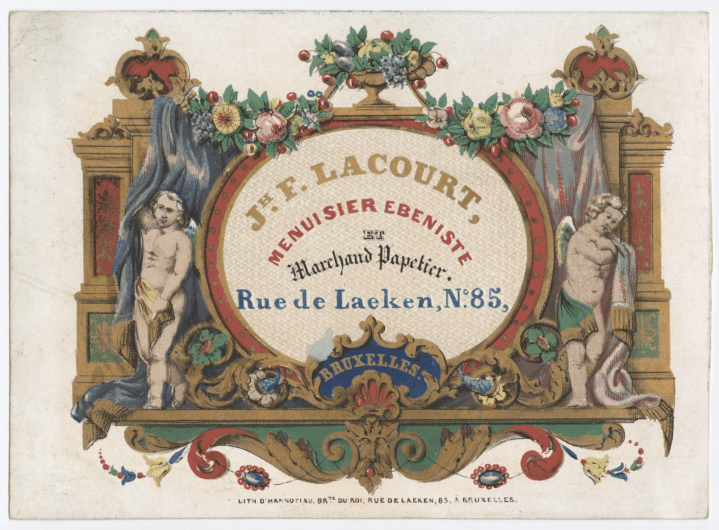
Trade Card of J. F. Lacourt (Leeds University Library, MS 2241 John Evan Bedford Library of Furniture History).
◊ ◊ ◊ ◊ ◊
From The Furniture History Society:
‘Pattern Books, Early Trade Catalogues, and Many Other Rarities’: The John Evan Bedford Library of Furniture History
The Furniture History Society Online Lecture, Wednesday, 24 March 2021, 18.00 (GMT)
Members of the Bedford project team from Special Collections at the University of Leeds will highlight some of the rare books and ephemera in the John Evan Bedford Library of Furniture History and explain more about the ambitions of the cataloguing project. Chaired by Mark Westgarth, the presentations will be followed by a discussion with the Bedford team and an opportunity to ask questions about the project.
When the art and antique dealer John Bedford died in February 2019 he gifted a remarkable collection of rare books, manuscripts, artworks, and objects to the University of Leeds. Assembled over almost half a century, the John Evan Bedford Library of Furniture History is an exceptional resource covering all aspects of the English home, from interiors and furnishings to lighting and metalwork, drapery and upholstery to architectural and garden design. Comprising over 3,000 printed items, many of them extremely rare, and in some cases unique, the collection includes furniture pattern books, designs for ornament, and inventories of country houses. The books, which also touch on household life and management, date from the seventeenth century onwards. The archive is also rich in rare ephemera including trade cards, labels, and pamphlets, many of which are unknown outside this collection. The John Victor Bedford Will Trust, with great generosity and vision, is funding a cataloguing project based in Special Collections at the University of Leeds to make the collection fully searchable and accessible.
This event is free for FHS members and £5 for non-members. If you are a non-member and would like to attend, please click here. Contact events@furniturehistorysociety.org to register interest.
Mark Westgarth is Associate Professor in Art History and Museum Studies at the University of Leeds and also Director of the Centre for the Study of the Art & Antiques Market. He has been instrumental in developing antique dealer collections at Leeds; Mark is a Council Member of the FHS.
Rhiannon Lawrence-Francis, Collections and Engagement Manager, has operational oversight of the project to catalogue the John Evan Bedford Library of Furniture History. She visited John at his Guernsey home a few weeks before he died, and planned and managed the transfer of his collection to Leeds. A medievalist by background she is responsible for the rare book collections in the University Library and has a special interest in incunabula, early modern printing, provenance, and bookbindings.
Rachel Eckersley, Rare Book Specialist, is responsible for cataloguing the pre-1851 books, researching provenance, and promoting the collection. Previously, she was a postdoctoral researcher at The Centre for the Comparative History of Print (also at Leeds), a library digitisation assistant at the Wren Library, Trinity College, Cambridge, and a research fellow in book history at Queen Mary University of London.
Rosie Dyson, Collections Officer, is currently researching trade cards and ephemera. She is undertaking work to catalogue, digitise, and repackage John’s collection of trade cards and associated ephemera and has written several articles on her findings so far. Her background is in photography and digitisation.

Illustration from Jean-Baptiste Pillement, The Ladies Amusement: Or, the Whole Art of Japanning Made Easy, second enlarged edition, ca. 1762 (Leeds University Library, MS 2241 John Evan Bedford Library of Furniture History). This is the only known complete and coloured copy.
Online | Art Museums and the Legacies of the Dutch Slave Trade
Presented by the Center for Netherlandish Art at the Museum of Fine Arts, Boston, the Harvard Art Museums, and Harvard University’s Department of History of Art and Architecture:
Art Museums and the Legacies of the Dutch Slave Trade: Curating Histories, Envisioning Futures
Online conference in four parts: 9–23 April 2021
Organized by Sarah Mallory, Kéla Jackson, and Rachel Burke, together with Joanna Sheers Seidenstein
Registration is now open for the conference Art Museums and the Legacies of the Dutch Slave Trade: Curating Histories, Envisioning Futures, presented by the Center for Netherlandish Art at the Museum of Fine Arts, Boston, the Harvard Art Museums, and Harvard University’s Department of History of Art and Architecture. This four-partprogram explores efforts by art museums to deploy their spaces and their collections—which are often enmeshed with colonialism and exploitation—to present more complete narratives of and perspectives on slavery and its legacies. This conference is organized by Sarah Mallory, Kéla Jackson, and Rachel Burke, all doctoral students in Harvard University’s Department of History of Art and Architecture, and Joanna Sheers Seidenstein, the Stanley H. Durwood Foundation Curatorial Fellow in the Division of European and American Art, at the Harvard Art Museums. We hope you will attend!
◊ ◊ ◊ ◊ ◊
Part 1 | Exhibiting Slavery and Representing Black Lives
Friday, 9 April 2021, 1–3pm EST
Curators will discuss their work on groundbreaking projects in the Netherlands and the United States, namely the Rijksmuseum’s current Slavery exhibition, the Rembrandthuis Museum’s exhibition Here: Black in Rembrandt’s Time, the Los Angeles County Museum of Art’s reinstallation of its permanent collection, and the Museums Are Not Neutral initiative. They will reflect on the broader call for museums to recognize the relationship of their collections to slavery and to present-day racial injustice. Speakers include Maria Holtrop (Curator of History, Rijksmuseum), Stephanie Archangel (Junior Curator, History Department, Rijksmuseum), Diva Zumaya (Assistant Curator, European Painting and Sculpture, Los Angeles County Museum of Art), and La Tanya S. Autry (cultural organizer, co-producer of Museums Are Not Neutral, founder of the Black Liberation Center, and independent curator).
For more information and to register, please click here»
◊ ◊ ◊ ◊ ◊
Part 2 | De-centering/Re-centering: Forging New Museological and Historical Narratives
Friday, 16 April 2021, 1–3 pm EST
This session brings together historians and art historians whose work has, on the one hand, been grounded in art museum collections and, on the other, challenged traditional museological narratives of slavery’s legacies in the Netherlands and the Americas. Speakers include Vincent Brown (Charles Warren Professor of American History, Professor of African and African American Studies, and Founding Director of the History Design Studio, Harvard University), Pepijn Brandon (Assistant Professor of Economic and Social History, Vrije Universiteit Amsterdam, and Senior Researcher, International Institute of Social History), Elmer Kolfin (Assistant Professor, University of Amsterdam), and Claudia Swan (Mark Steinberg Weil Professor of Art History & Archaeology, Washington University in St. Louis).
For more information and to register, please click here»
◊ ◊ ◊ ◊ ◊
Part 3 | History, Memory, and Legacy: Jamaica Kincaid, Rosana Paulino, and Cheryl Finley in Conversation
Friday, 23 April 2021, 11am–noon EST
Renowned writer Jamaica Kincaid and groundbreaking visual artist Rosana Paulino will discuss their explorations of the legacies of slavery in their work. They will be joined in conversation by eminent art historian Cheryl Finley.
For more information and to register, please click here»
◊ ◊ ◊ ◊ ◊
Part 4 | The Work of Objects: Interpretation within and beyond Museum Walls
Friday, 23 April 2021, 1– 2:30pm EST
This session includes brief talks, followed by a roundtable discussion, by academics and museum professionals who focus on Dutch and American art and history. Speakers will discuss specific objects—ranging from the 17th to the 21st century—that have posed interpretive and museological challenges. They will also present new possibilities for considering the relationship between slavery’s past and present-day racial injustice. Speakers include Justin Brown (Ph.D. candidate, Department of the History of Art, Yale University), Ana Lucia Araujo (Full Professor and Associate Chair, Department of History, Howard University), Makeda Best (Richard L. Menschel Curator of Photography, Harvard Art Museums), Nancy Jouwe (Chairwoman, BAK [basis voor actuele kunst] Supervisory Board, Utrecht; co-founder, Framer Framed; and co-founder, Mapping Slavery), Imara Limon (Curator, Amsterdam Museum), Adam Tessier (Barbara and Theodore Alfond Director of Interpretation, Museum of Fine Arts, Boston), and Lea van der Vinde (Curator, Royal Picture Gallery Mauritshuis).
For more information and to register, please click here»










 Enfilade
leave a comment