Lecture | Mei Mei Rado on French Tapestries at the Qing Court
From the Bibliotheca Hertziana – Max Planck Institute for Art History:
Mei Mei Rado | From France to the Qing Court: Tapestries as Cross-Cultural Textiles
Online and in-person, Villino Stroganoff, Rome, 24 June 2025, 11am

Left: The Indian Hunter, from the second set of the Tenture des Indes, detail, 1689–90, the Manufacture royale des Gobelins, tapestry, wool and silk (Paris: Mobilier national). Right: Yu Sheng and Zhang Weibang, “Cassowary,” in Manual of Birds (Niaopu), detail, 1774, album leaf, ink and colors on silk (Beijing: Palace Museum).
Large-scale pictorial tapestries ranked among the most precious art forms in the early modern period. While their circulations and functions among European courts have been well studied, less known are their journeys to China and subsequent roles in stimulating new developments in Qing imperial arts.
The first part of this talk uncovers the history of French tapestries that entered the Qing court during the eighteenth century as diplomatic gifts and trade goods, including the first and second Tentures chinoises woven by the Beauvais Manufactory and the Tenture des Indes made by the Gobelins Manufactory. Their trajectories reconstructed from both the French and Qing sides offer a window into the complexity of global networks and contingency of cultural encounters. These tapestries’ themes, marked by idealized exoticism compressing distance and time, functioned as a kind of diplomatic lingua franca adaptable to express divergent cultural and political visions. The second part of this presentation examines how European tapestries gave rise to a new type of textile art form in the Qing imperial workshops and an innovative mode for furnishing the palace interiors. The medium’s architectonic tension and interactive visual potential enabled the Qianlong emperor to envision his own physical presence in relation to the tapestry in space and offered him new ways to reenact narratives charged with imperial significance.
The event will be available online through the Bibliotheca Hertziana’s Vimeo Channel»
Mei Mei Rado is assistant professor at Bard Graduate Center. Her research and teaching focus on the history of textiles, dress, and decorative arts in China and France from the eighteenth to the early twentieth centuries, especially on Sino-French exchanges. Previously she held curatorial and research positions at the Los Angeles County Museum of Art, the Metropolitan Museum of Art, and the Palace Museum, Beijing. She is the author of The Empire’s New Cloth: Cross-Cultural Textiles at the Qing Court (Yale University Press, 2025). Next spring she will be an invited researcher at the Institut national d’histoire de l’art in Paris, where she will work on a new project on the adaptations of baroque and rococo ornament in Qing arts.
Week-Long Courses at The Courtauld, Summer 2025

Jean-Baptiste Raguenet, A View of Paris from the Pont Neuf, 1763, oil on canvas, 46 × 84 cm
(Los Angeles: J. Paul Getty Museum, 71.PA.26)
◊ ◊ ◊ ◊ ◊
From The Courtauld, with a few of the 20 offerings noted below (there also are 5 online courses available) . . .
Summer School at The Courtauld
The Courtauld, London, June — July 2025 (each class lasts one week)
Each in-person Summer School course is full-time, and while you can take only one course per week, you are able to pursue a particular interest in a period or theme across two or more weeks. The teaching day generally lasts from 10:00 to 16:30, with registration from 9:30 on the first day. Morning or afternoon classroom sessions are complemented by object-focused study in London’s museums, galleries, printrooms, churches, and other sites. We benefit greatly from The Courtauld Gallery. It features as a teaching resource in many of our courses, and is the venue for post-graduate talks introducing aspects of our collections and for our Summer School party. The fee for all Summer School on-campus courses is £645 (each online course is £395).
◊ ◊ ◊ ◊ ◊
#6 Harvey Shepherd | Rococo to Revolution: French Art and its Geographical Contexts, 1700–1789
In-person, 23–27 June 2025
This course will examine the ever-changing roles of French art during the turbulent eighteenth century, from the later years and death of Louis XIV to the Revolution of 1789. Students will consider the role that French art played in forming identities and tastes across the world; from shaping desirable aristocratic luxury to envisaging radical futures.
French art and taste of the eighteenth century will be encountered through a series of ever-widening geographical contexts. The opening classes will examine the political and economic centres of France, looking at the Château de Versailles, as well as the artistic culture of Paris and its society during the Enlightenment and the early years of the French Revolution. Alongside the court and the capital, we will consider France’s periphery and its neighbours, examining interactions with cities like Lyon and Marseille, and both peacetime connections and wartime rivalries with European states such as Great Britain, The Netherlands, and the Holy Roman Empire. Lastly, the course considers the wider global contexts of French art as it was both collected and sent abroad, examining the colonial and imperial interactions of France in an increasingly connected world, from the court of Qing China to Senegal, India, and the Caribbean.
◊ ◊ ◊ ◊ ◊
#7 Nicola Moorby | Travelling Light: Turner, Constable, and the Shape of British Art
In-person, 23–27 June 2025
This course will explore a fascinating aspect of British art history, the parallel careers of John Constable and J.M.W. Turner. Between them, these giants of landscape painting revolutionised the status of their genre, transforming the depiction of place through empirical experience and emotive response.
However, their approaches were very different. Turner roamed throughout Britain and the Continent in search of inspirational scenery, combining observation of nature with literary and historical references. By contrast, Constable nurtured his vision at home, rooting himself in the familiar and the everyday. As well as comparing differences and similarities within their works, we shall examine the wider cultural contexts pertinent to their careers: the reproductive print market, the nineteenth-century experience of travel, and particularly the role of the Royal Academy in London, the arena where their robust professional rivalry was played out. We shall also look closely at the artists’ materials and techniques, particularly their innovations with oil paint, watercolour and their use of sketchbooks. The course culminates with a discussion of their respective artistic legacies and their changing reputations through the twentieth century and beyond.
◊ ◊ ◊ ◊ ◊
#13 Kyle Leyden | Constructing the Heart of Empire: London’s Public Architecture
In-person, 30 June – 4 July 2025 (the course is booked, but there is a waiting list)
Architecture is the art form whose presence, symbolic message and socio-political legacy cannot be avoided. The construction of great buildings is an undertaking imbued with significant symbolic and political currency which continues to have an unavoidable resonance with those who continue to interact with these spaces today.
Through an overview of key historical moments and an examination of several major architectural projects, this course will present London as a city in which architecture was consciously deployed as a potent device through which the changing essential values of, and core political vision for, the British Empire were communicated to Londoners, the wider British population and to foreign observers. It will also consider current debates about how post-imperial societies can and ought to deal with the highly contested legacies of these prominent urban spaces.
Engaging with diverse issues and concepts, the course gives students an opportunity to gain a solid understanding of the social and artistic history of London and its critical role as a stage for the theatre of Empire. It features visits to major public buildings and royal palaces and includes spaces that are otherwise inaccessible to the general public including the Royal Apartments of the Palace of Westminster, and the spectacular interiors of the Foreign, Commonwealth and Development Office.
◊ ◊ ◊ ◊ ◊
#17 Giulia Martina Weston | Beyond Artemisia: Italian Women Artists in the Long 17th Century
In-person, 7–11 July 2025
Over the last decade a conspicuous number of monographic exhibitions has been devoted to Italian women artists of the early modern period, paving the way for notable scholarly findings, chief rediscoveries and newly emerged research avenues. Focusing on the careers and production of a selected group of artists, this course will unveil the most significant discoveries gathered so far, aiming to engage its attendees in a rich exchange on the roles played by these extraordinary women in their society as well as consider what lesson can be drawn today from their experiences.
Ranging from the pioneering examples set by Sofonisba Anguissola and Lavinia Fontana to the versatile output of Artemisia Gentileschi and Giovanna Garzoni, our enquiry will look at specific geographical areas (such as the Bologna of Elisabetta Sirani and Ginevra Cantofoli) and consider a wealth of artistic media, from minute artworks on parchment to Plautilla Bricci’s grand architectural designs. Visits to the National Gallery and The Courtauld Print Room will allow us to gain first-hand knowledge of this exquisite group of artists, and to consider their legacy in dialogue with the predominant art-historical canon.
◊ ◊ ◊ ◊ ◊
#23 Sheila McTighe | Re-Imagining the Everyday: Genre Paintings and Prints in 16th- to 18th-Century Europe
In-person, 14–18 July 2025
The secular subject matter we now call ‘genre’ imagery grew steadily in popularity through the early modern period across Europe. From depictions of peasants at work or play to the erotic intrigues of the aristocracy, genre imagery explores the full range of human behaviours, sometimes imagined, and sometimes rooted firmly in real life. We shall investigate this subject matter and the artistic practices of naturalism or realism with which it was often allied in works by artists like Pieter Bruegel the Elder, Sofonisba Anguissola, Caravaggio, Jacques Callot, Diego Velazquez, Georges de La Tour, Judith Leyster, Rembrandt, Johannes Vermeer, Antoine Watteau, and Jean-Siméon Chardin.
In contemporary writings about art, genre painting was often decried as unworthy of an ambitious artist. However, primary sources show that such art was highly sought after, whether by elite patrons commissioning paintings or by ‘middling’ people buying images made for the marketplace. Printed images were a constant source of new subjects drawn from modern life, while prints reproducing paintings further expanded the range of genre art and reached a wide audience. Among other, we shall discuss what the functions of everyday imagery might have been for such a diverse body of people. Classroom sessions will be complemented by visits to London’s rich collections of paintings and prints.
Conference | Publics of the First Public Museums: Visual Sources
From ArtHist.net:
Publics of the First Public Museums, 18th and 19th Centuries: Visual Sources
Online and in-person, Museo Nacional del Prado, Madrid, 5–6 June 2025
Organized by Carla Mazzarelli and David García Cueto
The conference Publics of the First Public Museums, 18th and 19th Centuries: Visual Sources is an integral part of the research project Visibility Reclaimed: Experiencing Rome’s First Public Museums (1733–1870), An Analysis of Public Audiences in a Transnational Perspective (FNS 100016_212922) directed by Carla Mazzarelli. Marking the third of three encounters (following I. Institutional Sources and II. Literary Discourses), this workshop delves into the examination of visual sources, vital to understanding the forms of representation of early museums and their publics. We intend to investigate a vast range of visual sources, from views of internal and external spaces to architectural and display projects, from caricatures to illustrations published in catalogues, guidebooks, voyages pittoresques up to the (self)representation of publics, museum staff (directors, custodians, ciceroni), and artists within the museum.
Visual sources have long represented a privileged source for investigating the origins of the first public museums and the impact on their publics. However, in the light of recent studies aimed at deepening the material history of the museum and the encounter of the public with the institutions, these sources deserve a closer scrutiny in both methodological and critical terms. As museums sought to define and engage their publics, visual sources often became both a mirror and a mould; they reflect and shape institutional and societal perceptions, contributing to build up the idea of museum but also to give a depiction of practices of access to public and private collections in Europe and in the World. The Museo Nacional del Prado welcomes this initiative as it has been involved since its foundation in 1819 in the process that the conference analyzes. The well known paintings that represent the spaces of Museo Nacional del Prado, since its opening, such as those of Fernando Brambilla, are an important starting and comparison point for the theme at the center of the conference discussion. On the other hand, paintings depicting ‘quadrerie’ have been a codified genre at least since the 17th century. Such artworks have also been read as sources for the study of the evolution of the display during the early modern age, but they also represent reference models for artists on how to represent the interiors of museum spaces, their publics and staff.
Direction
Carla Mazzarelli (Università della Svizzera italiana, Accademia di Architettura, Istituto di storia e teoria dell’arte e dell’architettura)
David García Cueto (Madrid, Museo Nacional del Prado)
It is possible to attend the sessions until all seats are filled or to follow the congress on line through the link to the Zoom platform that will be provided for all those enrolled. When enrolling you must choose a type of attendance.
Contact
visibilityreclaimed@gmail.com
congreso.visibily@museodelprado.es
t h u r s d a y , 5 j u n e
10.15 Registration
10.45 Welcoming Remarks — Alfonso Palacio (Director Adjunto de Conservación e Investigación del Museo del Prado)
11.00 Session 1 | Museums and Audiences in Image: Frameworks and Methodologies
Chair: David García Cueto (Museo Nacional del Prado)
• Carla Mazzarelli (Università della Svizzera italiana) — Alle origini del pubblico “esposto”. Proposte di lettura e confronto delle fonti visive
• Daniela Mondini (Università della Svizzera italiana) — Visiting Sacred Spaces as ‘Museums’
• Luise Reitstätter (Universität Wien) — Museums Ego Documents as Visual Source: Imaging First Publics within Founding Missions
• Javier Arnaldo Alcubilla (Museo Nacional del Prado) — La bohemia en el Prado: entre fuentes visuales y literarias
12.45 Keynote Address
• Sebastian Schütze (Universität Wien) — Going Public: The Gallery Picture and its Agencies
13.30 Lunch Break
14.45 Panel 2 | Mirroring Museums: The Public in Photographic Archives and Digital Atlases
Chair: Daniela Mondini (Università della Svizzera italiana)
• Beatriz Sánchez Torija (Museo Nacional del Prado) — El Museo del Prado y el uso de la fotografía como enlace con el público en la segunda mitad del siglo XIX
• Irina Emelianova (Università della Svizzera italiana) — European Art Museums and Their Audiences through the Photographic Collection of the Academy of Fine Arts in St. Petersburg: Between the End of the 19th Century and the Beginning of the 20th Century
• Paola D’Alconzo (Università degli studi di Napoli Federico II), Donata Levi (Università degli studi di Udine), Martina Lerda (Università di Pisa) — Dall’Atlante digitale dei musei italiani (DAIM): Immagini del pubblico, immagini per il pubblico
16.15 Coffee Break
16.30 Panel 3 | Museums in Sight: Visual Records of Visit and Display
Chair: Christoph Frank (Università della Svizzera italiana)
• Barbara Lasic (Sotheby’s Institute of Art) — Visualising Museal Trajectories at the Garde-Meuble de la Couronne
• Luca Piccoli (Università della Svizzera italiana) — ‘The colours of them so chosen to carry the eye forward’: alle origini dell’esperienza di visita del Museo Pio Clementino tra rappresentazione e realtà (1770–1796)
• Julia Faiers (Independent Scholar) — Experiencing Medieval Art at Toulouse’s First Public Museums
17.50 Break
18.00 Keynote Address
Andrew McClellan (Tufts University) — Towards a Machine for Looking: Science, Psychology, and Visitor Experience at the Museum of Fine Arts, Boston, 1900
f r i d a y , 6 j u n e
10.00 Panel 4 | Strategies of Self-Presentation: Museums between Politics and Cultural Stereotypes
Chair: Chiara Piva (Sapienza Università di Roma)
• Benjamin Carcaud (École du Louvre / Ministère de la Culture) — Quelle image du visiteur les artistes ont-ils construite dans leurs œuvres? Les stéréotypes du visiteur de musée dans les salles du Louvre
• Adrián Fernández Almoguera (Universidad Nacional de Educación a Distancia, Madrid) — ¿Imágenes como estrategia? A propósito del Musée des Antiques en la cultura visual del Louvre imperial
• Cynthia Prieur (University of Victoria, British Columbia) — Shaping the Image of the Louvre Museum: Maria Cosway’s Prints of the Exhibitions of Looted Art
11.20 Coffee Break
11.35 Panel 5 | The Critical Eye: Museums and Publics Between Promotion and Satire
Chair: Stefano Cracolici (Durham University)
• Grégoire Extermann (Université de Genève) — Un caricaturista en París: el ginebrino Wolfgang Adam Töppfer y el público del Louvre imperial
• Ludovica Scalzo (Università Roma Tre) — Il pubblico dei musei nei primi periodici illustrati europei (1830–1850)
• Gaetano Cascino (Università della Svizzera italiana) — I musei di Roma e i loro visitatori in satira nella pubblicistica dopo l’Unità
13.00 Lunch Break
14.00 Panel 6 | The Public Image of the Private Museum
Chair: Carlos G. Navarro (Museo Nacional del Prado)
• Federica Giacomini (Istituto Centrale per il Restauro, Roma) — La Galleria Borghese in un’illustrazione de ‘Le Magasin Pittoresque’: per un’indagine del pubblico nell’Ottocento
• Kamila Kludwiecz (Adam Mickiewicz University, Poznań) Aldona Tolysz (the Office of the Provincial Conservator of Monuments in Warsaw) — Between Documentation and Self-Creation: The Role of Illustration in the Activities of Polish Private Museums in the 19th Century
15.00 Panel 7 | From National to Global Image: The Identity of the Museum and Its Audiences
Chair: Giovanna Capitelli (Università Roma Tre)
• Susanne Anderson-Riedel (University of New Mexico) Caecilie Weissert (Universität Kiel) Joelle Raineau-Lehuédé (Petit Palais) — A Global Public for France’s National Museum
• Elizaveta Antashyan (Sapienza Università di Roma) — Visibility Granted: The Hermitage Museum in the 19th Century and Its Representation in Contemporary Imagery
• Raffaella Fontanarossa (Indipendent Scholar) — Le muse in Oriente. I primi visitatori dei musei in Cina e Giappone attraverso le fonti visive
• Jonatan Jair López Muñoz (Univesidad Complutense de Madrid) — La imagen omnipresente. La representación regia en los museos nacionales del siglo XIX en España e Italia
16.45 Coffee Break
17.00 Panel 8 | A Museum for All? The Variety of Audiences on Display
Chair: Daniel Crespo Delgado (Universidad Complutense de Madrid)
• Gemma Cobo (Universidad Nacional de Educación a Distancia, Madrid) — La mirada de la infancia: Nuevos museos y educación artística en la Europa de entresiglos, 1750–1850
• Anna Frasca-Rath (Friedrich-Alexander University) — Through the Eye of a Child? Visual Sources of/for Museum Publics in 19th-Century Vienna
• Marie Barras (Université de Genève) — See and Be Seen: Museums and Art Exhibitions as Fashion Stages, 1870–1900
18.20 Concluding Remarks by Carla Mazzarelli
Symposium | Opus Architectonicum
From ArtHist.net:
Opus Architectonicum: A Symposium Honoring Joseph Connors
Online and in-person, Notre Dame Rome, Roma, 12 May 2025
Organized by Silvia Dall’Olio and Susan Klaiber
This international symposium marks the eightieth birthday of the distinguished architectural historian Joseph Connors and his retirement from active teaching. Currently the Michael C. Duda Visiting Professor at the University of Notre Dame School of Architecture, Connors has shaped the study of Baroque art, architecture, and urbanism—particularly of Borromini and the city of Rome—as a scholar, teacher, and mentor for half a century. In his role as a visionary institutional leader, Connors has fostered innovative work in early modern Italian studies, the wider humanities, and the visual and performing arts.
The symposium gathers European colleagues and former students to celebrate this cherished friend. Presentations will explore issues in the history of art and architecture, their methodologies, and historiography, all using Joe’s personal ‘Opus Architectonicum’ as a point of departure. Attendance is free, but registration required at this link. The symposium will also be live streamed; those interested in following the symposium online should register at the same link on the symposium webpage, checking the box for the video link rather than in-person attendance.
p r o g r a m
9.00 Welcome — Silvia Dall’Olio (Director, Notre Dame Rome), David Mayernik (Notre Dame Architecture), and Susan Klaiber (co-organizer)
9.20 Session 1 | Celebrating Joseph Connors
Chair: Susan Klaiber (independent, Switzerland)
• Ingrid D. Rowland (University of Notre Dame) — Laudatio
• Barbara Jatta (Musei Vaticani) — Lievin Cruyl and the Rome of Alexander VII
10.30 Coffee
11.00 Session 2 | The Rome of Borromini
Chair: Sabina de Cavi (Universidade Nova, Lisboa)
• Augusto Roca De Amicis (Università di Roma La Sapienza) —Rivedendo i Santi Luca e Martina: Architettura come sintassi
• Alberto Bianco (Archivio della Congregazione dell’Oratorio di San Filippo Neri) — Virgilio Spada: Il progetto della Casa dei Filippini e l’identità oratoriana
• Fabio Barry (Warburg Institute) — St. Teresa in Ecstasy: Sacred or Profane Love?
12.45 Lunch break
14.00 Session 3 | Encounters with Joe and Borromini
Chair: Heather Hyde Minor (University of Notre Dame)
• Helen Hills (University of York) — Meeting Joe, via video
• Susan Klaiber (independent, Switzerland) — Borromini and Guarini: Master and Pupil?
• Sabina de Cavi (Universidade Nova, Lisboa) — ‘Borrominismi’ a Lisbona: Osservazioni preliminari sull’impatto dell’Opus Architectonicum in Portogallo
15.45 Break
16.15 Session 4 | Oltre Borromini
Chair: Fabio Barry (Warburg Institute)
• Elisabeth Kieven (Bibliotheca Hertziana) — About a Drawing by Carlo Marchionni: Delight and Despair
• Heather Hyde Minor (University of Notre Dame) — Piranesi’s Imaginary Prisons
• Susanna Pasquali (Università di Roma La Sapienza) — Qualche domanda intorno a un caffè preso nel bar nel Cortile della Biblioteca, Palazzo del Belvedere Vaticano
18.00 Reception
Conference | Sculpture between Britain and Italy, 1728–1854
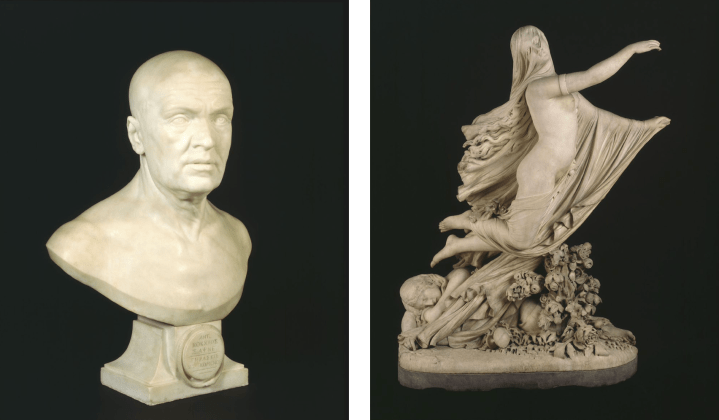
Left: Joseph Wilton, Dr Antonio Cocchi, 1755 (London: V&A: A.9‐1966). Right: Raffaele Monti, The Sleep of Sorrow and the Dream of Joy, 1861 (London: V&A: A.3-1964).
◊ ◊ ◊ ◊ ◊
From the conference programme:
Academy, Market, Industry
Sculptural Models, Themes, and Genres between Britain and Italy, 1728–1854
Online and in-person, Victoria and Albert Museum, London, 16–17 May 2025
Organized by Adriano Aymonino, Kira d’Alburquerque, Albertina Ciani Sciolla, and Andrea Bacchi
This two‐day interdisciplinary conference, organised by the University of Buckingham, the Victoria and Albert Museum, and the Fondazione Federico Zeri, investigates the role played by British‐Italian artistic exchanges in shaping sculptural models, themes, and genres between the eighteenth and nineteenth centuries. The conference adopts a longue durée approach, focusing on the century when these exchanges were most intense: from 1728, when the anglicised Flemish sculptors Laurent Delvaux and Peter Scheemakers travelled to Italy “to form and improve their studies,” to the 1854 opening of the Crystal Palace in Sydenham, whose sculptural decoration was directed by the Milanese Raffaele Monti. Throughout this period, the two traditions became interdependent, developing an artistic dialogue that influenced sculptural models, themes, and genres not only in Italy and Britain but also across Europe and the territories of the expanding British Empire, from the Indian subcontinent to the Americas.
This conference adopts a typological approach, analysing how academic frameworks and patronage networks influenced the diffusion of sculptural models, themes, and genres, and how market dynamics—along with the industrial production of new materials—either reinforced or challenged these aspects. Papers will explore the evolution of established genres such as busts, ideal sculptures, funerary and public monuments, copies and adaptations after the Antique, as well as the diffusion of models and themes in decorative figurative sculpture, including reliefs, medallions, chimneypieces, and in smaller artworks such as gems, cameos, impressions, ivories, or in objects produced in porcelain, earthenware, and various new artificial ‘stones’. While concentrating on sculpture, the conference embraces an interdisciplinary approach to evaluate how the development of new models, themes, and genres reflected or shaped cultural and national identities, social values, evolving canons, and shifting audiences in the different contexts of Italy and the Anglophone world. Recent years have witnessed a surge in monographic publications and PhD dissertations by art historians, social historians, and scholars focused on material culture, examining individual artists and themes connected to this trans‐national movement. This conference aims to assess the current state of research and explore future directions in the discipline.
The conference is part of a series of events organised to celebrate the launch of a new edition of Francis Haskell and Nicholas Penny’s Taste and the Antique in December 2024. A further conference focused on the “Future of the Antique” will take place at the Warburg Institute and Institute of Classical Studies on 10–12 December 2025 (see the call for papers here).
Registration for online attendance is available here»
Registration for in-person attendance is available here»
f r i d a y , 1 6 m a y
10.00 Registration
10.30 Welcome and Introduction — Adriano Aymonino, Kira d’Alburquerque, and Albertina Ciani Sciolla
10.45 Session 1 | New Approaches to Old Genres and Themes
Moderator: Andrea Bacchi (Fondazione Federico Zeri‐Università di Bologna)
• Italy, By Way of Flanders: John Michael Rysbrack and Peter Scheemakers the Younger in England, ca. 1720–1750 — Emily Hirsch (Brown University)
• The Impact of British Collecting on Italian Artistic Trends: The Case of Filippo della Valle (1698–1768) — Camilla Parisi (Università Roma Tre)
• Antonio Cocchi and Joseph Wilton: The Charm of Antiquity and the ‘True Catholic Air’ — Mattia Ciani (Università degli Studi di Siena)
• ‘The insolence of this puppy!’: Evidence for the Complexities of Commissioning Models between England and Rome in the Mid-Eighteenth Century — Susan Jenkins (Westminster Abbey)
• Christopher Hewetson and the Evolution of the Portrait Bust in Late Eighteenth‐Century Rome — Matteo Maggiolo (Independent Scholar)
13.15 Lunch
14.45 Session 2 | Models, Themes, Genres, and Media Transfer
Moderator: Malcolm Baker (University of California, Riverside)
• Media Transfers and Transnational Exchange in Edme Bouchardon’s Roman Portraits, 1727–1732 — Karl Brose (University of Virginia)
• Giles Hussey and the Revival of Gem Engraving in Georgian Britain — Dominic Bate (Brown University)
• Antiquity in Dialogue: Eleanor Coade’s Artificial Stone and Global Exchanges — Miriam Al Jamil (Independent Scholar)
• Flaxman Models and Wedgwood Design Process — Catrin Jones (V&A Wedgwood Collection)
16.55 Session 3 | Book Presentations
• Introducing the New Edition of Francis Haskell and Nicholas Penny, Taste and the Antique (Brepols/Harvey Miller, 3 vols, December 2024) — Adriano Aymonino
• Introducing the European Sculpture in the Collection of His Majesty The King (Modern Art Press and Royal Collection Trust, 4 vols, Autumn 2025) — Jonathan Marsden
17.15 Closing Remarks
s a t u r d a y , 1 7 m a y
10.00 Registration
10.30 Welcome and Introduction — Adriano Aymonino, Kira d’Alburquerque, and Albertina Ciani Sciolla
10.45 Session 4 | New Genres, New Subjects
Moderator: Anne‐Lise Desmas (The J. Paul Getty Museum)
• Cockerell’s ‘Progetto’ and the Transformation of the Sculpted Pediment — Max Bryant (Minneapolis Institute of Art)
• Outside Mythology: Religious and Historical Themes in Anglo‐Roman Sculpture (Late Eighteenth to Early Nineteenth Century) — Tiziano Casola (Independent Scholar)
• The Wounded Ideal: New Iconographies in Roman Sculpture around 1848 — Anna Frasca‐Rath (Universität Wien)
• Between Art and Industry: Raffaele Monti’s ‘Veiled Women’ — Albertina Ciani Sciolla (University of Buckingham)
13.00 Lunch
14.30 Session 5 | Patronage, Industry, and the Dissemination of Renaissance and Modern Models
Moderator: Alison Yarrington (Loughborough University)
• The British Glory of Thorvaldsen and His School — Alessio Costarelli (Università degli Studi di Messina)
• The Sutherlands’ Patronage and Copies of ‘Renaissance’ Statues in Britain: from Florence to Trentham Hall and Sydenham — Giuseppe Rizzo (Gallerie degli Uffizi)
• Exhibiting Italian Neo‐Renaissance Sculpture in Great Britain: The Commissions of the 3rd Marquess of Londonderry to Lorenzo Bartolini — Francesco Zagnoni (Università di Bologna)
• Genoese Casts from ‘Professor Varny’: Sculptural Exchanges between Genoa and England through the Work of Santo Varni — Matteo Salomone (Università degli Studi di Roma Tor Vergata)
16.30 Closing Remarks — Nicholas Penny (former Director, National Gallery, London)
Online Talk | Karen Jensen on Cataloging Rare Maps
From the registration page:
Karen Jensen | An Introduction to Cataloging Rare Maps
Online, 30 April 2025, 3pm (Eastern Time)
The Bibliographic Standards Committee (BSC) of the ACRL Rare Books and Manuscripts Section (RBMS) invites you to the webinar, “An Introduction to Cataloging Rare Maps.” The session will introduce rare map cataloging with the original RDA Toolkit; it will include discussion of DCRM(C)—Descriptive Cataloging of Rare Materials (Cartographic)— highlighting the distinctive aspects of cataloging pre-twentieth century maps. The aim is to assist those who rarely work with maps. Participants will become familiar with searching for cataloging records in WorldCat and selecting the best record for the map in hand. They will be able to decide when a new record is justified and be able to add an original cataloging record. The webinar will also briefly review map subject analysis and Library of Congress call numbers.
Karen Jensen is Head of Cataloguing and Collection Maintenance at Concordia University Library in Montreal.
Representing nearly 8,500 individuals and libraries, the Association of College and Research Libraries (ACRL), the largest division of the American Library Association, develops programs, products, and services to help those working in academic and research libraries learn, innovate, and lead within the academic community. Founded in 1940, ACRL is committed to advancing learning, transforming scholarship, and creating diverse and inclusive communities.
Online Talk | Michael Ohajuru on the Black Presence in European Art

◊ ◊ ◊ ◊ ◊
This evening from YCBA:
Michael Ohajuru | From Subjects of Capital to Makers of Culture
The Black Presence in Western European Art
Online and in-person, Norma Lytton Lecture, Yale Center for British Art, 10 April 2025, 5.30pm (ET)
Michael Ohajuru explores how Black figures, once positioned as exotic, subservient, or symbolic, have moved toward the center of artistic representation—sometimes through shifts in artistic intention, sometimes through reinterpretation by contemporary audiences. Through this lens, Ohajuru questions historical silences and considers how the Black presence in art speaks to the evolving relationship between Black and white identities in the Western world.
Join the livestream here»
Michael Ohajuru is a Fellow of the Royal Society of Arts and a Senior Research Fellow of the Institute of Commonwealth Studies. He blogs, writes, and speaks regularly on identifying, understanding, and interpreting the Black African presence in Renaissance art. He is founder of the Image of the Black in London Galleries, a series of gallery tours that highlight the overt and covert Black presences to be found in the national art collections of London. Ohajuru is the project director of the John Blanke Project, a contemporary art and archive project celebrating John Blanke, the Black trumpeter to the Tudor courts of Henry VII and Henry VIII. He is also a founding member of the Black Presence in British Portraiture network, managing their podcast The BP2 Podcast.
Generous support for this program has been provided by the Norma Lytton Fund for Docent Education, established in memory of Norma Lytton by her family. Lytton was an active docent at the YCBA for more than twenty years and subsequently spent a decade engaged in research for the museum’s Department of Paintings and Sculpture.
Banner images from left to right (all details): Francis Harwood, Bust of a Man, ca. 1758, black limestone on a yellow marble socle (Yale Center for British Art, Paul Mellon Collection); Sir Joshua Reynolds, Charles Stanhope, Third Earl of Harrington and Marcus Richard Fitzroy Thomas, 1782, oil on canvas (Yale Center for British Art, Paul Mellon Collection); Joanna Mary Wells (née Boyce), Fanny Eaton (née Antwistle or Entwistle), 1861, oil on paper laid to linen (Yale Center for British Art, Paul Mellon Fund); and Kehinde Wiley, Portrait of Lynette Yiadom-Boakye, Jacob Morland of Capplethwaite, detail, 2017, oil on canvas (Yale University Art Gallery and Yale Center for British Art, purchased with a gift from Mary and Sean Kelly in honor of Courtney J. Martin and with the Janet and Simeon Braguin Fund and Friends of British Art Fund. © Kehinde Wiley. Courtesy of Sean Kelly, New York).
Call for Papers | Material Culture Pre-1850 Workshop, Lifecycles
From the announcement:
Lifecycles | Material Culture Pre-1850 Workshop, University of Cambridge
Hybrid format, alternate Monday evenings, Easter Term 2025
Proposals due by 28 April 2025
 The Material Culture pre-1850 Workshop at the University of Cambridge invites submissions for 20-minute papers. Our theme for Easter term is Lifecycles, which we frame as encompassing the ways in which objects endure their afterlives; the manners in which they are transferred, rarefied, treasured, rearranged, commodified, used up, mended and destroyed. Papers may wish to respond to this concept particularly in terms of object biography.
The workshop is a forum for researchers at all career stages to discuss the material culture of the medieval period, early modernity, and the long eighteenth century. We welcome submissions from all disciplines. The workshop will meet in a hybrid format on alternate Monday evenings from 5 to 7pm GMT.
Submissions must include a title, abstract (250 words), and brief academic bio, to be sent to Sophia Feist (stcf2@cam.ac.uk) and Tomas Brown (tbnb2@cam.ac.uk) by 28 April 2025. Submissions with potentially distressing content should include a warning, excluded from the word count.
Symposium | Balkan and Aegean Artistic Identities in the 18th Century

◊ ◊ ◊ ◊ ◊
From ArtHist.net and the conference programme:
Balkan and Aegean Artistic Identities in the 18th Century: Between East and West
Online and in-person, Athens, 8–9 April 2025
Organized by Maria Georgopoulou and Alper Metin
This symposium aims to shed light on the intricate artistic and cultural identities that flourished in the eighteenth-century Ottoman Balkans and Aegean, regions positioned at the confluence of ‘Eastern’ and ‘Western’ historiographical conventions. The event encourages scholars to engage in a comprehensive examination of artistic production, architectural development, and socio-political dynamics during this transformative period.
Central to the symposium is the reassessment of the historiographical terms post-Byzantine art and Ottoman Baroque. Are these designations still relevant? If post-Byzantine art predominantly refers to religious works, how should we classify secular creations, such as the richly decorated interiors of Balkan and Anatolian mansions? How authentically Baroque was the so-called Ottoman Baroque, and does this term effectively convey the unique synthesis embodied in Ottoman architecture? Furthermore, how should we approach the non-Baroque elements within this period—features rooted in Byzantine, Western medieval, and Renaissance traditions—that complicate the conventional understanding of the Ottoman Baroque? The aim is to explore how these varied influences merged into hybrid forms that challenge conventional categorization.
The symposium will address the following themes:
1 The impact of political and cultural rivalries between the Ottomans and Venice in the Aegean and the Habsburgs in the Balkans, which not only redefined power structures but also shaped cross-cultural artistic and architectural identities. The manifestation of these rivalries in the built environment and material culture, such as building that bear testimony to shifts of power, conflict, and transformation.
2 The rich network of technical expertise of itinerant artists, architects, master builders, naval builders and artisans that fostered the exchange of knowledge and artistry. The fusion of local traditions in crafts (woodcarving, silverwork, textiles etc.) in areas such as Mount Athos and the Peloponnese. The influential interactions between the Archipelago and the coastal cities of mainland Greece and Anatolia, including Constantinople/Istanbul.
3 The interactions between Catholic, Orthodox, and Muslim communities in centers such as Crete, Chios, Constantinople/Istanbul, and Smyrna/Izmir, that shaped and transformed urban and architectural spaces.
4 The role of Orthodox merchants, whose economic influence and cultural mediation bridged the Ottoman Empire and Western Europe, fostering significant cross-cultural exchanges.
5 The mediation of Greek communities between the Venetian and Ottoman realms. The dual status of Greeks, as subjects of Venice and the Porte, in shaping of the artistic and architectural heritage they cultivated, with its broader implications for the region’s cultural fabric.
t u e s d a y , 8 a p r i l
16.00 Registration and coffee
16.15 Introduction — Maria Georgopoulou (Director of the Gennadius Library) and Alper Metin (University of Bologna and 2024–25 Cotsen Traveling Fellow at the Gennadius Library)
16.30 Session 1 | Mapping Architectural Connections
• Nikos Magouliotis (Institute for the History and Theory of Architecture, ETH Zurich) — The Printed Page and the Painted Column: An Architectural Microhistory of a Church in Ottoman Thessaly, ca. 1800
• Alper Metin (Department of the Arts, University of Bologna) — Warming Up to Change: Heating Appliances in the Gradual Transformation of Eighteenth-Century Ottoman Interiors
• Deniz Türker (Department of Art History, Rutgers University) — ‘Carvers of Chios’: Imperial Patrons, Ottoman Greek Kalfas, and Nimble Building in the Eighteenth Century
18.00 Coffee break
18.15 Session 2 | Domestic Spaces: History and Conservation
• Theocharis Tsampouras (Ephorate of Antiquities of Kozani, Hellenic Ministry of Culture) — The Political Character of Eighteenth-Century Christian Orthodox Art in the Ottoman Balkans
• Amalia Gkimourtzina (Ephorate of Antiquities of Kastoria, Hellenic Ministry of Culture) — The Secular Decoration in the Eighteenth-Century Mansions of Western Macedonia: The Example of the Conservation Works Carried Out in Tsiatsiapa Mansion in Kastoria
• Omniya Abdel Barr (Victoria and Albert Museum, London) — Eighteenth-Century Painted Ceilings in Cairo: Bayt al-Razzaz in the Context of Ottoman Architectural Networks
20.00 Reception
w e d n e s d a y , 9 a p r i l
9.30 Session 3 | ‘Post-Byzantine’ Sculpture, Textiles, Material Culture
• Anna Ballian (Benaki Museum, Athens) — From Art of the Empire to Art in the Empire: The Case of Ottoman and ‘Post-Byzantine’ Art
• Nikolaos Vryzidis (School of Applied Arts and Culture, University of West Attica) — Networks of Pluriversality: Trade, Diasporas, and ‘Baroque’ Textile Culture in Ottoman Greece
• Dimitrios Liakos (Ephorate of Antiquities of Chalkidike and Mount Athos, Hellenic Ministry of Culture) — Observations on Eighteenth-Century Sculpture in Mainland Greece: The Cases of Thessaly and Mount Athos
11.15 Coffee break
11.30 Sessions 4 | Relations with Antiquity
• Elizabeth Key Fowden (Faculty of Classics, University of Cambridge) — Pharos, Tower, Temple and Tent: Visualizing the Horologion in Eighteenth-Century Athens
• Paolo Girardelli (Department of History, Boğaziçi University) — A ‘Rotunda’ on the Aegean Shores: The Franciscan Church of Santa Maria in Bornova, 1797–1831
Symposium | Turner Today

J.M.W. Turner, Inverary Pier, Loch Fyne: Morning, detail, ca. 1845, oil on canvas
(New Haven: Yale Center for British Art, Paul Mellon Collection)
◊ ◊ ◊ ◊ ◊
Upcoming at YCBA:
Turner Today
Online and in-person, Yale Center for British Art, New Haven, 9 May 2025
The dramatic landscapes of J. M. W. Turner continue to enthrall audiences across the globe, more than two centuries after the artist’s birth. Organized in conjunction with the Yale Center for British Art’s exhibition J. M. W. Turner: Romance and Reality, this symposium invites scholars and curators from Canada, the United States, and the United Kingdom to explore the multiple ways that Turner’s oeuvre speaks to our present moment, from its relationship to contemporary visual art to its role in framing conversations about climate change and resource extraction. What exciting and new possibilities exist for interpreting and sharing Turner’s work in 2025?
The symposium is free and open to the public. It will be held in the Lecture Hall at the Yale Center for British Art and will be livestreamed. Registration is recommended but not required for this event.
s c h e d u l e
10.15 Welcome and opening remarks by Martina Droth (Paul Mellon Director, YCBA)
10.30 Panel One | Transatlantic Turner: Reputation and Reception
Moderator: Tim Barringer (Paul Mellon Professor of the History of Art, Yale University)
Turner established a significant reputation in North America in his lifetime and still draws considerable attention from American museums. This panel brings together curators from the Frick Collection, J. Paul Getty Museum, and Metropolitan Museum of Art to explore Turner’s transatlantic appeal in the past and present. How has Turner been introduced to, and understood by, American audiences? What factors cemented Turner’s reputation in the United States and how does his storied reputation affect the way we present and represent his work today?
• Julian Brooks (Senior Curator and Head of the Department of Drawings, J. Paul Getty Museum)
• Alison Hokanson (Curator, Metropolitan Museum of Art)
• Aimee Ng (John Updike Curator, Frick Collection)
11.30 Break
11.45 Panel Two | Turner’s Atmospheric Topography
Chair: Lucinda Lax (Curator of Paintings and Sculpture, YCBA)
How are Turner’s paintings being reinterpreted amid current ecological crises? This panel situates Turner’s interest in particular locations, and the specifics of place, within the broader sociopolitical and environmental context of industrialization and natural resource extraction. Curators based in the United States and United Kingdom will discuss how exhibitions of Turner’s work can address contemporary environmental issues and consider how museums can put contemporary works with environmental themes in dialogue with Turner’s paintings.
• John Chu (Senior Curator of Pictures and Sculpture / Senior Curator for Midlands, National Trust)
• Lizzie Jacklin (Keeper of Art, Tyne and Wear Archives and Museums)
• Jennifer Tonkovich (Eugene and Clare Thaw Curator of Drawings and Prints, Morgan Library and Museum)
12.45 Lunch
2.00 Panel Three | Turner, Tradition, and Modern Painting
Chair: Martin Myrone (Head of Research Support and Pathways, Paul Mellon Centre for Studies in British Art, and Convenor, British Art Network)
This panel considers a paradox: Turner is often portrayed as a harbinger of late nineteenth- and early twentieth-century Impressionism and abstraction, yet he made constant and overt reference in his art to major artists of the past. How is Turner being embraced and interpreted as an artist who both self-consciously worked within a longstanding tradition and broke radically with traditional painting practices? How are curators engaging with Turner’s elusive relationship to modernity and tradition? What is Turner’s relevance to contemporary artistic practice?
• Amy Concannon (Manton Senior Curator of Historic British Art, Tate)
• Anni Pullagura (Margaret and Terry Stent Associate Curator of American Art, High Museum of Art)
• Nicholas Bell (President and CEO, Glenbow)
3.00 Closing Remarks and Reflections on J. M. W. Turner: Romance and Reality
• Lucinda Lax (Curator of Paintings and Sculpture, YCBA)
• Tim Barringer (Paul Mellon Professor of the History of Art, Yale University)










 Enfilade
leave a comment