Exhibition | Keeping Time: Clocks by Boulle

Attributed to André-Charles Boulle, movement by Claude Martinot, Mantel clock with Father Time (detail), ca. 1726
(London: The Wallace Collection)
◊ ◊ ◊ ◊ ◊
From the press release for the exhibition (and note the study day on January 31) . . .
Keeping Time: Clocks by Boulle
The Wallace Collection, London, 27 November 2024 — 2 March 2025
Curated by Alexander Collins
For the first time, the Wallace Collection has brought together its clocks by André-Charles Boulle (1642–1732), one of history’s greatest designers and cabinetmakers, in a display that explores the art and science of timekeeping. Five exceptional timepieces tell the story of how Boulle took advantage of scientific discoveries to create unique clock designs, whose influence spread throughout the world and across the centuries.
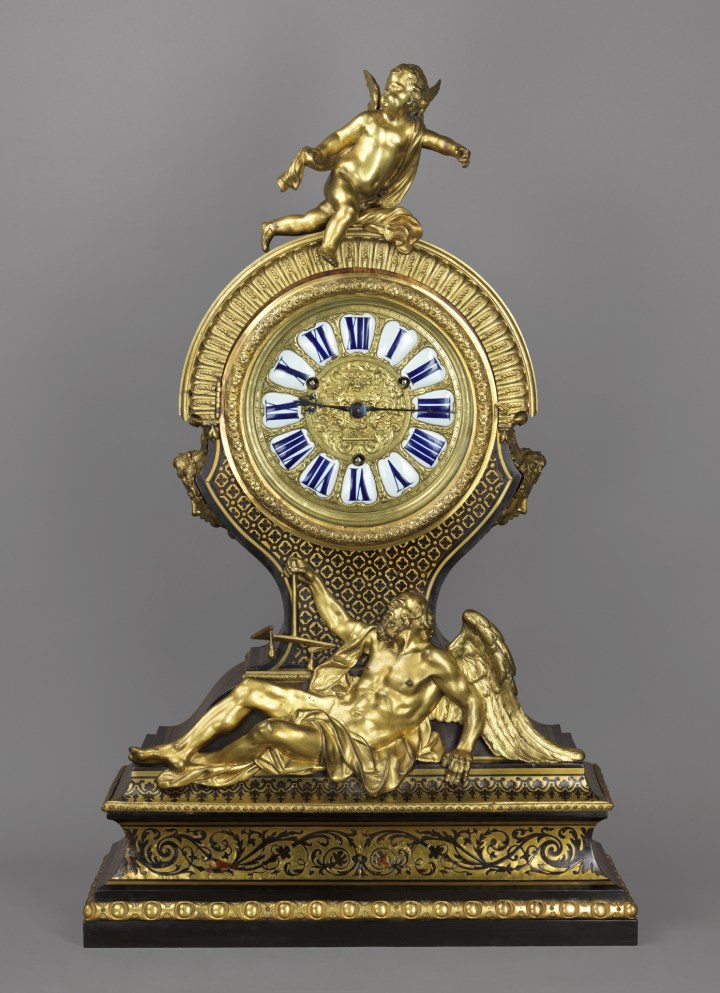
Attributed to André-Charles Boulle, movement by Claude Martinot, Mantel clock with Father Time, ca. 1726 (The Wallace Collection).
As the most famous cabinetmaker working for the court of the Sun King, Louis XIV (1638–1715), Boulle would eventually give his name to the specific style that signified the glittering spectacle of the Baroque—elaborate veneer designs incorporating turtleshell, brass, and other materials. Alongside his work as a royal furniture maker, Boulle also turned his attention to the clock, the accuracy of which had recently been revolutionised through the invention of the pendulum by Dutch scientist Christiaan Huygens (1629–1695) in 1656. As these sweeping weights called for larger clock cases, Boulle saw the opportunity to create bold and sumptuous designs.
Due to his position at court, Boulle was exempted from strict guild regulations, allowing him to work with great creative freedom. This artistic liberty was incredibly important, as the clocks not only had to demonstrate the wealth of their owners through the most luxurious materials available, but also had to show how intellectual they were. Therefore, Boulle infused his designs with narratives that chimed with scientific knowledge. Time and the natural laws of the universe are personified, for example Father Time as a bearded old man, and the Continents as figures from across the world. As well as creating innovative iconography, Boulle also reflected on the history of timekeeping by incorporating motifs such as gothic hourglasses in his clock cases.
The clocks are also products of collaboration involving the multi-disciplinary efforts of artists and craftspeople from all over 18th-century Paris. Each clock has a mechanism by a different leading clockmaker from Boulle’s time: Pierre Gaudron (died 1745), Jean Jolly (active about 1698), Claude Martinot (active about 1718), Louis Mynuël (1675–1742) and Jacques-Augustin Thuret (1669–1739). Some of these were Boulle’s neighbours in the workshops of the Louvre, as well as François Girardon (1628–1715), the king’s official sculptor, who supplied mounts of Father Time for Boulle’s clocks.
The clocks on display show the wide range of objects that Boulle turned his hand to. A monumental wardrobe from 1715 that encloses a clock, crowned with cherubs; two mantel clocks, one from around 1715 featuring Venus and Cupid, and another, from a decade later, with the figure of Father Time; as well as two extraordinary pedestal clocks.
The display opens ahead of an international conference on Boulle, to be held at the Wallace Collection in early 2025. One of the first major research events on the cabinetmaker in recent years, it will bring together specialists and conservators to consider the work of this fascinating artist, all within the same building where some of his greatest artistic achievements can be found.
Many of Boulle’s contemporaries also drew on the concept of time in their work. This will be explored in a complementary display in the museum’s Billiard Room, which is uniting two magnificent artworks: The Dance to the Music of Time (about 1634–36) by Nicolas Poussin (1594–1665), in which the Four Seasons dance to the song of Father Time, the composition of their rhythmic bodies echoing the workings of a clock movement; and The Borghese Dancers (1597–1656), where five female figures masquerade as the Hours, attendants to the goddesses of the Dawn and Moon.
Xavier Bray, Director of The Wallace Collection, says: “I am absolutely thrilled to be bringing great works of art by Boulle together for the first time. These clocks were at the cutting edge of 18th-century technology, combining exquisite artistry and mechanical expertise into a unique and innovative blend. Through Boulle’s clocks and the display, we hope visitors will be able to transport themselves into the world of Louis XIV, where luxury touched every element of the court, including something as essential and practical as timekeeping.”
Alexander Collins, Curatorial Assistant at the Wallace Collection and curator of the display, says: “Our research on these objects has revealed many unknown facets of their history, including bringing to life the multitude of artists and craftspeople who came together to make Boulle’s vision into a reality. The passage of time as a metaphor for life and death has been an important theme for artists since humanity discovered their creativity, and Boulle’s designs are important, and resonate with us today, because of this deep symbolism.”
◊ ◊ ◊ ◊ ◊
Boulle Study Day
Online and in-person, Friday, 31 January 2025
Delve into the world of baroque France and learn more about Boulle’s furniture with leading specialists, including curators and conservators from the Palace of Versailles, the Château de Chantilly, and C2RMF. You’ll explore the evolution of Boulle’s iconic designs, his materials and techniques, and his enduring legacy. This in-person event at the Wallace Collection will also be broadcast live on Zoom. Ticketholders will receive a link to a recording of the event, which will be available for two weeks. Full programme to follow: 10.00–17.00 GMT, with a drinks reception until 19.00.
Registration is available here»
Online Talk | Vanessa Sigalas on Meissen Figures
As noted at Events in the Field:
Vanessa Sigalas | All Walks of Life: Meissen Porcelain Figures of the 18th Century
Online, Connecticut Ceramics Circle, 9 December 2024, 2pm (EST)
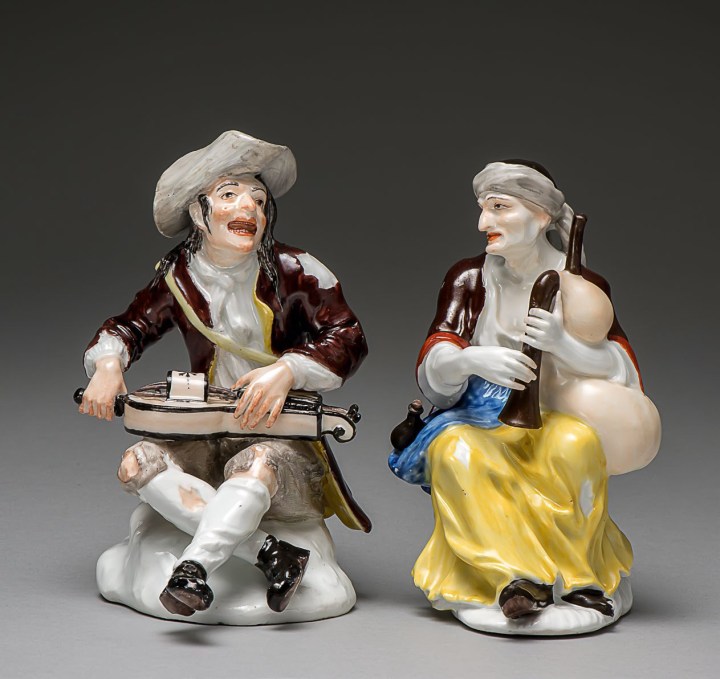
Pair of Figures of Beggar Musicians, German, Meissen Porcelain Manufactory, models by Johann Joachim Kaendler (1706–1775). Original year of modelling: ca. 1736; beggar-woman reworked later. Date of porcelain paste: both ca. 1730–65; date of decoration: both 18th century. Hard-paste porcelain. Man: Blue crossed swords mark on base; woman: no marks. Heights: man 13.4 cm; woman 13 cm. Model no. man: 918; woman: 915. Shimmerman Collection nos. MPBP_16 & 17.
Dr. Vanessa Sigalas will guide the audience through a captivating exploration of 18th-century life in Saxony, Paris, London, and St. Petersburg, using Meissen porcelain sculptures from the Alan Shimmerman Collection in Toronto, Canada, as well as the Wadsworth Atheneum’s collection in Hartford, Connecticut. Renowned master modeler Johann Joachim Kaendler, in collaboration with his fellow modelers at Meissen, portrayed glimpses of daily existence, meticulously capturing even the minutest details. From the carefully arranged trinkets of a street vendor to the intimate script of a love letter and the culinary tools of a cook preparing a hare, Kaendler’s work unveils the richness of ‘All Walks of Life’.
The Alan Shimmerman Collection, with its emphasis on groups of criers (street sellers) and artisans, offers a fresh perspective on the inception, production, and dissemination of Meissen porcelain. Dr. Sigalas’s lecture is based on her recently published collection catalogue bearing the same title, providing an immersive journey into the intricate world of 18th-century European society as depicted through these masterfully crafted sculptures.
Vanessa Sigalas holds a Dr. phil. in Art History from the Eberhard-Karls-Universität Tübingen, Germany. She joined the Wadsworth Atheneum in 2011, As an art historian, Sigalas specializes in European art from the 17th to the first half of the 20th centuries, especially 18th- and 19th-century German porcelain. One of her research interests is the connection between ivory and porcelain, particularly at the Dresden Court of Augustus the Strong (1670–1733). At the Wadsworth, she works with American and European decorative arts and sculpture from the ancient to the modern worlds, but also explores the collections of non-Western art. Despite her deep love for books and archives, Sigalas has always enjoyed the hands-on work with objects. In 2013, she assisted with the Storage Renovation and Relocation Project, and in 2015 she was part of the team to reinstall the European art collections, where she assisted the curatorial team and led the installation team of decorative arts.
She has published in a variety of journals, exhibition catalogues, and books. Her latest book, All Walks of Life: A Journey with the Alan Shimmerman Collection (2022), focuses on Meissen porcelain figures from the 18th century. She has taken on the role of editor for several publications, with her most recent work being Morgan—The Collector: Essays in Honor of Linda Roth’s 40th Anniversary at the Wadsworth Atheneum Museum of Art, co-edited with Jennifer Tonkovich. Additionally, she served as the managing editor of the American Ceramic Circle Journal from 2015 to 2023. Sigalas has curated exhibitions in Germany and the US. Her most recent exhibitions at the Wadsworth include, in conjunction with director Matthew Hargraves, Between Life & Death: Art and the Afterlife (Fall 2023), as well as the community-focused and staff-curated exhibition, Styling Identities: Hair’s Tangled Histories, which was on view until August 2024.
Online Talks | Pets and Portraiture / Art and the Portuguese Court
The final seminar of the series takes place on Wednesday:
Luba Kozak and Diogo Lemos | Pets, Portraiture, and Identity
Online, Material and Visual Culture Research Cluster, Edinburgh, 4 December 2024
 Each week we hear from two speakers, sharing their research on, and approaches to, the study of seventeenth- and eighteenth-century material and visual culture. We aim to make a space in which these rich histories can be explored from varied disciplines to enhance our research practices. We meet on Wednesdays, 5–6pm GMT, online using Zoom; registration closes 1 hour before seminar start time.
Luba Kozak | Pet Animals as Connectors: Exploring the Role of Pet Animals in Shaping British Identity and Colonial Encounters in 18th-Century British Portraiture
This paper explores the role of pet animals in shaping British identity and colonial encounters as portrayed in eighteenth-century British portraiture. Through an analysis of John Eccardt’s Portrait of Lady Grace Carteret, Countess of Dysart with a Child, Black Servant, Cockatoo, and Spaniel (1740) and Johann Zoffany’s Colonel Blair and his Family with an Indian Ayah (1786) as case studies, I investigate how pet animals reveal power structures and hierarchies within the domestic sphere, exposing deeper tropes of colonisation and race (Braddock; Bocquillon). Ultimately, I propose that pet animals act as critical contact points between the British aristocracy and enslaved individuals in these artworks, bridging cultural, racial, and species divides.
Recognising the need to address the material presence of animals in art and their marginalisation in the field of art history, I analyse these paintings through more inclusive theoretical frameworks including ecocriticism and post-colonialism. Building on the scholarship of Ingrid Tague and Erin Parker, who discuss the domestication of animals within British households, I examine how these animals negotiated status and place within elite homes as depicted in visual culture. This approach repositions non-human figures as active subjects rather than pictorial accessories. Adopting an interdisciplinary perspective, this paper is at the intersection of art history, animal studies, philosophy, and ethics. Amidst growing concern for animal ethics and the Anthropocene, this timely research offers a broader understanding of the complexities of human-animal relations, relevant in historical and contemporary.
Luba Kozak is a third-year Ph.D. student at the University of Regina, Saskatchewan (Canada).
◊ ◊ ◊ ◊ ◊
Diogo Lemos | Spreading the Icon: Visual Culture and Royal Patronage under the Reign of John V, King of Portugal
During his reign (1707–1750), John V recognized the importance of emulation and identifying the most renowned masterpieces of his time. By so, he instructed his diplomats to collect copies of certain artworks from various courts. The most iconic among them served as vital iconographic sources for artworks commissioned by the king, executed by artists trained in Europe’s leading apprenticeship circuits, who later disseminated these same iconographic references in other courts. This talk aims to highlight a set of artworks produced within European courts which played a pivotal role in shaping the image of the Portuguese court.
The primary goal is to decipher the mechanisms of ‘promotion’ of these artworks; to grasp the processes and means (ex. the press but also espionage) used to transform them into true icons. Relating this context with the Portuguese court, documentation will also reveal the mechanisms—and circles of influences—used by John V to know and acquire them. Furthermore, the project seeks to intersect these artworks (primarily portraits) with the material culture of both the Portuguese and European courts in which France plays an important role. Nevertheless, rather than solely emphasizing France as the primary influencer, the intention is to accentuate the nuances and distinctiveness of the artistic and material cultures within these courts, moreover, highlighted by Portuguese court itself. In short, focusing on the iconology of the Catholic Kings, this proposal aims to unveil and decode a curated collection of artworks commissioned by King John V, providing new insights into the cultural (and political) milieu of the era and demonstrating how certain iconic masterpieces (yet often underestimated) not only reflected cultural exchanges between nations during the reign of John V but also shaped European visual culture during this period.
Diogo Lemos is a researcher at the Centre for the History of Society and Culture of the University of Coimbra, where he is developing an art history PhD project in the Faculty of Arts and Humanities for which he was awarded a fellowship by the Portuguese Foundation for Science and Technology.
Symposium | Apprentices and Networks of Learning, 1650–1950
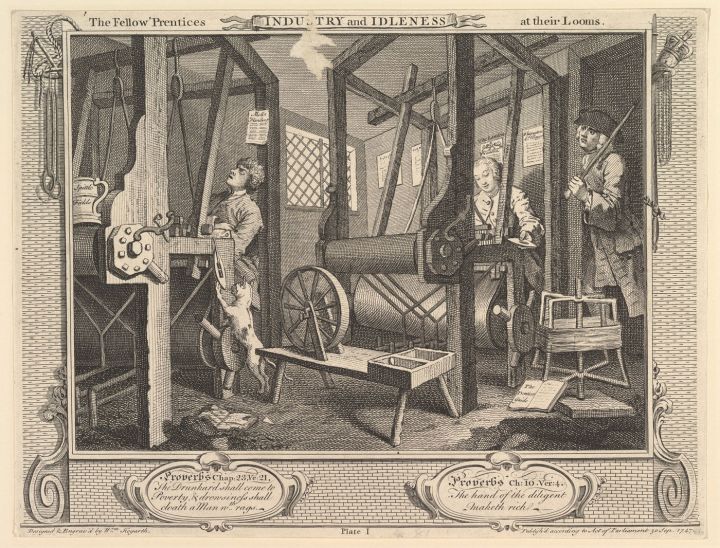
William Hogarth, Industry and Idleness, Plate I: The Fellow ‘Prentices at Their Looms, October 1747, etching and engraving
(Houston: Sarah Campbell Blaffer Foundation)
◊ ◊ ◊ ◊ ◊
This Saturday at the MFAH:
Skillful Hands: Apprentices and Networks of Learning, 1650–1950
Online and in-person, Museum of Fine Arts Houston, 9 November 2024
Established in 2014, the biennial Rienzi symposium focuses on topics inspired by the decorative arts, with papers presented by emerging scholars.
The 2024 symposium, Skillful Hands: Apprentices and Networks of Learning 1650–1950, explores the networks of learning available—and unavailable—to diverse groups of people, examining how access to training and materials through apprenticeships shaped craft traditions. Selected participants present their research on Saturday, 9 November 2024, on the MFAH main campus in Lynn Wyatt Theater, located in the Kinder Building. Entrance is included with Museum admission. The event is live streamed and can be accessed here.
Before the late 19th century, apprenticeships regulated by European craft guilds were the primary means of training in craft trades. These apprenticeships offered a valuable alternative to traditional education but often excluded women, immigrants, Indigenous and enslaved peoples, and children from low-income families. With the onset of the Industrial Revolution, informal apprenticeships emerged to adapt to new innovations and technologies. Outside traditional European models, skills were acquired through forced migration, local environments, and informal training in various colonial regions. These diverse experiences contributed to a network of skilled craftspeople, both anonymous and renowned.
p r o g r a m
11.15 Welcome — Christine Gervais (the Fredricka Crain Director, Rienzi)
11.20 Keynote
Making Time: Competition and Collaboration in Early Modern European Artisanal Networks — Lauren R. Cannady (Assistant Professor of Humanities, University of Houston–Clear Lake)
12:05 Session 1
• Tactile Nomenclature: Transgenerational Transmission of Silk Weaving Knowledge in Early Modern Iran —
Nader Sayadi (Visiting Assistant Professor, University of Rochester)
• Es Artisanes Du Roi: The Public Prohibition and Private Protection of Women’s Artisanal Knowledge in the Paris of Louis XIV, 1661–1715 — Jordan Hallmark (PhD student, Harvard University)
1.00 Lunch break
1.40 Session 2
• The Racial Afterlife of Revolutionary Goldsmithing and Absent Apprenticeships from Haiti to Bordeaux — Benet Ge (Williams College)
• ‘Perfect’ Imitations: Learning in The Spanish Colonial Philippines — Lalaine Little (Director, Pauly Friedman Art Gallery, Misericordia University)
2.35 Break
2.50 Session 3
• Haitian Cabinetmaking Community in New Orleans: The Apprentices of Jean Rouseau and Dutreuil Barjon — Lydia Blackmore (Decorative Arts Curator, Historic New Orleans Collection)
• Passing on Knowledge: Learning the Upholsterer’s Trade in the 19th Century — Justine Lécuyer (Sorbonne Université, Paris)
Online Lecture | Charles O’Brien and Simon Bradley on Pevsner
From the Paul Mellon Centre for Studies in British Art:
Charles O’Brien and Simon Bradley | Celebrating Pevsner: Reflections on the Completion of the Buildings of England
Online, 14 November 2024, 6.00pm (London time)
The editors of the Pevsner Architectural Guides will be in conversation, reflecting on the revision of the Buildings of England series from 1983 to 2024, lately completed with the new Staffordshire volume. Simon Bradley and Charles O’Brien will consider the development and updating of the guides over forty years, the expansion of their content and the challenges both of research and writing and of maintaining the spirit and ambition of Pevsner’s original vision for the books. They will also reflect on their own contributions as authors of the new and revised editions, spanning their time with Penguin Books and Yale University Press. The event will be chaired by Jeremy Musson.
Book tickets here»
Jeremy Musson is an architectural historian; he studied at UCL and the Warburg Institute and was an assistant curator for the National Trust and architectural editor at Country Life, 1998–2007. He is the author of a number of books on the country house, including English Country House Interiors (2011) and The Drawing Room (2014), and was co-writer and presenter of BBC2’s The Curious House Guest. A heritage consultant since 2007, Jeremy has worked on projects including Hardwick Hall and St Paul’s Cathedral. He is editor of The Victorian and teaches on the building history masters course at the University of Cambridge; a senior research fellow of the Humanities Research Institute of the University of Buckingham; and a supervisor of students at New York University (NYU) in London. He is also a trustee of the Historic Houses Foundation. He was a contributing author to the revision of the Buildings of England: Sussex West with Elizabeth Williamson, Tim Hudson, and Ian Narin.
Charles O’Brien FSA is Listing and Architectural Research Director at Historic England. Until 2022 he was joint Series Editor of the Pevsner Architectural Guides. He joined the series in 1997, where he worked full time on the research, writing, and editing of the new editions. As author and co-author he has written the revised volumes London 5: East; Bedfordshire, Huntingdonshire, and Peterborough; Hampshire: South; and Surrey. He is a former Commissioner of Historic England and former Chair of their London Advisory Committee.
Simon Bradley FSA joined the Pevsner series in 1994. His own revised volumes include London 1: The City of London; London 6: Westminster; Cambridgeshire; and Oxfordshire: Oxford and the South East. He has also published on the Gothic Revival, drawing on his PhD thesis, and on railways and railway buildings including St Pancras Station (2006), The Railways: Nation, Network, and People (2015), and Bradley’s Railway Guide: A Journey Through Two Centuries of British Railway History, 1825–2025 (2024).
Online Course | British Furniture Abroad in the 18th Century
From British and Irish Furniture Makers Online and The Furniture History Society:
British Furniture Abroad in the Eighteenth Century: Impacts and Influence
BIFMO-FHS Online Autumn Course: 12, 19, and 26 November 2024

Side chair, attributed to Benjamin Randolph, possibly carved by Hercules Courtenay, ca. 1769 (New York: The Metropolitan Museum of Art, 1974.325).
Join us online on three consecutive Tuesdays this November, when curators and historians will explore the influence of British furniture abroad and the ways furniture makers in other countries both copied and transformed these models to suit local traditions and tastes. This series of specialist lectures will look at the diaspora of British furniture in the eighteenth century, providing insights into the traditions of design and furniture making in other countries. Each session will deal with a slightly different stylistic phase in the eighteenth century with three expert speakers dealing with the impact of British furniture design on different countries.
Tickets may be purchased for individual sessions or for the entire course, but you will benefit from a discount if all three sessions are bought together. Don’t worry if you cannot attend the sessions live because they will be recorded and links to the recording will be sent to ticketholders. These recordings will not be available to purchase after the course has ended. FHS members and ECD members will receive a discount on all tickets. For further information and to purchase tickets, please go to the Eventbrite listing. If you have any questions, please email bifmo@furniturehistorysociety.org.
Times each week: 5.30–8pm (GMT) / 12.30–3pm (EST)
Week 1 | Tuesday, 12 November
British Furniture Abroad in the Early Eighteenth Century
• Amy Lim — Daniel Marot and the Influence of His Design
• Henriette Graf — Furniture Design in Germany, 1700–1760
• Alyce Englund — The Influence of Chippendale’s Designs in the Americas
Week 2 | Tuesday, 19 November
British Furniture in Germany, Portugal, and Spain
• Wolfram Koeppe — Abraham and David Roentgen: The Chippendale Connection
• João Magalhães — Portugal and English Furniture
• Mario Mateos Martín — English Influences in Spain: The Royal Collections as a Case Study
Week 3 | Tuesday, 26 November
The Influence of British Furniture in Germany and Italy
• Enrico Colle — British Models for Italian Craftsmen during the Eighteenth Century
• Ulrich Leben — Molitor and English Design
• Daniel Ackermann — Title forthcoming
Conference | The Expert’s Eye
From the conference website and programme:
El ojo experto: Método, límites y la disciplina de la Historia del Arte
The Expert’s Eye: Method, Limitations, and the Practice of Art History
Online and in-person, Museo Arqueológico Nacional, Madrid, 24–25 October 2024
Organized by Pilar Diez del Corral Corredoira and David Ojeda Nogales
 The work of the art historian revolves around the art object, and the need to tailor one’s methodology to that object gives the discipline its variety and richness. Yet paradoxically, to stress that art works are the centre of art history feels almost transgressive at a time when basic questions of identification and dating are increasingly deemphasized in training new generations of scholars and curators.
The new art history, by contrast, has shown itself perfectly capable of conducting research without having to study or even look at the art object. Without discrediting the results, which are sometimes more characteristic of departments of history or anthropology, the ease with which art-historical fact is blurred can be surprising. Over the last fifty years, the notable decrease in studies that examine the most fundamental problems of dating and authorship has raised questions about the usefulness of prevailing methodologies, leading to extreme cases in which a trained or expert eye is considered unnecessary, or at least insufficient, to deal with objects lacking documentary or other external proof of origin, creator, or date. By contrast, having an educated eye implies knowing the difference between a Roman bust from the first century AD and a modern copy, between discovering the hand of Leonardo and detecting an excellent falsification. In light of these trends, this conference aims to interrogate and challenge the abandonment of visual, material, and historical expertise among art historians.
Watch online here»
Technical coordination
• Marta I. Sánchez Vasco, misanchezvasco@gmail.com
Scientific coordination
• Pilar Diez del Corral Corredoira, diezdelcorral@geo.uned.es
• David Ojeda Nogales, dojeda@geo.uned.es
Scientific committee
• Amaya Alzaga Ruiz (UNED)
• Jeffrey Collins (Bard Graduate Center, Nueva York)
• Ana Diéguez Rodríguez (Instituto Moll)
• Pilar Diez del Corral Corredoira (UNED)
• David Ojeda Nogales (UNED)
• Markus Trunk (Universität Trier)
j u e v e s , 2 4 o c t u b r e
10.00 Presentación institucional a cargo de Isabel Izquierdo Peraile, directora del Museo Arqueológico Nacional
10.30 Conferencia plenaria
• Jeffrey Collins (BGC, NY) — Experts, Eyes, and Expert Eyes: A View from the Decorative Arts
11.30 Pausa café
11.50 Bloque 1
Modera P. Diez del Corral
• Hans R. Goette (DAI) — Remarks on Excavation Context and Epigraphy Serving Stylistic Analysis by Experts in Classical Archaeology: The ›Esquiline Sculptures‹ ‒ ca. 200 or 400 AD?
• Matteo Cadario (UNIUD) — I rischi dei giudizi ‘stilistici’ nello studio della scultura antica
• David Ojeda (UNED) — La desaparición del ‘ojo experto’: El problema del tiempo en el estudio de la escultura antigua
13.30 Pausa comida
15.00 Bloque 2
Modera Jeffrey Collins
• Benjamin Binstock (Independiente) — Less is More: Recognizing Young Rembrandt’s Painting-by-Painting Development
• Miguel Hermoso (UCM) — Truco o trato: Ojo crítico y pintura de la Edad Moderna
• Pilar Diez del Corral Corredoira (UNED) — Aprendices, copistas y falsarios: El dibujo de Carlo Maratta y sus seguidores
16.15 Pausa café
16.30 Bloque 3
Modera Ana Diéguez
• Beatriz Campderá Gutiérrez (MAN) — El ojo experto en las colecciones medievales
• Eduardo Lamas e Isabelle Lecocq (KIK-IRPA) — Inventory at the Service of the Expert Eye
• Sacha Zdanov (ULB) — Interrogating Erwin Panofsky’s Artistic Relativity: Methodological Reflections on the Aesthetic Diversity of Netherlandish Pictorial Production around 1500
• Rafael Villa (UNIGE) — Connoisseurship and French Stained Glass: On the Abandonment of a Method
v i e r n e s , 2 5 o c t u b r e
9.30 Conferencia plenaria
• Carmen Marcos Alonso (subdirectora del MAN) — Protección y enriquecimiento del Patrimonio Cultural: La labor de los museos en la expertización de bienes culturales
10.15 Bloque 4
Modera Amaya Alzaga
• José Luis Guijarro (Universidad Nebrija) — El ‘silencio de los expertos’: Consideraciones en torno a las responsabilidades legales del historiador del arte en el ejercicio de su labor
• Isabel Menéndez (UNED) — Historiadores y peritos en la valoración de la obra de arte
• Adolfo Gandarillas (UPO) — La Inteligencia Artificial y las tecnologías avanzadas aplicadas al patrimonio artístico: Herramientas y recursos del nuevo connoisseur
11.30 Pausa café
11.50 Mesa redonda
Online Symposium | Drawn to Blue
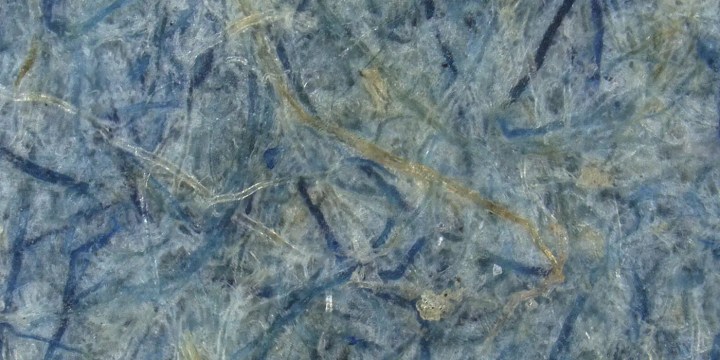
From the University of Amsterdam, as announced at ArtHist.net:
Drawn to Blue
Online, 12–13 November 2024
Organized by Edina Adam, Leila Sauvage, and Michelle Sullivan
This two-day online symposium, co-organized by the J. Paul Getty Museum and the University of Amsterdam, brings together art historians and paper and textile conservators to share their new research on the history of early modern blue paper.
Made from discarded blue rags, early modern blue paper was a humble material. However, producing it required expert knowledge, and its impact on European draftsmanship was transformative. The rich history of blue paper, from the fifteenth to the mid-eighteenth centuries, illuminates themes of transcultural interchange, international trade, and global reach. Inspired by the recent Getty exhibition Drawing on Blue: European Drawings on Blue Paper, 1400s–1700s and coinciding with the current exhibition Drawn to Blue: Artists’ Use of Blue Paper at the Courtauld, this two-day online symposium brings together art historians and paper and textile conservators to share their new research on the history of early modern blue paper.
Registration is available here»
All times listed in Pacific Time and Central European Time.
t u e s d a y , 1 2 n o v e m b e r
9.00am / 6.00pm Opening remarks by Edina Adam, Leila Sauvage, and Michelle Sullivan
9.10am / 6.10pm Artistic and Non-artistic Use of Blue Paper
• Presence of the Blue Paper inside French Paintings of the 18th Century — Lorenzo Giammattei and Selene Secondo, La Sapienza Università di Roma
• Seeds of Blue: Archival Evidence of the Use of Blue Paper as Seed Packets — Maria Zytaruk, University of Calgary
10.15am / 7.15pm Raw Materials, Trade, Economics
• Blue Paper: Its Life, Origin, History and Artistic Exploration — Judith Noorman, University of Amsterdam
• Paper, Pastels, and Patriotism: Artistic Innovation and the American Revolution — Megan Baker, University of Delaware
11.20am / 8.20pm Works in Progress: Study, Examination, Collection Surveys on Blue Paper
• Surveying The Morgan’s Blue Paper Collection — Elizabeth Gralton, Reba Fishman Snyder, and Rebecca Pollak, The Morgan Library & Museum
• The Blue Paper Project at the Art Gallery of Ontario: Developing an Architecture for Close Looking of Drawing Supports — Maia Donnelly, Joan Weir, and Tessa Thomas, Art Gallery of Ontario
• The Blue Papers of Allan Ramsay at the National Galleries Scotland — Charlotte Park, Clara de la Pena McTigue, and Charlotte Topsfield, National Gallery of Scotland
w e d n e s d a y , 1 3 n o v e m b e r
9.00am / 6.00pm Technical Case Studies
• On Blue: The Portrait Drawings of Ottavio Leoni — Georg Dietz et al., Kupferstichkabinett, Staatliche Museen zu Berlin
• Out of the Blue? Tracing Object Biographies, Early Conservation Treatments, and the Original Appearance of Italian Old Master Drawings on Blue Paper at the Kunstmuseum — Annegret Seger, Rebecca Honold, and Max Ehrengruber, Kunstmuseum Basel
• Blue Paper in Late-19th Century Paris: Mary Cassatt Pastel Supports — Tom Primeau, Philadelphia Museum of Art
10.30am / 7.30pm Printing on Blue Paper
• From Aldus to Zanetti, Parenzo to Proops, Venice to Volhynia: Three Centuries of Hebrew Printing on Blue Paper in Southern, Western, Central, and Eastern Europe — Brad Sabin Hill, George Washington University
• Blueprint(s) — Armin Kunz, C.B. Boerner Gallery
• Etched in Blue: A Unique Set of Prints by the Abbé de Saint-Non — Rachel Hapoienu, Courtauld Gallery of Art
11.55 am / 8.55pm Roundtable
Moderated by Ketty Gottardo, Courtauld Gallery of Art
Program participants reflect on new insights, questions raised, and future avenues of research.
Conference | Unfolding the Coromandel Screen
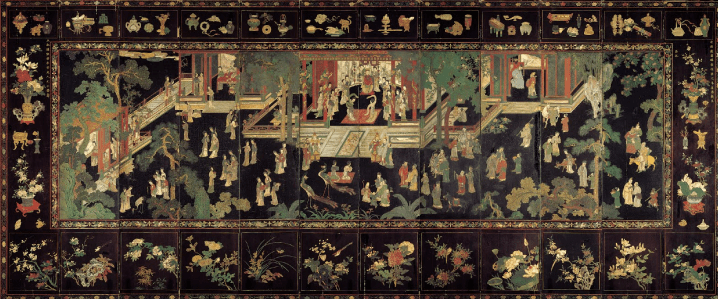
Coromandel Screen, Kangxi reign (1662–1722), Qing dynasty, carved lacquer, 258 × 52 × 3.5 cm
(Art Museum, The Chinese University of Hong Kong, 2001.0660)
◊ ◊ ◊ ◊ ◊
From the conference website and programme:
Unfolding the Coromandel Screen: Visual Mobility, Inscribed Objecthood, and Global Lives
Online and in-person, City University of Hong Kong, 22–23 November 2024
Organized by by Lianming Wang and Mei Mei Rado
During the second half of the seventeenth century, the production of Coromandel screens, also known as kuancai (‘carved polychrome’), flourished along China’s southeast coast. These screens became immensely popular both domestically and in European markets, establishing connections between regional artisans, merchants, and prominent European figures, including royalty and nobility. In the last two decades of this century, Coromandel screens emerged as one of China’s most frequently exported commodities, rivaling porcelain and challenging Japanese lacquerware exports. Their significance extends far beyond the common perception of them as merely mass-produced craftwork of inferior quality.
 With the generous support of the Bei Shan Tang Foundation, the Department of Chinese and History at City University of Hong Kong will host a two-part academic event titled Unfolding the Coromandel Screen to celebrate the department’s tenth anniversary. The conference, organized by Lianming Wang (City University of Hong Kong) in collaboration with Mei Mei Rado (Bard Graduate Center, New York), will take place on-site at City University of Hong Kong and via Zoom from 22 to 23 November 2024. It will bring together an international group of art historians, museum curators, conservators, collectors, and global historians. Participants will explore various aspects of the Coromandel screen and its intricate histories, including its interrelations with paintings, prints, decorative arts, palatial and interior designs, global maritime trade, and the fashion industry. Following the conference, the speakers will join a two-day traveling seminar from 24 to 25 November, visiting lacquer and conservation workshops as well as museum collections in Hong Kong and Guangzhou.
Registration for both onsite and online participation is available here»
Advisory Board
May Bo Ching (City University of Hong Kong), Burglind Jungmann (UCLA), Mei Mei Rado (Bard Graduate Center, New York), Anton Schweizer (Kyushu University), Ching-Fei Shih (National Taiwan University), Lianming Wang (City University of Hong Kong), Xiaodong Xu (†) (Art Museum of The Chinese University of Hong Kong)
Supporting Institutions
Art Museum of The Chinese University of Hong Kong, Indra and Harry Banga Gallery of City University of Hong Kong , Hong Kong Maritime Museum, Lee Shau Kee Library of The Hong Kong University of Science and Technology, Guangdong Provincial Museum, Guangzhou Museum, Chen Clan Ancestral Hall – Guangdong Folk Arts Museum
f r i d a y , 2 2 n o v e m b e r
8.30 Registration
9.00 Welcome and Introduction
• May Bo Ching (City University of Hong Kong), Lianming Wang (City University of Hong Kong), and Mei Mei Rado (Bard Graduate Center, New York)
9.15 Keynote
• Transcultural Treasures: Kuancai (Coromandel) Screens in China and Abroad — Jan Stuart (National Museum of Asian Art, Washington DC)
10.00 Coffee break
10.15 Panel 1 | Coromandel Screens as Sites of Power Representation
Chair: Libby Chan (Indra and Harry Banga Gallery, City University of Hong Kong)
• Place, Scale, and Medium in Several Cartographic Coromandel Screens — Stephen Whiteman (The Courtauld Institute of Art, London)
• Picture of the Immense Sea: Temporal and Spatial Transformation on the Birthday Celebration Screen of
Nan’ao (in Chinese with English subtitles) — Weiqi Guo (Guangzhou Academy of Fine Arts)
11.15 Panel 2 | Coromandel Screens and Intra-Asian Visual Entanglements
Chair: Wan Chui Ki Maggie (The Chinese University of Hong Kong)
• Coromandel Screens and Japanese Seminary Painters in Macau — Yoshie Kojima (Waseda University, Tokyo)
• When the Barbarians Came by Sea: Hunting Screens in China and Japan — Lianming Wang (City University of Hong Kong)
• Transcultural Pictorial Dynamics: Coromandel Screens and Joseon Court Painting and Visual Culture — Yoonjung Seo (Myongji University, Seoul)
12.40 Lunch break
14.00 Panel 3 | Format, Motif, and Technique: Understanding Coromandel Screens
Chair: Daisy Wang (Hong Kong Palace Museum)
• A Screen So Grand: Coromandel Screens from the Perspective of Scale — Tingting Xu (University of Rochester, New York)
• Decoding Frames: Unveiling Names, Provenance, and Connections of the Framed Images on the ‘Dutch
Tribute Screen’ in the National Museum of Denmark, Copenhagen — Xialing Liu (Central Academy of Fine Arts, Beijing / Utrecht University)
• Textiles, Taste, and Templates: Kuancai Screen Motifs and Techniques — Ricarda Brosch (Museum am Rothenbaum – World Culture and Arts, Hamburg)
• Copy Culture and Commodification in Coromandel Screens and Related Lacquerwares, 1680–1780 — Tamara Bentley (Colorado College)
15.40 Coffee Break
16.00 Panel 4 | Materials and Conservation: Perspectives from Labs and Workshops
Chair: Josh Yiu (Art Museum, The Chinese University of Hong Kong)
• On the Origins and Regional Differences of the Kuancai Screens (in Chinese with English subtitles) — Bei Chang (Southeast University, Nanjing) and Linlong Li (Centre de recherche sur les civilisations de l’Asie orientale, Paris)
• A Conservator’s Perspective: Technical Examination and Treatment Strategies for Coromandel Lacquer from the Kangxi Period — Christina Hagelskamp (The Metropolitan Museum of Art, New York)
• Scientific Analysis of a Coromandel Cabinet from the Victoria and Albert Museum, London — Julie Chang (Fu Jen Catholic University, Taipei) and Lucia Burgio (Victoria and Albert Museum, London)
18.00 Museum Visit — Might and Magnificence: Ceremonial Arms and Armour across Cultures,
Indra and Harry Banga Gallery, City University of Hong Kong
19.00 Dinner
s a t u r d a y , 2 3 n o v e m b e r
9.15 Keynote
• The Taste for Coromandel Lacquer in France in the 17th and 18th Centuries: Trade, Reception, and Customs — Stéphane Castelluccio (CNRS, Centre André Chastel, Paris)
10.00 Coffee Break
10.30 Panel 5 | Coromandel Screens as Global Artefacts
Chair: Phil Kwun-nam Chan (Art Museum, The Chinese University of Hong Kong)
• On the ‘Exoticness’ of the Coromandel Lacquerware — Ching-Ling Wang (Rijksmuseum Amsterdam)
• Coastal Landscape and Scenes of Europeans on Coromandel Folding Screens — Rui Oliveira Lopes (Museu das Convergências, Porto)
• Differences and Commonalities: Links between 17th- and 18th-Century Coromandel Export Lacquer Pieces and Luso-Asian Lacquers of the Previous Century — Ulrike Körber (IHA/FCSH//IN2PAST – Universidade Nova de Lisboa)
12.00 Lunch break
13.30 Panel 6 | Coromandel Screens and Their Global Lives, Part One
Chair: Nicole Chiang (Hong Kong Palace Museum)
• Beyond the Closet: The Taste for Coromandel Lacquerware Furniture in Holland and England, ca. 1675–1700 — Alexander Dencher (Rijksmuseum Amsterdam)
• ‘Sawed, Divided, Cut, Clift, and Split Asunder’? A Case Study of a European Chest of Drawers Decorated with Excerpts from a Coromandel Screen of Known Pictorial Model — Grace Chuang (Independent Scholar, Detroit)
• Reframing the West Lake in French Furniture and Interiors — Nicole Brugier (Ateliers Brugier, Paris)
14.30 Coffee Break
14.45 Panel 7 | Coromandel Screens and Their Global Lives, Part Two
Chair: Florian Knothe (University Museum and Art Gallery, The University of Hong Kong)
• The ‘Japanese Cabinet’ at the Hermitage in Bayreuth, Germany — Patricia Frick (Museum für Lackkunst, Münster)
• The Ludic Afterlife of Coromandel Screens: Integrating the Swinging Woman into 18th-Century French Interiors — Weixun Qu (Washington University in St. Louis)
16.00 Short Break
16.15 Panel 8 | The Afterlives of the Coromandel Screens
Chair: May Bo Ching (City University of Hong Kong)
• Art Dealer Florine Langweil and the European Market for Coromandel Screens in the Early 20th Century — Elizabeth Emery (Montclair State University, New Jersey)
• Inspiring Art Deco in Britain: The Architect, the Theatre, and the Coromandel Screen — Helen Glaister (Victoria and Albert Museum, London)
• Shifting Identities and Global Circulation of the Coromandel Screen in Early-20th-Century Buenos Aires — Mariana Zegianini (SOAS University of London)
• The Framework of Modernism: Lacquer Screen and Fashion Imagination in the 1920s — Mei Mei Rado (Bard Graduate Center, New York)
Exhibition | Colonial Crossings: The Spanish Americas

Unidentified workshop, Cuzco, Peru, Our Lady of the Rosary of Chiquinquirá with Female Donor, late 17th–early 18th century, oil and gold on canvas (Collection of Carl & Marilynn Thoma, 2013.046; photo by Jamie Stukenberg).
◊ ◊ ◊ ◊ ◊
Now on view at Cornell’s Johnson Museum of Art:
Colonial Crossings: Art, Identity, and Belief in the Spanish Americas
Johnson Museum of Art, Cornell University, Ithaca, New York, 20 July 2024 — 15 December 2024
Curated by Andrew Weislogel and Ananda Cohen-Aponte, with students in the course Colonial Connectivities: Curating the Arts of the Spanish Americas
The artworks featured in this exhibition span more than three hundred years of history, five thousand miles of territory, and two oceans, introducing the rich artistic traditions of Mexico, Venezuela, Colombia, Ecuador, Peru, Bolivia, Cuba, Puerto Rico, and the Philippines during the period of Spanish colonial rule (approximately 1492–1830).
This first exhibition of colonial Latin American art at Cornell considers the profound impact of colonization, evangelization, and the transatlantic slave trade in the visual culture of the Spanish empire, while also manifesting the creative agency and resilience of Indigenous, Black, and mixed-race artists during a tumultuous historical period bookended by conquest and revolution.
At first glance, these religious images, portraits, and luxury goods might seem to uphold colonial structures that suggest a one-way flow of power from Europe to the Americas. Yet closer consideration of these artists’ identities, materials, techniques, and subjects reveals compelling stories about the global crossings of people, commodities, and ideas in the creation of new visual languages in the Spanish Americas. These artworks testify to entangled cultural landscapes—from paintings of the Virgin Mary with ties to sacred sites of her apparition, to lacquer furniture bearing the visual stamp of trade with East Asia, they embody a plurality of cultural, material, and religious meanings.
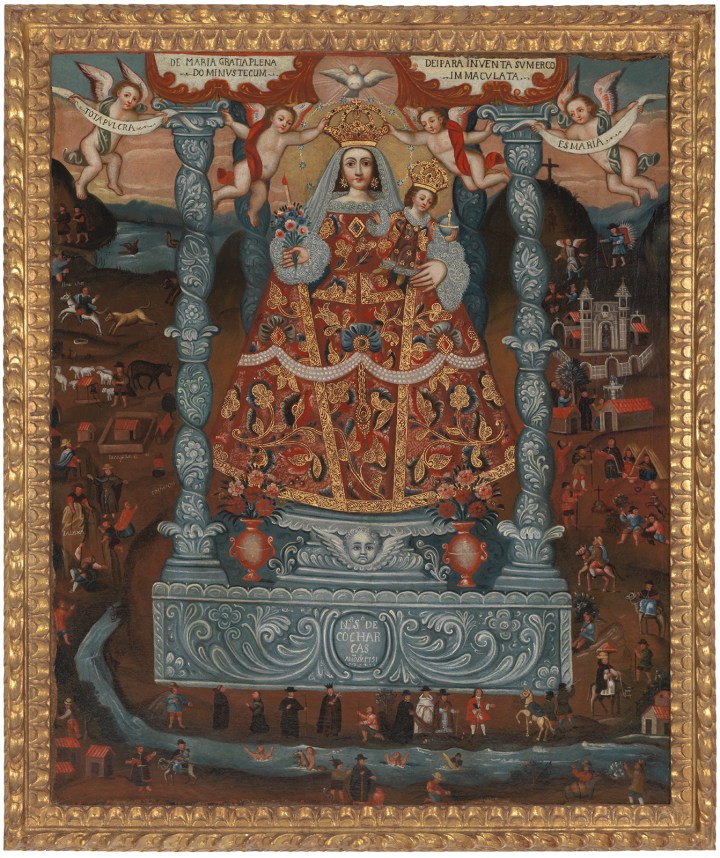
Unidentified workshop, Peru, Our Lady of Cocharcas, 1751, oiil and gold on canvas (Collection of Carl & Marilynn Thoma, 2011.040; photo by Jamie Stukenberg).
Colonial Crossings was curated by Dr. Andrew C. Weislogel, Seymour R. Askin, Jr. ’47 Curator of Earlier European and American Art at the Museum, and Dr. Ananda Cohen-Aponte, Associate Professor of the History of Art & Visual Studies, and the students in Colonial Connectivities: Curating the Arts of the Spanish Americas (ARTH 4166/6166):
Osiel Aldaba ’26
Miguel Barrera ’24
Daniel Dixon ’24
Juliana Fagua Arias, PhD student
Miche Flores, PhD student
Isa Goico ’24
Sara Handerhan ’24
Emily Hernandez ’25
Ashley Koca ’25
Maximilian Leston ’26
Maria Mendoza Blanco ’26
Lena Sow, PhD student
Nicholas Vega ’26
We are grateful to lenders Carl and Marilynn Thoma, the Denver Museum of Art, the Hispanic Society of America, and the Division of Rare and Manuscript Collections, Cornell University Library; and to David Ni ’24, the 2023 Nancy Horton Bartels ’48 Scholar for Collections, for organizational support.

Unidentified artist, Quito, Ecuador, Noah’s Ark, detail, late 18th century, oil on canvas (Collection of Carl & Marilynn Thoma, 2000.004).
◊ ◊ ◊ ◊ ◊
The Johnson Museum will also present this symposium:
Symposium | Reimagining the Américas: New Perspectives on Spanish Colonial Art
Online and in-person, Saturday, 9 November 2024
At this free symposium, presented in conjunction with the exhibition, established scholars whose work encompasses a variety of regions and approaches to colonial Latin American art history will offer new methodologies, seeking to expand the boundaries of this visual culture. Presentations will explore the exhibition’s thematic emphases on materiality and sacredness, hybridity and cross-cultural exchange, colonial constructions of race, and recovering art histories marked by silence and erasure.
• Time-Warping the Museum: Temporal Juxtapositions in Displays of Spanish Colonial Art — Lucia Abramovich, Museum of Fine Arts, Boston
• Framing Miracles for a New World: The Oval — Jennifer Baez, University of Washington
• Trent as Compass: Directions, Circuits, and Crossings of the Visual and Canonical in Spanish America — Cristina Cruz González, Oklahoma State University
• Splendor and Iridescence: Pearls in the Art of the Spanish Americas — Mónica Dominguez Torres, University of Delaware
• ‘Your Plenteous Grandeur Resides in You’: Asian Luxury in Spanish American Domestic Interiors — Juliana Fagua Arias, Cornell University
• Supplicant Africans: From Baptizands to Emblems of Abolition —Elena FitzPatrick Sifford, Muhlenberg College
• Voices of Influence: Exploring Power Dynamics in the Conservation of Musical Heritage in Colonial Latin America — Patricia García Gil, Cornell University
• Invisible Soldiers and Constant Servants: The Pre-Hispanic Roots of the Andean Cult of Angels — Maya Stanfield-Mazzi, University of Florida
A schedule will be posted soon. Please email eas8@cornell.edu to register in advance for in-person attendance. Click here to join the webinar.










 Enfilade
leave a comment