Online Talk | Brian Cowan on Extra-Illustration

◊ ◊ ◊ ◊ ◊
Today, from YCBA:
Brian Cowan | Extra-Illustration and the British Historical Imagination, ca. 1660–1850
Online, 30 April 2024, 12.30pm (Eastern Time)
Extra-illustration was a practice that developed in the later eighteenth century as a means by which collectors added imagery (most often prints, but sometimes manuscripts, objects, or original artworks) to existing books. In this talk, Brian Cowan will examine the practice of extra-illustration as a means of understanding the varieties of British historical imagination in the long eighteenth century. His project explores the relationships between political history, secret history, and biography as these genres developed over the course of the long eighteenth century in Britain.
The session is part of YCBA’s Art in Context series. Presented by faculty, staff, Student Guides, and Visiting Scholars, these talks focus on a particular work of art—often in the museum’s collections or special exhibitions—through an in-depth look at its style, subject matter, technique, or time period.
Registration is available here»
Brian Cowan is an associate professor of history at McGill University. He has published widely on early modern British and European history and is a founding member and inaugural president of the board for the international research group devoted to the history of sociability in the long eighteenth century. This group recently launched DIGIT.EN.S, an online encyclopedia of the history of sociability. Cowan’s publications include The Social Life of Coffee: The Emergence of the British Coffeehouse (2005), The State Trial of Doctor Henry Sacheverell (2012), and as a member of the twenty-two-person ‘multigraph collective’ Interacting with Print: Elements of Reading in the Era of Print Saturation (2018). His edited collection on The Cultural History of Fame in the Age of Enlightenment is forthcoming from Bloomsbury Academic, and he is currently editing (with Valerie Capdeville) The Oxford Handbook of the History of the European Enlightenment for Oxford University Press.
Image: Edward Hyde Clarendon, The History of the Rebellion and Civil Wars in England begun in the year 1641: with the precedent passages, and actions, that contributed thereunto, and the happy end, and conclusion thereof by the king’s blessed restoration and return upon the 29th of May, in the year 1660 (Oxford, 1702–04).
Lecture | Emmanuelle Chapron on Readers at the Royal Library of Paris
From the School of Advanced Study, University of London:
Emmanuelle Chapron | The Loan Registers of the 18th-Century Royal Library of Paris: A History of Readers, Books, and Institutions
Online, via Zoom, 4 June 2024, 5.30pm
The study of the loan registers of the Royal Library of Paris helps us to understand the use of the library and manuscripts in the 18th century, leading to a history of institutional trust and the library as archive.
In association with the History of Libraries seminar series. All are welcome; those wishing to attend should book a free ticket here.
Emmanuelle Chapron is Professor of Modern History at Aix-Marseille Université and Ecole pratique des hautes études, Paris. She is a specialist of the history of the book and libraries as well as history of scholarship in early modern times, in France and Italy. Among her publications are Ad utilità pubblica : politique des bibliothèques et pratiques du livre à Florence au XVIIIe siècle (Geneva, 2008) and Livres d’école et littérature de jeunesse en France au XVIIIe siècle (Liverpool, 2021). She is the curator of the digital edition of the letters and papers of Jean Jean-François Séguier (1704–1783). She is currently working in archives in libraries from the 17th century onwards.
Upcoming | Dinah Memorial Unveiling, Stenton, Philadelphia
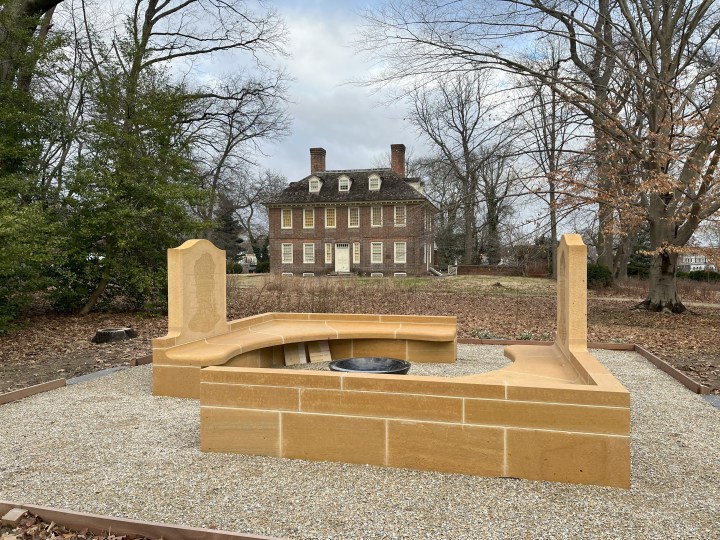
Karyn Olivier, Dinah Memorial, Stenton, Philadelphia, 2024. Nearly finished in this view, the memorial incorporates two brass plaques (one from 1912 and a new one), a small reflecting pool, and questions for both visitors and Dinah herself.
◊ ◊ ◊ ◊ ◊
I hope that Stenton’s Dinah Memorial Project garners the coverage it deserves in the coming weeks; what a compelling, important story! From the press release. . . –CH
Dinah Memorial Unveiling Celebration
Stenton Museum, Philadelphia, 20 April 2024, 2–4pm
On 20 April 2024, The Dinah Memorial, Philadelphia’s first monument dedicated to a formerly enslaved woman, will be unveiled on the grounds of Stenton, where she labored and was buried. This memorial is the physical culmination of Stenton’s Dinah Memorial Project, funded by The Pew Center for Arts & Heritage, a years-long community engagement discussion.
 Dinah’s complex life-story has been uncovered in archival sources in the Quaker Collection at Haverford College as well as in the Logan and related family papers collections at the Historical Society of Pennsylvania. Letters between family members, almanacs, ledgers, legal documents, and an investigation by the Quaker Meeting provided information that allowed Stenton staff to map Dinah’s life from her childhood in the home of Hannah Emlen, who would marry William Logan, to her death and burial in 1805. Though long celebrated for her storied role in saving Stenton from intended burning during the Revolutionary War, Stenton knew that there was more to Dinah than the ‘faithful slave’ narrative for which she was honored on a plaque erected in Stenton Park in 1912. This new memorial, a space in the Stenton landscape designed for questioning and reflection, conceived by acclaimed Philadelphia artist Karyn Olivier, seeks to rebalance Stenton’s historical interpretation, bringing to light the realities of Northern slavery and enslavement by Quakers while highlighting the fullness of Dinah’s humanity.
Executive Director Dennis Pickeral noted that “the Dinah Memorial Project has been transformative for the museum, revealing ignored and untold stories and histories of individuals who were enslaved and labored at Stenton, and for what the project has meant for the museum’s relationship with the surrounding community, who helped create the Dinah memorial and are now partners in charting Stenton’s course for the future.”
The unveiling falls on Stenton’s second annual Dinah Day celebration commemorating her requested release from bondage on 15 April 1776. Visitors can register here to attend the event.
◊ ◊ ◊ ◊ ◊
Built for James Logan, William Penn’s Secretary, between 1723 and 1730, Stenton is located in the historic Logan section of Philadelphia, at 4601 North 18th Street, four blocks east of Wayne Junction. The house is open for tours Tuesday through Saturday, from 1.00 to 4.00pm, April through December, and by appointment throughout the year. Stenton is a member of Historic Germantown, a consortium of nineteen cultural attractions and historic sites located in Northwest Philadelphia.
r e l a t e d p r o g r a m m i n g , r e c e n t a n d u p c o m i n g
Conversation with Memorial Artist Karyn Olivier and Remember My Name: Dinah’s Story Film Screening
Stenton, 2 February 2024, 6pm
The evening features Karyn Olivier, the artist who designed the Dinah Memorial, and a screening of Remember My Name: Dinah’s Story, a film written by Robert Branch and performed by Irma Gardner-Hamond and Marissa Kennedy.
Adrienne Whaley | A Glimpse into Dinah’s World: Revolutionary Black Philadelphia
Zoom, 22 February 2024, 6.30pm
Adrienne Whaley, Director of Education and Community Engagement at the Museum of the American Revolution, constructs Philadelphia through the eyes of Dinah. A recording is available here»
Laura Keim | From Archival Discoveries to Monumental Construction
Facebook Live, Historical Society of Pennsylvania, 1 March 2024, 4pm
Laura Keim has served as the Curator for Stenton since 1999. Images of archival sources for Dinah are available here. A recording of Keim’s presentation from the Historical Society of Pennsylvania is available here»
Amy Cohen | Black History in Philadelphia
Stenton, 4 April 2024, 12.30pm
After twenty years teaching social studies, Amy Cohen became Director of Education for History Making Productions and is a contributing writer for Hidden City Philadelphia. She’ll discuss her new book Black History in the Philadelphia Landscape: Deep Roots, Continuing Legacy (Temple University Press, 2024).
Online Talks | San Francisco Ceramic Circle
Upcoming talks from the San Francisco Ceramic Circle:
Membership to the San Francisco Ceramic Circle includes seven in-person and/or virtual lectures per year, a summer social, and our annual ‘Pot Night’, which occurs in September and combines an annual business meeting with a social time to share current acquisitions and ceramic information with fellow members. The membership fee for 2024/2025 is $35. For general questions, please write to sfceramiccircle@gmail.com.
The Art of German Stoneware: Meanings and Mysteries
Jack Hinton (Henry P. McIlhenny Curator of European Decorative Arts and Sculpture, Philadelphia Museum of Art)
Zoom, Sunday, 17 March 2024, 11am (PST)
All Walks of Life: Meissen Porcelain Figures of the 18th Century
Vanessa Sigalas (Associate Curator of Collections Research, Wadsworth Atheneum)
Zoom, Sunday, 14 April 2024, 11am (PST)
Lecture | Iris Moon on Stubbs and Wedgwood
Wednesday’s Research Semainar, from the Mellon Centre:
Iris Moon | A Body for Stubbs
Online and in-person, Paul Mellon Centre, London, 6 March 20224, 5.00–7.00pm
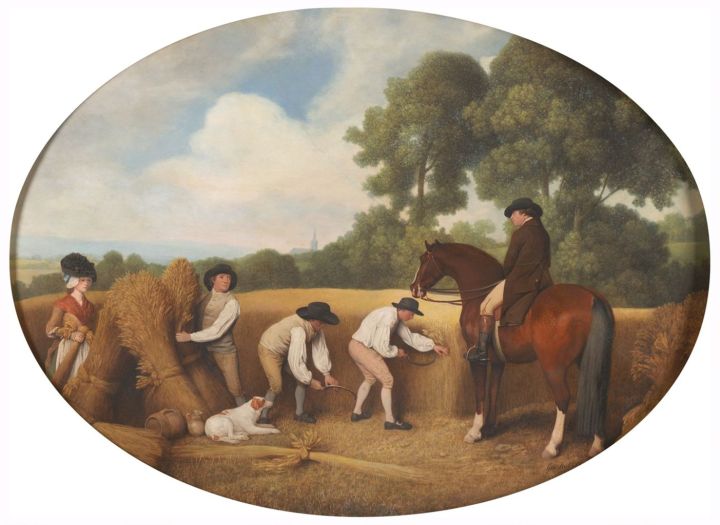
This talk focuses on the relationship between the painter George Stubbs and the potter and entrepreneur Josiah Wedgwood, and the work Reapers (1795). Alongside his commercial work making horse pictures for the landed gentry, Stubbs set out to create pictures of a more experimental nature executed on atypical surfaces, among them the oval ceramic tablets that Wedgwood created for him on demand. These were of an unusually large size, equally difficult to paint on, and fire in the kiln. Why was the horse painter drawn to the potter’s platters? Based on new material from Melancholy Wedgwood (MIT Press, 2024), this talk questions traditional readings of Wedgwood and the heritage paintings of Stubbs and, more broadly, notions of the eighteenth century as a foundational moment in Britain’s rise as a global commercial, financial, and industrial power. At the centre of this revisionist story is capitalism, empire, and exploitation. Found there too are babies, women, animals, and ceramics, among other lost figures not usually at the centre of eighteenth-century British art. Stubbs and Wedgwood take on new meanings when seen through the twisted prism of our own moment, amidst the ruins of late capitalist modernity.
Registration is available here»
Iris Moon is associate curator in the European Sculpture and Decorative Arts Department at the Metropolitan Museum of Art, where she is responsible for European ceramics and glass. At the Met, she participated in the reinstallation of the British Galleries, and she is currently planning an exhibition on Chinoiserie, women, and the porcelain imaginary that will open in 2025. She is the author of Luxury after the Terror, and co-editor with Richard Taws of Time, Media, and Visuality in Post-Revolutionary France. A new book on Wedgwood, generously supported by a publication grant from the Paul Mellon Centre, will be published next year with MIT Press. In addition to curatorial work, she teaches at Cooper Union.
Image: George Stubbs, Reapers, 1795, enamel on Wedgwood biscuit earthenware (New Haven: Yale Center for British Art, Paul Mellon Collection, B1981.25.618).
Online Workshop | European Frames, 15th–21st Centuries
From ArtHist.net:
Hubert Baija | Picture Frames in Europe, 15th–21st Centuries
Online, Beloit College Center for Collections Care, 10–24 September 2024
In a series of five online workshops Hubert Baija, an experienced frame scholar retired from the Rijksmuseum, presents the history of picture frames since the Late Middle Ages. Stylistic and technical characteristics are highlighted for distinguishing original frame manufacture from later production. This online course presents half a millennium of European picture framing by discussing the history of frame styles in connection to architecture, painting, and the decorative arts. The course will review the history of picture frames from the International Gothic style to the Italian and Northern Renaissance, via the Dutch Golden Age and the French frame styles, into 19th- and 20th-century framing. Participants will be shown tools for distinguishing styles and periods of frame manufacture. This online course serves first-time learners and professionals needing to refresh their knowledge. $500.
Tuesday, 10 September 2024
Late Medieval picture framing was influenced by architecture and illuminated manuscripts. Paintings and frames formed designed units, often emphasized by extending the pictorial space with trompe l’oeil painting on frames. The interplays between Gothic and Renaissance influences resulted in gradual transitions of frame shapes and profiles until the Iconoclasms finally ended the medieval frame styles.
Thursday, 12 September 2024
Italian art and architecture led to European frame designs during the 16th and 17th centuries. Renaissance frame profiles evolved in the Lowlands and eventually became more refined by embellishing with highly polished ebony, fruitwood, and even whalebone veneers, sometimes combined with Southern German ripple molding techniques.
Tuesday, 17 September 2024
The flamboyant Italian influences on woodcarving continued in 17th-century Europe, particularly in France and Holland. The Dutch Golden Age produced baroque frames and cartouches, including classicist, trophy, and auricular-style frames. The post-1685 Huguenot exodus from France paradoxically increased the French influence on the European decorative arts, including picture frames.
Thursday, 19 September 2024
The French decorative arts were renowned for their exceptional aesthetic and technical refinements during the reigns of Louis XIII, Louis XIV, Louis XV, and Louis XVI. Mold-made ornamentation began in Paris during the early 1700s, which would eventually lead to industrialized frame-making. French frame styles influenced frame styles for three centuries in England, Europe, and North America.
Tuesday, 24 September 2024
Empire frames with purely mold-made ornaments were followed by a dazzling variety of 19th-century neo-styles frames, like Biedermeier, Neo-Rococo, Neo-Gothic, Neo-Classical, Eclectic, and Barbizon frames. Arts and Crafts and Art Nouveau frames were contrasted to industrialization, while 20th-century Art Deco and Minimalist framing echoed modernism. During the 20th and 21st centuries, museum re-framing has changed from less informed approaches to studying original framing.
Target audience: Students and beginning/advanced professionals in art history or the conservation of paintings and picture frames.
Participants: Maximum of 20. After registration, you will be asked to provide a brief CV and motivation for enrolling in this course.
Times (in daylight savings time):
San Francisco 10.00am–noon
Chicago noon–2.00pm
New York 1.00–3.00pm
London 6.00–8.00pm
Amsterdam 7.00–9.00pm
This course was first given by the University of Amsterdam in 2021 and is available again this year via the Beloit College Center for Collections Care. Please, use this link to register.
Conference | Environmental Impacts of Catholic Missions, Atlantic
From ArtHist.net:
The Environmental Impacts of Early Modern Catholic Missions in the Atlantic Space
Online and in-person, Institut National d’Histoire de l’Art, 9 March 2024
This is one in a series of workshops aimed at exploring the role of the Catholic Church, through its missionary undertaken, in the global environmental upheavals and discoveries of the early modern period. Venturing wide and far beyond the familiar European sphere, early modern missionaries frequently used the rhetoric of Theatrum Mundi to reflect on their encounters with previously unknown cultures. What has escaped scholars’ attention, however, is how these rapidly evolving dramas of evangelization in turn shaped the seemingly timeless backstage setting of Nature. As the missionaries voyaged away and established new religious communities, they were not only faced with social and cultural challenges raised by the vastly different linguistic, political, and philosophical traditions, but they also had to adapt to unfamiliar geographical, climate, and material conditions as they sought to construct churches or realize liturgical rituals, not to mention the extensive agricultural and medical activities they had to pick up for personal survival in often severe natural conditions.
One overarching method we want to propose is to think about early modern Catholicism in the plural term, as theorized by Simon Ditchfield. Studies on post-Tridentine missions tended to emphasize the central authoritative role of Rome, focusing especially on the role of the missionary as leader in the creating of new religiosity, new economical exchanges, or new societies. The new attention paid to missionaries’ interactions with local natural conditions will complicate our understanding of Rome as one of the few truly global institutions of the early modern period acting not only as a religious and evangelist force but also in the colonialist expansions.
p r o g r a m m e
13.30 Introduction — Silvia Mostaccio (Université Catholique de Louvain)
13.45 Yasmina Rocio Ben Yessef Garfia (Università di Napoli Federico II) — La natura contro gli indigeni: religiosi e racconti della catastrofe nel viceregno del Perù (s. XVII–XVIII)
14.30 Nils Renard (Université Paris 1 Panthéon-Sorbonne) — The Catholic Church and the Liberty Trees during the French Revolution: An Environmental Syncretism between France and the New World
15.15 Break
15.45 Thomas Brignon (Université Paris 3 Sorbonne Nouvelle) — A Predatory Arcadia: Revisiting Animal Husbandry, Hunting, Fishing, and Gathering in the Jesuit-Guaraní Missions (Paraguay, 17–18th Centuries)
16.30 Andréanne Martel (Université du Québec à Montréal, Université de Genève) — Nommer la faune, la flore et le territoire « en Canada » : écriture, oralité et savoirs autochtones dans les cartes du missionnaire jésuite Pierre-Michel Laure (1688–1738)
17.15 Break
17.30 Isabel Harvey (Université du Québec à Montréal, UCLouvain) — L’environnement comme protagoniste historique
18.00 Final Discussion
Organizing Commitee
• Isabel Harvey, Université du Québec à Montréal
• Alysée Le Druillenec, Université Paris 1 Panthéon-Sorbonne
• Wenjie Su, Princeton University
Online Symposium | New Work on Old Dance
The conference program includes a handful of intriguing 18th-century talks:
New Work on Old Dance: A Pre-1800 Dance Studies Symposium
Online, 22–24 February 2024
It is with great pleasure that we share the program for New Work on Old Dance, an international early dance symposium jointly sponsored by Dance Studies Association and the University of Pennsylvania, to be held via Zoom 22–24 February 2024. Organized by the Early Dance Working Group of DSA, the symposium will feature a tremendous diversity of dance scholarship and practitioner workshops over the course of three days. Registration is free. Please address any questions to Amanda Danielle Moehlenpah (amanda.moehlenpah@slu.edu), Emily Winerock (contact@winerock.com), or Mary Channen (Caldwell maryca@sas.upenn.edu). We hope to see many of you on Zoom soon!
Online Talk | Mark Crinson on Hounslow Heath

Captain Thomas Hastings, after Richard Wilson, On Hounslow Heath, Outer Suburb, West, detail, 1820, etching on paper, sheet: 12 × 16 cm
(New Haven: Yale Center for British Art, Paul Mellon Collection, B1977.14.16595)
◊ ◊ ◊ ◊ ◊
Today, from YCBA:
Mark Crinson | The Insignificance of Hounslow Heath
Online, Tuesday, 13 February 2024, 12.30–1.00 (ET)
Now a rump of its former self, a municipal park of barely 200 acres, Hounslow Heath before the nineteenth century was a vast area of ‘wasteland’, 5,000 acres in extent. Mark Crinson will discuss the relatively late enclosure of the heath, its landscape characteristics, certain geometric impositions on it (mapping and the military), myths of delinquency and criminality (highwaymen) associated with it, its negative relation to contemporary discourses of the English garden and to the villa culture on its southeastern fringe, and even the very occasional painting of it. Crinson’s current research on ‘flatlands’ explores the claimed cultural insignificance of a particular area of flat landscape to the west of London as well its relation to the theme of flatlands in general. Part of a larger book-length project on Heathrow Airport and its surrounding environment, the research supplies a prehistory of evaluations and representations of the area, asking if this supposed cultural insignificance played a role in the environmental despoliations associated with the airport and its surroundings, both deemed subordinate to London’s global city status and the advantages of international connectedness.
Registration is available here»
Mark Crinson is emeritus professor of architectural history at Birkbeck, University of London, and previously taught at the University of Manchester (1993–2016). He served as vice president and president of the European Architectural History Network. Recent books include Shock City: Image and Architecture in Industrial Manchester (2022, winner of the 2024 Historians of British Art Prize); The Architecture of Art History: A Historiography (2019, co-authored with Richard J. Williams); Alison and Peter Smithson (2018); and Rebuilding Babel: Modern Architecture and Internationalism (2017). His current book, titled Heathrow’s Genius Loci, will be completed in summer 2024. He was elected Fellow of the British Academy in 2023.
Online Talk | Ivan Day on Ice Cream Coolers
From the Connecticut Ceramics Circle (with the full 2023–24 lecture schedule available here). . .
Ivan Day | Frozen Treats: The Development of the Ice Cream Cooler
Online, Connecticut Ceramics Circle, Monday, 12 February 2024, 2pm (Eastern)

Worcester Ice Cream Cooler (Ice Pail), ca. 1770, ‘Jabberwocky’ design, soft-paste porcelain (Houston: Rienzi Collection, 84.584.1.A-.C). Images of the bucket, liner, and cover pulled apart are available at Day’s Instagram account here.
Ice creams and water ices evolved in Italy in the second half of the seventeenth century. Initially they were a high-status luxury confined to court entertainments. Serving ices at table was not easy, as they had to be kept in a frozen state. Eventually, attractive three-part tin-glazed earthenware vessels called seaux à glace started to appear in France in the 1720s. Only a few of these faïence examples have survived, the earliest from Rouen dating from 1700–25. Another from Moustiers made in the Clérissey manufactory dates from circa 1725.
In order to keep the contents frozen, ice mixed with salt needed to be placed in the lower pail and the lid, with the ice cream contained in a bowl between. However, earthenware was not an ideal material for this purpose. It is likely that salt eventually found its way through any crazing in the glaze and was absorbed by the porous clay body, resulting in the glaze flaking off. Soft-paste and later hard-paste porcelain proved to be a much more durable material for making these beautiful vessels. The Sèvres manufactory based their porcelain seaux on the earlier faïence shapes, but developed a range of new forms closely allied to their own wine cooler designs. At first other European factories based their designs on the Sèvres model. In this illustrated Zoom lecture, Ivan Day will not only outline the development of these wonderful vessels, but demonstrate how they were used with an example from his collection.
Ivan Day is an independent historian of the social history and culture of food. He is celebrated for his reconstructions of historical table settings, which combine museum objects with accurate re-creations of period dishes. His work has been exhibited in many major museums in the UK, Europe, and North America, including the Getty Research Institute, Detroit Institute of Arts, Gardiner Museum, and Minneapolis Institute of Arts. In 2007, he worked on a re-creation of an imperial table featuring a Meissen Parnassus by Johann Joachim Kändler for the BGC exhibition Fragile Diplomacy: Meissen Porcelain for European Courts, ca. 1710–63, curated by Maureen Cassidy-Geiger.
◊ ◊ ◊ ◊ ◊
As Day notes through his Instagram account,
“The lecture is a much revised version of one that I once delivered at a symposium at the Gardiner Museum in honour of the truly great porcelain scholar Meredith Chilton. Meredith is a close friend and colleague, but also a highly valued mentor. I have learnt so much from her. So my presentation is in honour of this wonderful woman.”










 Enfilade
leave a comment