Arches Software for Cultural Heritage Sites
Press release (4 December 2013) from The Getty:
Getty Conservation Institute and World Monuments Fund Release Arches Software To Help Safeguard Cultural Heritage Sites Worldwide
The Getty Conservation Institute (GCI) and World Monuments Fund (WMF) today announced the public release of Arches (version 1.0), a user-friendly, open source information management software system built specifically to help heritage organizations safeguard cultural heritage sites worldwide.
Arches has been created to help inventory and manage heritage places, and by incorporating a broad range of international standards, meets a critical need in terms of gathering, making accessible and preserving key information about cultural heritage.
“Knowing what you have is the critical first step in the conservation process. Inventorying heritage assets is a major task and a major investment,” said Bonnie Burnham, President and CEO of World Monuments Fund.
Cultural heritage inventories are difficult to establish and maintain. Agencies often rely on costly proprietary software that is frequently a mismatch for the needs of the heritage field or they create custom information systems from scratch. Both approaches remain problematic and many national and local authorities around the world are struggling to find resources to address these challenges.
The GCI and WMF have responded to this need by partnering to create Arches, which is available at no cost. Arches can present its user interface in any language or in multiple languages, and is configurable to any geographic location or region. It is web-based to provide for the widest access and requires minimal training. The system is freely available for download from the Internet so that institutions may install it at any location in the world.
“Our hope is that by creating Arches we can help reduce the need for heritage institutions to expend scarce resources on creating systems from the ground up, and also alleviate the need for them to engage in the complexities and constantly changing world of software development,” said Tim Whalen, Director of the Getty Conservation Institute in Los Angeles.
In developing Arches, the GCI and WMF consulted international best practices and standards, engaging nearly 20 national, regional, and local government heritage authorities from the US, England, Belgium, France, and the Middle East, as well as information technology experts from the US and Europe. The contributions of English Heritage and the Flanders Heritage Agency have played a particularly important role during the development process. Data provided by English Heritage has been valuable for system development, and it is incorporated as a sample data set within the demonstration version of Arches.
The careful integration of standards in Arches also will encourage the creation and management of data using best practices. This makes the exchange and comparison of data between Arches and other information systems easier, both within the heritage community and related fields, and it will ultimately support the longevity of important information related to cultural sites.
Once the Arches system is installed, institutions implementing it can control the degree of visibility of their data. They may choose to have the system and its data totally open to online access, partially open, accessible with a log-in, not accessible at all, or somewhere in between.
“Shared understanding of cultural heritage sites is essential for their successful management and for their enjoyment, too. English Heritage has been really proud to contribute to the development of Arches, and believes it to offer a fresh and readily applicable solution to the challenges of data management. It’s been a great international partnership, and has overcome real complexities,” said Dr. Gillian Grayson, Head of Heritage Data Management at English Heritage.
The GCI and WMF are committed to providing resources to support the Arches open-source community during its formative period.
Arches is not the first joint initiative for the GCI and WMF. The partners previously developed the Middle Eastern Geodatabase for Antiquities, or MEGA, to help the Kingdom of Jordan manage archeological sites. In 2010, MEGA was deployed as Jordan’s National Heritage Documentation and Management System. Different from MEGA, Arches has taken advantage of new semantic technologies and that it is designed to help inventory and manage all types of cultural heritage information, not only archaeological sites. As well, Arches is intended for application anywhere in the world rather than simply one geographic area.
Arches has been developed by the GCI and WMF in conjunction with Farallon Geographics Inc., who also provided expertise for MEGA.
◊ ◊ ◊ ◊ ◊
From the FAQ page:
Does Arches record movable heritage?
Arches has been designed to record all types of immovable heritage, based on the CIDOC Core Data Standard for Archaeological and Architectural Heritage. In conformance with this standard, Arches provides the ability to record artifacts discovered at a site, but it has not been designed as a collections management tool. For a discussion of this question in greater detail, including ways to achieve additional functionality that may be required for movable heritage, please visit the Arches forum.
23 Things for Research: Teaching with Digital Tools
For anyone thinking about introducing digital tools into the classroom in connection with structured assignments, you might find this model from Oxford’s Bodleian Library useful. -CH
◊ ◊ ◊ ◊ ◊
23 Things for Research
An online learning programme for researchers, students and staff at the University of Oxford
 23 Things is a self-directed course, run as part of the Engage programme, that aims to expose you to a range of digital tools that could help you in your personal and professional development as a researcher, academic, student or in another role. The aim is for you to spend a little time each week over Michaelmas Term, building up and expanding your skills. Each week, we’ll talk about one or more of the tools/tasks from our 23 Things programme and encourage you to try it out and reflect on it. We hope that the programme presents a realistic challenge and will allow you to fit it into your schedule. 23 Things for Research is inspired by the first 23 Things Oxford and based on the original 23 Things program, which ran at the
Public Library of Charlotte & Mecklenburg County in the USA in 2006.
Continue reading here»
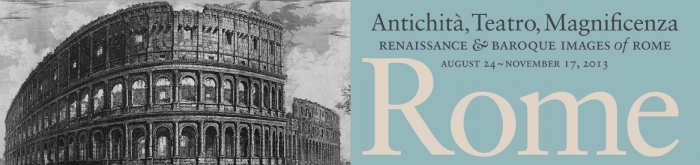
Exhibition | Antichità, Teatro, Magnificenza: Images of Rome
Press release (14 May 2013) from the Carlos Museum (with thanks to Hélène Bremer for noting it) . . .
Antichità, Teatro, Magnificenza: Renaissance and Baroque Images of Rome
Michael C. Carlos Museum, Emory University, Atlanta, 24 August — 17 November 2013
Curated by Margaret Shufeldt and Sarah McPhee
◊ ◊ ◊ ◊ ◊
Antichità, Teatro, Magnificenza: Renaissance and Baroque Images of Rome will be on view at the Michael C. Carlos Museum of Emory University from August 24 through November 17, 2013. This spectacular temporary exhibition includes maps, views, and books on Rome from the sixteenth, seventeenth, and eighteenth centuries.
Over 130 works of art, many from the Carlos Museum’s permanent collection, representing ancient Rome will be showcased in three major sections—Antichita, Teatro, and Magnificenza. Antichita includes the Antiquae urbis imago, Pirro Ligorio’s 1561 reconstruction of the ancient city as the focal point of the antiquarian interests during the Italian Renaissance of the sixteenth century. Ligorio’s reconstruction will be surrounded by works by Hieronymous Cock, several others from the Speculum Romanae Magnificentiae, Mirror of the Magnificence of Rome, a Renaissance ‘coffee table book’ of prints of the sights of Rome produced by the French print seller and publisher Antonio Lafreri (1512–77), and images of the obelisks moved by Sixtus V—all from the Museum’s collection. This section also includes volumes from the rare book collections of the Emory Libraries such as De ludis circensibus by Onophrio Panvinio.
Antiquarians of the Renaissance were humanist scholars who sought to reconstruct, at least intellectually, Rome as it was in antiquity by studying coins, inscriptions, fragments, and the city’s ruins. The images show monuments that have been restored, healed of the ravages of time. Ligorio was one of the leading antiquarian scholars of his day. Cock on the other hand depicts the ruins just as they appeared in the sixteenth-century. The Colosseum is ravaged by time, with plants sprouting among the stones. This is the picturesque Rome that contemporary visitors to the city actually saw.

◊ ◊ ◊ ◊ ◊
The Teatro of the seventeenth century, the second section of the exhibition, is anchored by an impression of Giovanni Battista Falda’s 1676 Nuova pianta, lent by Chicago collector Vincent J. Buonanno. Also included are images from Falda’s depictions of the Giardini di Roma, as well as several books of the period. These works record the efforts of the seventeenth-century popes to refocus attention on the modern city through urban interventions known as ‘theaters’ or ‘teatri’. Piazzas were broadened and opened up to become stages where the life of the city took place and the power of the Church could be asserted. The most striking example is St. Peter’s Square. Falda’s many etchings show the theaters of the Baroque city.
The Magnificenza of the eighteenth century features Giovanni Battista Nolli’s Pianta grande and Giuseppe Vasi’s Prospetto dell’alma città di Roma. Also included are numerous views by Giovanni Battista Piranesi from the Museum’s collection and a copy of Jean Barbault’s Les plus beaux monuments de Rome ancienne among other items from Emory’s rare book collections. Also featured is a survey of Roman guidebooks through the centuries. In this section there are three different types of representations of the magnificence of the Eternal City by three different designers. Nolli’s map is an example of the rational, scientific thinking of the Enlightenment. Vasi follows in Falda’s footsteps making an encyclopedic collection of views of contemporary Rome. Piranesi takes an archaeological interest in the city and creates strikingly dramatic, imaginative views of the ancient monuments. Visitors to Rome on the Grand Tour purchased these prints as mementos of their sojourn and as evidence of their own learned interests.
Margaret Shufeldt, Carlos Museum Curator of Works on Paper, and Sarah McPhee, Emory’s Professor of Art History, are co-curators of the exhibition. Shufeldt notes, “This exhibition offers our visitors a chance to experience the Eternal City through the works of master printmakers across three centuries. One will be able to wander the city in detailed maps and marvel at imposing architecture in the diverse images of Rome.”
A Virtual Experience of Rome
In an exciting and innovative use of technology to bring the exhibition to life, the Carlos Museum is collaborating with Sarah McPhee and Jordan Williams and Erik Lewitt of plexus r + d to develop Virtual Rome. The virtual experience is grounded in the celebrated bird’s-eye view map of Giovanni Battista Falda, published in 1676, which subsumes the fine detail of over 300 etched views of the city made by the young artist. The composite image shows the urban fabric in exquisite visual detail, allowing the patient viewer to stroll the streets, count the windows in facades, and distinguish deciduous trees from evergreens.
Falda’s two-dimensional map will be transformed into a virtual, walkable Rome using the gaming platform known as NVis360. A team of educators, architects, and IT experts are documenting Falda’s Rome in maps and views, checking Falda’s data against Rome today, the surveyed map of 1748 by Giambattista Nolli, and the seventeenth-century ichnographic and surveyed maps that survive in the Roman archives. Through Virtual Rome, museum visitors will be able to journey back in time to experience the Eternal City of the seventeenth century. Virtual Rome is possible because of the generosity of Vincent J. Buonanno, who has made his extraordinary collection of Falda maps and views available in actual and digital form. McPhee notes, “The gaming platform allows us to follow the invitation of Falda’s prints to stroll the city with our eyes: to navigate lost streets and squares, take in vanished prospects, experience seventeenth-century Roman teatri in the round. This is the first time a gaming platform has been used at Emory University to recover urban history through an immersive and interactive reconstruction. We look forward to sharing the exciting results.
This exhibition has been made possible through the generous support of the Lamar Mixson Foundation, the Emory Libraries and the Manuscript and Rare Book Library (MARBL), and Mr. Vincent J. Buonanno.
The Wellcome Library Open Access Fund
With the move toward open access gaining more momentum, even as questions regarding who funds the access remain, this is a particularly interesting example from the Wellcome Library:
◊ ◊ ◊ ◊ ◊
The Wellcome Library is a free resource and is open to anyone who wants to use our collections. We know that lots of our users publish the outcome of their Library research. We want to encourage and support this research, and to ensure that it can be read and enjoyed by as many people as possible.
The Wellcome Trust has a long-standing commitment to Open Access, and provides funding to grant-holders to help them make their research accessible. We’re extending this principle to users of the Wellcome Library in a new scheme aimed at independent scholars, as well as students and university-based researchers who don’t have funding to cover the costs of open-access publishing.
The new Wellcome Library Open Access Fund is (and will always be) entirely voluntary – it’s up to library users whether they want to take advantage of it. We will pay the costs associated with open-access publishing for peer-reviewed journal articles, scholarly monographs or book chapters aimed at academic audiences. To qualify, you’ll need to have made substantial use of our collections; to have had your research accepted for publication; and to be ineligible for open-access funding from any other source.
Review | A Selection of Digital Humanities Projects
The current issue of Renaissance Quarterly includes Michael Ullyot’s assessment of five digital resources, several of which are relevant to eighteenth-century studies:
Michael Ullyot, “Review Essay: Digital Humanities Projects,” Renaissance Quarterly 66 (Fall 2013): 937–47.
 “Are databases the defining genre of the twenty-first century? This question was at the core of a debate in 2007 over the nature of the Walt Whitman Archive in PMLA (Publications of the Modern Language Association of America). With digital resources now firmly established as an essential scholarly research tool, the question remains: what status do we afford databases relative to other forms of publication, like editions or monographs? The question is pertinent not just to tenure and promotion decisions, as the MLA Committee on Information Technology recently advocated, but more fundamentally to the circulation and provocation of ideas.1 If databases help us to interact with texts and cultural objects differently, enabling us to interpret them in ways we
could not otherwise do, how do they differ from monographs or journal articles? . . .” (937)
1. “Guidelines for Evaluating Work in Digital Humanities and Digital Media.” http://www.mla.org/guidelines_evaluation_digital; accessed 17 January 2013.
◊ ◊ ◊ ◊ ◊
· Mapping the Republic of Letters, which draws on the University of Oxford’s Electronic Enlightenment data, a collection containing over 50,000 letters.
· The Map of Early Modern London, a digital atlas of sixteenth- and seventeenth-century London (Ullyot references, in passing, Locating London’s Past, which is based on John Rocque’s 1746 map).
· 1641 Depositions Project, which collects 8,000 manuscript accounts of the 1641 Irish rebellion of Catholic gentry against Protestant settlers from England and Scotland.
· The Medici Archive Project, which aims to catalog the Medici Archival Collection (Mediceo del Principato), a collection of over four million letters written between 1537 and 1743. To date, approximately 10 percent of the archive is included within the database, though Ullyot explains a number of new, “promising” features aimed at making the platform more efficient and more interactive.
· Early English Books Online, a collection of texts published between 1473 and 1700. “What makes EEBO truly innovative and interesting is the Text Creation Partnership (TCP), under which the University of Michigan and Oxford University began in 1999 to convert these PDFs [created from microfilm copies of the books] into fully searchable texts. The TCP has focused on transcribing all 70,000 of the unique monographs in EEBO’s collection. These transcriptions are cross-linked to the page images they are taken from, so they are fully integrated into EEBO. At present, only members of the TCP consortium of libraries are able to access this resource, but it will ultimately pass into the public domain [starting in 2015 and finishing up in 2020]” (945).
HBA Publication Grant
Historians of British Art Publication Grant
Proposals due by 15 January 2014
The Historians of British Art (HBA) invites applications for its Publication Grant. The organization grants a sum of $600 to offset publication costs for a book manuscript in the field of British art or visual culture that has been accepted by a publisher. Applicants must be current members of HBA. To apply, send a 500-word project description, publication information (name of press and projected publication date), budget, and CV to Renate Dohmen, Prize Committee Chair, HBA, brd4231@louisiana.edu. The deadline is January 15, 2014.
82nd & Fifth | Mascarade à la Grecque
The latest installment of The Met’s 82nd & Fifth:
◊ ◊ ◊ ◊ ◊
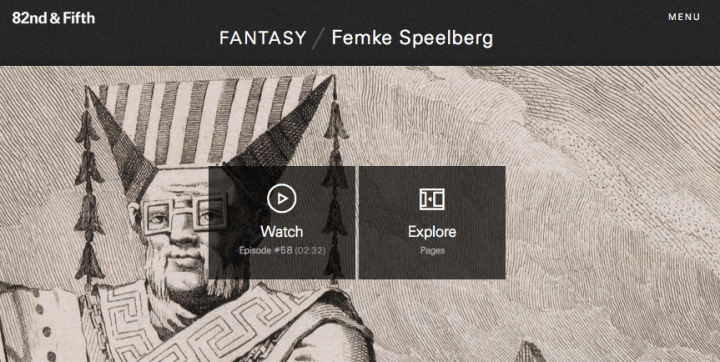
In “Fantasy” (episode #58), Femke Speelberg addresses the Mascarade à la Grecque; Suite des Vases; and [Cheminées], a series of eight etchings designed by Ennemond Alexandre Petitot, and etched and published by Benigno Bossi (1771, 1764).
Updates at The William Blake Archive
30 May 2013
 The William Blake Archive is pleased to announce the publication of an electronic edition of Europe a Prophecy copy A. Only nine copies of Europe printed by Blake are extant. In 1794, the date on its title plate, Blake color printed copies B, C, D, E, F, and G; in 1795 he printed copies A and H, and in 1821 he printed copy K. All are in the Archive except copies C and F, which will be published next year to complete the history of this illuminated book. Europe consists of 18 plates, like its counterpart, America a Prophecy, produced the previous year, but most copies, including copy A, have 17 plates. Only copies H and K contain plate 3, a whimsical prefatory statement about the poem’s origin.
Europe a Prophecy was the second of Blake’s “Continental Prophecies,” followed in 1795 by “Africa” and “Asia,” the two sections of The Song of Los. Important examples of all three books—America, Europe, The Song of Los—are in the Archive. Like the other illuminated books in the Archive, the text and images of Europe copy A are fully searchable and are supported by the Archive’s Compare feature. New protocols for transcription, which produce improved accuracy and fuller documentation in editors’ notes, have been applied to copy A and to all the Europe texts previously published.
Copy A, in the Yale Center for British Art, was printed on large leaves of paper as part of a deluxe set of illuminated books, which included America copy A, The Marriage of Heaven and Hell copy D, and The Book of Urizen copy B, all in the Archive. David Bindman has raised doubts about the coloring in Europe copy A, suspecting that it may have been added by a later hand, perhaps in the twentieth century. In our opinion the coloring was done by Blake and his wife Catherine. The coloring of the frontispiece, with thick dabs of reds and blacks seemingly uncharacteristic of Blake, was probably the result of his experimenting with opaque pigments to create effects similar to his color printing. We see similar opaque reds and blacks applied in like manner in impressions of plate 8 of The Song of Los, especially in copy C. These too were printed and finished in 1795, the year Blake produced his set of 12 large color printed drawings. The color washes of some of the other plates in Europe copy A, however, appear to be by Catherine Blake (see Joseph Viscomi, Blake and the Idea of the Book, 133-34). (more…)
82nd & Fifth: One work. One curator. Two minutes at a time.
As art historians come around to moving pictures and expanding notions of audience, experiments from the Met (smartly packaged under the label 82nd & Fifth) are particularly interesting. -CH
◊ ◊ ◊ ◊ ◊
As introduced by Thomas Campbell:
[Earlier this year, the Metropolitan Museum of Art] launched 82nd & Fifth, a new Web feature that asks one hundred curators from across the Museum to each talk about a work of art from the Met’s collection that changed the way they see the world. One work. One curator. Two minutes at a time.
82nd & Fifth speaks directly to my interest in linking historical art and culture to a broader conversation. The Met is located at 82nd & Fifth but its relevance is global, allowing people to better understand both themselves and the world around them in the broadest sense.
We live in a sea of constant information, and these two-minute, authoritative commentaries are a welcome way to get powerful and compelling content in quick doses. We hope they will intrigue audiences who love the Met and those who are new to art.
◊ ◊ ◊ ◊ ◊
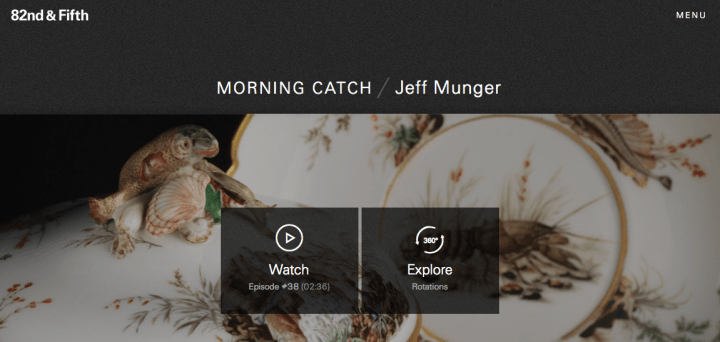
In “Morning Catch” (episode #38), Jeff Munger addresses a broth bowl from Vincennes, ca. 1740-56.
In “Family” (episode #40), Perrin Stein discusses Jacques-Louis David’s Study for The Lictors Bringing Brutus the Bodies of his Sons, 1787.

Resource | George III’s Topographical Collection at the BL
Within the British Library’s online gallery (which includes some 30,000 images), a series of online exhibitions highlight particular collections and strengths. One example, the King George III Topographical Collection, underscores how rich are the visual holdings of the British Library, notwithstanding common assumptions that all pictorial materials are now to be found at the British Museum. In fact, this collection alone include approximately 50,000 items dating from 1500 to 1824. Roughly 40% addresses the British Isles, 10% Britain’s former colonies, and a third key sites of the Grand Tour (particularly Italy, France, the Netherlands, and Germany). -CH

Nicholas Hawksmoor, West Front of the Parish Church Wapping-Stepney
pencil and ink on paper, August 1714 (London: British Library).
◊ ◊ ◊ ◊ ◊
From Peter Barber’s introduction at the BL:
Few of King George Ill’s varied interests seem to have been stronger than his fascination with geography. As a child of eleven, when he had barely learned to read, he was painted sitting next to a globe with his brother, the Duke of York. Though an unpromising pupil, George grew into one of the most cultured of English monarchs when he succeeded his grandfather at the age of twenty-two.
Topography was one of the King’s favourite studies: “he copies every capital chart,” observed a contemporary, “takes models of all celebrated fortifications, knows the soundings of the chief harbours in Europe and the strong and weak sides of most of the fortified towers.”
Scattered on shelves and tucked away in drawers of the royal palaces were a considerable number of atlases, maps, plans and charts that had been part of the working libraries of sovereigns and their consorts since the Restoration in 1660. On this foundation, George III began building his topographical collections from the mid-1760s, a period during which Britain was becoming the most prolific, and arguably the most technically skilled, producer of maps and prints in the world.
The King was well served by his librarian, Frederick Augusta Bamard, who employed agents throughout Europe in his mission to acquire large, ready-made collections as well as individual maps and atlases. As ’new found lands’ were opened up beyond Europe by commercial exploration, their territories were mapped and their place-names given the British imperial stamp: Georgia, Georgetown, King George’s Sound. Single maps and bound volumes formally presented to the King by his subjects at home and abroad, and by the occasional foreign visitor, were incorporated into his collections. . . .
The full introduction is available via the online exhibition here»










 Enfilade
leave a comment