YCBA Building Conservation Project 2013
Yale Center for British Art
Building Conservation Project 2013
This summer and fall the Yale Center for British Art will complete the first phase of a major building conservation project. Beginning in June and continuing through early January 2014, the Center will refurbish its Study Room and areas used by the departments of Prints and Drawings and Rare Books and Manuscripts.
During the renovations, the second- and third-floor galleries will be closed and there will be no access to the Prints and Drawings and Rare Books and Manuscripts collections from June 4 through August 30. Beginning in September, access to the collections, which will remain in the building, will be by appointment only. Requests for appointments and materials will require at least two weeks’ notice. Center staff will make every effort to accommodate the needs of faculty, students, and scholars. The Reference Library will keep normal hours, although there will be periods of disruption.
Records of both departments’ collections are available via an online search on the Center’s website. Orbis, the online catalogue of the Yale Libraries, provides access to material from Rare Books as well as other Yale departments. The Yale Finding Aid Database offers detailed descriptions of the Rare Books Department’s archival collections, along with other archives at Yale.
The permanent collection will remain on view in the fourth-floor galleries. It is expected that normal services in the Study Room will resume by early January 2014. Details will be circulated as they become known.
Contact details
Requests for materials from the departments of Prints and Drawings and Rare Books and Manuscripts should be made at least two weeks in advance by e-mailing ycba.prints@yale.edu
For questions about Prints and Drawings collections:
Gillian Forrester, Curator of Prints and Drawings, gillian.forrester@yale.edu
For questions about Rare Books and Manuscripts collections:
Elisabeth Fairman, Senior Curator of Rare Books and Manuscripts, elisabeth.fairman@yale.edu
Inquiries about the Reference Library:
Kraig Binkowski, Chief Librarian, kraig.binkowski@yale.edu
British Sales 1780–1800: The Rise of the London Art Market
From The National Gallery:
The National Gallery has completed a collaborative project with the Getty Research Institute, Los Angeles, to augment records about British art sales in the crucial decades from 1780 to 1800
Overview
 The disruptions caused by the French Revolution had a huge effect on the redistribution of art throughout Europe during the late 18th century. Countless important art collections, including the famous Orléans collection, were dispersed in auction sales. Since many of these auctions took place in Britain’s capital city, London developed into a major import market and soon established itself as the hub of the international art trade.
The Getty Research Institute has been conducting research into European art sales for the past 25 years, notably in relation to art sales catalogues from major cities in Great Britain, France, Germany, Belgium, the Netherlands, and Scandinavia from 1650 to 1840. The Institute has been making its findings available on the Getty Provenance Index®.
In relation to British art sales, it concentrated earlier research into early 19th-century British records. By comparison, little attention was ever focussed on late 18th-century British auction records. This big gap in knowledge prevented meaningful analysis into the art markets of Great Britain, into the continuing lives of dispersed French collections, and – due to the interconnectedness of national art markets – into the development of cultural networks throughout Europe.
In order to rectify the situation, the National Gallery and the Getty Research Institute forged a collaboration from October 2009 to August 2012. The aim of this jointly-funded project was to discover all extant British sale catalogues – in London and across the UK – and to enter them into the Index, thus significantly augmenting the coverage of one of the most powerful and important tools for scholars researching art markets and collecting practices.
British art sales catalogues
The research project, ‘British Sales 1780-1800’, has successfully added over 67,000 records from 1,408 British art auction catalogues to the Getty database: 29,000 records from the 1780s and a further 38,000 records from the 1790s. The database now contains almost 80% of known British art sales catalogues in public collections for the period.
Explore British art sales on the Getty Provenance Index®
The research
The research team worked with many institutions in the UK and abroad to find and then consult and photograph relevant holdings of catalogues from the period. Among the important archives and libraries in London, data was input from annotated auction catalogues held by the Wallace Collection, the British Library, the British Museum, the Victoria & Albert Museum, the Courtauld Institute and the National Archives at Kew, as well as from the National Gallery’s own substantial holdings of historic sales catalogues.
In addition, the team sourced catalogues from numerous regional UK record offices, local archives and university collections, including the Barber Institute of Fine Arts, Birmingham; the Fitzwilliam Museum, Cambridge; and the Ashmolean Museum and Bodleian Library, Oxford. Furthermore, the researchers forged close links with various foreign institutions, notably the Bibliothèque Nationale de France in Paris.
Outcomes
The British Sales research project has resulted in expanded coverage of British materials in the Index®. These tools will allow researchers to track patterns of taste in order to understand better cultural transfers, and to explore more fully the power of art markets. Furthermore, generating new knowledge about the history of the art market will allow greater interdisciplinary exchange among scholars from a variety of fields, including art history, economics, and cultural studies.
To highlight some of the fruits of the collaboration between the National Gallery and the Getty Research Institute, as well as to promote further research in the field, the two institutions are organising a scholarly symposium at the National Gallery on 21–22 June 2013: London and the Emergence of a European Art Market (c. 1780-1820). The theme of the conference will be the European art market of the later 18th century, and in particular, the ways that the market operated at both national and international levels as well as its impact on the history of collecting and taste in public and private spheres.
HECAA’s Pinterest Boards Unveiled
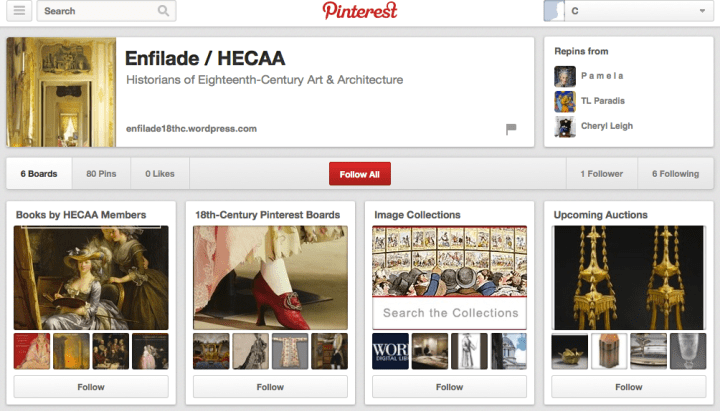
With two fabulous Clerks of the Pinterest Boards — Katrina London and Debs Wiles — taking the lead, I’m delighted to announce that HECAA and Enfilade now have a Pinterest presence! Having written about the site in the past (21 May 2012 and 17 January 2013), I’m now even more optimistic. Lots of you are already pinning. Some of you, on the other hand, are rolling your eyes at the very mention of it — not another new digital platform to make sense of! As one who signed up for a Pinterest account (yes, accounts are free) and then did nothing with it for months, I understand feelings of nagging annoyance and even disdain. But after a year of using Pinterest for personal interests and projects, I’ve been won over. It’s not nearly as good as it should (or could) be, but I think there is enormous potential for scholars to provide some leadership and make this new vehicle serve our own interests. It’s still an experiment, and six months from now, we’ll likely have a much better sense of the limits. On the front end, I offer the following suggestions; and don’t worry, we have no plans to change what happens here at the regular site for Enfilade. As always, feedback is welcome. -CH
◊ ◊ ◊ ◊ ◊
1) Plan. You’ll need to sign up for an account — but even before that — you need to consider how you want to use your account. As a social media platform, Pinterest will want to intertwine you with the people you ‘follow’ and the things you ‘pin’. It’s entirely common for people to use their real names, and if you’re using it to extend a professional presence, that’s probably advantageous. On the other hand, if you’re pinning cleaning tips, then maybe you’ll want something a bit more discreet (initials, pseudonyms, &c.).
2) Press on. When you sign up for an account, you’ll list several sites you want to ‘follow’. Over time, that list will grow as you hone your preferences and likes. For most people, Pinterest is only as satisfying as the things they’re following. Warning: here’s there’s a small learning curve. After you first sign up, you’ll likely be bombarded by lots of images (‘pins’) that have little to do how you want to use the site. Don’t fret. In a day or two, you’ll gradually begin to make sense of how it works, the visual clutter will dissipate, and it’s easy enough to ‘unfollow’ things you want to go away.
3) Follow HECAA! We currently have several ‘boards’. Whenever we post a new pin, it will automatically be pinned to your homepage, too. People who follow you will see it only if you ‘repin’ it yourself.
4) Explore. There are lots of museums, academic presses, and other scholarly institutions to ‘follow’ (Yale UP is one example). There are also lots of images of amazing eighteenth-century artifacts — often posted by historical novelists. At the level of strategy, Enfilade is not aiming to assemble large collections of interesting objects — paintings by Chardin or Kauffman, for instance. We have all kinds of resources for such collections: books, databases, &c. Instead, we’re interested in exploring what kinds of information would be a good fit with Pinterest and how we would take advantage of Pinterest as a venue for distributing visual information. Ultimately, we’ll be exploring how we might marshal collective efforts to maximize a critical mass of interest in eighteenth-century studies.
5) Think about organization. You’ll be able to create your own boards, assigning each pin to one of these. Generally, the more precise a board, the more useful it will be — to yourself and to others who may follow you. If you’re unsettled by the social media component, users are allowed three ‘secret boards’.
6) Think about who might see what you’re pinning. If you’re wondering how Pinterest could possibly be useful, consider this. Say you’re working on a paper on eighteenth-century picture frames. Through web searches, you find 10-20 sites and images you’d like to keep in mind. In a matter of seconds, it’s easy to pin each of those examples to a board you call ‘Frames’. With a system much easier than bookmarking or printing hard copies, you’re able to make a visual record, with brief captions and links. But also bear in mind: if those examples turn out to be crucial to your paper, anyone following you can, now, in effect, peer over your shoulder as you’re working. Perhaps that’s fine. Or perhaps you should use one of your ‘secret boards’ for that material. It’s easy enough to turn a ‘secret board’ into a public one later on, but you can’t go the other way.
HECAA’s Pinterest boards are available here»
Christie’s Object Lessons: Flower Holders of the 18th Century
As we transition from still to moving images, it’s interesting to see people (and institutions) exploring possibilities — in this case for educational and marketing purposes. Note the inclusion of music behind the narration of Jody Wilkie, a ceramics specialist at Christie’s and a regular appraiser on Antiques Roadshow. Does the music enhance or detract? I can report, from first-hand experience, that art historians working on similar projects are debating precisely this question. Do your lectures and articles come with soundtracks — either real or imagined? -CH
◊ ◊ ◊ ◊ ◊
From Christie’s Object Lessons series:
Gale Announces New Platform, Artemis
Press release from Gale (2 April 2013) . . .
Gale, part of Cengage Learning and a leading publisher of research and reference resources for libraries, schools and businesses, today announced plans to unify, over the coming years, its extensive digital humanities collections on one state-of-the-art platform, creating the world’s largest online curated primary source and literary collection. The new research experience, Artemis, named for the Greek goddess who symbolizes new ideas, discovery, power and “the hunt,” will enable researchers to make connections and realize relationships among content that has never before been possible.
“Artemis represents a significant investment in our products and new technology. No other publisher offers this combination of rich full-text content, metadata, and intuitive subject indexing – all enhanced by revolutionary work-flow and analytical technology that breathes new life into the study of the humanities,” said Frank Menchaca, executive vice president, research solutions, Cengage Learning. “We are creating the most valuable curated digital humanities collection in the world through this integrated research environment.”
Artemis moves beyond the limitations of simple search and retrieve – it offers users the ability to search across both primary and secondary materials as well as different subjects and genres. It also adds term clusters and term-graphing tools to allow users to conduct new kinds of analysis on familiar content sets, thematic subject indexing to aid in content discovery, and interface updates that conform to today’s design standards, including sharing and collaboration tools. Overall, Artemis will transform the way students and researchers explore material, giving them the ability to challenge assumptions and create new theories and academic debate. (more…)
Chrisman-Campbell, “When Fashion Set Sail” at Worn Through
It’s been too long since I’ve noted offerings at Worn Through, a blog that addresses apparel from an academic perspective. In addition to a Call for Papers for the Annual Meeting of the Costume Society of America (Midwest Region) on the theme of Uncommon Beauty, recent postings include an interesting contribution from Kimberly Chrisman-Campbell on maritime headdresses: “When Fashion Set Sail.” -CH
◊ ◊ ◊ ◊ ◊
Kimberly Chrisman-Campbell, “When Fashion Set Sail,” Worn Through (20 March 2013).

Anonymous, Coëffure à l’Indépendance ou le Triomphe de la liberté, ca. 1778, Musée franco-américain du château de Blérancourt
One of the most iconic images of eighteenth-century extravagance is a fashion plate depicting a lady wearing a miniature ship in her powdered and pomaded hair.
But this much-misunderstood hairstyle was not just an eye-catching novelty. It was one of many ship-shaped headdresses that celebrated specific French naval victories and, more importantly, advertised their wearers’ patriotism and political acumen.
Far from being the whimsical caprice of bored aristocrats, these maritime modes were directly inspired by one of the defining political and philosophical issues of the day: America’s struggle for independence, in which France was a key military and political ally.
The full posting is available here»
Round Table Session | New Database: Authors Writing on Art in France
Next month at INHA, as noted at Le Blog de l’ApAhAu:
Auteurs d’écrits sur l’art en France, XVIe-XVIIIe siècles
Institut national d’histoire de l’art, Paris, 4 April 2013
Présentation de la base Auteurs d’écrits sur l’art en France (XVIe-XVIIIe siècles) à l’occasion de sa mise à la disposition de la communauté scientifique par l’intermédiaire de l’application Agorha
L’histoire de l’art s’est constituée en France à partir de discours aux formes, aux intentions et aux constructions multiples dont l’émergence, entre le XVIe et le XVIIIe siècles, a accompagné des pratiques savantes aussi diverses que la création, la collection, l’érudition et la préservation des vestiges du passé. La base de données Auteurs d’écrits sur l’art en France (XVIe-XVIIIe siècles) donne accès à la diversité de ces traditions intellectuelles. Près de 700 notices personnes et 4000 notices bibliographiques composent un répertoire bio-bibliographique introduisant à un vaste corpus d’auteurs et de références telles que recueils biographiques, études antiquaires, littérature de voyage et guides, conférences académiques, textes descriptifs, techniques, théoriques ou critiques. Complément du Dictionnaire critique des historiens de l’art actifs en France de la Révolution à la Première Guerre mondiale, cette nouvelle base de données ne constitue pas seulement un formidable outil documentaire mais dévoile également le processus de construction de la discipline Histoire de l’art comme creuset dans lequel des traditions intellectuelles variées ont fusionné pour donner naissance à un nouveau discours sur l’art passé et présent.
Thoughts on Paper: A Blog and a Book
Those of you taken by the materiality of paper may be interested in Lucy Vivante’s blog posting from 15 January 2013 on Paper and Watermarks, in which she interviews Neil Harris and Peter Bower. And if the distance between those traditions of making and our own dependence upon screens leaving you feeling elegiac, you might have a look at Ian Sansom’s new book. -CH
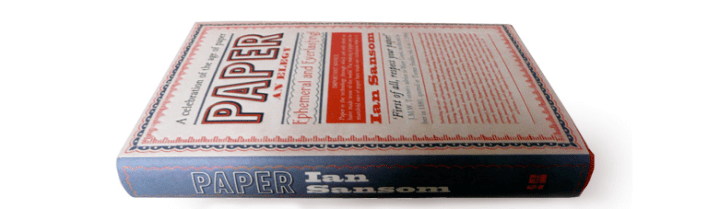
Ian Sansom, Paper: An Elegy (London: Fourth Estate, 2012), 224 pages, ISBN: 978-0007480265, $25.
The history of civilization is bound up with — and bound in — the history of paper. Paper is the technology through which and with which we make sense of the world: knowledge and information is arranged in words, images and numbers on paper; values and ideas are exchanged and transmitted by paper. The making of paper, the trade in it, the use of it, brought about a new era in human civilization.
That era is coming to an end. In 2010, Amazon announced that for the first time it was selling more e-books than paper books. According to Nicholas Negroponte, founder of MIT′s Media Lab, the paper book has five years left to live before becoming extinct. The world we know was made from paper: yet everywhere you look, paper is dying, its influence literally disintegrating.
In Paper: An Elegy Ian Sansom traces the history of paper-making from the 7th-century Chinese workmen who made paper from the inner bark of plants and trees, to the 17th-century vatmen and couchers who dipped and shook and dried paper moulds to make folios and quartos, to today′s billion-dollar paper industry; from papyrus to e-books. Both a cultural overview and a series of warm, personal meditations on the history and meaning of paper in all its forms – as both a means of communication and as an artefact in itself – this book is a lively valediction to the paper it′s printed on.
Free Trial Access to Gale Digital Collections until June 15
ASECS Trial for Gale Digital Collections
Gale Digital Collections is providing a free trial to many of its collections, from now until June 15, 2013. This trial does not require a username or password. Feel free to share this trial with your colleagues. If you find value in any of these collections, please contact your library liaison. Often times, faculty feedback and comments influence library collection development decisions. Here are the digital collections for review in alphabetical order:
British Literary Manuscripts – This extensive digital archive includes hundreds of thousands of pages of poems, plays, essays, novels, diaries, journals, correspondence and other manuscripts from the Restoration through the Victorian era.
Eighteenth Century Collections Online (ECCO) – Consisting of every significant English-language and foreign-language title printed in the United Kingdom during the 18th century, along with thousands of important works from the Americas, Eighteenth Century Collections Online was the most ambitious single scholarly digitization project ever undertaken. Bearing witness to what many scholars consider the three most significant events in world history — The American Revolution, The French Revolution and The Industrial Revolution.
Gale NewsVault – The definitive cross-searching experience for exploring Gale’s range of historical newspaper and periodical collections. Users can simultaneously search or browse across The Times Digital Archive 1785-1985, 17th and 18th Century Burney Collection Newspapers, Financial Times Historical Archive 1888-2006, 19th Century U.S. Newspapers, and many more.
The Making of the Modern World, Parts I&II – This unrivaled online library fully documents the dynamics of Western trade and wealth that shaped the world from the last half of the 15th century to the mid-19th century. Part II adds approximately 5,000 newly scanned titles extends this impressive series into the beginning of the 20th century.
Nineteenth Century Collections Online (NCCO) – The most ambitious scholarly digitization and publication program ever undertaken, this collection is invaluable to research and teaching in one of the most studied historical periods. Rare primary sources, curated by an international team of experts, provide never-before-possible access to important works sourced from leading libraries worldwide.
Sabin Americana, 1500-1926 – This is an online collection of books, pamphlets, serials and other works about the Americas, from the time of their discovery to the early 1900s.
Slavery and Anti-Slavery: A Transnational Archive – The largest and most ambitious project of its kind, this collection is a thematically organized, four-part historical archive devoted to the scholarly study and understanding of slavery from a multinational perspective.
State Papers Online–This collection is the gold standard for anyone conducting research on early modern English politics and culture. Organized in four parts, each cross-searchable and available separately, this online archive of original manuscript documents of British State Papers chronicles domestic and foreign history, from 1509-1714, the period of Henry VIII to Queen Anne.
Exhibition and Resource | French Pamphlets at The Newberry
From The Newberry:
Politics, Piety, and Poison: French Pamphlets, 1600–1800
The Newberry Library, Chicago, 28 January — 13 April 2013
This exhibition displays French pamphlets published during the transitional period from the Ancien Régime to the French Revolution. They served as modes of dissemination and diversion, teaching tools and educational models, and the foundation for current and future scholarly projects. The exhibition focuses on the ways in which these pamphlets complement and enhance the Newberry’s other vast collections of primary sources documenting early modern European culture and the history of printing. The Newberry’s outstanding collection of French pamphlets was recently cataloged through a grant from the Council on Library and Information Resources.
◊ ◊ ◊ ◊ ◊
About The Newberry’s cataloging project:
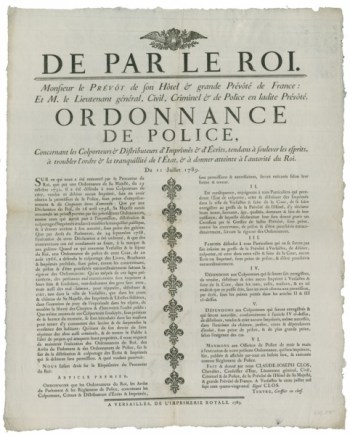
Case Wing Z 144.A1, vol.10 No.87, Ordonance (The Newberry Library)
French Pamphlet Collections at the Newberry Library is a three-year project funded by a Council on Library and Information Resources (CLIR) Cataloging Hidden Special Collections and Archives grant. CLIR administers this national effort with the support of generous funding from The Andrew W. Mellon Foundation. French Pamphlet Collections at the Newberry Library began in January 2010 and will be completed in January 2013. Through the project, the Newberry is creating full, item-level MARC records for 22,000 French pamphlets that date from the 16th to the 19th century.
The Newberry applied for the CLIR grant to support one of its top cataloging priorities of processing hidden collections. A committee comprised of staff with library service, stacks management, curatorial and collection development responsibilities prioritized these uncataloged and undercataloged materials based on its knowledge of researcher requests, scholarship trends, Newberry collection strengths, subject areas in need of development, and strong complementary collections in other institutions. Pamphlet collections were one of the highest priorities. More specifically, the committee identified the French Pamphlet Collections as being an urgent cataloging need. The material complements strengths of the Newberry’s collection and it is in high-demand by researchers. The bulk of the pamphlets date to the period of the French Revolution and are primary sources for legal, social, and cultural history; literary studies; and the history of publishing. These ephemeral documents have often been overlooked and undervalued by past generations of scholars and undercataloged in research collections. They are of particular value to modern scholarship because they move past official histories and contribute to new interpretations. . .










 Enfilade
leave a comment