Exhibition | Bronze at The Royal Academy
Reviewed for Enfilade by Craig Ashley Hanson
Bronze
Royal Academy of Arts, London, 15 September — 9 December 2012
Curated by David Ekserdjian and Cecilia Treves
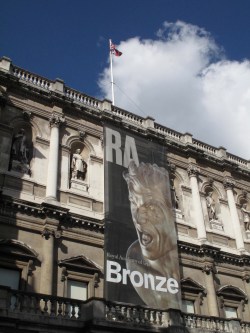 Critics have been raving about Bronze since it opened last month at the Royal Academy of Arts in London. Notwithstanding the exhibition’s sweeping coverage–in terms of geography and history–I didn’t initially include it here at Enfilade as I had trouble finding eighteenth-century points of relevance. Indeed, out of dozens of objects shown across ten rooms, only a handful of works were produced during the period. And yet, now that I’ve seen the exhibition, I’m convinced dix-huitièmistes should pay attention.
Organized by theme rather than time and place, the range of works is staggering. If, in keeping with traditional historiographical models, the show begins with an achingly beautiful example from ancient Greece–a recently recovered Dancing Satyr–it quickly brings an international array of work into open and productive dialogue. On display are works from Ghana and Nigeria, Eturia and Rome, China and Japan, Northern Europe and the United States. Categories one might expect to see are well represented: ritual dining vessels from Shang dynasty tombs, classicizing work from Renaissance Florence, Buddhist work from India (including an extraordinary sixth-century Buddha Shakyamuni from Bihar). Rodin’s Age of Bronze is, of course, included. But there are surprises, too: ancient court objects from Israel (a crown, scepter, and vulture standard), sixteenth-century French spurs, a basketball by Jeff Koons. Works by Giambologna appear next to an oversized spider by Louise Bourgeois (climbing the wall, no less).

François Girardon, Laocoön and His Sons, ca. 1690 Houghton Hall, Norfolk/Photo © Royal Academy of Arts, London, Roy Fox (click for more info)
While it all could have gone horribly wrong, the experience of viewing the exhibition appears to be, for most viewers, one of coherence rather than confusion, coherence derived from the thoughtful attention to the possibilities of bronze as a material. The medium is the subject in an entirely convincing, indeed revelatory manner. The varieties of objects, selected from a global vision of art history, work thanks to careful attention to exploration of seven thematic categories: figures, animals, groups, objects, reliefs, gods, and heads. Scale and texture, color and composition, the tensile strength and resulting artistic flexibility of bronze all become matters of first, rather than passing, interest.
And for the eighteenth-century? The final room of heads includes original choices: Massimiliano Soldani-Benzi’s Damned Soul of 1705 after Bernini and Anne Damer’s Mary Berry from 1793, while François Girardon’s Laocoön from Houghton Hall, ca. 1690, exerts a commanding presence in the gallery dedicated to groups. Particularly compelling for me, in that same room, is the sensitive installation of Francesco Bertos’s 1730s allegorical group of Sculpture, Arithmetic, and Architecture from the Prado. Placed alongside Giambologna’s 1576 Nessus and Deianira (a centaur abduction scene) and Alessandro Algardi’s 1647 St. Michael Overcoming the Devil, Bertos’s work appears as an entirely legible development from Renaissance humanism, to forceful Baroque religious expression, to refined Enlightened optimism. Adrian de Vries’s Hercules, Nessus and Deianira of 1622 dominates the center of the gallery, making the relationships–the similarities and differences within this 150-year period–all the more striking.

Massimiliano Soldani-Benzi, after Bernini, Damned Soul (‘Anima Dannata’), 1705-07. Bronze with golden-red lacquer patina, 39.5 cm. Liechtenstein Museum, Vienna. Photo © Liechtenstein. The Princely Collections, Vaduz-Vienna
And so historical arguments do exist within the exhibition, even if there’s no obvious central argument based on tracking change over time (it is I think one reason material from all over the world can be placed side by side so effectively). One may wish there were more eighteenth-century offerings–I’ll leave those criticisms to the sound judgment of my colleagues. But, for me, it is an exhibition that likely would make a lot more sense to eighteenth-century connoisseurs than the much more tightly focused, monographic approaches dominating exhibitions in the present age. No only is it a show I think many eighteenth-century viewers would understand (with admittedly a bit of instruction), it’s a show I think they would like.
Alongside it, the catalogue offers innovative models for thinking about different ways exhibitions generally might succeed. The book pairs beautifully with the catalogue for the 2009 exhibition Cast in Bronze: French Sculpture from Renaissance to Revolution, available–for anyone regretting that there aren’t more eighteenth-century works on
display–in the Royal Academy gift shop on the way out.
◊ ◊ ◊ ◊ ◊
Catalogue: Bronze (London: Royal Academy Publications, 2012), 248 pages, ISBN: 9781907533280, $65.
 Bronze, long celebrated for its durability and the wide range of effects that it offers, has been prized as an artistic material in many parts of the world throughout the ages. Magnificent bronze sculptures from the ancient times have emerged unscathed after millennia on the sea bed. It is a material that has been used on all scales, from the minute to the monumental. This sumptuous catalogue examines bronze’s earliest beginnings in North Africa, the Middle East and China as it transcended tools and weaponry to become a medium of fine art. Expert authors chart the virtuousity of artists in ancient Greece and Rome; developments in Asia and Africa; bronze’s great flowering in the European Renaissance and its use in the modern era by artists such as Rodin, Picasso, Brancusi and Bourgeois.
A unique testament to the works of art that one medium has inspired, Bronze contains lavish colour plates of over 150 masterworks arranged chronologically to take the reader on a voyage through time, tracing the work of sculptors, casters and chasers through the centuries.
New Title | The Origins of Sex
Dabhoiwala’s book appeared earlier this year, building on a 2010 Past and Present article, and I should have noted it months ago. I’m not sure scholarly reviews of it are yet in (please add what I’ve overlooked), but it was reviewed widely in the popular press. Here’s one of those from The Literary Review:
Faramerz Dabhoiwala, The Origins of Sex: A History of the First Sexual Revolution (Oxford University Press, 2012), 496 pages, ISBN: 9780199892419, $35.
Reviewed by Norma Clarke, Kingston University
A woman born in 1600 grew up being told she was the most lustful of God’s creatures. Come 1800 and the message was reversed: she was ‘naturally’ delicate and pure. No longer having lusts of her own to manage, her role was to control the ‘natural’ lust of men and thus preserve civilisation. Dogmas about sexuality had undergone remarkable change. What remained the same was female subordination.
In this ambitious and wide-ranging book, Faramerz Dabhoiwala charts what he calls ‘a history of the first sexual revolution’. He examines the religious, economic, intellectual and social pressures that provided the context for a shift in attitudes towards sexuality. The move from pre-modern to modern times was towards sexual permissiveness and privacy, and away from external controls of individual sexual behaviours. . . .
The full review is available here»
New Novel | The Potter’s Hand
Just out in the UK from Atlantic Books:
A. N. Wilson, The Potter’s Hand (London: Atlantic, 2012), 512 pages, ISBN: 9781848879515, £18.
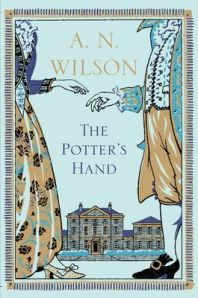 In 1774, Josiah Wedgwood, master craftsman possessed with a burning scientific vision, embarks upon the thousand piece Frog Service for Catherine the Great. Josiah’s nephew Tom journeys to America to buy clay from the Cherokee for this exquisite china. Tom is caught up in the American rebellion, and falls for a Cherokee woman who will come to play a crucial role in Josiah’s late, great creation: the Portland Vase. As the family fortune is made, and Josiah’s entrepreneurial brilliance creates an empire that will endure for generations, it is his daughter Sukey, future mother of Charles Darwin, who bears clear-eyed witness.
A novel of epic scope, rich in warmth, intellect and humanity, The Potter’s Hand explores the lives and loves of one of Britain’s greatest families, whose travails are both ordinary — births, deaths, marriages, opium addiction, depression — and utterly extraordinary.
A. N. Wilson grew up in Staffordshire, where his father was Managing Director of Josiah Wedgwood and Sons. He was educated at Rugby and New College, Oxford. A Fellow of the Royal Society of Literature, he holds a prominent position in the world of literature and journalism. He is a prolific and award-winning biographer and celebrated novelist. His most recent novel, Winnie and Wolf, was longlisted for the 2007 Man Booker Prize. He lives in North London.
◊ ◊ ◊ ◊ ◊
From Country Life:
Reviewed by Giles Waterfield; posted 10 September 2012.
Historian, biographer, commentator and novelist A. N. Wilson is full of variety. Having recently written about St Paul and Adolf Hitler, he turns his attention in this long and richly flavoured novel to Josiah Wedgwood, probably the most famous of all British ceramicists, at least until the 20th century. Wedgwood excelled as craftsman, designer and businessman, building up the ceramics industry in Staffordshire. . .
This boldly panoramic novel mixes history and invention, swooping from the narrator’s viewpoint to the personal feelings of the very large cast of characters. Highly experienced narrator that he is, Mr Wilson skilfully interweaves his various plots, yet keeps Wedgwood, his wife and his daughter Sukie at the centre of the book. This is the historical novel at its most ambitious.
The full review is available here»
June 2012 Issue of ‘The Court Historian’
Eighteenth-century topics in the current issue of The Court Historian 17 (June 2012) . . .
Articles
• Clarissa Campbell Orr, “Popular History, Court Studies, and Courtier Diaries,” pp. 1-15.
• Robin Thomas, “Building the Monarchy: The Teatro di San Carlo in Naples, 1737,” pp. 35-60
• Neil Jeffares, “Between France and Bavaria: Louis-Joseph d’Albert de Luynes, Prince de Grimberghen,” pp. 61-85.
Reviews
• Clare Hornsby, Review of David Marshall, Susan Russell, and Karin Wolfe, eds., Roma Britannica: Art Patronage and Cultural Exchange in Eighteenth-Century Rome (London: British School at Rome, 2011), pp. 91-93.
• Wolf Burchard, Review of Christina Strunck and Elisabeth Kieven, eds., Europäische Galeriebauten: Galleries in a Comparative European Perspective (1400-1800), Römische Studien der Bibliotheca Hertziana 29 (Munich: Hirmer Verlag, 2010); and Mathieu da Vinha and Claire Constans, eds., Les grandes galeries européennes XVIIe-XIXe siècles (Paris: Éditions de la Maison des sciences de l’homme, 2010), pp. 95-104.
Conference Reports
• Antonio Ernesto Denunzio, “Aristocratic Residences in Naples: The Palazzo Zevallos Stigliano and Arts Patronage by the Nobility from the 16th to the 20th Centuries” (Naples, October 2011), pp. 113-14.
• Charles C. Noel, “The Court in Europe: Politics and Religion, 1500-1800,” (Madrid, December 2010), pp. 117-20.
New Field Editor for Eighteenth-Century Art at ‘caa.reviews’
From the Editor
 I am thrilled to announce that I’ll be stepping in as the new field editor for Eighteenth-Century Art at caa.reviews, succeeding Laura Auricchio who has brilliantly filled the position since 2007. I am especially grateful to both Laura and the editor-in-chief of caa.reviews, Sheryl Reiss, for all they’ve done to facilitate what, I hope, will be a smooth transition.

Published by the College Art Association, caa.reviews plays a valuable role for the scholarly community, keeping a pulse on art historical discourse but also — crucially, to my thinking — helping shape that discourse with more reviews and more timely reviews than would have ever been possible from CAA’s paper-based publications. As I’ve often said in my capacity as editor at Enfilade, I now say in this new role as a caa.reviews editor: the success of the publication depends upon you, the readers. I’ll do my best to invite thoughtful, engaged responses to a selection of the most striking and substantive scholarship addressing the eighteenth century, to give you good cause to keep reading. While promising neither revolutions (glorious or otherwise) nor sweeping societal enlightenment — certainly no guarantees regarding the sublime — I can affirm that I approach the position as an amateur, in the best sense of the eighteenth-century designation, as one who finds much to love in this period, a period as central as ever for grappling with questions of what it means to be human, what it means to make and use art, what it means to be modern, and what it means to address the past productively.
-Craig Ashley Hanson
◊ ◊ ◊ ◊ ◊
About caa.reviews
Founded in 1998, caa.reviews publishes timely scholarly and critical reviews of studies and projects in all areas and periods of art history, visual studies, and the fine arts, providing peer review for the disciplines served by the College Art Association. Publications and projects reviewed include books, articles, exhibitions, conferences, and other works as appropriate. It also publishes essays on these subjects, as well as on art education and policy and related topics. In reviewing and publishing recent texts and projects, caa.reviews fosters timely, worldwide access to the intellectual and creative materials and issues of art-historical, critical, curatorial, and studio practice, and promotes the highest standards of discourse in the disciplines of art and art history. The journal is published on a continual basis by the College Art Association. Access to caa.reviews is a benefit of membership in the College Art Association. For details about becoming a CAA member, please visit CAA’s membership pages.
Reviewed | Orientialism in Louis XIV’s France
 Appearing some time ago, Nicholas Dew’s Orientialism in Louis XIV’s France is reviewed in the current issue of French History (by way of reminder of the upcoming ASECS deadline, it’s worth noting that at least three proposed panels at the 2013 conference relate to the theme of Europe’s engagement with Asia). As Julia Landweber notes in her review of Dew’s book for H-France Review 10 (July 2010): 437-40, readers should also consult Ina McCabe’s Orientalism in Early Modern France (Berg, 2008). Landweber writes: “McCabe aimed for an almost encyclopedic gathering of information, bringing in figures great and small alike for brief cameos,whereas Dew chose to focus his research on the deep analysis of a much narrower set of individuals. By happy fortune, Dew’s subjects barely overlap with McCabe’s; in consequence, the two works complement each other nicely. Read together, their theses essentially reinforce one another, and indicate that a consensus has been reached in terms of a new post-Saidian interpretation of ‘baroque Orientalism'” (439). -CH
◊ ◊ ◊ ◊ ◊
French History 26 (September 2012): 403-04.
Review of Nicholas Dew, Orientalism in Louis XIV’s France (Oxford: Oxford University Press, 2009), 301 pages, ISBN: 9780199234844. $120.
Reviewed by Diane C. Margolf; posted online 28 July 2012
Historians of Europe’s Republic of Letters during the late seventeenth and early eighteenth centuries will welcome this book as a valuable addition to the field. Focusing on what he calls ‘baroque Orientalism’, Nicholas Dew explores the ways in which a small group of French scholars produced knowledge about China, India, and the Ottoman Empire before the Enlightenment of the later eighteenth century and the European empires of the modern era. Although the scholars’ research and publication efforts were often unsuccessful and always fraught with delays and complications, Dew’s analysis of the process they followed further enriches our understanding of intellectual and cultural activity in France under Louis XIV. . .
The full review is available here» (subscription required)
Reviewed | Dubin’s ‘Futures and Ruins’
Recently added to caa.reviews:
Nina L. Dubin, Futures and Ruins: Eighteenth-Century Paris and the Art of Hubert Robert (Los Angeles: Getty Research Institute, 2010), 210 pages, ISBN: 9781606060230, $50.
Reviewed by Frédérique Baumgartner, Mellon Postdoctoral Fellow, Columbia University; posted 27 July 2012.
In an article entitled “Les musées ne sont pas à vendre” (“Museums Are Not For Sale”) published on December 12, 2006, in the daily French paper ‘Le Monde’, the art historians Françoise Cachin, Jean Clair, and Roland Recht strongly denounced the increasing commercialization of the national patrimony, epitomized by the Louvre’s plan to rent out part of its collection to a branch established in Abu Dhabi. The authors warned the French administration against the incoherence of its cultural policy: claiming to protect the nation’s artistic treasures, while at the same time using those treasures as commodities.
The controversy over the Louvre Abu Dhabi is one of the many contemporary resonances that Nina Dubin’s book, ‘Futures and Ruins: Eighteenth-Century Paris and the Art of Hubert Robert’, holds for its reader. A meticulously researched study examining Robert’s paintings of Parisian ruins in light of the new financial interests and related economic and cultural risks that defined the city’s urban and patrimonial policies in the 1770s–1790s, ‘Futures and Ruins’ will prompt readers to consider the origins of the economic and cultural precariousness of today’s world. As such, the book is both historically stimulating and morally engaging.
At the center of ‘Futures and Ruins’ lies the following historical claim: in the course of the eighteenth century, Paris, in the grip of the forces of early capitalism, became the terrain of intense real estate speculation. It was enabled by the introduction of paper money in 1716, as the greater capacity for circulation of paper money precipitated transactions and engendered prospects of hastily accumulated wealth. At the same time, the reliance of the real estate market on the expansion of credit raised the specter of bankruptcy. As Dubin underscores, in agreement with the historian Michael Sonenscher, the nature of credit was characterized by “the ease with which it enabled economic prosperity, while at the same time catalyzing the potential for expansive debt” (Michael Sonenscher, ‘Before the Deluge: Public Debt, Inequality, and the Intellectual Origins of the French Revolution‘, Princeton: Princeton University Press, 2007, 91).
These economic phenomena, Dubin argues, found their aesthetic counterpart in pictures of ruins—a genre in which Robert (1733–1808), received as Peintre d’architecture at the Royal Academy of Painting and Sculpture in 1776, excelled. . .
The full review is available here» (CAA membership required)
Recent Reviews Posted at BSECS
Recent reviews at BSECS:
A Will of Their Own: Judith Sargent Murray and Women of Achievement in the Early Republic
Location: National Portrait Gallery, Washington, DC
Event Date: August 2012
Reviewed By: Linda Troost, Washington & Jefferson College
A pantheon presenting the female face of the Early American Republic.
Playing, Learning, Flirting: Printed Board Games from Eighteenth-Century France
Location: Waddesdon Manor, Aylesbury
Event Date: July 2012
Reviewed By: Jennifer Thorp, New College, Oxford
The long eighteenth century, as told via the revealing medium of the board game.
Pieces of Wedgwood
Location: State Library of New South Wales, Sydney
Event Date: July 2012
Reviewed By: Mark de Vitis, University of Sydney & National Art School, Sydney
A compact but illuminating reminder of Wedgwood’s Australian connection.
Physionotraces: galerie de portraits, de la Révolution à l’Empire
Location: Musée des Arts Décoratifs, Paris
Event Date: July 2012
Reviewed By: Dr Kate Grandjouan, The Courtauld Institute of Art
A diminutive yet potent display tracing the development of a revolutionary form of portraiture.
The English Prize: The Capture of the Westmorland
Location: The Ashmolean Museum, Oxford
Event Date: June 2012
Reviewed By: Carly Collier, University of Warwick
This exciting exhibition about a defining event in Grand Tour history delivers the treasures of thorough archival research.
Jane Austen’s Bookshop – An Exhibition
Location: Chawton House Library, Alton, Hampshire
Event Date: June 2012
Reviewed By: Judyta Frodyma, University of Oxford
Chawton House charms with an exhibition that brings the thriving network of eighteenth-century regional print culture back to life.
The Comte de Vaudreuil: Courtier and Collector
Location: National Gallery, London
Event Date: June 2012
Reviewed By: Francesca Whitlum-Cooper, The Courtauld Institute of Art
A tiny exhibition with big potential, offering an innovative glimpse into eighteenth-century collecting practices.
Reviewed | Wax Exhibition in Venice
Notice of this exhibition appeared here at Enfilade back in March, but it’s nice to include a portion of Allison Goudie’s review from The British Society for Eighteenth-Century Studies. It also serves as a reminder of the rich offerings at the BSECS site. Links to other relevant reviews are included toward the bottom of this posting.
◊ ◊ ◊ ◊ ◊
From BSECS:
Avere una Bella Cera: Le Figure in Cera a Venezia e in Italia, Exhibition at the Fortuny Museum, Venice (10 March – 25 June 2012)
Reviewed by Allison Goudie, University of Oxford; posted 16 May 2012
. . .The current exhibition was conceived by its curator, Andrea Daninos, as a tribute to Schlosser’s pioneering efforts. Daninos recently published an Italian translation of Schlosser’s History (Officina Libraria, 2011), accompanied by an augmented catalogue of works, complementing the 2008 English translation that was incorporated into the outstanding Getty Research Institute publication ‘Ephemeral Bodies: Wax Sculpture and the Human Figure‘. Certainly, as such publications demonstrate, recent scholarly interest in the medium of wax has already very quickly made up for lost time and made significant inroads towards writing the medium back into the history of art. The Italian title of the exhibition translates in English as ‘in the pink’ – an apposite assessment of the current scholarly enthusiasm for the medium.
All the while however, what has been lacking, rather conspicuously – and of particular urgency given the investment in the materiality of wax by contemporary scholarship – is a cohesive exhibition in which the physical objects of this hitherto lost chapter in the history of portraiture may be viewed quite literally in the flesh. The exhibition at Palazzo Fortuny does exactly this. While its scope may be limited to the Italian context, its treatment of it is comprehensive, surveying almost all the life-size wax portraits extant today in Italian collections, public and private, and broaching private and commemorative, religious and quasi-scientific applications of wax portraiture. A notable absence in this survey of Italian wax portraiture would be the work of Medardo Rosso, however Schlosser, too, chose not to extend his exploration of the topic into the modern age. It was the eighteenth century that witnessed an expansion of wax portraiture on a scale incomparable in other periods, and the majority of portraits on display are eighteenth-century works. . .
The full review is available here»
◊ ◊ ◊ ◊ ◊
Additional reviews available at the BSECS site
Nicholas Hawksmoor: Architect of the Imagination
Location: Royal Academy of Arts, London
Event Date: June 2012
Reviewed By: David Frazer Lewis, University of Oxford
An homage to Hawksmoor to mark the 350th anniversary of his birth.
Location: Institut National d’Histoire de l’Art (INHA), Galerie Colbert, Paris
Event Date: June 2012
Reviewed By: Valérie Kobi, University of Neuchâtel
This perfectly formed exhibition captures the essence of how knowledge was visualised in the age of the encyclopaedia.
Johan Zoffany RA: Society Observed
Location: Royal Academy of Arts, London
Event Date: June 2012
Reviewed By: Allison Goudie, New College, Oxford
An impressive exhibition of the RA’s very own master of the conversation piece, Johan Zoffany.
Turner Inspired: in the Light of Claude
Location: National Gallery, London
Event Date: June 2012
Reviewed By: Clare Pettitt, King’s College, London
The new National Gallery show emphasises links between Turner and Claude, to the detriment of both.
Taking Time: Paintings by Chardin
Location: Waddeston Manor, Aylesbury
Event Date: May 2012
Reviewed By: Hannah Williams, University of Oxford
An enlightening exhibition of the four versions of Chardin’s Boy Building a House of Cards.
Location: Museo di Roma
Event Date: May 2012
Reviewed By: Hannah Malone
A subtle exhibition showing Rome and its many faces, as city and myth.
Location: The Foundling Museum, London
Event Date: May 2012
Reviewed By: Olive Baldwin and Thelma Wilson
Explore the world of Vauxhall Gardens at the Foundling Museum.
Reviewed | Heidi Strobel on ‘The Look of Love’
Graham Boettcher, ed., with essays by Graham Boettcher, Elle Shushan, and Jo Manning, The Look of Love: Eye Miniatures from the Skier Collection (London: D. Giles Limited in association with the Birmingham Museum of Art, Birmingham, Alabama, 2012), 208 pages, ISBN: 9781907804014, $35.
Reviewed for Enfilade by Heidi Strobel
Drink to me only with thine eyes,
And I will pledge with mine.
– Ben Jonson, “Song to Celia” (1616)
 In the sumptuously illustrated catalogue for The Look of Love: Eye Miniatures from the Skier Collection (on at the Birmingham Museum of Art from 7 February to 10 June 2012 ), Graham Boettcher, Elle Shushan, and Jo Manning highlight the world’s largest collection of eye pictures: small, often jewel-encrusted, paintings of individual eyes of lovers or beloved family members. These synecdochal portraits enjoyed a brief heydey between 1790 and 1850, in large part due to the patronage of the Prince of Wales (later George IV) who famously commissioned several lover’s eye portraits for his forbidden amour, Maria Fitzherbert. Although the best known of such commissions, these were not the first. In antiquity, the Romans and Etruscans produced similar images and, more recently, according to Horace Walpole, the French did so in the eighteenth century (18).
In “The Artist’s Eye,” Elle Shushan describes the evolution of the eye miniature and introduces its practitioners, portraitists such as Richard Cosway, who produced the aforementioned miniatures in his role as Miniature Painter to the Prince of Wales, and George Engleheart, Miniature Painter to the prince’s father, George III. In addition to the latter’s prolific output (4853 portrait miniatures between 1775 and 1813), Engleheart trained several relatives to paint eye miniatures, including his cousin Thomas Richmond and nephew John Cox Dillman Engleheart, whose work is also included in the catalogue. Shushan explains the initial modern popularity of the genre (in England and on the Continent) and describes patrons who later resuscitated the genre, including Queen Victoria who requested eye pictures of her closest friends and relatives from her Royal Miniaturist, Sir William Charles Ross. In closing, Shushan attributes the genre’s demise to its hybrid status — “part portrait, part jewelry, and part decoration” (27).
In “Symbol & Sentiment: Lover’s Eyes and the Language of Gemstones,” Graham Boettcher demonstrates how the jewels that often surrounded an eye portrait provided additional information about the qualities and features of the sitter and its wearer. Since many of these portraits were memorials to a deceased loved one, Boettcher’s discussion of these items as mourning jewelry is particularly useful.
In the third section of the catalogue, Jo Manning contributes five fictional vignettes inspired by items in the Skier Collection, an inclusion stimulated by the lost identities of most of the sitters and artists. Interspersed amid the catalogue entries are brief biographies of specialists George Engleheart and his family protégés, Cosway, Richmond, William Grimaldi, as well as George IV. Some of the entries also supply information about inscriptions and particular sitters.
Although most recent publications on miniatures include a section on eye miniatures, The Look of Love is the first publication devoted to this fleeting genre. While the liminal status of the eye miniature as part jewelry, part decoration, and part portrait may have contributed to the genre’s transience, we might ask whether such images should be considered portraits at all, a point made by Hanneke Grootenboer in her 2006 Art Bulletin article, “Treasuring the Gaze: Eye Miniature Portraits and the Intimacy of Vision.”[1] Perhaps it would be more accurate to describe these small paintings as ‘eye pictures’ (rather than portraits) since they work so differently from traditional portrait conventions grounded in personal identification. And, given that more typical portrait miniatures were also commonly hybrids (part portrait, part jewelry, and part decoration), why was their popularity more enduring than that of the eye pictures? Were eye pictures – often profusely decorated – more expensive than standard portrait miniatures? And if so, did this factor contribute to the genre’s demise?
Notwithstanding such questions, this generously illustrated catalogue marks a significant addition to the study of miniatures and should appeal to a broad audience with its combination of scholarly scrutiny and fictional narratives.
[1] Hanneke Grootenboer, “Treasuring the Gaze: Eye Miniature Portraits and the Intimacy of Vision,” The Art Bulletin 88 (September 2006): 496-507; also see her forthcoming book from the University of Chicago Press, Treasuring the Gaze: Intimate Vision in Late Eighteenth-Century Eye Miniatures (November 2012).
◊ ◊ ◊ ◊ ◊
Heidi Strobel is Associate Professor of Art History at the University of Evansville, in Indiana. Her dissertation research, focused on the promotion of eighteenth-century female artists by female patrons such as Charlotte, wife of King George III of England, is published as The Artistic Matronage of Queen Charlotte (1744-1818) (Edwin Mellen Press, 2011). Other recent publications include articles on twentieth-century topics such as British sculptor Barbara Hepworth, American folklore artist Howard Finster, World War II icon Rosie the Riveter, and women’s scholarship on women.










 Enfilade
leave a comment