Reviewed: Trio of Books on the Dilettanti and Antiquarianism
Recently added to caa.reviews:
Bruce Redford, Dilettanti: The Antic and the Antique in Eighteenth-Century England, exhibition catalogue (Los Angeles: Getty Trust Publications, 2008), 232 pages, ISBN: 9780892369249, $49.95.
Ilaria Bignamini and Clare Hornsby, Digging and Dealing in Eighteenth-Century Rome, 2 volumes (New Haven: Yale University Press, 2010), 622 pages, ISBN: 9780300160437, $85.
Jason M. Kelly, The Society of Dilettanti: Archaeology and Identity in the British Enlightenment (New Haven: Yale University Press, 2010), 366 pages, ISBN: 9780300152197, $75.
Reviewed by Susan Dixon, University of Tulsa; posted 1 December 2011.
These three recent books explore an eighteenth-century British engagement with classical archaeology during a time when the practice was transforming from an early modern antiquarianism into a modern scientific discipline. Two of the books are monographic studies of the Society of the Dilettanti, an organization that became known for its support of unprecedented archaeological activity in Greece, while a third outlines how British subjects, some of whom were Dilettanti, undertook archaeological excavations on Italian soil and refurbished, sold, and bought the antiquities found there. In some measure, all the authors note this engagement as integral to shaping British cultural identity in the eighteenth century, and in this way add to robust scholarship on the issue. . . .
The full review is available here» (CAA membership required)
Reviewed: Meredith Martin’s ‘Dairy Queens’
Recently added to caa.reviews:
Meredith Martin, Dairy Queens: The Politics of Pastoral Architecture from Catherine de’ Medici to Marie-Antoinette, Harvard Historical Studies, vol. 176 (Cambridge: Harvard University Press, 2011), 336 pages, ISBN: 9780674048997, $45.
Reviewed by Jean-François Bédard; posted 3 November 2011.
Among the most fanciful objects commissioned by the French monarchy is a pair of Sèvres porcelain pails designed for Marie-Antoinette’s pleasure dairy at the Château de Rambouillet. They are shaped like tinettes—wooden buckets used on ordinary dairy farms for making fresh cheese—and painted with wood grain to imitate their rustic models. Like Marie-Antoinette’s mock hamlet at Trianon, the Rambouillet pails are outlandish inventions of the pastoral movement in literature and art, which celebrated naturalness with contrived theatricality. As the ill-fated monarch so cruelly experienced, bourgeois sensibilities soon lashed out at this noble ostentation. To pre-Revolutionary critics of the society of orders, a queen masquerading as a dairy maid in a luxurious simulated farm was particularly odious. Marie-Antoinette’s pastoral persona triggered venomous accusations of social irresponsibility, political usurpation, and even sexual deviance that contributed to her downfall and still taint her reputation.
The pastoral has not always elicited such heated reactions. In her amusingly titled book, Meredith Martin sets out to rehabilitate this courtly art form. Looking beyond the alleged frivolity of pastoral art and architecture, Martin emphasizes the crucial role they played in the social and political self-fashioning the French nobility, most notably the queens, forged for itself. Her discussion focuses on the pleasure dairy—known in French as the ‘laiterie d’agrément’, or ‘laiterie de propreté’, to distinguish it from the functioning dairy (laiterie de préparation). . . . Martin makes a convincing case for the importance of pleasure dairies as sites of empowerment for French noblewomen. . . .
The full review is available here» (CAA membership required)
Reviewed: ‘Thomas Lawrence: Regency Power and Brilliance’
Recently added to caa.reviews:
Cassandra Albinson, Peter Funnell, and Lucy Peltz, eds., Thomas Lawrence: Regency Power and Brilliance, exhibition catalogue (New Haven and London: Yale Center for British Art, National Portrait Gallery, London, and Yale University Press, 2011), 280 pages, ISBN: 9780300167184, $70.
Reviewed by Bruce Redford; posted 17 November 2011.
‘How various he is!’ Thomas Gainsborough’s tribute to Joshua Reynolds applies equally well to their successor in grand-manner portraiture. It is one of the signal achievements of ‘Thomas Lawrence: Regency Power and Brilliance’ that it removes any lingering traces of the negative stereotype: Lawrence the slick, formulaic sycophant who prostituted his gifts in the service of a decadent Regency elite. In its place this wide-ranging exhibition and thoughtful catalogue substitute a dynamic, probing, and inventive explorer of human psychology—one who is keenly attentive to the interplay of surface and depth, social mask and private self. Even Lawrence’s most public statements create a form of co-extensive space: not by breaking the picture plane, as in Caravaggio for instance, but by drawing the viewer into an
electric zone of intimacy. . . .
The full review is available here» (CAA membership required)
November 2011 Issue of ‘Art History’
Eighteenth-century offerings from the November 2011 issue:
Andrei Pop, “Sympathetic Spectators: Henry Fuseli’s Nightmare and Emma Hamilton’s Attitudes,” Art History 34.5 (November 2011): 934-57.
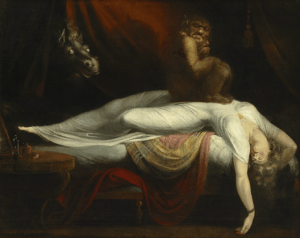
Henry Fuseli, "The Nightmare," 1781, exhibited in 1782 at the Royal Academy of London (Detroit Institute of Arts)
Abstract: Henry Fuseli’s painting The Nightmare (1782), unusual in the artist’s oeuvre and in the painting of its time as the public visualization of a private mental state, can be made sense of in light of late eighteenth-century practices and theories of privacy and of the agency that minds can exert on the world on on each other. By comparison with another dream-like performance, Emma Hamilton’s Attitudes, and informed by David Hume’s theory of sympathy, which was designed to explain the social communicability of mental states, a reading of The Nightmare emerges which shows that it did not aim to make visible dream imagery, but to induce spectators to have or feel as if they had an analogous experience. The painting is thus typical of the formative stage of a modern understanding of public life as a contingent
association of private lives.
Andrei Pop studied art history at Stanford and Harvard Universities and is a postdoctoral fellow at the Universität Berlin. The present essay is part of Neopaganism, a book in progress on the cultural politics of classicism. His article on Fuseli and tragedy will appear in the March 2012 Art Bulletin. His translation, together with Mechtild Widrich, of Karl Rosenkranz’s Aesthetics of Ugliness (1853) is forthcoming.
◊ ◊ ◊ ◊ ◊
Steven Adams, “Amateurs and Revolutionaries in Eighteenth-century France,” Art History 34.5 (November 2011): 1042-46.
 Review of Charlotte Guichard, Les Amateurs d’art à Paris au XVIII siècle (Paris: Champ Vallon, 2008); Laura Auricchio, Adélaïde Labille-Guiard: Artist in the Age of Revolution (Los Angeles: Getty Publications, 2009); and Rolf Reichardt and Hubertus Kohle, Visualizing the Revolution: Politics and the Pictorial Arts in Late Eighteenth-century France (London: Reaktion Books, 2008).
◊ ◊ ◊ ◊ ◊
Marion Endt-Jones, “Commemorative Reconsiderations,” Art History 34.5 (November 2011): 1053-56.
 Review of Diana Donald and Jane Munro, eds., Endless Forms: Charles Darwin, Natural Science, and the Visual Arts (New Haven and London: Yale Center for British Art, 2009); and Andrew Graciano, ed., Visualizing the Unseen: Imagining the Unknown, Perfecting the Natural: Art and Science in the 18th and 19th Centuries (Newcastle: Cambridge Scholars Publishing, 2008).
◊ ◊ ◊ ◊ ◊
Editor’s Note: At February’s CAA meeting in Los Angeles, there is an entire session, sponsored by the Midwest Art History Society, on the subject of The Nightmare. -CH.
Icons of the Midwest: Henry Fuseli’s Nightmare
Wednesday, 22 February, 12:30–2:00
Chairs: Laura Gelfand (Utah State University) and Judith Mann (Saint Louis Art Museum)
• Salvador Salort-Pons (Detroit Institute of the Arts), Living with Fuseli’s Nightmare
• Beth S. Wright (University of Texas at Arlington), ‘As I Was Perpetually Haunted by These
Ideas’: Fuseli’s Influence on Mary Shelley’s Mathilda and Frankenstein
• Scott Bukatman (Stanford University), Dreams, Fiends, and Dream Screens
Holiday Gift Guide, Part 1: Music
Wondering what to get the dix-huitièmiste in your life for the holidays? This year at Enfilade, we’re here to help with our first (annual?) gift guide. Before the week is over, we’ll cover food, drink, travel, and some lovely finds from museum gift shops. From the accessible to the purely aspirational, you’ll at least get a wide variety of ideas. And the postings provide a fine chance to consider some of the things the past year has brought to the marketplace. Michael Yonan brilliantly kicks off the series with his top music picks. Feel free to add your own ideas in the comments sections, and enjoy! -CH
◊ ◊ ◊ ◊ ◊
By Michael Yonan
 The classical music recording industry, we are told, is dying, but you’d never know that when looking at new releases of eighteenth-century music. There were so many new recordings issued this year that even an avid music lover couldn’t possibly keep up with them. In the realm of opera alone, 2011 saw new releases of Handel’s Agrippina, Ariodante, and Alessandro Severo; Vivaldi’s Ottone in Villa, Il Farnace, and Teuzzone; Telemann’s Germanicus, and even José de Nebra’s Spanish-language Iphigenia en Tracia, first performed in Madrid in 1747. These appeared alongside literally dozens of new instrumental music recordings. The following is, therefore, a highly personal list that reflects my fancies and predilections, but all are also critically acclaimed recordings and easy to acquire.
 1. François-André-Danican Philidor, Sancho Pança (Naxos) This is an opéra comique first performed at Fontainebleau in 1762, realized by Opera Lafayette, a period-instruments group based in Washington, D.C. The story is based on Cervantes’s novel, but only loosely: here Sancho Panza is the governor of an imaginary island and suffers from delusions of grandeur not unlike those of his onetime master.
2. Gluck, Ezio (Virgin Classics) The 1750 version of Gluck’s opera, first performed in Prague in 1750. An international cast and liner notes by ASECS regular Bruce Alan Brown!
3. Johann Sebastian Bach, Cantatas BWV 82, “Ich habe genug,” and BWV 169, “Gott soll allein mein Herze haben,” Andreas Scholl, countertenor, and the
Kammerorchester Basel (Decca) Could this be the most
beautiful countertenor voice in the world? I think so.
 4. Carl Philipp Emanuel Bach, Sei concerti per il cembalo concertato, Wq43 (Harmonia Mundi) With Andreas Staier, harpsichord, and Petra Müllejans conducting the superb Freiburg Baroque Orchestra.
5. Handel, Amor Oriental: Händel alla Turca (Dhm) For something completely different, an interesting attempt to program works by Handel with performances by a traditional Turkish sufti singer.
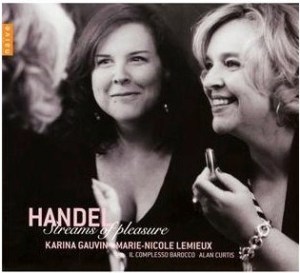
6. Handel, Streams of Pleasure, Karina Gauvin and Marie-Nicole Lemieux, with Il Complesso Barocco conducted by Alan Curtis (Naïve Classique) My top recommendation. Two extremely gifted French Canadian singers
with beautiful voices—Gauvin is a coloratura soprano, Lemieux a
true contralto—performing arias and duets from Handel’s English-
language oratorios.
◊ ◊ ◊ ◊ ◊
Michael Yonan is Associate Professor of Art History at the University of Missouri-Columbia. His book, Empress Maria Theresa and the Politics of Habsburg Imperial Art, appeared earlier this year from Penn State University Press (and would itself make for a lovely gift!).
November Issue of ‘The Burlington’
The Burlington Magazine 153 (November 2011)
 Articles
• Gauvin Alexander Bailey and Fernando Guzmán, “The ‘St Sebastian’ of Los Andes: A Chilean Cultural Treasure Re-examined,” pp. 721-26. — A discussion of the polychrome statue of St Sebastian (c.1730-35) in Los Andes, Chile, which is here attributed to Adam Engelhard.
• Chiara Teolato, “Roman Bronzes at the Court of Gustavus III of Sweden: Zoffoli, Valadier and Righetti,” pp. 727-33. — The provenance and installation of Roman bronzes by Giacomo Zoffoli, Luigi Valadier and Giovan Battista Piranesi in the collection of Gustavus II of Sweden.
Reviews
• Tommaso Manfredi, Review of Heather Hyde Minor, The Culture of Architecture in Enlightenment Rome (University Park: Penn State University, 2010), p. 749.
Reviewed: ‘Pierre Jacques Volaire (1729-1799)’
Recently added to The Art Tribune:
Emilie Beck Saiello, Pierre Jacques Volaire (1729-1799), dit le Chevalier Volaire (Paris: Arthena, 2010), 486 pages, ISBN: 9782903239435, 119€ / $175.
Reviewed by Bénédicte Bonnet Saint-Georges; posted 31 October 2011.
 He does not lie in the pantheon of great artists and his work does not fall under the genre of grand painting; some would even say that his art is repetitive, a succession of views of Mount Vesuvius meant to sell briskly as souvenirs of the Grand Tour. Emilie Beck Saiello has nevertheless set out to reinstate the artistic legacy of Pierre Jacques Volaire, known as the Chevalier Volaire, by publishing the catalogue raisonné of his works at Arthena Ed. She explains that ‘art history is not made up of only great masters just as history is not made up only of great men and the study of a successful or “commercial” artist might lead us to discover how his work reflected the taste, culture and aesthetics of a certain period and was able to express a moment, a place and a society.’ . . .
The full review is available here»
Reviewed: The Intelligence of Tradition in Rajput Court Painting
Recently added to caa.reviews:
Molly Emma Aitken, The Intelligence of Tradition in Rajput Court Painting (New Haven: Yale University Press, 2010), 352 pages, ISBN: 9780300142297, $65.
Reviewed by Catherine Glynn; posted 21 October 2011.
“Why Rajput paintings look the way that they do” is the enormous concept that Molly Emma Aitken addresses in ‘The Intelligence of Tradition in Rajput Court Painting’. Fortunately for readers entering into her innovative and complex thinking, Aitken is especially gifted in her word choice, graphically evocative, and the book is filled with well-reproduced images of stunning Rajput paintings. Her descriptions of the paintings and the artists who produced them give both the seasoned scholar and uninitiated reader a series of intriguing ideas to ponder.
Aitken’s premise is concisely explained in her introduction: conventions used in Rajput painting were purposefully developed; painters made choices based on intent. As she posits, much past analysis by scholars of Indian painting has juxtaposed “a simple, archaic aesthetic [Rajput painting] against a technically advanced idiom [Mughal painting]” (11). It is Aitken’s contention that Rajput painters were skilled in their own aesthetic, taking what they deemed useful from Mughal painting and rejecting those elements that did not fit into their vision. It was not a question of ability—the Rajput painters were able to paint in any style that they chose—it was a question of choice.
The full review is available here» (CAA membership required)
The Eighteenth Century in the October Issue of The Burlington
The Burlington Magazine 153 (October 2011)
◊ ◊ ◊ ◊ ◊
Editorial
• The Holburne Museum, Bath
 . . . Earlier this year, the Museum received extensive publicity when it re-opened after renovation and an extension carried out by Eric Parry Architects. This has included the daring and entirely successful moving of the central staircase of the house, to a few feet to the left, unblocking the vista through the ground-floor entrance to the gardens at the back; a beautiful full-height glass extension to the rear of the building that creates temporary exhibition rooms and a greater feeling of light and air; and the almost complete redisplay of the collections. While it has to be admitted that the Museum is distinctly eclectic and charmingly provincial (and in places still fussily crowded), in its renovated state its former shabby gentility has been vanquished. It now presents itself like Gainsborough’s Lord and Lady Byam, stepping out with the next generation, all in their finery, to greet the future.
The full editorial is available here»
◊ ◊ ◊ ◊ ◊
Articles
• Antonello Cesareo, “New Portraits of Thomas Jenkins, James Byres and Gavin Hamilton” — Two new portraits of Thomas Jenkins and James Byres by Anton von Maron and a self-portrait by Gavin Hamilton.
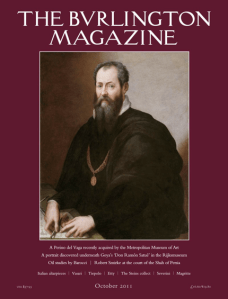
• Christopher Baker, “Robert Smirke and the Court of the Shah of Persia” — A watercolour study by Robert Smirke in the National Gallery of Scotland, Edinburgh, for a painting of the court of the Shah of Persia.
• Duncan Bull and Anna Krekeler, with Matthias Alfeld, Doris Jik, and Koen Janssens, “An Intrusive Portrait by Goya” — The discovery of an earlier three-quarter length portrait of a man by Goya beneath his Portrait of Ramón Satué (1823) in the Rijksmuseum, Amsterdam.
◊ ◊ ◊ ◊ ◊
Books
• Philip McEvansoneya, Review of N. Glendinning and H. Macartney, eds., Spanish Art in Britain and Ireland, 1750–1920: Studies in Reception in Memory of Enriqueta Harris Frankfort.
• Mark Stocker, Review of M. Kisler, Angels and Aristocrats: Early European Art in New Zealand Public Collections.
• Luke Herrmann, Review of M. and J. Payne, Regarding Thomas Rowlandson (1757–1827): His Life, Art & Acquaintance and P. Phagan, Thomas Rowlandson: Pleasures and Pursuits in Georgian England.
◊ ◊ ◊ ◊ ◊
Exhibitions
• Xavier F. Salomon, Young Tiepolo
New Film: ‘Mozart’s Sister’
Mozart’s Sister, from French director René Féret, is now playing in select theaters. -AS
Reviewed by Manohla Dargis for The New York Times (18 August 2011) . . .

A 1779 portrait of the Mozarts: Nannerl, Wolfgang and their watchful father Leopold. Image Credit: Hulton Archive/Getty Images
Mozart’s Sister has just started when the French director René Féret makes the point that his fictional look at the early life and times of Wolfgang Amadeus isn’t interested in the pretty manners and nostalgia of many period movies. In truth, the film has little to do even with Wolfgang, a side note in a story focused on his only sister who’s first seen squatting on the side of a road taking care of business at a short distance from her similarly engaged father, mother and brother. This is the Family Mozart, Mr. Féret seems to declare with this scene, stripped down and at their most human.
That sister, Maria Anna Walburga Ignatia Mozart, born in 1751 and known as Nannerl, was said to posses a rare talent that, by some accounts, this film included, nearly rivaled that of her brother. Played by Marie Féret (the filmmaker’s daughter), Nannerl is an attractive, obedient and rather opaque 14-year-old going on 15, given to watchful silences and long looks at Wolfgang (David Moreau), who was younger by four and a half years. They were the only children out of the seven born to Leopold (Marc Barbé) and Anna-Maria (Delphine Chuillot) to survive childhood. If the calamity of those deaths weighed on the family it doesn’t register in “Mozart’s Sister,” which unfolds at the end of a long tour that began in 1763 when Wolfgang was 7.
Drawing on Leopold’s letters, among other sources, Mr. Féret paints a speculative, intimate portrait of a family bound by love, genius and ambition and almost undone by the same. . . .
For the entire review, visit The New York Times
◊ ◊ ◊ ◊ ◊










 Enfilade
leave a comment