Reviewed: Portrait of the County of Dorset
Notice of the exhibition appeared here back in February. Alex Kidson’s recent review is, however, much more illuminating — and laudatory — than the general description.
Alex Kidson, “Review of Georgian Faces: Portrait of a County,” The Burlington Magazine 153 (April 2011): 274-75.
Anyone expecting . . . the kind of celebratory ‘treasures from local houses’ show that was a staple of regional museums until the later part of the last century is in for a surprise. The sixty-seven portraits that make up this exhibition are for the most part not masterpieces; but they have been selected with immense rigour. . . Gwen Yarker, the curator, for whom the show is a triumph, has lived in Dorset for many years, and her understanding of the history of the county is apparent at every turn. She has explicitly based her selection on the structure of the Revd John Hutchin’s ‘History and Antiquities of the County of Dorset’ of 1774, with its emphasis on social hierarchy, and has given full weight to eighteenth-century modes of patronage. She fearlessly prefers, for example, to include replicas over originals to remind us that our present-day obsession with ‘originality’ is not one that was shared in the eighteenth century. . . .
Yet in Yarker’s text [for the catalogue], as well as with her selection, art-historical revisionism is far from suppressed. . . . In fact, the show is full of art-historical trouvailles. . . . It seems almost an understatement to say that the exhibition is at the forefront of the current study of eighteenth-century British portraiture. More than that, in its concern for local detail, its accuracy, but also its willingness to confront problems and to speculate, it points the way forward for future research. In revealing just how powerfully the old county structure acts as a focus of inquiry, it occupies some of the same research terrain as the catalogues of the Public Catalogue Foundation, or some of the initiatives of the National Portrait Gallery’s Subject Specialist Network project Understanding British Portraits (which supported the exhibition’s study day); yet its impact is far more direct and forceful than theirs. . . What takes this exhibition out of the realms of the remarkable and into those of the miraculous is that it was accomplished on a budget of £1000. . . .
Reviewed: ‘Gem Engraving in Britain from Antiquity to the Present’
Recently published by Apollo Magazine:
Julia Kagan, Gem Engraving in Britain from Antiquity to the Present (Oxford: Archaeopress, 2010), ISBN 9781407305578, £80 / $160.
Reviewed by Diana Scarisbrick; posted 1 April 2011.
Neglected for years, the study of English glyptics has recently taken on a new lease of life. Following the publication of Professor Sir John Boardman’s ‘The Marlborough Gems’ (2009) and of his catalogue, co-authored by Kirsten Aschengreen Piacenti, of the collection of HM Queen Elizabeth II, it is now the turn of Julia Kagan. Here, she tells the whole story, from its roots in the mid-1st- century-BC Roman invasion up to modern times, bringing together in chronological sequence the many artists, patrons, collectors and scholars involved. Her narrative is easy to read, fully illustrated, with every statement supported by a reference, helpfully inserted into the text and not relegated to the back of the book. . . .
The full review is available here»
Reviewed: ‘Early Georgian Furniture’
Adam Bowett, Early Georgian Furniture 1715–1740 (Woodbridge, UK: Antique Collectors’ Club, 2009) 328 pages, ISBN: 9781851495849.
Reviewed for Enfilade by David Pullins
 In the preface to Adam Bowett’s first book English Furniture 1660–1714 From Charles II to Queen Anne (2002), he wrote “I have attempted to write this book from first principles and, in the main, from primary evidence — bills, inventories and, of course, the furniture itself” (10). In Bowett’s latest work, Early Georgian Furniture 1715–1740, he pursues this disciplined and productive approach, providing numerous correctives to the sloppy dating that has infiltrated not only the antiques trade but also academic publications on English furniture. In particular, his research reveals the dangers of back-dating in the field, which, he argues, has created stylistic vacuums, particularly for the period of the 1720s and 1730s. In order more precisely to date a given form or motif, Bowett focuses on “fashionable furniture” — which is to say items typically produced in London for less than ten percent of the population. While this might at first appear to limit the usefulness of his study beyond the most rarefied examples, his point is not so much to disregard less elevated or vernacular examples but to provide solid points of departure through vanguard furniture. A trickle-down effect, largely accepted by most scholars who examine commerce during the period, is therefore a basic premise of the study. For readers aiming to identify and date a given piece of furniture, this method — along with the structure of the book, which is divided into six chapters according to form (e.g., “Seat Furniture” or “Mirrors”) — results in a remarkably user friendly text that, through a rich range of intelligently selected illustrations, can help contextualize furniture of varied quality and geography.
While Bowett’s meticulously documented corrections to the accepted chronology of English furniture will probably prove the strongest case for the importance of his book, the contribution he offers expands beyond issues of dating. Bowett’s primary research has revealed a fascinating body of information on the training of craftsmen, power structure in the workshop and the intricacies of interaction between patrons and furniture makers. By looking at contemporary documents, including inventories, trade-cards and labels (many of them illustrated), Bowett is able better to define basic terms used to describe furniture forms and the division of labor in the trade between, for example, turners and chair-makers or cabinet-makers and carvers. In the best case scenarios, contemporary descriptions are matched with the surviving work allowing us better to describe undocumented pieces of furniture and better to imagine pieces which are known now only through written descriptions. Bowett also lays the groundwork for understanding two especially complex issues relevant to his subject, the timber trade and the influence of East Asian furniture on English stylistic developments. While expanding on either topic would have greatly enriched his book and its relevance apart from the objects immediately at hand, he wisely curtails his discussion within the context of a self-acknowledged survey (though East Asia appropriately reappears in his description of the development of the cabriole leg, the top rails and back splats of early Georgian chairs).
In addition to Bowdett’s primary concern with form, this survey is also notable for its detailed account of gilt furniture (an important counterpoint to the materials caught in the colloquial phrase “Age of Walnut” to describe the period) and japanned surfaces, which Bowett first treated with considerable care in his earlier book on the preceding period. Both kinds of decoration remind us of the resilience of baroque modes well into the eighteenth century which issues of condition have sometimes occluded.
Bowett’s reappraisal of early Georgian furniture stands out as arguably the most important since R.W. Symonds’s classic texts from the 1920s through 1950s and the Dictionary of English Furniture (last revised in 1954), all of which continue to be used regularly by scholars. At two to three color illustrations per page, each given a detailed caption, the book moves beyond what earlier authors could offer while retaining their high standards of archival research. Following from his earlier work on furniture from Charles II through Queen Anne, Bowett’s book also paves a carefully plotted path for his next anticipated project devoted to the rise and influence of the most famous English cabinet-maker, Thomas Chippendale.
David Pullins is a Ph.D. candidate in History of Art and Architecture at Harvard University. His research addresses the circulation of images across media in eighteenth-century France.
Reviewed: ‘Italy’s Eighteenth Century’
Recently added to caa.reviews:
Paula Findlen, Wendy Wassyng Roworth, and Catherine M. Sama, eds., Italy’s Eighteenth Century: Gender and Culture in the Age of the Grand Tour (Stanford: Stanford University Press, 2009), 504 pages, ISBN: 9780804759045, $65.
Reviewed by Sarah Betzer, McIntire Department of Art, University of Virginia; posted 31 March 2011.
Following an efflorescence of critical work on the subject over the last twenty-five years, the European Grand Tour has emerged as a focus of innovative interdisciplinary scholarship. The significance of ancient and Renaissance art to the Grand Tour itinerary—together with the emergence of modern display practices and attendant opportunities for the exercise of aesthetic judgment—have conspired to guarantee the Grand Tour’s special appeal to art historians. The subject’s enduring interest is surely also due to the fact that it has proven especially fertile ground for art history’s disciplinary move toward thinking beyond national borders. The Grand Tour was founded on the experience of boundary crossing, and the best recent work on the subject has explored how the touristic encounter with real and imagined Italian geographies put productive pressure on national, class, and gender identities. “Italy’s Eighteenth Century: Gender and Culture in the Age of the Grand Tour” is an important addition to this literature, charting new territory by examining Italy in the age of Enlightenment with a view from inside.
Like Paula Findlen’s excellent introduction, the collection reflects a “multidisciplinary conversation about the state of this field” (1), with authors hailing from the history of science, history of art, history of music, literature, and gender studies. The collection makes available in English the recent work of established Italian scholars who are united with their North American counterparts by their scrupulous mining of archival sources; the generous footnotes shed light on a veritable treasure trove of primary documents.
The volume’s ambitious core contribution is couched methodologically: to unsettle the tendency to examine Italy of the Grand Tour primarily through the eyes of foreign visitors whereby “Italy” emerges as a sort of afterimage, a composite of lived experiences, mythic tropes, and memories. This approach, shared by many of the foremost Grand Tour scholars, has yielded fundamental insights about foreign perceptions of Italy, albeit one that Findlen observes can threaten to reduce the site to “an itinerary rather than a living, breathing entity” (4). This volume proposes to expand our understanding of the place and period by examining the particular cultural episodes of the Italian peninsula “in its own terms” (7). . . .
The full review is available here» (CAA membership required)
Reviewed: ‘Artistic and Cultural Exchanges between Europe and Asia’
Recently added to caa.reviews:
Michael North, ed., Artistic and Cultural Exchanges between Europe and Asia, 1400–1900: Rethinking Markets, Workshops and Collections (Burlington, VT: Ashgate, 2010), 216 pages, ISBN: 9780754669371, $114.95.
Reviewed by David Carrier, Case Western Reserve University/Cleveland Institute of Art; posted 24 March 2011.
The necessary precondition for a world art history is the close study of cultural exchanges. Even nowadays, when you can travel from New York to Beijing in less than a day, the distance between America’s and China’s visual cultures is still immense. When such travel was much slower, and curators were not much concerned with exotic art, the diverse artistic traditions were relatively self-sufficient. But once Vasco da Gama circumnavigated the globe, it was inevitable that those artifacts called works of art would move from their places of origin to other cultures. The world had become one, which is to say that all art traditions were interconnected. This, then, is why close analysis of the slow-moving process in which Europeans brought their art to China, India, and other places outside the West, as well as collected non-European art, is extremely important.
“Artistic and Cultural Exchanges between Europe and Asia,” an anthology that collects the proceedings of a conference held in Sydney in 2005, contains an introduction by Thomas DaCosta Kaufmann and Michael North, and essays by Karl-Heinz Spiess on Asian artifacts in Western European courts during the Middle Ages; Peter Borschberg on the trade in Bezour stones, the minerals believed to possess magical properties; Ting Chang on French fantasies about Asia; Martin Krieger on Dutch collecting in colonial India, circa 1800; Alexander Drost on Mughal architecture as it was incorporated into European memorials in seventeenth-century India; North on art making by European companies in Asia; Mia Mochizuki on the uses of Dutch maps in Japan; Kaufmann on markets in Funi-e; and Yoriko Kobayashi-Sato on the relationships between Japan and the West during the Edo period. . . .
The full review is available here» (CAA membership required)
Review: Amanda Lahikainen on Thomas Rowlandson
The Rowlandson exhibition opens next week at The Frances Lehman Loeb Art Center at Vassar College (8 April — 11 June 2011). And so in a timely manner, Amanda Lahikainen here inaugurates a new feature of Enfilade, original reviews. They won’t become a major feature of the site anytime soon, but there are a few more on the way.
Patricia Phagan, Vic Gatrell, and Amelia Rauser, Thomas Rowlandson: Pleasures and Pursuits in Georgian England (London: D. Giles Limited, 2011), 184 pages, ISBN: 9781904832782.
Reviewed for Enfilade by Amanda Lahikainen
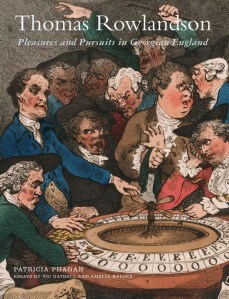 The lens of social life and social mixing frames the exhibition and accompanying catalogue, Thomas Rowlandson: Pleasure and the Pursuits in Georgian England. It’s a concept that Rowlandson himself might have chosen for such an exhibition of his own work. The show and catalogue stress the importance of broad historical contextualization, with an emphasis on pleasure and socialization in England during Rowlandson’s life (1757-1857). Edited by the exhibition’s curator, Patricia Phagan, the catalogue divides Rowlandson’s prints into six categories, each with an introductory essay, including images of street life and scenes from the theater. The color photographs are generously sized, and the entries aid readers both in deciphering the social and political references within the satires and in contextualizing the prints within the market for satire more generally. Entry #9, for instance, includes a caricature by the cotemporary satirist James Gillray for comparison, and entry #27 allows us to compare Rowlandson’s print The Brilliants to its likely predecessor, A Midnight Modern Conversation by William Hogarth. Readers find detailed information about Rowlandson’s life and the placement of his work within Britain’s hierarchy of genres. Also included is discussion of his pornographic subject matter and boisterous tavern scenes so important for an artist who relished whimsical and grotesque vignettes from common life. Fortunately, the catalog offers multiple points of engagement between “high art” and “low art,” thereby problematizing facile distinctions that have long plagued scholarly assessments of Rowlandson.
Especially valuable for British art studies are the two essays by Vic Gatrell, a historian, and Amelia Rauser, an art historian. Both scholars have recently published important books on graphic satire, in 2006 and 2008 respectively, and they usefully approach Rowlandson’s art from different perspectives. Gatrell lays bare the complex network of print makers and artists that defined Rowlandson’s world and visualizes this history using a detailed topographical map of Covent Garden and the Strand, an area of London which he describes as the “emotional heartland and a chief source” of Rowlandson’s comic vision. Toward the end of the essay, he tackles the critical reception of Rowlandson; this section is well worth reading even as an abstract meditation on the values that often guide our judgments of prints, including anxieties about reproduction and the pitfalls of strict subject categories.
Rauser’s essay asks us to look closely at Rowlandson’s prints and acknowledge that his work often simultaneously captivates and repulses. She gives a compelling answer to the question of what makes Rowlandson’s satire distinctive. Starting from the observation that Rowlandson’s art is amoral, she identifies his “commitment to embodiedness” and bemused “ironic detachment” as exceptional strengths. Her point is a good one: Rowlandson deflates his subjects by relentlessly reminding his viewers that they inhabit a body bound by the laws of nature and desire. Whether or not we follow Rauser in thinking of Rowlandson’s unrelenting interest in the human body as a product of Romanticism or Gatrell in thinking of Rowlandson’s humorous and grotesque bodies as responses to the growing wealth of the middle-class print buyers, we can agree that Rowlandson handles the human form to great effect. It is perhaps because of his disregard for didactic messages that he so successfully demonstrates the absurdity of social norms, especially deflating the rich and powerful along the way.
Amanda Lahikainen, a Ph.D. candidate at Brown University, is finishing her dissertation on the representation of abstract ideas in British graphic satire during the French Revolution. She has an article forthcoming in Print Quarterly and is currently working towards writing a book on the embodiment of debt in satire over the course of the eighteenth and nineteenth centuries.
Reviewed: ‘The City’s Pleasures: Istanbul in the Eighteenth Century’
From The Art Bulletin 93 (March 2010): 101-04.
Shirine Hamadeh, The City’s Pleasures: Istanbul in the Eighteenth Century (Seattle: University of Washington Press, 2007), 368 pages, ISBN: 9780295986678, $60.
Reviewed alongside Cigdem Kafescioglu’s Constantinopolis/Istanbul: Cultural Encounter, Imperial Vision, and the Construction of the Ottoman Capital (2009) and Murat Gül’s The Emergence of Modern Istanbul: Transformation and Modernisation of a City (2009).
Reviewed by Robert S. Nelson, Yale University.
. . . Hamadeh defines the character of a period through its buildings. Especially noteworthy is her use of poetry and building inscriptions. And, like Kafescioglu, she discusses vision, power, and the location of buildings . . . . she relies on the concept of ‘pleasure’ in the title and, behind it, a more fundamental notion of public space, adapted from Jürgen Habermas and others, that did not exist in the earlier centuries. Istanbul in the eighteenth century resembles John Brewer’s view of London from the late seventeenth century, in which ‘high culture moved out of the narrow confines of the court and into diverse spaces’ [The Pleasures of the Imagination, p. 3]. Finally, while her book is firmly ensconced in Turkish studies, the author also situates it laterally in early modern studies and critiques Westernization theories of
Ottoman architecture, that is, the notion that it follows at a
distance fashions set elsewhere. . .
Book Review: ‘Thomas Roberts’ Catalogue
From the February issue of Apollo Magazine:
William Laffa and Brendan Rooney, Thomas Roberts (1748-1777): Landscape and Patronage in Eighteenth-Century Ireland, exhibition catalogue (Tralee: Churchill House Press for the National Gallery of Ireland, 2009), 416 pages, ISBN: 9780955024634, $110.
Reviewed by Toby Barnard, Hertford College, Oxford University; posted 1 February 2011.
Thomas Roberts (1748–77) blazed briefly across the Irish skies in the 1770s. Little in Irish painting before that decade prepared for his sudden appearance on the scene. At that time in 18th-century Ireland, the techniques and subjects of Claude, Poussin and Salvator Rosa appealed to artists and collectors alike. A succession of painters – Willem van der Hagen, Robert Carver, John Lewis and Joseph Tudor – assimilated the conventions and demands of pastoral landscape painting, and created decorative but generalised images. Roberts, in contrast, applied these classical dressings to recognisable Irish scenes. The results, seen in a revelatory exhibition at the National Gallery in Dublin in 2009, encompass the mansions and demesnes of Protestant grandees and remoter views of the west, notably the modest townships of Ballyshannon and Belleek. . . .
The full review is available here»
Reviewing for Enfilade
From the Editor
I recently received three books with requests that I consider publishing reviews of them here at Enfilade. Given that expanding the site’s original content is one goal, I’m certainly open to the idea. Consequently, I’m writing to solicit reviewers. In many ways, Enfilade remains a work-in-progress, and I would imagine this new direction (even if it succeeds) will call for adjustments along the way. I would like to propose the following ideas as a starting point. I welcome any feedback or advice readers might have.
A. Reviewers must be HECAA members in good standing.
B. Given that Enfilade is intended to serve as a newsletter for those interested in eighteenth-century art and architecture — as opposed to serving as an academic journal in its own right — it seems that the goal of a review at Enfilade is different than a review published in an academic journal. Description of contents and assessment of potential audiences are probably more important, for instance, than teasing out the nuances of a particular argument. An informed characterization premised on the scholarly expertise of the reviewer should still be an important goal, but the model for emulation might be more akin to a brief notice in The New York Review of Books or the TLS than The Art Bulletin or Eighteenth-Century Studies.
C. The blog format lends itself to relatively brief postings: 400-800 words might be an appropriate length. Prompt turn-around seems especially important for a newsletter format, and again the brevity should help in this regard.
D. One big problem: HECAA has no budget to fund the logistics of reviewing books (Enfilade costs absolutely nothing to produce). If publishers send me books, I have no money to send out copies to reviewers. In the case of the three books at hand, I’m happy to haul them to New York with me for CAA and distribute copies there (likewise with ASECS in Vancouver). Otherwise, I think the cost of shipping would have to be paid by the reviewer. It’s less than ideal, but given the cost of art books (easily ranging from $50 to 125), paying several dollars for shipping is perhaps not unreasonable.
The three books I presently have address two current exhibitions in the United States and the topic of eighteenth-century furniture. If you would like to be added to the list of potential reviewers, please send me an email outlining your particular areas of expertise (a brief CV would be helpful, too). Graduate students are encouraged to contribute, though any member of HECAA should feel free to volunteer. Again, I welcome your suggestions. -C.H.
Conference Review: Does the Picturesque Have a Future?
Recently added to caa.reviews:
Conference — Emerging Landscapes: Between Production and Representation (London: University of Westminster, 25-27 June 2010).
Reviewed by Samantha L. Martin-McAuliffe, School of Architecture, University College Dublin; posted 11 January 2011.
. . . When the conference had seemingly reached the point where an obituary for the Picturesque seemed inevitable, Jonathan Hill (The Bartlett, University College London) delivered his keynote address, “Weather Architecture,” in which he called for a redemption of the tradition. Through a considered reflection on John Soane’s house in Lincoln’s Inn Fields and J. M. W. Turner’s London studio, Hill explained how the Picturesque attended to important themes, such as mortality, history, and, notably, the environment. Because this tradition aligned with topics such as the seasons and the senses (and hence the weather), the places it qualified were never static, but always emerging and forever changing. From this stance, the Picturesque is seen not so much as a formal model for construction that is fixed to a particular historical period, but instead as a sensitivity toward the surrounding world and its manifold processes—time, temperature, narrative. Is it possible, therefore, to recast the role of the Picturesque within contemporary landscape studies? Can it help the invisible yet constantly present conditions of the environment rise into notice? . . .
For the full review, click here» (CAA membership required)










 Enfilade
leave a comment