January’s Numbers
I’m delighted to report that Enfilade continues to grow. January was another record month with 3,300 individual visitors and 330 return readers. It’s exciting to see increases in both numbers. So thanks very much to all of you — whether you’re new to the site or a regular reader by now!
We intend to discuss ideas for the site with HECAA members at the annual ASECS meeting in Albuquerque (including the addition of several new editors). I certainly welcome any feedback you may have before then as well. Next week, I shall be in Chicago for the annual CAA conference and would be delighted to hear any concerns, suggestions, or ideas you may have about the site. And by all means, please continue to send announcements and news items you would like to see posted. Thanks so much!
-Craig Hanson
Warmest Wishes
With the semester over, grades turned in, and a day to catch my breath before Christmas, I won’t be posting as regularly during the next two weeks. By all means, though, please continue to send any announcements or news items you may have. Thanks so much for your support of Enfilade and all the best for whatever moments of peace you can squeeze in before the new year!
–Craig Hanson
Site Logistics
Editor’s Note
October was another record-breaking month for HECAA’s Enfilade, with over 2600 individual visitors and 243 visits from return readers. Both numbers are important. The former points to the site’s ability to attract an ever-widening audience while the latter suggests the degree to which there’s a genuine match between visitors’ interests and the site’s content (it’s encouraging to see continued increases in both numbers). For HECAA members, this means there is a substantial audience for your submissions. So by all means, send in announcements and updates on your work!
 Earlier this week, Enfilade was honored with an Amadeus Award from the Official Weblog of Wolfgang Amadé Mozart! Blogs set in the twenty-first century are all well and good, but the potential for historical figures’ uses of digital formats is especially intriguing. One can, for instance, now follow John Quincy Adams on Twitter. I know of no eighteenth-century artists or collectors with equivalent sites, though it’s easy to imagine such a thing (please send in links if you know of any examples). Danke schön, Herr Mozart!
Finally, I’ve included below excerpts from a message from the Great Minds at WordPress.com, the platform on which Enfilade is built. The memo underscores their committment to adapting WordPress sites to viewers’ patterns of use, including mobile devices such as the iPhone and Blackberry (in fact, Enfilade now looks terrific on the former). Thanks again to everyone for reading.
Craig Hanson
New smartphones do a great job with most web sites, but older phones have many problems and may not display anything at all. Today we’re launching a couple of mobile themes that will automatically be displayed when your blog is accessed with a compatible mobile phone. The first theme is a modification of WPtouch and will be displayed to phones with modern web browsers like those on the iPhone and Android phones. The second theme was developed from an older version of the WordPress Mobile Edition and will be displayed to all other mobile devices. Mobile visitors greeted by WPtouch will get easy access to posts, pages, and archives. They’ll get fancy AJAX commenting and post loading. . . . When viewing your blog on other phones, the focus will be on loading the blog quickly while displaying the important information about your content.
Grazie Mille!
Editor’s Note
Whether you’re here for the twenty-fifth time or the first, thanks ever so much. After only a month, Enfilade has had just over a thousand visitors! Thanks especially to those of you who have sent in ideas. I’m more convinced than ever of the need for this kind of information entrepôt. In addition to serving the immediate function of communicating HECAA news, the site also aims to promote the field of eighteenth-century art history more generally. It is an extraordinary period for the visual arts, and we all probably could do a better job of making that case, both to academic colleagues and the broader public. If you’re not a HECAA member, you are by all means most welcome here. At the same time, we hope you’ll consider joining; at $20 it’s a bargain even during a recession (and just $5 for students).
In the coming weeks, you’ll hear directly from a widening range of voices – starting on Monday with an ‘On Site’ piece from Michael Yonan. So please continue to pass along notices regarding exhibitions, CFPs, and new books. But also consider submitting content of your own – reflections on particular aspects of the field, a response to a recent museum visit, a review of two or three articles linked by a common theme, or perhaps a favorite teaching assignment. I know all too well the tinge of panic that sets in at August: where has the summer gone, and how can I still have this much to do? But articles for Enfilade need not be long (300-600 words), and in contrast to most forms of academic publishing, you’ll have readers taking notice within a matter of days.
Thanks again for such a strong launch!
Craig Hanson
Housekeeping
First, thanks so much to all of you who’ve visited within the last few days! Julie Plax and I have received numerous messages full of kind expressions of encouragement. We really appreciate them all.
I should also say that I have been delighted with WordPress while getting Enfilade up and running. It’s been extremely user friendly. In the site’s current manifestion, it’s also free – which means HECAA funds can go toward other sorts of projects. Still, depending upon what we want from the site, at some point, a few inexpensive upgrades may be in order.
WordPress.com notes under Premium Featueres that “from time to time, we display text ads on your blog to logged-out users who aren’t regular visitors.”
I’ve no idea how frequently “from time to time” is nor what counts as a “regular” visitor (and I probaly will not since I likely won’t fall in either category). So this is really a request to Enfilade readers: in the event you do experience this site with ads, please let me know. To ensure that no visitor ever sees an ad, we can pay a modest annual fee. I would rather not, but I’m also averse to the ads. The site remains a work in progress. I appreciate your patience and feedback.
-C.A.H.
Introducing . . .
As the newsletter editor for HECAA, I hope to make this forum as useful as possible. When consulting a sampling of members about what kinds of information they hoped the newsletter might supply, I repeatedly encountered enthusiastic assertions that the newsletter could fill a vital niche. I heard overwhelming consensus that it would ideally not simply report upon members’ scholarly activities but also serve as a clearing house for information about eighteenth-century studies, that it would not simply mark past events but look even more diligently to the future. I envision entries on upcoming exhibitions, conferences and calls for papers, reviews, and notes on pertinent books and articles. I also hope that the forum will create a space for musings and observations from members that just don’t quite fit anywhere else in the world of scholarly expression. All of these functions should be served quite well by a blog, which can be easily updated and conveniently accessed. I am especially grateful to our former editor, Susan Dixon, who was especially helpful with the transition.
Finally, I should stress that Enfilade is very much a work in progress. I welcome your comments and suggestions.
-Craig Hanson
A Note on the Name
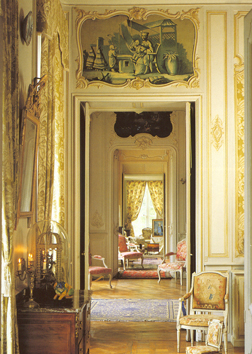
Jacques-François Blondel, Château de Vendeuvre (Normandy), 1750s. Wikimedia Commons.
Enfilade is intended to encapsulate the sense in which various entries are threaded together along a central axis (in this case the order of the postings).Throughout the eighteenth century — in the realm of the ideal plan as well as often enough in life itself — the enfilade served to organize space and vision.










 Enfilade
leave a comment