Mezzotint Collection May Go to the British Museum
Martin Bailey reports in The Art Newspaper, 21 October 2009:
British Museum to Acquire Major Print Collection
LONDON — The British Museum in London hopes to make its largest acquisition of prints since 1902. It wants to buy 7,250 mezzotints from Christopher Lennox-Boyd, a specialist who has assembled a collection of 50,000 during a period of 40 years. The British Museum has examined them all, selecting mezzotints (produced with a tonal printing method) from the 17th to 19th centuries, which it lacks. The agreed price is £1,250,000, an average of £170 each. . . .
For the full article, click here»
Raphael Drawing and Its Eighteenth-Century Provenance
As reported this week by various news outlets (including The Guardian, The Telegraph, and Reuters), a drawing by Raphael is up for auction in December. The Financial Times notes that “it comes to the block after the Fitzwilliam Museum in Cambridge was unable to raise funds over the summer to purchase the drawing by Private Treaty Sale.” As reported by Artdaily.org:
 LONDON — Christie’s will offer an exceptional drawing by Raphael (1483-1520) at the Old Masters and 19th Century Art Evening Sale on Tuesday, December 8, 2009 in London. Head of a Muse was drawn by the artist as a study for a figure in Parnassus, one of the series of four frescoes in the Stanza della Segnatura in the Vatican which was commissioned by Pope Julius II and which was executed between 1508 and 1511. This series is widely considered to be the artist’s greatest masterpiece. The drawing will be offered at public auction for the first time in over 150 years at Christie’s in December and is expected to realize £12 million to £16 million. The current record price for an old master drawing sold at auction is £8.1 million which was realized by Michelangelo’s Risen Christ at Christie’s in July 2000, and by Leonardo da Vinci’s Horse and Rider, also at Christie’s, in July 2001. . . .
The drawing was first recorded in 1725 when it was engraved by Bernard Picart to be published in Impostures Innocentes. At the time it belonged to the celebrated Dutch collector Gosuinus Uilenbroeck (d.1741) who assembled one of the most important private libraries of the period, together with a number of splendid old master drawings. The drawing was subsequently in the collections of Sir Thomas Lawrence (1769-1830), the distinguished painter who was also one of the most celebrated old master drawing collectors, and the future King William II of Holland (1792-1849) who assembled one of the finest art collections in Europe.
◊ ◊ ◊ ◊ ◊

Carolus de Aquino, "Sacra exequialia in funere Jacobi II. Magne Brittanniae Regis" (Rome, 1702)
From an eighteenth-century vantage point, it’s the provenance that’s especially interesting. Lawrence’s ownership is notable, but my hunch is that the “celebrated” Dutch collector, whose name is more commonly spelled Gosuinus Uilenbroek, is largely unknown even to dixhuitièmistes. Perhaps the sale of the drawing will help make him more familiar. The British Library’s Database of Book Bindings — a remarkable resource, incidentally — includes several examples from Uilenbroek’s library.
— Craig Hanson
Charlotte Vignon Takes up Curatorship at the Frick
The Frick’s first curator of decorative arts officially starts this month in her new position. As described in a press release from the museum:

Charlotte Vignon, Associate Curator of Decorative Arts, The Frick Collection (Photo: Michael Bodycomb)
The Frick Collection announces the appointment of Charlotte Vignon to the first curatorship dedicated to the museum’s impressive decorative arts collection. Vignon takes up the newly created post of Associate Curator of Decorative Arts in October 2009, a development that sets the stage for a deeper understanding of and focus on the institution’s holdings in this area. Comments Director Anne Poulet, “It has long been our desire to make our decorative arts holdings better known through improved displays, temporary exhibitions, publications, and educational programs. We were able to endow this position with the assistance of a generous challenge grant offered in 2007 by the National Endowment for the Humanities that has been matched three to one by a group of individuals and foundations. It is a pleasure to welcome Charlotte Vignon to this new post.” Adds Associate Director and Chief Curator Colin Bailey, “This is an extremely exciting moment for the Frick, as the addition of this significant position, which followed a competitive, international search, will allow us to interpret and present our collections more fully. Vignon brings a depth of knowledge of the decorative arts that is combined with a keen interest in American collectors, among them Henry Clay Frick and J. P. Morgan, as well as the dealer Joseph Duveen—a topic that is compelling in its own right and particularly so at the Frick. The post also represents a new collaboration with New York’s Bard Graduate Center, where Vignon will teach an annual seminar on the decorative arts, one of many ways in which this new curatorship is designed to contribute to the academic community.”

Pair of deep blue Chinese porcelain jars with French gilt-bronze mounts, 1700–49 (NY: Frick Collection)
A native of France, where she received her education and spent several fruitful years early in her career working as a researcher in the field of European decorative arts, Vignon comes to the position having also held three highly regarded fellowships at American museums, The Metropolitan Museum of Art, The Cleveland Museum of Art, and currently, The Frick Collection, where she is an Andrew W. Mellon Curatorial Fellow. In Cleveland, she held Andrew W. Mellon and Peter Krueger Christie Fellowships, and she worked on the first catalogue of that museum’s eighteenth-century decorative arts collection under the direction of Curator Henry Hawley. Her research resulted in the discovery of significant information about the provenance of objects and, in several cases, new identification and attributions. Vignon’s involvement in the activities of the department deepened over the course of four years, especially with Hawley’s retirement. Holding an Annette Kade Fellowship at The Metropolitan Museum of Art, she worked with curator Danielle Kisluk-Grosheide on a variety of projects, contributed to acquisition reports, and was engaged in research on the permanent collection, also resulting in new identifications.
For The Frick Collection, Vignon is currently developing a fall 2009 exhibition, Exuberant Grotesques: Renaissance Maiolica from the Fontana Workshop, for which she is also writing the catalogue. This project focuses on an important recent gift to the institution and follows the model of other critically acclaimed Cabinet presentations by examining an object in the context of important related works of art. She has also been working closely with Conservator Joseph Godla to present seminars on aspects of the Frick’s furniture collection and, while at all three museums, has frequently lectured and written articles on topics in the decorative arts and collecting.
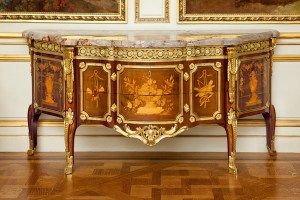
Commode with pictorial marquetry, made by Roger Lacroix under the direction of Gilles Joubert, Paris, 1769 (NY: Frick Collection)
This fall, she will complete her Ph.D. dissertation for the Sorbonne, Paris, on the dealings of the Duveen Brothers in European decorative arts and Chinese porcelains between 1880 and 1940. This is a topic of great relevance to the museum, as many of Henry Clay Frick’s purchases came through Duveen’s firm. The subject also relates to the focus of interest at the Frick’s recently established Center for the History of Collecting in America, based at its Art Reference Library.
Comments Vignon, “It is a privilege to join the Frick staff in this important new role, undoubtedly an opportunity of great possibilities. Today, the Frick is known for its Old Master paintings and sculpture, and I look forward to expanding the public’s understanding and appreciation of its superb collection of decorative arts through exhibitions and education programs. At the same time, I hope to bring the Frick into the forefront of scholarly research in the field through ground-breaking publications and creative courses at the Bard Graduate Center.”
◊ ◊ ◊ ◊ ◊
In The Magazine Antiques (30 June 2009), Vignon shares a selection of her favorite objects from the Frick Collection, including the jars and commode pictured above. Click here for the article»
Keats House in London Restored
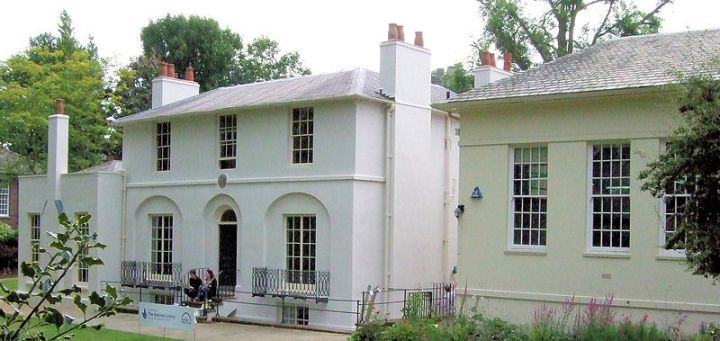 As noted in the London Times, the Guardian, the New York Times, and the Wall Street Journal (among others), the Keats House in London (Hampstead to be precise) has just reopened after a four-year restoration program. Work on the Grade I Listed building was funded by a Heritage Lottery Grant of £424,000. John Keats lived in the house from 1818 to 1820, just before his departure to Rome (you can also visit the house where he lived – and died – there, just five months into his Italian sojourn, by the Piazza di Spagna; it’s now the Keats-Shelley House Museum). It was in the garden of the Hampstead house that Keats wrote “Ode to a Nightingale.”
Mary Morton to Head French Paintings in D.C.
Press Release, dated July 31, from the National Gallery, Washington, DC:

Mary Morton, appointed curator of French paintings at the National Gallery of Art, Washington. Photo courtesy National Gallery of Art. Photograph by Jessica Robinson, 2009.
Mary Morton has been named curator and head of the department of French paintings at the National Gallery of Art by Director Earl A. Powell III. Morton’s appointment becomes effective in early January 2010, when she will oversee one of the world’s outstanding public collections of approximately 575 French paintings dating from the 17th to the early 20th century, as well as an active program of related exhibitions and acquisitions.
“Mary Morton brings to the National Gallery of Art a rich background steeped in academia and distinguished by curatorial positions at top museums, where she has been deeply involved in scholarly exhibitions and catalogues,” said Powell.

Antoine Watteau, "Italian Comedians," ca. 1720 (National Gallery)
Widely published, Morton has been associate curator of paintings at the J. Paul Getty Museum since 2004 and was associate curator of European art at the Museum of Fine Arts, Houston, from 1998 to 2004. She is currently developing an online catalogue of the Getty’s paintings collection. Among the recent exhibitions she has organized at the Getty are Sur le Motif: Painting in Nature around 1800 (2008), Oudry’s Painted Menagerie (2007), and Courbet and the Modern Landscape (2006). While in Houston, she organized Focus on the Beck Collection: André Derain’s “The Turning Road, L’Estaque” in 2002 and during the same period collaborated on such shows as Paris in the Age of Impressionism: Masterworks from the Musée d’Orsay and Old Masters, Impressionists and Moderns: French Masterworks from the
State Pushkin Museum, Moscow.
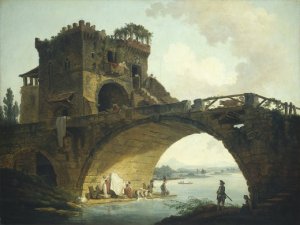
Hubert Robert, "The Old Bridge," ca. 1775 (National Gallery)
Morton received her M.A. in 1992 and her Ph.D. in the history of art and architecture in 1998 from Brown University, Providence; her dissertation was entitled “Naturalism and Nostalgia: Hippolyte Taine’s Lectures on Art History at the Ecole des Beaux-Arts, 1865–1869.” Her area of specialization was 19th- and early 20th-century European art. In 1987 she earned her B.A. in history with departmental honors from Stanford University, CA, where she focused on European intellectual history.
Morton has held teaching positions in art history at the Art Center College of Design, Pasadena, CA; Woodbury University, Burbank, CA; Chapman University, Orange, CA; and Rhode Island School of Design, Providence, RI.
Morton will arrive at the National Gallery of Art some two years after the death of Philip Conisbee, senior curator of European paintings. In the intervening period, Kimberly Jones, associate curator, has been acting head of the department of French paintings.
Beginning in late fall 2009, most of the Gallery’s West Building main floor galleries dedicated to French paintings of the 19th century will be closed for approximately 18 months during the Gallery’s continuing program of repair, renovation, and restoration. However, major works from the collection will be on view from January 31, 2010 through July 31, 2011 in the central galleries of the West Building as part of the exhibition From Impressionism to Modernism: The Chester Dale Collection. In other relocations, French paintings from the 18th century will return to their original galleries next to the American collection, some works will be integrated into the Small French Paintings galleries in the East Building, and other select 19th-century works will be hung near modern paintings in the upper level galleries of the East Building.
Amazon + Ann Arbor = ?
An agreement announced earlier this week between Amazon.com and the University of Michigan will make over 400,000 rare books available through softcover reprints, ranging in price from $10-45. No word yet on what eighteenth-century works are included, but might there be possibilities for teaching texts? Should we be thrilled or wary? For details, see this article at the University of Michigan’s ‘New Service’.
‘the heart an undescribable feud’
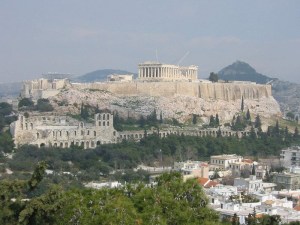 Whatever poetic resonances Keats might have had in mind with this phrase from his 1806 poem “On Seeing the Elgin Marbles for the First Time,” he wasn’t describing the present debate between those who argue the Parthenon marbles now in the British Museum should be returned to Athens and those who believe they should remain in London. Still, the conflict — stretching back to the early nineteenth century — certainly counts as a feud, and it’s one that’s likely to receive renewed attention with the opening of the new Acropolis Museum in Athens.
A long-time advocate for returning the marbles, Christopher Hitchens weighs in with praise for the new museum in “The Lovely Stones,” Vanity Fair (July 2009).
In “Elgin Marble Argument in a New Light,” New York Times (23 June 2009), Michael Kimmelman resists taking sides but evinces historical awareness and a thoughtful appreciation of the difficulties each camp faces in making its case: “So both sides, in different ways, stand on shaky ground. Ownership remains the main stumbling block.”
The new $200-million building by Bernard Tschumi is itself front and center in Anthee Carassava’s article, “In Athens, Museum Is an Olympian Feat,” New York Times (19 June 2009).
The New York Times has also assembled a fine slide show of fifteen photographs of the new museum and its installations.
The classicist Mary Beard provides a response to some of the opening ceremonies in a posting from her own (often fascinating) blog, A Don’s Life.
Meanwhile, James Cuno continues to argue for the legitimacy of museum ownership over and against claims of national patrimony. His two books on the subject (one an edited collection of essays) are reviewed by Hugh Eakin in, “Who Should Own the World’s Antiquities?,” New York Review of Books 56 (14 May 2009).










 Enfilade
1 comment