Art Historical Ethics: From Professional Codes to Ai Weiwei
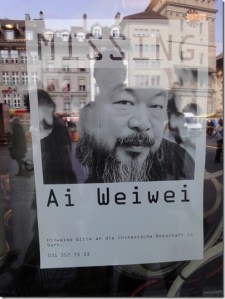
Photo from the Hurford Humanities Center, which is collecting graphics related to Ai Weiwei's imprisonment
A recent Google search for / HECAA art / provided a link to a page on ‘Art Ethics’ hosted by the Office of the Vice Chancellor of Research at the University of Illinois at Urbana-Champaign. The section on professional associations includes about a dozen organizations, most of which (including HECAA) don’t supply a code of ethics — as noted, rather curiously I think, at the site (the point seems less to direct users to codes of ethics than to imply that lots of organizations don’t think about these things).
The HECAA link is out of date in any case, but it did get me thinking about the place of ethics for an association like ours. Given that we’re an affiliate of the College Art Association, I think it’s safe to say that we’re covered by its work in this area. The most relevant document is presumably “A Code of Ethics for Art Historians and Guidelines for the Professional Practice of Art History.” Probably more complicated than articulating an ethical code for Art History is doing so for museum practices. Here, too, CAA has certainly addressed the problem, though it seems that new dilemmas often call for new responses.
In considering one example of the challenges museum officials face, Mary Louise Schumacher offers this piece on the intersection of Chinese involvement in the eighteenth-century exhibition, The Emperor’s Private Paradise, which opens in Milwaukee in June, and China’s recent imprisonment of the contemporary artist, Ai Weiwei. -CH.
◊ ◊ ◊ ◊ ◊
Mary Louise Schumacher, “Should the Milwaukee Art Museum Protest Ai Weiwei’s Detention?,” Journal Sentinel, 20 May 2011.
. . . Because of this new level of cultural exchange, China’s Palace Museum has authorized, for the first time, a large-scale exhibition of its treasures to travel to the U.S. This art historically significant show of 18th-century art and decorative objects, The Emperor’s Private Paradise will make its final stop at the Milwaukee Art Museum this summer.
Meanwhile, China has also imprisoned its most famous living artist Ai Weiwei. Ai is one of dozens of artists, lawyers, activists and bloggers arrested or gone missing in recent months in one of the worst spikes in repression in more than a decade and a presumed attempt to prevent the kinds of uprisings that have taken place across the Middle East and Nortth Africa, according to Human Rights Watch. . . .
These contradictory narratives are about to intersect in a unique way here in Milwaukee. The Milwaukee Art Museum is the only museum in the world about to open a major exhibition of Chinese art organized in direct cooperation with China.
On the one hand, it is a coup for MAM to snag this critically acclaimed show, fresh from a successful run at the Metropolitan Museum of Art in New York and the Peabody Essex Museum in Salem, Mass., which organized the show in cooperation with China’s Palace Museum. . . .
MAM is making this show, which has been in the works for many years, the centerpiece of its Summer of China, an entire slate of exhibits and events. Early on, the museum sought to include an outdoor installation by Ai Weiwei, but those plans fell through. The museum couldn’t identify an artwork that fit its plans and budgets, museum officials said.
The exhibit places MAM in an uneasy spot and raises ethical questions.
Should the museum join many of the world’s other cultural institutions in signing petitions and speaking publicly? Would China pull the show? And if they did, would MAM lose the exhibition fee, presumably in the millions?
If MAM is mum, however, will it run the risk of the appearance of appeasement? Does the museum have an obligation to educate its audience about the oppression of Ai Weiwei during its “Summer of China?”
Does this show provide an opportunity for dialogue or even diplomacy? And – a question for all art museums – will overt forms of protest be more effective than behind-the-scenes efforts in affecting Ai’s release . . .
The full article is available here»
Wellcome Library Acquires Portrait of French Surgeon, Imbert-Delonnes
Yes, that’s a 28-pound testicular tumor on the table — extracted by this surgeon from the body of the father (at least nominally the father) of Eugène Delacroix. Press release from the Wellcome:
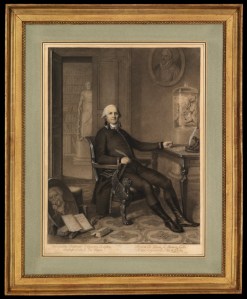
Pierre Chasselat, "Portrait of the French Surgeon Ange-Bernard Imbert-Delonnes," ca. 1800 (London: Wellcome Library)
The Wellcome Library in London has added to its collection of drawings with the acquisition of a magnificent portrait drawing of the French surgeon Ange-Bernard Imbert-Delonnes (1747-1818) by Pierre Chasselat – a portrait with a distinctive feature. The drawing is unusual in that in addition to its more conventional features, the minutely detailed interior includes, on the right, a gruesome souvenir of Imbert Delonnes’s proudest achievement: a gigantic testicular tumour (sarcocele) which – in a controversial operation – Imbert-Delonnes removed from Charles-François Delacroix, the French foreign minister.
The drawing in black chalk is signed by the artist and dated L’an 8 (year 8 in the French Revolutionary calendar, meaning 1799-1800). The portrait itself, and the identity of the man portrayed, were discovered by the firm of Didier Aaron, from whom the drawing has been purchased by the Wellcome Library with the aid of grants from the MLA/V&A Purchase Grant Fund and the Art Fund.
The drawing is both a work of art and a historical document. In accordance with Imbert-Delonnes’s self-image, it shows him sitting in a lordly pose in a fashionable interior at the dawn of the Empire period. In his professional life, he was a fearless and forceful surgeon who made his name in the French Army serving under Napoleon at the battle of Marengo (1800). In the drawing, he is holding his pen as if putting the finishing touches to a manuscript of the Progress of the Art of Healing. The operation on Delacroix proceeded despite seven of his eight medical advisers counselling against touching the tumour, which weighed some 28 pounds.
The seemingly incongruous display of excised body-parts on a plinth in an elegant interior makes the drawing a vivid witness to the sensibility of the surgical elite of the time – and the sarcocele has its own subplot. Its unwilling owner, Charles-François Delacroix, was nominally the father of the painter Eugène Delacroix, although he was almost certainly not his biological father, owing to this very tumour. Eugène Delacroix’s biological father was reputed to be Charles-François Delacroix’s successor as French foreign minister, Charles Maurice de Talleyrand, to whom Eugène bore a strong physical resemblance. (more…)
James Cuno Named President and CEO of the Getty Trust
Press release from the Getty:
 The Board of Trustees of the J. Paul Getty Trust announced today that James Cuno, recognized both nationally and internationally as a noted museum leader and scholar and an accomplished leader in the field of the visual arts, has been named president and CEO of the J. Paul Getty Trust. Dr. Cuno, who comes to the Getty after serving as president and Eloise W. Martin Director of the Art Institute of Chicago since 2004, will assume his position August 1.
Prior to directing the Art Institute of Chicago, one of the world’s leading encyclopedic art museums, where in 2009 he presided over the opening of the museum’s Modern Wing, Dr. Cuno was the director and professor of the Courtauld Institute of Art, University of London, from 2003-2004; the Elizabeth and John Moors Cabot Director of the Harvard University Art Museums and professor of the history of art and architecture at Harvard from 1991 to 2003; director of the Hood Museum of Art, Dartmouth College, from 1989-1991; director of the Grunwald Center for the Graphic Arts, UCLA, from 1986-1989; and assistant professor of art, Vassar College, from 1983-1986. Dr. Cuno, 60, received his A.M. and Ph.D. in the History of Art from Harvard in 1980 and 1985, respectively; an M.A. in the History of Art from the University of Oregon in 1978; and a B.A. in History from Willamette University in 1973. A Fellow of the American Academy of Arts and Sciences, Dr. Cuno is a prolific author and lecturer on museums and cultural policy. His most recent book, Museums Matter: In Praise of the Encyclopedic Museum, will be published by the University of Chicago Press later this fall.
Mark S. Siegel, chair of the Getty’s Board of Trustees said, “Jim’s background as a scholar and arts leader, and as a proven executive at major arts institutions in the United States and Great Britain, made him an ideal candidate to lead the J. Paul Getty Trust. The Getty operates locally through its highly regarded Museums at the Getty Center and at the Getty Villa, and globally through the work of its four programs. The Getty needs a leader with an understanding of all aspects of the visual arts, who is known and respected around the world for intellectual curiosity and achievement. But the Getty also needs an experienced executive who has the managerial and strategic skills needed to lead a complex organization. Jim’s proven record gives our Board confidence that he, working with our outstanding management team, will be able to lead the Getty to ever greater accomplishments.” (more…)
State Music Room at Stowe House To Be Restored
Press release from Sue Bond Public Relations:
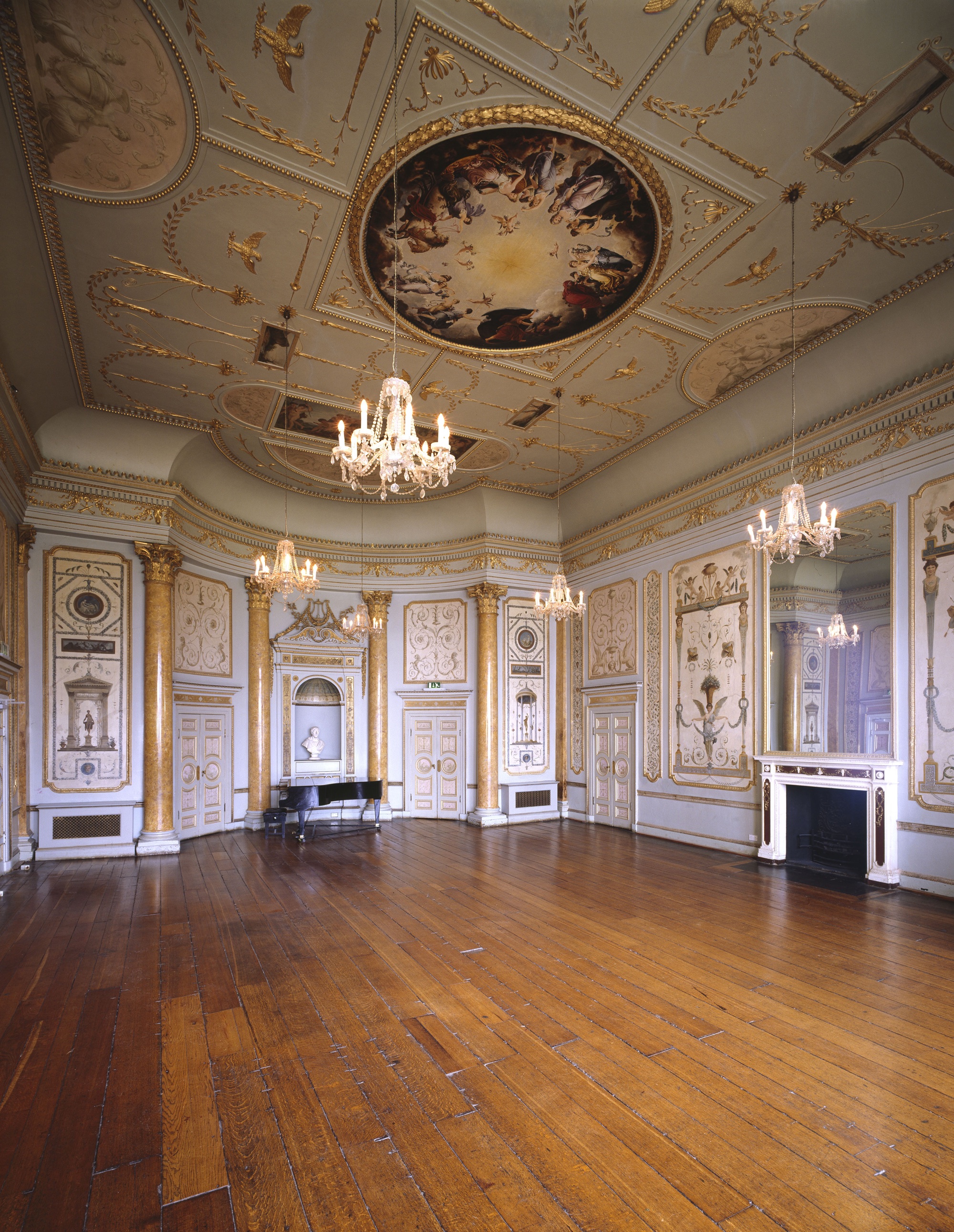
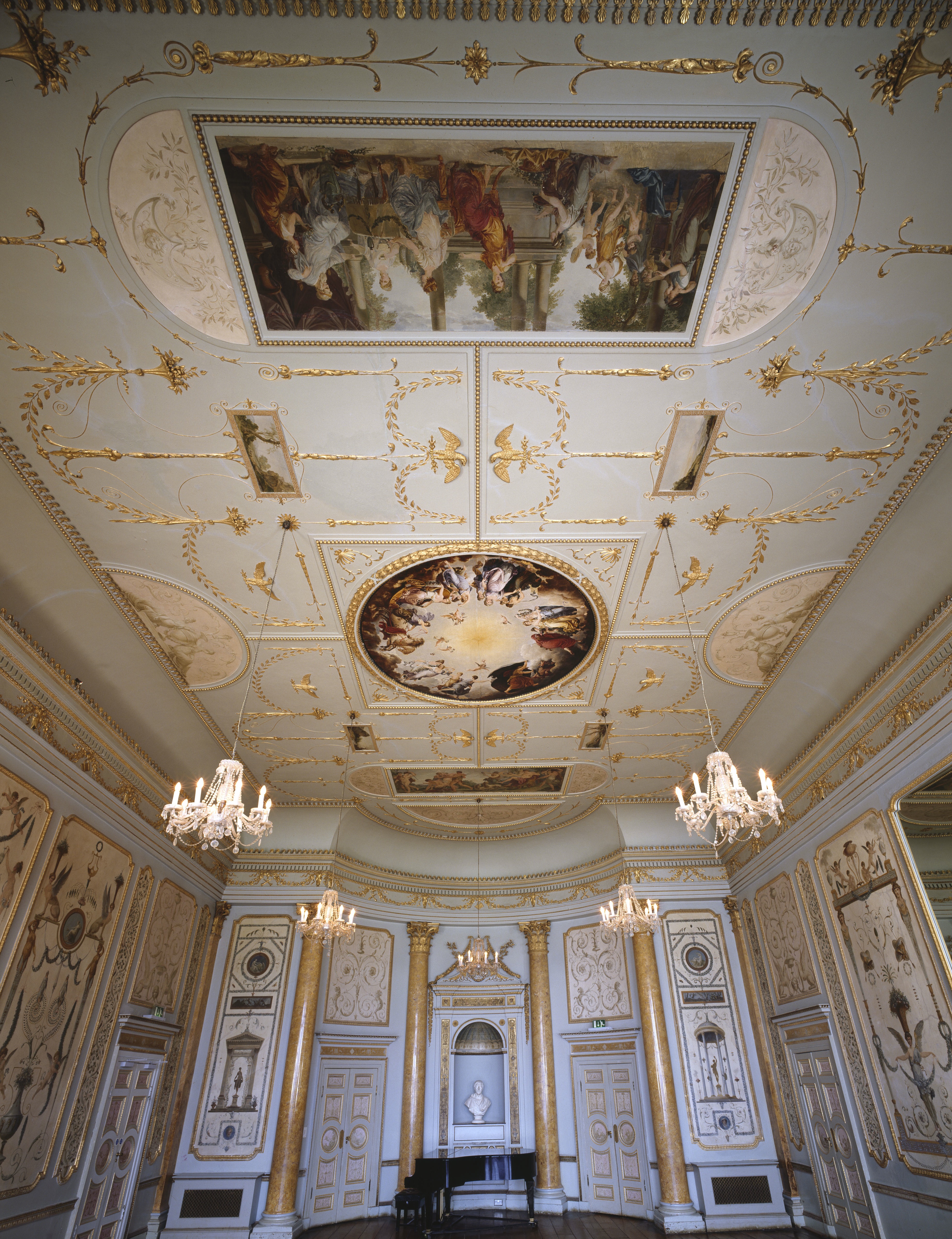 Through World Monuments Fund (WMF), The Paul Mellon Estate has announced a pledge of $250,000 towards the restoration of the State Music Room at Stowe House, the magnificent Grade I listed Neo-Classical palace set in 400 acres of landscaped park in Buckinghamshire. The funding means that the work will begin this year and should be completed by 2012-13.
WMF Britain’s Chief Executive Dr Jonathan Foyle said “The generous gift of The Paul Mellon Estate, along with donations from our members, trusts and foundations and others who responded to our recent Music Room Challenge, will allow one of the principal rooms of Stowe to be restored for everyone to enjoy. This magnificent response brings WMF’s £10 million fundraising challenge for Stowe to within £410,000 of its target – wonderfully positive news in these economically challenged times.” Completion of the State Music
Room will allow the core of historic spaces at Stowe to be presented as they
were at the turn of the 19th century, following the recent restoration of the
Marble Saloon and the Large Library.
 World Monuments Fund Britain (WMF) included Stowe in its 2002 Watch List of endangered sites and began to support the project by substantially funding the restoration of the astonishing Marble Saloon with its 57-foot-high dome which was completed in 2005. One of the largest and most spectacular spaces to be found in any British country house, the Saloon is an oval version of the Pantheon in Rome. WMF in partnership with Stowe House Preservation Trust (SHPT) has undertaken the daunting challenge of restoring this great mansion with its 400 rooms and 1/6 mile-wide façade.
Situated between the Marble Saloon and the Large Library, the State Music Room is one of the finest late 18th century spaces in Britain, showcasing Italian artistry in the heart of England. Whilst begun in 1676, it was only after a century of ceaseless building and landscape gardening that Richard Grenville-Temple (1711-79), 2nd Earl Temple to some, largely completed
Stowe House, including the south front, the Temple Room and the Music
Room in the 1770s. (more…)
The State of Paris Churches
The last time I was in Paris (January 2010), I was especially struck by the city’s churches. Apart from Notre Dame, these seem to be largely overlooked by both travelers and (all too often) scholars. Apparently, those in charge of preserving the city’s historic sites may also be neglecting them; at least this is the contention of Didier Rykner.
Didier Rykner, “The State of Churches in Paris (1): Saint-Philippe-du-Roule,” The Art Tribune (18 December 2010).

Jean-François Chalgrin, Saint-Philippe-du-Roule, 1774-84 (Photo by Vincent Babilotte, Wikimedia Commons)
This article inaugurates a new series devoted to Parisian churches. Although we often point out endangered religious sites, those here in the capital have escaped our attention thus far as we tend to assume that they are well protected. Unfortunately, this is not at all the case. The department in charge of preserving and restoring art works and mural paintings (the COARC) works diligently on important projects, certain restorations of major sections of buildings have also been carried out in the past few years by the Bureau des Edifices Cultuels & Historiques (BECH), but the need is so great and some churches are so deteriorated that it is now time to admit that this is not enough. . . .
To show our good faith and thus also more positive points, some of the articles in our series will highlight churches which have been restored, or where work is underway. We begin today, however, with a building which is in extremely grave danger, though not visible to visitors who enter: the church of Saint-Philippe-du-Roule. It was built in the late 18th century, designed by Jean-François Chalgrin who submitted his plans in 1764 although construction did not begin until 1774 and the blessing of the church took place only in 1784. . . .
The full article on Saint-Philippe-du-Roule and its deteriorating condition is available here»
Conservation of Jefferson’s Bible
Press release (11 March 2011), from the National Museum of American Art:
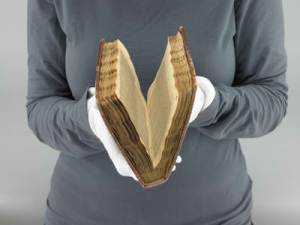 The Smithsonian’s National Museum of American History is currently performing a specialized conservation treatment to ensure the long-term preservation of Thomas Jefferson’s bible, a small handmade book that provides an intimate view of Jefferson’s private religious and moral philosophy.
At age 77 and living at Monticello in retirement following his two terms as President, Jefferson completed a project he had long planned and long discussed with others. In 1820 he assembled what he titled “The Life and Morals of Jesus of Nazareth.” Using excerpts from the Four Gospels of the New Testament, Jefferson
arranged the text to tell a chronological and edited story of Jesus’
life and moral philosophy.
 “The volume provides an exclusive insight to the religious and moral beliefs of the writer of the Declaration of Independence, the nation’s third President, as well as his position as an important thinker in the Age of Enlightenment,” said Brent D. Glass, director of the museum. “The treatment will ensure that generations to come will be able to study and view this tangible witness to history.”
Professionally bound in rich Morocco leather with gold tooling, this volume (86 pages; 8.25 inches by 5 inches) was not printed but rather constructed more like a “scrapbook.” Jefferson clipped
various passages from printed New Testaments in English, French,
Greek and Latin and glued them onto the front and back of blank
pages in four columns to allow for immediate comparison. On
those pages, Jefferson wanted to clarify and distill Jesus’ teachings. (more…)
Edward Rothstein on Recounting the Histories of Slavery
Critic’s Notebook
Edward Rothstein, “Emancipating History,” The New York Times (11 March 2010)
. . . Slavery and its heritage are everywhere here. Charleston was one of the main colonial ports of the 18th century, dealing in rice, indigo and slaves. In 1860 South Carolina held as many slaves as Georgia and Virginia, which were at least twice its size. The genteel grace and European travels of its wealthy citizens were made possible by the enslavement of about half the population.
So on a recent visit, I searched for a public display of an understanding of that American past and its legacy. After all, is there any more vexed aspect of this country’s history than its embrace and tolerance of slavery? And is there any aspect of its past that has been less well served in museums, exhibitions and memorials? . . . .
The full article is available here»
Happy President’s Day — Toasting Jefferson et al
From the Monticello blog:
 A revolution is brewing in the artisanal beer world, inspired by the taste of Thomas Jefferson and what was brewed historically at Monticello. The Thomas Jefferson Foundation, in collaboration with Starr Hill Brewery, announces the launch of Monticello Reserve Ale, the official beer of Monticello. . . .
Monticello Reserve Ale is inspired by what was produced and consumed regularly at Monticello. It is made from a combination of wheat and corn, lightly hopped. Brewing beer was an important plantation activity at Monticello. Beer, one of the “table liquors” served with meals, was a staple of the Jefferson household. Records go back to 1772, when Jefferson’s wife Martha oversaw the periodic brewing operations, producing 15 gallon casks of small beer – beer with low alcohol content – about every two weeks. In 1815, Jefferson
writes in a letter to Joseph Coppinger (himself a brewer): “I am lately become a brewer for family use, having had the benefit of instruction to one of my people by an English brewer of the first order.”
Larger scale brewing began with the appearance of a British brewer detained in Albemarle County during the War of 1812. Captain Joseph Miller improved upon the quality and quantity of Monticello beer, introducing ale, stronger beer suited to storage. While at Monticello, Joseph Miller trained the enslaved Peter Hemings in the arts of malting and brewing. Hemings – a brother of Sally – carried on the brewing operations, making 100 gallons of ale every spring and fall.
Jefferson wrote in 1821 that he had “no receipt for brewing,” doubting “if the operations of malting and brewing could be successfully performed from a receipt.” Using ingredients grown on the Monticello plantation, Jefferson’s brews varied based on the grains that were available at any given time, including barley, and larger quantities of corn and wheat. At Monticello, about three-quarters of a pound of hops were used for every bushel of malt.
Monticello Reserve Ale will be sold in 750ml bottles and served on tap at local restaurants. It will be brewed and bottled locally by Starr Hill Brewery LLC, in Crozet, Virginia, by Master Brewer Mark Thompson. Starr Hill has won 14 prestigious awards for its craft beers.
Presidents’ Day Tasting at Monticello
Monday, February 21, noon to 3:00 p.m.
New Acquisition at The Brooklyn Museum: Painting by Brunias
Press release from the Brooklyn Museum (as noted at ArtDaily) . . .

Agostino Brunias, "Free Women of Color with their Children and Servants in a Landscape," oil on canvas, ca. 1764-96 (Brooklyn Museum)
The Brooklyn Museum has acquired, by purchase from the London Gallery Robilant + Voena, Agostino Brunias’s (1730–96) painting Free Women of Color with Their Children and Servants in a Landscape (circa 1764–96), a portrait of the eighteenth-century mixed-race colonial elite of the island of Dominica in the West Indies. Brunias, a London-based Italian painter, left England at the height of his career to chronicle Dominica, then one of Britain’s newest colonies in the Lesser Antilles. The painting depicts two richly dressed mixed-race women, one of whom was possibly the wife of the artist’s patron. They are shown accompanied by their mother and their children, along with eight African servants, as they walk on the grounds of a sugar plantation, one of the agricultural estates that were Dominica’s chief source of wealth. Brunias documented colonial women of color as privileged and prosperous. The two wealthy sisters are distinguished from their mother and servants by their fitted European dresses.
The painting is a Caribbean version of contemporaneous English works made popular by artists such as William Hogarth and Thomas Gainsborough, whose art often depicts the landed gentry engaged in leisurely pursuits. Free Women of Color with Their Children and Servants in a Landscape and other Caribbean paintings by Brunias celebrate the diversity of European, Caribbean, and African influences in the region. (more…)
Christoph Vogtherr Announced as New Director of the Wallace
From The Wallace:
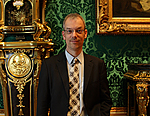 The Chairman, Sir John Ritblat, and the Trustees of the Wallace Collection are most pleased to announce the appointment of Dr Christoph Vogtherr as the next Director of the Collection upon the retirement of Dame Rosalind Savill DBE next October 2011. ‘Having run a fully international competition, it is very satisfying to find the right balance of scholarship and leadership from within the Wallace Collection itself, and that the appointment of Dr Vogtherr has the wholehearted endorsement of the Board of Trustees’ says Sir John Ritblat, Chairman of the Trustees.
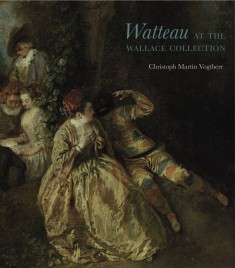 Dr Christoph Martin Vogtherr is a specialist scholar/curator in eighteenth-century French painting. He was born in 1965 and studied Art History, Medieval History and Classical Archaeology at Berlin (Freie Universität), Heidelberg and at Trinity College, Cambridge. He received his Ph.D. from the Freie Universität in 1996 with a thesis on The Early History of the Berlin State Museums (published in 1997). After two years as a Research Assistant at the Akademie der Künste (Academy of Fine Arts), Berlin, he became Curator of French and Italian Paintings at the Stiftung Preußische Schlösser und Gärten (Foundation Prussian Palaces and Gardens) in Potsdam and Berlin in 1997. He curated exhibitions on Chardin, Pater and on the patronage of the Prussian Royal house and initiated an interdisciplinary research project on French paintings in the collection of Frederick II sponsored by the Getty Foundation. His catalogue raisonné of the paintings by Antoine Watteau, Jean-Baptiste Pater and Nicolas Lancret in Berlin and Potsdam appeared in December 2010. Since 2007 he has been Curator of Pictures pre-1800 at the Wallace Collection, from 2008-10 he was Acting Head of Collections, and is the curator of two exhibitions on Watteau which will open at the Wallace Collection in March 2011. He will take up his appointment on 24 October 2011.










 Enfilade
3 comments