Wilton House Takes Restoration Award
From Art Daily (10 August 2010) . . .
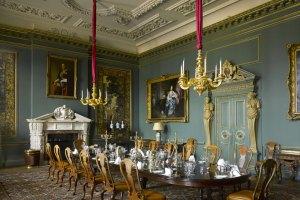 The Historic Houses Association (HHA) and Sotheby’s announced that the winning entry of their Restoration Award for 2010 — an award now in its third year — is Wilton House near Salisbury in Wiltshire. Wilton’s winning project is its spectacular private Dining Room, which is the centerpiece of an extensive programme of exceptional restoration projects at the house in recent years, which has also seen the Library, North Ante Library, Smoking Rooms, Cloisters, Gothic Hall, Inner Courtyard and North Forecourt brought back to their former glory. Three commendations are also announced by the HHA and Sotheby’s: Ballywalter Park in Newtownards, Northern Ireland; Thorpe Hall in Wycliffe, County Durham; and The Stables at Penpont in Brecon, Wales. The previous winners of the award were Markenfield Hall in Yorkshire and Chillington Hall in Staffordshire. . . .
William Herbert, the 18th Earl of Pembroke, inherited the title and the Wilton estate in 2005, since when – with the assistance of the Wilton House Trustees and the interior designer David Mlinaric – he has initiated an extensive programme of restoration projects. The overriding aim of all these projects has been to restore the parts of the house that it was felt had lost their historical integrity or which had been neglected during previous structural repairs. Both traditional and modern methods of restoration have been used and, wherever possible, the work has been undertaken by estate and local craftsmen.* Renovations undertaken, so far, include the Cloisters, the Gothic Hall, the Eastern and Western Cloister Oriel windows, the Courtyard, the Smoking Room, the Library and the North Forecourt, and works are still ongoing in other parts of the house. The sensitive revival of the spectacular private Dining Room forms the centerpiece of the extensive renovations on the estate to date.
For many years the Dining Room was used as a games room and general storage room but in 2008 the 18th Earl commenced the major restoration efforts to return it to its former glory. This work has taken local craftsmen many months to complete. The work undertaken:
- The walls were painted in a dark blueish green to match an existing paint sample and the ceiling and paneling mouldings in a stone colour, which were subsequently part-gilded by Hare & Humphreys.
- Two new caryatids were created from those in the Library by Coade Ltd, to stand either side of the doorway.
- Antiqued-looking glass panels were set between the windows on the north wall, and new metal radiator covers were made.
- The furnishings underwent major conservation work – two giltwood torcheres, three tapestries, the table, two large Reynolds portraits. Two new chandeliers were also made by Coade Ltd and subsequently gilded by Lord Pemboke’s sister.
- The walls were painted in a dark blueish green to match an existing paint sample
Discussing Wilton House’s winning entry, Edward Harley, President of the Historic Houses Association, states: ‘‘Lord Pembroke is to be congratulated on the superb restoration of these fine rooms, as well as the courtyards which form part of the setting of this great house, home of his family for over 450 years. Sensitively but dramatically restored, Wilton House has entered a new chapter in its long history. This great restoration project also reflects more widely the work being carried out by private owners throughout the country to preserve their historic properties. By attracting increasing numbers of visitors historic houses make a critical contribution to the economies of fragile rural areas.’’ . . .
What’s to Become of the Hôtel de la Marine?
With a 6.3€ million restoration completed, the question of the future of the Hôtel de la Marine in Paris has been brewing for over a year now (see, for instance, this March 2009 story in Le Figaro or this February 2009 piece in The Art Tribune). On Friday, The New York Times chimed in with the following report:
“Navy Buildings’s Next Tenant Has Paris Guessing,” by Steven Erlanger and Maïa de la Baume, The New York Times (6 August 2010)
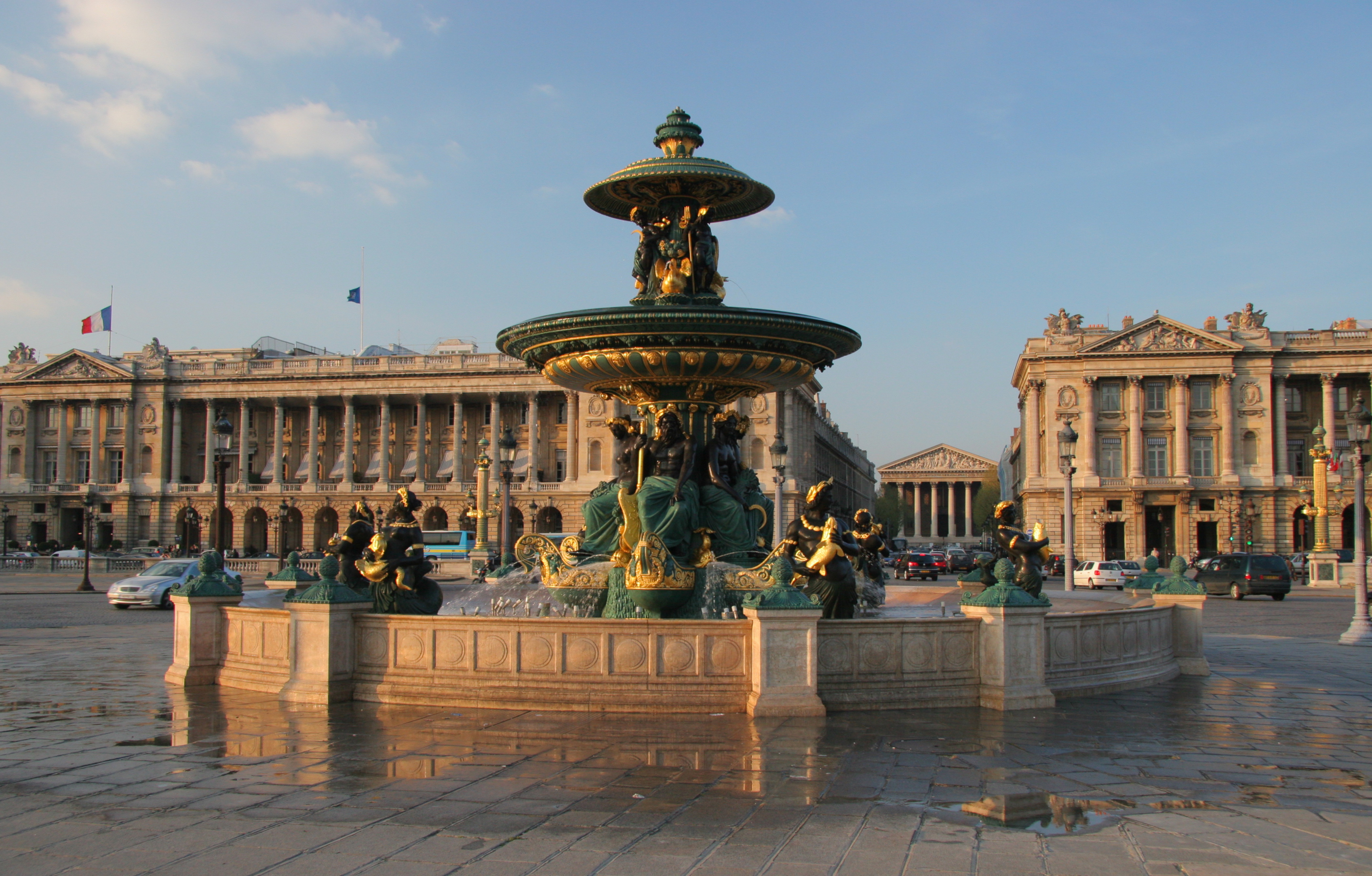
Place de la Concorde, Paris, Hôtel de la Marine to the right, photo by Tristan Nitot (Wikimedia Commons)
The building where Marie Antoinette’s death certificate was signed, and from whose balcony her execution by guillotine was witnessed, may soon be up for grabs. The building, the massive Hôtel de la Marine, sits on what is now the Place de la Concorde, one of the choicest and most expensive bits of land in Paris. It has been the operational headquarters of the French Navy and its top command since 1789, when revolutionary mobs pushed King Louis XVI from Versailles and forced him to Paris.
But France is building a modern military headquarters in southwest Paris, and the navy is expected to leave the Hôtel de la Marine by 2015. The old building’s fate has not been decided, and it has become something of a parlor game here to suggest uses for its 215,000 square feet and 553 rooms. “The navy has been here for 220 years,” said Olivier Laurens, 63, a vice admiral now working in the Department of Naval Heritage, escorting a reporter on a rare visit to the building. “There is nostalgia, of course. But we are greatly attached to this building and wish to see it preserved.”
The navy mattered even more in the 18th century than it does now, and Louis XVI’s minister of the navy found space in the building, which was then being used to store royal furnishings near the king’s Tuileries Palace. Designed by the royal architect Jacques-Ange Gabriel and constructed between 1757 and 1774 at the request of Louis XV, possibly for the dauphin, the Hôtel de la Marine is one of the jewels of 18th-century Paris. Much of it is largely untouched. Its splendid ceremonial rooms were recently restored for $9.5 million by the French industrial and construction group Bouygues. The work, which took more than two years and was finished in May 2009, included renovation of the columns of the facade, known widely as the Balcony of History, from which the executions of Marie Antoinette and Louis XVI were viewed. . . .
In an era of tight budgets, many plans and rumors of plans have been floated: for a museum of French history, a museum of decorative arts, a branch of the national library, an annex of the Louvre, a reception area for foreign dignitaries or even a center for human-rights organizations. . . .
For the full story, click here»
Shopping with Susan Weber
For its regular ‘Home & Garden’ shopping column, The New York Times recently (21 July) featured Susan Weber — Director, Founder, and Professor at the Bard Graduate Center for Studies in the Decorative Arts (and, as the story notes, the former wife of George Soros). Persistence is the key theme of the profile — perhaps a virtue that fits well with our recent discussion of the status of eighteenth-century art historical studies. In any case, it’s a notable instance of mainstream exposure for an academic working in our period — however exceptional Weber may be — as well as exposure for a still relatively new program that’s already produced exciting results.
Xavier Salomon Said to Move from Dulwich to the Met
From ArtInfo (13 July 2010). . .
 Eighteen months into his tenure as director of the Metropolitan Museum of Art, Thomas P. Campbell is beginning to make significant hires at the museum. Earlier this month he stole American painting and sculpture curator Elizabeth Mankin Kornhauser from the Wadsworth Atheneum, and now Artnet is reporting that the museum has snapped up Xavier Salomon, the chief curator of London’s Dulwich College Picture Gallery, to join the Met’s Italian painting department. . . .
◊ ◊ ◊ ◊ ◊
In a 30-minutes audio interview available at Yang-May Ooi’s Fusion View (and occasioned by the 2007 Canaletto exhibition at Dulwich), Salomon discusses
his own pan-European roots and about the fusion art of Canaletto, the great Venetian painter who came to London in 1746. Canaletto painted famous London scenes with his Italian eye, staying in this vibrant city for 10 years. Xavier talks about what London might have been like at that time and why Canaletto came here for his painting. He also talks about his personal experiences of European art and what it takes to become the curator of one of the most respected art galleries in the UK.
◊ ◊ ◊ ◊ ◊
A 2008 feature from the Dulwich website indicates a variety of Salomon’s preferences including bespoke suits, scallops, Palermo, Verdi, and Venetian velvet slippers. What’s not to like? Well . . . maybe the camel (though even at that, I’ve never been on one; so who knows? Perhaps taste depends on trust more than we might like to admit).
Ann Mah: Walking (and Drinking) in Jefferson’s Footsteps
From Ann Mah, “Following Jefferson through the Vineyards,” The New York Times 3 June 2010:

In Pommard, a plaque commemorates Jefferson’s visit to the region (Ed Alcock for The New York Times)
When Thomas Jefferson embarked on his grand tour of France in 1787, he claimed the journey was for his health. A broken wrist sent him on a circuitous route, 1,200 miles south from Paris to take the mineral waters at Aix-en-Provence, and on the way he planned to fulfill his professional obligations as America’s top envoy to France, researching French architecture, agriculture and engineering projects.
But when he chose to begin his three-month journey in the vine-covered slopes of Burgundy, Jefferson’s daughter, Martha, became suspicious. “I am inclined to think that your voyage is rather for your pleasure than for your health,” she teased him in a letter.
In fact, Jefferson’s five-day visit to the Côte d’Or — a region famous even in the 18th century for its extraordinary terroir — was not accidental. After spending more than two years in Paris establishing diplomatic relations with the court of Louis XVI, Jefferson, a lifelong oenophile, had tasted his share of remarkable vintages. Now he was keen to discover the vineyards and cellars of Burgundy, and to study firsthand a winemaking tradition that stretched back to the 11th century. “I rambled thro’ their most celebrated vineyards, going into the houses of the laborers, cellars of the vignerons, and mixing and conversing with them as much as I could,” Jefferson wrote about the winemakers in a letter posted during his trip.
Although almost 225 years, a revolution, a vine-ravaging epidemic and several wars separate us from Jefferson’s wine tour, I discovered on a recent trip that it is still possible to explore the celebrated swath of vine-covered hills as the self-described “foreign gentleman” once did . . .
The full article is available here»
Huntington and LACMA Receive Gifts of French Ceramics
Press release from the Huntington:

Teapot, ca. 1750, Strasbourg, Paul Hannong factory, petit feu faïence. Gift of MaryLou Boone. Huntington Library, Art Collections, and Botanical Gardens.
Art patron and collector MaryLou Boone has given The Huntington Library, Art Collections, and Botanical Gardens and the Los Angeles County Museum of Art each a group of important French ceramics from her collection. The works of faïence and soft-paste porcelain represent all of the major centers of production in France from roughly 1600 to 1900. The Huntington received 27 objects and LACMA received 26 that were selected to complement the existing holdings of each institution. They include teapots, potpourris, tabletop sculptures, inkwells, sugar casters, large plates, pitchers, tureens, and cups and saucers.
Boone, a resident of Pasadena, Calif., and a longtime supporter of LACMA and The Huntington, began collecting French ceramics more than 25 years ago while traveling through France with her late husband, George, also a great patron of the arts. She is the author of the catalog that accompanied a 1998 exhibition of highlights from her collection at Scripps College in Claremont, Calif. She will help produce a catalog of her entire collection, numbering around 150, working with Catherine Hess, chief curator of European art at The Huntington, and Elizabeth Williams, Marilyn B. and Calvin B. Gross Assistant Curator in the decorative arts and design department at LACMA. An exhibition of the works will take place at LACMA from October 2012 to January 2013. (more…)
Taking a Count
As reported by the AP, “a first edition of the first U.S. census signed by Thomas Jefferson in 1791 is heading for the auction block in New York City.”
Here’s the description from Sotheby’s:

N08653, Wednesday, 14 April 2010, 2pm, Lot 98
Return of the Whole Number of Persons within the Several Districts of the United States. Philadelphia: Childs and Swaine, 1791
Estimate: 50,000-70,000 USD
8vo (8 x 4 3/4 in.; 204 x 125 mm). Signed on the final text leaf (“Th:Jefferson”); minor worming in lower left margin affecting the title-page and first text leaf, some marginal spotting. Contemporary Dutch-combed marbled paper wrappers; right edge of upper wrapper frayed, lower half of backstrip perished, wormhole in lower left corner of upper wrapper, some remnants
of paper adhering to joints. Green cloth folding-case, tan morocco
spine lettered gilt. . . .
CATALOGUE NOTE
First edition of the first United States census, signed by Thomas Jefferson on the final text leaf. The enumeration was evidently printed in a very small edition for distribution by the Secretary of State at whose urging the census was undertaken. Rare, only two other copies have appeared at auction since 1975: the Park and the Sedgwick-Norton copies.
Stephen Bury Named New Librarian at the Frick
From a Frick press release:
 The Frick Collection is pleased to announce the appointment of Dr. Stephen J. Bury to the post of Andrew W. Mellon Chief Librarian at the Frick Art Reference Library. For the past ten years, he has been at the British Library, the national library of the United Kingdom, and one of the world’s greatest research institutions, where he is a Deputy Director and Head of European and American Collections, as well as Maps, Music, and Philatelic Collections. Previously, Dr. Bury was Head of Learning Resources at the Chelsea College of Art & Design, London. Comments Anne Poulet, Director of The Frick Collection, “Dr. Bury brings to this leadership position an exceptional dual perspective. He is both an art historian― who understands first hand the needs of those who teach, research, and curate―as well as an internationally regarded librarian. An active participant on numerous professional commissions as well as dynamic division head of the British Library, he is a great strategic thinker in a rapidly changing field. Stephen Bury has developed a keen understanding in areas of mutual interest to the Frick, among them digitization, collection sharing, storage, and encouraging greater use of new technologies by staff. Furthermore, the nature of the collections he oversees at the British Library, being both European and American, dovetails beautifully with the scope of our holdings and initiatives. With his arrival in May, we know that the Frick Art Reference Library will benefit greatly from Dr. Bury’s insights as well as from the broad connections he has developed through years of highly engaged service and scholarship.”
Adds Dr. Bury, “The Frick Art Reference Library is internationally well-regarded, not just for its rich resources, but for the very proactive approach the institution has taken in light of the changing universe of libraries and the needs of the audiences they serve. The Frick has played a notable role in exploring such important ventures as digitization and collection sharing, and we are of like mind that the future of libraries is an exciting one. I am thrilled to have the opportunity to lead the remarkably talented staff at this venerable research center. At the same time, the post represents a wonderfully appealing opportunity for me to return to an art historical focus, that area of study being at the core of my academic background.” (more…)
Private Collection of Decorative Arts in San Francisco
In its January 2010 issue, The Magazine Antiques profiles a remarkable collection of eighteenth-century decorative arts. It’s notable both for the quality of the objects–including a looking glass from Spencer House–and the fact that the Met’s Wrightsman Galleries (just recently reinstalled) provided the design inspiration. As Martin Chapman writes:
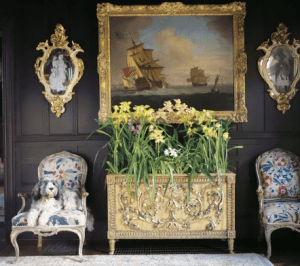
View of the entrance hall, with a grouping of objects around a large gilded wood jardiniere attributed to Giuseppe Maria Bonzanigo (1749-1820) of Turin. Photo by Aya Brackett.
One of California’s finest collections of eighteenth-century English and European decorative arts is to be found in San Francisco in a large Queen Anne revival house in Pacific Heights. Carefully chosen to evoke the atmosphere of an English country house or a French château, these objects shine brilliantly against the dark brown paneling in the main rooms. When the eminent San Francisco decorator Michael Taylor (1927-1986) worked here in the 1960s, the first thing he wanted to do was bleach the paneling to off-white tones, but the owners persisted with their original idea of preserving the dark character of the walls to act as a foil for their collections. The results are extremely effective. These rich and jewellike interiors were achieved with the services of another notable San Francisco decorator, Anthony Hail (1925-2006). They work most beautifully at night when warm subtle lighting provides an entrancing background for the objects.
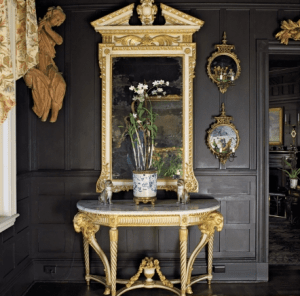
On the opposite wall of the entrance hall is an English Palladian looking glass attributed to John Vardy (1718-1765), ca. 1755-1758, one of a pair from Spencer House, London. The neoclassical console table, also one of a pair, is stamped by Georges Jacob (1739-1814, m. 1765), the Chinese porcelain cachepot has French mounts of the 1840s, and the chinoiserie mirrored wall sconces were formerly in Government House in Cape Town, South Africa. Photo by Aya Brackett.
What strikes the visitor most about the main rooms is the owners’ extraordinary facility for choosing fine objects and putting them together in striking groupings. This singular talent was found most famously in the work of John Fowler (1906-1977), the English designer who did so much to create English country house taste after World War II. Almost as famous, and certainly as influential on the Continent, were the interiors of the amateur Carlos de Beistegui (1895-1970). Beistegui’s Proustian evocations of the past at the Château de Groussay outside Paris beginning in the 1940s were more formal than Fowler’s, although they retained the relaxed ambience of the English country house. But it was the Wrightsman Galleries at the Metropolitan Museum of Art in New York that most directly influenced these collectors. They were so impressed by the installation of those galleries in the 1960s that they asked Hail to use them for inspiration in their house. In the last ten years the owners have made a series of acquisitions that have added another dimension to the interiors. The main rooms all combine comfort with a measure of formality, but it is the arrangements of objects that give
them scale and richness. . . .
For the full article and lots more photos, click here»
Starting in April: Jonathan Marsden to Direct the Royal Collection
As noted in a press release from the Royal Collection:
 Her Majesty The Queen has appointed Mr. Jonathan Marsden to the position of Director Designate of the Royal Collection. Mr. Marsden, who is currently Deputy Surveyor of The Queen’s Works of Art, will succeed Sir Hugh Roberts as Director of the Royal Collection on Sir Hugh’s retirement in April 2010.
Jonathan Marsden joined the Royal Collection in 1996. He previously worked as a curator for the National Trust in North Wales and Oxfordshire. As Deputy Surveyor of The Queen’s Works of Art he has been responsible for the decorative arts collections in all the royal residences. He has published widely on sculpture, especially French bronzes, and on the history of collecting. He has contributed to a number of exhibitions at The Queen’s Gallery in London, including George III and Queen Charlotte in 2004.

 He is currently working on an exhibition about Queen Victoria and Prince Albert, which opens at The Queen’s Gallery, Buckingham Palace in March 2010.
◊ ◊ ◊ ◊ ◊
Jane Roberts (ed.), George III and Queen Charlotte; Patronage, Collecting and Court Taste (The Royal Collection, 2004), ISBN: 1902163737.
Jonathan Marsden, ed., The Wisdom of George the Third:
Papers from a Symposium at the Queen’s Gallery,
Buckingham Palace (Royal Collection, 2006), ISBN:
978-1902163727.










 Enfilade
leave a comment