National Gallery of Ireland Restores Scagliola Table Top
Press release from the National Gallery of Ireland:

Richard Castle, Russborough House, Wicklow, Ireland, 1740s
In 1902, Lady Geraldine Dowager Countess of Milltown gifted to the National Gallery of Ireland the contents of Russborough, Co. Wicklow, in memory of her husband, Edward Nugent, 6th Earl of Milltown (1835-1890). The gift was so extensive and varied – it included paintings, furniture, sculpture, mirrors, silver and objets d’art – that it was necessary to construct a new building (The Milltown Wing) to accommodate the collection.
Included in the Milltown Gift were three eighteenth-century scagliola console table-tops, the largest of which is currently on loan to Russborough, and now in need of conservation. To this end the National Gallery of Ireland has commissioned two conservators, Chiara Martinelli and Francesca Toso of the Opificio delle Pietre Dure in Florence, who have the specialist expertise in the restoration of this medium.

Don Pietro Belloni, Scagliola table-top (detail) Photo © 2010 National Gallery of Ireland
Scagliola is an artificial ornamental marble. Used as a substitute for real marble it is created by way of a complex process which uses pulverized selenite, mixed with glue and pigments. The technique was refined in the mid-eighteenth century by Enrico Hugford, Abbot of the Vallombrosan Monastery of Santa Reparata, near Florence.
The large scagliola table top at Russborough is one of three commissioned from Hugford’s pupil at the monastery, Don Pietro Belloni, for Russborough, by Joseph Leeson 1st Earl of Milltown during his Grand Tour to Italy in 1744. The design of the table is intricate and highly colourful with a rich pattern of decorations framing pastoral scenes in each corner and a large
landscape in the centre.

Scagliola console base (detail) Photo © 2010 National Gallery of Ireland
Given the size (107 x 211.5 x 6cm) and fragility of the piece, conservation on the table top is being carried out in situ at Russborough until the end of January 2010. It is also being reunited with the recently recovered gilded Rococo console base that Joseph Leeson had made for it when it first arrived in Russborough. The scagliola table-top and its original base will return to public view when the house reopens in the spring.
Scagliola is a plaster made of pulverised selenite (gypsum), mixed with glue and pigments. In the Russborough tables, a coperta layer of black scagliola, composed of gypsum, natural glues and charcoal pigment was thinly spread on a stone support. After an initial polish using pumice and oil the craftsman carefully etched out the design, just a few millimetres deep, using a burin, or a similar tool. These shallow areas were filled with liquid gypsum plaster, glues and pigments, and this process was repeated as necessary to add layers of additional detail to the decoration. Finally the finished top was polished using oils, waxes and shellac. The refinement and sophistication of detail thus achieved is remarkable. While Belloni may have been criticised by Mann as being ‘inferior’ to Enrico Hugford, and for his slowness, the table tops he produced for Leeson and his friends are examples of the scagliola technique at its finest. (more…)
Huntington Names Its First Curator of American Decorative Arts
From a December 2009 press release from The Huntington:
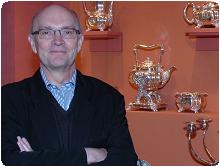 Harold B. “Hal” Nelson has been named the first curator of American decorative arts at The Huntington Library, Art Collections, and Botanical Gardens. A specialist in decorative art and contemporary craft for more than 30 years, Nelson has written numerous publications and organized a variety of exhibitions. As guest curator at The Huntington beginning in January 2008, he contributed to the comprehensive reinstallation of the newly expanded Virginia Steele Scott Galleries of American Art, which opened in May.
“We have become increasingly committed to the collection, display, and interpretation of American decorative art in recent years,” says John Murdoch, Hannah and Russel Kully Director of the Art Collections at The Huntington. “And we are absolutely ecstatic that we now can celebrate not only a new curatorial position but also our ability to attract a specialist of Mr. Nelson’s caliber.”
The Huntington’s collection of American decorative art spans a great range of styles, functions, and media, with examples from the colonial period through the 20th century. It is composed of furniture; silver; ceramics; glass; and metalwork, including jewelry, desk implements, and architectural ornaments. The collection has grown significantly in recent years. When The Huntington’s first American art galleries opened in 1984, it held 152 such objects. Twenty-five years later, there are approximately 950 pieces in the collection, many of which are displayed in the new galleries. Nelson worked closely on the new installation with Jessica Todd Smith, Virginia Steele Scott Curator of American Art.
“Hal was absolutely integral to the research and preparation behind the new installation,” said Smith. “A key part of the vision for the display of decorative arts was to fully integrate them with paintings and sculpture. Hal embraced that approach and took it to the ultimate creative and professional level. As a permanent curator, he will no doubt impress us again and again with his prowess in collections management, exhibitions, and interpretation.” (more…)
Speaking of Shipwrecks: Nautical Archaeology — in Court and at Sea
From artdaily.org, 24 December 2009:

Gold coins and a gold box lie in situ. Hundreds of gold coins and more than 500,000 silver coins were discovered on the site. Photo from the Odyssey website.
A Florida treasure-hunting firm must hand over to Spain the $500 million in gold and silver coins the company salvaged more than two years ago from the bottom of the Atlantic, U.S. District Judge Steven D. Merryday ruled. The judge rejected the arguments offered by Odyssey Marine Exploration, Inc. to support its claim to the treasure. While giving Odyssey 10 days to turn over the hoard, Merryday left the door open to extending that deadline to accommodate a possible appeal by the Tampa-based company. Merryday found that the treasure recovered by Odyssey came from the Nuestra Señora de las Mercedes, a Spanish navy frigate destroyed in battle in 1804, and that the vessel and its contents rightfully belong to Spain. He thus endorsed a June 3 report by federal Magistrate Mark Pizzo, who concluded the wreck was subject to the principle of sovereign immunity and that the valuables should be handed over to Madrid. The Mercedes sank in action against a British fleet on Oct. 5, 1804, off the coast of southern Portugal, and Spain claims not only the vessel and cargo, but a right to preserve the gravesite of more than 250 Spanish sailors and citizens who went down with the frigate. . .
For the full article, click here»
◊ ◊ ◊ ◊ ◊
From artdaily.org, 30 December 2009:
A research team has discovered off Nagua, a city in the northeastern Dominican Republic, a Spanish galleon that apparently sank in the area between 1690-1700, the press reported Monday. The galleon, whose name is unknown, was found in October, allowing pieces of “incalculable historical value” to be recovered, the daily Listin Diario said. Among the objects discovered was a bell made in 1693, while on the deck is the Latin phrase “Soli Deo Gloria” (Glory Only to God), which could be the ship’s name, though that has yet to be confirmed by the experts. Also found on the galleon were navigation compasses and plumb lines for measuring depth, silver coins, a pistol, sword sheaths and other military items, as well as ornaments and several jewels, notably a ring set with eight diamonds, Listin Diario said. Other discoveries included plates with makers’ marks (castles, lions and fleurs-de-lis), silverware, buckles, bronze candlesticks, sword handles, and a device for measuring the ship’s speed in knots. . . .
For the full article, click here»
An Eighteenth-Century Coffeehouse Opens in Virginia
With winter certainly here, a cup of coffee or hot chocolate tastes even better than usual. The latest addition to Williamsburg allows one to gather in front of a piping hot cup for an eighteenth-century experience. Mr. and Mrs. Charlton pour the drinks; you supply the imagination. From the Williamsburg website:
 In November 2009, R. Charlton’s Coffeehouse became the newest reconstructed building on Duke of Gloucester Street in 50 years. An authentic 18th-century coffeehouse, this exhibition building is now open to ticketed guests. R. Charlton’s Coffeehouse is located just across from the Capitol. On the same site more than 240 years ago, a Williamsburg wigmaker named Richard Charlton operated a popular coffeehouse, just a few steps from the colonial Capitol. Over cups of coffee, chocolate, and tea, Williamsburg’s gentlemen and politicians gathered to make deals, discuss business, learn the news from England, and exchange the latest gossip.
 One of the most dramatic encounters of the period leading up to the American Revolution took place on the coffeehouse porch in 1765, when an angry crowd protesting against the Stamp Act confronted the appointed collector for Virginia, George Mercer. The royal governor, Francis Fauquier, intervened and saved Mercer from the crowd. Mercer later resigned his position, and the Stamp Act was repealed by the British Parliament the following year. From the building itself created with period techniques and incorporating the original foundations to the opportunity to meet Mr. or Mrs. Charlton and enjoy a coffee, chocolate, or tea in an 18th-century setting, everything about the new coffeehouse reflects the very best of what Colonial Williamsburg has to offer.
◊ ◊ ◊ ◊ ◊
Additional information (including details on the building’s construction) can be found at the blog for R. Charlton’s. The opening of the coffeehouse was covered by Philip Kennicott for the Washington Post.
Restoration of James Wyatt’s Darnley Mausoleum Recognized
Now in the hands of the UK’s National Trust, the Darnley Mausoleum at Cobham Park is the recipient of this year’s Country House of the Year Award from from Country Life (2 December 2009). From the magazine’s website:
Country House of the Year — The Darnley Mausoleum, Cobham, Kent
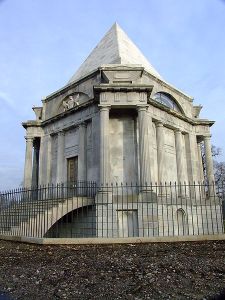
James Wyatt, Darnley Mausoleum at Cobham Park 1786 (Photo: Wikimedia Commons)
Built on the instructions of the 3rd Earl of Darnley in 1786, this mausoleum is one of the great masterpieces of the architect James Wyatt. The story of its recent restoration as part of an £8 million project to revive the whole park at Cobham is one of the most heartening of recent years. It has been effected through a remarkably complex partnership of bodies, including Gravesham Borough Council, Cobham Hall, English Heritage, Union Railways, Natural England, Kent County Council, the Woodland Trust and the National Trust. Following the break-up of the Cobham estate in 1957, the mausoleum became neglected, and the construction of the M2 motorway in 1963 made it a magnet for joyriders and vandals. The nadir of its fortunes came on Guy Fawkes Night in 1980, when the crypt was packed with petrol cans and tyres and ignited. The subsequent explosion reduced the interior to ruin. Stimulus for the project came from compensation money paid out when the Channel Tunnel Railway Link cut through the northern edge of Cobham Park. A trust was set up to drive forward the restoration as part of a more ambitious park project. The architect for the restoration was Purcell Miller Tritton, the main contractor was Paye, and Worthington Stone Carving has been responsible for the admirable masonry repairs and replacements to the mausoleum. The architectural work was underpinned by historical research by Roger Bowdler of English Heritage. Having been awarded Heritage Lottery funding in 2003, the restored mausoleum was handed over to the National Trust this year and is open to the public.
Vanbrugh’s Seaton Delaval Hall Saved
As reported by Martin Bailey in The Art Newspaper, 17 December 2009:
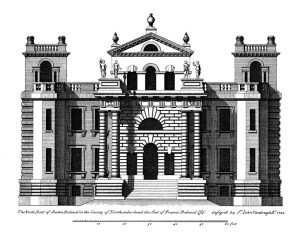
John Vanbrugh, Seaton Delaval Hall, finished in 1731, engraving from Colen Campbell, "Vitruvius Britannicus," vol. 3, 1725 (Photo: Wikimedia Commons)
Seaton Delaval Hall, near Blyth in Northumberland, has been acquired by the National Trust, along with its contents. Completed in 1731, it was designed by Sir John Vanbrugh and is Britain’s most important baroque country house. The central block suffered a devastating fire in 1822, and it was not until 1980 that there was a major restoration, undertaken by the 22nd Baron Hastings (Edward Delaval Henry Astley) .
The 22nd Baron and his wife both died in 2007, and the hall and land (worth approximately £3.5m) have now been accepted in lieu of £1.7m of inheritance tax and the contents in lieu of a further £3.2m of tax. This is the first acceptance in lieu (Ail) deal for a historic house since 1984, when Calke Abbey was saved.

Photo from "The Seaton Delaval Journal"
The National Trust has put in £6.9m to create an endowment fund to care for the estate in perpetuity (its largest ever initial contribution for a country house). A further £3m has been raised from outside sources to cover the immediate costs of opening the property to visitors. Of this, £1m came from One North East, the regional development agency.
The Ail deal has led to the acquisition of 199 items, including a portrait of Admiral George Delaval by Sir Godfrey Kneller, a Queen Anne suite of seat furniture and two lead life-size sculptures after Giambologna by the John Cheere workshop. The Art Fund is giving £100,000 for the Fairfax Jewel (which has three painted enamel roundels) and a marble bust of Charles II by Sir John Bushnell. . .
For the full article, click here»
◊ ◊ ◊ ◊ ◊
Additional coverage can be found at the National Trust, Apollo Magazine, Artdaily.org, the Guardian, and the Seaton Delaval Journal.
V&A Acquires Long-Hidden Volume of Gillray Prints
From a press release from the UK’s Ministry of Justice, as reported by artdaily.org, 16 December 2009:

James Gillray, "Fashionable Contrasts", or the "Duchess’s Little Shoe Yielding to the Magnitude of the Duke’s Foot", etching, 1792 ©V&A Images.
An album of 40 ‘suppressed’ cartoons by leading British caricaturist James Gillray (1756-1815) has recently come to light in the Criminal Law Policy Unit of the Ministry of Justice. It features material judged socially unacceptable in the 19th century – including explicitly sexual, scatological and politically outrageous subject matter. The album [of etchings] was probably seized by police more than a century ago as ‘pornographic material’ and handed to Government officials. This slim volume of ‘Curiosa’ has now been transferred to the print collections of the V&A.
In the 1840s Gillray’s plates were acquired by an enterprising publisher, Henry Bohn, who re-issued the caricatures both as single sheets and in large bound volumes. In the narrow moral climate of early Victorian London, Bohn could not publish all the Gillray plates and so printed those considered offensive in much smaller numbers and made them available from his establishment clandestinely.
It is one of these clandestine volumes which has now been rediscovered. Initially preserved by the department then dealing with vice and pornography at the Home Office, it recently came to light in the Ministry of Justice. The folio joins one held by the V&A since 1869, containing around 500 caricatures. Both folios can be seen in the V&A’s Prints and Drawings Study Room. . . .
For the rest of the article, click here»
◊ ◊ ◊ ◊ ◊
Coverage can also be found in the London Times and the Guardian (the latter includes a terrific photograph of the curator Stephen Calloway with the folio volume).
Conservation at the Frick
Press release, dated 30 November 2009, from the Frick’s website:

Joseph Godla, Chief Conservator of the Frick Collection, photo Michael Bodycomb
The Frick Collection is pleased to announce that it has been awarded a $1 million challenge grant by The Andrew W. Mellon Foundation. When matched over the next four years with $3 million in contributions from other sources, the grant will create a $4 million endowment for the position of Chief Conservator, also providing, in perpetuity, funds for research, professional development, and related expenses. Comments Frick Collection Board Chairman Margot Bogert, “Change happens in perhaps less obvious ways at the Frick than elsewhere, which for many of our enthusiasts is an attraction. However, in the last decade, the institution has experienced an exciting level of growth and advancement in its curatorial and conservation departments. The Andrew W. Mellon Foundation has been involved in these efforts in significant ways, generously funding a vital curatorial fellowship program and contributing support for the endowed position of Curator of Decorative Arts. With this latest grant, we have the opportunity to create a firm foundation for permanence and growth in the vital area of conservation.”
Adds Director Anne Poulet, “The establishment of a formal Conservation Department at The Frick Collection is a relatively recent event. We are extremely proud of the superb team now in place, led by Joseph Godla, and the myriad ways in which he and his staff care for our holdings and the beautiful mansion that houses them. We depend daily on the remarkable skills and watchful eye of this department, whose efforts extend collaboratively into research and education. In helping us meet the challenge grant, our supporters will ensure that this area of the Collection’s stewardship continues, while also making possible the staff’s broader contributions within the conservation community. It is an exciting prospect, and we are deeply grateful to The Andrew W. Mellon Foundation for making it possible.” (more…)
CAA Distinguished Scholar: Jules David Prown
Jules David Prown, a devoted teacher of the history of American art and material culture and Paul Mellon Professor Emeritus of the History of Art at Yale University, has been selected as the CAA Distinguished Scholar for 2010. A special session in his honor will be held at the CAA annual conference in Chicago on 11 February 2010.
Bryan Wolf, professor of American art and culture at Stanford University, underscores the importance of Prown’s work in an essay for CAA, available through the association’s website:
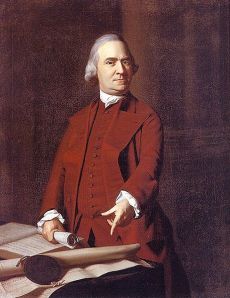
John Singleton Copley, "Samuel Adams," ca. 1772 (Boston: MFA)
His remarkable career marks the coming of age of American art history. His two-volume study of the painter John Singleton Copley (Cambridge, MA: Harvard University Press, 1966) overturned the usual concerns of positivistic biography. His growing focus during the next several decades on the formal properties of objects, together with what he termed the system of cultural “belief” embedded within them, led to a methodological revolution that still resonates loudly in classrooms wherever American art and material culture are taught. . . .
Scholarship on American art in the 1960s tended to divide into two camps: those eager to claim an “American exceptionalism” for artists of virtually all eras of American history, and those determined to prove the former wrong, largely by tracing the European antecedents for traits otherwise labeled “American.” Prown’s two-volume Copley book, which grew from his dissertation on English Copley, coincided with the catalogue he authored for a comprehensive exhibition of Copley’s work at the National Gallery of Art in Washington, DC, the Metropolitan Museum in New York, and the Museum of Fine Arts in Boston. Prown’s approach to Copley was to replace what in fact was a cold-war battle over American exceptionalism with science and statistics. He used a computer—I believe that he was the first art historian to do so—to “analyze data on 240 of Copley’s American sitters, correlating such factors as religion, gender, occupation, place of residence, politics, age, marital status, wealth, size of canvas, date, and medium.” An early paper he presented at CAA describing the project began with a slide of an IBM punch card. The audience “hissed,” as Prown later recounted, albeit with humorous intent. “The chairman of my department at the time advised me to remove the computer-analysis section from my book manuscript because its publication would jeopardize my chances for tenure.”

Yale UP, 2002 ($60)
The Copley book provided readers with a magisterial overview of this painter as a citizen of the British trans-Atlantic. Prown’s vision deftly sidestepped both sides of the American exceptionalism debate by insisting—decades before transnationalism would emerge as a focus of scholarly studies—on the complicated and hybrid relations between English-speaking cultures on either side of the Atlantic. . . .
For Wolf’s complete article (also available in the November 2009 issue of CAA News), click here»
Penelope Curtis Appointed New Tate Britain Director
Last week Tate Britain announced the appointment of Dr. Penelope Curtis as its new Director. A specialist in twentieth-century sculpture, Curtis reinforces the institution’s strong modern and contemporary interests, though, of course, the museum aims to address the history of British art from 1500 to the present (with important eighteenth-century holdings). Perhaps the small show on David Garrick’s circle, Subject/Sitter/Maker, and the more ambitious thematic exhibition, Sculpture in Painting (covering the period from 1500 to the present) provide a sense of her work within the context of an institution dedicated to sculpture. Writing in The Guardian, Charlotte Higgins addresses various challenges Curtis may face. As noted in the Tate’s official press release from 11 November 2009:

Dr. Penelope Curtis; photo from BBC News
Dr Curtis (48) has been Curator of the Henry Moore Institute in Leeds since 1999 where she has been responsible for developing an acclaimed and distinctive programme of exhibitions, presenting sculpture of all periods. Alongside this she has also overseen the development of the Leeds collections, with the acquisition of significant works by Rodin, Epstein and Calder as well as contemporary artists such as Martin Boyce and Eva Rothschild, and has built up a unique archive of sculptors’ papers.
Joining Leeds Museums & Galleries in 1994 as Head of the Henry Moore Centre for the study of sculpture, she led its transformation into the Henry Moore Institute, where research and collections have played an important role alongside the exhibitions programme. Previously she was the first Exhibitions Curator at Tate Liverpool when it opened in 1988 where she was closely involved with Tate’s British collections. Major exhibitions she has curated include Barbara Hepworth: A Retrospective at Tate Liverpool in 1994 and the current exhibition at the Henry Moore Institute Sculpture in Painting.
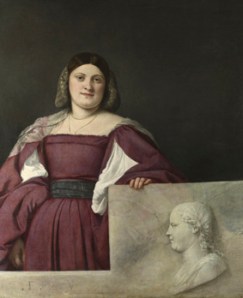
Penelope Curtis et al, "Sculpture in Painting: The Representation of Sculpture in Painting from Titian to the Present" (2009), 144 pages, £20.00
Penelope studied Modern History at Corpus Christi College, Oxford (1979-1982) followed by a Masters and Ph.D. at the Courtauld Institute of Art (1983-89). She is an established scholar and author with particular interest in twentieth-century British art. Her publications include Sculpture 1900-1945 in the Oxford History of Art (Oxford 1999) and Patio & Pavilion: The Place of Sculpture in Modern Architecture (Ridinghouse/Getty 2007). She was on the British Council Committee for the Venice Biennale in 2008 and a member of the Turner Prize Jury in 1997. She is currently on the Advisory Committee for the Government Art Collection and a member of Art Commissions Committee for the Imperial War Museum.
Penelope Curtis said, “I am delighted to be appointed Director of Tate Britain which has a unique remit – historic and contemporary, national and international – and look forward to exploring and expanding those areas.”
Tate Director, Sir Nicholas Serota, said, “Penelope Curtis has made an outstanding contribution to the study of sculpture and especially to our understanding of British sculpture in the twentieth century. I am delighted that she will bring her scholarship and original vision to the presentation of British art at Tate Britain.”
Curtis will take up the appointment of Director, Tate Britain in April 2010.










 Enfilade
leave a comment