Installation | Revolution!

Paul Revere Jr., after Henry Pelham, The Boston Massacre, or, The Bloody Massacre perpetrated in King Street, Boston on 5 March 1770 by a party of the 29th Regiment, detail, 1770, hand-colored engraving and etching, second state, sheet: 11 × 9.5 inches (New York: The Metropolitan Museum of Art, Gift of Mrs. Russell Sage, 1910, 10.125.103).
◊ ◊ ◊ ◊ ◊
Opening soon at The Met:
Revolution!
The Metropolitan Museum of Art, New York, 19 January — 6 August 2026
Curated by Sylvia Yount, Constance McPhee, and Wolf Burchard
This special installation marks the 250th anniversary of the Declaration of Independence, the founding document of the United States of America. Works drawn from many different areas of The Met offer a wide view of the roots, course, and aftermath of the Revolutionary War (1775–1783)—from early conflicts between colonists and Indigenous peoples and the 1765 Stamp Act imposed by the British government on its North American colonies to George Washington’s voluntary retirement, in 1797, from his two-term presidency.
Rarely seen prints reveal the transatlantic circulation of news about the struggle for independence during a fractious political era. This window into the era’s print culture highlights the global dimensions of the rebellion, the contested ideas about liberty that shaped it, and its consequential outcomes. Also on view are American and European works of art that depict a range of significant individuals. These include iconic contributors to the Declaration of Independence John Adams, Benjamin Franklin, and Thomas Jefferson; patriots and presidents such as Paul Revere and George Washington; the Wampanoag chief Metacomet, whose conflicts with early British colonists laid the groundwork for revolution; Mohawk leader Thayendanegea, who allied with the British in an effort to retain Indigenous sovereignty; and African American poet Phillis Wheatley, who raised her voice against an expansive tyranny in her call for emancipation. Together, these artworks acknowledge multiple complex and intertwined histories that continue to resonate in the United States and beyond, some two and half centuries later.
Revolution! is curated by Sylvia Yount, Lawrence A. Fleischman Curator in Charge of the American Wing; Constance McPhee, Curator, Department of Drawings and Prints; and Wolf Burchard, Curator, Department of European Sculpture and Decorative Arts.
◊ ◊ ◊ ◊ ◊
With this additional information from the press release:
The American Wing will also feature in its Alexandria Ballroom (Gallery 719), an historical interior focused on George Washington and his complex legacy—from fall 2025 through early August 2026—with artist Titus Kaphar’s 2016 ‘tar’ portraits of Ona Judge and William Lee, both enslaved members of the Washington family’s households, on loan from private collections. In addition, from March through summer 2026, a recent acquisition by Carla Hemlock (Mohawk) will be on view in dialogue with Rembrandt Peale’s portrait of Washington in the foyer of the Art of Native America installation (Gallery 746 South).
◊ ◊ ◊ ◊ ◊
The Art of the American Revolution: A Conversation with Ken Burns and Sarah Botstein
Thursday, 29 January 2026, 6pm
The Museum will present a panel discussion on the “Art of Revolution” with filmmakers Ken Burns and Sarah Botstein, co-directors with David Schmidt of their new documentary, The American Revolution; historians Philip Deloria and Jane Kamensky; and art historian Gwendolyn DuBois Shaw, along with a screening of excerpts from the PBS series, produced exclusively for The Met, highlighting the creative process of visual storytelling. The conversation will provide an opportunity to reflect on the continued relevance of historical imagery and the power of art to explore the varied stories of the country’s founding.
Exhibition | Times in Tapestry

Judocus de Vos after the model by Philippe de Hond, La Rencontre des belligérants, tapestry from l’Art de la guerre, ca. 1718–24, Brussels
(Lausanne: Fondation Toms Pauli, donation Mary Toms)
◊ ◊ ◊ ◊ ◊
Now on view at mudac:
Times in Tapestry / Tisser son temps / Am Webstuhl der Zeit
Musée cantonal de design et d’arts appliqués contemporains, Lausanne, 7 November 2025 — 8 March 2026
mudac and Fondation Toms Pauli are proud to present this exhibition dedicated to tapestry as a vector for social and political discourse.
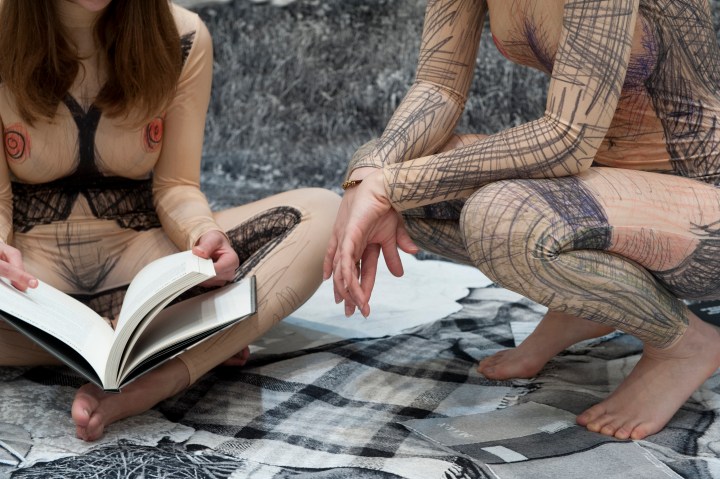
Goshka Macuga, Performance of Death of Marxism, Women of All Lands Unite, 2013, wool tapestry with two women wearing printed lycra suits, 560 × 290 cm, 2013.
Far from being confined to a decorative role, tapestry has always been a powerful tool for storytelling. From medieval times to contemporary creations, it provides a space for dialogue at the crossroads of collective aspirations, historical narratives, and contemporary issues. The exhibition brings together major works from the Toms collection, woven in the prestigious Brussels workshops between 1660 and 1725, alongside contemporary creations by Goshka Macuga and Grayson Perry. Tapestries, such as The History of Scipio Africanus and The Emperors Titus and Vespasian, depict glorious and symbolic episodes from Roman narratives. At this occasion two tapestries will be presented to the public for the first time, highlighting the value and prestige of this collection, owned by the State of Vaud.
These historical masterpieces resonate with the powerful creations of Goshka Macuga and Grayson Perry. Through tapestries such as Perry’s The Vanity of Small Differences and bespoke works by Macuga, the exhibition explores contemporary themes of social struggle, critiques of consumer society, and power dynamics. For this occasion, Macuga will create a unique textile work, specially created in dialogue with the Toms collection, which will enhance the exhibition with a distinctive and contemporary perspective. The confrontation of ancient and contemporary works highlights the timeless power of tapestry, with its visual language capable of conveying complex messages and fostering reflection on universal issues.
The exhibition press kit is available here»
More on the Toms Collection is available from the press release:
The Toms Collection is one of the most significant privately assembled collections of historic tapestry from the second half of the 20th century. Bequeathed to the State of Vaud by Mary Toms in 1993, it comprises over one hundred wall tapestries and decorative pieces from major European workshops, dating from the early 16th to the late 19th centuries. After amassing a fortune in real estate, British developer Reginald Toms (1892–1978) and his wife Mary (1901–1993) settled at Château de Coinsins in French-speaking Switzerland in 1958, where they discovered a passion for historic textiles. During the 1960s, they acquired over a hundred works, including furniture, carpets, and embroidery.
More than fifty tapestries in the collection originate from the leading workshops of Flanders, particularly from the 17th to the 18th centuries. The gold- and silver-threaded masterpieces on show are drawn from the original Toms collection and later acquisitions by the Toms Pauli Foundation, established in 2000. Known for its geographical, chronological and thematic breadth, as well as its outstanding state of preservation, this collection, owned by the State, has been exhibited in venues such as Payerne Abbey, the Metropolitan Museum in New York, the MCBA in Lausanne, the Palacio Real in Madrid, the Cité de la Tapisserie in Aubusson and Musée Rath in Geneva. It now takes pride of place at mudac for this landmark exhibition.
While the name Mary Toms is now recognised worldwide thanks to her prestigious collection, the life of the donor herself remains largely private. Trained as a secretary, Mary Alice Winterton married Reginald Toms in 1933. Reginald had achieved considerable success in finance and real estate, allowing the couple to live an international life between Britain, South Africa, Monte Carlo, and Ireland, before finally settling in French-speaking Switzerland in 1958, where they acquired the Château de Coinsins. In the short span of just ten years (1959–1969), Mary and Reginald Toms assembled, through purchases on the London art market, one of the world’s largest private collections of tapestries from the 16th to the 19th centuries, outside royal or aristocratic holdings.
Until Reginald’s death in 1978, the couple kept their collection relatively private. Yet they were fully aware of its exceptional nature and were concerned with ensuring its preservation. In 1990, Mary Toms drew up a will bequeathing to the Canton of Vaud the Château de Coinsins, its furnishings, art collections and the surrounding vineyard. Upon accepting this legacy, the State undertook to preserve and promote the remarkable collection of tapestries that Mary and Reginald Toms had so passionately assembled during the 1960s.
Based in Lausanne since its founding in 2000, the Toms Pauli Foundation is an active institution on both Swiss and international stages. Its core mission is to research, preserve and promote collections of historic and 20th-century textile art owned by the State of Vaud. The Foundation’s heritage consists of a significant collection of European tapestries and embroidery dating from the 16th to the 19th century, bequeathed by Mary Toms in 1993, as well as textile artworks from 1954 to 2011 that are emblematic of the Nouvelle Tapisserie movement.
Lacking its own exhibition space to showcase its exceptional holdings, the Foundation regularly presented its collections abroad. Since 2020, the Toms Pauli Foundation has been based at Plateforme 10. Its offices, collections, and specialised library are housed within the building of the MCBA. The public can discover the Foundation’s historic and contemporary collections through temporary exhibitions held at Plateforme 10—such as the major 2023 exhibition Magdalena Abakanowicz: Textile Territories, organised in collaboration with Tate—and in other venues in Switzerland and beyond. At the end of 2025, another piece from the Titus and Vespasian series will go on display at the MCBA as a follow-up to the Tisser son temps exhibition.
As the successor to the Centre International de la Tapisserie Ancienne et Moderne (CITAM), the organisation behind the Lausanne Tapestry Biennials from 1962 to 1995, the Foundation also maintains artist archives from these historic events and regularly hosts researchers from around the world.
Exhibition | Flora Yukhnovich’s Four Seasons
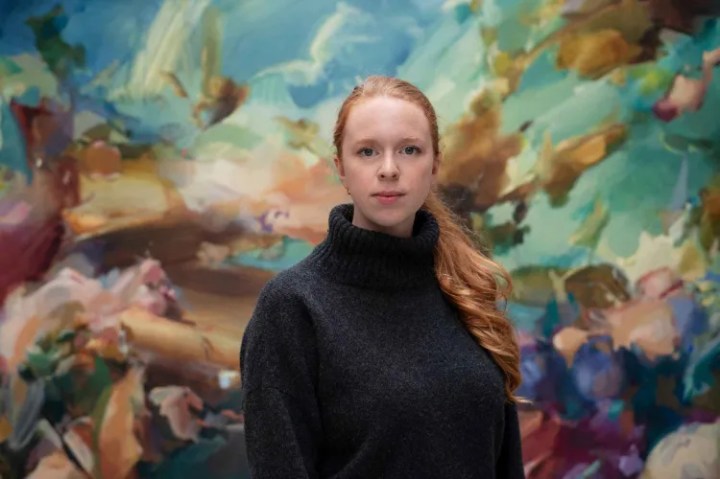
Flora Yukhnovich in Her London Studio, 2024
(Photo by Kasia Bobula © Flora Yukhnovich)
◊ ◊ ◊ ◊ ◊
Opening this week at The Frick; see the preview by Ted Loos for The New York Times (28 August 2025) . . .
Flora Yukhnovich’s Four Seasons
The Frick Collection, New York, 3 September 2025 — 9 March 2026
Taking inspiration from the French Rococo, Italian Baroque, and Abstract Expressionist movements, Flora Yukhnovich (b. England, 1990) creates works that are at once modern and timeless by translating historic compositions into contemporary abstractions. Using the Frick’s Four Seasons by François Boucher as a point of departure, Yukhnovich’s site-specific mural will cover the walls of the museum’s Cabinet. This project is accompanied by the publication of a new volume in the Frick’s acclaimed Diptych series, which highlights a single masterpiece from the permanent collection by pairing complementary essays by a curator and a contemporary artist, musician, or other cultural luminary. This volume will feature a text by Yukhnovich and an essay by Xavier F. Salomon, the Frick’s Deputy Director and Peter Jay Sharp Chief Curator, on the significance of Boucher’s beloved series.
Flora Yukhnovich’s Four Seasons is made possible by Hauser & Wirth and Victoria Miro.
Xavier Salomon and Flora Yukhnovich, Boucher’s Four Seasons (London: D. Giles, 2026), 80 pages, ISBN: 978-1913875732, $30.
Lecture | Beatrice Glow on Speculative Objects
From the BGC:
Beatrice Glow | Speculative Objects
Bard Graduate Center, New York, 5 February 2025, 6pm

Beatrice Glow, Pax Hollandica (Dutch Peace), 2022. VR-sculpted photopolymer 3D print, metallic paint, acrylic paint, enamel coating, chains (Photo: Aertiron).
Responding to archival research on lesser-known public histories, artist Beatrice Glow creates objects that blend digital processes (such as virtual reality sculpting and 3D printing) with meticulous handcrafting to envision speculative futures. In this talk, Glow will introduce two of her recent projects that leverage playful artistry to foster a deeper public understanding of cultural inheritance. First, she will unpack her recent New York Historical solo exhibition, When Our Rivers Meet, in which she collaborated with culture bearers whose heritages were impacted by Dutch colonialism to create an alternative commemoration of the 400th anniversary of the founding of New Amsterdam. This exploration has continued beyond the exhibition and has taken a new form as a board game—Finding Magic Turtle (Unpacking the Four Continents)—commissioned by the Institute of Contemporary Art, San Diego. Glow will also share her current work-in-progress, Gilt/Guilt, a performance-installation imagined as a speculative auction. The hauntingly luxurious collectibles in this project reveal the cascading impacts of colonial violence and environmental extraction.
Beatrice Glow is an American multidisciplinary artist of Taiwanese heritage whose practice includes examinations of archives and collaboration with culture bearers and researchers in the creation of sculpture, installations, textiles, emerging media, and olfactory experiences to envision a more just and thriving world guided by history. Recent solo exhibitions have taken place at the New York Historical and the Baltimore Museum of Art. Her work has been supported by Creative Capital, the National Endowment for the Arts, Rockefeller Brothers Fund, Smithsonian Artist Research Fellowship, Yale-NUS College, Lower Manhattan Cultural Council, the Asian/Pacific/American Institute at New York University, the Fulbright Program, and many more. More information about her work is available here.
Exhibition | Stan Douglas: The Enemy of All Mankind
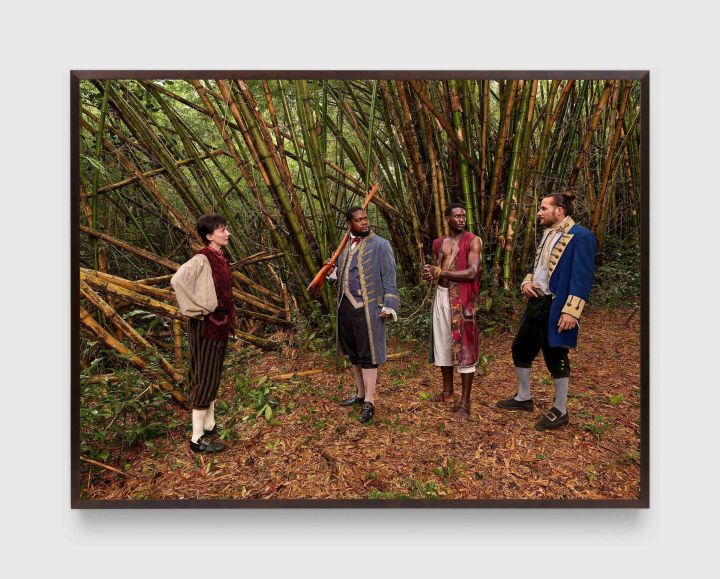
Stan Douglas, Act II, Scene XII: In which Polly Convinces Pirates Laguerre and Capstern to Release their Captive, Prince Cawwawkee, for a Prize Rather than go to War Against His People with Morano, 2024, inkjet print mounted on Dibond aluminum, 150 × 200 cm, edition of 5.
◊ ◊ ◊ ◊ ◊
From the press release for the show, which was covered by Walker Mimms for The New York Times (17 October 2024). . .
Stan Douglas | The Enemy of All Mankind: Nine Scenes from John Gay’s Polly
David Zwirner, New York, 12 September — 26 October 2024
David Zwirner is pleased to announce an exhibition by Stan Douglas, on view at the gallery’s 525 West 19th Street location in New York. Featuring a new photographic series, The Enemy of All Mankind: Nine Scenes from John Gay’s Polly, this will be the artist’s eighteenth solo exhibition with the gallery. In this stand-alone group of nine images, Douglas stages scenes from the eighteenth-century comic opera Polly, written by English dramatist John Gay (1685–1732), using the narrative as a vehicle through which to engage a wide range of themes that remain highly relevant today, including race, class, gender, and media. One work from the series debuted in David Zwirner: 30 Years, on view in summer 2024 in Los Angeles, and this will mark the first presentation of the body of work in its entirety.
Since the 1980s, Douglas has created films, photographs, and other multidisciplinary projects that investigate the parameters of their respective mediums. His ongoing inquiry into technology’s role in image making, and how those mediations infiltrate and shape collective memory, has resulted in works that are at once specific in their historical and cultural references and broadly accessible. Since the beginning of his career, photography has been a central focus of Douglas’s practice, used at first as a means of preparing for his films and eventually as a powerful pictorial tool in its own right. The artist is influenced in particular by media theorist Vilém Flusser’s notion of the photographic image as an encoded language that is determined by a specific set of technological, social, cultural, and political circumstances.
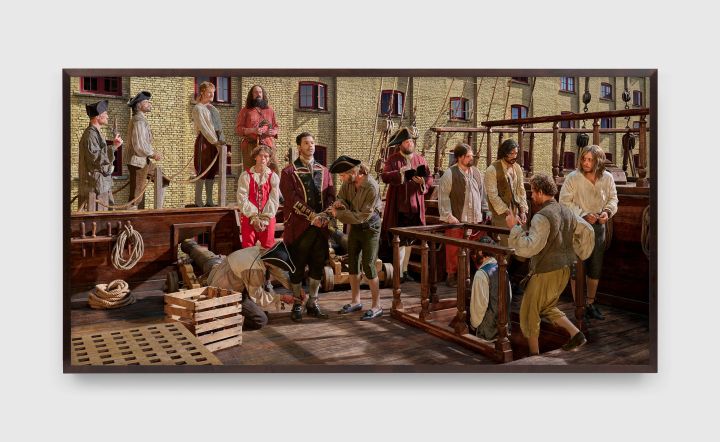
Stan Douglas, Overture: In which Convicted Brigand Captain Macheath is Transported to the West Indies Where He will be Impressed into Indentured Labour, 2024, inkjet print mounted on Dibond aluminum, 150 × 200 cm, edition of 5.
◊ ◊ ◊ ◊ ◊
A sequel to Gay’s well-known The Beggar’s Opera (which was later adapted as The Threepenny Opera), Polly was censored by the British government for its embedded satire and critique, particularly of policies around the parceling out of land; as a result, it was never produced during Gay’s lifetime. Douglas further notes that Polly was ahead of its time, as it “satirizes imperial patriarchal hierarchies of race and class—as well as gender norms, which it depicts as performative” (Douglas, in correspondence with the gallery, March 2024).
Gay’s stage play follows the eponymous Polly Peachum, who travels to the West Indies to search out her estranged husband, Captain Macheath, who has disguised himself as a Black man known as Morano and adopted the life of a pirate. Upon her arrival on the island, Polly is, unbeknownst to her, sold to a wealthy plantation owner as a courtesan. After eventually securing her freedom, she is advised to disguise herself as a young man to ward off unwanted male attention, and as a result becomes entangled in a series of skirmishes between the colonial settlers, the native population, and the pirates.
To create the photographs—which were shot in Jamaica using Hollywood-level production effects—Douglas enlisted a cast of actors to read from a loose script that he adapted for the chosen scenes, modifying certain characters and elements to bring the themes in line with the present day. For example, in Douglas’s version, Captain Macheath was a Black man passing as white in London who, once in the West Indies, drops the disguise and lets his hair grow out. Rather than posing the players, he photographed them continuously as they acted out and improvised the dialogue, then selected as the final images those that best embodied the ideas put forth in the narrative. The resulting large-scale photographs are dynamically realized, taking the form of sweeping tableaux where dramatis personae and setting collide in vivid color. Retaining Gay’s sense of comedic folly and satire as well as the underlying pathos of the story, the images bear traces of the various forms of media through which they have been filtered, employing formal elements drawn from theatrical, cinematic, and photographic conventions alike. Accordingly, Douglas positions the viewer as a spectator—a voyeuristic witness to the various narrative turns and apparent absurdities in which relationships are transactional and enemies expendable.
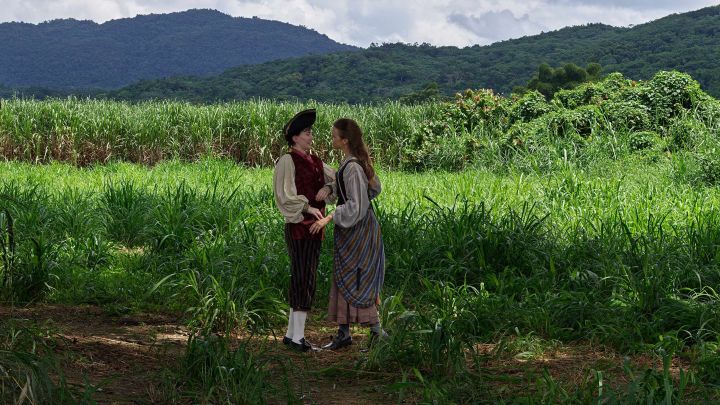
Stan Douglas, Act II, Scene VI: In which the Wife of Pirate Captain Morano, Jenny Diver, Attempts to Seduce Polly, who is Disguised as a Man to Avoid Molestation, detail, 2024, inkjet print mounted on Dibond aluminum, 150 × 150 cm, edition of 5.
◊ ◊ ◊ ◊ ◊
Douglas’s use of Polly as the basis for this project arose out of his long-standing interest in maroon societies, large groups of enslaved persons who banded together to run away and start new, proto-democratic societies. Contrary to their depiction in popular media, pirate ships occasionally functioned as collaborative maroon societies in their own right. The title of the series, The Enemy of All Mankind, is taken from a doctrine of eighteenth-century maritime law (in Latin, hostis humani generis) under which pirates could be attacked by anyone since they fell outside the protection of any nation, but its core notion of defining certain groups as enemies or outsiders resonates broadly today. In Polly, the pirates—in contrast to the settlers and indigenous people—are meant to embody immorality and evil, yet in pulling out specific strands of the narrative, Douglas points to a more nuanced understanding of such sweeping generalities.
Stan Douglas (b. 1960) was born in Vancouver and studied at Emily Carr College of Art in Vancouver in the early 1980s. Douglas was one of the earliest artists to be represented by David Zwirner, where he had his first American solo exhibition in 1993—the second show in the gallery’s history.
Douglas’s work has been the subject of solo exhibitions at prominent institutions worldwide since the 1980s. In 2022, the artist represented his native Canada at the Venice Biennale, where he debuted a major video installation, ISDN (2022)—now in the collection of the National Gallery of Canada, San Francisco Museum of Modern Art, and The Museum of Modern Art, New York—and a related body of photographs. Subsequently, the exhibition Stan Douglas: 2011 ≠ 1848 traveled around Canada with stops at The Polygon Gallery, Vancouver (fall 2022); Remai Modern, Saskatoon (February–April 2023); and the National Gallery of Canada, Ottawa (September 2023–October 2024). A solo exhibition also titled 2011 ≠ 1848 was subsequently staged in 2023 at De Pont Museum, Tilburg, the Netherlands. In 2023, this body of work inaugurated David Zwirner’s new Los Angeles location, and it is currently on view at the Parque de Serralves in Porto, Portugal, through 12 January 2025.
Douglas has been the recipient of notable awards, including the Audain Prize for Visual Art (2019); the Hasselblad Foundation International Award in Photography (2016); the third annual Scotiabank Photography Award (2013); and the Infinity Award from the International Center of Photography, New York (2012). In 2021, Douglas was knighted as a Chevalier of the Ordre des Arts et des Lettres by the French Minister of Culture, and in 2023 he was awarded an honorary doctorate by Simon Fraser University, Greater Vancouver. Work by the artist is held in major museum collections worldwide.
Exhibition | Sonya Clark: The Descendants of Monticello

Blinking eyes appear in the windows of Declaration House as part of Sonya Clark’s installation The Descendants of Monticello. Thomas Jefferson resided at the site while writing the Declaration of Independence, together with his enslaved valet Robert Hemmings. The original house was razed in 1883; it was reconstructed in 1975. (Photo by Steve Weinik/Monument Lab).
◊ ◊ ◊ ◊ ◊
From Philadelphia’s Monument Lab:
Declaration House | Sonya Clark’s The Descendants of Monticello
Independence National Historical Park, Philadelphia, 24 June — 1 December 2024
Declaration House is a public art and history exhibition presented by Monument Lab at Independence National Historical Park that explores the site where Thomas Jefferson and Robert Hemmings spent several months in Philadelphia during the drafting of the Declaration of Independence in 1776. The project poses a central question: What does the Declaration of Independence mean to us today? By moving Hemmings to the center of this moment in history, the project seeks to illuminate the entangled legacies of freedom and enslavement at the core of our nation’s founding.
Declaration House presents the exclusive premiere of Sonya Clark’s The Descendants of Monticello, a public artwork that brings the historic house to life through a monumental montage featuring the blinking eyes of Robert Hemmings’ collateral descendants and others who are related to the over 400 people enslaved at Monticello, including descendants biologically related to Jefferson. Declaration House also includes public programs with creative residents Jeannine A. Cook and Ty ‘Dancing Wolf’ Ellis, and a Welcome Station during summer weekend hours at the historic house where visitors are invited to respond to the project’s central question with hand-drawn responses that will be collected by Monument Lab and shared with Independence National Historical Park to inform future programming and reflection ahead of America’s Semiquincentennial in 2026.
◊ ◊ ◊ ◊ ◊
Philip Kennicott wrote about the installation for The Washington Post (12 August 2024). More information, including additional press coverage, is available at Monument Lab.
Performance | Handel: Made in America
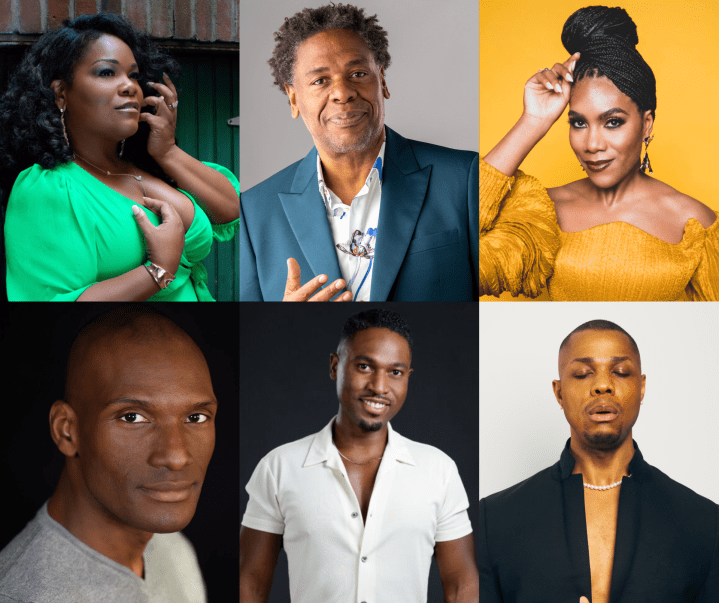
Image (clockwise from top-left): Latonia Moore, Terrance McKnight (photo by Julie Yarbrough Photography), J’Nai Bridges (photo by Dario Acosta), Davóne Tines (photo by Noah Morrison), Malcolm J. Merriweather, and Noah Stewart.
◊ ◊ ◊ ◊ ◊
Two performances, next week at The Met:
Handel: Made in America
Grace Rainey Rogers Auditorium, The Metropolitan Museum of Art, New York, 15 and 16 February 2024
Friday, February 16 at 6pm, join us for a pre-concert discussion with Juilliard ethnomusicology professor Fredara Hadley and Handel scholar (and Handel: Made in America co-creator) Ellen Harris, moderated by journalist Eric V. Copage (The New York Times)—free with ticketed admission to the performance
George Frideric Handel was the it-boy of 18th-century England. His music spread across boundaries of genre and social class, making his operas, oratorios, and instrumental works wildly popular with the British masses. But Handel rose to fame atop the burgeoning British Empire, history’s most influential global superpower, and in Georgian England, the same trading companies that underwrote arts and culture turned their profits from sinister activities: the trade of exotic goods and, most notably, enslaved people.
Through the lens of Handel’s life and works, musician and storyteller Terrance McKnight (WQXR) leads an intimate and revealing journey about art, power, history, and family, weaving his own history as a young African American man inspired by classical music with the story of Handel’s world and the money, power, and people that moved and were moved by it. Director Pat Eakin Young (La Celestina at The Met), conductor Malcolm J. Merriweather (The Ballad of the Brown King at The Met), and famed Handel scholar Ellen Harris complement a cast of star opera singers: soprano Latonia Moore, mezzo-soprano J’Nai Bridges, tenor Noah Stewart, and bass-baritone Davóne Tines. Commissioned by MetLiveArts. Tickets start at $35.
• Terrance McKnight, co-creator and performer
• Pat Eakin Young, co-creator and director
• Ellen Harris, co-creator and dramaturg
• Malcolm J. Merriweather, conductor
• Latonia Moore, soprano
• J’Nai Bridges, mezzo-soprano
• Noah Stewart, tenor
• Davóne Tines, bass-baritone
• Voices of Harlem, choir
Exhibition | Michail Michailov’s Dust to Dust at the Belvedere
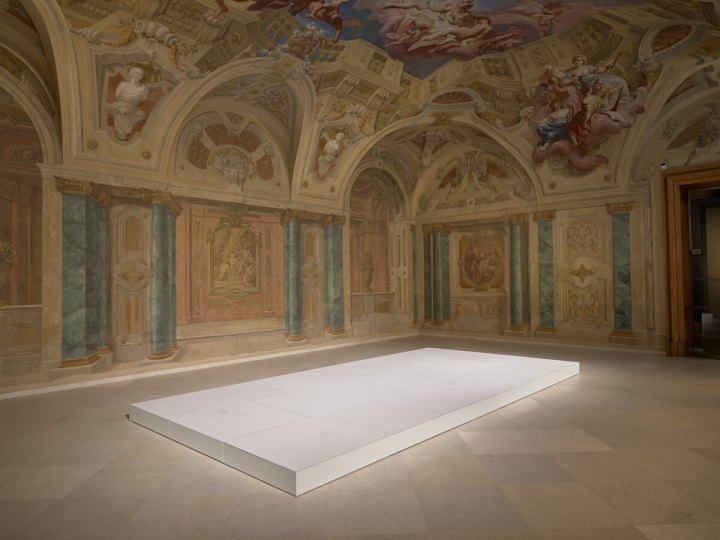
Michail Michailov, Dust to Dust, as installed in the Carlone Hall of the Upper Belvedere in 2023.
(Photo by Johannes Stoll)
◊ ◊ ◊ ◊ ◊
From the press release (via Art Daily) for the exhibition:
Michail Michailov: Dust to Dust
Upper Belvedere, Vienna, 19 October 2023 — 14 April 2024
Curated by Stella Rollig with Johanna Hofer
As part of the Belvedere’s Carlone Contemporary series, Michail Michailov presents Dust to Dust, an 18-part trompe l’oeil drawing, previously exhibited at the Bulgarian Pavilion of the 2022 Venice Biennale. The modular work captures incidental, often overlooked vestiges of time, such as dust, hair, imprints, and stains, calling into question the value and existence of things.
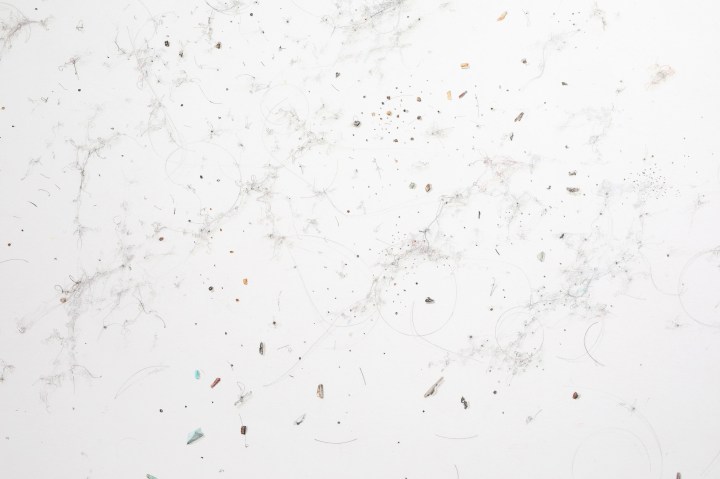
Michail Michailov, Dust to Dust, detail, colored pencil on paper, 2022 (Photograph by Lisa Rastl).
Upon first glance, Dust to Dust may seem like a minimalist installation amid the baroque ambiance of the Carlone Hall. However, upon closer inspection, the display’s space-consuming surface reveals profound poetry. Michailov has meticulously crafted an 18-part series of colored pencil drawings that capture the often unnoticed and incidental vestiges of time. The work is a microcosm touching on fundamental questions of value, transience, and existence with striking simplicity. The realism of Michailov’s trompe l’oeil technique can also be observed above the installation, in the Triumph of Aurora ceiling fresco, which portrays the victory of light over darkness.
Michail Michailov states: “While science explores matter through its composition, I try to understand its meaning through art.”
General Director Stella Rollig states: “Michail Michailov is interested in providing his audience with an experience that only art can make possible. The old master technique of trompe l’oeil that he employs in the Carlone Hall seeks to amaze, amuse, and fascinate. Whether in a large-scale installation or a sheet of paper, Michailov’s work challenges the senses to set the mind in motion.”
Michail Michailov was born in 1978 in Veliko Tarnovo, Bulgaria, where he studied fine arts. Since 2002, he has lived and worked in Vienna, where he completed a degree in art history. His artistic practice moves fluidly between the fields of drawing, installation, film, and performance. The Carlone Contemporary Series showcases contemporary works in the Carlone Hall of the Upper Belvedere. From the frescoed ancient world of the deities Apollo and Diana to the present day, artists bridge the Baroque pictorial program with fresh artistic perspectives.
Exhibition | Raphaël Barontini: We Could Be Heroes
From the English summary (via ArtFacts) of the exhibition opening this week at the Panthéon (Jessica Fripp’s review of Barontini’s Blue Lewoz appeared in J18 last October) . . .
Raphaël Barontini: We Could Be Heroes
Panthéon, Paris, 19 October 2023 — 11 February 2024
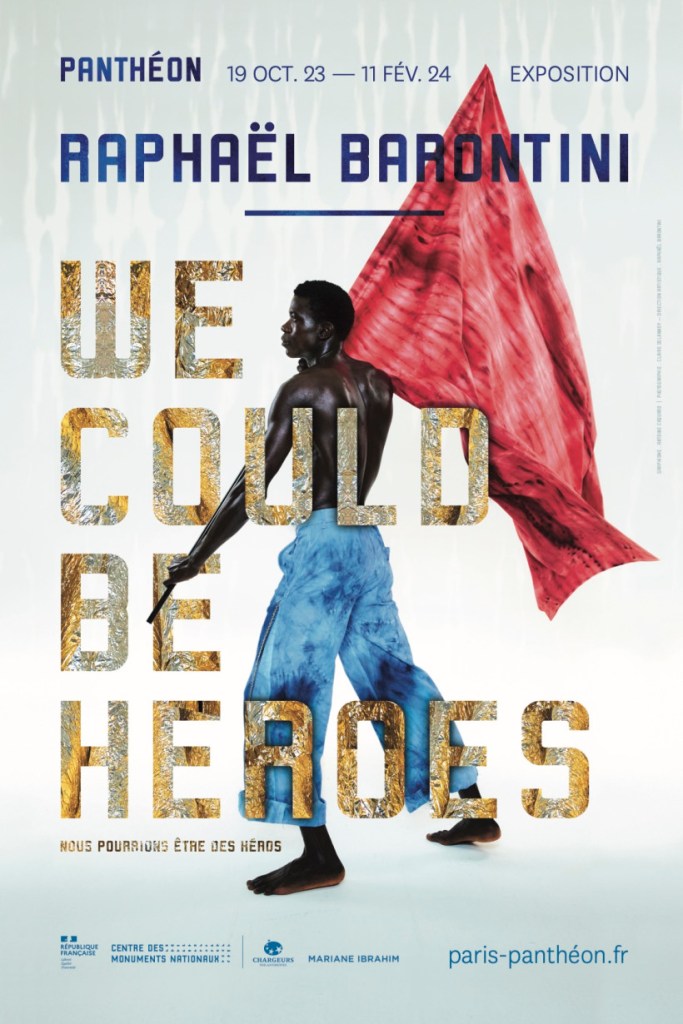 In October, Raphaël Barontini will unveil a major presentation at the Panthéon in Paris, focusing on the history and the memory of anti-slavery struggle. With this monument of national memory, which honors numerous and important figures in the abolitionist movement (i.e. Condorcet, abbé Grégoire, Toussaint Louverture, Louis Delgrès, Schoelcher, Félix Éboué), Raphaël Barontini aims to shine a spotlight on heroic figures of the fight against slavery. Whether well-known or not, each played critical roles in achieving abolition.
The artist has designed a monumental, on-site installation composed of flags and banners in a guard of honor. The north and south transepts will host two panoramic textile installations, Barontini is planning a live performance during the opening: a West Indian carnival procession. The collaborative creation will involve musicians and dancers. In bringing to life the memory of these struggles, they will be interacting with the textile and graphic works installed within the artist’s creation.
New Installation | Joana Vasconcelos’s Wedding Cake at Waddesdon
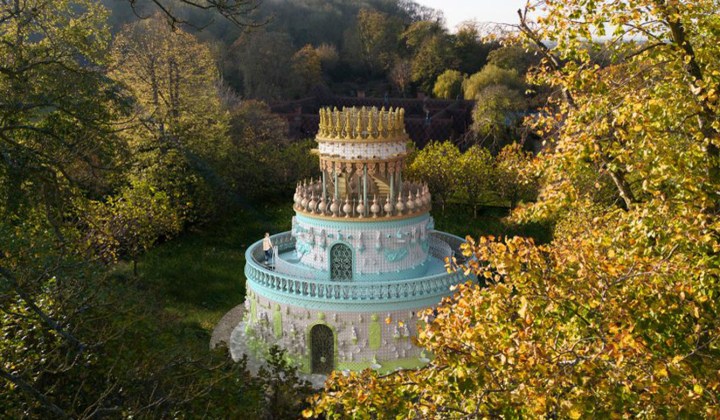
Joana Vasconcelos, Wedding Cake, at Waddesdon Manor in Aylesbury, installed 2023.
◊ ◊ ◊ ◊ ◊
From the press release for the new installation at Waddesdon:
Joana Vasconcelos: Wedding Cake at Waddesdon
The Dairy at Waddesdon Manor, open from 8 June 2023, with tours available until 26 October
Wedding Cake—a 12-metre-high sculptural pavilion in the form of a three-tiered wedding cake, clad entirely in ceramic tiles—is a major new work at Waddesdon by celebrated Portuguese artist Joana Vasconcelos (b. 1971). Almost five years in the making, Wedding Cake was commissioned by the Rothschild Foundation for Waddesdon, prompted by the relationship between visionary collector Lord Rothschild and Vasconcelos.
Part sculpture, part architectural garden folly, Wedding Cake is an extraordinary, enormous, fully immersive sculpture that combines pâtisserie and architecture. Gleaming and icing-like outside and in, it offers an intricate and richly sensory experience—glazed in pale pinks, greens, and blues, beset with sculptural ornament, and complete with the sounds of trickling water and a site-specific lighting scheme. Wedding Cake is Vasconcelos’s most ambitious commission to date, described by the artist as “a temple to love” celebrating festivity and marriage.
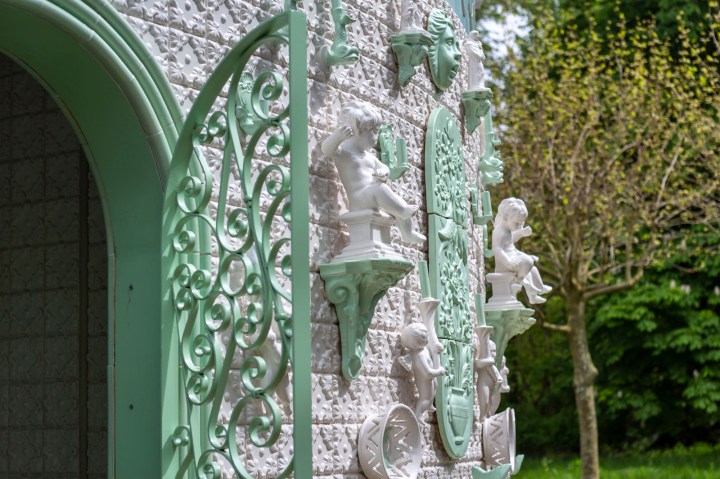
Joana Vasconcelos, Wedding Cake, at Waddesdon, detail of the ground level.
The history of the wedding cake is long and varied, full of symbolism and tradition—from ancient Rome where bread was broken over the bride’s head to bring good fortune to the couple, to contemporary confections that embody celebration and social status. Vasconcelos’s Wedding Cake is a playful addition to this rich history. Inspired by the exuberant Baroque buildings and highly decorative ceramic traditions of Lisbon—where Vasconcelos lives and works—the work is also a contemporary response to the great Rothschild traditions of hospitality with echoes of 18th-century garden pavilions.
At Waddesdon Wedding Cake will stand in a grove of trees alongside the 19th-century Dairy, built by Baron Ferdinand de Rothschild to entertain and charm guests at his famous house parties, and described by contemporaries as “a treasure house of what is beautiful, curious, or ancient.” It reminds us of the long European history of placing fanciful buildings in gardens and landscapes and forms part of a growing collection of significant contemporary and historic sculpture, brought together by Lord Rothschild. Today, the Dairy is still a much sought-after entertaining space, and the presence of the Wedding Cake, a symbol of love and happiness, is a perfect complement.
Wedding Cake is emblematic of Vasconcelos’s practice. She is deeply influenced by the artistic traditions of her home country, and the way in which she combines her materials reflects international influences on Portuguese culture over centuries—born from a history of exploring and seafaring, from Chinese and Japanese ceramics to Brazilian carnival, incorporating colour and light. Her work is often playful, manipulating scale to dramatic effect and using familiar daily objects in surprising, charming, and inventive ways. On a deeper level, her work explores notions of domesticity, femininity, empowerment, and the tension between private and public realms.
Vasconcelos’s work often challenges the assumptions of traditional hierarchies of ‘noble’ materials, such as marble, used frequently to embellish grand structures and often set above more everyday substances like ceramics and textiles. Her practice champions traditional, hand-made objects and techniques, and the ceramics for Wedding Cake have been made by the Viúva Lamego manufactory, which has been operating in Sintra for 170 years. The company’s standard 14×14cm tiles determined the size of the overall structure of Wedding Cake, whose 11m diameter is the smallest circle that can be made with whole tiles.
At Waddesdon, this combination of materials and the exploration of scale and technique is a perfect fit. The house is famous for its ceramics, particularly Sèvres and Meissen porcelain. The fashions and traditions of 18th- and 19th-century dining, entertaining, and festivity are also deeply embedded in the collections, whether a silver dinner service made for King George III, an 18th-century book recording the festivities laid on to mark a royal wedding, or a manual illustrating sugar sculpture. The sumptuous decoration of the Wedding Cake also speaks to the architecture of the house, itself covered in ornament and designed to complement the collections inside and the carefully laid out garden and landscape. These include the fanciful buildings in Waddesdon’s grounds like the Dairy, Flint House, and the Aviary, all intended to surprise and delight visitors.
According to Joana Vasconcelos, “An enormous project such as this one could only happen with the vision and encouragement provided by a generous and extraordinary patron such as Lord Rothschild. He could see its dreamlike potential, believe in it, and provide the means to make it come true. I have been addressing the subject of love through my career for almost 30 years now, but this is my biggest challenge so far. Many artists have the ‘impossible project’ and this is mine. I wanted people to have three different approaches to it: looking from the outside, enjoying the surroundings from the different levels or balconies, and rising to the top, finally completing the artwork with their presence. Above all, I always thought of it as a temple to love.”
Lord Rothschild says, “We are delighted to be collaborating again with Joana Vasconcelos, whose work is already magnificently represented at Waddesdon by her giant candlesticks, Lafite. The vision, imagination, and ambition exemplified in the Wedding Cake is a perfect match for the passion which drove Baron Ferdinand, the creator of Waddesdon, to build the Manor and the Dairy, where he intended that his many friends would be surprised and delighted at every turn. I am sure that the Wedding Cake will have just as great an impact on visitors and wedding guests today.”
Pippa Shirley, Director of Waddesdon says, “Waddesdon was built to entertain; so, what better way to mark the continuity today of that spirit of hospitality, artistic creativity, and Rothschild family patronage than through the commission of this magical object, an emblem of love and celebration. Projects like this require a leap of faith from both artist and patron, and we are proud to have been a partner in this innovative work.”
Recipe for Wedding Cake
• 1 creative artist
• 1 visionary patron
• 2 international teams
• Pinch of experts
• 3500 wrought iron parts
• 21,815kg iron sheet
• Approximately 25,150 Viúva Lamego ceramic tiles (99 different types) and 1,238 Viúva Lamego ceramic pieces (52 different types). Ceramic tile area: 365 m2
• Plethora of ornaments — mermaids, dolphins, candles, globes, etc
• Indoor and outdoor lights — 350 glass flames receiving optical fiber (about 3,000 meters)
• 592 light points
• Rivers of glaze
• Sprinklings of water
• Hope, belief, and effort
Blend the circa 50 tons with generous amounts of creativity and patience. Bind into different panels; raise tier by tier to height of 12 meters. Assemble at Waddesdon. Serve with love.
Joana Vasconcelos’s Lafite, two giant candlesticks made of illuminated Chateau Lafite Rothschild magnums (commissioned in 2015 by the Rothschild Foundation in celebration of the family associations with the world of great Bordeaux wine), will be moving to the Dairy. In 2012, her Pavillon de Thé, a giant wrought-iron tea pot, was the focal point of House of Cards, a contemporary sculpture exhibition in the gardens, and in 2016 her Cup Cake (2011) was exhibited on the North Front.
Vasconcelos’s work is also represented in major collections around the world, such as those of Calouste Gulbenkian, François Pinault, and the Louis Vuitton Foundation. She has exhibited regularly since the mid-1990s. Her work became known internationally after her participation in the 51st Venice Biennale in 2005, with the work A Noiva [The Bride] (2001–05). She was the first woman and the youngest artist to exhibit at the Palace of Versailles, in 2012. Other highlights of her career include a solo exhibition at Guggenheim Museum Bilbao (2019); the project Trafaria Praia for the Pavilion of Portugal at the 55th Venice Biennale (2013); the participation in the group exhibition The World Belongs to You at the Palazzo Grassi/François Pinault Foundation, Venice (2011); taking part in Un Certain Etat du Monde? A Selection of Works from the François Pinault Foundation at the Garage Center for Contemporary Culture in Moscow (2013); and her first retrospective Sem Rede held at the Museu Coleção Berardo, Lisbon (2010). Her solo show Time Machine was on view at Manchester Art Gallery in 2014; in London she exhibited at Royal Academy of Arts’ Summer Exhibition in 2018; and she was given a major show at the Yorkshire Sculpture Park, Beyond in 2021.
Visitors to Waddesdon will be able to visit Wedding Cake on a guided tour that will include the impressive collection of contemporary sculpture situated in the Water Garden at the Dairy. Wedding Cake tours will run from 8 June until 26 October on Thursdays and selected Sundays.










 Enfilade
leave a comment