Lecture | Annette Richards on the ‘Blind Virtuosa, Mademoiselle Paradis’
In March at the Yale University Art Gallery, from The Walpole Library:
Annette Richards | Music on the Dark Side of 1800:
Listening to the Blind Virtuosa, Mademoiselle Paradis
Yale University Art Gallery, New Haven, 28 March 2024, 5.30pm
 The 26th Lewis Walpole Library Lecture will be delivered by Annette Richards, the Given Foundation Professor in the Humanities and University Organist at Cornell University.
In concerts across Europe in the 1780s, the young Viennese virtuosa Maria Theresia Paradis made blindness visible, even audible. Her performances invited listeners and viewers primed by horror ballads and literary romance to experience her story of trauma and misfortune within the frame of fictional narratives of doomed innocence and victimized Gothic heroines. Yet her outspoken views on blindness—informed by her own experience and contemporary philosophical discourse (by Diderot, Condillac, and Herder, among many others)—explicitly resisted the language of victimization, even as she sold pity for profit. This lecture brings to sounding life the Paridisian contradiction between performing disability for money and resisting pity. It asks what 18th-century music culture can tell us about contemporary views on blindness and explores the ways the public performances of a young female virtuoso simultaneously embraced and critiqued a culture of gawking spectatorship, freak show aesthetics, and the ethics and economics of pity. How did this Gothic musical heroine capture the public imagination, and what does she reveal about how music looked and sounded on the dark side of 1800?
Annette Richards is Professor of Music and University Organist at Cornell, and the Executive Director of the Westfield Center for Historical Keyboard Studies. She is a performer and scholar with a specialty in 18th-century music and aesthetics, and interdisciplinary research into music, literature, and visual culture. Dr. Richards was educated at Oxford University (BA, MA), Stanford University (PhD), and the Sweelinck Conservatorium Amsterdam (Performer’s Diploma, Uitvoerend Musicus).
Summer Seminar | Disability Histories in the Visual Archive
This week-long summer seminar will take place at the American Antiquarian Society:
Disability Histories in the Visual Archive: Redress, Protest, and Justice
American Antiquarian Society, Worcester, Massachusetts, 9–14 June 2024
Led by Jennifer Van Horn and Laurel Daen
Applications due by 8 April 2024
The seminar will focus on the visual and material cultures of disability in eighteenth and nineteenth-century North America. Participants will hone their skills in visual and material culture analysis, learn key methods and theories, including cripping, and gain experience working closely with archives and visual materials that support disability history. We will explore the unparalleled collections of the AAS, especially the library’s exemplary graphic arts collection of prints, photographs, and ephemera as well as collections materials on related topics such as education and printing for the blind.
The seminar will interrogate disability as lived experience, analytical category, and site for creativity and protest. Centering the histories of diverse peoples, we will explore topics such as enslavement, colonization, indigeneity, gender, education, warfare, and disability rights. Participants will actively work toward disability justice by attending to understudied and obscured histories, by questioning how we can use visual and material things to redress past injustices and dismantle ableism, and by considering equitable archival access.
Interdisciplinary in approach, the seminar welcomes scholars across multiple fields and areas of expertise that might include art history, Black studies, design history, disability studies, medical humanities, histories of vast early America, Native and Indigenous studies, and visual and material culture studies. Librarians, museum professionals, and public historians are encouraged to apply. No previous experience in disability studies or visual culture is required.
Guest speakers will include Jenifer Barclay, Associate Professor of History, University of Buffalo and author of The Mark of Slavery: Disability, Race, and Gender in Antebellum America (University of Illinois Press, 2020), and Erin Corrales-Diaz, Curator of American Art, Toledo Museum of Art.
Please follow this link for more information and instructions on how to apply.
The tuition fee for each seminar is $800, which includes meals throughout the week and evening receptions. Modest aid may be available for graduate students and early-career scholars to assist with travel and housing costs. Please feel free to reach out to Jennifer Van Horn with any questions (jvanhorn@udel.edu), or questions can be addressed to John J. Garcia, AAS Director of Scholarly Programs and Partnerships, jgarcia@mwa.org.
The seminar is sponsored by the Center for Historic American Visual Culture (CHAViC).
New Book | Yale and Slavery: A History
From Yale UP:
David Blight, with Yale and Slavery Research Project, foreword by Peter Salovey, Yale and Slavery: A History (New Haven: Yale University Press, 2024), 448 Pages, ISBN: 978-0300273847, $35.
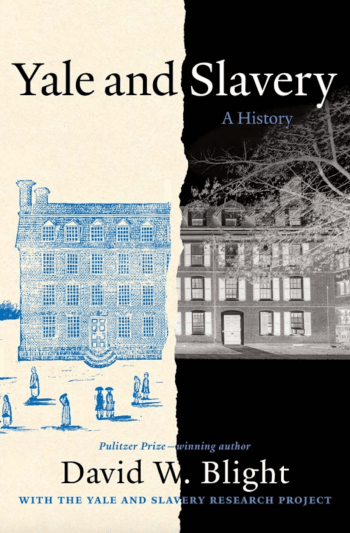 A comprehensive look at how slavery and resistance to it have shaped Yale University
Award-winning historian David W. Blight, with the Yale and Slavery Research Project, answers the call to investigate Yale University’s historical involvement with slavery, the slave trade, and abolition. This narrative history demonstrates the importance of slavery in the making of this renowned American institution of higher learning.
Drawing on wide-ranging archival materials, Yale and Slavery extends from the century before the college’s founding in 1701 to the dedication of its Civil War memorial in 1915, while engaging with the legacies and remembrance of this complex story. The book brings into focus the enslaved and free Black people who have been part of Yale’s history from the beginning—but too often ignored in official accounts. These individuals and their descendants worked at Yale; petitioned and fought for freedom and dignity; built churches, schools, and antislavery organizations; and were among the first Black students to transform the university from the inside.
Always alive to the surprises and ironies of the past, Yale and Slavery presents a richer and more complete history of Yale, the third-oldest college in the country, showing how pillars of American higher education, even in New England, emerged over time intertwined with the national and international history of racial slavery.
David W. Blight is Sterling Professor of History and director of the Gilder Lehrman Center for the Study of Slavery, Resistance, and Abolition at the MacMillan Center at Yale. The Yale and Slavery Research Project was convened in 2020.
TEFAF Maastricht 2024
TEFAF Maastricht opens soon, with lots of interesting 18th-century offerings, including these catalogues from Zebregs & Röell, one of which focuses on a rediscovered portrait of Gustav Badin, a well-known Black African at the court of Maria Louisa of Prussia, Queen of Sweden.
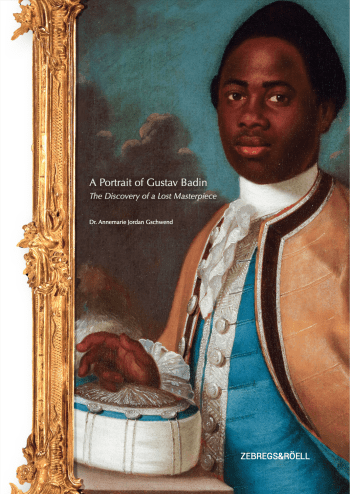
Jakob Björk, after Gustav Lundberg, Portrait of Fredrik Adolf Ludvig Gustav Albert Badin Couschi (ca. 1750–1822), 1776, oil on canvas.
Guus Röell and Dickie Zebregs, Uit verre Streken / From Distant Shores (Maastricht: Zebregs & Röell, 2024), 146 pages. Link»
Annemarie Jordan-Gschwend, A Portrait of Gustav Badin: The Discovery of a Lost Masterpiece (Maastricht: Zebregs & Röell, 2024), 20 pages. Link»
◊ ◊ ◊ ◊ ◊
TEFAF Maastricht
Maastricht, 9–14 March 2024
The European Fine Art Foundation, TEFAF Maastricht, is widely regarded as the world’s premier fair for fine art, antiques, and design, bringing together 7,000 years of art history under one roof. Featuring over 260 prestigious dealers from some 20 countries, TEFAF Maastricht is a showcase for the finest art works currently on the market. Alongside the traditional areas of Old Master paintings, antiques, and classical antiquities that cover approximately half of the fair, you can also find modern and contemporary art, photography, jewelry, 20th century design, and works on paper.
Online Workshop | European Frames, 15th–21st Centuries
From ArtHist.net:
Hubert Baija | Picture Frames in Europe, 15th–21st Centuries
Online, Beloit College Center for Collections Care, 10–24 September 2024
In a series of five online workshops Hubert Baija, an experienced frame scholar retired from the Rijksmuseum, presents the history of picture frames since the Late Middle Ages. Stylistic and technical characteristics are highlighted for distinguishing original frame manufacture from later production. This online course presents half a millennium of European picture framing by discussing the history of frame styles in connection to architecture, painting, and the decorative arts. The course will review the history of picture frames from the International Gothic style to the Italian and Northern Renaissance, via the Dutch Golden Age and the French frame styles, into 19th- and 20th-century framing. Participants will be shown tools for distinguishing styles and periods of frame manufacture. This online course serves first-time learners and professionals needing to refresh their knowledge. $500.
Tuesday, 10 September 2024
Late Medieval picture framing was influenced by architecture and illuminated manuscripts. Paintings and frames formed designed units, often emphasized by extending the pictorial space with trompe l’oeil painting on frames. The interplays between Gothic and Renaissance influences resulted in gradual transitions of frame shapes and profiles until the Iconoclasms finally ended the medieval frame styles.
Thursday, 12 September 2024
Italian art and architecture led to European frame designs during the 16th and 17th centuries. Renaissance frame profiles evolved in the Lowlands and eventually became more refined by embellishing with highly polished ebony, fruitwood, and even whalebone veneers, sometimes combined with Southern German ripple molding techniques.
Tuesday, 17 September 2024
The flamboyant Italian influences on woodcarving continued in 17th-century Europe, particularly in France and Holland. The Dutch Golden Age produced baroque frames and cartouches, including classicist, trophy, and auricular-style frames. The post-1685 Huguenot exodus from France paradoxically increased the French influence on the European decorative arts, including picture frames.
Thursday, 19 September 2024
The French decorative arts were renowned for their exceptional aesthetic and technical refinements during the reigns of Louis XIII, Louis XIV, Louis XV, and Louis XVI. Mold-made ornamentation began in Paris during the early 1700s, which would eventually lead to industrialized frame-making. French frame styles influenced frame styles for three centuries in England, Europe, and North America.
Tuesday, 24 September 2024
Empire frames with purely mold-made ornaments were followed by a dazzling variety of 19th-century neo-styles frames, like Biedermeier, Neo-Rococo, Neo-Gothic, Neo-Classical, Eclectic, and Barbizon frames. Arts and Crafts and Art Nouveau frames were contrasted to industrialization, while 20th-century Art Deco and Minimalist framing echoed modernism. During the 20th and 21st centuries, museum re-framing has changed from less informed approaches to studying original framing.
Target audience: Students and beginning/advanced professionals in art history or the conservation of paintings and picture frames.
Participants: Maximum of 20. After registration, you will be asked to provide a brief CV and motivation for enrolling in this course.
Times (in daylight savings time):
San Francisco 10.00am–noon
Chicago noon–2.00pm
New York 1.00–3.00pm
London 6.00–8.00pm
Amsterdam 7.00–9.00pm
This course was first given by the University of Amsterdam in 2021 and is available again this year via the Beloit College Center for Collections Care. Please, use this link to register.
Workshop | Understanding Period Plasterwork
From the Traditional Architecture Group:
Understanding Period Plasterwork: A Workshop with Philip Gaches
Gaches Workshops, Deeping St James, Lincolnshire, 25–26 April 2024
Registration due by 1 March 2024
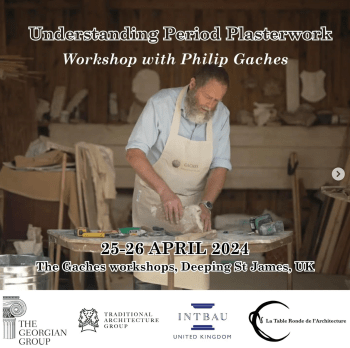 There are three distinctly different periods of plasterwork in the UK. The use of plaster on ceilings began toward the end of the 15th century, flourished with 16th-century Elizabethan masterpieces, and blossomed in the 17th century with more complex Jacobean work. By 1700, fashion was changing with more influence from Europe, and Palladianism swept in with its beautiful balance and precision, a style that continued through the Georgian period and its neo-classicism. By 1850, however, a new method was introduced: cheaper, quicker fibrous casting, which is installed dry. Though inferior to all that came before, fibrous cast plaster still remains the most popular method of creating ornamental plasterwork.
Philip Gaches has taught traditional plastering in Myanmar, Afghanistan, and across Europe during his 45-year career, from which he has gained a huge amount of experience that he brings to his courses. In the two-day Understanding Period Plasterwork course, he will guide students through the three periods of British plasterwork, using a combination of presentations and practical demonstrations—after which participants will create, with Philip’s guidance, their own pieces of plasterwork from each period, underscoring the differences between materials, methods, and designs.
Course fees are £350 per person / £250 (full-time student rate). Included are Gaches aprons for each student, along with all tools, materials, and PPE. To register, please send an email to admin@traditionalarchitecturegroup.org before 1 March 2024 for payment instructions. Students should include proof of school/university registration.
Conference | Environmental Impacts of Catholic Missions, Atlantic
From ArtHist.net:
The Environmental Impacts of Early Modern Catholic Missions in the Atlantic Space
Online and in-person, Institut National d’Histoire de l’Art, 9 March 2024
This is one in a series of workshops aimed at exploring the role of the Catholic Church, through its missionary undertaken, in the global environmental upheavals and discoveries of the early modern period. Venturing wide and far beyond the familiar European sphere, early modern missionaries frequently used the rhetoric of Theatrum Mundi to reflect on their encounters with previously unknown cultures. What has escaped scholars’ attention, however, is how these rapidly evolving dramas of evangelization in turn shaped the seemingly timeless backstage setting of Nature. As the missionaries voyaged away and established new religious communities, they were not only faced with social and cultural challenges raised by the vastly different linguistic, political, and philosophical traditions, but they also had to adapt to unfamiliar geographical, climate, and material conditions as they sought to construct churches or realize liturgical rituals, not to mention the extensive agricultural and medical activities they had to pick up for personal survival in often severe natural conditions.
One overarching method we want to propose is to think about early modern Catholicism in the plural term, as theorized by Simon Ditchfield. Studies on post-Tridentine missions tended to emphasize the central authoritative role of Rome, focusing especially on the role of the missionary as leader in the creating of new religiosity, new economical exchanges, or new societies. The new attention paid to missionaries’ interactions with local natural conditions will complicate our understanding of Rome as one of the few truly global institutions of the early modern period acting not only as a religious and evangelist force but also in the colonialist expansions.
p r o g r a m m e
13.30 Introduction — Silvia Mostaccio (Université Catholique de Louvain)
13.45 Yasmina Rocio Ben Yessef Garfia (Università di Napoli Federico II) — La natura contro gli indigeni: religiosi e racconti della catastrofe nel viceregno del Perù (s. XVII–XVIII)
14.30 Nils Renard (Université Paris 1 Panthéon-Sorbonne) — The Catholic Church and the Liberty Trees during the French Revolution: An Environmental Syncretism between France and the New World
15.15 Break
15.45 Thomas Brignon (Université Paris 3 Sorbonne Nouvelle) — A Predatory Arcadia: Revisiting Animal Husbandry, Hunting, Fishing, and Gathering in the Jesuit-Guaraní Missions (Paraguay, 17–18th Centuries)
16.30 Andréanne Martel (Université du Québec à Montréal, Université de Genève) — Nommer la faune, la flore et le territoire « en Canada » : écriture, oralité et savoirs autochtones dans les cartes du missionnaire jésuite Pierre-Michel Laure (1688–1738)
17.15 Break
17.30 Isabel Harvey (Université du Québec à Montréal, UCLouvain) — L’environnement comme protagoniste historique
18.00 Final Discussion
Organizing Commitee
• Isabel Harvey, Université du Québec à Montréal
• Alysée Le Druillenec, Université Paris 1 Panthéon-Sorbonne
• Wenjie Su, Princeton University
Call for Papers | New Perspectives on Life Drawing
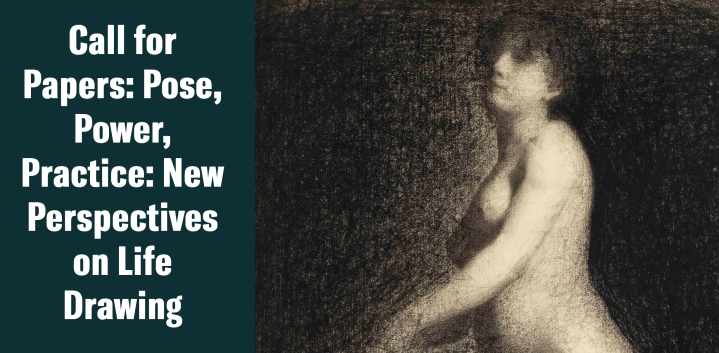
Georges Seurat, Female Nude, detail, ca. 1879–81, black conté crayon over preliminary drawing with stumped graphite
(London: The Courtauld, D.1948.SC.151)
◊ ◊ ◊ ◊ ◊
From the Call for Papers and The Courtauld:
Pose, Power, Practice: New Perspectives on Life Drawing
The Courtauld Institute of Art, Vernon Square, London, 20 June 2024
Proposals due by 22 March 2024
From the sixteenth century to the present, drawing the human body from life has remained a mainstay of Western institutional art practice. Despite significant shifts in the aesthetics, media, and purpose of art over the last five hundred years, life drawing endures in both the studio and the classroom. Pose, Power, Practice is a one-day symposium that seeks to reassess the state of the field on life drawing and apply new critical frameworks to this sustained practice. It aims to better understand life drawing in all its complexity, from its presumed advantages to its consequences. This is a practice deeply intertwined with concerns central to the discipline of art history, including but not limited to: the power dynamics of the gaze; the politics of representation; recognition of multiple forms of artistic labor; formulations of race, dis/ability, gender, and sexuality; and critiques of institutions. How has life drawing changed across time and place? How and why has it endured as a pedagogical practice, despite repeated dismissals of its ‘academicism’? What uses does it hold today, for artists and art historians alike?

Charles Joseph Natoire, The Life Class at the French Royal Academy of Painting and Sculpture, 1746, pen, black and brown ink, grey wash and watercolour, graphite over black chalk (Courtauld, D.1952.RW.3973).
We invite studies that unearth the specificities of life drawing to interrogate larger questions of ethics, labor, power, and potential in the life studio. Papers might attend to any and all aspects of this practice, from the models who pose, to the materials used, to the dynamics of the environments—formal and informal—in which life drawing takes place. We welcome papers that consider artistic engagements with drawing the human figure from life across all regions and periods, historical and contemporary.
This symposium aims to bridge connections and bolster dialogue across specialist scholarly communities by centring this shared subject of concern, while also inspiring broader understandings of what constitutes expertise in this field. We therefore encourage applications from all scholars and practitioners of life drawing, including students, artists, and models, in the UK and abroad. In addition to 20-minute conference papers, we welcome creative or collaborative submissions.
Pose, Power, Practice will take place at the Courtauld’s Vernon Square campus in person on Thursday, 20 June 2024. The programme will be recorded and subsequently shared on the Courtauld’s YouTube channel. Speakers will be further invited to participate in a workshop in The Courtauld’s Prints and Drawings Study Room on 21 June 2024. Partial reimbursement for travel and accommodation may be available. In addition, we are planning a remote component of the symposium earlier in the week in collaboration with The Drawing Foundation, so if you are unable to travel to Vernon Square please do submit an application and indicate this preference.
Applications are due via this Google form on 22 March and speakers will be notified by 5 April. If you have any questions, please contact Zoë Dostal (azd2103@columbia.edu) or Isabel Bird (isabelbird@g.harvard.edu).
7th Annual Ricciardi Prize from Master Drawings
Ian Hicks was the winner of the 2024 Ricciardi Prize for his ground-breaking reconsideration of a group of drawings by Giambattista Tiepolo, research that was begun during his term as the Moore Curatorial Fellow at the Morgan (2020–22). From Master Drawings:
Seventh Annual Ricciardi Prize from Master Drawings
Submissions due by 15 November 2024

Johann Schenau, The Crowning of the Rosiere, pen and brown ink and wash over graphite, on wove paper (New York: The Morgan Library & Museum, 2009.287).
Master Drawings is now accepting submissions for the 7th Annual Ricciardi Prize of $5,000. The award is given for the best new and unpublished article on a drawing topic (of any period) by a scholar under the age of 40. The winning submission will be published in a 2025 issue of Master Drawings. Information about essay requirements and how to apply can be found here. Information about past winners and finalists is available here.
The average length is between 2,500 and 3,750 words, with five to twenty illustrations. Submissions should be no longer than 10,000 words and have no more than 100 footnotes. All submissions must be in article form, following the format of the journal. Please refer to our Submission Guidelines for additional information. We will not consider submissions of seminar papers, dissertation chapters, or other written material that has not been adapted into the format of a journal article. Written material that has been previously published, or is scheduled for future publication, will not be eligible. Articles may be submitted in any language. Please be sure to include a 100 word abstract outlining the scope of your article with your submission.
New Book | Disegni di Prospettiva Ideale (1732)
This collection of drawings of Rome by Filippo Juvarra is published as part of the series FONTES: Text- und Bildquellen zur Kunstgeschichte 1350–1750, from arthistoricum.net, where the full PDF is available for free.
Cristina Ruggero, Disegni di Prospettiva Ideale (1732): Un omaggio di Filippo Juvarra ad Augusto il Forte e i rapporti fra le corti di Roma, Torino, Dresda (Heidelberg: arthistoricum.net, 2023), 456 pages, ISBN: 978-3985010851.
 Nella primavera del 1732 Filippo Juvarra spediva da Roma un album con 41 Disegni di Prospettiva Ideale destinato ad Augusto il Forte, principe elettore sassone e re di Polonia. Latore del dono doveva essere Antonio Giuseppe Gabaleone conte di Wackerbarth Salmour—il nobile torinese naturalizzato in Sassonia—che in quel momento era nella città pontificia in missione segreta per suo conto. L’album conservato nel Kupferstich-Kabinett di Dresda celebra l’esemplarità di Roma nei secoli, laddove, attraverso i temi affrontati, le composizioni scenografiche e la tecnica si sviluppa una narrazione di grande forza evocativa, a ulteriore conferma delle poliedriche qualità di Juvarra come grande regista delle arti. I disegni sono pubblicati qui per la prima volta integralmente assieme ad alcune lettere inedite che aiutano a far luce su un episodio artistico che coinvolse le corti di Roma, Torino e Dresda.
Cristina Ruggero è attualmente collaboratrice scientifica del progetto Antiquitatum Thesaurus presso la Berlin-Brandeburgische Akademie der Wissenschaften. Oltre alle sue pubblicazioni su Juvarra, studia da anni la ricezione dell’antico e le reti culturali e artistiche tra le corti europee nel XVIIe XVIII secolo. Ha collaborato con rinomate istituzioni internazionali quali la Bibliotheca Hertziana e l’Università La Sapienza di Roma, il Zentralinstitut für Kunstgeschichte di Monaco e l’Italian Academy at Columbia University di New York.
c o n t e n t s
Page preliminari
Indice
Ringraziamenti
• Introduzione
• Il libro di Disegni di Prospettiva Ideale nel Kupferstich-Kabinett di Dresda
• Catalogo dei disegni
• Filippo Juvarra (1678–1736): l’architetto e i suoi doni di grafica
• Augusto il Forte (1670–1733): un sovrano cultore delle arti
• Giuseppe Antonio Gabaleone conte di Wackerbarth–Salmour (1685–1761) e il suo ruolo di intermediario
• I Disegni di Prospettiva Ideale tra capriccio e seduzione
• Conclusione
• An homage from Filippo Juvarra to August the Strong and the relationships between the courts of Rome, Turin, and Dresden
Abbreviazioni
Bibliografia
Referenze fotografiche
Indice dei nomi










 Enfilade
leave a comment