Call for Essays | Animal Preservation before 1850
From ArtHist.net, which includes the German version of the CFP:
‘Weder Fisch noch Fleisch’: Animal Preservation before 1850 in Theory and Practice
‘Weder Fisch noch Fleisch’: Tierpräparation vor 1850 in Theorie und Praxis
Volume of essays edited by Dorothee Fischer and Robert Bauernfeind
Proposals due by 31 May 2024, with final essays due by 15 November 2024
The volume ‘Weder Fisch noch Fleisch’ will explore the theory and practice of animal preparation prior to 1850. The book project focuses thus on animal preparations made before the modernization of taxidermy around the middle of the 19th century. While taxidermied objects themselves are irritating in their semantic ambivalence of being both the animal itself and its representation, early modern animal preparation often underwent a further distortion: It was susceptible to deformation due to inadequate conservation methods and created less evidence of the animals’ appearance rather than developing its own momentum as an aesthetic object. Neglect of historical specimens in modern collections contributed to the continuation of this momentum right up to the present day. Damage, deformation, and discolouration can often be observed on the—relatively few—preserved pre-modern specimens. However, both unintentional and deliberate deformations of the specimens contributed to the idea of the ‘nature’ of the respective animals since specimens formed the basis of early modern natural history collections in the 16th century.
In line with these observations, the volume aims to interpret historical specimens not only as objects of the history of both science and collecting, but also in terms of their distinct aesthetics and as sources of insights into (historical) human-animal relationships. In this way, the topic responds to current impulses from various research discourses, promoting interdisciplinary research. While these objects have recently been increasingly addressed from the perspective of collection history, questions about the taxidermied animal as an aesthetic object and trace of the living animal, further bridges the topic to questions of Visual Studies and Human-Animal Studies. From a Human-Animal Studies perspective, deceased yet materially preserved animals still receive less attention than living ones, despite their comparable impact on the relationship between humans and non-human animals. Also, questions about the ‘biographies’ of individual specimens are often a desideratum. Moreover, the exact practices of animal preparation before 1850 have only been marginally examined. The contributions of this volume aim to fill these gaps.
Topics for contributions could encompass, for example, preparation methods, preserved specimens, and their contribution to knowledge production. How do early preparations straddle naturalist interest and artistic craftsmanship? How do these procedures differ from subsequent centuries, and what insights do these objects offer into historical and contemporary human-animal relationships? A workshop held at the University of Trier in the summer of 2022 ignited the dialogue among perspectives from the humanities and natural history museum practice. The volume positions itself as a continuation of this exchange and a deepening of the interdisciplinary examination of early animal preparation. We welcome contributions not only from scholars in cultural studies, art history, and the history of science and knowledge, but also from practitioners of the trade and museum professionals, as well as individuals from other disciplines and perspectives.
Prospective contributors are invited to submit an abstract (maximum of 350 words) and a brief biography via email to the editors, Dorothee Fischer (fischerd@uni-trier.de) and Robert Bauernfeind (robert.bauernfeind@philhist.uni-augsburg.de) by 31 May 2024. Abstracts and contributions may be presented in either English or German. Feedback on our decision will be provided by the end of June 2024. The submission date of the complete contribution (with up to 40,000 characters and 3–4 illustrations) is 15 November 2024. The publication is planned for 2025.
Call for Papers | Improvisation and Citation in the Arts of 18th-C. France
For next year’s MLA conference, which takes ‘Visibility’ as its presidential theme:
Improvisation and Citation: Experimentation and Creativity in the Arts
18th-Century French Forum at the Modern Language Association Convention, New Orleans, 9–12 January 2025
Proposals due by 18 March 2024
This panel, covering topics of or related to eighteenth-century French or Francophone culture, invites submissions that explore the role of improvisation and citation as techniques in aesthetic creation, focusing on their adaptation from music to other art forms such as literature, theatre, and visual arts. We are particularly interested in interdisciplinary topics, including but not limited to: portrayals of musical performances in literary and theatrical works, and the use of improvisational and citational methods in literary forms. Additionally, we seek analyses of art criticism that employ the improvisational vocabulary of music. Another area of interest is also the representation of improvisation in various arts: we aim to examine which type of artists are portrayed as possessing the innate ability to improvise, and how literary works reinterpret and repurpose the motifs associated with the improvisational prowess of artists. Please send abstract submissions to scott.m.sanders@dartmouth.edu by Monday, 18 March 2024.
Conference | Traveling Objects: Material Cultures of the Atlantic Routes
Hosted by the INHA, as noted at ArtHist.net:
Travelling Objects: The Material Culture of the Atlantic Routes — Encounters of Cultures and Things
Institut national d’histoire de l’art, Paris, 21 February 2024
Organized by Maddalena Bellavitis and José Manuel Santos Pérez
9.30 Welcome and Opening
Maddalena Bellavitis (EPHE) and José Manuel Santos Pérez (Centro de Estudios Brasileños, Universidad de Salamanca)
9.45 Morning Session
1 Alicia Sempere Marín and Ignacio José García Zapata (Universidad de Murcia), Jesuits’ Travel Journal from New Spain to Europe: Routes, Stops, and Acquisitions of Devotional Objects in 1757
2 Genevieve Warwick (University of Edinburgh), Jewelled Currency: Glass Conterie in the First Age of Circumnavigation
3 Charikleia (Haris) Makedonopoulou (NTU Athens / ETH Zurich), Tracing the Multiple Journeys of the Palm Tree between the East and the West
4 Rebecca Legrand, Fanny Bulté (Université de Lille), The Taste of Others: Between Fear and Fascination
5 Patrícia Gomes da Silveira (Colégio Pedro II/Universidade do Estado do Rio de Janeiro), William John Burchell and the Representation of Brazilian Landscape in His Expedition, online
13.30 Lunch Break
14.30 Afternoon Session
6 Carmen Espejo-Cala (Universidad de Sevilla) and Paul Firbas (Stony Brook University, New York), Conexiones entre las imprentas de lima y Sevilla (siglos XVI y XVII): agentes y actores-red
7 Eduardo Corona Pérez (Universidad de Sevilla), En los albores de la fundación y de la fiebre del oro: los hombres y mujeres que hicieron Vila Rica de Ouro Preto
8 Lauren Beck (Mount Allison University), Viewing Spain from the Americas: Indigenous Perspectives, Experiences, and Sources
9 Britt Dams (Ghent University / Université Paul Valéry), « I am a better Christian than you are », The Remarkable Epistolary Exchange between Two Potiguara Leaders, Pedro Poti and Felipe Camarão
10 Eduardo Cesar Valuche Oliveira Brito (Universidade Federal Fluminense, UFF-Brasil), As ‘Missões de Marinheiros’ no Atlântico anglo-americano: a cultura material protestante na virada dos séculos XVIII e XIX
11 Ana-Marianela Rochas-Porraz (ÉNSA Versailles), Images d’expatriation de la France au Mexique: le fonds photographique de l’architecte Fernand Marcon (1877–1962)
17.30 Discussion and Conclusions
The description of the project from the Call for Papers is available here»
Contact Information
Maddalena Bellavitis
Laboratoire Saprat
École pratique des hautes études
Campus Condorcet – Bâtiment Recherche Nord
14, Cours des Humanités
93322 Aubervilliers Cedex
France
maddalena.bellavitis@gmail.com
Exhibition | Clockwork Treasures from China’s Forbidden City

Zimingzhong with a Crane Carrying a Pavilion, 18th century
(Beijing: The Palace Museum)
◊ ◊ ◊ ◊ ◊
From the press release (via Art Daily) for the exhibition:
Zimingzhong 凝时聚珍: Clockwork Treasures from China’s Forbidden City
Science Museum, London, 1 February — 2 June 2024
A major exhibition opened at the Science Museum on Thursday, 1 February 2024, featuring more than 20 resplendent mechanical clocks, called zimingzhong, on loan from The Palace Museum in Beijing and never before displayed together in the UK. Zimingzhong 凝时聚珍: Clockwork Treasures from China’s Forbidden City takes visitors on a journey through the 1700s, from the Chinese trading port of Guangzhou and onto the home of the emperors in the Forbidden City, the UNESCO-listed palace in the heart of Beijing. The exhibition shines a light on the emperors’ keen interest in and collection of these remarkable clockwork instruments, the origins of this unique trade, and the inner workings of the elaborate treasures that inspired British craftsmen and emperors alike. Translating to ‘bells that ring themselves’, zimingzhong were more than just clocks: they presented an enchanting combination of a flamboyant aesthetic, timekeeping, music and movement using mechanisms new to most people in 18th-century China.

Pagoda Zimingzhong, 18th century (Beijing: The Palace Museum).
On entering the exhibition, visitors encounter the ornate Pagoda Zimingzhong, a celebration of the technology and design possibilities of zimingzhong. This unique piece dating from the 1700s was made in London during the Qing Dynasty in China. The complex moving mechanism is brought to life in an accompanying video which shows the nine delicate tiers slowly rise and fall.
Next, the ‘Emperors and Zimingzhong’ section explores the vital role of zimingzhong in facilitating early cultural exchanges between East and West. Some of the first zimingzhong to enter the Forbidden City were brought by Matteo Ricci, an Italian missionary in the early 1600s. Ricci and other missionaries were seeking to ingratiate themselves in Chinese society by presenting beautiful automata to the emperor. Decades later, the Kangxi Emperor (1662–1722) was intrigued by, and went on to collect, these automata which he christened zimingzhong, displaying them as ‘foreign curiosities’. They helped demonstrate his mastery of time, the heavens, and his divine right to rule.
The ‘Trade’ section explores the clock trade route from London to the southern Chinese coast. The journey took up to a year, but once British merchants reached the coast, they could buy sought-after goods including silk, tea, and porcelain. Within this section, visitors can see a preserved porcelain tea bowl and saucer set which sank on a merchant ship in 1752 and was found centuries later at the bottom of the South China Sea.
Whilst the demand for Chinese goods was high, British merchants were keen to develop their own export trade, and British-made luxury goods like zimingzhong provided the perfect opportunity to do so. This exchange of goods led to the exchange of skills. In the ‘Mechanics’ section of the exhibition visitors can see luxurious pieces like the Zimingzhong with mechanical lotus flowers, which was constructed using Chinese and European technology. When wound, a flock of miniature birds swim on a glistening pond as potted lotus flowers open. The sumptuous decorative elements are powered by a mechanism made in China while the musical mechanism was made in Europe.
Sir Ian Blatchford, Director and Chief Executive of the Science Museum Group, said: ”The flamboyant combination of design flair and mechanical precision exemplified in these three-hundred-year-old time pieces has to be seen to be believed. We are deeply grateful to The Palace Museum in Beijing for entrusting us with these rare treasures from the Forbidden City.”
The ‘Making’ section of the exhibition explores the artistic skills and techniques needed to create zimingzhong. On display together for the first time is the Temple zimingzhong made by key British maker James Upjohn in the 1760s and his memoir which provides rich insight into the work involved in creating its ornate figurines and delicate gold filigree. Four interactive mechanisms that illustrate technologies used to operate the zimingzhong are also on display. Provided by Hong Kong Science Museum, these interactives enable visitors to discover some of the inner workings of these delicate clocks.

Zimingzhong, 18th century (Beijing: The Palace Museum).
In the ‘Design’ section, the exhibition explores how British zimingzhong, designed for the Chinese market by craftsmen who had often never travelled to Asia, reflect British perceptions of Chinese culture in the 1700s. On display is a selection of zimingzhong that embody this attempt at a visual understanding of Chinese tastes, including the Zimingzhong with Turbaned Figure. This piece mixes imagery associated with China, Japan, and India to present a generalised European view of an imagined East, reflecting the ‘chinoiserie’ style that was popular in Britain at the time. It highlights British people’s interest in China but also their lack of cultural understanding.
Although beautiful to behold, zimingzhong weren’t purely decorative. As timekeepers, they had a variety of uses, including organising the Imperial household and improving the timing of celestial events such as eclipses. The ability to predict changes in the night sky with greater accuracy helped reinforce the belief present in Chinese cosmology that the emperor represented the connection between Heaven and Earth. On display in the exhibition is a publication from 1809 written by Chaojun Xu and on loan from the Needham Research Institute, titled 自鸣钟表图说 (Illustrated Account of Zimingzhong). The document was used as a guide for converting the Roman numerals used on European clocks into the Chinese system of 12 double-hours, 时 (shi) and represents the increasing cultural exchanges between East and West.
Jane Desborough, Keeper of Science Collections at the Science Museum, said: “In this new exhibition visitors can explore how the detailed designs and mechanisms at the heart of zimingzhong represent a unique cultural exchange of ideas and skills. One of the many delicate objects that represents this exchange is the Zimingzhong with a crane carrying a pavilion. The mechanism of this intricate timepiece was made by British maker and retailer James Cox, but the delicate outer casing and beautiful decorations were almost certainly made in China. This particular zimingzhong highlights the importance of the emperors’ patronage in creating these remarkable objects.”
Part of the appeal of zimingzhong was also the sophisticated music technology they showcased; they often played a selection of popular European or Chinese songs. Skilled programmers would convert written musical scores into mechanisms. Throughout the exhibition, an accompanying soundscape of the clocks’ melodies are being played, including the “Molihua” or “Jasmine Flower,” a popular Chinese folk song, and an extract from George Frideric Handel’s 1711 opera, Rinaldo.
To explore the cultural legacy of zimingzhong, the Science Museum has collaborated with China Exchange to gather stories and memories from people of Chinese heritage living in London. These are on display throughout the exhibition and provide a range of rich, personal perspectives on the significance and meaning of zimingzhong.
Visitors can also see rare books and archival material from the Science Museum Group Collection, including Louis Le Comte’s account of his visit to China; a clock made by one of London’s leading clockmakers, George Graham; an analemmatic sundial made by the talented mathematical instrument maker, Thomas Tuttell; and a selection of hand tools from James Watts’s workshop. These objects beautifully complement the stories represented by the zimingzhong, showcasing the complexity of the instrument and clockmaking trades.
On entering the final section, visitors can explore the decline of the zimingzhong trade. In 1796, Emperor Jiaqing ascended the throne; he believed zimingzhong to be a frivolous waste of money and the trade faded. But zimingzhong continued to be used by China’s elite rulers in the Forbidden City and highlighted the growing global links being forged by trade.
Wang Xudong, Director of the Palace Museum, said: “In the 1580s, Western clocks entered China’s interior from its southern coast, and the country’s history of clock collection and manufacture began. The rich collection of timepieces in the Forbidden City serves not only as a medium of contact between China and the Western world, but also as a vehicle of cultural diversity: through a unique historical angle, it showcases over three centuries of communication, exchange and integration between China and the wider world. This is an exhibition worth looking forward to!”
Graduate Seminar | Drawing in 18th-C. London
Stacey Sloboda and Meredith Gamer | Drawing in 18th-C. London: Academies and Entrepreneurs
The Morgan Library & Museum, New York, Friday, 19 April 2024, 10.00–4.00
Applications due by 1 March 2024
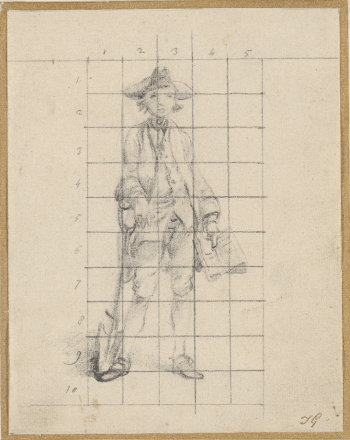
Thomas Gainsborough, A Boy with a Book and a Spade, 1748, graphite with smudging on laid paper; squared for transfer with a numbered grid, 189 × 143mm (New York: The Morgan Library & Museum, III, 59b).
Drawing was at the center of a range of artistic developments in the eighteenth-century London art world. It flourished with the development of drawing academies that culminated in the establishment of the Royal Academy in 1768. It also played a key role in the careers of entrepreneurs such as John Vanderbank, William Hogarth, Thomas Gainsborough, and Thomas Chippendale as the commercial market for printed images increased dramatically in this period. New opportunities for graphic expression encouraged artists and amateurs alike to pursue drawing as a polite and learned activity, and sketching became an increasingly innovative artistic practice. The Morgan Library & Museum has substantive holdings of drawings by British artists from this period, and this seminar offers a chance to study them as a group. Participants in this graduate seminar will engage in lively sessions addressing topics such as drawing academy practice and the use of models, the function of drawings in the studio and workshop, the role of prints, sketching as an artistic practice, and the art market and private patronage.
Stacey Sloboda is the Paul H. Tucker Professor of Art History at UMass, Boston.
Meredith Gamer is Assistant Professor of Art History and Archeology at Columbia University.
This seminar is open to graduate students of the history of art and the conservation of works on paper. Interested participants are kindly invited to submit a one paragraph statement which should include the following:
• Name and email
• Academic institution
• Class year
• Field of study
• Interest in British eighteenth-century drawings and relevance of the seminar to your research
Applications should be submitted electronically with the subject header ‘British Drawings Seminar’ to drawinginstitute@themorgan.org. Participants will be notified by 15 March 2024.
Exhibition | 50 Years and Forward: British Prints and Drawings
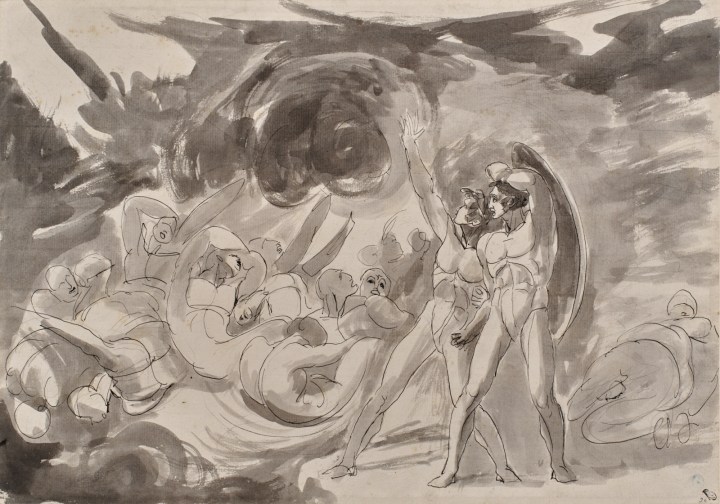
George Romney, Satan Surveying the Fallen Angels, ca. 1790, pen and black ink and brush and gray wash over graphite on laid paper, 36 × 53 cm
(Williamstown: The Clark, 2023)
◊ ◊ ◊ ◊ ◊
Now on view at The Clark:
50 Years and Forward: British Prints and Drawings Acquisitions
The Clark Art Institute, Williamstown, MA, 18 November 2023 — 11 February 2024
Curated by Anne Leonard
The emergence of British art as a significant collecting area at the Clark is a recent phenomenon. For museum founders Sterling and Francine Clark, works by artists from the British Isles did not constitute a major collecting focus. British art was largely eclipsed by the French Impressionist, American, and Old Master paintings that the Clarks so loved and that became central to the museum’s identity. A transformative gift from Sir Edwin and Lady Manton’s collection of British art, donated by the Manton Art Foundation in 2007, changed all that. British art soared dramatically in significance and visibility at the Clark, and a dedicated gallery allowed works from the Manton Collection (mostly paintings) to be on permanent display. Works on paper such as prints and drawings, however, are light-sensitive and can be on view only for short intervals, if they are to be preserved for posterity. Therefore, this exhibition is a rare opportunity to present, all at once, the broad scope of our British collection with prints and drawings of the highest quality.
50 Years and Forward: British Prints and Drawings Acquisitions offers a richly varied selection of works on paper acquired since the Manton Research Center opened in 1973. Highlights include lively figure drawings by Thomas Rowlandson; vibrant watercolor landscapes by J.M.W. Turner, Thomas Girtin, and H.W. Williams; heartfelt interpretations of nature by John Constable and Samuel Palmer; vivid portrait heads by Thomas Frye and Evelyn de Morgan; and an astonishing watercolor interior by Anna Alma-Tadema. This abundant display showcases how the Clark continues, in the wake of the Manton gift, to enrich the British works on paper collection—ensuring that it grows in strength and variety far into the future.
50 Years and Forward: British Prints and Drawings Acquisitions is organized by the Clark Art Institute and curated by Anne Leonard, Manton Curator of Prints, Drawings, and Photographs.
Exhibition | 50 Years and Forward: Works on Paper Acquisitions
Now on view at The Clark:
50 Years and Forward: Works on Paper Acquisitions
The Clark Art Institute, Williamstown, MA, 16 December 2023 — 10 March 2024
Curated by Anne Leonard

Ubaldo Gandolfi, Seated Male Nude, ca. 1770, red chalk on paper, 41 × 29 cm (Williamstown: The Clark, gift of David Jenness in honor of Arthur Jenness, Professor at Williams College, 1946–63, 2012.17.4).
When the Clark Art Institute opened in 1955, it had 500 drawings and 1,400 prints, totaling 1,900 works on paper. In the past fifty years, 4,000 works on paper have been added—more than double the museum’s founding gift—and acquisitions continue apace. While these numerical increases are important, they are only part of the story. What they fail to convey is the change in the collection’s character over time. With constant reappraisal over the decades, new dimensions have emerged, building upon Sterling and Francine Clark’s original vision.
50 Years and Forward: Works on Paper Acquisitions marks the fiftieth anniversary of the Manton Research Center—the home of the works on paper collection—with a selection of prints, drawings, and photographs acquired between 1973 and 2023. Featuring recent acquisitions and other works never shown here before, the exhibition starts from classic territories with which the Clark has long been closely identified—such as early modern drawings and nineteenth-century French art—and shows how those pockets of strength continued to grow in later decades. In a parallel development, the Institute initiated fresh collecting areas such as photography and Japanese prints. Such additions, while hewing to the same standards of quality and art-historical significance, have allowed the Clark to fill acknowledged gaps and raise its institutional profile.
In this anniversary exhibition, we explore and celebrate the developments of the past fifty years. Along with familiar works by Albrecht Dürer, Francisco de Goya, Édouard Manet, and Mary Cassatt, we highlight lesser-known areas of the collection, including early twentieth-century art, photographs by Berenice Abbott and Doris Ulmann, and important images of and by Black Americans. With each passing year and decade, the Clark reaffirms its commitment to the founders’ storied collecting mission, modifying and expanding it to meet the needs of a new era.
50 Years and Forward: Works on Paper Acquisitions is organized by the Clark Art Institute and curated by Anne Leonard, Manton Curator of Prints, Drawings, and Photographs.
A checklist of all works is available here»
The Magazine of the Decorative Arts Trust, Winter 2023–24
The Decorative Arts Trust has shared select articles from the winter issue of their member magazine as online articles for all to enjoy. The following articles are related to the 18th century:
The Magazine of the Decorative Arts Trust, Winter 2023–24
 • Catherine Carlisle , “Inspiring Thomas Jefferson: Art and Architecture in France” Link»
• Matthew A. Thurlow, “Papered and Painted in Providence” Link»
• Charles Dawson, “The Finest Regency Porcelain Painter: Thomas Baxter in Worcester” Link»
• Philip D. Zimmerman, “Historic Odessa Collections Published” Link»
• Reed Gochberg, “Interwoven: Women’s Lives Written in Thread” Link»
• Kaila Temple, “‘A Place to Cultivate Her Mind in by Musing’: New Exploration of Anne Emlen’s 1757 Shellwork Grotto” Link»
• Laura Ochoa Rincon, “A Million Hidden Stories: Uncovering Materials at the New Orleans Museum of Art” Link»
• Laura C. Jenkins, “French Interiors for an American Gilded Age” Link»
• Alyse Muller, “18th-Century Marine Imagery in the Sèvres Archive” Link»
The printed Magazine of the Decorative Arts Trust is mailed to Trust members twice per year. Memberships start at $50, with $25 memberships for students.
Pictured: The magazine cover features the front parlor of the Rhode Island Historical Society’s John Brown House, which contains a Providence-made nine-shell desk and bookcase (1760–80) flanked by variants of Providence-made Neoclassical side chairs (1785–1800). The wallpaper is a 1975 reproduction by the Birge Co. of Buffalo, NY, based on a 1790s French example.
Online Talk | Ivan Day on Ice Cream Coolers
From the Connecticut Ceramics Circle (with the full 2023–24 lecture schedule available here). . .
Ivan Day | Frozen Treats: The Development of the Ice Cream Cooler
Online, Connecticut Ceramics Circle, Monday, 12 February 2024, 2pm (Eastern)

Worcester Ice Cream Cooler (Ice Pail), ca. 1770, ‘Jabberwocky’ design, soft-paste porcelain (Houston: Rienzi Collection, 84.584.1.A-.C). Images of the bucket, liner, and cover pulled apart are available at Day’s Instagram account here.
Ice creams and water ices evolved in Italy in the second half of the seventeenth century. Initially they were a high-status luxury confined to court entertainments. Serving ices at table was not easy, as they had to be kept in a frozen state. Eventually, attractive three-part tin-glazed earthenware vessels called seaux à glace started to appear in France in the 1720s. Only a few of these faïence examples have survived, the earliest from Rouen dating from 1700–25. Another from Moustiers made in the Clérissey manufactory dates from circa 1725.
In order to keep the contents frozen, ice mixed with salt needed to be placed in the lower pail and the lid, with the ice cream contained in a bowl between. However, earthenware was not an ideal material for this purpose. It is likely that salt eventually found its way through any crazing in the glaze and was absorbed by the porous clay body, resulting in the glaze flaking off. Soft-paste and later hard-paste porcelain proved to be a much more durable material for making these beautiful vessels. The Sèvres manufactory based their porcelain seaux on the earlier faïence shapes, but developed a range of new forms closely allied to their own wine cooler designs. At first other European factories based their designs on the Sèvres model. In this illustrated Zoom lecture, Ivan Day will not only outline the development of these wonderful vessels, but demonstrate how they were used with an example from his collection.
Ivan Day is an independent historian of the social history and culture of food. He is celebrated for his reconstructions of historical table settings, which combine museum objects with accurate re-creations of period dishes. His work has been exhibited in many major museums in the UK, Europe, and North America, including the Getty Research Institute, Detroit Institute of Arts, Gardiner Museum, and Minneapolis Institute of Arts. In 2007, he worked on a re-creation of an imperial table featuring a Meissen Parnassus by Johann Joachim Kändler for the BGC exhibition Fragile Diplomacy: Meissen Porcelain for European Courts, ca. 1710–63, curated by Maureen Cassidy-Geiger.
◊ ◊ ◊ ◊ ◊
As Day notes through his Instagram account,
“The lecture is a much revised version of one that I once delivered at a symposium at the Gardiner Museum in honour of the truly great porcelain scholar Meredith Chilton. Meredith is a close friend and colleague, but also a highly valued mentor. I have learnt so much from her. So my presentation is in honour of this wonderful woman.”
New Book | The Art of Cooking
Montiño’s cookbook appeared in new editions throughout the 17th and 18th centuries. Carolyn Nadeau’s English translation was just published in November. Her Instagram account is immense fun (and I’m grateful to Ivan Day for noting it on his account). –CH
From the University of Toronto Press:
Carolyn Nadeau, edited and translated, Francisco Martínez Montiño, The Art of Cooking, Pie Making, Pastry Making, and Preserving: Arte de cocina, pastelería, vizcochería y conservería (Toronto: University of Toronto Press, 2023), 760 pages, $150. Bilingual edition.
 In 1611 Francisco Martínez Montiño, chef to Philip II, Philip III, and Philip IV of Spain, published what would become the most recognized Spanish cookbook for centuries: Arte de cocina, pastelería, vizcochería y conservería. This first English translation of The Art of Cooking, Pie Making, Pastry Making, and Preserving will delight and surprise readers with the rich array of ingredients and techniques found in the early modern kitchen. Based on her substantial research and hands-on experimentation, Carolyn Nadeau reveals how early cookbooks were organized and read and presents an in-depth analysis of the ingredients featured in the book. She also introduces Martínez Montiño and his contributions to culinary history, and provides an assessment of taste at court and an explanation of regional, ethnic, and international foodstuffs and recipes. The 506 recipes and treatises reproduced in The Art of Cooking, Pie Making, Pastry Making, and Preserving outline everything from rules for kitchen cleanliness to abstinence foods to seasonal banquet menus, providing insight into why this cookbook, penned by the chef of kings, stayed in production for centuries.
Francisco Martínez Montiño was a Spanish cook and writer of the Golden Age.
Carolyn A. Nadeau is a Byron S. Tucci Professor of Spanish at Illinois Wesleyan University.
c o n t e n t s
List of Figures and Tables
Acknowledgments
Introduction
1 The Cookbook as Cultural Artefact
2 Martínez Montiño’s Biography and the Early Modern Spanish Kitchen
3 Cookbook Organization
4 Ingredients
5 Taste at Court and the Emergence of Spanish Cuisine
6 Curiosities of Martínez Montiño’s Cookbook
7 Martínez Montiño’s Legacy
8 Previous Editions
9 This Edition and Commentary
Arte de cocina, pastelería, vizcochería y conservería
Tasa / Certificate of Price
El Rey (Privilegio) / The King (Privilege)
Prologo al lector / Prologue for the Reader
Advertencia / Notice
Tabla de los banquetes / Table on the Banquets
Chapter 1
Chapter 2
Appendix 1: Kitchen Furnishings and Equipment
Appendix 2: On Measurements
Appendix 3: Images from Recipes Recreated
Glossary
Bibliography
Index










 Enfilade
leave a comment