Lecture | Pascale Ballesteros on Painters Historicizing 18th-C Fashion
This spring at BGC:
Pascale Gorguet Ballesteros, Eighteenth-Century Fashion and the Decisive Museological Action of French Historicizing Painters
A Françoise and Georges Selz Lecture on Eighteenth- and Nineteenth-Century French Decorative Arts and Culture
Bard Graduate Center, New York, 3 April 2024
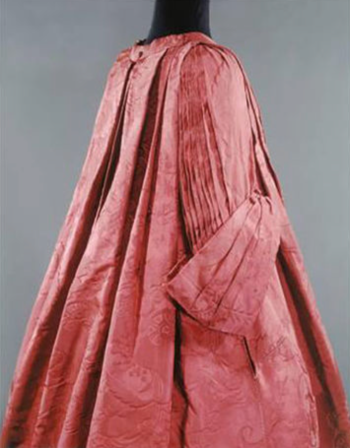
Dress detail from the collection of the Musée de la Mode de la Ville de Paris, formerly known as Musée Galliera.
On January 10, 1907, the Société de l’Histoire du Costume was founded in Paris to create a ‘Musée du Costume’. Sixteen of the founders were painters, and most of them were artists that historicized the eighteenth century. In this lecture, curator and scholar Pascale Gorguet Ballesteros considers the influence of artists such as Maurice Leloir (1853–1940), Gustave Jean Jacquet (1846–1909), and François Flameng (1856–1923) in the formation of the eighteenth-century fashion collection of the Palais Galliera and the construction of its image.
Responsible for the nineteenth-century collections at Palais Galliera, Musée de la Mode de la Ville de Paris, Pascale Gorguet Ballesteros has curated several exhibitions including Fastes de cours et cérémonies royales in 2009 at the castle of Versailles and L’art de paraître au 18e siècle at Nantes and Dijon Fine Arts Museums in 2021 and 2022. She teaches fashion history and fashion materials at Sorbonne Université. Her next exhibition will deal with women, travels, art, and fashion in the Enlightenment.
Registration is available here»
Call for Papers | Dress and Painting: Clothing and Textiles in Art
From the Call for Papers:
Dress and Painting: Clothing and Textiles in Art
The Association of Dress Historians International Conference
National Portrait Gallery, London, 7–8 October 2024
Proposals due by 28 April 2024
The Association of Dress Historians are delighted to introduce our two-day autumn conference for 2024 on the theme of Dress and Painting: Clothing and Textiles in Art. The conference aims to bring together scholars, professionals, and practitioners to explore and examine the wide range of interconnections between dress, textiles, and painting across any culture or region of the world, from before classical antiquity to the present day.
Confirmed Keynote Speakers
– Aileen Ribeiro, Professor Emeritus of the Courtauld Institute of Art
– Timothy McCall, Associate Professor of Art History at Villanova University
– Anna Reynolds, Deputy Surveyor of The King’s Pictures at Royal Collection Trust
Papers are invited that investigate, but are not limited to, any of the following prompts:
• The value (and limitations) of painted sources for historians of dress including portraits, genre scenes, illuminated manuscripts, frescoes, and miniatures
• The reality (or otherwise) of clothing portrayed in paintings through comparison with extant garments, documentary sources, etc
• The practices of dressing up (e.g. fancy dress, professional robes) or dressing down (e.g. déshabillé) for portraits
• The symbolism of dress in paintings
• The role of clothing in interpretations of meaning or narrative
• Individual artists and their different approaches to depicting dress
• Artists’ involvement in decisions about what sitters should wear for portraits
• Artists’ personal attitudes to fashion and the selection of clothing worn in self-portraits
• Techniques used by artists to represent textiles and three-dimensional garments in paint
• The draped figure in painting, depictions of the clothed and unclothed body
• The role of the specialist drapery painter in artists’ studios
• Overlapping spheres of production in the raw materials for paintings and textiles e.g. pigments and dyes, linen canvas, animal hair
• Paintings as fashion illustration, and their role in the fashion design process
• Textile designs inspired by paintings
• Painters who were also fashion/textile designers
• Museum practices of exhibiting paintings alongside items of dress
We welcome submissions for 15- to 20-minute research presentations. To submit a proposal, please send an abstract of no more than 200 words alongside a biography of no more than 50 words and an optional illustrative image* with caption to be included in an online programme to dressandpainting@dresshistorians.org by 00:00 BST on 28 April 2024. The conference is guest chaired by Anna Reynolds (Royal Collection Trust) and co-convened by Kirsten Burrall (Deputy Chair of ADH).
* Please send images as separate tiff or jpeg attachments and include the relevant caption beneath your abstract. Image captions are not included in abstract word count.
New Book | The Domino and the 18th-C London Masquerade
Part of the Elements in Eighteenth-Century Connections series from Cambridge UP:
Meghan Kobza, The Domino and the Eighteenth-Century London Masquerade: A Social Biography of a Costume (New York: Cambridge University Press, 2024), 75 pages, ISBN: 978-1009468244 (hardcover), $65 / ISBN: 978-1009045551 (paperback), $22. Also available digitally through Cambridge UP.
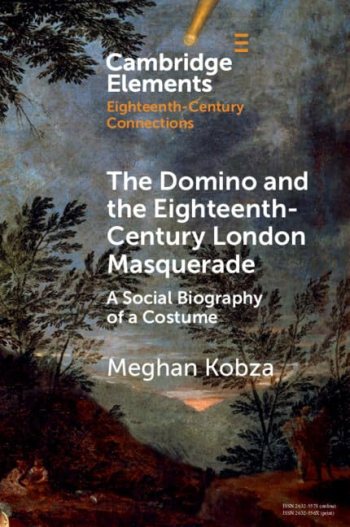 This Element presents new cultural, social, and economic perspectives on the eighteenth-century London masquerade through an in-depth analysis of the classic domino costume. Constructing the object biography of the domino through material, visual, and written sources, Meghan Kobza brings together various experiences of the masquerade and expand the existing geographical, chronological, and socio-economic scope of the entertainment beyond the masquerade event itself. The book examines the domino’s physical and figurative movements from the masquerade warehouse, through eighteenth-century fashionable society, and into print and visual culture, drawing upon masquerade warehouse records, newspapers, manuscripts, prints, and physical objects to establish a comprehensive understanding of the domino and how it reflected contemporary experiences of the real and imagined masquerade. Analysing the domino through interdisciplinary methodologies illustrates the impact material and visual sources can have on reshaping existing scholarship.
Meghan Kobza is currently a Leverhulme Early Career Fellow at Newcastle University, where she completed her PhD in 2020. As a social historian, she is particularly interested in the history of eighteenth-century leisure culture in the British Empire and transatlantic world.
c o n t e n t s
Introduction
1 The Masquerade and the Domino
2 Three Dominos
3 The Domino as a Commodity
4 Everywhere and Nowhere
Conclusion
References
Call for Papers | ‘The Hearts of the Leuchtenberg’
From the Call for Papers (see the DFK’s website for the German and French versions) . . .
‘The Hearts of the Leuchtenberg’: Cultures of Remembrance of a 19th-C. European Noble Family
‘Die Herzen der Leuchtenberg’: Erinnerungskultur(en) einer europäischen Adelsfamilie im 19. Jahrhundert
Munich, Bayerisches Nationalmuseum, 24–26 October 2024
Proposals due by 15 April 2024
On the occasion of the two-hundredth anniversary of the death of the founding father of the Leuchtenberg dynasty—Eugène de Beauharnais, who died on 21 February 1824 in Munich—the German Center for Art History Paris (DFK Paris) is co-organizing, with the Musée national des châteaux de Malmaison et Bois-Préau and the Bayerisches Nationalmuseum, an international colloquium on the cultures of remembrance within the Leuchtenberg family. The Leuchtenbergs’ French-Napoleonic origins, as well as the loss of former greatness that accompanied the family’s exile in Bavaria and change of name, had a lasting impact on their position in the Kingdom of Bavaria, where, following Eugène’s appointment as the Duke of Leuchtenberg and Prince of Eichstätt by Maximilian I Joseph on 15 November 1817, they were the highest-ranking nobles outside the royal family.
The development of the various memorial practices and/or memorial concepts of this important noble family is to be examined against the backdrop of the specific cultures of remembrance that characterized the first half of the nineteenth century, which were shaped equally by the new emotional culture of the era of sentimentality as by the Restoration period with its anti-French tendencies. Their rich material legacy—which includes souvenir albums, commemorative pieces of jewellery, hand-crafted objects and furnishings, which today remain preserved in public and private collections—partakes of the epochal phenomenon of the “unübersehbare[n] Konjunktur des dinglichen Andenkens in der materiellen Kultur des 19. Jahrhunderts” (unmistakable boom in souvenirs within the material culture of the nineteenth century) [Holm/Oesterle 2005]. In addition to objects, the Leuchtenbergs left behind abundant correspondence and diaries. Along with collections, libraries, and archives; moreover, they bequeathed a aristocratic culture of remembrance and a material culture that consisted not only of monuments—such as the heart urns, former in the chapel of the Palais Leuchtenberg in Munich and today in the Wittelsbachergruft in St Michael—but also charitable foundations and portraits. As “means of remembrance,” these are eloquent expressions of the intimate relationships among the individual family members, which intensified with the early death of the father and with the conditions of spatial separation that resulted from the family’s successful marriage politics. Aside from its main historical residences in France, Italy, and Bavaria, the family is traceable through the marriages of Joséphine von Leuchtenberg (1807–1876) in Sweden, of Amélie (1812–1873) in Brazil, of Auguste (1810–1835) in Portugal, and of Eugénie (1808–1847) and Théodelinde (1814–1857) in southern Germany (principalities of Hohenzollern-Hechingen and Württemberg). The Russian phase of the family’s history began on 14 July 1839 with the marriage of the youngest son and heir, Maximilian, 3rd Duke of Leuchtenberg (1817–1852), to Maria Nikolaevna, the daughter of Tsar Nicholas I.
The aim of the colloquium is to document, for the first time, the “artifacts and media” scattered around the world from the Leuchtenberg estate and to jointly reassess them through the lens of the culture of remembrance, including questions of materiality and mediality, investigation of haptic properties and performativity, and the presentation of exact provenances. The ways in which objects were gifted, dedicated, passed down, and perhaps exchanged among the Leuchtenbergs are crucial for understanding their precise location in the memorial practices of the family. In addition to the sentimental-emotional orientation—e.g. commemorative objects “die der bedürftigen Seele zur Anlehnung dienen” (that offer support for the needy soul) [Praz], or the “Interieur als Fluchtorte in die Erinnerung” (interior as a place of escape into memory)—the question of commemorative motivation also arises in the case of the newly princely Leuchtenbergs. The exploration of “sozialer Sinn- und Zeithorizonte” (social horizons of meaning and time), for instance by examining the referentiality to the past and a still-to-be-defined orientation of the family’s culture(s) of remembrance, is intended to contribute to a better understanding of the Leuchtenberg family, which had to reinvent and assert itself as a dynasty in its time—as a Gedächtnisgemeinschaft, or community of memory [Jan Assmann; Pierre Nora].
The colloquium marks the conclusion of a long-term research project, wherein, after France and Italy, Bavaria is the current focus of research as the last of the three stages of Prince Eugène’s life. The period under investigation includes the lifetime of his wife Augusta Amalia of Bavaria (d. 1851), who as a supervisory entity decisively steered and shaped the mementos of Prince Eugène (Honneur et fidelité), as well as his direct descendants. Comparative examples from other families or national contexts that address questions around the aristocratic culture of remembrance in the nineteenth century are just as welcome as transdisciplinary and transcultural research approaches. Possible topics are: objects and object biographies (e.g. souvenirs, memorial jewellery, hand-crafted items); the culture of gifting; commemorative albums, including questions about performativity; communication culture (e.g. letters, diaries); memory in literature (e.g. biographies, editions of letters); monuments (e.g. commemorative plaques, grave monuments); collections (e.g. archives between Funktionsgedächtnis and Speichergedächtnis, libraries, art collections); places; domestic culture and materiality; festivals; travel; image culture (e.g. portraits); and the cults of family and friendship.
The colloquium will take place 24–26 October 2024 in the Mars-Venussaal of the Bayerisches Nationalmuseum in Munich. Junior scholars are welcome to submit their proposals. Presentations are limited to 20 minutes, followed by a 15-minute discussion. Proposals are requested in German, French, or English by 15 April 2024 and should not exceed approximately 3,000 characters (including spaces), a short biography and contact details (email address, address, and institution). Submit proposals to the following address: leuchtenberg@dfk-paris.org. A notification of the acceptance of submissions will be made by the beginning of May 2024.
Organizing Committee
• Elisabeth Caude, Director of the Service à Compétence Nationale des musées nationaux des châteaux
de Malmaison et Bois-Préau, de l’île d’Aix et de la Maison Bonaparte à Ajaccio
• Dr Jörg Ebeling, Research Director, German Center for Art History Paris
• Dr Sybe Wartena, head of department, Furniture, games, musical instruments and models, Bavarian
National Museum, Munich
Scientific Committee
• Dr Birgit Jooss, Head of Art and Tradition, Wittelsbacher Ausgleichsfonds
• Dr Sylvia Krauss-Meyl, Former Archive Director, Bayerischen Hauptstaatsarchiv München
• Lars Ljungström, Head of the Department of Collections and Documentation, Swedish Royal Collections
• Prof. Dr Hans Ottomeyer, Former President, Stiftung Deutsches Historisches Museum, Berlin
• Marina Rosa, Chair, Centro documentazione Residenze Reali Lombarde
A select bibliography for the Leuchtenberg Family is available with the full Call for Papers.
Call for Papers | Visualizing Antiquity: Collectors, Artists, Scholars
From the Call for Papers and ArtHist.net (which includes the Call for Papers in German). . .
Visualizing Antiquity: On the Episteme of Early Modern Drawings and Prints —
Part III: Collectors, Artists, Scholars: Knowledge and Will in Collection Catalogs
Bildwerdung der Antike: Zur Episteme von Zeichnungen und Druckgrafiken der Frühen Neuzeit — III: Sammler, Künstler, Gelehrte: Wissen und Wollen in Sammlungskatalogen
Berlin-Brandenburgische Akademie der Wissenschaften, 21 June 2024
Organized by Ulrich Pfisterer, Cristina Ruggero, and Timo Strauch
Proposals due by 17 March 2024
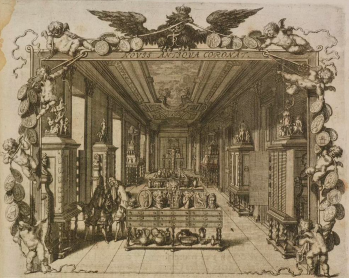
Lorenz Beger, Numismatum Modernorum Cimeliarchii Regio-Electoralis Brandenburgici Sectio Prima … (Coloniæ Brandenburgicæ 1704), p. 1 (Photo: UB Heidelberg).
The academy project Antiquitatum Thesaurus: Antiquities in European Visual Sources from the Seventeenth and Eighteenth Centuries, hosted at the Berlin-Brandenburg Academy of Sciences and Humanities (thesaurus.bbaw.de/en), and the Zentralinstitut für Kunstgeschichte Munich (zikg.eu) are organizing a series of colloquia in 2023–2025 on the topic Visualizing Antiquity: On the Episteme of Drawings and Prints in the Early Modern Period. The significance of drawings and prints for ideas, research, and the circulation of knowledge about ancient artifacts, architecture, and images in Europe and neighboring areas from the late Middle Ages to the advent of photography in the mid-19th century will be examined. The two previous colloquia were dedicated to the topics of the ‘unrepresentable’ properties of the depicted objects and the documentation of different states and contexts of ancient artifacts. This third conference will explore the questions of form, purpose and meaning of images and illustrations in collection catalogs and the role of the people involved.
Collecting is one of the oldest human activities. The interest in gathering objects of varying artistic, scientific, historical, religious, idealistic and emotional value or antiquitates, realia, naturalia, and curiositates was initially documented primarily by written sources such as inventories, but since the 16th century there has been an increase in illustrated (drawn or printed) evidence of the passion for collecting. Our colloquium questions possibilities and strategies to visualize a collection. Descriptions of private or public collections, Thesauri, Monumenta, Specimens, Recueils, Specula, Theatra mundi, Segmenta nobilium, Admiranda antiquitatum, Corpora, and Commentaria are the most common titles of publications dedicated to the various types of collections of (antique) objects. The need to record their holdings in pictures, to give them a classificatory order, to supplement or interpret them descriptively with commentaries, grew particularly with the development of printmaking, while the drawn collection was usually the privilege of a few, mostly wealthy or educated personalities.
We would like to examine the illustrated collection catalogs and analyze the role of the collectors, artists, and scholars involved in relation to the knowledge and intentions expressed in the collection catalogs. Furthermore, we are interested in different uses of these important visual sources and strive to gain new insights into the functions and impact of these catalogs on the art world. Possible contributions can address the following aspects, but further suggestions are also welcome:
• First genre-specific or heterogeneous collection catalogs in Europe
• The role of collectors in the art world and their influence on the construction of collection catalogs
• The relationship between artists and collectors in relation to the presentation of artworks in catalogs
• The importance of scholars and experts in the creation of collection catalogs and their involvement in the creative process
• The range of visualization of collections as a whole and of the individual collection object; formats, techniques, plate vs. text illustration, etc.
• The possibilities of comparative representation, displaying different sizes, quantities, formal characteristics, thematic focuses, material values, etc.
Solicited for the third colloquium are papers in English, French, German, or Italian, 20 minutes in length, ideally combining case study and larger perspective. Proposals (maximum of 400 words), together with a short CV (maximum of 150 words), can be submitted until 17 March 2024 to thesaurus@bbaw.de, keyword ‘Episteme III’. Publication in extended form is planned. Travel and hotel expenses (economy-class flight or train; 2 nights’ accommodation) will be reimbursed according to the Federal Law on Travel Expenses (BRKG).
The fourth and final study day in the series—expected to take place in January 2025 on the occasion of a planned exhibition at the Zentralinstitut für Kunstgeschichte—will be entitled Fake-News? Fantasy Antiquities and will address the problem of the authenticity of the antiquities depicted.
New Book | Annals and Antiquities of Rajast’han
Distributed for the Royal Asiatic Society by Yale UP:
James Tod and Norbert Peabody, with contributions by Brian Cannon and Ramya Sreenivasan, Annals and Antiquities of Rajast’han (New Haven: Yale University Press, 2024), 1728 pages, ISBN: 978-0300270525, $1,000.
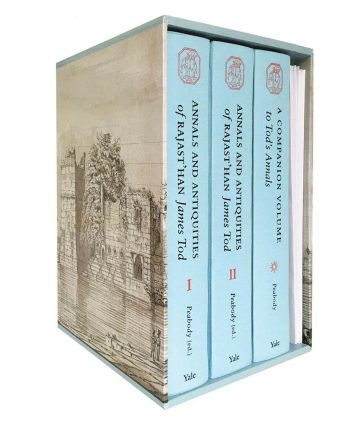 The two volumes of James Tod’s Annals and Antiquities of Rajast’han, first published in 1829–32, remain to this day the first port of call for anyone interested in the history and culture of Rajasthan and the early colonial encounter in India. Written by the first East India Company official to the region, the text was also seminal for the early figures in India’s independence movement who reworked Tod’s imagined ancient Rajput national identities into a call for India’s national liberation from British colonial rule. Now available in a numbered limited edition of 750 copies, this re-issue of the original text including over 80 original copperplate engravings, woodblock prints, and lithographs returns the text to its original state, while the accompanying companion volume critically reframes this monumental, but often misunderstood, work. The new volume shows how Tod’s Annals is not merely the product of the singular voice of a Western ‘orientalist’ imagination, instead revealing a richly complex work in which Rajasthani voices provide a ‘multi-authored’ heterogeneity to the text which is often discordant and unpredictable. Re-articulating the variety of voices that simultaneously inhabit Tod’s Annals, the revised volume argues for a more conjunctural, contingent, and open-ended reading of colonial history.
Norbert Peabody is an affiliated scholar at the Centre of South Asian Studies, University of Cambridge. Ramya Sreenivasan is associate professor of history at the University of Pennsylvania. Brian Cannon is a PhD student in South Asian history at the University of Pennsylvania.
New Book | The India Museum Revisited
This publication is one of the outcomes of the research project The India Museum Revisited, which aims to reconstruct the museum’s history (c.1800–1879) with special reference to V&A’s collection. From the V&A’s description of the project:
At the dispersal of the India Museum in 1879 the 20,000 objects transferred to the South Kensington Museum (later the V&A) were inventoried in a catalogue printed for internal use in the following year. That list forms the basis of the analysis and reconstruction presented here, augmented where appropriate by objects surviving in the collections, in order to reunite the contents and their supporting documentation in virtual form and to set them in context.
From UCL Press (and note that digital copies of the book are available free of charge) . . .
Arthur MacGregor, The India Museum Revisited (London: UCL Press, 2023), 472 pages, ISBN: 978-1800085725 (hardback), £60 / ISBN: 978-1800085718 (paperback) £45 / ISBN: 978-1800085701 (PDF file), free.
 The museum of the East India Company formed, for a large part of the nineteenth century, one of the sights of London. In recent years, little has been remembered of it beyond its mere existence, while an assumed negative role has been widely attributed to it on the basis of its position at the heart of one of Britain’s arch-colonialist enterprises. Extensively illustrated, The India Museum Revisited provides a full examination of the museum’s founding manifesto and evolving ambitions. It surveys the contents of its multi-faceted collections—with respect to materials, their manufacture and original functions on the Indian sub-continent—as well as the collectors who gathered them and the manner in which they were mobilized to various ends within the museum. From this integrated treatment of documentary and material sources, a more accurate, rounded and nuanced picture emerges of an institution that contributed in major ways, over a period of 80 years, to the representation of India for a European audience, not only in Britain but through the museum’s involvement in the international exposition movement to audiences on the continent and beyond.
Arthur MacGregor is Andrew W. Mellon Visiting Professor at the Victoria and Albert Museum’s Research Institute.
c o n t e n t s
Foreword by Tristram Hunt
Preface
Acknowledgements
The India Museum Revisited Project
Part I | Historical Introduction
1 An ‘Oriental Museum’ at the India House
2 The Objects Themselves: Restoring an Identity to the Collections
Part II | The Collections of the India Museum
3 Historical Relics: Their Role in the Collection
4 Trading with and within India: Material Culture of Commerce and Control
5 Industry and Technology: Inorganic Materials
6 Industry and Technology: Organic Materials
7 The Mirror of India: Clothing, Dress, and Ornament
8 Making War: Weapons and Defensive Armour
9 Religious Observation: Introducing Indian Devotional Practice
10 Culture and Recreation
11 Imaging India
12 Collections of Individuals and the Emergence of Ethnography
13 The India Museum (partly) Recollected
Appendix: Glossary of Indigenous Terms as Transcribed in the Catalogue of 1880
Bibliography
Index
Exhibition | South Asian Miniature Painting and Britain
Closing this month at The Box, with the catalogue appearing this spring from Bloomsbury:
Beyond the Page: South Asian Miniature Painting and Britain, 1600 to Now
The Box, Plymouth, 7 October 2023 — 28 January 2024
 Beyond the Page explores how the traditions of South Asian miniature painting have been reclaimed and reinvented by modern and contemporary artists, taken forward beyond the pages of illuminated manuscripts to experimental forms that include installations, sculpture, and film. The exhibition features work by artists from different generations working in dialogue with the miniature tradition, including Hamra Abbas, Zahoor ul Akhlaq, David Alesworth, Nandalal Bose, Noor Ali Chagani, Lubna Chowdhary, Adbur Rahman Chughtai, Olivia Fraser, Samuel Fyzee-Rahamin, Alexander Gorlizki, N.S. Harsha, Howard Hodgkin, Ali Kazim, Bhupen Khakhar, Matthew Krishanu, Jess MacNeil, Imran Qureshi, Nusra Latif Qureshi, Mohan Samant, Willem Schellinks, Raqib Shaw, Gulammohammed Sheikh, Nilima Sheikh, Arpita Singh, the Singh Twins, Shahzia Sikander, Abanindranath Tagore and Muhammad Zeeshan. Contemporary works are shown alongside examples of miniature painting dating as far back as the 16th century drawn from major collections including The Royal Collection, the Victoria & Albert Museum, and The British Museum, many on public display for the first time.
Anthony Spira and Fay Blanchard, eds., with essays by Emily Hannam and Hammad Nasar and catalogue entries by Emily Hannam, Cleo Roberts-Komireddi, and Elizabeth Brown, Beyond the Page: South Asian Miniature Painting and Britain, 1600 to Now (London: Philip Wilson Publishers, 2024), 224 pages, ISBN: 978-1781301258, $40.
Exhibition | Indian Skies: The Howard Hodgkin Collection

An Elephant and Keeper, India, Mughal, ca. 1650–60, opaque color and gold on paper
(New York: The Metropolitan Museum of Art, Howard Hodgkin Collection, 2022.187)
◊ ◊ ◊ ◊ ◊
Opening next month at The Met:
Indian Skies: The Howard Hodgkin Collection of Indian Court Painting
The Metropolitan Museum of Art, New York, 6 February — 9 June 2024
Over the course of sixty years, British artist Howard Hodgkin (1932–2017) formed a collection of Indian paintings and drawings that is recognized as one of the finest of its kind. A highly regarded painter and printmaker, Hodgkin collected works from the Mughal, Deccani, Rajput, and Pahari courts dating from the 16th to the 19th centuries that reflect his personal passion for Indian art. This exhibition presents over 120 of these works, many of which The Met recently acquired, alongside loans from The Howard Hodgkin Indian Collection Trust.
The works on view include stunning portraits, beautifully detailed text illustrations, studies of the natural world, and devotional subjects. The exhibition will also display a painting by Hodgkin, Small Indian Sky, which alludes to the subtle relationship between his own work, India, and his collection. This exhibition is accompanied by an issue of The Metropolitan Museum of Art Bulletin.
New Book | The Art of Cloth in Mughal India
From Princeton UP:
Sylvia Houghteling, The Art of Cloth in Mughal India (Princeton: Princeton University Press, 2022), 280 pages, ISBN: 978-0691215785, £58 / $68.
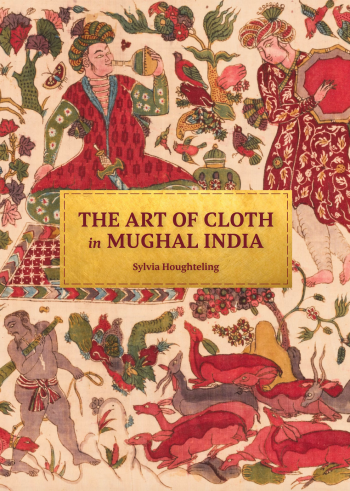 In the sixteenth and seventeenth centuries, a vast array of textiles circulated throughout the Mughal Empire. Made from rare fibers and crafted using virtuosic techniques, these exquisite objects animated early modern experience, from the intimate, sensory pleasure of garments to the monumentality of imperial tents. The Art of Cloth in Mughal India tells the story of textiles crafted and collected across South Asia and beyond, illuminating how cloth participated in political negotiations, social conversations, and the shared seasonal rhythms of the year. Drawing on small-scale paintings, popular poetry, chronicle histories, and royal inventory records, Sylvia Houghteling charts the travels of textiles from the Mughal imperial court to the kingdoms of Rajasthan, the Deccan sultanates, and the British Isles. She shows how the ‘art of cloth’ encompassed both the making of textiles as well as their creative uses. Houghteling asks what cloth made its wearers feel, how it acted in space, and what images and memories it conjured in the mind. She reveals how woven objects began to evoke the natural environment, convey political and personal meaning, and span the distance between faraway people and places. Beautifully illustrated, The Art of Cloth in Mughal India offers an incomparable account of the aesthetics and techniques of cloth and cloth making and the ways that textiles shaped the social, political, religious, and aesthetic life of early modern South Asia.
• Winner of the Charles Rufus Morey Book Award, College Art Association
• Shortlisted for the R.L. Shep Memorial Book Award, Textile Society of America
Sylvia Houghteling is assistant professor of history of art at Bryn Mawr College.
c o n t e n t s
Note on Transliteration
Introduction
1 Landscapes of Cloth in the Mughal Empire
2 The Tell-Tale Textile: Fabric and Emotions in Mughal Hindustan
3 The Moving Walls of the Amber Court
4 The Fame of Machilipatnam Cloth
5 The Flowering of Mughal Textiles in Britain
Conclusion
Acknowledgments
Notes
Bibliography
Index
Image Credits










 Enfilade
leave a comment