New Book | Des étoffes pour le vêtement et la décoration
From PUR:
Aziza Gril-Mariotte, Des étoffes pour le vêtement et la décoration: Vivre en indiennes, France, XVIIIe–XIXe siècle (Rennes: Presses Universitaires de Rennes, 2023), 216 pages, ISBN: 978-2753592445, €32.
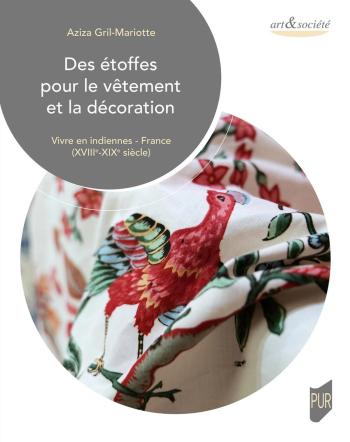 Retracer une histoire du goût en étudiant l’usage des indiennes dans la mode et la décoration intérieure aux XVIIIe et XIXe siècles, tel est l’objectif de ce livre. Il montre comment les manufacturiers ont participé à l’essor d’une société consumériste où la question des modes et des couleurs est indissociable du développement d’une industrie textile. En appréhendant des pratiques vestimentaires et décoratives sur deux siècles, les phénomènes de recyclages, de renouvellement ainsi que de permanence de certains décors sont analysés à la lumière de la fascination que le XVIIIe siècle exerça sur la société du XIXe siècle. Dans la parure vestimentaire, l’usage des indiennes raconte la diffusion dans la société de pratiques longtemps réservées aux élites et la capacité des industriels à se renouveler pour accompagner l’essor de la consommation des étoffes, depuis les marchandes de mode jusqu’aux grands magasins. La question de la place des cotonnades dans la décoration intérieure offre un point de vue renouvelé sur le rôle des étoffes dans l’embellissement du cadre de vie qui perdure et se développe au XIXe siècle en participant au concept des styles historiques.
Avec le soutien de la Fondation Jeanne et Pierre Spiegel et du laboratoire CRESAT de l’université Haute-Alsace.
Aziza Gril-Mariotte est professeur des universités en histoire de l’art moderne à Aix-Marseille université et chercheuse à l’UMR TELEMMe. Elle a présidé le musée de l’Impression sur étoffes entre 2019 et 2022. Actuellement, elle dirige le musée des Tissus et des arts décoratifs de Lyon. Ses travaux portent sur la création et l’innovation dans l’industrie textile aux XVIIIe et XIXe siècles, ainsi que sur les phénomènes de muséification et de patrimonialisation des étoffes depuis le XIXe siècle.
s o m m a i r e
I. Des indiennes aux étoffes, définir l’objet textile
Une nomenclature variée
Une production artistique pour un objet usuel
Des créations pour des usages variés
II. Indiennes et toiles peintes pour la mode
De nouvelles étoffes dans les garde-robes
La fabrique des modes
L’indiennage entre collections annuelles et motifs immuables
III. Les toiles peintes dans les intérieurs
Les étoffes et l’art de vivre à la française
Décorer son intérieur en indienne
Décors et étoffes intemporels
New Book | Turkey Red
From Bloomsbury:
Julie Wertz, Turkey Red (London: Bloomsbury Visual Arts, 2024), 232 pages, ISBN: 978-1350216518 (hardcover), $110 / ISBN: 978-1350216501 (paperback), $37.
 This multi-disciplinary study examines the exceptional Turkey red textile dyeing process and product. Prized for its brilliant colour and durability, yet notoriously difficult to produce, the textile was consumed locally and exported around the world. Considered one of the first instances of industrial espionage, the expansion of the Turkey red industry is closely linked to the Industrial Revolution and the emergence of a new global economy. Significant technological advances in chemistry and dyeing were motivated by the demands of Turkey red dyers and printers, who were located primarily in the west of Scotland, the north of England, and around Mulhouse, Switzerland.
This book explores the arc of the Turkey red industry, the evolution of the process through key producers and technical developments, the complicated printing process, and finishes with an examination of significant Turkey red collections and a selection of object case studies. The chemistry of the process is described in an accessible, contextual manner, highlighting the significance of the distinctive technique that yielded the best red attainable on cotton. Drawing on both historical and contemporary study, Turkey Red presents significant new research on the material characterisation of this fascinating, eye-catching textile, and offers an in-depth historical example of the global effect of textile consumption.
Julie Wertz is Beal Family Postgraduate Fellow in Conservation Science at Harvard Art Museums.
c o n t e n t s
List of Figures
Preface
Acknowledgments
Note on the Text
Introduction
1 The Most Brilliant Color Dyed on Cotton
1.1 Defining Turkey red
1.1.1 A reputable red
1.1.2 A complicated process
1.2 Identifying Turkey red
1.3 Material record
1.4 Conclusion
2 Global Exchanges and Anthraquinone Dyes
2.1 The origin and dissemination of Turkey red
2.1.1 India
2.1.2 Indonesia
2.1.3 The Levant and the Ottoman Empire
2.1.4 The Hapsburg Empire
2.1.5 France
2.1.6 Britain
2.2 Madder
2.2.1 The cultivation of madder
2.2.2 Madder composition and derivatives
2.3 Synthetic alizarin
2.3.1 Understanding alizarin
2.3.2 Alizarin synthesis and patent disputes
2.3.3 Synthetic alizarin products
2.4 Conclusion
3 The Dyeing, Chemistry, and Technological Advances of Turkey Red
3.1 Oiling
3.1.1 Oiling in the old process
3.1.2 The chemistry of oiled cotton
3.1.3 Ruminant dung and tannins
3.1.4 Turkey red oil and the new process
3.1.5 The Steiner process
3.2 Aluminium
3.2.1 Precipitated aluminium soaps
3.3 Dyeing
3.3.1 Color complexes in Turkey red
3.3.2 Blood and albumen
3.4 Clearing
3.5 Conclusions
4 Printed Turkey Red
4.1 Textile printing methods
4.2 Discharge printing
4.2.1 Lead plate press discharging
4.2.2 Acid paste discharging
4.3 A bright palette
4.3.1 Black, blue, yellow, and green
4.3.2 Identifying colorants on Turkey red prints
4.4 Design
4.4.1 Industrial design and production
4.4.2 European design for the export market
4.5 Conclusions
5 Turkey Red in the Industrial Revolution
5.1 Turkey red industry by country
5.1.1 France
5.1.2 England
5.1.3 Scotland
5.1.4 Switzerland
5.1.5 The Netherlands
5.1.6 North America
5.1.7 Other locations
5.2 Working conditions and labor
5.3 Colonialism
5.4 Conclusions
6 Trade, Use, and Object Record
6.1 Documentary evidence of availability
6.2 How Turkey red was used
6.2.1 Bandanas
6.2.2 Domestic textiles, quilts and bedcovers
6.2.3 Accessories, garments, and tools
6.3 Conclusions
Conclusions
Glossary
References
Index
Exhibition | Fashioning an Empire: Textiles from Safavid Iran

Textile with Pink, Red and Blue Flowers, Iran, 1700–22, silk and metal-wrapped thread
(Doha: Museum of Islamic Art, 2014.282)
◊ ◊ ◊ ◊ ◊
From the press release (via Art Daily) for the exhibition:
Fashioning an Empire: Textiles from Safavid Iran
Smithsonian’s National Museum of Asian Art, Washington, DC, 18 December 2021 — 15 May 2022
Museum of Islamic Art, Doha, 23 October 2023 — 20 April 2024
The Museum of Islamic Art, Doha is currently showcasing Fashioning an Empire: Textiles from Safavid Iran, a captivating exhibition that highlights the critical role silk played during the Safavid period (1501–1736). The exhibition is organised into four sections: starting with the establishment of the silk monopoly and state-funded manufacturing and exploring the production and technical components of textiles; the rise of Isfahan as imperial capital; fashion and trends in Safavid society; and lastly, contemporary commissions created by local designers inspired by Safavid textiles. Fashioning an Empire was conceived by and first presented at the Smithsonian’s National Museum of Asian Art, Washington, DC (2021–22).
Silk’s complex manufacturing process and supple feel against the skin make it a valuable and highly prized luxury good. Since the 6th century, Iran has produced high quality silk, widely appreciated and traded long distances. It was, however, during the reign of Iran’s most important ruler in modern history, Shah ‘Abbas I the Great (r. 1588–1629), that silk became a state-controlled industry—it boosted the country’s economy by supplying both an eager internal demand and feeding a vigorous export market spanning from England to Thailand. Shah ‘Abbas was the fifth shah of the Safavid dynasty (1501–1722). Under the Safavids, Iran experienced a period of renewed political strength and artistic creativity, geographical borders were consolidated, and most of the population adopted Shi‘a Islam, which became the country’s official state religion. The rise of the silk economy during Shah ‘Abbas’s reign had effects beyond the markets, inspiring artistic development and fostering cultural exchange.
Born out of a collaboration with the National Museum of Asian Art in Washington, DC, the exhibition explores the development of the silk industry under Shah ‘Abbas. It presents the capital city of Isfahan as the heart of the Safavid state and showcases fashion styles during a time when Iran established itself as a major player in the global arena.
The exhibition ends with a series of contemporary works created by Qatar-based designers in collaboration with M7, Qatar’s epicentre for innovation and entrepreneurship in fashion and design. Their artworks respond to the splendid historic textiles on display and illustrate the powerful creativity that Safavid silks still inspire in today’s creative minds.
Call for Articles | Valuing Luxury
From ArtHist.net:
Valuing Luxury: Controversial Collections, Divisive Displays, and Ethical Exhibits
Collection of essays edited by Elisabetta Maistri and Robert Hanson
Proposals due by 15 March 2024; complete essays due by 1 November 2024
In an era concerned with social and historical injustices, of wealth inequality and exploitation, and increasing awareness of the anthropogenic ecological impact, the vast collections of luxury goods that fill museums seem at odds with the current political mood. Whilst luxuries have driven much of human development, our attitude towards justice compels us to ask the question: how should museums present their collections in a manner that celebrates humanity’s triumphs without erasing the injustices that fuelled them? This interdisciplinary anthology focuses on the dark side of luxuries from early modern empires, exploring the questions of how we should acknowledge, respond to, and represent their problematic legacies in the contemporary era in public and private collections. The book investigates the role and responsibilities of museums, our relationship with luxuries, and our duties to historical legacies, both good and bad.
We invite scholars to contribute case-study driven chapters which will see authors discuss the history, concept, and normativity of luxury status through the following thematic lenses:
1 Conceptualising Luxury
2 Decolonisation and Social Justice
3 Environment and Sustainability
4 Negative Heritage
5 Inequality and Excess
6 Appropriation and Repatriation
7 Luxury and Desperation
Abstracts should be no more than 500 words and should be submitted to rwhem19@gmail.com by 15th March 2024. Authors should state which theme their paper should be associated with. Please name the file as follow: Surname_THEME NUMBER_TOPIC
Successful abstracts will be called to submit the complete paper to the same email address by 1 November 2024, and will be subject to double-blind peer review prior to the submission of the anthology to the publishing house. Priority given to submissions on objects created prior to the 20th century and to objects associated with the global south. We are also particularly keen to promote the work from underrepresented demographics in the scholarship, particularly women and scholars from the global south.
More information is available here»
Exhibition | Within Reach of Asia
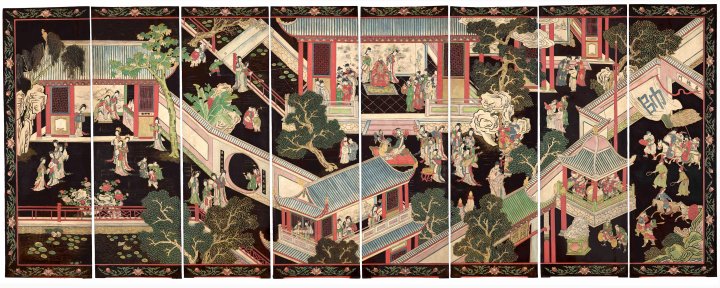
Eight-leaf screen, depicting a Palace Scene with the Arrival of a Delegation and Festivities in Honor of Tang General Guo Ziyi 郭子儀, Qing dynasty, Kangxi (1662–1722) or Qianlong (1736–1795) period, late 17th or 18th century; wood, ‘Coromandel’ lacquer, 135 × 346 cm (Dijon: Musée des beaux-arts). In the 18th century, the screen was part of the collection of Jehannin de Chamblanc (1722–1797).
◊ ◊ ◊ ◊ ◊
A review of the exhibition (in French) by Gilles Kraemer, with excellent installation photographs, is available at Le Curieux des Arts:
Within Reach of Asia: Asian Art Collectors and Dealers in France, 1750–1930
Musée des Beaux-Arts, Dijon, 20 October 2023 — 22 January 2024
Curated by Catherine Tran-Bourdonneau, Pauline d’Abrigeon, and Pauline Guyot
On 20 October 2023, the Musée des Beaux-Arts in Dijon opened its new exhibition À portée d’Asie: Collectors, Collectors and Dealers of Asian Art in France, 1750–1930, labelled of national interest by the Ministry of Culture. In partnership with the Institut National de l’Histoire de l’Art (INHA), the exhibition highlights two centuries of enthusiasm for Asian arts in France, from the royal collections of Louis XV and Marie-Antoinette, to collections gathered for commercial and scientific purposes between 1850 and 1930, along with the vogue for Japonism shared by artists, collectors, and simple amateurs of the bibelotage in the 19th century.
 Extending a research program of INHA, the exhibition brings together national collections and Far Eastern collections of regional museums, which include multiple objects brought from Asia over the ages. With more than 300 works—diverse technically (with lacquers, porcelains, ivories, bronzes, screens, prints and illustrated books, silk paintings, and theater masks), as well as historically and geographically (with objects from China, Japan, Korea, and Cambodia)—the exhibition draws on prestigious loans from important national institutions, including the Musée Guimet, the Louvre, the Palace of Versailles, the Musée des Arts Décoratifs, and the Musée du Quai Branly. Also well represented are the Asian collections of the region (those of Florine Langweil in Colmar and Strasbourg, Jules Adeline in Rouen, and Adhémard Leclère in Alençon) and especially those of Dijon’s Musée des Beaux-Arts. Moreover, through a participatory sponsorship campaign, €10,000 was raised for the museum’s restoration of a Coromandel lacquer screen from the 18th-century collection of Jehannin de Chamblanc.
Organized by the City of Dijon, in partnership with the National Institute of Art History (INHA), the exhibition is recognized as being of national interest by the Ministry of Culture, which provides exceptional financial support. The label ‘Exhibition of National Interest’ (Exposition d’intérêt national) was created by the Ministry of Culture in 1999 to support remarkable exhibitions organized by French museums in different regions. Such exhibitions highlight themes that reflect the richness and diversity of the collections of museums in France. The label rewards an innovative museum discourse, a new thematic approach, a scenography and a mediation device with the aim of reaching various audiences.
Pauline d’Abrigeon, Pauline Guyot, and Catherine Tran-Bourdonneau, eds., À portée d’Asie: Collectionneurs, collecteurs et marchands d’art asiatique en France, 1750–1930 (Paris: Lienart éditions, 2023), 320 pages, ISBN: 978-2359064049, €35.
Exhibition | Shopping in Canton

Opening this month at the Hong Kong Museum of Art:
Shopping in Canton: China Trade Art in the 18th and 19th Centuries (Phase II) / 廣州購物誌──18至19世紀外銷藝術(第二期)
Hong Kong Museum of Art, 13 January — 15 November 2024
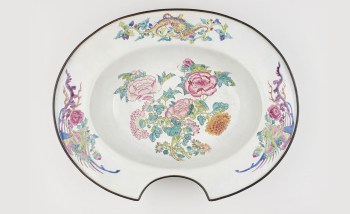
Barber’s basin with floral design in painted enamel, mid 18th century, copper, 36 × 28 × 7 cm (Hong Kong Art Museum, C1987.0010).
During the 18th and 19th centuries, Canton (Guangzhou) was the centre of foreign trade in China. There were some busy shopping streets near the Thirteen Factories district in the southwest suburbs of the Canton city along the Pearl River, with rows of stores selling various crafts and curiosities, tea leaves, local products, snacks and drinks. The target customers were mostly foreign merchants. This exhibition showcases a wide variety of China trade art collections to reconstruct scenes of the bustling shopping paradise in Canton. Visitors will immerse themselves in the interactive animations created by local animators the Tsui Brothers, as they go window-shopping down the memory lane while discovering the art and history of this thriving neighbourhood.
New Book | Pierrot and His World
From Manchester UP (and currently discounted dramatically at Amazon). . . .
Marika Takanishi Knowles, Pierrot and His World: Art, Theatricality, and the Marketplace in France, 1697–1945 (Manchester: Manchester University Press, 2024), 264 pages, ISBN: 9781526174093, £85 / $130.
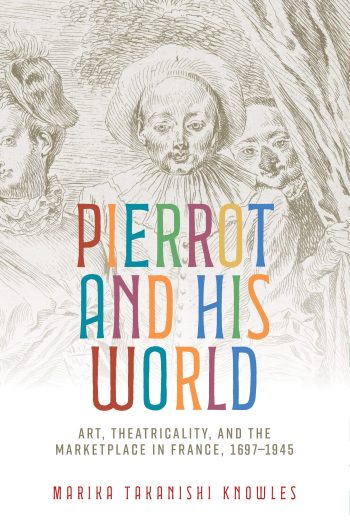 Pierrot, a theatrical stock character known by his distinctive costume of loose white tunic and trousers, is a ubiquitous figure in French art and culture. This richly illustrated book offers an account of Pierrot’s recurrence in painting, printmaking, photography and film, tracing this distinctive type from the art of Antoine Watteau to the cinema of Occupied France. As a visual type, Pierrot thrives at the intersection of theatrical and marketplace practices. From Watteau’s Pierrot (c. 1720) and Édouard Manet’s The Old Musician (1862) to Nadar and Adrien Tournachon’s Pierrot the Photographer (1855) and the landmark film Children of Paradise (1945), Pierrot has given artists a medium through which to explore the marketplace as a form for both social life and creative practice. Simultaneously a human figure and a theatrical mask, Pierrot elicits artistic reflection on the representation of personality in the marketplace.
Marika Takanishi Knowles is a Senior Lecturer in Art History at the University of St Andrews.
c o n t e n t s
Introduction
1 Antoine Watteau and the fête marchande
2 Pierrot-co-co
3 New Paris, Old Pierrot (New Pierrot, Old Paris)
4 Nadar Charlatan
5 Old Clothes and the Dreams of the Artist
Conclusion
Index
New Book | The Art of the Actress
Part of the Elements in Eighteenth-Century Connections series from Cambridge UP (digital downloads are available for free until 25 January!).
Laura Engel, The Art of the Actress: Fashioning Identities (New York: Cambridge University Press, 2024), 75 pages, ISBN: 978-1009486811 (hardcover), $65 / ISBN: 978-1108977906 (paperback), $22. Also available digitally through Cambridge UP.
 The Art of the Actress: Fashioning Identities considers how eighteenth-century visual materials across genres, such as prints, portraits, sculpture, costumes, and accessories, contribute to the understanding of the nuances of female celebrity, fame, notoriety, and scandal. The ‘art’ of the actress refers to the actress represented in visual art, as well as to the actress’s labor and skill in making art ephemerally through performance and tangibly through objects. Moving away from the concept of the ‘actress as muse,’ a relationship that privileges the role of the male artist over the inspirational subject, Laura Engel focuses instead on the varied significance of representations, reproductions, and re-animations of actresses, female artists, and theatrical women across media. Via case studies, this Element explores how the archive charts both a familiar and at times unknown narrative about female performers of the past.
Laura Engel is a Professor in the English Department at Duquesne University, where she specializes in eighteenth-century British literature and theater. She is the author of Women, Performance, and the Material of Memory: The Archival Tourist, 1780–1915 (2019); Austen, Actresses, and Accessories: Much Ado about Muffs (2015); and Fashioning Celebrity: Eighteenth-Century British Actresses and Strategies for Image Making (2011). She also co-edited, with Elaine McGirr, Stage Mothers: Women, Work, and the Theater, 1660–1830 (2014).
c o n t e n t s
Introduction: The Art of the Actress in the Eighteenth Century
1 The Paradox of Pearls
2 The Actress as Artist and the Artist as Actress: Anne Damer and Angelica Kauffman
3 Mary Anne’s Muff: Actresses and Satire
4 Epilogue: Unfinished Business: Elizabeth Inchbald, Lady Cahir, Sir Thomas Lawrence, and the Aftermath of the Art of the Actress
References
Philippe Halbert Named Associate Curator at the Wadsworth Atheneum
From the press release, via Art Daily:
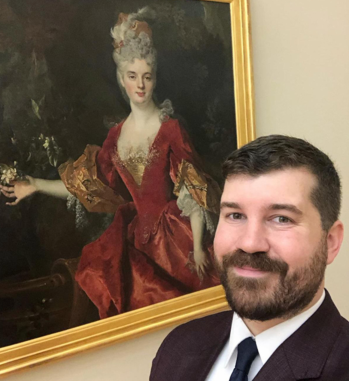 The Wadsworth Atheneum Museum of Art in Hartford, Connecticut has named Dr. Philippe Halbert as Richard Koopman Associate Curator of American Decorative Arts. A graduate of the College of William and Mary and the Winterthur Program in American Material Culture, Halbert earned his PhD in the history of art from Yale University, where he studied the intersections of art, empire, race, and self-fashioning in the Atlantic world. His academic work centers American decorative arts and material culture broadly, from its Indigenous roots to interconnected phenomena of diaspora, creolization, and settler-colonialism. Halbert has served as Interim Curator of American Decorative Arts at the Wadsworth since November 2022.
“I am committed to telling dynamic, object-centered stories of people and place that transcend geographic, ethnic, linguistic, and temporal bounds,” Halbert said, explaining that his academic interdisciplinary research and professional endeavors are grounded in a desire to encourage appreciation of American decorative arts by specialists and general audiences of all ages.
Proficient in French and Spanish, Halbert has been involved in the development of numerous exhibitions and special installations at the Wadsworth. Oversight responsibilities include over 3,000 decorative arts objects (circa 1650–2020) at the Wadsworth, with duties ranging from daily care of the collection and related research to overseeing rotations in the permanent collection galleries, developing special exhibits, volunteer training, and building partnerships with other institutions and constituents in Hartford and beyond.
Special projects underway and upcoming include New Nation, Many Hands, a special exhibition of federal-era decorative arts and material culture drawn from the permanent collection (on view from June 2023 until September 2024); reinterpretation of the Wetmore parlor, a painted and paneled room from a circa 1746 Middletown, Connecticut, house; and reevaluation of the Wadsworth’s American decorative arts holdings in anticipation of their reinstallation in 2025.
“Philippe is an outstanding scholar and curator of the Atlantic world, especially the interaction between France and North America. His passion for the material culture of vast early America is infectious and his love of curatorial work, breadth of knowledge, and extensive scholarship are incredible assets for the Wadsworth,” said Matthew Hargraves, Director of the Wadsworth Atheneum Museum of Art. “We are delighted that he has assumed this new role and look forward to his continued stewardship of our remarkable American Decorative Arts collection.”
Previously in his career, Halbert served as a curatorial intern at various museums, including at the Yale University Art Gallery, the J. Paul Getty Museum in Los Angeles, Philadelphia Museum of Art, and Colonial Williamsburg. He has earned numerous awards and fellowships and been an adjunct lecturer and consultant for various institutions, including at the Embassy of the United States in Paris. He is a resident of West Hartford, CT.
Conference | Visualizing Antiquity, Part II
From ArtHist.net:
Visualizing Antiquity: On the Episteme of Early Modern Drawings and Prints — Part II: Find and Display / Fragment and Whole
Bildwerdung der Antike: Zur Episteme von Zeichnungen und Druckgrafiken der Frühen Neuzeit — II. Fund und Aufstellung / Fragment und Ganzes
Online and in-person, Zentralinstitut für Kunstgeschichte Munich, 31 January 2024
Organized by Ulrich Pfisterer, Cristina Ruggero, and Timo Strauch
The academy project Antiquitatum Thesaurus: Antiquities in European Visual Sources from the Seventeenth and Eighteenth Centuries, hosted at the Berlin-Brandenburg Academy of Sciences and Humanities (thesaurus.bbaw.de), and the Zentralinstitut für Kunstgeschichte Munich (zikg.eu) are organizing a series of colloquia in 2023–2025 on the topic Visualizing Antiquity: On the Episteme of Drawings and Prints in the Early Modern Period. The significance of drawings and prints for ideas, research, and the circulation of knowledge about ancient artifacts, architecture, and images in Europe and neighboring areas from the late Middle Ages to the advent of photography in the mid-19th century will be examined. The second colloquium will explore how the various states and contexts of ancient objects, in the broadest sense, between their discovery and their ‘final’ display, were captured and documented in images. Later study days will focus on Collectors, Artists, Scholars: Knowledge and Will in Collection Catalogs and Fake News? Fantasy Antiquities. Participation in the event is free of charge, and the talks will also be broadcast via Zoom (Meeting-ID: 856 5934 5839 | Password: 148258).
p r o g r a m
11.00 Begrüßung & Einführung
11.15 Dokumentation
Moderation: Arnold Nesselrath (Rom)
• Francesco Benelli (Alma Mater Studiorum – Università di Bologna), ‘Che no sia tondo e che abia dello aovato’: Uffizi U1132A, a stratification of meanings and strategies within the Sangallo’s workshop
• Barbara Sielhorst (Ruhr-Universität Bochum), Pars pro toto. Zur visuellen Dokumentation des Palatins in Rom vom Beginn des 18. bis zur Mitte des 19. Jahrhunderts
• Alessia Zambon (UVSQ-University Paris-Saclay), Thomas Burgon’s Excavations in Athens in 1813: Fieldwork and Finds’ Recording
13.00 Mittagspause
14.00 Restaurierung – Rekonstruktion
Moderation: Elena Vaiani (ZIKG München)
• Elena Efimova (Lomonossow-Universität Moskau), Dessins des détails d’ordres: entre un livre de modèles et une collection antiquaire
• Lena Demary (Ruhr-Universität Bochum), Transparenz und Verschleierung – Ambivalenzen früher restauratorischer Dokumentationen in Katalogen antiker Bildwerke
• Annie Maloney (Oberlin College), Reconstructing the Fragments of Pietro Santi Bartoli’s Reproductive Corpus
• Koenraad Vos (University of Cambridge), Restorations of Ancient Sculpture as Epistemic Images: Filippo Aurelio Visconti on the Benefits of Intervention
16.20 Kurze Pause
16.30 Aufstelling
Moderation: Henri de Riedmatten (Université de Genève)
• Anna Degler (Freie Universität Berlin), Auf unsicherem Grund. Der sog. Torso Belvedere und die Körperdiskurse in der ersten Hälfte des 16. Jahrhunderts
• Daniela Picchi (Museo Civico Archeologico di Bologna), Giovanni Nardi and Ancient Egypt at the Medici Court
• Sophie Kleveman (Georg-August-Universität Göttingen), Kommissarisches Antikenwissen und die Regulation des Antikenmarktes im 17. Jahrhundert
• Henri de Riedmatten (Université de Genève), Zusammenfassung und Leitung Abschlussdiskussion










 Enfilade
leave a comment