New Book | Portrait Miniatures
From Michael Imhof:
Bernd Pappe and Juliane Schmieglitz-Otten, eds., Portrait Miniatures: Artists, Functions, Techniques, and Collections (Petersberg: Michael Imhof Verlag, 2023), 272 pages, ISBN: 978-3731913399, €40.
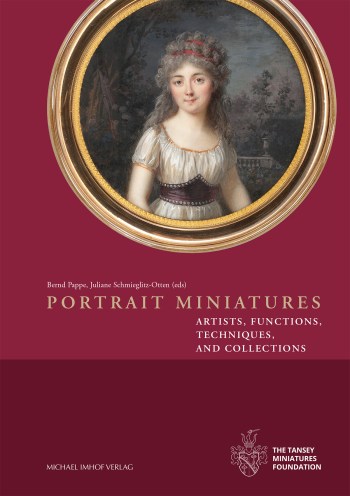 The specialist conferences on miniature portraits, organized for the past ten years by the Tansey Miniatures Foundation, have enabled an in-depth examination of this particularly intimate genre of portrait painting. In this third volume of conference proceedings, twenty-one internationally renowned experts from ten countries explore the miniature portrait from different perspectives, highlighting the private use of miniatures and contrasting it with their function in a more public context. Several authors provide new insights into important but hitherto little-known private and museum collections; others introduce specific artists. For the first time, this volume also addresses in significant depth specific technical aspects of creating and preserving portrait miniatures.
The contents can be viewed here»
Exhibition | Good Impressions: Portraits across Three Centuries
From the press release for the exhibition:
Good Impressions: Portraits across Three Centuries from Reynolda and Wake Forest
Reynolda House Museum of American Art, Winston-Salem, 20 October 2023 — 27 October 2024
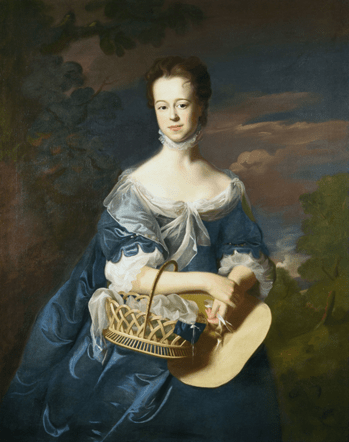
John Singleton Copley, Portrait of Elizabeth Gorham Rogers (wife of Daniel Rogers), 1762, oil on linen, 50 × 40 inches (Winston-Salem: Wake Forest University, Hanes Collection, Gift of Philip and Charlotte Hanes, HC1991.1.1). More information is available here.
Portraits are often taken at face value—as accurate representations of a person’s appearance, sometimes removed by decades or centuries. But portraits are often the products of delicate negotiations between artist and subject. Sometimes they flatter, exaggerating the sitter’s beauty or rich attire. Sometimes they capture the subject engaged in his or her occupation, whether pausing during study or painting in his or her studio. Sometimes they celebrate an auspicious occasion, such as a recent engagement or the imminent birth of a child. This exhibition features three centuries of portraits of men and women, Black and White, solitary and companionate, classic and modern.
“The museum and university are both strengthened by collaborations like this small yet glorious presentation of portraits,” said Allison Perkins, executive director, Reynolda House and Wake Forest University associate provost for Reynolda House & Reynolda Gardens. “More importantly, Wake Forest’s students and Winston-Salem’s community have the privilege of seeing extraordinary works in conversation on our walls.”
Good Impressions was mounted to mark the recent conservation treatment of John Singleton Copley’s 1762 Portrait of Elizabeth Gorham Rogers (Mrs. Daniel Rogers) in the collection of Wake Forest University and Reynolda House’s recent acquisition of the 1973 photograph Changing Times by Kwame Brathwaite (1938–2023).

Kwame Brathwaite, Changing Times, 1973, archival pigment print, 30 × 30 inches (Winston-Salem: Reynolda House Museum of American Art, Museum purchase, 2022.3.2).
Reynolda is set on 170 acres in Winston-Salem, North Carolina and comprises Reynolda House Museum of American Art, Reynolda Gardens and Reynolda Village Shops and Restaurants. The Museum presents a renowned art collection in a historic and incomparable setting: the original 1917 interiors of Katharine and R. J. Reynolds’s 34,000-square-foot home. Its collection is a chronology of American art and featured exhibitions are offered in the Museum’s Babcock Wing Gallery and historic house bedrooms. The Gardens serve as a 134-acre outdoor horticultural oasis open to the public year-round, complete with colorful formal gardens, nature trails and a greenhouse. In the Village, the estate’s historic buildings are now home to a vibrant mix of boutiques, restaurants, shops and services.
Conference | 76th Annual Williamsburg Antiques Forum
From Colonial Williamsburg:
76th Annual Antiques Forum: Domestic Affairs
Online and in-person, Colonial Williamsburg, 23–27 February 2024
Registration due by 1 February 2024 (virtual registration by 10 February)
 From London to Nova Scotia, New England to Virginia and the Carolinas, the Mid Atlantic to the Gulf South: all make an appearance at Colonial Williamsburg’s 76th Annual Antiques Forum: Domestic Affairs. Join us as we explore fashions, furnishings, and the familial while traveling through time and space and delving into houses and histories. We will journey through public and private collections, revealing new research, revitalized spaces, and the fascinating stories that are told by objects, architecture, and interiors.
On opening day of this year’s Antiques Forum, we are joined by Tim Whittaker, former Director of The Spitalfields Trust, who introduces the visionaries and eccentrics who saved the Georgian architectural legacy of East London. Robert Leath, Executive Director of Edenton Historical Commission, then dives into four centuries of North Carolina History as he examines the story of Hayes Plantation. Chief Curator Adam Erby reveals recent discoveries from Mount Vernon, and architectural paint conservator Maeve Woolley Delph peels back the layers on the interior paint restoration of Wilton House Museum. Trevor Brandt from Americana Insights and Colonial Williamsburg’s Associate Curator of Paintings, Drawings, and Sculpture, Kate Teiken Rogers round out our visit to houses and objects as they take a deeper look at spiritual labyrinths in Pennsylvania German fraktur and portraiture of early Williamsburg residents, respectively.
On Sunday, Cynthia Cooper from the McCord Stewart Museum reveals the unlikely travels of an 18th-century dress from Virginia to Quebec City. We then travel to Mississippi as Jefferson Mansell, Historian with the Natchez National Historical Park, looks at the rise of the of the Natchez suburban estate. In the afternoon, attendees are invited to venture to the Art Museums of Colonial Williamsburg for an update on recent acquisitions in the foundation’s collection, with mini-lectures by Colonial Williamsburg’s Curator of Furniture Tara Chicirda; Senior Curator of Mechanical Arts, Metals, and Numismatics Erik Goldstein; and Curator of Costumes and Textiles Neal Hurst. Following afternoon refreshments, lectures resume in the Virginia Room of the Lodge with the Carolyn and Michael McNamara Young Scholars Series, sponsored by The Decorative Arts Trust and featuring emerging scholars Ahmauri Williams-Alford (Telfair Museum), Henry Beard (Old Salem), and Cecelia Eure (Winterthur). The Annual Forum Shields Tavern Barbecue, sponsored by Jeffrey S. Evans & Associates, concludes the day.
We explore indoors and out, above ground and below on Monday with independent scholar Errol Manners addressing “Ceramics and the Garden: Display, Delight, and Consumption,” and Drayton Hall’s Director of Archaeology Luke Pecoraro investigating Drayton Hall’s designed landscape. Colonial Williamsburg’s Director of Archaeology Jack Gary and Associate Curator of Ceramics and Glass, Angelika Kuettner then join our guest speakers on stage to discuss garden ceramics, archaeology, and historic preservation. In the afternoon attendees are invited to an open house at Custis Square to see the ongoing garden archaeology project and join Colonial Williamsburg’s Nation Builder Kurt Smith for a fascinating look at “Thomas Jefferson and English Gardens,” inspired by the visits of both men spanning different centuries. The Margaret Beck Pritchard Associate Curator of Maps and Prints, Katie McKinney, will end the day with a look at Robert Furber, his prints, and their influence on garden and floral arrangement design in the 18th century and today.
Our final day of lectures ventures to New England and the Mid-Atlantic with Historic Deerfield’s Amanda Lange looking at ceramics for the American home. Montgomery County Pennsylvania’s Daniel Hiester House is the subject of this year’s Collectors Talk, given by scholar and owner Lisa Minardi, while Matthew Skic, Curator of Exhibitions, Museum of the American Revolution, takes a look at the material world of the Forten Family of Philadelphia. Brenton Grom, Director of Connecticut’s Webb-Deane-Stevens Museum discusses how the spectacle of house museums can bring us together, and architectural historian Willie Graham gives our closing keynote highlighting remarkable discoveries during the restoration of Cloverfields, one of Tidewater Maryland’s grandest houses. A night to remember follows with live entertainment for the closing dinner.
Images from the Forum Flyer: Top Left: Detailed shot of a three-piece Court Suit, Warsaw, Poland, 1787–95, silk, linen, wool, iron, silver, gold, garnets, wood, paper (Transfer from The Valentine Museum, Richmond, VA, 2023-21,1-3). Bottom Left: Portrait of Helen M. Eddy, Joseph Whiting Stock, Springfield, Massachusetts, 1845, oil on canvas (Bequest of Abby M. O’Neill, 2018.100.3). Top Middle: Three-piece Court Suit, Warsaw, 1787–95, silk, linen, wool, iron, silver, gold, garnets, wood, paper (Transfer from The Valentine Museum, Richmond, VA, 2023-21,1-3). Bottom Middle: Hong Bowl, Jingdezhen, China, ca. 1787–88, hard-paste porcelain (Museum Purchase, The Joseph H. and June S. Hennage Fund, 2023-4). Top Right: Portrait of Major General Alexander Finley Whitaker possibly by John Bradley, New York, ca. 1835, oil on mattress ticking (Museum Purchase, Hank and Dixie Wolf in honor of Margaret Beck Pritchard and Laura Pass Barry, 2023.100.1). Bottom Right: Armchair, London, 1763–67, mahogany (Museum Purchase, 1959-351,3).
Conference | Working Wood in the 18th Century: By the Book

From Colonial Williamsburg:
Working Wood in the 18th Century: By the Book
Online and in-person, Colonial Williamsburg, 25–28 January 2024
Registration due by 1 January 2024
Printed words and images: How did 18th-century craftspeople turn them into actions and objects? How did craftspeople fill in the blanks left by what was unwritten or unillustrated? And how can the ink they left on paper inform our understanding of a past in which most craft knowledge was shared orally? Join tradespeople and scholars from Colonial Williamsburg and esteemed guest presenters as they explore woodworking by the book.
All lectures will take place in the Hennage Auditorium, at the Art Museums of Colonial Williamsburg. In-person capacity is limited and those on the waitlist will be notified via email should space become available. Virtual capacity is unlimited.
Christopher Schwarz—woodworker, author, and publisher of Lost Art Press—will open the conference with a keynote on the long historical arc of woodworking books. Later, he’ll demonstrate the low workbench illustrated by M. Hulot in L’Art du Tourneur Mécanicien (1775) to explore how the design has persisted among chairmakers up to the present. Chairmaking of a different flavor will be the focus of demonstrations by master cabinetmaker and educator Dan Faia, who will explore the structure and ornament of a high-style neoclassical chair design published by George and Alice Hepplewhite in The Cabinet-maker and Upholsterer’s Guide (1789). Colonial Williamsburg cabinetmakers Bill Pavlak and John Peeler will explore how 18th-century craftspeople could use Thomas Chippendale’s elaborate published patterns as a springboard for designing and building chairs in the ’plain and neat’ manner favored by colonial Virginia’s fashion-conscious consumers.
In the realm of architectural woodworking, Colonial Williamsburg’s joiners Brian Weldy and Peter Hudson will employ a variety of 18th-century pattern books to design and build a door, its frame, and the decorative woodwork that surrounds it. In a panel moderated by supervisor-journeyman Matt Sanbury, apprentice carpenters Harold Caldwell, Mary Lawrence Herbert, and McKinley Groves will crack open Joseph Moxon’s late 17th-century work Mechanick’s Exercises to put his lessons in carpentry to the test. Does Moxon’s writing accurately reflect the practices of carpenters?
Decorative techniques are discussed at length in period writings, though usually in an incomplete manner. Conservators Chris Swan and Sarah Towers will introduce their recent exploration into traditional silvering techniques for carved picture frames. Harpsichord makers Edward Wright and Melanie Belongia will explore decorative veneering methods that are useful for furniture and musical instruments alike. In both cases, presenters will show how the written word combined with hours of experimentation at the bench led to successful results.
In addition to bringing the techniques and designs from books to life, we’ll also explore books themselves from a variety of perspectives. Whitney L.B. Miller, author of Henry Boyd’s Freedom Bed, will share how she was inspired to turn her research on Henry Boyd—a free Black furniture maker, inventor, and abolitionist who was born into enslavement—into a book for today’s children. Colonial Williamsburg’s curator of furniture Tara Chicirda will introduce the role that pattern books and price books played in the cabinetmaker’s trade. To learn about what went into making detailed printed illustrations, master engraver Lynn Zelesnikar will demonstrate her craft while reproducing a plate from Chippendale. She and Bill Pavlak will also compare notes on how to turn the same ornamental pattern into a two-dimensional engraving or a three-dimensional wood carving. Any collection of books needs shelves, and decorative arts historian Thomas Savage will deliver our banquet keynote on the acclaimed Holmes-Edwards library bookcase, a beautifully crafted home for books with a compelling story of its own.
Decorative Arts Trust Announces Failey Grant Recipients for 2024
From the press release:

Page from the African Union Society book of records, recording a land transaction between Arthur Flagg and Cupid Brown for a house and lot on Thames Street (NHS Vol. 1674B, Page 190).
The Decorative Arts Trust is pleased to announce that the 2024 Dean F. Failey Grant recipients are the Andrew Jackson Foundation in Nashville, TN; the Brandywine Conservancy & Museum of Art in Chadds Ford, PA; Fallingwater in Mill Run, PA; Museo de las Americas in Denver, CO; the Newport Historical Society in Newport, RI; and the Tomaquag Museum in Exeter, RI.
The Failey Grant program provides support for noteworthy research, exhibition, and conservation projects through the Dean F. Failey Fund, named in honor of the Trust’s late Governor. Each of these projects also incorporates contributions from an emerging scholar. Failey Grant applications are due October 31 annually.
The Andrew Jackson Foundation will conserve and exhibit Sarah Yorke Jackson’s 1820–30 Spanish guitar attributed to Cabasse-Visnaire L’ainé that is currently on display in the Hermitage Mansion. The project will be led by Collections Manager Jennifer Schmidt and Collections Aide Haley Weltzien.
The Brandywine Conservancy & Museum of Art will publish the catalogue for The Crafted World of Wharton Esherick exhibition. Wharton Esherick Museum (WEM) Director of Curatorial Affairs Emily Zilber will be the catalogue’s primary author, with essays by WEM Director of Interpretation and Research Holly Gore, Philadelphia-based design and culture writer Sarah Archer, and Philadelphia Museum of Art Assistant Curator in the Department of European Decorative Arts Colin Fanning.
Fallingwater will restore 24 oversized blueprints of shop drawings for Frank Lloyd Wright’s built-ins and furniture as well as 28 blueprints of the guest house. Paper conservator Jayne Girold Holt will work with Hannah Cioccho, Fallingwater’s newly appointed Collections Manager and Archivist.
Museo de las Americas plans to launch a digital resource focusing on a collection of Latin American textiles, which includes containers, clothing, and blankets. Curator of Collections Laura Beacom will work with a paid intern to photograph, digitize, and upload content to Bloomberg Connects and Google Arts and Culture.
The Newport Historical Society will develop A Name, a Voice, a Life: The Black Newporters of the 17th–19th Centuries, an exhibition about how the lives of Africans and African Americans have been interpreted from the written record. The exhibition will be led by Collaborating Curator Zoe Hume and Project Director Kaela Bleho.
The Tomaquag Museum will conserve an 1840s Narragansett birchbark canoe, which was crafted by the great uncle of Ferris Dove, the Narragansett Chief Roaring Bull. Conservator Linda Nieuwenhuizen will perform a condition assessment, and Tomaquag Museum Archival Assistant and Narragansett Nation citizen Kathryn Cullen-Fry will document the history and community memories of the canoe, which will serve as a centerpiece of Tomaquag’s new visible storage facility.
Doctoral Scholarship | Representations of Black People in European Art
From ArtHist.net, where the posting includes the German description:
Doctoral Scholarship | The Representation of Black People in European Art and Material Culture Using the Example of the Tucher Family Coat of Arms
Argelander Professorship for Critical Museum and Heritage Studies, University of Bonn, and Tucher Kulturstiftung
Applications due by 31 January 2023
Since 1345, the central motif of the Tucher family coat of arms has been the head of a Person of Colour in profile. While in the early modern period the depiction was interpreted as a portrait of St Maurice and a symbol of Christian defence and virtue, depictions from the colonial period tend to suggest stereotypical, racialising ideas of Black people. As part of the doctoral scholarship The Representation of Black People in European Art and Material Culture Using the Example of the Tucher Family Coat of Arms (Die Darstellung von Schwarzen Menschen in europäischer Kunst und materieller Kultur am Beispiel des Tucher Familienwappens), some of the diverse questions raised by the family coat of arms will be explored. What can the changing depiction of Black people / BIPoC / people of the global majority in the coat of arms over the centuries tell us about the perception of people from Africa and the African diaspora in Europe? How did the presence of Black people in Europe shape the representations? What role did upheavals in the history of ideas and political economy—such as the Enlightenment in Europe, the transatlantic trade in enslaved people, and the colonisation of non-European territories—play in the different forms of representation? What purposes did the identification of a white patrician family with a Black person serve in these different eras? And to what extent did the changing materiality of European art and craftsmanship influence the forms of depiction of the family coat of arms? The doctoral candidate selected is invited to set their own research priorities according to their expertise (epochs, materialities) and to contribute comparative examples to the research. A critical examination of the tipping points of self-perception and external attribution expressed by the changing family coat of arms is desired. Reference to approaches from Postcolonial and Critical Whiteness Studies is also expressly encouraged.
Tasks
• Independent research on the topic The Representation of Black People in European Art and Material Culture Using the Example of the Tucher Family Coat of Arms
• Annual research reports
• Conclusion of a supervisory relationship at the University of Bonn at the start of the fellowship
Applicant Profile
• Completed Master’s degree in social and cultural anthropology, history, art history, cultural studies, museum studies, material culture studies, postcolonial studies, or related subjects
• Experience with historical German scripts
• Experience with historical material culture
1700€ / month doctoral scholarship; 1500€ / year travel and material costs
To apply, please send a cover letter, a description of the proposed research project (1–2 pages), a writing sample, and a CV in one PDF file to Nana Tsiklauri, ntsiklau@uni-bonn.de. The scholarship should be started as soon as possible. The deadline for applications is 31 January 2024. For details, please refer to the official call for applications at this link. If you have any questions, please contact Jun.-Prof. Dr. Julia Binter, julia.binter@uni-bonn.de.
Sculpture Journal, November 2023
The latest issue of the Sculpture Journal is dedicated to the long eighteenth and nineteenth centuries:
Sculpture Journal 32.4 (November 2023)
 • Samantha Lukic-Scott and Charlotte Davis, “Valuing Sculpture: Art, Craft, and Industry, 1660–1860,” pp. 409–16.
Responding to the many useful and intriguing discussions that arose over the two days of the Valuing Sculpture: Art, Craft and Industry, 1660–1860 conference held in July 2021, this special issue explores new directions for scholarly research. This introduction considers the usefulness of the classifications of art, craft, and industry, and in doing so presents this collection’s methodology of expanding dialogues by reaching across medial, dimensional, geographical, and categorical boundaries.
• M. G. Sullivan, “Valuing Sculpture in the Long Eighteenth Century: Materials and Technology,” pp. 417–32.
In 1712 the sale catalogue of John Nost’s studio defined the value of sculpture as lying in the intrinsic value of materials, the performance of the artist, and the costs and complexity of sculptural production. This article looks at how these values of materials and making shifted over the course of the following 150 years through specific examples of materials—lead and granite—that gained and then lost value; and how production processes that streamlined sculptural production, notably James Tulloch’s marble works, were first celebrated and then seen as anathema to sculptural value. The article argues for the malleability of sculptural value systems in the long eighteenth century, and the need to understand sculptural value in materials and production in relation to economic and technological history.
• Caroline Stanford, “‘Peculiarly Fit for Statues’: The Contribution of Coade’s Fired Artificial Stone to Sculpture in the Eighteenth Century,” pp. 433–50.
This article considers the enduring ‘value’ of Coade stone as artefact. Using insights from Alois Riegl’s The Modern Cult of Monuments, it examines the contribution of fired artificial stone as a key enabler of the eighteenth-century passion for sculpture in Britain, as replicated sculptural forms entered interiors, gardens, and architecture. This durable stoneware first crossed into statuary in the 1720s. From 1769, Eleanor Coade (1733–1821) became its figurehead, successfully positioning Coade stone as superior to natural stone. Formulation and production were collaborative processes dependent upon specialist, often overlooked fabricating skills. This article considers factors that led to the success of Coade stone, as well as its composition and production. It concludes with a brief case study of the Coade stone caryatids that Sir John Soane took as a personal motif.
• Rebecca Wade, “The Young Naturalist by Henry Weekes: Intermediality, Industry, and International Exhibitions,” pp. 451–68.
The Young Naturalist by Henry Weekes (1807–77) was first presented in plaster at the Royal Academy of Arts in 1854. Beginning as an object located firmly in the domain of the fine arts through its modes of production and sites of display, the sculpture encountered industry through a series of international exhibitions in Paris, London and Manchester during the 1850s and 1860s. Not only was the work in proximity to industrial objects, processes and collectors, it was fundamentally transformed by them, resulting in a collaboration between Weekes and the Birmingham-based manufacturer Elkington & Co. This article charts the changing status of sculpture and labour in the second half of the nineteenth century, with its increasing visibility and availability to new markets through both emerging and established technologies of reproduction.
• Liberty Paterson, ” ‘Wider than the Realm of England’: The Hosack Family Heritage, Atlantic Slavery, and Casting Mary, Queen of Scots for the Nation,” pp. 469–92.
In 1871 the Scottish-born magistrate John Hosack (1809–87) was described as ‘the chivalrous and most recent defender’ of Mary, Queen of Scots. After writing a popular historical account of her life, he had presented a plaster cast bust of her Westminster effigy to London’s National Portrait Gallery, which it then used to create an electrotype sculpture with the help of Elkington & Co. This article interrogates the ‘value’ of this sculpture as a cultural heritage object by retracing its history. It places Hosack’s desire to replicate and commemorate Scottish heritage alongside his family ties to Jamaica, including the parallel life of his half-brother William and the wealth John derived from his father’s sugar profits, which relied on African enslavement. It argues the importance of understanding how such legacies enabled individuals to participate in cultural philanthropy in the Victorian period, which simultaneously distanced them from their Atlantic pasts. It also considers how, in its transformation into an electrotype, Hosack’s cast became part of a wider effort by museums and galleries to replicate national heritage using manufacturing methods indebted to the industrial economy intertwined with the British Empire. Sculpture offered a powerful medium through which to fortify national history, but its commemorative capacity can, and should, be unpicked to better understand British legacies of enslavement and colonialism.
• Justine Gain, “Valuing Ornament: Jean-Baptiste Plantar (1790–1879) between Art, Craft, and Industry,” pp. 493–511.
In the nineteenth century, as European countries reacted to industrialization, art, and burgeoning industries intertwined in a myriad of new ways. From this union, several major changes occurred in building construction, decorative arts, and sculpture. The career and oeuvre of Jean-Baptiste Plantar, French ornamentalist and sculptor des Bâtiments du Roi, illustrate the new relationships forged between traditional architectural patterns and industrial artistic production. Despite holding a central role in their establishment, Plantar has been largely unheeded both by his contemporaries and later writers. This article reasserts Plantar’s significance in the creation of a visual—essentially Parisian—landscape in the first half of the nineteenth century.
• Patricia Monteiro, “The Art of Stucco in Southern Portugal: Morphologies, Value Judgements, and the Prejudice of Conservation,” pp. 513–29.
The Portuguese artistic production of stucco is part of a long tradition of decorative techniques that form part of a shared visual and cultural legacy in southern Europe. However, little is understood of local idiosyncrasies within this legacy. By focusing on stucco artworks in the peripheral area of Alentejo, away from the cultural capitals of Europe, this article explores the emergence of an original and distinct formal and functional interplay over the course of several centuries. This article re-evaluates the morphologies of Alentejo’s stucco sculptures and assesses the degree to which such morphologies express common artistic practices and constitute a distinct art form. Finally, the article identifies the deleterious ramifications that have arisen from such considerations not being taken account of during the conservation of these works.
• David Mark Mitchell, “Fabricating Enchantment: Antoine Benoist’s Wax Courtiers in Louis XIV’s Paris,” pp. 531–44.
Antoine Benoist’s Cercle royal was an exhibition of life-size wax figures on display in Louis XIV’s Paris. In the absence of extant objects from the exhibition itself, this article focuses on the corpus of sources that attest to its reception. It concentrates on the Cercle royal’s initial recognition, beginning in the 1660s, when the exhibition centred on French royalty’s courtly entourage. Alternately celebrated as vivid miracles or derided as deceitful trivialities, Benoist’s wax figures provide an informatively problematic case for considering questions of sculptural craft and the decorum of its display in this era. In tracing the discord of wax portraiture’s reception, this article demonstrates that vexed questions of artisanal stature were embedded within aesthetic debates about illusionistic verisimilitude.
• Jennifer Dudley, Review of the exhibition If Not Now, When? Generations of Women in Sculpture in Britain, 1960–2022 (Hepworth Wakefield, 2023), pp. 545–48.
Call for Papers | Environmental Impacts of Catholic Missions, Atlantic
From ArtHist.net:
The Environmental Impacts of Early Modern Catholic Missions in the Atlantic Space
Université Paris 1 Panthéon-Sorbonne, 9 March 2024
Université du Québec à Montréal, 18 March 2024
Proposals due by 31 December 2023
These series of workshops aim to explore the role of the Catholic Church, through its missionary undertaken, in the global environmental upheavals and discoveries of the early modern period. Venturing wide and far beyond the familiar European sphere, early modern missionaries frequently used the rhetoric of Theatrum Mundi to reflect on their encounters with previously unknown cultures. What has escaped scholars’ attention, however, is how these rapidly evolving dramas of evangelization in turn shaped the seemingly timeless backstage setting of Nature. As the missionaries voyaged away and established new religious communities, they were not only faced with social and cultural challenges raised by the vastly different linguistic, political, and philosophical traditions, but they also had to adapt to unfamiliar geographical, climate, and material conditions as they sought to construct churches or realize liturgical rituals, not to mention the extensive agricultural and medical activities they had to pick up for personal survival in often severe natural conditions.
We would like to ask and try to answer questions such as:
• How did the missionaries adapt to local conditions of climate, sunlight, and building technologies when constructing churches?
• How did the missionaries accommodate rituals and its theological implications (such as the presence of wine and bread in the Mass) in reaction to local natural resources?
• How did early modern missionaries develop survival precautions over time to adapt to the dangers of these new natural environments?
• To what extent were the early modern global missionary activities impacted by major environmental crisis of this period, such as the epidemics or the Little Ice Age?
• How did the missionaries’ encounters with new geographical spaces and conditions stimulate knowledge creation and circulation, such as in the areas of cartography, botany, zoology, and medicine?
These are a few of the many possible new questions we hope to explore in this workshop. One overarching method we want to propose is to think about early modern Catholicism in the plural term, as theorized by Simon Ditchfield. Studies on post-Tridentine missions tended to emphasize the central authoritative role of Rome, focusing especially on the role of the missionary as leader in the creating of new religiosity, new economical exchanges, or new societies. The new attention paid to missionaries’ interactions with local natural conditions will complexified our understanding of Rome as one of the few truly global institutions of the early modern period acting not only as a religious and evangelist force but also in the colonialist expansions.
These two workshops will be consecrated to the missions in the Atlantic space. It will be followed by a second series of workshop in 2025 to look over the Pacific space and will be concluded by an edited volume. Please send an title, a short abstract (300 words) and a one-page CV to harvey.isabel@uqam.ca, Alysee.Le-Druillenec@univ-paris1.fr, and wenjies@princeton.edu, before 31 December 2023.
Organizers
Isabel Harvey (Université du Québec à Montréal), Alysée Le Druillenec (University of Paris 1 Pantheon-Sorbonne), and Wenjie Su (Princeton University)
Call for Papers | Romanticism’s Colonial Legacies
From ArtHist.net:
Romanticism’s Colonial Legacies in and beyond Europe: Critical Perspectives on Art and Visual Culture
Frankfurt am Main, 10–12 October 2024
Proposals due by 29 February 2024
The study of Romanticism has been markedly imbued with a sense of heroism, an epic aura, and a novelistic ethos, ultimately culminating in a pronounced ‘romanticisation’ of that era. However, this standpoint proves insufficient to elucidate the evolution of Romanticism and its impact beyond Europe. While some studies have critically engaged with the nationalist aspects of some variants of European Romanticism, matters pertaining to race, class, expansionism, and colonialism seemed not to belong to the Romantics’ sensitivity, becoming ‘the monsters hidden in the attic’ of Romanticism studies.
Scholarship has so far neglected, for example, the role played by the Romantic generation as agents of power actively engaged in the surveying, chronicling, mapping and imaginative rendering of distant territories that either already were or were about to be colonised. Similarly, practices such as the classification and depiction of flora, fauna, and humans carried out at and beyond the boundaries of Europe in the name of Enlightenment ideals are widely praised, despite the involvement of Romantic sciences in an extensive global inventory project that, for the most part, sought the imposition of a singular and dominant conception of knowledge as part of the Western agenda of modernity.
In light of these observations, the conference seeks to expand the critical examination of late 18th- and 19th-century art and visual culture, including intermedial perspectives. We aim to challenge canonical narratives by delving into the intricate connections with wider socio-political dimensions. These encompass racialism, class, gender, evolution, Imperialism, and colonial power. We warmly invite presentations that address facets and transformations of Romantic art and, more widely, late 18th- and 19th-centuries visual cultures in the Americas, the Caribbean, Africa, Asia, and Oceania, as well as Europe and its peripheries viewed through the lenses of intersectionality, (eco-)feminism, Marxism, postcolonial theories, Indigenous epistemologies, and critical race studies.
Possible areas of focus and themes include
• Romanticism and race
• Arts and Romantic sciences
• Concepts of ‘Nature’ and ‘Landscape’
• Romantic ecology
• The Sublime and the (tropical) Picturesque
• Botanical and zoological illustrations
• Maps and cartographies
• Gender and sexuality
• Nationalism(s) and colonialism(s)
• Indigeneity and Europeanness
• Class and social relationships
The language of the conference is English. Please email abstracts (max. 300 words), a short biography (150 words) and a selected list of publications to Dr Miguel Gaete (miguel.gaete@york.ac.uk) by 29th February 2024. Total or partial travel expenses can be covered if needed.
Keynote Speaker
Professor Luciana Martins (Birkbeck University London)
Organisers
Prof. Dr. Mechthild Fend
Dr. Miguel Gaete
Prof. Dr. Frederike Middelhoff
Call for Papers | Historical Botanical Gardens
From ArtHist.net and the conference website:
2nd International Congress of Historical Botanical Gardens
Wien, 29–31 July 2024
Proposals due by 15 January 2024
 The Austrian Federal Gardens in cooperation with the Botanical Garden of the University of Vienna, the Natural History Museum Vienna, and the International Association of Botanic Gardens (IABG) look forward to an interesting continuation of the 1st International Congress of Historical Botanical Gardens held in Lisbon in 2021. The initial impulse to communicate the issues and importance of botanical gardens to a broader public, highlighting their history as well as their importance and building a common network will be continued in 2024. For more than 450 years, plants have been collected, cultivated, studied, and exhibited in Vienna. This long and continuous tradition makes Vienna one of the most important locations for current and historic plant research and conservation.
This second event will expand the focus to include conservation and preservation of plants and gardens. How can we protect historical botanical gardens and their heritage from the major threats of our time, such as lack of resources, climate change, war, and conflicts of all kinds? What can we learn from the turbulents in the past? We invite papers related to the fields of Botanical Gardens, Historical Gardens, Plant Collections, and related disciplines. Submissions from students, associations, and independent researchers are encouraged. Presentation formats include 5-minute pitch presentations and 20-minute talks, as well as posters.
Examples for potential presentations:
Session 1 | The Transition of Historical Botanical Collections
• Survival of botanical collections in times of war or crisis
• Transition of princely botanical collections into the ownership of modern republics
• Transition of colonial collections into the ownership of independent states
• Endangerment of historical botanical collections during military conflicts
• Historical botanical collections and climate crisis
• Preliminary protective measures
Session 2 | Horticulture: Challenges in Daily Horticulture Practice
• Pest control and measures
• Prevention: biological cultivation and biological treatments
• Changes in cultivation because of climate change
• Cultivation and conservation of single plants of particular high value
• Protection of the collection
• Handling and protection of plants for and during exhibitions
Session 3 | Science: Sharing of Knowledge
• Importance of traditional horticultural crafts in historical botanical gardens
• Methods to conserve and transmit (horticultural) knowledge
• Which knowledge is transmitted
• Transition of traditional knowledge and traditional techniques to modernism
• Networking: international and transdisciplinary relationships
Session 4 | Historical Botanical Gardens
• Portraits of historical botanical gardens (existing and lost)
Please send your abstract (maximum of 250 words, excluding title and affiliation) as a Word file with an indication of the topic as well as the preferred presentation format to ichbg2024@bundesgaerten.at before 15 January 2024. You will be informed about acceptance and format of the presentation by 25 March 2024. For further information, please see the conference website, and don’t hesitate to contact the organizing committee at ichbg2024@bundesgaerten.at.










 Enfilade
leave a comment