Conference | Scientific Objects in the Museum
From ArtHist.net:
Les objets scientifiques au musée: Comment étudier et exposer l’histoire des sciences? XVIe–XIXe siècle
Musée du Louvre, Centre Dominique-Vivant Denon, Paris, 11–13 December 2023
Rencontre organisée dans le cadre du projet «Réflexions ciblées autour de la muséologie entre la France et l’Amérique du Nord d’hier à nos jours: collections, politiques culturelles et innovations muséographiques», soutenu par l’accord France-Canada pour la coopération et les échanges dans le domaine des musées (Ministère de la Culture, France / Ministère de l’enseignement supérieur et de la recherche, France / Ministère du patrimoine canadien, Canada).
l u n d i , 1 1 d e c e m b r e 2 0 2 3
Journée du 11 décembre ouverte au public, Centre Dominique-Vivant Denon; inscription obligatoire à centre-vivant-denon@louvre.fr. Les inscrits sont priés de se présenter munis de leur carte d’identité.
9.00 Mot de bienvenue par Françoise Mardrus (Directrice, direction des Études muséales et de l’Appui à la recherche, musée du Louvre) et Vincent Droguet (Conservateur général du patrimoine, sous-directeur des collections, Service des Musées de France), à confirmer
9.10 Présentation du déroulement des trois journées par Françoise Dalex (direction des Études muséales et de l’Appui à la recherche, musée du Louvre)
9.30 Objets d’art et de science: Points de vue de la recherche
Présidence de séance: Philippe Cordez
• Susanne Thürigen (Curator for Scientific Instruments, History of Medicine and Pharmacy, Arms and Armour, Germanisches Nationalmuseum, Nuremberg), The Behaim Globe: History and Future of a Political Instrument
• Federica Gigante (Research Associate, Faculty of Asian and Middle Eastern Studies / Oxford Centre for the History of Science, Medicine, and Technology, University of Oxford), Du cabinet de curiosités au musée d’aujourd’hui: L’histoire remarquable d’un astrolabe longtemps méconnu
• Sven Dupré (Professor of History of Art, Science and Technology / Director, Research Institute for History and Art History, Utrecht University), Glass, Conservation, and the Art of Scientific Instrument Making
• Marco Storni (Postdoctoral researcher, EOS project RENEW18, Université Libre de Bruxelles), Vers une histoire alternative de la mesure du temps: Les sabliers, XVe–XVIIIe siècle
• Omar Nasim (Professor of History of Science, University of Regensburg), Furniture History of Science: Merging Material and Visual Cultures
12.30 Pause déjeuner
14.00 Visite et présentation de la salle des objets scientifiques au musée du Louvre
15.00 Quelques collections et expositions d’objets scientifiques en Europe
Présidence de séance: Françoise Dalex
• Marta Lourenço (National Museum of Natural History and Science, MUHNAC, Portuguese Infrastructure of Scientific Collections, University of Lisbon), An Overview of the Recent Past in the Preservation and Access of Scientific Heritage: Where Are We Now?
• Rebekah Higgitt (Principal Curator of Science, National Museums, Scotland, Edinburgh), Collections and Displays of Historic Scientific Instruments in United Kingdom Museums
• Giorgio Strano (Head of Collections, Museo Galileo, Florence), Displaying the Medici and Lorena Collections of Historic Scientific Instruments at the Museo Galileo in Florence
• Dominique Bernard (maître de conférences (honoraire) en physique, Université de Rennes 1, membre de l’association Rennes en Sciences), Les instruments scientifiques et l’enseignement: Quelques exemples de l’université de Rennes
17.30 Vanessa Ferey et Jean-François Gauvin: Commentaire général et résumé de la journée
m a r d i , 1 2 d e c e m b r e 2 0 2 3
Visites-ateliers, pour les intervenants
Musée des Arts et Métiers
10.00 Présentation de la collection Lavoisier par Marco Beretta (Professor, Department of Philosophy and Communication Studies, History of Science and Technology, Université de Bologne)
Muséum national d’Histoire Naturelle
14.00 Visite de la salle des collections de chimie avec Christine Maulay-Bailly (ingénieur d’études CNRS en analyse chimique, Responsable technique de la Chimiothèque/Extractothèque, Unité Molécules de Communication et Adaptation des Microorganismes, Museum national d’Histoire naturelle) et Brice Monnely (secrétaire Gestionnaire, Unité Molécules de Communication et Adaptation des Micro-organismes, Museum national d’Histoire naturelle)
15.00 Visite de la zoothèque avec Pierre-Yves Gagnier (délégué à l’innovation numérique, Muséum national d’Histoire naturelle)
m e r c r e d i , 1 3 d e c e m b r e 2 0 2 3
Visites-ateliers, pour les intervenants
Musée de la Marine, réserves de Dugny
10.00 Présentation des réserves, de la documentation, d’objets non exposés par Louise Contant (Cheffe du département des Collections), Eric Rieth (responsable de la recherche scientifique au musée national de la Marine, directeur de recherche émérite au CNRS, membre de l’Académie de Marine, spécialiste d’archéologie nautique médiévale et moderne des espaces maritimes et fluviaux), Marianne Tricoire (conservatrice du patrimoine en charge des objets scientifiques et techniques), et Léa Surrel (chargée de documentation)
Musée de la Marine, Paris, palais de Chaillot
15.00 Visite du musée par Louise Contant (Cheffe du département des Collections) et Marianne Tricoire (conservatrice du patrimoine en charge des objets scientifiques et techniques)
Online Talk | Julie Park, Lady Scott’s Landscape in a Dark Room

Paul Sandby, Roslin Castle, Midlothian, ca. 1780, gouache on medium laid paper, mounted on board, sheet: 46 × 68 cm
(New Haven: Yale Center for British Art, Paul Mellon Collection, B1975.4.1877)
◊ ◊ ◊ ◊ ◊
This afternoon from 12.30 to 1.00, from the Yale Center for British Art:
Julie Park | Lady Scott’s Landscape in a Dark Room
Online, Tuesday, 5 December 2023, 12.30pm
Julie Park will discuss the role of the camera obscura used by Lady Frances Scott as depicted in Paul Sandby’s landscape painting Roslin Castle, Midlothian (ca. 1780) and the dynamics of interiority and looking that it mediates. Park chose a detail from this painting for the cover of her recent monograph My Dark Room, which explores the camera obscura as a paradigm for the designs and experiences of interiority in eighteenth-century England’s spaces of the built environment. Please register here»
Julie Park is Paterno Family Librarian for Literature and professor of English at Pennsylvania State University. She is the author of My Dark Room (2023) and The Self and It (2009).
Exhibition | Pleasing Truths: Power and Portraits in the American Home
Closing this month at the DAR Museum, with a curatorial talk scheduled for the 12th.
Pleasing Truths: Power and Portraits in the American Home
Daughters of the American Revolution Museum, Washington, DC, 17 March — 31 December 2023
Curated by William Strollo

Unidentified French artist, Portrait of Elisabeth Has Haley, ca. 1810, oil on canvas, 32 × 38 inches (Washington, DC: DAR Museum, Gift of Sarah Hawkes Thornton, 75.189.2).
In 1754, artist Lawrence Kilburn advertised that “all Gentlemen and Ladies inclined to favour him in having their pictures drawn, that he don’t doubt of pleasing them in taking a true Likeness.” Kilburn’s advertisement, loaded with meaning, is one of many examples of advertisements placed by artists in the 18th and 19th centuries to garner portrait commissions. This ad reveals a lot about his, and other artists, potential clients, and their desires for being represented on canvas. In looking closer at portraits, subjects, artists, and the context in which they were produced, a deeper understanding of society is revealed—a society that valued power, personal leisure, and prescribed gender roles. This exhibition takes a deeper dive into the context and symbolism of early portraits to better understand the transmission of ideas and their impact on people over time.
William Strollo, Pleasing Truths: Power and Portraits in the American Home (Washington, DC: Daughters of the American Revolution Museum, 2023), 135 pages, $35.
◊ ◊ ◊ ◊ ◊
As noted at Events in the Field, the calendar maintained by The Decorative Arts Trust:
Curator’s Talk: William Strollo on Pleasing Truths
Online and in-person, DAR Museum, Washington, DC, 12 December 2023, noon
The exhibition Pleasing Truths: Power and Portraits in the American Home features over 50 portraits from the DAR Museum’s collection, dating from the 17th to the 19th centuries. In this talk, William Strollo, Curator of Exhibitions, will discuss the use of portraits to convey power and prestige and to reinforce traditional gender roles in the early American home. This free event will take place in-person and will also be streamed online; pre-registration is requested.
Decorative Arts Trust Grant to Support Study of Frames at AGO
From the press release (1 December 2023). . .
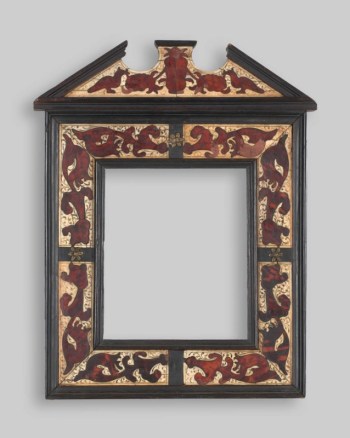
Italian Tabernacle Frame, 1600s, tortoiseshell, bone or ivory, and wood. (Toronto: AGO, gift from a private collector, 94/994).
The Decorative Arts Trust is pleased to announce that the Art Gallery of Ontario (AGO) in Toronto, Canada, will serve as our 2024–26 Curatorial Internship Grant partner. The Decorative Arts Trust underwrites curatorial internships for recent Masters or PhD graduates in collaboration with museums and historical societies. These internships allow host organizations to hire a deserving professional who will learn about the responsibilities and duties common to the curatorial field while working alongside a talented mentor.
This intern will focus on a type of material culture that links the decorative and fine arts: frames. The AGO is home to one of the largest collections of historic frames in the world, currently amounting to well over 1,200 examples. The collection is expansive in terms of both chronology and geography, ranging from the late 1400s to the early 1990s, and with fine frames from France, England, Germany, the Netherlands, Italy, Spain, the Americas, and Asia. The AGO’s goals are twofold: to study the history of frame making to preserve knowledge at a moment when most experts in the field are currently retiring; and to pair paintings and frames to show artwork within a surround that was made in the same region and time period.
Under the mentorship of Caroline Shields, Curator, European Art, and Adam Harris Levine, Associate Curator, European Art, the intern will research and catalogue the AGO’s holdings and assist in making the collection available to the public online. They will work to pair paintings with frames that are chronologically and geographically suited, and they will facilitate the loan of frames to peer museums. The intern’s term will begin in May 2024, when the AGO hosts an international conference, Many Lives: Picture Frames in Context, featuring keynote speakers Hubert Baija, Senior Frames Conservator, and Lynn Roberts, Frame Historian. As part of their tenure at the AGO, the intern will help prepare the conference papers for a digital publication.
A formal call for applications for the internship will be posted early in 2024. Current and recent graduate students who are interested in this opening are encouraged to visit AGO’s website at ago.ca for updates.
Concord Museum Awarded Funding Prize by Decorative Arts Trust

Visitors viewing powder horns on display in the April 19, 1775 gallery at the Concord Museum, the recipient of the 2023 Decorative Arts Trust Prize for Excellence and Innovation, which includes an award of $100,000.
◊ ◊ ◊ ◊ ◊
Press release (16 November 2023) from The Decorative Arts Trust:
The Decorative Arts Trust is thrilled to announce that the 2023 Prize for Excellence and Innovation was awarded to the Concord Museum in Concord, Massachusetts, for their exhibitions and publication commemorating the 250th anniversary of the American Revolution in 2025–26.
The Concord Museum’s initiative will feature a series of three special exhibitions showcasing the stories of individuals, families, and communities during the American Revolution. Focused on the theme of “Whose Revolution,” the special exhibitions will explore themes of liberty, community, and memory, tracing the continued legacy of the Revolution today. The Museum will also create a companion digital exhibition to extend the geographical reach of the exhibitions beyond Concord and promote further education and engagement. Additionally, the Museum will release the first major publication of its American Revolution collection, from flints and powder horns carried by militia soldiers to textiles, furniture, and ceramics that were valued and preserved for their role in witnessing a revolution.
The Concord Museum began in the 1850s as the private collection of local resident Cummings Davis, who gathered and preserved the relics of his friends and neighbors as a record of local history. The collection grew throughout the 19th century and was incorporated as the Concord Antiquarian Society in 1886, moving to a new building in 1930 and later becoming known as the Concord Museum. The Museum now houses a significant collection of over 45,000 objects, with particular strengths in the decorative arts from the 18th and 19th centuries, the American Revolution, transcendentalism, and other areas relating to Concord and New England history. The Museum recently completed a major building expansion and renovation of its permanent galleries, including new spaces for collections, education, and public programs.
The Decorative Arts Trust Prize for Excellence and Innovation, founded in 2020, funds outstanding projects that advance the public’s appreciation of decorative art, fine art, architecture, or landscape. The Prize is awarded to a nonprofit organization in the United States or abroad for a scholarly endeavor, such as museum exhibitions, print and digital publications, and online databases. Past recipients include Cooper Hewitt, Smithsonian Design Museum; the Black Craftspeople Digital Archive; and Craft in America.
Exhibition | Interwoven: Women’s Lives Written in Thread

Now on view at the Concord Museum:
Interwoven: Women’s Lives Written in Thread
Concord Museum, 29 September 2023 — 25 February 2024
Our current special exhibition, Interwoven: Women’s Lives Written in Thread, highlights needlework produced by young women in New England and specifically the extraordinary collection of samplers at the Concord Museum. Featuring 30 samplers sewn in the early 1700s to mid-1800s, Interwoven explores how young women created records of their own lives and experiences, written in thread.

Detail of Sampler by Phebe Bliss, 1749 (Concord, MA: Concord Museum, gift of Mrs. Richard D. Boyer, T18).
The exhibition explores the history of needlework and embroidery, its importance as an art form, and its significance to women in the 18th and 19th centuries. Intended to showcase young women’s accomplishments, the samplers also communicate details of their lives and education, their communities, and their families. The exhibition provides a unique view into their private lives. For most of these young women, their samplers are the only objects that survive from their lives. Many of the samplers have never been displayed before.
Learn about the education of privileged young women in the early republic and understand how wealth and enslaved labor enabled them to pursue decorative arts. Explore the materials used in constructing samplers, such as linens, dyes and silk, and how and where these materials were produced. View samplers that demonstrate how women recorded family history and the loss of loved ones through needlework. Understand how they incorporated the importance of community and a strong sense of place in their samplers. The gallery includes areas for hands-on and interactive activities. Exhibition programs connect the history of samplers to contemporary work through visiting artists, demonstrations, workshops, and more.
New Book | The Art of Mary Linwood
From Bloomsbury (and on sale for $76 until the 10th December) . . .
Heidi Strobel, The Art of Mary Linwood: Embroidery, Installation, and Entrepreneurship in Britain, 1787–1845 (London: Bloomsbury Visual Arts, 2023), 256 pages, ISBN: 978-1350428096, $120.
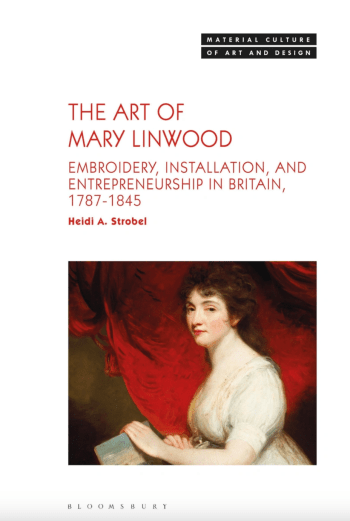 The first book on Leicester textile artist Mary Linwood, with a catalogue of her work
When British textile artist and gallery owner Mary Linwood died in 1845 just shy of 90 years old, her estate was worth the equivalent of £5,199,822 in today’s currency. As someone who made, but did not sell, embroidered replicas of famous artworks after artists such as Gainsborough, Reynolds, Stubbs, and Morland, how did she accumulate so much money? A pioneering woman in the male-dominated art world of late Georgian Britain, Linwood established her own London gallery in 1798 that featured copies of well-known paintings by these popular artists. Featuring props and specially designed rooms for her replicas, she ensured that her visitors had an entertaining, educational, and kinetic tour, similar to what Madame Tussaud would do one generation later. The gallery’s focus on picturesque painters provided her London visitors with an idyllic imaginary journey through the countryside. Its emphasis on quintessentially British artists provided a unifying focus for a country that had recently emerged from the threat of Napoleonic invasion.
This book brings to the fore Linwood’s gallery guides and previously unpublished letters to her contemporaries, such as Birmingham inventor Matthew Boulton and Queen Charlotte. It also includes the first and only catalogue of Linwood’s extant and destroyed works. By examining Linwood’s replicas and their accompanying objects through the lens of material culture, the book provides a much-needed contribution to the scholarship on women and cultural agency in the early 19th century.
Heidi A. Strobel is Associate Dean of Academic and Student Affairs at the University of North Texas.
c o n t e n t s
Acknowledgements
List of Plates
List of Figures
Introduction
1 Embroidery, Education, and Commerce: Linwood’s Early Years
2 The Pantheon and Hanover Square Exhibitions
3 Portraiture, Publications, and Promotion
4 The Leicester Square Gallery: Performing British Patriotism
5 Of Students and Studying: The Academic Tradition and the Scripture Room
6 Linwood’s Legacies
Appendix: Catalogue of Linwood’s Textiles
Notes
Bibliography
New Book | National Museum of Women in the Arts Collection Highlights
Following a two-year closure, the National Museum of Women in Arts, reopened in October (with details available in this press release). Complementing the renovation is this new publication from Hirmer and distributed by The University of Chicago Press:
National Museum of Women in the Arts Collection Highlights (Munich: Hirmer Verlag, 2023), 264 pages, ISBN: 978-3777441696, $60.
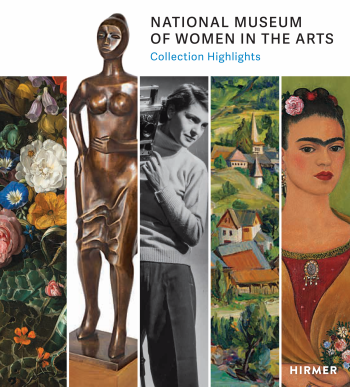 The National Museum of Women in the Arts, Washington, DC, is the first museum in the world solely dedicated to championing women through the arts. Drawing from a collection that spans five centuries and includes artists from six continents, this publication spotlights new additions to the museum as well as longstanding highlights. Vibrant images present over 175 works from the museum’s collections, including key artworks by Louise Bourgeois, Lalla Essaydi, Frida Kahlo, Hung Liu, Clara Peeters, Faith Ringgold, Niki de Saint Phalle, Amy Sherald, Alma Woodsey Thomas, and many others. Thematic chapters weave connections across medium, genre, and time. Essays by museum curators and more than thirty guest artists and scholars illuminate the mission of NMWA and help readers discover great women artists.
New Book | Heroines and Local Girls
First published in 2019, Heroines and Local Girls was awarded the 2022 Laura Shannon Prize in Contemporary European Studies by the Nanovic Institute for European Studies at the University of Notre Dame; it’s scheduled for paperback release in February.
Pamela Cheek, Heroines and Local Girls: The Transnational Emergence of Women’s Writing in the Long Eighteenth Century (Philadelphia: University of Pennsylvania Press, 2019), 280 pages, ISBN: 978-0812251487 (hardcover), $85 / ISBN: 978-1512826166 (paperback), $30.
 Over the course of the long eighteenth century, a network of some fifty women writers, working in French, English, Dutch, and German, staked out a lasting position in the European literary field. These writers were multilingual and lived for many years outside of their countries of origin, translated and borrowed from each others’ works, attended literary circles and salons, and fashioned a transnational women’s literature characterized by highly recognizable codes. Drawing on a literary geography of national types, women writers across Western Europe read, translated, wrote, and rewrote stories about exceptional young women, literary heroines who transcend the gendered destiny of their distinctive cultural and national contexts. These transcultural heroines struggle against the cultural constraints determining the sexualized fates of local girls.
In Heroines and Local Girls, Pamela L. Cheek explores the rise of women’s writing as a distinct, transnational category in Britain and Europe between 1650 and 1810. Starting with an account of a remarkable tea party that brought together Frances Burney, Sophie von La Roche, and Marie Elisabeth de La Fite in conversation about Stéphanie de Genlis, she excavates a complex community of European and British women authors. In chapters that incorporate history, network theory, and feminist literary history, she examines the century-and-a-half literary lineage connecting Madame de Maintenon to Mary Wollstonecraft, including Charlotte Lennox and Françoise de Graffigny and their radical responses to sexual violence. Neither simply a reaction to, nor collusion with, patriarchal and national literary forms but, rather, both, women’s writing offered an invitation to group membership through a literary project of self-transformation. In so doing, argues Cheek, women’s writing was the first modern literary category to capitalize transnationally on the virtue of identity, anticipating the global literary marketplace’s segmentation of affinity-based reading publics, and continuing to define women’s writing to this day.
Pamela L. Cheek is Professor of French and Comparative Literature at the University of New Mexico and author of Sexual Antipodes: Enlightenment Globalization and the Placing of Sex.
c o n t e n t s
Preface
1 Networks of Women Writers, circa 1785–87
2 Two Quarrels
3 Ravishing and Romance Language
4 The Repertoire of the School for Girls
5 Heroines and Local Girls
6 Heroines in the World
Notes
Works Cited
Index
Acknowledgments
NGA Acquires Important Work by Anne Vallayer-Coster
Press release (17 November 2023) from the National Gallery of Art in Washington, DC:

Anne Vallayer-Coster, Still Life with Flowers in an Alabaster Vase and Fruit, 1783, oil on canvas (unlined), overall: 109 × 90 cm (Washington, DC: National Gallery of Art, Chester Dale Fund 2023.40.1).
The National Gallery of Art has acquired an important painting by Anne Vallayer-Coster (1744–1818), Still Life with Flowers in an Alabaster Vase and Fruit (1783). One of the greatest still life painters of 18th-century France, Vallayer-Coster achieved remarkable success in the male-dominated art world of her time. She not only attracted the patronage of some of the most powerful collectors of the time, including Marie Antoinette, but she also became one of the few women to be admitted to the prestigious Royal Academy of Painting and Sculpture and to show her work at its official public exhibition, the Salon.
Still Life with Flowers in an Alabaster Vase and Fruit is the first painting by Vallayer-Coster to enter the National Gallery’s collection. Despite the limited access to training and patronage, women artists achieved unprecedented professional opportunities and success in the latter half of the 18th century. Vallayer-Coster, alongside Élisabeth Louise Vigée Le Brun, is now the second woman artist represented in the National Gallery’s collection of 18th-century French paintings. This masterpiece not only fills out a more complete story of this pivotal period in European art history, but also highlights the accomplishments of one of its most significant artists.
One of Vallayer-Coster’s most ambitious works, this painting showcases her unrivaled ability to capture the soft, delicate textures of flowers and to coordinate their dazzling colors and irregular shapes into a harmonious whole. When it was exhibited at the Salon of 1783, critics hailed Still Life with Flowers in an Alabaster Vase and Fruit as a masterpiece. Vallayer-Coster herself considered it her finest painting, and she kept it until her death. Lost for nearly 200 years, this extraordinary work was recently rediscovered in an almost pristine state of preservation: unlined, on its original stretcher, and in the Louis XVI frame in which it was likely exhibited.
Depicting an opulent bouquet brimming with meticulously studied and exquisitely rendered flowers, this work includes roses, irises, lilacs, carnations, hollyhocks, dahlias, bluebells, and hydrangeas, among others, that create a dazzling display of color against the rich, chocolate brown scumbling of the background. The flowers sit in an alabaster vase adorned with French gilt-bronze mounts, featuring a child satyr supporting a cornucopia of fruits and flowers. Resting on an elaborately carved and gilded mahogany table with a pale gray marble top, the vase and flowers are completed by a bunch of white grapes, a pineapple, and three peaches. Evoking the cool polish of marble and alabaster, the glistening surface of cast-bronze, the translucency of grapes, the spiky form of a pineapple, the velvety skin of peaches, and the delicate freshness of flower petals, the painting epitomizes Vallayer-Coster’s extraordinary skill in portraying colors and textures.










 Enfilade
leave a comment